COPING WITH LOSS
A Guide for you…
WHAT IS LOSS AND
GRIEF?
• Losing someone or something you love or care deeply about is
very painful. You may experience all kinds of difficult
emotions and it may feel like the pain and sadness you're
experiencing will never let up. These are normal reactions to
a significant loss. But while there is no right or wrong way to
grieve, there are healthy ways to cope with the pain that, in
time, can renew you and permit you to move on.
Grief is a natural response to loss. It’s the emotional suffering
you feel when something or someone you love is taken away. The
more significant the loss, the more intense the grief will be. You
may associate grief with the death of a loved one—which is often
the cause of the most intense type of grief—but any loss can
cause grief.
STAGES OF GRIEF OR LOSS
• In 1969, psychiatrist Elisabeth Kübler-Ross introduced what became
known as the “five stages of grief.” These stages of grief were based on her
studies of the feelings of patients facing terminal illness, but many people
have generalized them to other types of negative life changes and losses,
such as the death of a loved one or a break-up.
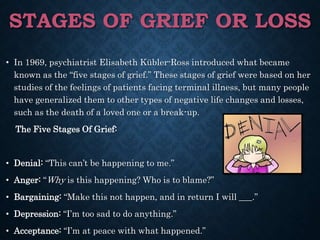
The Five Stages Of Grief:
• Denial: “This can’t be happening to me.”
• Anger: “Why is this happening? Who is to blame?”
• Bargaining: “Make this not happen, and in return I will ___.”
• Depression: “I’m too sad to do anything.”
• Acceptance: “I’m at peace with what happened.”
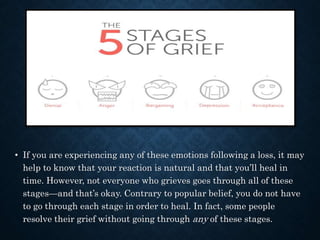
• If you are experiencing any of these emotions following a loss, it may
help to know that your reaction is natural and that you’ll heal in
time. However, not everyone who grieves goes through all of these
stages—and that’s okay. Contrary to popular belief, you do not have
to go through each stage in order to heal. In fact, some people
resolve their grief without going through any of these stages.
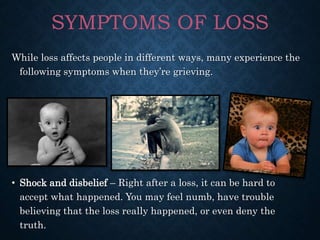
While loss affects people in different ways, many experience the
following symptoms when they’re grieving.
• Shock and disbelief – Right after a loss, it can be hard to
accept what happened. You may feel numb, have trouble
believing that the loss really happened, or even deny the
truth.
SYMPTOMS OF LOSS
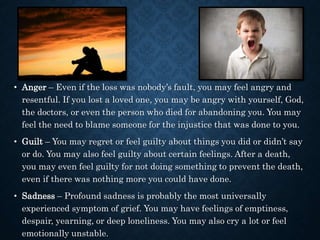
• Anger – Even if the loss was nobody’s fault, you may feel angry and
resentful. If you lost a loved one, you may be angry with yourself, God,
the doctors, or even the person who died for abandoning you. You may
feel the need to blame someone for the injustice that was done to you.
• Guilt – You may regret or feel guilty about things you did or didn’t say
or do. You may also feel guilty about certain feelings. After a death,
you may even feel guilty for not doing something to prevent the death,
even if there was nothing more you could have done.
• Sadness – Profound sadness is probably the most universally
experienced symptom of grief. You may have feelings of emptiness,
despair, yearning, or deep loneliness. You may also cry a lot or feel
emotionally unstable.
TIPS FOR COPING WITH LOSS:
GET SUPPORT
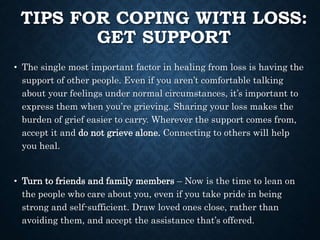
• The single most important factor in healing from loss is having the
support of other people. Even if you aren’t comfortable talking
about your feelings under normal circumstances, it’s important to
express them when you’re grieving. Sharing your loss makes the
burden of grief easier to carry. Wherever the support comes from,
accept it and do not grieve alone. Connecting to others will help
you heal.
• Turn to friends and family members – Now is the time to lean on
the people who care about you, even if you take pride in being
strong and self-sufficient. Draw loved ones close, rather than
avoiding them, and accept the assistance that’s offered.
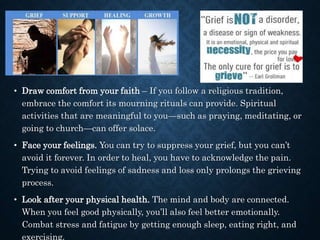
• Draw comfort from your faith – If you follow a religious tradition,
embrace the comfort its mourning rituals can provide. Spiritual
activities that are meaningful to you—such as praying, meditating, or
going to church—can offer solace.
• Face your feelings. You can try to suppress your grief, but you can’t
avoid it forever. In order to heal, you have to acknowledge the pain.
Trying to avoid feelings of sadness and loss only prolongs the grieving
process.
• Look after your physical health. The mind and body are connected.
When you feel good physically, you’ll also feel better emotionally.
Combat stress and fatigue by getting enough sleep, eating right, and
exercising.
Coping with loss

Coping with loss

  • 1.
    COPING WITH LOSS AGuide for you…
  • 2.
    WHAT IS LOSSAND GRIEF? • Losing someone or something you love or care deeply about is very painful. You may experience all kinds of difficult emotions and it may feel like the pain and sadness you're experiencing will never let up. These are normal reactions to a significant loss. But while there is no right or wrong way to grieve, there are healthy ways to cope with the pain that, in time, can renew you and permit you to move on.
  • 3.
    Grief is anatural response to loss. It’s the emotional suffering you feel when something or someone you love is taken away. The more significant the loss, the more intense the grief will be. You may associate grief with the death of a loved one—which is often the cause of the most intense type of grief—but any loss can cause grief.
  • 4.
    STAGES OF GRIEFOR LOSS • In 1969, psychiatrist Elisabeth Kübler-Ross introduced what became known as the “five stages of grief.” These stages of grief were based on her studies of the feelings of patients facing terminal illness, but many people have generalized them to other types of negative life changes and losses, such as the death of a loved one or a break-up. The Five Stages Of Grief: • Denial: “This can’t be happening to me.” • Anger: “Why is this happening? Who is to blame?” • Bargaining: “Make this not happen, and in return I will ___.” • Depression: “I’m too sad to do anything.” • Acceptance: “I’m at peace with what happened.”
  • 5.
    • If youare experiencing any of these emotions following a loss, it may help to know that your reaction is natural and that you’ll heal in time. However, not everyone who grieves goes through all of these stages—and that’s okay. Contrary to popular belief, you do not have to go through each stage in order to heal. In fact, some people resolve their grief without going through any of these stages.
  • 6.
    While loss affectspeople in different ways, many experience the following symptoms when they’re grieving. • Shock and disbelief – Right after a loss, it can be hard to accept what happened. You may feel numb, have trouble believing that the loss really happened, or even deny the truth. SYMPTOMS OF LOSS
  • 7.
    • Anger –Even if the loss was nobody’s fault, you may feel angry and resentful. If you lost a loved one, you may be angry with yourself, God, the doctors, or even the person who died for abandoning you. You may feel the need to blame someone for the injustice that was done to you. • Guilt – You may regret or feel guilty about things you did or didn’t say or do. You may also feel guilty about certain feelings. After a death, you may even feel guilty for not doing something to prevent the death, even if there was nothing more you could have done. • Sadness – Profound sadness is probably the most universally experienced symptom of grief. You may have feelings of emptiness, despair, yearning, or deep loneliness. You may also cry a lot or feel emotionally unstable.
  • 8.
    TIPS FOR COPINGWITH LOSS: GET SUPPORT • The single most important factor in healing from loss is having the support of other people. Even if you aren’t comfortable talking about your feelings under normal circumstances, it’s important to express them when you’re grieving. Sharing your loss makes the burden of grief easier to carry. Wherever the support comes from, accept it and do not grieve alone. Connecting to others will help you heal. • Turn to friends and family members – Now is the time to lean on the people who care about you, even if you take pride in being strong and self-sufficient. Draw loved ones close, rather than avoiding them, and accept the assistance that’s offered.
  • 9.
    • Draw comfortfrom your faith – If you follow a religious tradition, embrace the comfort its mourning rituals can provide. Spiritual activities that are meaningful to you—such as praying, meditating, or going to church—can offer solace. • Face your feelings. You can try to suppress your grief, but you can’t avoid it forever. In order to heal, you have to acknowledge the pain. Trying to avoid feelings of sadness and loss only prolongs the grieving process. • Look after your physical health. The mind and body are connected. When you feel good physically, you’ll also feel better emotionally. Combat stress and fatigue by getting enough sleep, eating right, and exercising.