COPD Exacerbation
Outline
• Definition & causes
• Differential diagnosis
• Classification of severity
• Indications for hospitalizations
• Management of severe exacerbations
• Indications for MICU admission, NIV & IMV
• Discharge criteria and recommendations for follow up
Definition
• An exacerbation of COPD is a sustained worsening of
the patient's condition, from the stable state and
beyond normal day-to-day variations that is acute in
onset and may warrant additional treatment in a
patient with underlying COPD.
• Exacerbations are infrequent in early COPD and are
largely a feature of moderate-to-severe disease.
COPD exacerbation
• Negatively affects a patient’s quality of life
• Accelerates the rate of decline of lung function
• Associated with significant mortality, particularly in
those requiring hospitalizations
Main Causes of COPD Exacerbations
• Bacterial and viral infections
• pollution events
• cold weather
• interruption of regular treatment
© 2020 Global Initiative for Chronic Obstructive Lung Disease
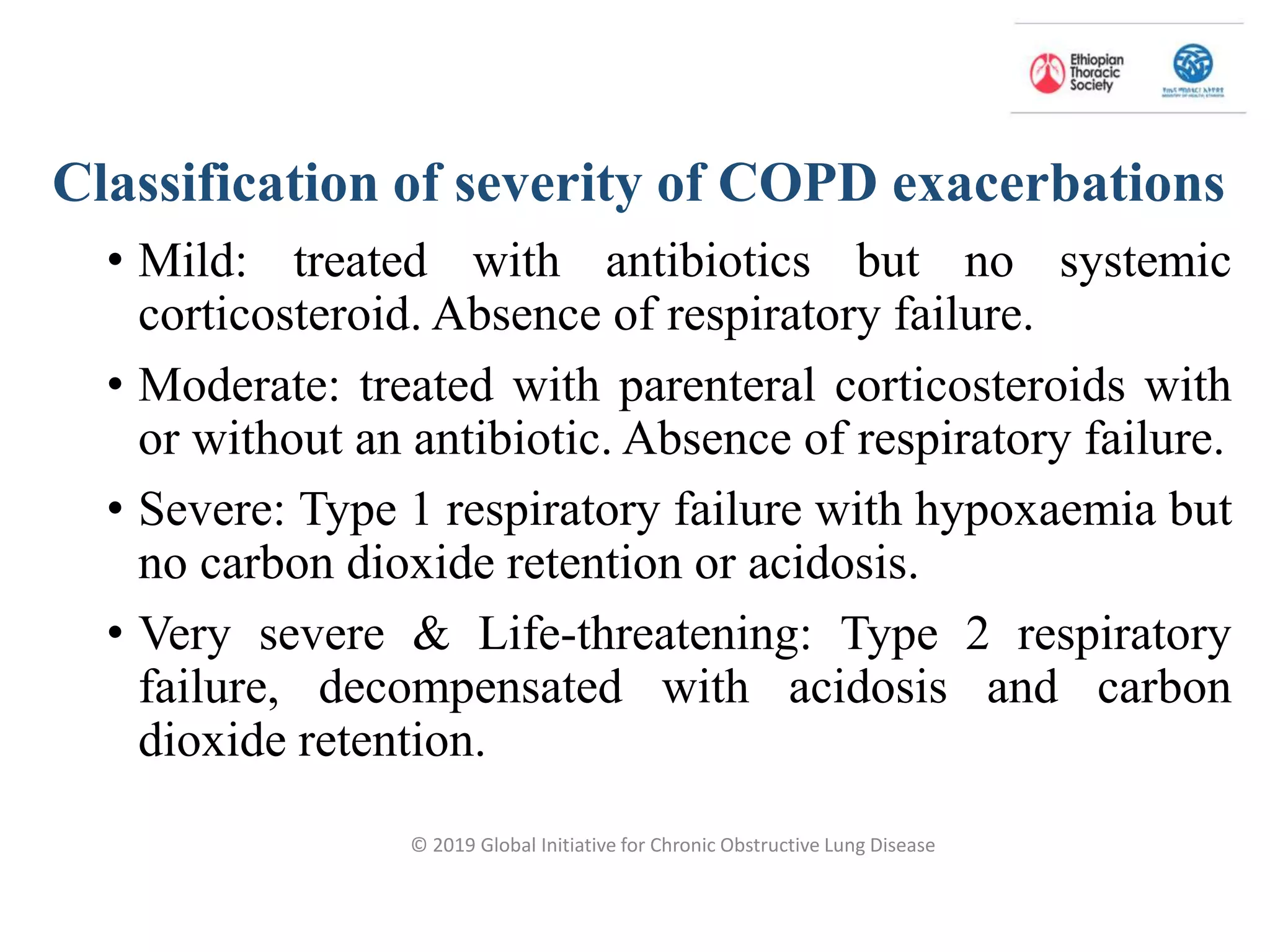
Classification of severity of COPD exacerbations
• Mild: treated with antibiotics but no systemic
corticosteroid. Absence of respiratory failure.
• Moderate: treated with parenteral corticosteroids with
or without an antibiotic. Absence of respiratory failure.
• Severe: Type 1 respiratory failure with hypoxaemia but
no carbon dioxide retention or acidosis.
• Very severe & Life-threatening: Type 2 respiratory
failure, decompensated with acidosis and carbon
dioxide retention.
© 2019 Global Initiative for Chronic Obstructive Lung Disease
Potential indications for hospitalization
assessment*
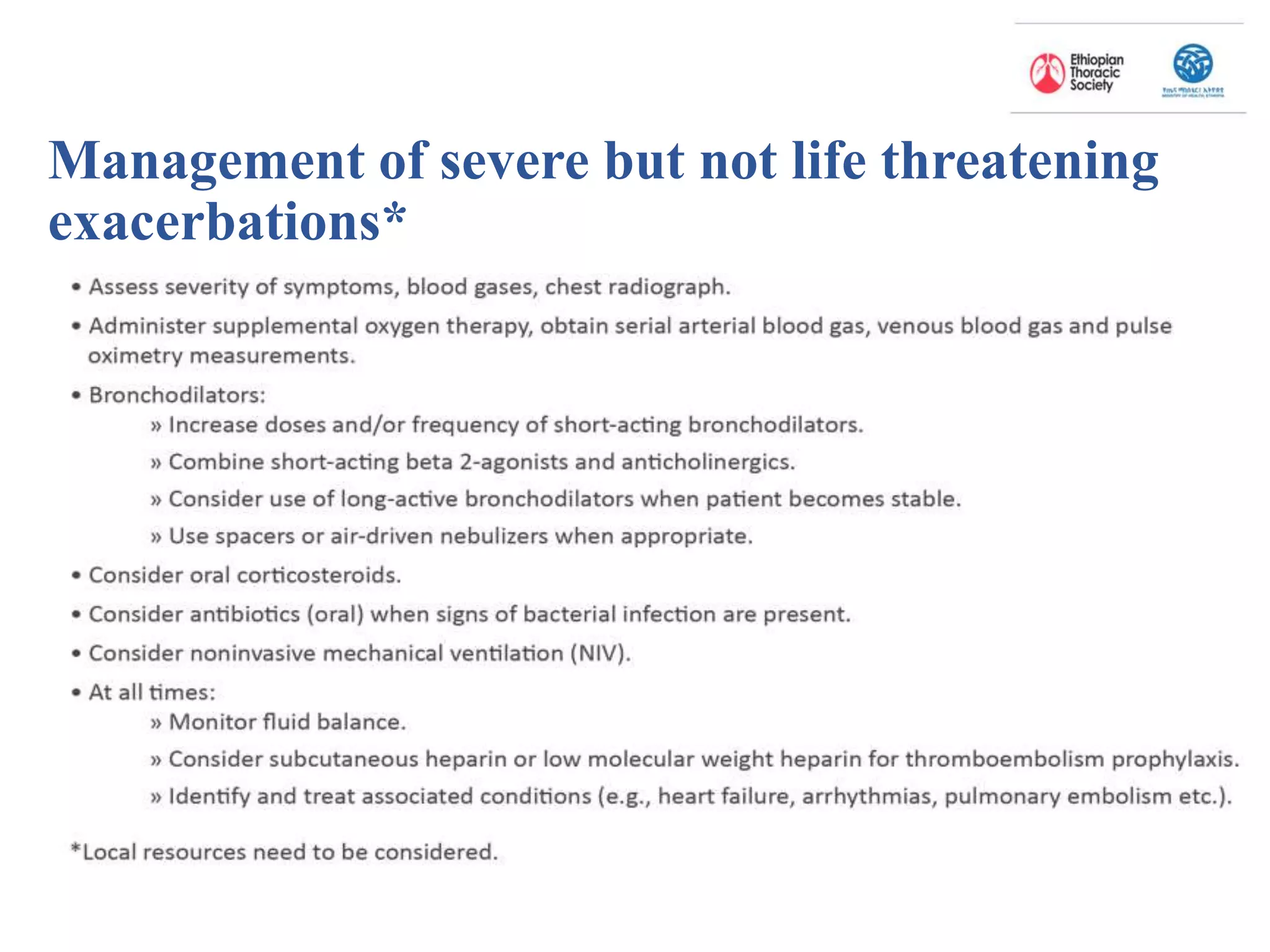
Management of severe but not life threatening
exacerbations*
What are the indications to add antibiotics
• Three cardinal symptoms-increase in dyspnea, sputum
volume and sputum purulence
• Signs of pneumonia
• Mechanical ventilation
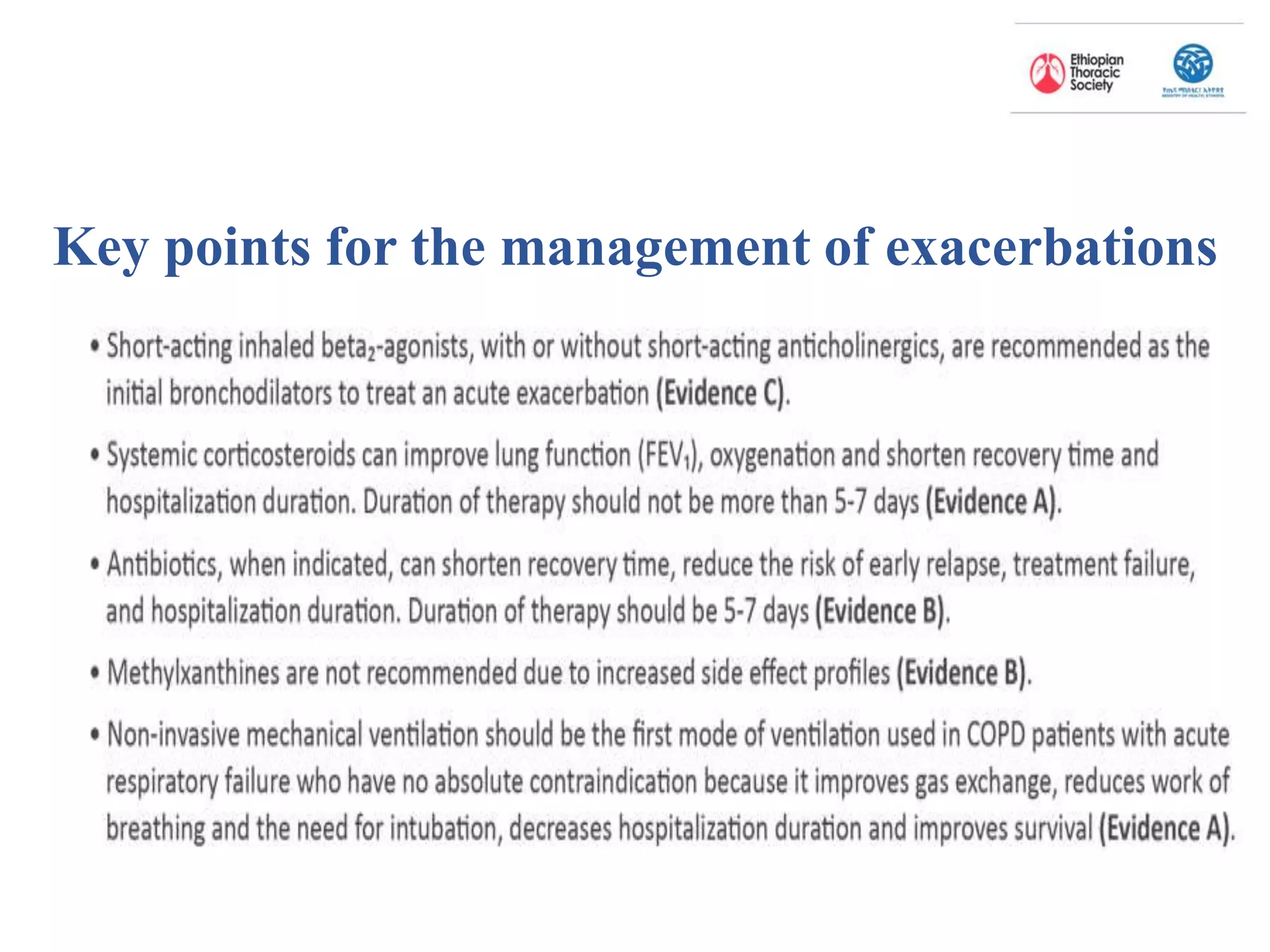
Key points for the management of exacerbations
Indications for medical intensive care unit
admission*
Indications for Noninvasive mechanical ventilation
(NIV)
Indications for Invasive mechanical ventilation
Discharge criteria
Recommendations for follow up
Case study 4
• A 45 year old woman from rural area has noticed a mild,
occasionally productive cough for the past 3-4 months. The cough is
worse whenever she spends the day at her home while cooking where
is exposed to the smoke of the wood fire.
• She finally decides to visit you at the health center. Her husband and
she never smoked cigarette.
• The cough has been present for almost a year. She has no fever or
chills. She does admit to more shortness of breath when she walks
for long distance over the past six months.
• Physical examination was normal findings.
• Discussion points
• 1- What further questions do you want to ask ?
• 2- What differential diagnoses do you consider?
• 3-At this point, what further investigations do you think would
be appropriate?
• 4-What would be the best option to improve her symptoms and
slow progression?
Answers
1- What further questions do you want to ask ?
-characteristic of cough intermittent or persistent?
-cough with phlegm or productive?
-nigh sweating, fever or weight loss?
2- What differential diagnoses do you consider?
Tuberculosis
Bronchial asthma
Bronchiectasis
Lung cancer
COPD
3-At this point, what further investigations do you think would be appropriate?
Chest x ray, Sputum AFB, ESR, CBC
Lung function studies: flow meter and spirometer and response to salbutamol
4-What would be the best option to improve her symptoms and slow progression?
• Reduce exposure to Smoking (outdoor cooking)
• Behavioral change communication
• Nutrition and regular treatment of chest infection etc…
• Bronchodilator treatment
• Exercise to improve exercise tolerance and quality of life
• Home oxygen treatment and morphine depending on the advance of disease
We would like to thank
• Dr. Tewodros Haile, Dr Hanan Yusuf, Dr Amsalu Bekele and
Dr Rahel Argaw for preparing this powerpoint

COPD Exacerbation.pptx

  • 1.
  • 2.
    Outline • Definition &causes • Differential diagnosis • Classification of severity • Indications for hospitalizations • Management of severe exacerbations • Indications for MICU admission, NIV & IMV • Discharge criteria and recommendations for follow up
  • 3.
    Definition • An exacerbationof COPD is a sustained worsening of the patient's condition, from the stable state and beyond normal day-to-day variations that is acute in onset and may warrant additional treatment in a patient with underlying COPD. • Exacerbations are infrequent in early COPD and are largely a feature of moderate-to-severe disease.
  • 4.
    COPD exacerbation • Negativelyaffects a patient’s quality of life • Accelerates the rate of decline of lung function • Associated with significant mortality, particularly in those requiring hospitalizations
  • 5.
    Main Causes ofCOPD Exacerbations • Bacterial and viral infections • pollution events • cold weather • interruption of regular treatment
  • 6.
    © 2020 GlobalInitiative for Chronic Obstructive Lung Disease
  • 7.
    Classification of severityof COPD exacerbations • Mild: treated with antibiotics but no systemic corticosteroid. Absence of respiratory failure. • Moderate: treated with parenteral corticosteroids with or without an antibiotic. Absence of respiratory failure. • Severe: Type 1 respiratory failure with hypoxaemia but no carbon dioxide retention or acidosis. • Very severe & Life-threatening: Type 2 respiratory failure, decompensated with acidosis and carbon dioxide retention. © 2019 Global Initiative for Chronic Obstructive Lung Disease
  • 8.
    Potential indications forhospitalization assessment*
  • 9.
    Management of severebut not life threatening exacerbations*
  • 10.
    What are theindications to add antibiotics • Three cardinal symptoms-increase in dyspnea, sputum volume and sputum purulence • Signs of pneumonia • Mechanical ventilation
  • 11.
    Key points forthe management of exacerbations
  • 12.
    Indications for medicalintensive care unit admission*
  • 13.
    Indications for Noninvasivemechanical ventilation (NIV)
  • 14.
    Indications for Invasivemechanical ventilation
  • 15.
  • 16.
  • 17.
    Case study 4 •A 45 year old woman from rural area has noticed a mild, occasionally productive cough for the past 3-4 months. The cough is worse whenever she spends the day at her home while cooking where is exposed to the smoke of the wood fire. • She finally decides to visit you at the health center. Her husband and she never smoked cigarette. • The cough has been present for almost a year. She has no fever or chills. She does admit to more shortness of breath when she walks for long distance over the past six months. • Physical examination was normal findings. • Discussion points • 1- What further questions do you want to ask ? • 2- What differential diagnoses do you consider? • 3-At this point, what further investigations do you think would be appropriate? • 4-What would be the best option to improve her symptoms and slow progression?
  • 18.
    Answers 1- What furtherquestions do you want to ask ? -characteristic of cough intermittent or persistent? -cough with phlegm or productive? -nigh sweating, fever or weight loss? 2- What differential diagnoses do you consider? Tuberculosis Bronchial asthma Bronchiectasis Lung cancer COPD 3-At this point, what further investigations do you think would be appropriate? Chest x ray, Sputum AFB, ESR, CBC Lung function studies: flow meter and spirometer and response to salbutamol 4-What would be the best option to improve her symptoms and slow progression? • Reduce exposure to Smoking (outdoor cooking) • Behavioral change communication • Nutrition and regular treatment of chest infection etc… • Bronchodilator treatment • Exercise to improve exercise tolerance and quality of life • Home oxygen treatment and morphine depending on the advance of disease
  • 19.
    We would liketo thank • Dr. Tewodros Haile, Dr Hanan Yusuf, Dr Amsalu Bekele and Dr Rahel Argaw for preparing this powerpoint