Global Initiative For Chronic
Obstructive Pulmonary
Disease.
(Management)
BY DR AYESHA KHALID
DEFINITION:
Chronic obstructive pulmonary disease is a heterogenous lung
condition characterized by chronic respiratory symptoms (dyspnea,
cough, sputum production and/or exacerbations) due to
abnormalities of airways (bronchitis , bronchiolitis) and/or alveoli
(emphysema) that cause persistent, often progressive, airflow
obstruction.
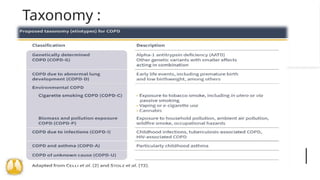
Taxonomy :
DIAGNOSTIC CRITERIA:
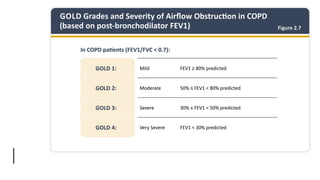
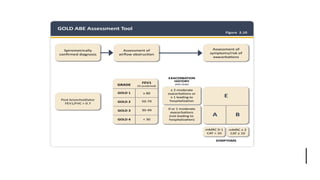
The presence of non-fully reversible airflow obstruction
( FEV1/FVC < 0.7 post bronchodilation measured by
spirometry confirm the diagnosis of COPD.
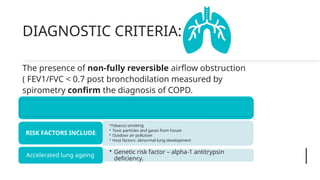
COPD results from gene(G) – environment(E) interaction occurring over the lifetime (T) of the individual
that can damage the lungs and/or alter their normal developmental/ ageing processes.
•Tobacco smoking
• Toxic particles and gases from house
• Outdoor air pollution
• Host factors- abnormal lung development
RISK FACTORS INCLUDE:
• Genetic risk factor – alpha-1 antitrypsin
deficiency.
Accelerated lung ageing
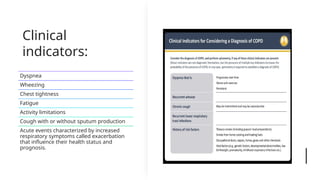
Clinical
indicators:
Dyspnea
Wheezing
Chest tightness
Fatigue
Activity limitations
Cough with or without sputum production
Acute events characterized by increased
respiratory symptoms called exacerbation
that influence their health status and
prognosis.
Diagnosis and assessment :
Screening and case finding:
The role of screening by spirometry for
the diagnosis of COPD in the general
population is controversial.
In asymptomatic individuals without
any significant exposures to tobacco or
other risk factors, screening spirometry
is probably not indicated; whereas in
those with symptoms or risk factors
(e.g., > 20 pack-years of smoking,
recurrent chest infections, early life
events), the diagnostic yield for COPD
is relatively high and spirometry should
be considered as a method for early
case finding.
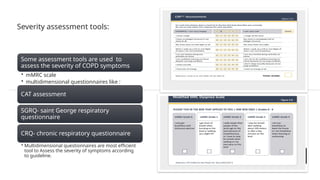
Severity assessment tools:
Some assessment tools are used to
assess the severity of COPD symptoms
• mMRC scale
• multidimensional questionnaires like :
CAT assessment
SGRQ- saint George respiratory
questionnaire
CRQ- chronic respiratory questionnaire
• Multidimensional questionnaires are most efficient
tool to Assess the severity of symptoms according
to guideline.
Prevention and management of
COPD.
Smoking
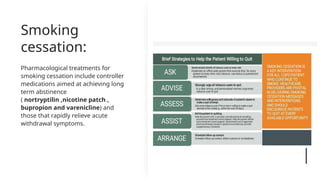
cessation:
Pharmacological treatments for
smoking cessation include controller
medications aimed at achieving long
term abstinence
( nortryptilin ,nicotine patch ,
bupropion and varenicline) and
those that rapidly relieve acute
withdrawal symptoms.
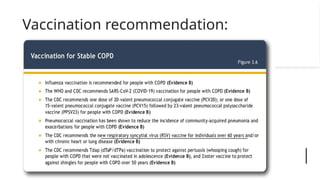
Vaccination recommendation:
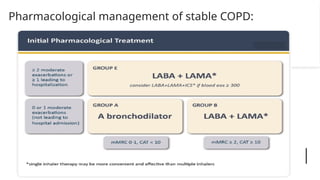
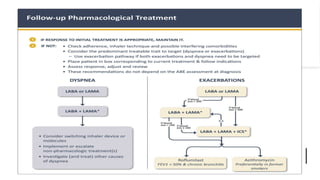
Pharmacological management of stable COPD:
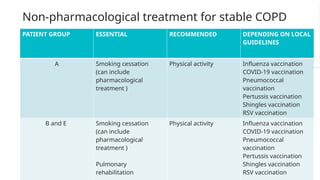
Non-pharmacological treatment for stable COPD
PATIENT GROUP ESSENTIAL RECOMMENDED DEPENDING ON LOCAL
GUIDELINES
A Smoking cessation
(can include
pharmacological
treatment )
Physical activity Influenza vaccination
COVID-19 vaccination
Pneumococcal
vaccination
Pertussis vaccination
Shingles vaccination
RSV vaccination
B and E Smoking cessation
(can include
pharmacological
treatment )
Pulmonary
rehabilitation
Physical activity Influenza vaccination
COVID-19 vaccination
Pneumococcal
vaccination
Pertussis vaccination
Shingles vaccination
RSV vaccination
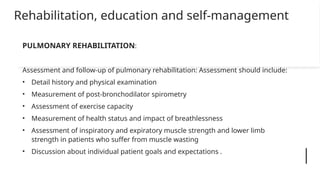
Rehabilitation, education and self-management
PULMONARY REHABILITATION:
Assessment and follow-up of pulmonary rehabilitation: Assessment should include:
• Detail history and physical examination
• Measurement of post-bronchodilator spirometry
• Assessment of exercise capacity
• Measurement of health status and impact of breathlessness
• Assessment of inspiratory and expiratory muscle strength and lower limb
strength in patients who suffer from muscle wasting
• Discussion about individual patient goals and expectations .
OXYGEN
THERAPY AND
VENTILATORY
SUPPORT
Long term
oxygen therapy
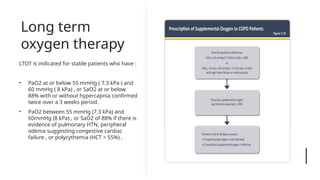
LTOT is indicated for stable patients who have :
• PaO2 at or below 55 mmHg ( 7.3 kPa ) and
60 mmHg ( 8 kPa) , or SaO2 at or below
88% with or without hypercapnia confirmed
twice over a 3 weeks period.
• PaO2 between 55 mmHg (7.3 kPa) and
60mmHg (8 kPa) , or SaO2 of 88% if there is
evidence of pulmonary HTN, peripheral
odema suggesting congestive cardiac
failure , or polycythemia (HCT > 55%) .
Therapeutic interventions that
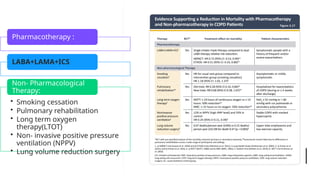
reduce COPD mortality
Pharmacotherapy :
LABA+LAMA+ICS
• Smoking cessation
• Pulmonary rehabilitation
• Long term oxygen
therapy(LTOT)
• Non- invasive positive pressure
ventilation (NPPV)
• Lung volume reduction surgery
Non- Pharmacological
Therapy:
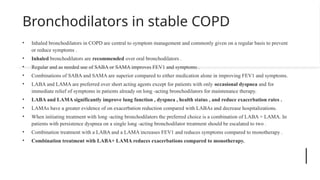
Bronchodilators in stable COPD
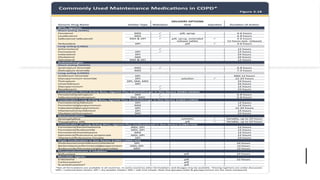
• Inhaled bronchodilators in COPD are central to symptom management and commonly given on a regular basis to prevent
or reduce symptoms .
• Inhaled bronchodilators are recommended over oral bronchodilators .
• Regular and as needed use of SABA or SAMA improves FEV1 and symptoms .
• Combinations of SABA and SAMA are superior compared to either medication alone in improving FEV1 and symptoms.
• LABA and LAMA are preferred over short acting agents except for patients with only occasional dyspnea and for
immediate relief of symptoms in patients already on long -acting bronchodilators for maintenance therapy.
• LABA and LAMA significantly improve lung function , dyspnea , health status , and reduce exacerbation rates .
• LAMAs have a greater evidence of on exacerbation reduction compared with LABAs and decrease hospitalizations.
• When initiating treatment with long -acting bronchodilators the preferred choice is a combination of LABA + LAMA. In
patients with persistence dyspnea on a single long -acting bronchodilator treatment should be escalated to two .
• Combination treatment with a LABA and a LAMA increases FEV1 and reduces symptoms compared to monotherapy .
• Combination treatment with LABA+ LAMA reduces exacerbations compared to monotherapy.
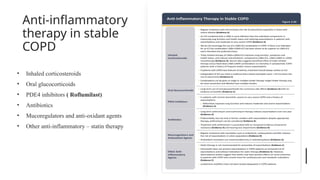
Anti-inflammatory
therapy in stable
COPD
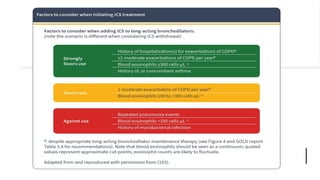
• Inhaled corticosteroids
• Oral glucocorticoids
• PDE4 inhibitors ( Roflumilast)
• Antibiotics
• Mucoregulators and anti-oxidant agents
• Other anti-inflammatory – statin therapy
Management of Exacerbations
Definition:
An exacerbation of COPD is defined as
an event characterized by dyspnea
and /or cough and sputum that worsen
over less than 14 days. Exacerbations
of COPD are often associated with
increased local and systemic
inflammation caused by airway
infection , pollution, or other insults to
the lungs.
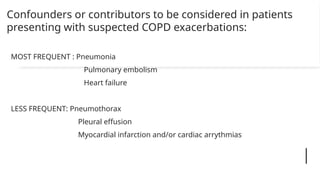
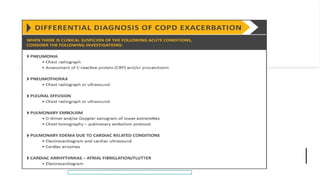
Confounders or contributors to be considered in patients
presenting with suspected COPD exacerbations:
MOST FREQUENT : Pneumonia
Pulmonary embolism
Heart failure
LESS FREQUENT: Pneumothorax
Pleural effusion
Myocardial infarction and/or cardiac arrythmias
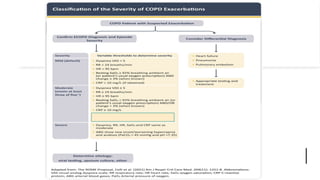
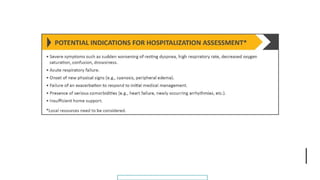
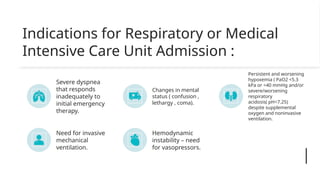
Indications for Respiratory or Medical
Intensive Care Unit Admission :
Severe dyspnea
that responds
inadequately to
initial emergency
therapy.
Changes in mental
status ( confusion ,
lethargy , coma).
Persistent and worsening
hypoxemia ( PaO2 <5.3
kPa or <40 mmHg and/or
severe/worsening
respiratory
acidosis( pH<7.25)
despite supplemental
oxygen and noninvasive
ventilation.
Need for invasive
mechanical
ventilation.
Hemodynamic
instability – need
for vasopressors.
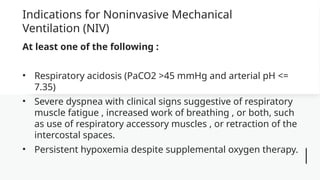
Indications for Noninvasive Mechanical
Ventilation (NIV)
At least one of the following :
• Respiratory acidosis (PaCO2 >45 mmHg and arterial pH <=
7.35)
• Severe dyspnea with clinical signs suggestive of respiratory
muscle fatigue , increased work of breathing , or both, such
as use of respiratory accessory muscles , or retraction of the
intercostal spaces.
• Persistent hypoxemia despite supplemental oxygen therapy.
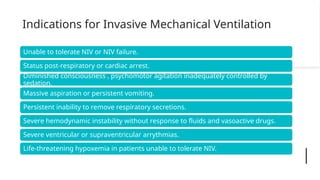
Indications for Invasive Mechanical Ventilation
Unable to tolerate NIV or NIV failure.
Status post-respiratory or cardiac arrest.
Diminished consciousness , psychomotor agitation inadequately controlled by
sedation.
Massive aspiration or persistent vomiting.
Persistent inability to remove respiratory secretions.
Severe hemodynamic instability without response to fluids and vasoactive drugs.
Severe ventricular or supraventricular arrythmias.
Life-threatening hypoxemia in patients unable to tolerate NIV.
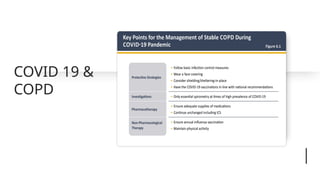
COVID 19 &
COPD
Take home
message.
COPD is a common, preventable, and
treatable disease, but extensive
under-diagnosis and misdiagnosis
leads to patients receiving no
treatment or incorrect treatment.
Appropriate and earlier diagnosis of
COPD can have a very significant
public-health impact.
The realization that environmental factors other than
tobacco smoking can contribute to COPD, that it can
start early in life and affect young individuals, and
that there are precursor conditions (Pre-COPD,
PRISm), opens new windows of opportunity for its
prevention, early diagnosis, and prompt and
appropriate therapeutic intervention.
Thank you

COPD gold guideline presentation.....pptx

  • 1.
    Global Initiative ForChronic Obstructive Pulmonary Disease. (Management) BY DR AYESHA KHALID
  • 2.
    DEFINITION: Chronic obstructive pulmonarydisease is a heterogenous lung condition characterized by chronic respiratory symptoms (dyspnea, cough, sputum production and/or exacerbations) due to abnormalities of airways (bronchitis , bronchiolitis) and/or alveoli (emphysema) that cause persistent, often progressive, airflow obstruction.
  • 3.
  • 4.
    DIAGNOSTIC CRITERIA: The presenceof non-fully reversible airflow obstruction ( FEV1/FVC < 0.7 post bronchodilation measured by spirometry confirm the diagnosis of COPD. COPD results from gene(G) – environment(E) interaction occurring over the lifetime (T) of the individual that can damage the lungs and/or alter their normal developmental/ ageing processes. •Tobacco smoking • Toxic particles and gases from house • Outdoor air pollution • Host factors- abnormal lung development RISK FACTORS INCLUDE: • Genetic risk factor – alpha-1 antitrypsin deficiency. Accelerated lung ageing
  • 5.
    Clinical indicators: Dyspnea Wheezing Chest tightness Fatigue Activity limitations Coughwith or without sputum production Acute events characterized by increased respiratory symptoms called exacerbation that influence their health status and prognosis.
  • 6.
  • 7.
    Screening and casefinding: The role of screening by spirometry for the diagnosis of COPD in the general population is controversial. In asymptomatic individuals without any significant exposures to tobacco or other risk factors, screening spirometry is probably not indicated; whereas in those with symptoms or risk factors (e.g., > 20 pack-years of smoking, recurrent chest infections, early life events), the diagnostic yield for COPD is relatively high and spirometry should be considered as a method for early case finding.
  • 9.
    Severity assessment tools: Someassessment tools are used to assess the severity of COPD symptoms • mMRC scale • multidimensional questionnaires like : CAT assessment SGRQ- saint George respiratory questionnaire CRQ- chronic respiratory questionnaire • Multidimensional questionnaires are most efficient tool to Assess the severity of symptoms according to guideline.
  • 11.
  • 14.
    Smoking cessation: Pharmacological treatments for smokingcessation include controller medications aimed at achieving long term abstinence ( nortryptilin ,nicotine patch , bupropion and varenicline) and those that rapidly relieve acute withdrawal symptoms.
  • 15.
  • 16.
  • 18.
    Non-pharmacological treatment forstable COPD PATIENT GROUP ESSENTIAL RECOMMENDED DEPENDING ON LOCAL GUIDELINES A Smoking cessation (can include pharmacological treatment ) Physical activity Influenza vaccination COVID-19 vaccination Pneumococcal vaccination Pertussis vaccination Shingles vaccination RSV vaccination B and E Smoking cessation (can include pharmacological treatment ) Pulmonary rehabilitation Physical activity Influenza vaccination COVID-19 vaccination Pneumococcal vaccination Pertussis vaccination Shingles vaccination RSV vaccination
  • 19.
    Rehabilitation, education andself-management PULMONARY REHABILITATION: Assessment and follow-up of pulmonary rehabilitation: Assessment should include: • Detail history and physical examination • Measurement of post-bronchodilator spirometry • Assessment of exercise capacity • Measurement of health status and impact of breathlessness • Assessment of inspiratory and expiratory muscle strength and lower limb strength in patients who suffer from muscle wasting • Discussion about individual patient goals and expectations .
  • 20.
  • 21.
    Long term oxygen therapy LTOTis indicated for stable patients who have : • PaO2 at or below 55 mmHg ( 7.3 kPa ) and 60 mmHg ( 8 kPa) , or SaO2 at or below 88% with or without hypercapnia confirmed twice over a 3 weeks period. • PaO2 between 55 mmHg (7.3 kPa) and 60mmHg (8 kPa) , or SaO2 of 88% if there is evidence of pulmonary HTN, peripheral odema suggesting congestive cardiac failure , or polycythemia (HCT > 55%) .
  • 22.
  • 23.
    Pharmacotherapy : LABA+LAMA+ICS • Smokingcessation • Pulmonary rehabilitation • Long term oxygen therapy(LTOT) • Non- invasive positive pressure ventilation (NPPV) • Lung volume reduction surgery Non- Pharmacological Therapy:
  • 25.
    Bronchodilators in stableCOPD • Inhaled bronchodilators in COPD are central to symptom management and commonly given on a regular basis to prevent or reduce symptoms . • Inhaled bronchodilators are recommended over oral bronchodilators . • Regular and as needed use of SABA or SAMA improves FEV1 and symptoms . • Combinations of SABA and SAMA are superior compared to either medication alone in improving FEV1 and symptoms. • LABA and LAMA are preferred over short acting agents except for patients with only occasional dyspnea and for immediate relief of symptoms in patients already on long -acting bronchodilators for maintenance therapy. • LABA and LAMA significantly improve lung function , dyspnea , health status , and reduce exacerbation rates . • LAMAs have a greater evidence of on exacerbation reduction compared with LABAs and decrease hospitalizations. • When initiating treatment with long -acting bronchodilators the preferred choice is a combination of LABA + LAMA. In patients with persistence dyspnea on a single long -acting bronchodilator treatment should be escalated to two . • Combination treatment with a LABA and a LAMA increases FEV1 and reduces symptoms compared to monotherapy . • Combination treatment with LABA+ LAMA reduces exacerbations compared to monotherapy.
  • 26.
    Anti-inflammatory therapy in stable COPD •Inhaled corticosteroids • Oral glucocorticoids • PDE4 inhibitors ( Roflumilast) • Antibiotics • Mucoregulators and anti-oxidant agents • Other anti-inflammatory – statin therapy
  • 28.
  • 29.
    Definition: An exacerbation ofCOPD is defined as an event characterized by dyspnea and /or cough and sputum that worsen over less than 14 days. Exacerbations of COPD are often associated with increased local and systemic inflammation caused by airway infection , pollution, or other insults to the lungs.
  • 30.
    Confounders or contributorsto be considered in patients presenting with suspected COPD exacerbations: MOST FREQUENT : Pneumonia Pulmonary embolism Heart failure LESS FREQUENT: Pneumothorax Pleural effusion Myocardial infarction and/or cardiac arrythmias
  • 36.
    Indications for Respiratoryor Medical Intensive Care Unit Admission : Severe dyspnea that responds inadequately to initial emergency therapy. Changes in mental status ( confusion , lethargy , coma). Persistent and worsening hypoxemia ( PaO2 <5.3 kPa or <40 mmHg and/or severe/worsening respiratory acidosis( pH<7.25) despite supplemental oxygen and noninvasive ventilation. Need for invasive mechanical ventilation. Hemodynamic instability – need for vasopressors.
  • 37.
    Indications for NoninvasiveMechanical Ventilation (NIV) At least one of the following : • Respiratory acidosis (PaCO2 >45 mmHg and arterial pH <= 7.35) • Severe dyspnea with clinical signs suggestive of respiratory muscle fatigue , increased work of breathing , or both, such as use of respiratory accessory muscles , or retraction of the intercostal spaces. • Persistent hypoxemia despite supplemental oxygen therapy.
  • 38.
    Indications for InvasiveMechanical Ventilation Unable to tolerate NIV or NIV failure. Status post-respiratory or cardiac arrest. Diminished consciousness , psychomotor agitation inadequately controlled by sedation. Massive aspiration or persistent vomiting. Persistent inability to remove respiratory secretions. Severe hemodynamic instability without response to fluids and vasoactive drugs. Severe ventricular or supraventricular arrythmias. Life-threatening hypoxemia in patients unable to tolerate NIV.
  • 41.
  • 43.
    Take home message. COPD isa common, preventable, and treatable disease, but extensive under-diagnosis and misdiagnosis leads to patients receiving no treatment or incorrect treatment. Appropriate and earlier diagnosis of COPD can have a very significant public-health impact. The realization that environmental factors other than tobacco smoking can contribute to COPD, that it can start early in life and affect young individuals, and that there are precursor conditions (Pre-COPD, PRISm), opens new windows of opportunity for its prevention, early diagnosis, and prompt and appropriate therapeutic intervention.
  • 44.

Editor's Notes

  • #11  they still emphasize on the cat*(COPD assessment tool, and other assessment score which really puts forth the point that symptoms are very important …..
  • #47 After slide ending …..I would like to acknowledge that all of these slides have been taken from the 2024 teaching slide set which is available for free download on the COPD gold guideline website so that's it for today . next slide ….thank you