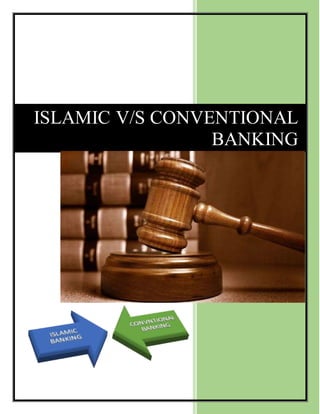
ISLAMIC V/S CONVENTIONAL
BANKING
i
Institute of Business
Management
TERM REPORT
ISLAMIC V/S CONVENTIONAL BANKING
CORPORATE & BUSINESS LAW
Submitted to: Sir Mansoor Ali Shahani
Submitted by:
Pawan Kumar (20141-17537)
Ali Zain (20141-17049)
Sagar (20131-16436)
Sarib Khan (20141-17909)
Sadiq Raza (20141-17663)
Submission date: 21-04-2015
ii
TRANSMITTAL LETTER
_______________________________________
April 21, 2015
Institute of Business Management,
Karachi
Dear Mr. Mansoor Ali Shahani
We are submitting to you the report, due April 21, 2015, that you requested. The report is titled
“ISLAMIC BANKING V/s CONVENTIONAL BANKING.” The purpose of the report is to
determine how Law that is Shariah Court plays role in this system of banking.
Sincerely,
Pawan Kumar
Ali Zain
Sagar
Sarib
Sadiq
iii
LETTER OF ACKNOWLEDGEMENT
In the Name of ALLAH the most Merciful and Benevolent. As we present this report, we would like
totakethis opportunity to pass our gratitude to our respected teacher, who gaveus this opportunity
and guided us during the course of our endeavor to accomplish this task. We have taken efforts in
this report. However, it would not have been possible without your kind support. We are highly
indebted to Mr. Mansoor Ali Shahani for his guidance and constant supervision as well as for
providing necessary information regarding the report. We would like to express our gratitude
towards our colleague’s for their kind co-operation and encouragement, which help us in
completion of this report.
iv
Table of Contents
TRANSMITTAL LETTER .............................................................................................................ii
LETTER OF ACKNOWLEDGEMENT ........................................................................................iii
EXECUTIVE SUMMARY ............................................................................................................vi
INTRODUCTION .......................................................................................................................... 1
SCOPE OF BANKING................................................................................................................... 2
What is Bank and what history is behind THIS? ........................................................................ 2
 BANK............................................................................................................................... 2
 HISTORY OF BANKING............................................................................................... 2
ISLAMIC BANKING..................................................................................................................... 3
ROLE OF ISLAMIC BANKING ............................................................................................... 3
PRINCIPLES BEHIND ISLAMIC BANKING ......................................................................... 3
MODES OF ISLAMIC BANKING............................................................................................ 4
 MURABAHA................................................................................................................... 4
 IJARAH............................................................................................................................ 4
 IJARAH-WAL-IQTINA .................................................................................................. 4
 MUSHARAKAH ............................................................................................................. 4
 MUSAWAMAH .............................................................................................................. 5
 ISTISNA'A....................................................................................................................... 5
 BAI MUAJJAL................................................................................................................ 5
 MUDARABA................................................................................................................... 5
 BAI SALAM.................................................................................................................... 5
CONVENTIONAL BANKING.................................................................................................. 6
ROLE OF CONVENTIONAL BANKING................................................................................ 6
Products of conventional banking............................................................................................... 6
 TRANSACTIONAL ACCOUNT.................................................................................... 7
 SAVINGS ACCOUNT .................................................................................................... 7
 CERTIFICATE OF DEPOSIT......................................................................................... 7
 CREDIT CARD ............................................................................................................... 7
 DEBIT CARD.................................................................................................................. 8
 MORTGAGE LOAN ....................................................................................................... 8
 UNSECURED DEBT (Personal loan) ............................................................................. 8
v
 LOAN............................................................................................................................... 8
DIFFERENCES B/W ISLAMIC AND CONVENTIONAL BANKING .................................... 10
CASE STUDY 1 ........................................................................................................................... 11
Study based conclusion:............................................................................................................ 11
Case study 2 .................................................................................................................................. 12
RELATIVE SHARES OF TOTAL FINANCIAL INTERMEDIARY ASSETS, .................... 12
CONCLUSION:............................................................................................................................ 13
RECOMMANDATIONS : ........................................................................................................... 13
vi
EXECUTIVE SUMMARY
The Conventional banking is very dependent upon the interest in every aspect of banking, while
the Islamic banking is totally against the interest in every aspect of banking so due to the interest.
The Islamic banking and the Conventional banking, have very differences, which are mainly in
product. Products are offering just like the interest banks offers credit cards, debit cards, loans on
interest ,leasing on interest, but the Islamic banking offer different products which are totally on
the Islamic halal rules Murabaha ,Ijara ,Ijarah-Wal-Iqtina ,Musharakah ,Musawamah ,Istisna'a ,Bai
Muajjal etc. So these products are totally different from that of Conventional banking.
1
INTRODUCTION
This report is undertaken to understand the concept of Islamic banking and Conventional banking,
the difference between the two systems and their economic implications for an economy. The
prime source of revenue and cost of funds to conventional banks (interest-based banks) is charging
interest through lending and accepting deposits for interest respectively. Interest is the major driver
of operations of conventional banks although other valuable services including guarantees, funds
transfers, safety of wealth, facilitation in international trade etc. also form a substantial part of
income of banks. Islamic banking, on the other hand, is a banking system, which is in consonance
with the spirit, ethos and value system of Islam and governed by the principles laid down by
Islamic Shariah. Interest free banking is a narrow concept denoting a number of banking
instruments or operations, which avoid interest. Islamic banking, the more general term, is based
not only to avoid interest-based transactions prohibited in Islamic Shariah but also to avoid
unethical and un-social practices. In practical sense, Islamic Banking is the transformation of
conventional money lending into transactions based on tangible assets and real services. The model
of Islamic banking system leads towards the achievement of a system, which helps achieve
economic prosperity.
The origination of term interest dates back to 17th century with the emergence of banking system
at global level. Interest means giving and/or taking of any excess amount in exchange of a loan or
on debt. Hence, it carries the same meaning/value as that of Riba. Further, it is narrated, “the loan
that draws interest is Riba.” There is consensus among the Muslim scholars of all the fiqhs that
interest is Riba in all its forms and manifestations.
2
SCOPE OF BANKING
WHAT IS BANK AND WHAT HISTORY IS BEHIND THIS?
 BANK
A bank is a financial institution and a financial intermediary that accepts deposits and channels those
deposits into lending activities, either directly or through capital markets. A bank connects customers
that have capital deficits to customers with capital surpluses.
Due to their critical status within the financial system and the economy generally, banks are highly
regulated in most countries. Most banks operate under a system known as fractional reserve banking
where they hold only a small reserve of the funds deposited and lend out the rest for profit. They are
generally subject to minimum capital requirements, which are based on an international set of capital
standards, known as the Basel Accords.
 HISTORY OF BANKING
The History of Banking begins with the first prototype banks of merchants of the ancient world that
made grain loans to farmers and traders carrying goods between cities; recorded as having occurred at
about 2000 BC within the areas of Assyria and Babylonia. Later on, in ancient Greece and during the
Roman Empire, lenders based in temples made loans and added two important innovations: the
accepting of deposits and the changing of money. Archaeology from this period in ancient China and
India shows the existence also of money lending activity. Banking, in the modern sense of the word,
can be traced to medieval and early Renaissance Italy, to the rich cities in the north such as Florence,
Venice, and Genoa.
During the 20th century, developments in telecommunications and computing resulting in major
changes to the way banks operated and allowed them to dramatically increase in size and geographic
spread. The Late-2000s financial crisis saw significant number of bank failures, including some of the
world's largest banks, and much debate about bank regulation.
3
ISLAMIC BANKING
A banking system that is based on the principles of Islamic law (also known Shariah) and guided
by Islamic economics. Two basic principles behind Islamic banking are the sharing of profit and
loss and, significantly, the prohibition of the collection and payment of interest. Collecting interest
is not permitted under Islamic law.
ROLE OF ISLAMIC BANKING
Since this system of banking is grounded in Islamic principles, all the undertakings of the banks
follow Islamic morals. Therefore, it could be said that financial transactions within Islamic banking
are a culturally distinct form of ethical investing Islamic bank, formed in 1975.
Islamic banking refers to a system of banking or banking activity that is consistent with Islamic
law (Shari’ah) principles and guided by Islamic economics. In particular, Islamic law prohibits
usury, the collection, and payment of interest commonly called Riba. Generally, Islamic law also
prohibits trading in financial risk (which is seen as a form of gambling). In addition, Islamic law
prohibits investing in businesses that are considered unlawful, or haram.
PRINCIPLES BEHIND ISLAMIC BANKING
Islamic banking has the same purpose as conventional banking: to make money for the banking
institute by lending out capital while adhering to Islamic law. Because Islam forbids simply
lending out money at interest, Islamic rules on transactions (known as Fiqh al-Muamalat) have
been created to prevent it. The basic principle of Islamic banking is based on risk sharing which is
a component of trade rather than risk-transfer, which is seen in conventional banking. Islamic
banking is restricted to Islamically acceptable transactions, which exclude those involving alcohol,
pork, gambling, etc. The aim of this is to engage in only ethical investing, and moral purchasing.
The Islamic Banking and Finance Database provide more information on the subject.
In an Islamic mortgage transaction, instead of lending the buyer money to purchase the item, a
bank might buy the item itself from the seller, and re-sell it to the buyer at a profit, while allowing
the buyer to pay the bank in installments. However, the bank's profit cannot be made explicit and
therefore there are no additional penalties for late payment. In order to protect itself against default,
the bank asks for strict collateral. The goods or land is registered to the name of the buyer from
the start of the transaction. This arrangement is called Murabaha. Another approach is Ijara was
EIqtina, which is similar to real estate leasing. Islamic banks handle loans for vehicles in a similar
way (selling the vehicle at a higher-than-market price to the debtor and then retaining ownership
of the vehicle until the loan is paid).
An innovative approach applied by some banks for home loans, called Musharakah al-Mutanaqisa,
allows for a floating rate in the form of rental. The bank and borrower form a partnership entity,
both providing capital at an agreed percentage to purchase the property. The partnership entity
then rents out the property to the borrower and charges rent. The bank and the borrower will then
share the proceeds from this rent based on the current equity share of the partnership. At the same
4
time, the borrower in the partnership entity also buys the bank's share of the property at agreed
installments until the full equity is transferred to the borrower and the partnership is ended.
MODES OF ISLAMIC BANKING
 MURABAHA
 IJARAH
 IJARAH-WAL-IQTINA
 MUSHARAKAH
 MUSAWAMAH
 ISTISNA'A
 BAI MUAJJAL
 MUDARABA
 BAI SALAM
 MURABAHA
Literally, it means a sale on mutually agreed profit. Technically, it is a contract of sale in which
the seller declares his cost and profit. Islamic banks have adopted this as a mode of financing. As
a financing technique, it involves a request by the client to the bank to purchase certain goods for
him. The bank does that for a definite profit over the cost, which is stipulated in advance.
 IJARAH
Ijara is a contract of a known and proposed usufruct against a specified and lawful return or
consideration for the service or return for the benefit proposed to be taken, or for the effort or work
proposed to be expended. In other words, Ijara or leasing is the transfer of usufruct for a
consideration which is rent in case of hiring of assets or things and wage in case of hiring of
persons.
 IJARAH-WAL-IQTINA
A contract under which an Islamic bank provides equipment, building, or other assets to the client
against an agreed rental together with a unilateral undertaking by the bank or the client that at the
end of the lease period, the ownership in the asset would be transferred to the lessee. The
undertaking or the promise does not become an integral part of the lease contract to make it
conditional. The rentals as well as the purchase price are fixed in such manner that the bank gets
back its principal sum along with profit over the period of lease.
 MUSHARAKAH
Musharakah means a relationship established under a contract by the mutual consent of the parties
for sharing of profits and losses in the joint business. It is an agreement under which the Islamic
bank provides funds, which are mixed with the funds of the business enterprise and others. All
5
providers of capital are entitled to participate in management, but not necessarily required to do
so. The profit is distributed among the partners in pre-agreed ratios, while the loss is borne by each
partner strictly in proportion to respective capital contributions.
 MUSAWAMAH
Musawamah is a general and regular kind of sale in which price of the commodity to be traded is
bargained between seller and the buyer without any reference to the price paid or cost incurred by
the former. Thus, it is different from Murabaha in respect of pricing formula. Unlike Murabaha,
seller in Musawamah is not obliged to reveal his cost. Both the parties negotiate on the price. All
other Islamic banking and Conventional banking
 ISTISNA'A
It is a contractual agreement for manufacturing goods and commodities, allowing cash payment in
advance and future delivery or a future payment and future delivery. Istisna'a can be used for
providing the facility of financing the manufacture or construction of houses, plants, projects, and
building of bridges, roads, and highways.
 BAI MUAJJAL
Literally, it means a credit sale. Technically, a financing technique adopted by Islamic banks takes
the form of Murabaha Muajjal. It is a contract in which the bank earns a profit margin on his
purchase price and allows the buyer to pay the price of the commodity at a future date in a lump
sum or in installments. It has to expressly mention cost of the commodity and the margin of profit
is mutually agreed. The price fixed for the commodity in such a transaction can be the same as the
spot price or higher or lower than the spot price.
 MUDARABA
A form of partnership where one party provides the funds while the other provides expertise and
management. The latter is referred to as the Mudarib. Any profits accrued are shared between the
two parties on a pre-agreed basis, while loss is borne only by the provider of the capital.
 BAI SALAM
Salam means a contract in which advance payment is made for goods to be delivered later on. The
seller undertakes to supply some specific goods to the buyer at a future date in exchange of an
advance price fully paid at the time of contract. It is necessary that the quality of the commodity
intended to be purchased be fully specified leaving no ambiguity leading to dispute. The objects
of this sale are goods and cannot be gold, silver, or currencies. Barring this, Bai Salam covers
almost everything, which is capable of being definitely described as to quantity, quality, and
workmanship.
6
CONVENTIONAL BANKING
Banking means the business of receiving money on current or deposit account, paying and
collecting cheques drawn by or paid in by customers, the making of advances to customers, and
includes such other business as the Authority may prescribe for the purposes of this Act; (Banking
Act (Singapore), Section 2, Interpretation).
Conventional banking is based on the principle that the more you have, the more you can get. In
other words, if you have little or nothing, you get nothing. As a result, more than half the population
of the world is deprived of the financial services of the Conventional banks. Conventional banking
is based on collateral. Conventional banks look at what has already been acquired by a person
Conventional banks go into ‘punishment’ mode when a borrower is taking more time in repaying
the loan than it was agreed upon. They call these borrowers “defaulters”. When a client gets into
difficulty, Conventional banks get.
ROLE OF CONVENTIONAL BANKING
Conventional banks engage in the following activities:
Processing of payments by way of telegraphic transfer, internet banking, or other means Issuing
bank drafts and bank cheques, accepting money on term deposit, lending money by overdraft,
installment loan, or other means providing documentary and standby letter of credit, guarantees,
performance bonds, securities underwriting commitments and other forms of off balance sheet
exposures. Safekeeping of documents and other items in safe deposit boxes, sales, distribution, or
brokerage, with or without advice, of: insurance, unit trusts, and similar financial products as a
financial supermarket.
Cash management and treasury, merchant banking and private equity financing traditionally, large
Conventional banks also underwrite bonds, and make markets in currency, interest rates, and
credit-related securities, but today large Conventional banks usually have an investment bank arm
that is involved in the mentioned activities.
PRODUCTS OF CONVENTIONAL BANKING
Products offered by mostly Conventional banking usually called conventional banking are given
below.
 Transactional account
 Savings account
 Certificate of deposit
 Credit card
 Debit card
 Mortgage loan
7
 Unsecured debt (personal loan)
 Loan
 TRANSACTIONAL ACCOUNT
A transactional account is a deposit account held at a bank or other financial institution, for the
purpose of securely and quickly providing frequent access to funds on demand, through a variety
of different channels. Transactional accounts are mean neither for earning interest nor for the
purpose of savings, but for convenience of the business or personal client; hence do they tend not
to bear interest. Instead, a customer can deposit or withdraw any amount of money any number of
times, subject to availability of funds.
 SAVINGS ACCOUNT
savings accounts are accounts maintained by retail financial institutions that pay interest but cannot
be used directly as money in the narrow sense of a medium of exchange (for example, by writing
a check). These accounts let customers set aside a portion of their liquid assets while earning a
monetary return. For the bank, money in a savings account may not be callable immediately and
therefore often does not incur a reserve requirement freeing up cash from the bank's vault to lend
out with interest. Withdrawals from a savings account are occasionally costly, and they are more
time-consuming than withdrawals from a demand (current) account.
 CERTIFICATE OF DEPOSIT
A certificate of deposit (CD) is a time deposit, a financial product commonly offered to consumers
in the United States by banks, thrift institutions, and credit unions. CDs are similar to savings
accounts in that they are insured and thus virtually risk free; they are "money in the bank." In
exchange for keeping the money on deposit for the agreed-on term, institutions usually grant higher
interest rates than they do on accounts from which money may be withdraw on demand, although
this may not be the case in an inverted yield curve situation. Fixed rates are common, but some
institutions offer CDs with various forms of variable rates.
 CREDIT CARD
Credit card is a small plastic card issued to users as a system of payment. It allows its holder to
buy goods and services based on the holder's promise to pay for these goods and services. The
issuer of the card creates a revolving account and grants a line of credit to the consumer (or the
user) from which the user can borrow money for payment to a merchant or as a cash advance to
the user. A credit card is different from a charge card: a charge card requires the balance to be paid
in full each month. In contrast, credit cards allow the consumers a continuing balance of debt,
subject to interest being charge.
8
 DEBIT CARD
A debit card (also known as a bankcard or check card) is a plastic card that provides the cardholder
electronic access to his or her bank account(s) at a financial institution. Some cards have a value
with which a payment is to be made, while most relay a message to the cardholder's bank to
withdraw funds from a designated account in favor of the payee's designated bank account. In
some cases, the primary account number is assigned exclusively for use on the Internet and there
is no physical card. Debit cards usually also allow for instant withdrawal of cash, acting as the
ATM card for withdrawing cash. Merchants may also offer cash back facilities to customers, where
a customer can withdraw cash along with their purchase.
 MORTGAGE LOAN
The word mortgage is a Law French term meaning either “death contract,” meaning that the pledge
ends (dies) when the obligation is to be fulfill or the property taken through foreclosure. A
mortgage loan is a loan secured by real property using a mortgage note, which evidences the
existence of the loan and the encumbrance of that realty through the granting of mortgage, which
secures the loan. However, the word mortgage alone, in everyday usage, and most often used to
mean mortgage loan. A homebuyer or builder can obtain either financing (a loan) to either purchase
or secure against the property from a financial institution, such as a bank, directly or indirectly
through intermediaries. Features of mortgage loans such as the size of the loan, maturity of the
loan, interest rate, method of paying off the loan, and other characteristics can vary considerably.
It is normal for home purchases to be funded by a mortgage loan. Few individuals have enough
savings or liquid funds to enable them to purchase property outright.
 UNSECURED DEBT (Personal loan)
Personal Loan or unsecured debt refers to any type of debt or general obligation that was not
collateralized by a lien on specific assets of the borrower in the case of a bankruptcy or
liquidation or failure to meet the terms for repayment. In the event of the bankruptcy of the
borrower, the unsecured creditors will have a general claim on the assets of the borrower after
the specific pledged assets have been assigned to the secured creditors, although the unsecured
creditors will usually realize a smaller proportion of their claims than the secured creditors. In
some legal systems, unsecured creditors who are also indebted to the insolvent debtor are able
(and in some jurisdictions, required) to set-off the debts, which actually puts the unsecured
creditor with a matured liability to the debtor in a pre-preferential position.
 LOAN
A loan is a type of debt. Like all debt instruments, a loan entails the redistribution of financial
assets over time, between the lender and the borrower. In a loan, the borrower initially receives or
borrows an amount of money, called the principal, from the lender, and is obligated to pay back
9
or repay an equal amount of money to the lender later. Typically, the money is paid back in regular
installments, or partial repayments; in annuity, each installment is the same amount. The loan is
generally provided at a cost, referred to as interest on the debt, which provides an incentive for the
lender to engage in the loan. In a legal loan, each of these obligations and restrictions is enforced
by contract, which can also place the borrower under additional restrictions known as loan
covenants. Although this article focuses on monetary loans, in practice any material object might
be lent.
10
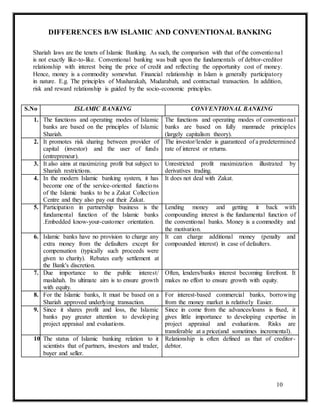
DIFFERENCES B/W ISLAMIC AND CONVENTIONAL BANKING
Shariah laws are the tenets of Islamic Banking. As such, the comparison with that of the conventional
is not exactly like-to-like. Conventional banking was built upon the fundamentals of debtor-creditor
relationship with interest being the price of credit and reflecting the opportunity cost of money.
Hence, money is a commodity somewhat. Financial relationship in Islam is generally participatory
in nature. E.g. The principles of Musharakah, Mudarabah, and contractual transaction. In addition,
risk and reward relationship is guided by the socio-economic principles.
S.No ISLAMIC BANKING CONVENTIONAL BANKING
1. The functions and operating modes of Islamic
banks are based on the principles of Islamic
Shariah.
The functions and operating modes of conventional
banks are based on fully manmade principles
(largely capitalism theory).
2. It promotes risk sharing between provider of
capital (investor) and the user of funds
(entrepreneur).
The investor/lender is guaranteed of a predetermined
rate of interest or returns.
3. It also aims at maximizing profit but subject to
Shariah restrictions.
Unrestricted profit maximization illustrated by
derivatives trading.
4. In the modern Islamic banking system, it has
become one of the service-oriented functions
of the Islamic banks to be a Zakat Collection
Centre and they also pay out their Zakat.
It does not deal with Zakat.
5. Participation in partnership business is the
fundamental function of the Islamic banks
.Embedded know-your-customer orientation.
Lending money and getting it back with
compounding interest is the fundamental function of
the conventional banks. Money is a commodity and
the motivation.
6. Islamic banks have no provision to charge any
extra money from the defaulters except for
compensation (typically such proceeds were
given to charity). Rebates early settlement at
the Bank's discretion.
It can charge additional money (penalty and
compounded interest) in case of defaulters.
7. Due importance to the public interest/
maslahah. Its ultimate aim is to ensure growth
with equity.
Often, lenders/banks interest becoming forefront. It
makes no effort to ensure growth with equity.
8. For the Islamic banks, It must be based on a
Shariah approved underlying transaction.
For interest-based commercial banks, borrowing
from the money market is relatively Easier.
9. Since it shares profit and loss, the Islamic
banks pay greater attention to developing
project appraisal and evaluations.
Since in come from the advances/loans is fixed, it
gives little importance to developing expertise in
project appraisal and evaluations. Risks are
transferable at a price(and sometimes incremental).
10. The status of Islamic banking relation to it
scientists that of partners, investors and trader,
buyer and seller.
Relationship is often defined as that of creditor-
debtor.
11
CASE STUDY 1
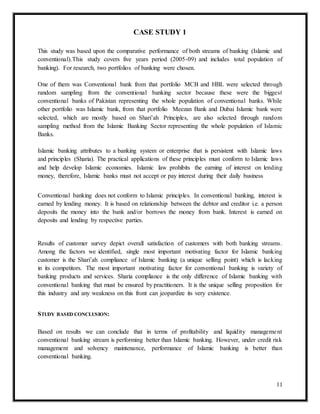
This study was based upon the comparative performance of both streams of banking (Islamic and
conventional).This study covers five years period (2005-09) and includes total population of
banking). For research, two portfolios of banking were chosen.
One of them was Conventional bank from that portfolio MCB and HBL were selected through
random sampling from the conventional banking sector because these were the biggest
conventional banks of Pakistan representing the whole population of conventional banks. While
other portfolio was Islamic bank, from that portfolio Meezan Bank and Dubai Islamic bank were
selected, which are mostly based on Shari’ah Principles, are also selected through random
sampling method from the Islamic Banking Sector representing the whole population of Islamic
Banks.
Islamic banking attributes to a banking system or enterprise that is persistent with Islamic laws
and principles (Sharia). The practical applications of these principles must conform to Islamic laws
and help develop Islamic economies. Islamic law prohibits the earning of interest on lending
money, therefore, Islamic banks must not accept or pay interest during their daily business
Conventional banking does not conform to Islamic principles. In conventional banking, interest is
earned by lending money. It is based on relationship between the debtor and creditor i.e. a person
deposits the money into the bank and/or borrows the money from bank. Interest is earned on
deposits and lending by respective parties.
Results of customer survey depict overall satisfaction of customers with both banking streams.
Among the factors we identified, single most important motivating factor for Islamic banking
customer is the Shari’ah compliance of Islamic banking (a unique selling point) which is lacking
in its competitors. The most important motivating factor for conventional banking is variety of
banking products and services. Sharia compliance is the only difference of Islamic banking with
conventional banking that must be ensured by practitioners. It is the unique selling proposition for
this industry and any weakness on this front can jeopardize its very existence.
STUDY BASED CONCLUSION:
Based on results we can conclude that in terms of profitability and liquidity management
conventional banking stream is performing better than Islamic banking. However, under credit risk
management and solvency maintenance, performance of Islamic banking is better than
conventional banking.
12
CASE STUDY 2
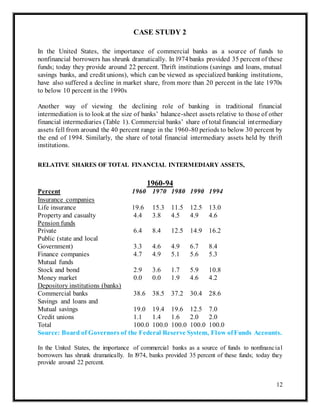
In the United States, the importance of commercial banks as a source of funds to
nonfinancial borrowers has shrunk dramatically. In l974banks provided 35 percent of these
funds; today they provide around 22 percent. Thrift institutions (savings and loans, mutual
savings banks, and credit unions), which can be viewed as specialized banking institutions,
have also suffered a decline in market share, from more than 20 percent in the late 1970s
to below 10 percent in the 1990s.
Another way of viewing the declining role of banking in traditional financial
intermediation is to look at the size of banks’ balance-sheet assets relative to those of other
financial intermediaries (Table 1). Commercial banks’ share of total financial intermediary
assets fell from around the 40 percent range in the 1960-80 periods to below 30 percent by
the end of 1994. Similarly, the share of total financial intermediary assets held by thrift
institutions.
RELATIVE SHARES OF TOTAL FINANCIAL INTERMEDIARY ASSETS,
1960-94
Percent 1960 1970 1980 1990 1994
Insurance companies
Life insurance 19.6 15.3 11.5 12.5 13.0
Property and casualty 4.4 3.8 4.5 4.9 4.6
Pension funds
Private 6.4 8.4 12.5 14.9 16.2
Public (state and local
Government) 3.3 4.6 4.9 6.7 8.4
Finance companies 4.7 4.9 5.1 5.6 5.3
Mutual funds
Stock and bond 2.9 3.6 1.7 5.9 10.8
Money market 0.0 0.0 1.9 4.6 4.2
Depository institutions (banks)
Commercial banks 38.6 38.5 37.2 30.4 28.6
Savings and loans and
Mutual savings 19.0 19.4 19.6 12.5 7.0
Credit unions 1.1 1.4 1.6 2.0 2.0
Total 100.0 100.0 100.0 100.0 100.0
Source: Board of Governors of the Federal Reserve System, Flow ofFunds Accounts.
In the United States, the importance of commercial banks as a source of funds to nonfinancial
borrowers has shrunk dramatically. In l974, banks provided 35 percent of these funds; today they
provide around 22 percent.
13
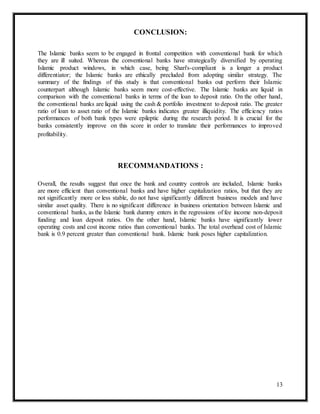
CONCLUSION:
The Islamic banks seem to be engaged in frontal competition with conventional bank for which
they are ill suited. Whereas the conventional banks have strategically diversified by operating
Islamic product windows, in which case, being Shari's-compliant is a longer a product
differentiator; the Islamic banks are ethically precluded from adopting similar strategy. The
summary of the findings of this study is that conventional banks out perform their Islamic
counterpart although Islamic banks seem more cost-effective. The Islamic banks are liquid in
comparison with the conventional banks in terms of the loan to deposit ratio. On the other hand,
the conventional banks are liquid using the cash & portfolio investment to deposit ratio. The greater
ratio of loan to asset ratio of the Islamic banks indicates greater illiquidity. The efficiency ratios
performances of both bank types were epileptic during the research period. It is crucial for the
banks consistently improve on this score in order to translate their performances to improved
profitability.
RECOMMANDATIONS :
Overall, the results suggest that once the bank and country controls are included, Islamic banks
are more efficient than conventional banks and have higher capitalization ratios, but that they are
not significantly more or less stable, do not have significantly different business models and have
similar asset quality. There is no significant difference in business orientation between Islamic and
conventional banks, as the Islamic bank dummy enters in the regressions of fee income non-deposit
funding and loan deposit ratios. On the other hand, Islamic banks have significantly lower
operating costs and cost income ratios than conventional banks. The total overhead cost of Islamic
bank is 0.9 percent greater than conventional bank. Islamic bank poses higher capitalization.
14
BIBLIOGRAPHY
Abdul Gafoor, A.L.M., Interest-Free Commercial Banking, ch.4.1995, available at
www.islamic-finance.com
Aggarwal, R.K., and Yousef, T., "Islamic Banks and Investment Financing", Journal of Money,
Credit, and Banking,32, I (February 2000): 93-120.
http://%3A%2F%2Fwww.slideshare.net%2Fwaqas_qazi862002%2Fa-comparison-of-islamic-and-
conventional-banking-system&h=NAQHhnJYZ

Islamic vs conventional banking

  • 1.
  • 2.
    i Institute of Business Management TERMREPORT ISLAMIC V/S CONVENTIONAL BANKING CORPORATE & BUSINESS LAW Submitted to: Sir Mansoor Ali Shahani Submitted by: Pawan Kumar (20141-17537) Ali Zain (20141-17049) Sagar (20131-16436) Sarib Khan (20141-17909) Sadiq Raza (20141-17663) Submission date: 21-04-2015
  • 3.
    ii TRANSMITTAL LETTER _______________________________________ April 21,2015 Institute of Business Management, Karachi Dear Mr. Mansoor Ali Shahani We are submitting to you the report, due April 21, 2015, that you requested. The report is titled “ISLAMIC BANKING V/s CONVENTIONAL BANKING.” The purpose of the report is to determine how Law that is Shariah Court plays role in this system of banking. Sincerely, Pawan Kumar Ali Zain Sagar Sarib Sadiq
  • 4.
    iii LETTER OF ACKNOWLEDGEMENT Inthe Name of ALLAH the most Merciful and Benevolent. As we present this report, we would like totakethis opportunity to pass our gratitude to our respected teacher, who gaveus this opportunity and guided us during the course of our endeavor to accomplish this task. We have taken efforts in this report. However, it would not have been possible without your kind support. We are highly indebted to Mr. Mansoor Ali Shahani for his guidance and constant supervision as well as for providing necessary information regarding the report. We would like to express our gratitude towards our colleague’s for their kind co-operation and encouragement, which help us in completion of this report.
  • 5.
    iv Table of Contents TRANSMITTALLETTER .............................................................................................................ii LETTER OF ACKNOWLEDGEMENT ........................................................................................iii EXECUTIVE SUMMARY ............................................................................................................vi INTRODUCTION .......................................................................................................................... 1 SCOPE OF BANKING................................................................................................................... 2 What is Bank and what history is behind THIS? ........................................................................ 2  BANK............................................................................................................................... 2  HISTORY OF BANKING............................................................................................... 2 ISLAMIC BANKING..................................................................................................................... 3 ROLE OF ISLAMIC BANKING ............................................................................................... 3 PRINCIPLES BEHIND ISLAMIC BANKING ......................................................................... 3 MODES OF ISLAMIC BANKING............................................................................................ 4  MURABAHA................................................................................................................... 4  IJARAH............................................................................................................................ 4  IJARAH-WAL-IQTINA .................................................................................................. 4  MUSHARAKAH ............................................................................................................. 4  MUSAWAMAH .............................................................................................................. 5  ISTISNA'A....................................................................................................................... 5  BAI MUAJJAL................................................................................................................ 5  MUDARABA................................................................................................................... 5  BAI SALAM.................................................................................................................... 5 CONVENTIONAL BANKING.................................................................................................. 6 ROLE OF CONVENTIONAL BANKING................................................................................ 6 Products of conventional banking............................................................................................... 6  TRANSACTIONAL ACCOUNT.................................................................................... 7  SAVINGS ACCOUNT .................................................................................................... 7  CERTIFICATE OF DEPOSIT......................................................................................... 7  CREDIT CARD ............................................................................................................... 7  DEBIT CARD.................................................................................................................. 8  MORTGAGE LOAN ....................................................................................................... 8  UNSECURED DEBT (Personal loan) ............................................................................. 8
  • 6.
    v  LOAN............................................................................................................................... 8 DIFFERENCESB/W ISLAMIC AND CONVENTIONAL BANKING .................................... 10 CASE STUDY 1 ........................................................................................................................... 11 Study based conclusion:............................................................................................................ 11 Case study 2 .................................................................................................................................. 12 RELATIVE SHARES OF TOTAL FINANCIAL INTERMEDIARY ASSETS, .................... 12 CONCLUSION:............................................................................................................................ 13 RECOMMANDATIONS : ........................................................................................................... 13
  • 7.
    vi EXECUTIVE SUMMARY The Conventionalbanking is very dependent upon the interest in every aspect of banking, while the Islamic banking is totally against the interest in every aspect of banking so due to the interest. The Islamic banking and the Conventional banking, have very differences, which are mainly in product. Products are offering just like the interest banks offers credit cards, debit cards, loans on interest ,leasing on interest, but the Islamic banking offer different products which are totally on the Islamic halal rules Murabaha ,Ijara ,Ijarah-Wal-Iqtina ,Musharakah ,Musawamah ,Istisna'a ,Bai Muajjal etc. So these products are totally different from that of Conventional banking.
  • 8.
    1 INTRODUCTION This report isundertaken to understand the concept of Islamic banking and Conventional banking, the difference between the two systems and their economic implications for an economy. The prime source of revenue and cost of funds to conventional banks (interest-based banks) is charging interest through lending and accepting deposits for interest respectively. Interest is the major driver of operations of conventional banks although other valuable services including guarantees, funds transfers, safety of wealth, facilitation in international trade etc. also form a substantial part of income of banks. Islamic banking, on the other hand, is a banking system, which is in consonance with the spirit, ethos and value system of Islam and governed by the principles laid down by Islamic Shariah. Interest free banking is a narrow concept denoting a number of banking instruments or operations, which avoid interest. Islamic banking, the more general term, is based not only to avoid interest-based transactions prohibited in Islamic Shariah but also to avoid unethical and un-social practices. In practical sense, Islamic Banking is the transformation of conventional money lending into transactions based on tangible assets and real services. The model of Islamic banking system leads towards the achievement of a system, which helps achieve economic prosperity. The origination of term interest dates back to 17th century with the emergence of banking system at global level. Interest means giving and/or taking of any excess amount in exchange of a loan or on debt. Hence, it carries the same meaning/value as that of Riba. Further, it is narrated, “the loan that draws interest is Riba.” There is consensus among the Muslim scholars of all the fiqhs that interest is Riba in all its forms and manifestations.
  • 9.
    2 SCOPE OF BANKING WHATIS BANK AND WHAT HISTORY IS BEHIND THIS?  BANK A bank is a financial institution and a financial intermediary that accepts deposits and channels those deposits into lending activities, either directly or through capital markets. A bank connects customers that have capital deficits to customers with capital surpluses. Due to their critical status within the financial system and the economy generally, banks are highly regulated in most countries. Most banks operate under a system known as fractional reserve banking where they hold only a small reserve of the funds deposited and lend out the rest for profit. They are generally subject to minimum capital requirements, which are based on an international set of capital standards, known as the Basel Accords.  HISTORY OF BANKING The History of Banking begins with the first prototype banks of merchants of the ancient world that made grain loans to farmers and traders carrying goods between cities; recorded as having occurred at about 2000 BC within the areas of Assyria and Babylonia. Later on, in ancient Greece and during the Roman Empire, lenders based in temples made loans and added two important innovations: the accepting of deposits and the changing of money. Archaeology from this period in ancient China and India shows the existence also of money lending activity. Banking, in the modern sense of the word, can be traced to medieval and early Renaissance Italy, to the rich cities in the north such as Florence, Venice, and Genoa. During the 20th century, developments in telecommunications and computing resulting in major changes to the way banks operated and allowed them to dramatically increase in size and geographic spread. The Late-2000s financial crisis saw significant number of bank failures, including some of the world's largest banks, and much debate about bank regulation.
  • 10.
    3 ISLAMIC BANKING A bankingsystem that is based on the principles of Islamic law (also known Shariah) and guided by Islamic economics. Two basic principles behind Islamic banking are the sharing of profit and loss and, significantly, the prohibition of the collection and payment of interest. Collecting interest is not permitted under Islamic law. ROLE OF ISLAMIC BANKING Since this system of banking is grounded in Islamic principles, all the undertakings of the banks follow Islamic morals. Therefore, it could be said that financial transactions within Islamic banking are a culturally distinct form of ethical investing Islamic bank, formed in 1975. Islamic banking refers to a system of banking or banking activity that is consistent with Islamic law (Shari’ah) principles and guided by Islamic economics. In particular, Islamic law prohibits usury, the collection, and payment of interest commonly called Riba. Generally, Islamic law also prohibits trading in financial risk (which is seen as a form of gambling). In addition, Islamic law prohibits investing in businesses that are considered unlawful, or haram. PRINCIPLES BEHIND ISLAMIC BANKING Islamic banking has the same purpose as conventional banking: to make money for the banking institute by lending out capital while adhering to Islamic law. Because Islam forbids simply lending out money at interest, Islamic rules on transactions (known as Fiqh al-Muamalat) have been created to prevent it. The basic principle of Islamic banking is based on risk sharing which is a component of trade rather than risk-transfer, which is seen in conventional banking. Islamic banking is restricted to Islamically acceptable transactions, which exclude those involving alcohol, pork, gambling, etc. The aim of this is to engage in only ethical investing, and moral purchasing. The Islamic Banking and Finance Database provide more information on the subject. In an Islamic mortgage transaction, instead of lending the buyer money to purchase the item, a bank might buy the item itself from the seller, and re-sell it to the buyer at a profit, while allowing the buyer to pay the bank in installments. However, the bank's profit cannot be made explicit and therefore there are no additional penalties for late payment. In order to protect itself against default, the bank asks for strict collateral. The goods or land is registered to the name of the buyer from the start of the transaction. This arrangement is called Murabaha. Another approach is Ijara was EIqtina, which is similar to real estate leasing. Islamic banks handle loans for vehicles in a similar way (selling the vehicle at a higher-than-market price to the debtor and then retaining ownership of the vehicle until the loan is paid). An innovative approach applied by some banks for home loans, called Musharakah al-Mutanaqisa, allows for a floating rate in the form of rental. The bank and borrower form a partnership entity, both providing capital at an agreed percentage to purchase the property. The partnership entity then rents out the property to the borrower and charges rent. The bank and the borrower will then share the proceeds from this rent based on the current equity share of the partnership. At the same
  • 11.
    4 time, the borrowerin the partnership entity also buys the bank's share of the property at agreed installments until the full equity is transferred to the borrower and the partnership is ended. MODES OF ISLAMIC BANKING  MURABAHA  IJARAH  IJARAH-WAL-IQTINA  MUSHARAKAH  MUSAWAMAH  ISTISNA'A  BAI MUAJJAL  MUDARABA  BAI SALAM  MURABAHA Literally, it means a sale on mutually agreed profit. Technically, it is a contract of sale in which the seller declares his cost and profit. Islamic banks have adopted this as a mode of financing. As a financing technique, it involves a request by the client to the bank to purchase certain goods for him. The bank does that for a definite profit over the cost, which is stipulated in advance.  IJARAH Ijara is a contract of a known and proposed usufruct against a specified and lawful return or consideration for the service or return for the benefit proposed to be taken, or for the effort or work proposed to be expended. In other words, Ijara or leasing is the transfer of usufruct for a consideration which is rent in case of hiring of assets or things and wage in case of hiring of persons.  IJARAH-WAL-IQTINA A contract under which an Islamic bank provides equipment, building, or other assets to the client against an agreed rental together with a unilateral undertaking by the bank or the client that at the end of the lease period, the ownership in the asset would be transferred to the lessee. The undertaking or the promise does not become an integral part of the lease contract to make it conditional. The rentals as well as the purchase price are fixed in such manner that the bank gets back its principal sum along with profit over the period of lease.  MUSHARAKAH Musharakah means a relationship established under a contract by the mutual consent of the parties for sharing of profits and losses in the joint business. It is an agreement under which the Islamic bank provides funds, which are mixed with the funds of the business enterprise and others. All
  • 12.
    5 providers of capitalare entitled to participate in management, but not necessarily required to do so. The profit is distributed among the partners in pre-agreed ratios, while the loss is borne by each partner strictly in proportion to respective capital contributions.  MUSAWAMAH Musawamah is a general and regular kind of sale in which price of the commodity to be traded is bargained between seller and the buyer without any reference to the price paid or cost incurred by the former. Thus, it is different from Murabaha in respect of pricing formula. Unlike Murabaha, seller in Musawamah is not obliged to reveal his cost. Both the parties negotiate on the price. All other Islamic banking and Conventional banking  ISTISNA'A It is a contractual agreement for manufacturing goods and commodities, allowing cash payment in advance and future delivery or a future payment and future delivery. Istisna'a can be used for providing the facility of financing the manufacture or construction of houses, plants, projects, and building of bridges, roads, and highways.  BAI MUAJJAL Literally, it means a credit sale. Technically, a financing technique adopted by Islamic banks takes the form of Murabaha Muajjal. It is a contract in which the bank earns a profit margin on his purchase price and allows the buyer to pay the price of the commodity at a future date in a lump sum or in installments. It has to expressly mention cost of the commodity and the margin of profit is mutually agreed. The price fixed for the commodity in such a transaction can be the same as the spot price or higher or lower than the spot price.  MUDARABA A form of partnership where one party provides the funds while the other provides expertise and management. The latter is referred to as the Mudarib. Any profits accrued are shared between the two parties on a pre-agreed basis, while loss is borne only by the provider of the capital.  BAI SALAM Salam means a contract in which advance payment is made for goods to be delivered later on. The seller undertakes to supply some specific goods to the buyer at a future date in exchange of an advance price fully paid at the time of contract. It is necessary that the quality of the commodity intended to be purchased be fully specified leaving no ambiguity leading to dispute. The objects of this sale are goods and cannot be gold, silver, or currencies. Barring this, Bai Salam covers almost everything, which is capable of being definitely described as to quantity, quality, and workmanship.
  • 13.
    6 CONVENTIONAL BANKING Banking meansthe business of receiving money on current or deposit account, paying and collecting cheques drawn by or paid in by customers, the making of advances to customers, and includes such other business as the Authority may prescribe for the purposes of this Act; (Banking Act (Singapore), Section 2, Interpretation). Conventional banking is based on the principle that the more you have, the more you can get. In other words, if you have little or nothing, you get nothing. As a result, more than half the population of the world is deprived of the financial services of the Conventional banks. Conventional banking is based on collateral. Conventional banks look at what has already been acquired by a person Conventional banks go into ‘punishment’ mode when a borrower is taking more time in repaying the loan than it was agreed upon. They call these borrowers “defaulters”. When a client gets into difficulty, Conventional banks get. ROLE OF CONVENTIONAL BANKING Conventional banks engage in the following activities: Processing of payments by way of telegraphic transfer, internet banking, or other means Issuing bank drafts and bank cheques, accepting money on term deposit, lending money by overdraft, installment loan, or other means providing documentary and standby letter of credit, guarantees, performance bonds, securities underwriting commitments and other forms of off balance sheet exposures. Safekeeping of documents and other items in safe deposit boxes, sales, distribution, or brokerage, with or without advice, of: insurance, unit trusts, and similar financial products as a financial supermarket. Cash management and treasury, merchant banking and private equity financing traditionally, large Conventional banks also underwrite bonds, and make markets in currency, interest rates, and credit-related securities, but today large Conventional banks usually have an investment bank arm that is involved in the mentioned activities. PRODUCTS OF CONVENTIONAL BANKING Products offered by mostly Conventional banking usually called conventional banking are given below.  Transactional account  Savings account  Certificate of deposit  Credit card  Debit card  Mortgage loan
  • 14.
    7  Unsecured debt(personal loan)  Loan  TRANSACTIONAL ACCOUNT A transactional account is a deposit account held at a bank or other financial institution, for the purpose of securely and quickly providing frequent access to funds on demand, through a variety of different channels. Transactional accounts are mean neither for earning interest nor for the purpose of savings, but for convenience of the business or personal client; hence do they tend not to bear interest. Instead, a customer can deposit or withdraw any amount of money any number of times, subject to availability of funds.  SAVINGS ACCOUNT savings accounts are accounts maintained by retail financial institutions that pay interest but cannot be used directly as money in the narrow sense of a medium of exchange (for example, by writing a check). These accounts let customers set aside a portion of their liquid assets while earning a monetary return. For the bank, money in a savings account may not be callable immediately and therefore often does not incur a reserve requirement freeing up cash from the bank's vault to lend out with interest. Withdrawals from a savings account are occasionally costly, and they are more time-consuming than withdrawals from a demand (current) account.  CERTIFICATE OF DEPOSIT A certificate of deposit (CD) is a time deposit, a financial product commonly offered to consumers in the United States by banks, thrift institutions, and credit unions. CDs are similar to savings accounts in that they are insured and thus virtually risk free; they are "money in the bank." In exchange for keeping the money on deposit for the agreed-on term, institutions usually grant higher interest rates than they do on accounts from which money may be withdraw on demand, although this may not be the case in an inverted yield curve situation. Fixed rates are common, but some institutions offer CDs with various forms of variable rates.  CREDIT CARD Credit card is a small plastic card issued to users as a system of payment. It allows its holder to buy goods and services based on the holder's promise to pay for these goods and services. The issuer of the card creates a revolving account and grants a line of credit to the consumer (or the user) from which the user can borrow money for payment to a merchant or as a cash advance to the user. A credit card is different from a charge card: a charge card requires the balance to be paid in full each month. In contrast, credit cards allow the consumers a continuing balance of debt, subject to interest being charge.
  • 15.
    8  DEBIT CARD Adebit card (also known as a bankcard or check card) is a plastic card that provides the cardholder electronic access to his or her bank account(s) at a financial institution. Some cards have a value with which a payment is to be made, while most relay a message to the cardholder's bank to withdraw funds from a designated account in favor of the payee's designated bank account. In some cases, the primary account number is assigned exclusively for use on the Internet and there is no physical card. Debit cards usually also allow for instant withdrawal of cash, acting as the ATM card for withdrawing cash. Merchants may also offer cash back facilities to customers, where a customer can withdraw cash along with their purchase.  MORTGAGE LOAN The word mortgage is a Law French term meaning either “death contract,” meaning that the pledge ends (dies) when the obligation is to be fulfill or the property taken through foreclosure. A mortgage loan is a loan secured by real property using a mortgage note, which evidences the existence of the loan and the encumbrance of that realty through the granting of mortgage, which secures the loan. However, the word mortgage alone, in everyday usage, and most often used to mean mortgage loan. A homebuyer or builder can obtain either financing (a loan) to either purchase or secure against the property from a financial institution, such as a bank, directly or indirectly through intermediaries. Features of mortgage loans such as the size of the loan, maturity of the loan, interest rate, method of paying off the loan, and other characteristics can vary considerably. It is normal for home purchases to be funded by a mortgage loan. Few individuals have enough savings or liquid funds to enable them to purchase property outright.  UNSECURED DEBT (Personal loan) Personal Loan or unsecured debt refers to any type of debt or general obligation that was not collateralized by a lien on specific assets of the borrower in the case of a bankruptcy or liquidation or failure to meet the terms for repayment. In the event of the bankruptcy of the borrower, the unsecured creditors will have a general claim on the assets of the borrower after the specific pledged assets have been assigned to the secured creditors, although the unsecured creditors will usually realize a smaller proportion of their claims than the secured creditors. In some legal systems, unsecured creditors who are also indebted to the insolvent debtor are able (and in some jurisdictions, required) to set-off the debts, which actually puts the unsecured creditor with a matured liability to the debtor in a pre-preferential position.  LOAN A loan is a type of debt. Like all debt instruments, a loan entails the redistribution of financial assets over time, between the lender and the borrower. In a loan, the borrower initially receives or borrows an amount of money, called the principal, from the lender, and is obligated to pay back
  • 16.
    9 or repay anequal amount of money to the lender later. Typically, the money is paid back in regular installments, or partial repayments; in annuity, each installment is the same amount. The loan is generally provided at a cost, referred to as interest on the debt, which provides an incentive for the lender to engage in the loan. In a legal loan, each of these obligations and restrictions is enforced by contract, which can also place the borrower under additional restrictions known as loan covenants. Although this article focuses on monetary loans, in practice any material object might be lent.
  • 17.
    10 DIFFERENCES B/W ISLAMICAND CONVENTIONAL BANKING Shariah laws are the tenets of Islamic Banking. As such, the comparison with that of the conventional is not exactly like-to-like. Conventional banking was built upon the fundamentals of debtor-creditor relationship with interest being the price of credit and reflecting the opportunity cost of money. Hence, money is a commodity somewhat. Financial relationship in Islam is generally participatory in nature. E.g. The principles of Musharakah, Mudarabah, and contractual transaction. In addition, risk and reward relationship is guided by the socio-economic principles. S.No ISLAMIC BANKING CONVENTIONAL BANKING 1. The functions and operating modes of Islamic banks are based on the principles of Islamic Shariah. The functions and operating modes of conventional banks are based on fully manmade principles (largely capitalism theory). 2. It promotes risk sharing between provider of capital (investor) and the user of funds (entrepreneur). The investor/lender is guaranteed of a predetermined rate of interest or returns. 3. It also aims at maximizing profit but subject to Shariah restrictions. Unrestricted profit maximization illustrated by derivatives trading. 4. In the modern Islamic banking system, it has become one of the service-oriented functions of the Islamic banks to be a Zakat Collection Centre and they also pay out their Zakat. It does not deal with Zakat. 5. Participation in partnership business is the fundamental function of the Islamic banks .Embedded know-your-customer orientation. Lending money and getting it back with compounding interest is the fundamental function of the conventional banks. Money is a commodity and the motivation. 6. Islamic banks have no provision to charge any extra money from the defaulters except for compensation (typically such proceeds were given to charity). Rebates early settlement at the Bank's discretion. It can charge additional money (penalty and compounded interest) in case of defaulters. 7. Due importance to the public interest/ maslahah. Its ultimate aim is to ensure growth with equity. Often, lenders/banks interest becoming forefront. It makes no effort to ensure growth with equity. 8. For the Islamic banks, It must be based on a Shariah approved underlying transaction. For interest-based commercial banks, borrowing from the money market is relatively Easier. 9. Since it shares profit and loss, the Islamic banks pay greater attention to developing project appraisal and evaluations. Since in come from the advances/loans is fixed, it gives little importance to developing expertise in project appraisal and evaluations. Risks are transferable at a price(and sometimes incremental). 10. The status of Islamic banking relation to it scientists that of partners, investors and trader, buyer and seller. Relationship is often defined as that of creditor- debtor.
  • 18.
    11 CASE STUDY 1 Thisstudy was based upon the comparative performance of both streams of banking (Islamic and conventional).This study covers five years period (2005-09) and includes total population of banking). For research, two portfolios of banking were chosen. One of them was Conventional bank from that portfolio MCB and HBL were selected through random sampling from the conventional banking sector because these were the biggest conventional banks of Pakistan representing the whole population of conventional banks. While other portfolio was Islamic bank, from that portfolio Meezan Bank and Dubai Islamic bank were selected, which are mostly based on Shari’ah Principles, are also selected through random sampling method from the Islamic Banking Sector representing the whole population of Islamic Banks. Islamic banking attributes to a banking system or enterprise that is persistent with Islamic laws and principles (Sharia). The practical applications of these principles must conform to Islamic laws and help develop Islamic economies. Islamic law prohibits the earning of interest on lending money, therefore, Islamic banks must not accept or pay interest during their daily business Conventional banking does not conform to Islamic principles. In conventional banking, interest is earned by lending money. It is based on relationship between the debtor and creditor i.e. a person deposits the money into the bank and/or borrows the money from bank. Interest is earned on deposits and lending by respective parties. Results of customer survey depict overall satisfaction of customers with both banking streams. Among the factors we identified, single most important motivating factor for Islamic banking customer is the Shari’ah compliance of Islamic banking (a unique selling point) which is lacking in its competitors. The most important motivating factor for conventional banking is variety of banking products and services. Sharia compliance is the only difference of Islamic banking with conventional banking that must be ensured by practitioners. It is the unique selling proposition for this industry and any weakness on this front can jeopardize its very existence. STUDY BASED CONCLUSION: Based on results we can conclude that in terms of profitability and liquidity management conventional banking stream is performing better than Islamic banking. However, under credit risk management and solvency maintenance, performance of Islamic banking is better than conventional banking.
  • 19.
    12 CASE STUDY 2 Inthe United States, the importance of commercial banks as a source of funds to nonfinancial borrowers has shrunk dramatically. In l974banks provided 35 percent of these funds; today they provide around 22 percent. Thrift institutions (savings and loans, mutual savings banks, and credit unions), which can be viewed as specialized banking institutions, have also suffered a decline in market share, from more than 20 percent in the late 1970s to below 10 percent in the 1990s. Another way of viewing the declining role of banking in traditional financial intermediation is to look at the size of banks’ balance-sheet assets relative to those of other financial intermediaries (Table 1). Commercial banks’ share of total financial intermediary assets fell from around the 40 percent range in the 1960-80 periods to below 30 percent by the end of 1994. Similarly, the share of total financial intermediary assets held by thrift institutions. RELATIVE SHARES OF TOTAL FINANCIAL INTERMEDIARY ASSETS, 1960-94 Percent 1960 1970 1980 1990 1994 Insurance companies Life insurance 19.6 15.3 11.5 12.5 13.0 Property and casualty 4.4 3.8 4.5 4.9 4.6 Pension funds Private 6.4 8.4 12.5 14.9 16.2 Public (state and local Government) 3.3 4.6 4.9 6.7 8.4 Finance companies 4.7 4.9 5.1 5.6 5.3 Mutual funds Stock and bond 2.9 3.6 1.7 5.9 10.8 Money market 0.0 0.0 1.9 4.6 4.2 Depository institutions (banks) Commercial banks 38.6 38.5 37.2 30.4 28.6 Savings and loans and Mutual savings 19.0 19.4 19.6 12.5 7.0 Credit unions 1.1 1.4 1.6 2.0 2.0 Total 100.0 100.0 100.0 100.0 100.0 Source: Board of Governors of the Federal Reserve System, Flow ofFunds Accounts. In the United States, the importance of commercial banks as a source of funds to nonfinancial borrowers has shrunk dramatically. In l974, banks provided 35 percent of these funds; today they provide around 22 percent.
  • 20.
    13 CONCLUSION: The Islamic banksseem to be engaged in frontal competition with conventional bank for which they are ill suited. Whereas the conventional banks have strategically diversified by operating Islamic product windows, in which case, being Shari's-compliant is a longer a product differentiator; the Islamic banks are ethically precluded from adopting similar strategy. The summary of the findings of this study is that conventional banks out perform their Islamic counterpart although Islamic banks seem more cost-effective. The Islamic banks are liquid in comparison with the conventional banks in terms of the loan to deposit ratio. On the other hand, the conventional banks are liquid using the cash & portfolio investment to deposit ratio. The greater ratio of loan to asset ratio of the Islamic banks indicates greater illiquidity. The efficiency ratios performances of both bank types were epileptic during the research period. It is crucial for the banks consistently improve on this score in order to translate their performances to improved profitability. RECOMMANDATIONS : Overall, the results suggest that once the bank and country controls are included, Islamic banks are more efficient than conventional banks and have higher capitalization ratios, but that they are not significantly more or less stable, do not have significantly different business models and have similar asset quality. There is no significant difference in business orientation between Islamic and conventional banks, as the Islamic bank dummy enters in the regressions of fee income non-deposit funding and loan deposit ratios. On the other hand, Islamic banks have significantly lower operating costs and cost income ratios than conventional banks. The total overhead cost of Islamic bank is 0.9 percent greater than conventional bank. Islamic bank poses higher capitalization.
  • 21.
    14 BIBLIOGRAPHY Abdul Gafoor, A.L.M.,Interest-Free Commercial Banking, ch.4.1995, available at www.islamic-finance.com Aggarwal, R.K., and Yousef, T., "Islamic Banks and Investment Financing", Journal of Money, Credit, and Banking,32, I (February 2000): 93-120. http://%3A%2F%2Fwww.slideshare.net%2Fwaqas_qazi862002%2Fa-comparison-of-islamic-and- conventional-banking-system&h=NAQHhnJYZ