Constructivism Art
Constructivism was an invention of the Russian avant-garde that
found adherents across the continent. Germany was the site of the
most Constructivist activity outside of the Soviet Union but
Constructivist ideas were also carried to other art centers, like Paris,
London, and eventually the United States. Constructivist art is marked
by a commitment to total abstraction and a wholehearted acceptance
of modernity
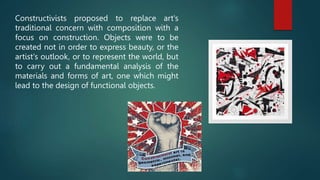
Constructivists proposed to replace art's
traditional concern with composition with a
focus on construction. Objects were to be
created not in order to express beauty, or the
artist's outlook, or to represent the world, but
to carry out a fundamental analysis of the
materials and forms of art, one which might
lead to the design of functional objects.
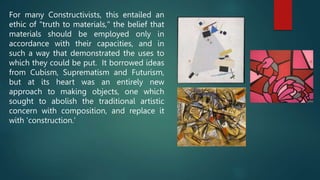
For many Constructivists, this entailed an
ethic of "truth to materials," the belief that
materials should be employed only in
accordance with their capacities, and in
such a way that demonstrated the uses to
which they could be put. It borrowed ideas
from Cubism, Suprematism and Futurism,
but at its heart was an entirely new
approach to making objects, one which
sought to abolish the traditional artistic
concern with composition, and replace it
with 'construction.'
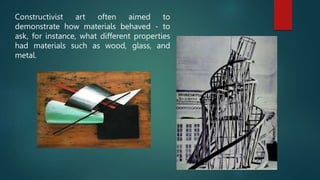
Constructivist art often aimed to
demonstrate how materials behaved - to
ask, for instance, what different properties
had materials such as wood, glass, and
metal.
The seed of Constructivism was a desire to
express the experience of modern life - its
dynamism, its new and disorientating
qualities of space and time. But also crucial
was the desire to develop a new form of art
more appropriate to the democratic and
modernizing goals of the Russian
Revolution.
Constructivism was the last and most
influential modern art movement to
flourish in Russia in the 20th century.
Constructivist art was in part a progression
from Russian Futurism, with stylistic signs
of the earlier movement being evident in
some of the angular industrial sculptures
and reliefs of artists like Vladimir Tatlin and
Naum Gabo.
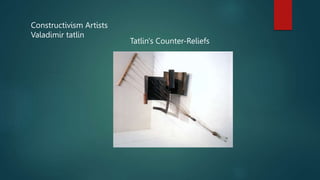
Vladimir Tatlin
Naum Gabo
Constructivism Artists
Valadimir tatlin
Tatlin's Counter-Reliefs
Naum Gabo
The Constructed Head No.2
The movement was in favour of art as
a practice for social purposes.
Constructivism had a great effect on
modern art movements of the 20th
century, influencing major trends such
as the Bauhaus and De Stijl
movements. Its influence was
widespread, with major effects upon
architecture, sculpture, graphic
design, industrial design, theatre, film,
dance, fashion and, to some extent,
music.
De Stijl Art
De Stijl was a circle of Dutch abstract
artists who promoted a style of art based
on a strict geometry of horizontals and
verticals. Originally a publication, De Stijl
was founded in 1917 by two pioneers of
abstract art, Piet Mondrian and Theo van
Doesburg. De Stijl means style in Dutch.
As a movement, De Stijl influenced
painting, decorative arts (including
furniture design), typography, and
architecture, but it was principally
architecture that realized both De Stijl’s
stylistic aims and its goal of close
collaboration among the arts. The harmony
and order was established through a
reduction of elements to pure geometric
forms and primary colors.
Arist
Piet Mondrian,
Composition with Yellow, Blue, and Red, 1937-42
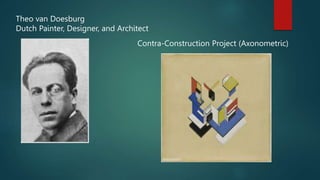
Theo van Doesburg
Dutch Painter, Designer, and Architect
Contra-Construction Project (Axonometric)
Conclusion:
Like other avant-garde movements of the time, De Stijl, which means
simply "the style" in Dutch, emerged largely in response to the horrors of
World War I and the wish to remake society in its aftermath. Viewing art
as a means of social and spiritual redemption, the members of De Stijl
embraced a utopian vision of art and its transformative potential.
REERENCES:
https://www.tate.org.uk/art/art-terms/d/de-stijl
https://www.khanacademy.org/humanities/ap-art-history/later-europe-
and-americas/modernity-ap/a/mondrian-composition
https://www.tate.org.uk/kids/explore/who-is/who-piet-mondrian
https://www.theartstory.org/movement/de-stijl/
https://www.theartstory.org/movement/constructivism/
https://www.artmovements.co.uk/constructivism.htm
https://www.theartstory.org/movement/constructivism/
https://www.doublestonesteel.com/blog/art-and-sculpture/naum-
gabo/

......Contructivism art and History.pptx