Topics to be covered
1 control and coordination
2 nervous coordination
2.1 neuron types
3 Types of nervous system nervous
4 central nervous system
4.1 brain
5 peripheral nervous system
5.1 Nerves and its types
5.2 reflex action and reflex arc
6 chemical coordination in animals
6.1 Endocrine glands
6.2 hormones and its functions coordination in plants
6.3 plant moments plant hormones
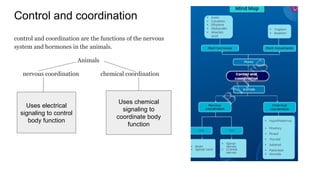
Control and coordination
control and coordination are the functions of the nervous
system and hormones in the animals.
Animals
nervous coordination chemical coordination
Uses electrical
signaling to control
body function
Uses chemical
signaling to
coordinate body
function
ANIMALS – NERVOUS SYSTEM
Definition:
The nervous system is a specialized system in animals that controls and coordinates body activities by transmitting
signals between different body parts.
🧩 Main Parts:
1. Central Nervous System (CNS)
● Includes Brain and Spinal Cord.
● Controls most body and mind functions.
2. Peripheral Nervous System (PNS)
● Composed of nerves that connect the CNS to the rest of the body.
● Divided into:
○ Somatic Nervous System (voluntary control)
○ Autonomic Nervous System (involuntary control)
The information from our environment is detected by specialised Nerve cells. The receptors are usually located in our sense
organs such nose, tongue . Gustatory receptors will detect taste while olfactory receptors will detect smell .
Neuron(nerve cell)
The structural and functional unit of the nervous
System which is highly specialised for being
stimulated and then transmitting the stimulus
within the body .
Types of Neurons
Neuron
Neuron is the structural and functional unit of the nervous system.
● Each neuron has three main parts: dendrites, cyton/soma/cell body and axon.
● Dendrites receive impulses from other neurons.
● Cyton/soma processes the impulse.
● Axon transmits the impulse, either to another neuron or to muscles/glands, etc.
● Axon may be myelinated or non-myelinated.
● The impulse transmission is faster in myelinated neurons.
Central nervous system (CNS)
The central nervous system (CNS) is made up of the brain and the spinal cord.
The functions of different parts of the brain are:
● The cerebrum is responsible for reasoning, logic, emotions, speech, memory,
visual processing, recognition of auditory and taste stimuli, etc.
● Cerebellum regulates and coordinates body movements, posture and balance.
● Pons relays signals from the hindbrain to the forebrain.
● Medulla Oblongata controls all involuntary movements like vomiting, sneezing,
yawning, heartbeat, breathing, blood pressure, etc.
● Medulla oblongata continues as the spinal cord, which runs through the
vertebral column and it controls reflex actions.
Parts of brain
FOREBRAIN
MIDBRAIN
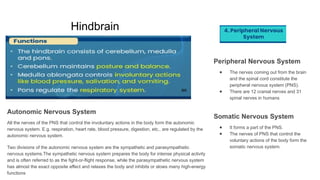
Hindbrain
Peripheral Nervous System
● The nerves coming out from the brain
and the spinal cord constitute the
peripheral nervous system (PNS).
● There are 12 cranial nerves and 31
spinal nerves in humans
Somatic Nervous System
● It forms a part of the PNS.
● The nerves of PNS that control the
voluntary actions of the body form the
somatic nervous system.
Autonomic Nervous System
All the nerves of the PNS that control the involuntary actions in the body form the autonomic
nervous system. E.g. respiration, heart rate, blood pressure, digestion, etc., are regulated by the
autonomic nervous system.
Two divisions of the autonomic nervous system are the sympathetic and parasympathetic
nervous systems.The sympathetic nervous system prepares the body for intense physical activity
and is often referred to as the fight-or-flight response, while the parasympathetic nervous system
has almost the exact opposite effect and relaxes the body and inhibits or slows many high-energy
functions
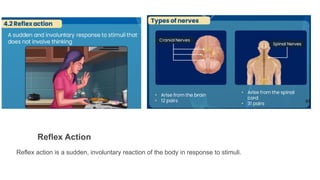
Reflex Action
Reflex action is a sudden, involuntary reaction of the body in response to stimuli.
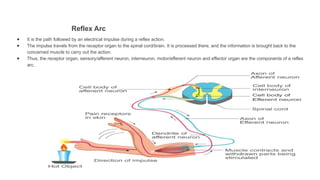
Reflex Arc
● It is the path followed by an electrical impulse during a reflex action.
● The impulse travels from the receptor organ to the spinal cord/brain. It is processed there, and the information is brought back to the
concerned muscle to carry out the action.
● Thus, the receptor organ, sensory/afferent neuron, interneuron, motor/efferent neuron and effector organ are the components of a reflex
arc.
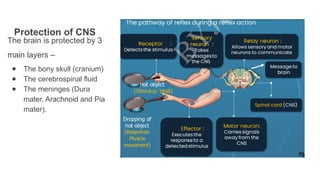
Protection of CNS
The brain is protected by 3
main layers –
● The bony skull (cranium)
● The cerebrospinal fluid
● The meninges (Dura
mater, Arachnoid and Pia
mater).
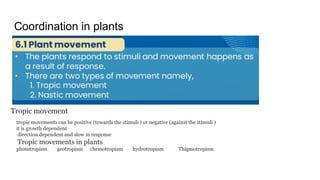
Coordination in plants
Tropic movement
tropic movements can be positive (towards the stimuli ) or negative (against the stimuli )
it is growth dependent
direction dependent and slow in response
Tropic movements in plants
phototropism geotropism chemotropism hydrotropism Thigmotropism
Examples:
● Phototropic movement (light-dependent)
● Geotropic movement (gravity-dependent)
● Chemotropic movement (chemical-dependent)
● Hydrotropic movement (water-dependent)
● Thigmotropic movement (touch dependent)
Geotropism
Movement of plant parts in response to earth’s gravitational force is known as geotropism/gravitropism.
● Towards gravity – positive geotropism
● Away from gravity – negative geotropism
● The root grows towards gravity, and the shoot grows away from gravity
Geotropism
Movement of plant parts in response to earth’s gravitational force is known as geotropism/gravitropism.
● Towards gravity – positive geotropism
● Away from gravity – negative geotropism
● The root grows towards gravity, and the shoot grows away from gravity
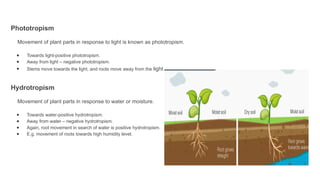
Phototropism
Movement of plant parts in response to light is known as phototropism.
● Towards light-positive phototropism.
● Away from light – negative phototropism.
● Stems move towards the light, and roots move away from the light
Hydrotropism
Movement of plant parts in response to water or moisture.
● Towards water-positive hydrotropism.
● Away from water – negative hydrotropism.
● Again, root movement in search of water is positive hydrotropism.
● E.g. movement of roots towards high humidity level.
Chemotropism
Movement of plant parts in response to chemical stimuli is known as chemotropism.
● Towards chemical-positive chemotropism.
● Away from chemical-negative chemotropism.
● The growth of the pollen tube towards the ovule is positive chemotropism.
Thigmotropism
Movement of plant parts in response to touch is called as thigmotropism.
● Towards touch – Positive thigmotropism.
● Away from touch – negative thigmotropism.
● Movement of tendrils around the support is positive thigmotropism.
Plants hormone
1.Auxin:Helps in unidirectional shoot and root growth.
2. Cytokinin: Promotes lateral growth and induces branching.
3. Gibberellin: Works along with auxin for stem elongation and also produces
seedless fruits.
4. Abscisic acid(ABA): Growth inhibitor which promotes seed dormancy and closes
stomata during droughts and reduces water loss .
5. Ethylene: Helps in ripening of fruits and shedding of leaves.
The Endocrine System
Exocrine Glands
Exocrine glands are glands that discharge secretions by means of ducts, which open onto an epithelial surface.
Endocrine Glands
Endocrine glands are the ductless glands which secrete hormones into the bloodstream in humans.
The endocrine glands present in the human body are the pituitary, thyroid, adrenal, pineal, pancreas, ovary (female), testis
(male), etc.
Pituitary Gland
● It is a pea-sized gland located at the base of the brain.
● It is the master gland, as it controls the secretions of all
the other endocrine glands.
● It also secretes Growth Hormone (GH). Under-
secretion of GH causes Dwarfism, and over-secretion
causes Gigantism in children and ‘Acromegaly’ in adults
Thyroid Gland
● It is a butterfly-shaped gland located in the throat.
● It secretes the hormone ‘Thyroxine’, which regulates
the metabolism of the body.
● Iodine is required to synthesize thyroxine in the body.
● In the case of iodine deficiency, under-secretion of
thyroxine leads to goitre
Pancreas
● It is a leaf-like gland present behind the stomach in the abdomen.
● It is an endocrine as well an exocrine gland.
● As an endocrine gland, it manufactures two hormones – Insulin and glucagon. Both these
hormones act antagonistically and regulate the sugar level in the blood.
● As an exocrine gland, it secretes enzymes to break down the proteins, lipids, carbohydrates
and nucleic acids in food.
● An insufficient amount of insulin from the pancreas leads to diabetes.
Adrenal Gland
● Occurs in pairs above each kidney.
● It decreases in size with age.
● Secrets the hormone adrenaline, which helps in flight and fight response.
● Also secretes noradrenaline.
Gonads
● Gonads are the gamete-producing organs – testes in males and ovaries in females.
● The testes produce the male hormone testosterone, and the ovaries produce the female
hormones oestrogen and progesterone.
● Testosterone and oestrogen help in producing gametes and are responsible for the sexual
characteristics of males and females, respectively.
● Progesterone is the pregnancy hormone
control and coordination class 10th.pptx

control and coordination class 10th.pptx

  • 1.
    Topics to becovered 1 control and coordination 2 nervous coordination 2.1 neuron types 3 Types of nervous system nervous 4 central nervous system 4.1 brain 5 peripheral nervous system 5.1 Nerves and its types 5.2 reflex action and reflex arc 6 chemical coordination in animals 6.1 Endocrine glands 6.2 hormones and its functions coordination in plants 6.3 plant moments plant hormones
  • 2.
    Control and coordination controland coordination are the functions of the nervous system and hormones in the animals. Animals nervous coordination chemical coordination Uses electrical signaling to control body function Uses chemical signaling to coordinate body function
  • 5.
    ANIMALS – NERVOUSSYSTEM Definition: The nervous system is a specialized system in animals that controls and coordinates body activities by transmitting signals between different body parts. 🧩 Main Parts: 1. Central Nervous System (CNS) ● Includes Brain and Spinal Cord. ● Controls most body and mind functions. 2. Peripheral Nervous System (PNS) ● Composed of nerves that connect the CNS to the rest of the body. ● Divided into: ○ Somatic Nervous System (voluntary control) ○ Autonomic Nervous System (involuntary control) The information from our environment is detected by specialised Nerve cells. The receptors are usually located in our sense organs such nose, tongue . Gustatory receptors will detect taste while olfactory receptors will detect smell .
  • 6.
    Neuron(nerve cell) The structuraland functional unit of the nervous System which is highly specialised for being stimulated and then transmitting the stimulus within the body .
  • 7.
  • 8.
    Neuron Neuron is thestructural and functional unit of the nervous system. ● Each neuron has three main parts: dendrites, cyton/soma/cell body and axon. ● Dendrites receive impulses from other neurons. ● Cyton/soma processes the impulse. ● Axon transmits the impulse, either to another neuron or to muscles/glands, etc. ● Axon may be myelinated or non-myelinated. ● The impulse transmission is faster in myelinated neurons.
  • 9.
    Central nervous system(CNS) The central nervous system (CNS) is made up of the brain and the spinal cord. The functions of different parts of the brain are: ● The cerebrum is responsible for reasoning, logic, emotions, speech, memory, visual processing, recognition of auditory and taste stimuli, etc. ● Cerebellum regulates and coordinates body movements, posture and balance. ● Pons relays signals from the hindbrain to the forebrain. ● Medulla Oblongata controls all involuntary movements like vomiting, sneezing, yawning, heartbeat, breathing, blood pressure, etc. ● Medulla oblongata continues as the spinal cord, which runs through the vertebral column and it controls reflex actions.
  • 10.
  • 11.
    Hindbrain Peripheral Nervous System ●The nerves coming out from the brain and the spinal cord constitute the peripheral nervous system (PNS). ● There are 12 cranial nerves and 31 spinal nerves in humans Somatic Nervous System ● It forms a part of the PNS. ● The nerves of PNS that control the voluntary actions of the body form the somatic nervous system. Autonomic Nervous System All the nerves of the PNS that control the involuntary actions in the body form the autonomic nervous system. E.g. respiration, heart rate, blood pressure, digestion, etc., are regulated by the autonomic nervous system. Two divisions of the autonomic nervous system are the sympathetic and parasympathetic nervous systems.The sympathetic nervous system prepares the body for intense physical activity and is often referred to as the fight-or-flight response, while the parasympathetic nervous system has almost the exact opposite effect and relaxes the body and inhibits or slows many high-energy functions
  • 12.
    Reflex Action Reflex actionis a sudden, involuntary reaction of the body in response to stimuli.
  • 13.
    Reflex Arc ● Itis the path followed by an electrical impulse during a reflex action. ● The impulse travels from the receptor organ to the spinal cord/brain. It is processed there, and the information is brought back to the concerned muscle to carry out the action. ● Thus, the receptor organ, sensory/afferent neuron, interneuron, motor/efferent neuron and effector organ are the components of a reflex arc.
  • 14.
    Protection of CNS Thebrain is protected by 3 main layers – ● The bony skull (cranium) ● The cerebrospinal fluid ● The meninges (Dura mater, Arachnoid and Pia mater).
  • 15.
    Coordination in plants Tropicmovement tropic movements can be positive (towards the stimuli ) or negative (against the stimuli ) it is growth dependent direction dependent and slow in response Tropic movements in plants phototropism geotropism chemotropism hydrotropism Thigmotropism
  • 16.
    Examples: ● Phototropic movement(light-dependent) ● Geotropic movement (gravity-dependent) ● Chemotropic movement (chemical-dependent) ● Hydrotropic movement (water-dependent) ● Thigmotropic movement (touch dependent) Geotropism Movement of plant parts in response to earth’s gravitational force is known as geotropism/gravitropism. ● Towards gravity – positive geotropism ● Away from gravity – negative geotropism ● The root grows towards gravity, and the shoot grows away from gravity
  • 17.
    Geotropism Movement of plantparts in response to earth’s gravitational force is known as geotropism/gravitropism. ● Towards gravity – positive geotropism ● Away from gravity – negative geotropism ● The root grows towards gravity, and the shoot grows away from gravity
  • 18.
    Phototropism Movement of plantparts in response to light is known as phototropism. ● Towards light-positive phototropism. ● Away from light – negative phototropism. ● Stems move towards the light, and roots move away from the light Hydrotropism Movement of plant parts in response to water or moisture. ● Towards water-positive hydrotropism. ● Away from water – negative hydrotropism. ● Again, root movement in search of water is positive hydrotropism. ● E.g. movement of roots towards high humidity level.
  • 19.
    Chemotropism Movement of plantparts in response to chemical stimuli is known as chemotropism. ● Towards chemical-positive chemotropism. ● Away from chemical-negative chemotropism. ● The growth of the pollen tube towards the ovule is positive chemotropism. Thigmotropism Movement of plant parts in response to touch is called as thigmotropism. ● Towards touch – Positive thigmotropism. ● Away from touch – negative thigmotropism. ● Movement of tendrils around the support is positive thigmotropism.
  • 20.
    Plants hormone 1.Auxin:Helps inunidirectional shoot and root growth. 2. Cytokinin: Promotes lateral growth and induces branching. 3. Gibberellin: Works along with auxin for stem elongation and also produces seedless fruits. 4. Abscisic acid(ABA): Growth inhibitor which promotes seed dormancy and closes stomata during droughts and reduces water loss . 5. Ethylene: Helps in ripening of fruits and shedding of leaves.
  • 21.
    The Endocrine System ExocrineGlands Exocrine glands are glands that discharge secretions by means of ducts, which open onto an epithelial surface. Endocrine Glands Endocrine glands are the ductless glands which secrete hormones into the bloodstream in humans. The endocrine glands present in the human body are the pituitary, thyroid, adrenal, pineal, pancreas, ovary (female), testis (male), etc.
  • 22.
    Pituitary Gland ● Itis a pea-sized gland located at the base of the brain. ● It is the master gland, as it controls the secretions of all the other endocrine glands. ● It also secretes Growth Hormone (GH). Under- secretion of GH causes Dwarfism, and over-secretion causes Gigantism in children and ‘Acromegaly’ in adults Thyroid Gland ● It is a butterfly-shaped gland located in the throat. ● It secretes the hormone ‘Thyroxine’, which regulates the metabolism of the body. ● Iodine is required to synthesize thyroxine in the body. ● In the case of iodine deficiency, under-secretion of thyroxine leads to goitre
  • 23.
    Pancreas ● It isa leaf-like gland present behind the stomach in the abdomen. ● It is an endocrine as well an exocrine gland. ● As an endocrine gland, it manufactures two hormones – Insulin and glucagon. Both these hormones act antagonistically and regulate the sugar level in the blood. ● As an exocrine gland, it secretes enzymes to break down the proteins, lipids, carbohydrates and nucleic acids in food. ● An insufficient amount of insulin from the pancreas leads to diabetes. Adrenal Gland ● Occurs in pairs above each kidney. ● It decreases in size with age. ● Secrets the hormone adrenaline, which helps in flight and fight response. ● Also secretes noradrenaline.
  • 24.
    Gonads ● Gonads arethe gamete-producing organs – testes in males and ovaries in females. ● The testes produce the male hormone testosterone, and the ovaries produce the female hormones oestrogen and progesterone. ● Testosterone and oestrogen help in producing gametes and are responsible for the sexual characteristics of males and females, respectively. ● Progesterone is the pregnancy hormone