Greek Grammar I
 Re-examine   how the Present Active Indicative
  is formed.
 Observe the transformations that take place
  with contract verbs.
 Observe examples of the three contract
  formation patterns.
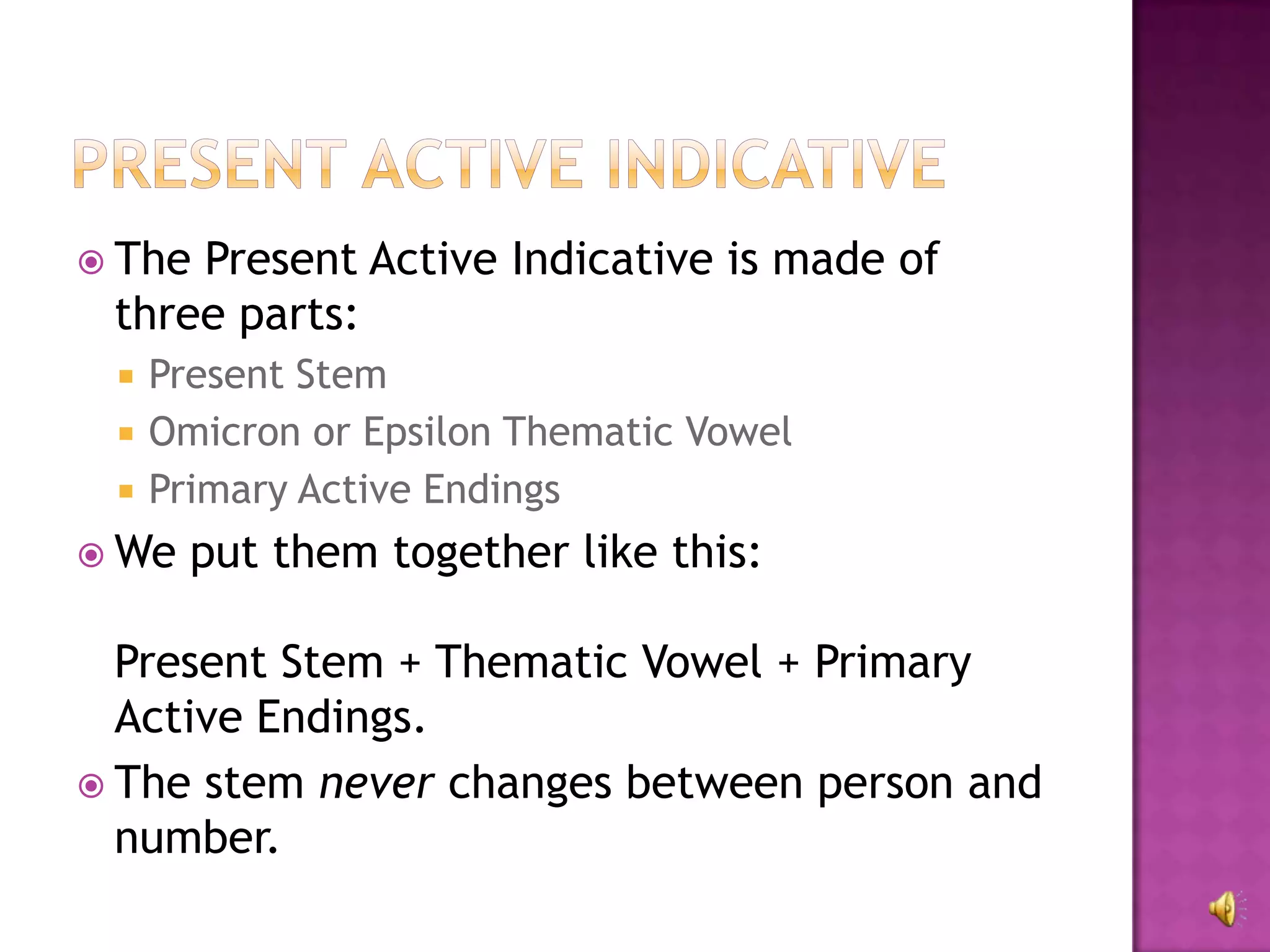
 ThePresent Active Indicative is made of
 three parts:
    Present Stem
    Omicron or Epsilon Thematic Vowel
    Primary Active Endings
 We   put them together like this:

  Present Stem + Thematic Vowel + Primary
  Active Endings.
 The stem never changes between person and
  number.
 pisteu,w    – I am believing.
    pisteu + o + - = pisteu,w
    pisteu + e + j = pisteu,eij
    pisteu + e + i = pisteu,ei
    pisteu + o + men = pisteu,omen
    pisteu + e + te = pisteu,ete
    pisteu + o + nsi = pisteu,ousi$n%
 Onceagain, notice that the stem never
 changes here.
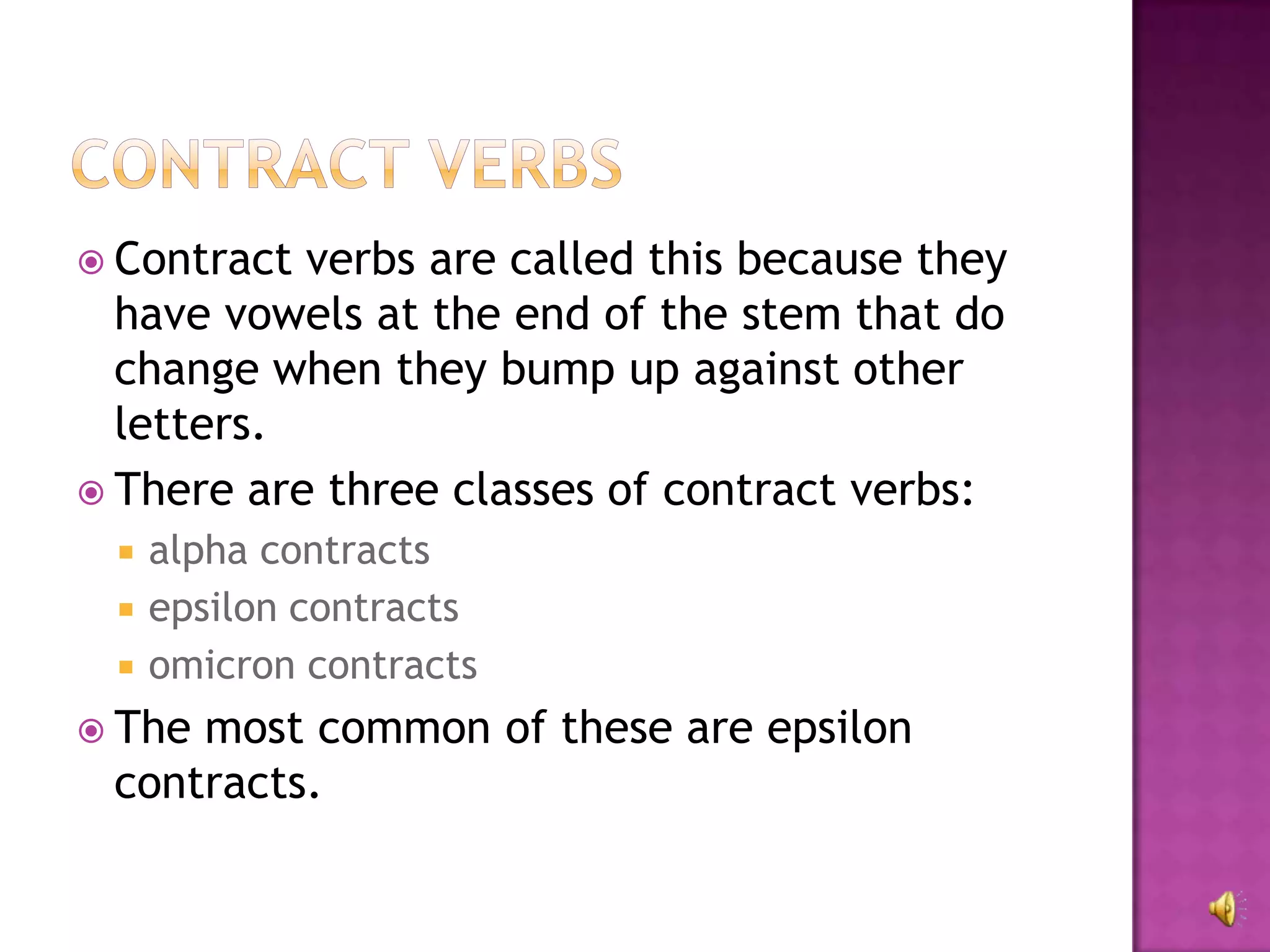
 Contract verbs are called this because they
  have vowels at the end of the stem that do
  change when they bump up against other
  letters.
 There are three classes of contract verbs:
    alpha contracts
    epsilon contracts
    omicron contracts
 Themost common of these are epsilon
 contracts.
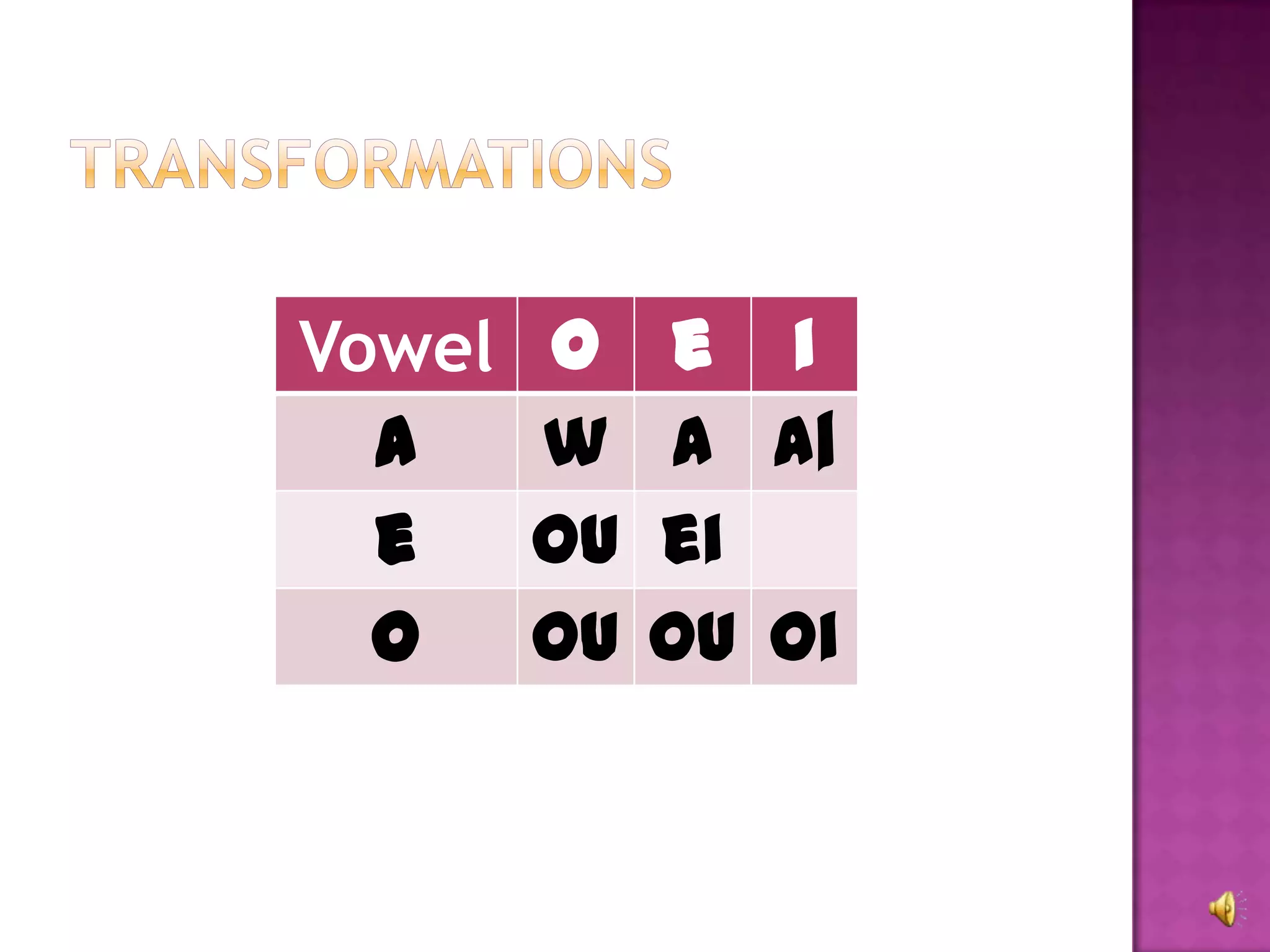
Vowel   o    e i
  a     w    a a|
  e     ou   ei
  o     ou   ou oi
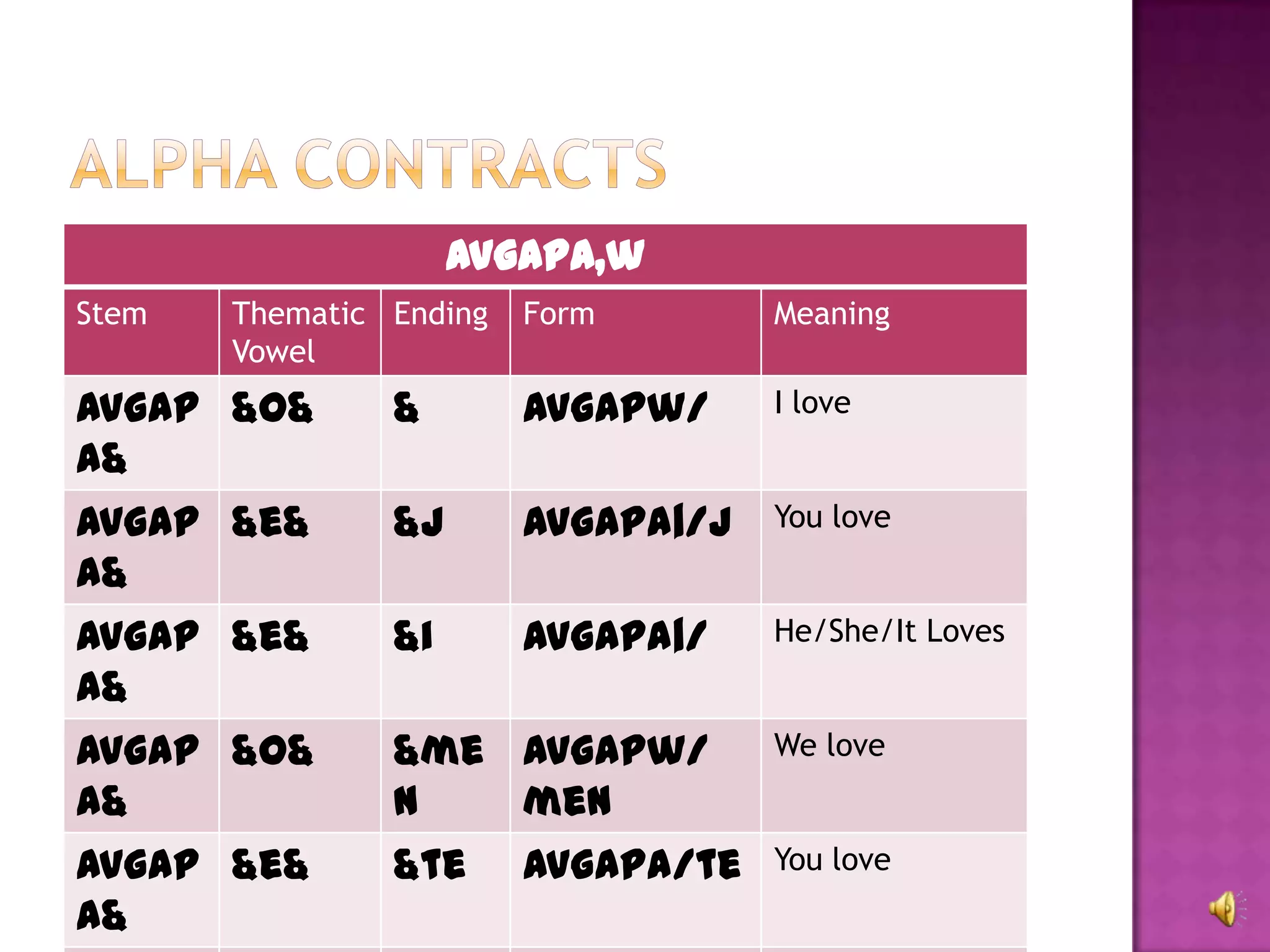
avgapa,w
Stem   Thematic Ending   Form        Meaning
       Vowel
avgap &o&       &        avgapw/     I love
a&
avgap &e&       &j       avgapa|/j   You love
a&
avgap &e&       &i       avgapa|/    He/She/It Loves
a&
avgap &o&       &me avgapw/          We love
a&              n   men
avgap &e&       &te avgapa/te        You love
a&
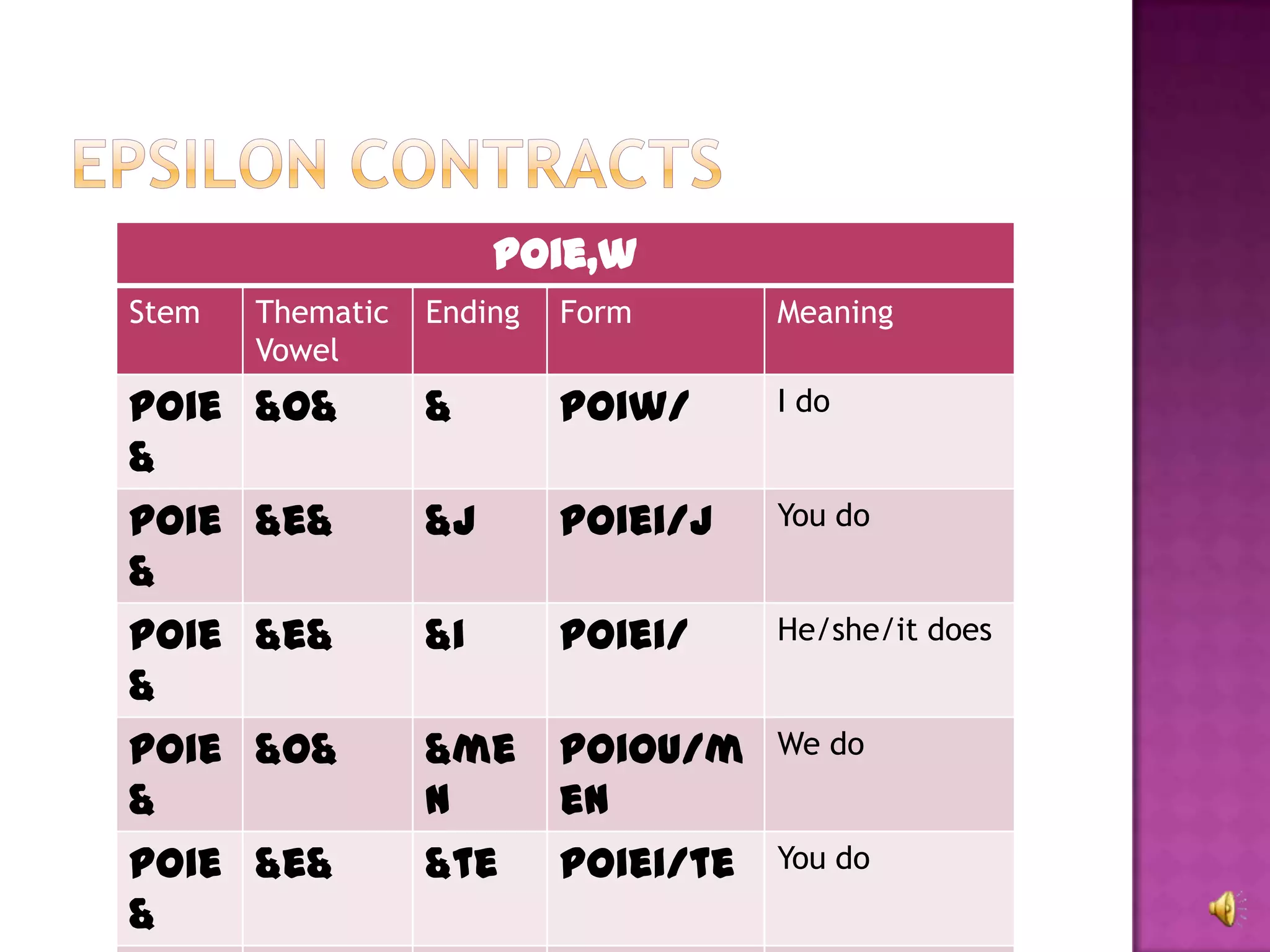
poie,w
Stem   Thematic   Ending   Form       Meaning
       Vowel
poie &o&          &        poiw/      I do
&
poie &e&          &j       poiei/j    You do
&
poie &e&          &i       poiei/     He/she/it does
&
poie &o&          &me      poiou/m    We do
&                 n        en
poie &e&          &te      poiei/te   You do
&
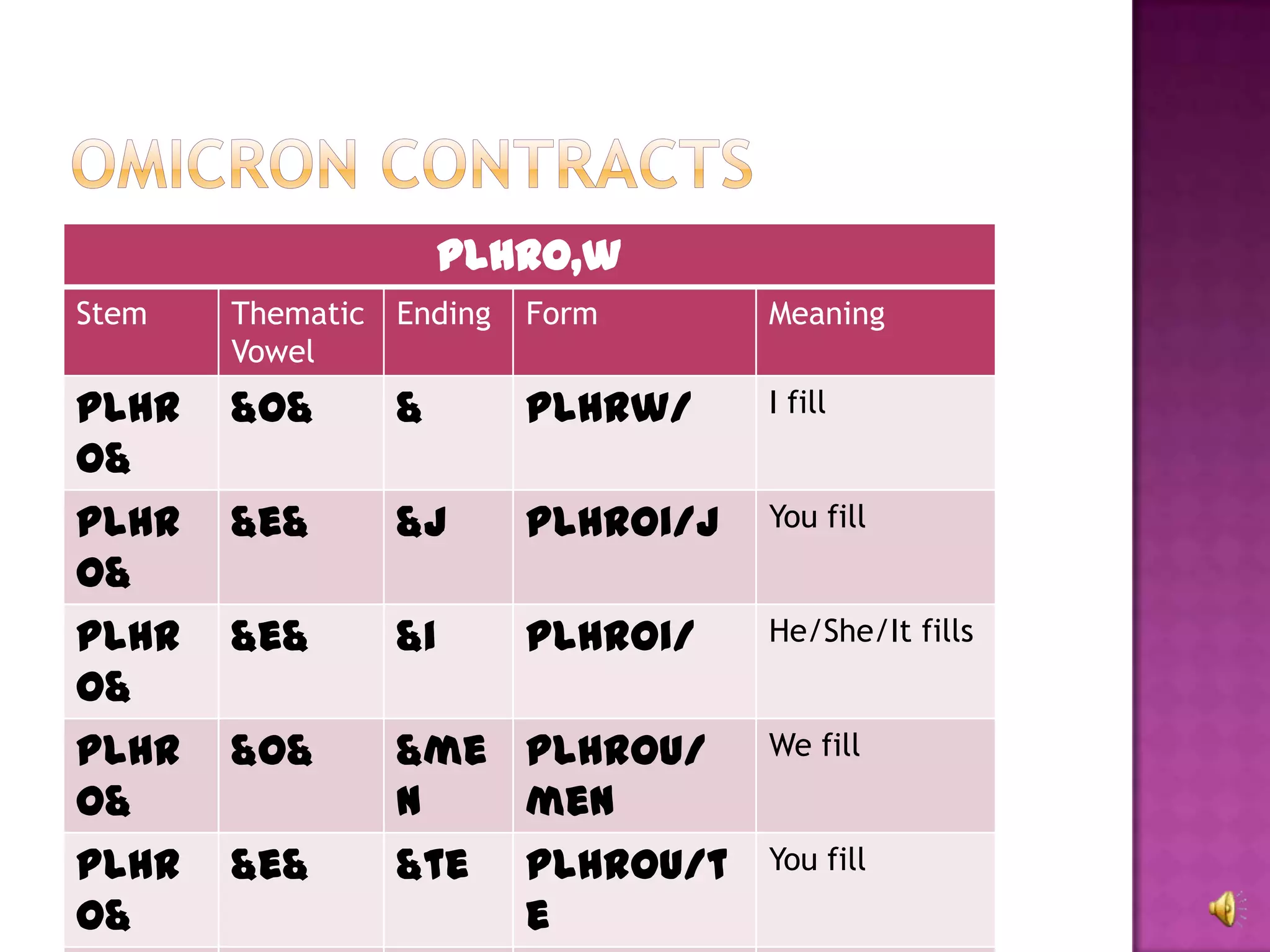
plhro,w
Stem   Thematic   Ending   Form       Meaning
       Vowel
plhr   &o&        &        plhrw/     I fill
o&
plhr   &e&        &j       plhroi/j   You fill
o&
plhr   &e&        &i       plhroi/    He/She/It fills
o&
plhr   &o&        &me plhrou/         We fill
o&                n   men
plhr   &e&        &te plhrou/t        You fill
o&                    e
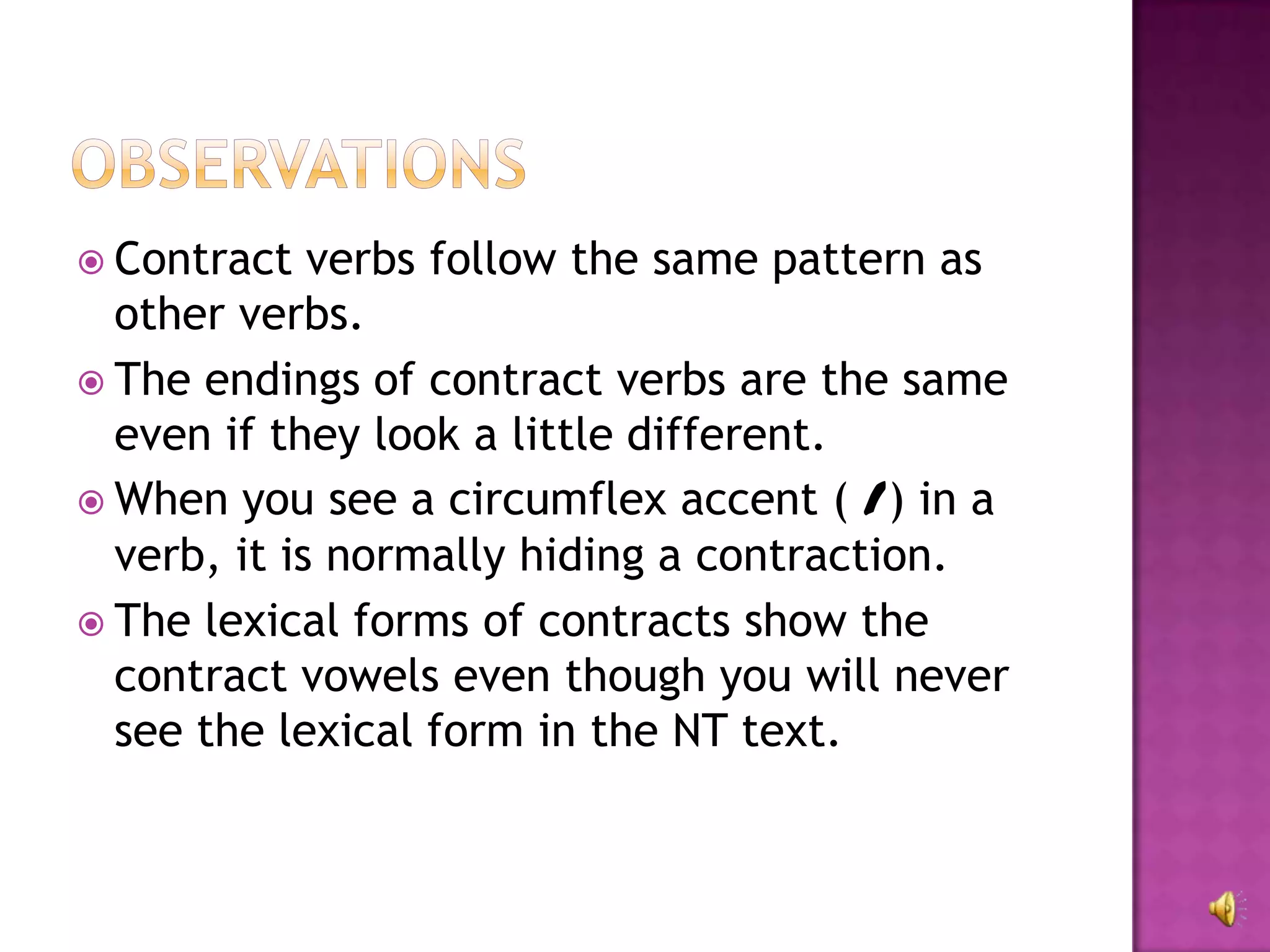
 Contract   verbs follow the same pattern as
  other verbs.
 The endings of contract verbs are the same
  even if they look a little different.
 When you see a circumflex accent ( /) in a
  verb, it is normally hiding a contraction.
 The lexical forms of contracts show the
  contract vowels even though you will never
  see the lexical form in the NT text.
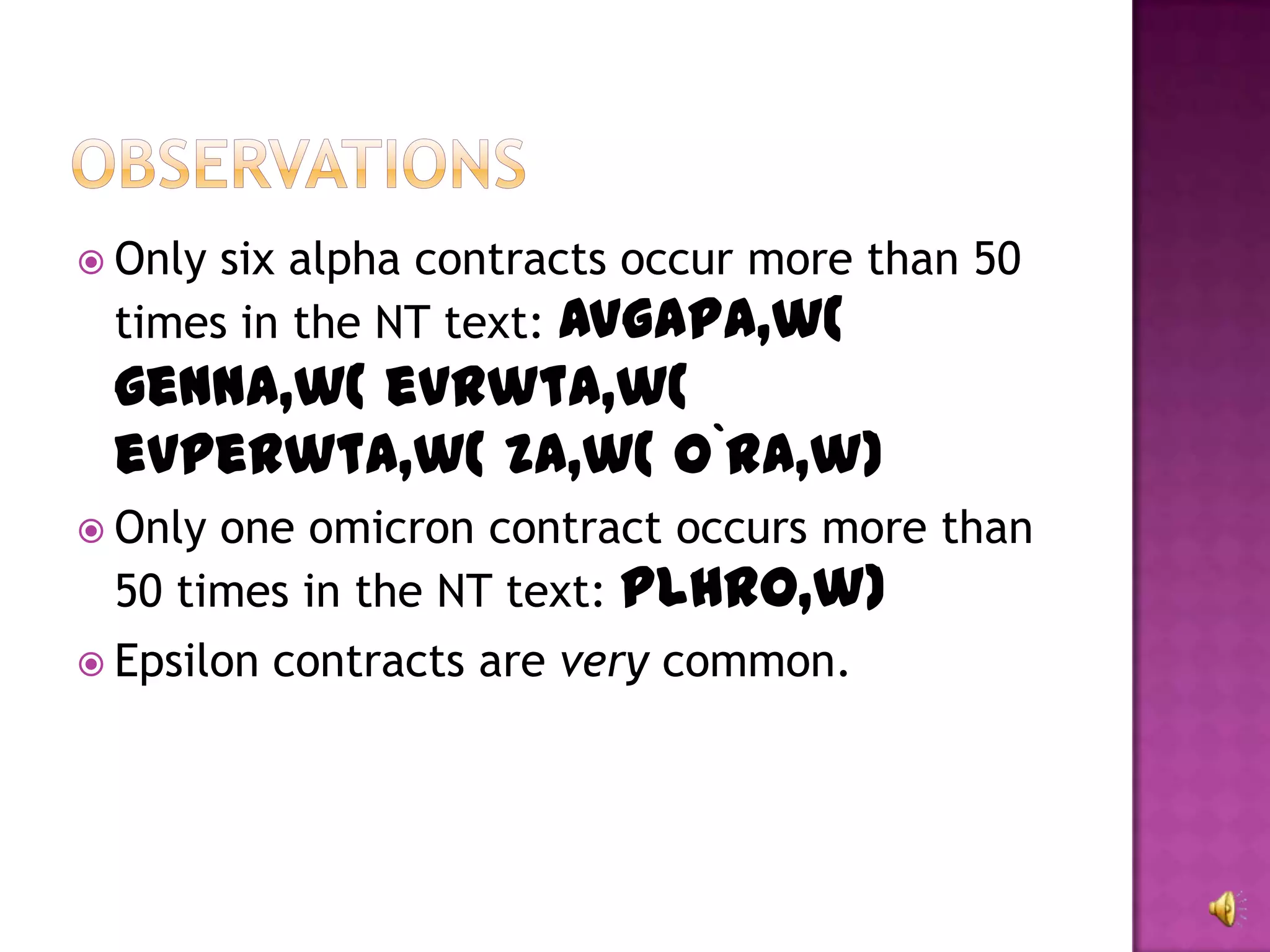
 Onlysix alpha contracts occur more than 50
 times in the NT text: avgapa,w(
 genna,w( evrwta,w(
 evperwta,w( za,w( o`ra,w)
 Onlyone omicron contract occurs more than
 50 times in the NT text: plhro,w)
 Epsilon   contracts are very common.
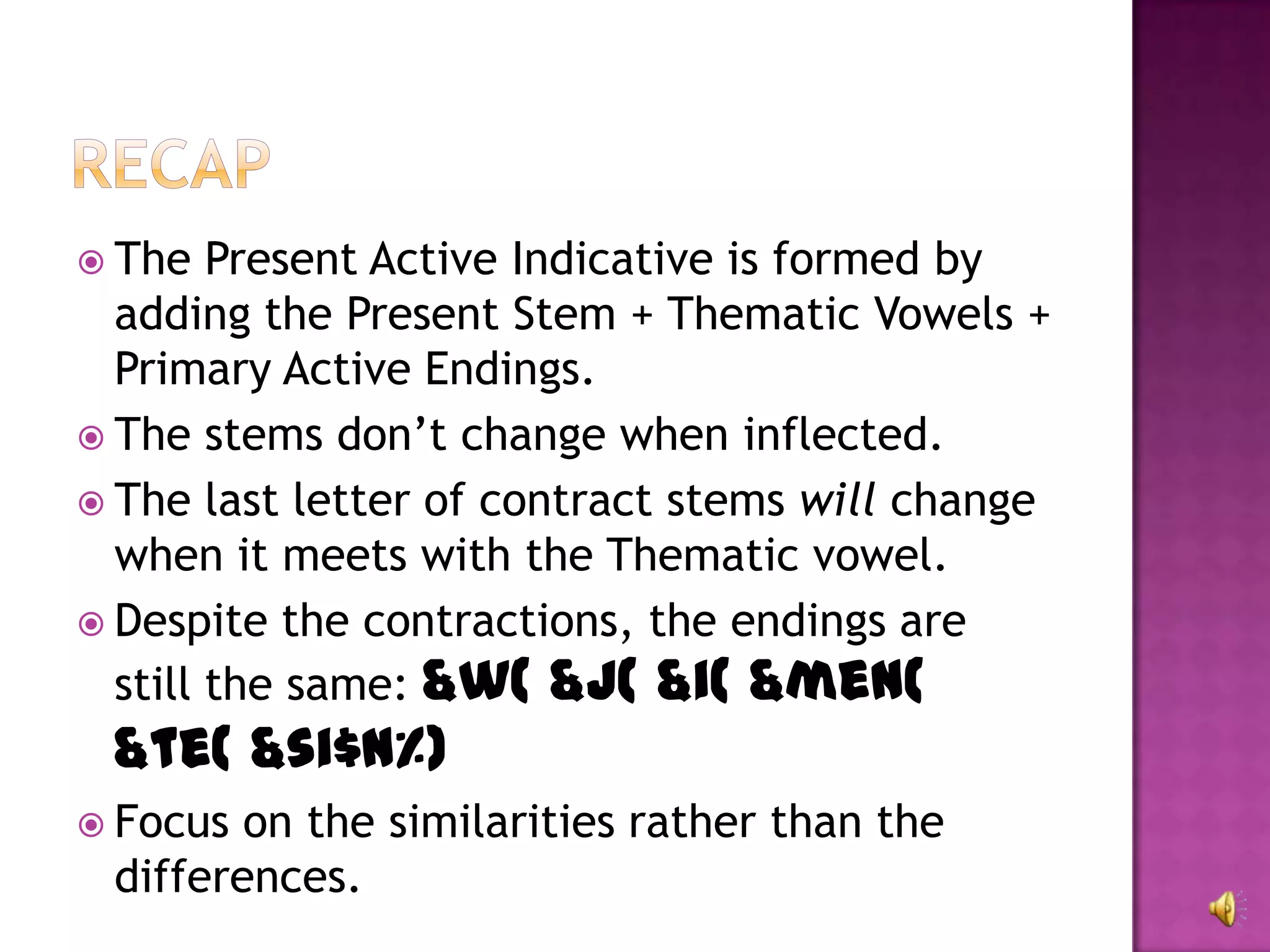
 The   Present Active Indicative is formed by
  adding the Present Stem + Thematic Vowels +
  Primary Active Endings.
 The stems don’t change when inflected.
 The last letter of contract stems will change
  when it meets with the Thematic vowel.
 Despite the contractions, the endings are
  still the same: &w( &j( &i( &men(
 &te( &si$n%)
 Focus on the similarities rather than the
 differences.
 Re-examine   how the Present Active Indicative
  is formed.
 Observe the transformations that take place
  with contract verbs.
 Observe examples of the three contract
  formation patterns.

Contract verbs

  • 1.
  • 2.
     Re-examine how the Present Active Indicative is formed.  Observe the transformations that take place with contract verbs.  Observe examples of the three contract formation patterns.
  • 3.
     ThePresent ActiveIndicative is made of three parts:  Present Stem  Omicron or Epsilon Thematic Vowel  Primary Active Endings  We put them together like this: Present Stem + Thematic Vowel + Primary Active Endings.  The stem never changes between person and number.
  • 4.
     pisteu,w – I am believing.  pisteu + o + - = pisteu,w  pisteu + e + j = pisteu,eij  pisteu + e + i = pisteu,ei  pisteu + o + men = pisteu,omen  pisteu + e + te = pisteu,ete  pisteu + o + nsi = pisteu,ousi$n%  Onceagain, notice that the stem never changes here.
  • 5.
     Contract verbsare called this because they have vowels at the end of the stem that do change when they bump up against other letters.  There are three classes of contract verbs:  alpha contracts  epsilon contracts  omicron contracts  Themost common of these are epsilon contracts.
  • 6.
    Vowel o e i a w a a| e ou ei o ou ou oi
  • 7.
    avgapa,w Stem Thematic Ending Form Meaning Vowel avgap &o& & avgapw/ I love a& avgap &e& &j avgapa|/j You love a& avgap &e& &i avgapa|/ He/She/It Loves a& avgap &o& &me avgapw/ We love a& n men avgap &e& &te avgapa/te You love a&
  • 8.
    poie,w Stem Thematic Ending Form Meaning Vowel poie &o& & poiw/ I do & poie &e& &j poiei/j You do & poie &e& &i poiei/ He/she/it does & poie &o& &me poiou/m We do & n en poie &e& &te poiei/te You do &
  • 9.
    plhro,w Stem Thematic Ending Form Meaning Vowel plhr &o& & plhrw/ I fill o& plhr &e& &j plhroi/j You fill o& plhr &e& &i plhroi/ He/She/It fills o& plhr &o& &me plhrou/ We fill o& n men plhr &e& &te plhrou/t You fill o& e
  • 10.
     Contract verbs follow the same pattern as other verbs.  The endings of contract verbs are the same even if they look a little different.  When you see a circumflex accent ( /) in a verb, it is normally hiding a contraction.  The lexical forms of contracts show the contract vowels even though you will never see the lexical form in the NT text.
  • 11.
     Onlysix alphacontracts occur more than 50 times in the NT text: avgapa,w( genna,w( evrwta,w( evperwta,w( za,w( o`ra,w)  Onlyone omicron contract occurs more than 50 times in the NT text: plhro,w)  Epsilon contracts are very common.
  • 12.
     The Present Active Indicative is formed by adding the Present Stem + Thematic Vowels + Primary Active Endings.  The stems don’t change when inflected.  The last letter of contract stems will change when it meets with the Thematic vowel.  Despite the contractions, the endings are still the same: &w( &j( &i( &men( &te( &si$n%)  Focus on the similarities rather than the differences.
  • 13.
     Re-examine how the Present Active Indicative is formed.  Observe the transformations that take place with contract verbs.  Observe examples of the three contract formation patterns.

Editor's Notes

  • #2 Welcome to the lesson on Contract Verbs. This is a supplement to lesson 17 in Mounce’sBasics of BIblical Greek Grammar. I recommend you read chapter 17 in Mounce’s text before viewing this lecture.
  • #3 In this lesson, we will : re-examine how the Present Active Indicative is formed; Observe the transformations that take place with contract verbs; and observe examples of the three contract formation patterns.
  • #4 The Present Active Indicative is made of three parts: the Present Stem, an omicron or epsilon thematic vowel, and Primary Active endings. We put them together like this: Present Stem + Thematic Vowels + Primary Active Endings. The stem never changes between person and number.
  • #5 Let’s look at an example of what I meant by that last statement: the stem never changes from person and number to person and number. A good verb to use for this example is pisteu,w, because its stem ends in an upsilon, and that tempts us to assume some change will happen. In this case, it will not.So pisteu,w means, I am believing. Its stem is pisteu. In the first singular, it’s pisteu,w; second singular is pisteu,eij; third singular is pisteu,ei; first plural is pisteu,omen; second plural is pisteu,ete; and third plural is pisteu,ousi$n%.Once again, notice that the stem never changes here.
  • #6 Contract verbs are called contract verbs because they have vowels at the end of the stem that do change when they bump up against other letters. There are three classes of contract verbs: alpha contracts—that is, stems ending in an alpha; epsilon contracts, and omicron contracts. The most common of these by far are the epsilon contracts.
  • #7 Before we look at the verb examples themselves, let’s take a look at the transformations that will happen.The first column shows us the vowels these stems will end with: alpha, epsilon, or omicron. Each contract verb’s stem ends with only one of these vowels. The second and third column show what happens when these vowels interact with the thematic vowels, omicron or epsilon. The fourth column is a special case demonstrating what happens when alpha and omicron interact with a following iota, which happens in the 2nd and 3rd singular.The first column will affect 1st singular, 1st plural, and 3rd plural verbs. The second column will effect 2nd singular, 3rd singular, and 2nd plural verbs. The third column comes into play on 2nd and 3rd singular contracts. So first let’s look at alpha. When it meets with omicron they form omega. When it meets with epsilon, it wins out and forms alpha. In the 2nd and 3rd singular, the following iota will be subscripted.Epsilon and omicron form omicron-upsilon regardless of the order in which they meet. Epsilon and epsilon will become epsilon-iota. And omicron and omicron will become omicron-upsilon. Finally, omicron and iota become omicron-iota.
  • #8 Now let’s look at the example verbs. The first one is listed in lexicons as avgapa,w. That said, you will never see this form in the NT text, because of the contractions. The lexical form shows you what the contract vowel is: alpha. This is to alert you that it will behave as an alpha contract.So the first singular is avgapw/. Notice that circumflex accent over the ending. Let that be a guide for you with contract verbs. They will always have a circumflex accent over the contraction.Second singular is avgapa|/j. The alpha eats the epsilon thematic vowel and the iota subscripts beneath the much stronger alpha. The sigma ending is then added. The same is true for the third singular, but here the ending is iota. In the first plural, it is avgapw/men; in the second plural, avgapa/te; and in the third plural it is avgapw/si$n%.In addition to the circumflexes notice the most important thing: the endings are still the same. Even in the 3rd singular, the ending is still an iota.
  • #9 Epsilon contracts are the most common contract verbs; they’re also the easiest. The example word is poie,w. Once again, you will never see this form in the NT text. In the text the 1st singular form will be poiw/. Once again, notice the circumflex accent. over the contraction. The 2nd singular is poiei/j and the 3rd singular is poiei/. So in the singular, epsilon contracts will look like all other present active indicatives except for the circumflex accent.In the plural, we have poiou/men, poiei/te, and poiou/sin. While the contractions make these look a little weird, the endings are exactly the same.
  • #10 Only one omicron contract verb occurs more than 50 times in the NT: our example verb plhro,w. As with the previous contracts, we won’t see this form in the NT, seeing instead the 1st singular form plhrw/.The 2nd and 3rd singular take some explaining. The epsilon thematic vowel dropped out (or wasn’t added), which leaves the elongated ending, containing the iota, to attach directly to the omicron contract vowel: plhroi/j and plhroi/ respectively. In the plural we have plhrou/men( plhrou/te( plhrou/si$n%.Once again, we’re seeing circumflexes above all our contractions. Although some of the contractions are surprising, we still have the same endings in each case.
  • #11 So some observations based on what we’ve just seen. Contract verbs follow the same pattern as other verbs. The endings of contract verbs are the same even if they look a little different. When you see a circumflex accent ( /) in a verb, it is normally hiding a contraction. And the lexical forms of contracts show the contract vowels even though you will never see the lexical form in the NT text.
  • #12 Only six alpha contracts occur more than 50 times in the NT text: avgapa,w( genna,w( evrwta,w( evperwta,w( za,w( and o`ra,w. Each of these will form the same way we saw for avgapa,w. You do not need to memorize this list of verbs.Only one omicron contract occurs more than 50 times in the NT, our example word plhro,w.Epsilon contract are very common, as you will see in chapter 17 vocabulary.
  • #13 Let’s recap: the present active indicative is formed by adding the present stem to the thematic vowels and primary active endings. The stems do not change when inflected. The last letter of contract stems, however, will change when it meets with the thematic vowel or ending. Despite the contractions, the endings are still the same. Focus on the similarities rather than the differences.
  • #14 In this lesson, we re-examined how the Present Active Indicative is formed; observed the transformations that take place with contract verbs; and observed examples of the three contract formation patterns.This concludes lesson 17. If you feel comfortable with this material, do the parsing and warm-up in Mounce’sBasics of Biblical Greek Workbook exercise 17.