Contents
of the Report
PART1 CPD Explained
PART 2
PART 3
CPD Learning Types
PART 4
What is accredited CPD training?
Frequently Asked Questions
02
3.
CPD stands forContinuing Professional
Development and is the term used to
describe the learning activities
professionals engage in to develop and
enhance their abilities.
Continuing Professional Development
Presented By Henrietta Mitchell | Report 2025 03
CPD is the holistic commitment of
professionals towards the enhancement
of personal skills and proficiency
throughout their careers.
4.
Accompanied by suchgrowth is the
acceptance that academic qualifications
must offer more vocational and skills-
based learning.
Engaging in Continuing Professional
Development ensures that both academic
and practical qualifications do not become
out-dated or obsolete; allowing
individuals to continually ‘up skill’ or ‘re-
skill’ regardless of occupation, age or
educational level.
Continuing Professional Development
04
Presented By Henrietta Mitchell | SDG Progress Report 2025
5.
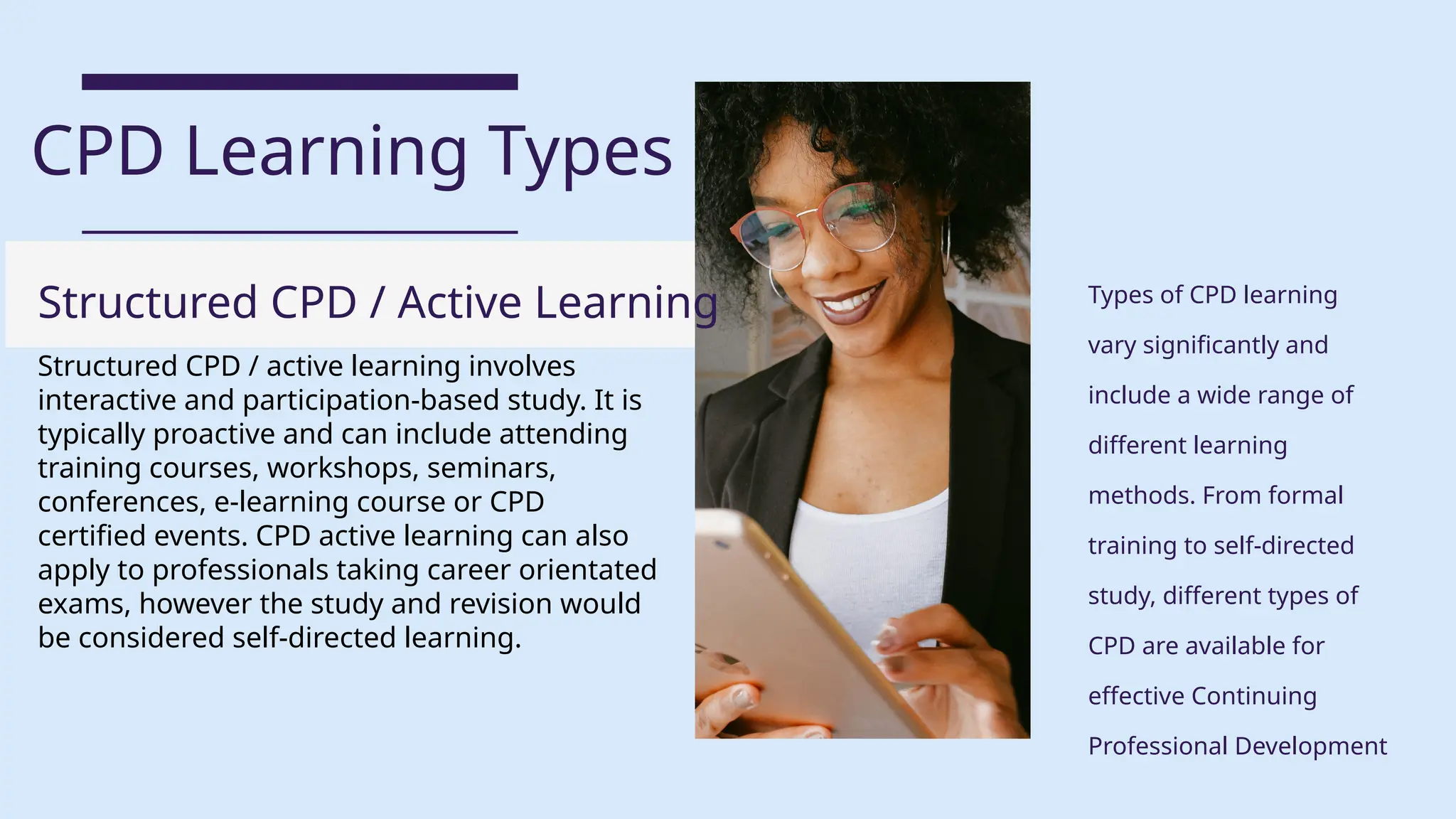
Structured CPD /active learning involves
interactive and participation-based study. It is
typically proactive and can include attending
training courses, workshops, seminars,
conferences, e-learning course or CPD
certified events. CPD active learning can also
apply to professionals taking career orientated
exams, however the study and revision would
be considered self-directed learning.
CPD Learning Types
Types of CPD learning
vary significantly and
include a wide range of
different learning
methods. From formal
training to self-directed
study, different types of
CPD are available for
effective Continuing
Professional Development
Structured CPD / Active Learning
6.
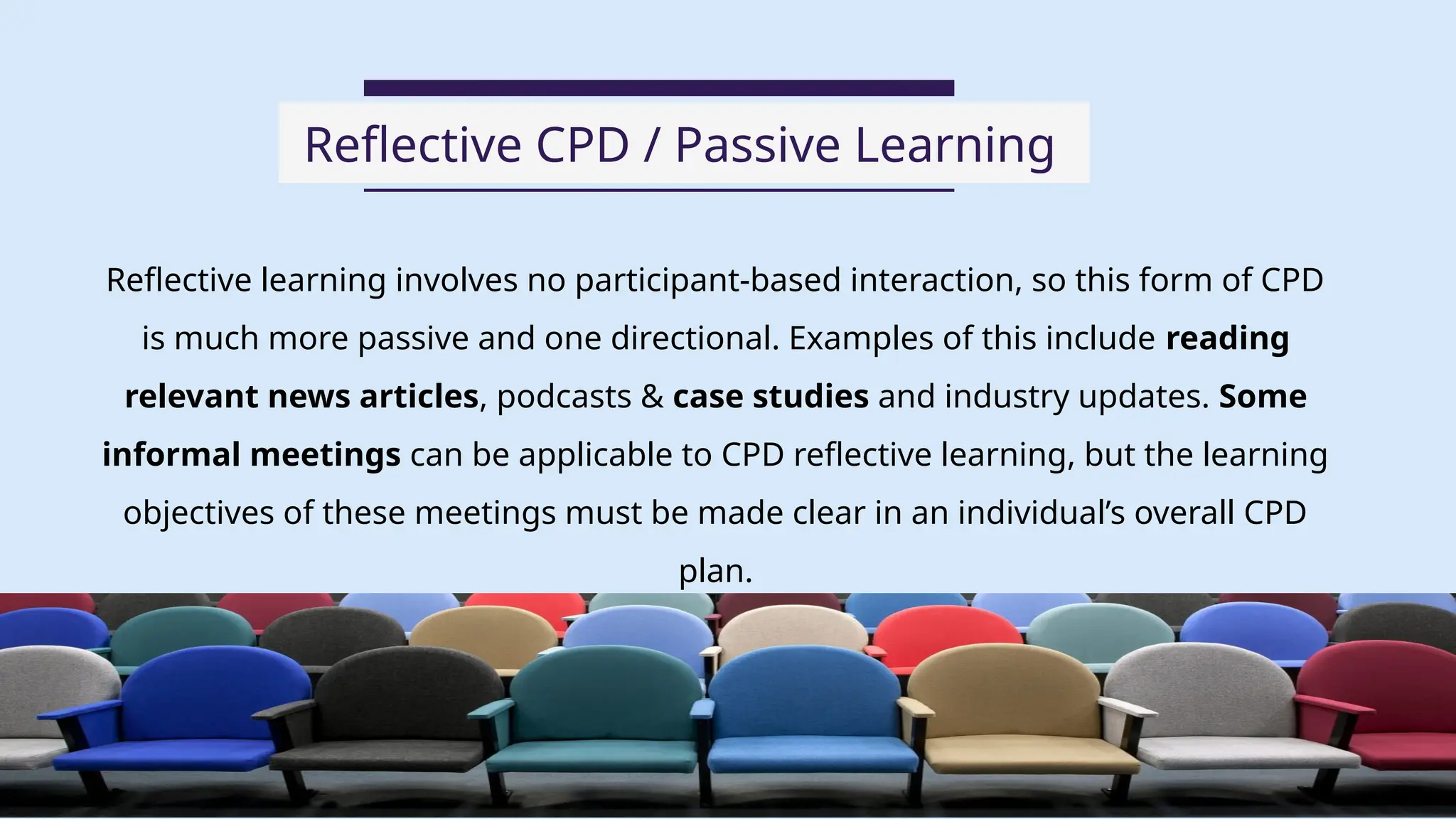
Reflective learning involvesno participant-based interaction, so this form of CPD
is much more passive and one directional. Examples of this include reading
relevant news articles, podcasts & case studies and industry updates. Some
informal meetings can be applicable to CPD reflective learning, but the learning
objectives of these meetings must be made clear in an individual’s overall CPD
plan.
Reflective CPD / Passive Learning
06
7.
Self-Directed CPD /
UnstructuredLearning
Self-directed learning involves all unaccompanied CPD
activities. It covers the reading of documents, articles and
publications; either in print or online. Reading relevant
publications, books by leading experts, industry journals
and trade magazines are all types of self-directed CPD.
You could also include industry-specific news feeds or
research into relevant fields.
07
8.
CPD for Individuals
•Continuing Professional Development enables
individuals to adapt positively to changes in both
work and industry requirements.
• CPD provides an opportunity for an individual to
identify knowledge gaps and to resolve these in a
recognizable approach to improvement.
• CPD shows a clear commitment to self-
development and professionalism.
08
9.
09
CPD for
Organizations
• ProvidingCPD accredited training and events can benefit your
organization through recognition and an increased brand
perception.
• Many organizations have staff with CPD obligations as
members of professional bodies. In circumstances where
internal CPD training resources are low, organizations use
outsourced CPD training providers to meet staff requirements.
• They are experts in their field and provide practical learning
opportunities through CPD events, seminars and accredited
CPD courses. Some CPD courses are just 1 or 2 hours long,
delivered in a seminar or workshop environment.
10.
What is accreditedCPD training?
Accredited CPD training means the learning activity has reached
the required Continuing Professional Development standards
and benchmarks. The learning value has been scrutinized to
ensure integrity and quality. The CPD Certification Service
provides recognized independent CPD accreditation compatible
with global CPD requirements.
Presented By Henrietta Mitchell | SDG Progress Report
2025
10
11.
Frequently
Asked
Questions
What is aCPD
point, unit or
credit?
A frequent question about Continuing
Professional Development is how CPD is
recorded, and specifically the question, “What
is a CPD point, unit or credit?” It is often found
across all industries that CPD points, units and
credits all relate to the same thing, CPD Hours?
What are CPD Hours? The definition of a CPD
Hour is the time spent for a delegate to be in
“active learning”.
11
12.
Frequently
Asked
Questions
How is CPD
recorded?
Anindividual must keep a track of their annual
Continuing Professional Development activities on a
CPD record form and must ensure it is correct, up to
date and meets the requirements of their
professional body or association. The CPD activity is
recorded in terms of learning outcomes and
practical application of the knowledge obtained.
Continuing Professional Development undertaken is
recorded by a CPD Certificate of Attendance, CPD
Self-Assessment forms and personal CPD Record
Cards.
11
13.
Frequently
Asked
Questions
How should I
allocatemy CPD
time?
Most institutes provide their members with
Continuing Professional Development requirements
generally as a minimum annual number of hours.
These targets are defined by the accrual of CPD
hours through training, seminars & workshops,
events & conferences as well as other structured
forms of CPD learning. These CPD hours are
sometimes converted to points, units or credits.
11
14.
Frequently
Asked
Questions
How should I
allocatemy CPD
time?
The CPD Assessments team will evaluate the
materials, review the structure and provide advice to
help develop the training courses where required.
This process is to ensure the training courses are
educational in content, structured coherently, with
clear learning objectives and outcomes.
11