Digital Technology Consulting
Continuous Delivery
Operating Model for
Insurers: Building
a Software “Value-
Delivery Factory”
To compete with digital start-ups, established insurers need
to build a streamlined, waste-free pipeline for rapid software
delivery. We recommend an integrated approach to the
four types of change needed: culture, process, engineering
practices and platforms.
May 2019
2  /  Continuous Delivery Operating Model for Insurers: Building a Software “Value-Delivery Factory”
Digital Technology Consulting
Executive Summary
To compete with digital-native insurance start-ups,1, 2,
and
new insurtech products,3
incumbent insurers are scrambling
to deliver higher-value software, faster. The World Economic
Forum projects that 30% of total revenues will come from new
digital models by 2020.4
One insurtech example is Lemonade,
which is winning over millennial renters by settling claims in as
little as three seconds – with no paperwork.5
To make the shift to digital, insurers need to create a “value-delivery factory” – a
streamlined, waste-free pipeline for rapidly delivering software with demonstrable
business value. In a 2018 study, DevOps Research and Assessment (DORA) reported
that elite business performers outstripped laggards on the four software-delivery metrics
generally accepted as mattering most to business success:6, 7
❙❙ Code release frequency: 46 times more frequent
❙❙ Lead time to change 2,555 times faster
❙❙ Change failure rate: 7 times lower
❙❙ Mean time to recover: 2,604 times faster
Transitioning to a continuous delivery operating model is not simple. It’s a major
undertaking that requires modernizing the entire insurance value chain – from the front-
end system of engagement through the system of record. The complete development
process, from concept to cash, must revolve around what delivers value to the customer
(policy holder, distribution partner or line of business).
This white paper, intended for insurance company CIOs and leaders within lines of
business, presents an incremental approach to building a value-delivery factory. We
explain why a successful transition requires modernizing along four dimensions in parallel:
teams and culture, processes, engineering practices (including microservices and a
modern data architecture) and cloud-native platforms. To illustrate what success looks like,
we share the experiences of a company that engaged us to help introduce a new cyber
insurance product.
Continuous Delivery Operating Model for Insurers: Building a Software “Value-Delivery Factory”   /  3
Digital Technology Consulting
Why legacy IT has become a liability for insurers
Insurance companies rely on hundreds or thousands of applications for customer
engagement, policy management, compensation management and more. Many of these
applications were written decades ago, some in the 1970s. Unlike modern applications built
from reusable microservices, most legacy applications are monolithic. Adding or changing
a section of code – say, to introduce a new feature or connect with a new distribution
partner – can have the unexpected consequences described in The Phoenix Project:8
❙❙ Downtime that affects customers, the workforce and partners.
❙❙ Impeded agility. Even small changes take a long time because of the need for regression
testing.
❙❙ Quality issues.
❙❙ Lack of transparency. Business leaders have little insight into which software development
efforts drive business value.
❙❙ High costs. Maintaining legacy applications and the infrastructure they run on squeezes
IT budgets, inhibiting innovation. In our experience, the portion of IT budget spent simply
keeping the lights on frequently exceeds 70% - 90% for one of our clients. (See Quick
Take, page 9.)
4  /  Continuous Delivery Operating Model for Insurers: Building a Software “Value-Delivery Factory”
Digital Technology Consulting
Imagining a continuous delivery operating model
“Our highest priority is to satisfy the customer through the early
and continuous delivery of valuable software.”
	 -- The Agile Manifesto9
Competing with digital natives takes more than one-off projects to
build a better product, interface or back-end system. Success requires
a strategic approach: building a factory that can regularly produce
software that delivers true business value as measured by sales,
retention or cost reduction.
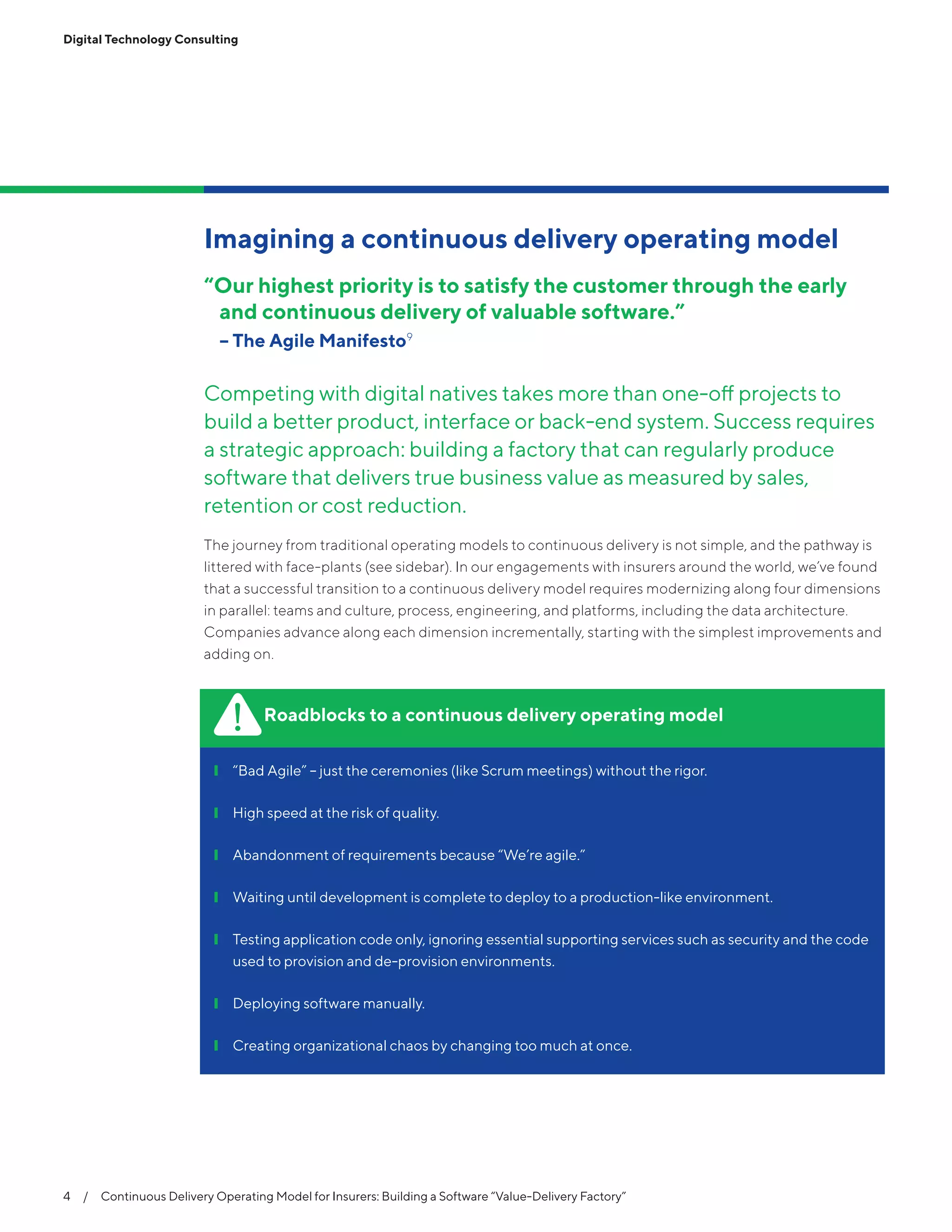
The journey from traditional operating models to continuous delivery is not simple, and the pathway is
littered with face-plants (see sidebar). In our engagements with insurers around the world, we’ve found
that a successful transition to a continuous delivery model requires modernizing along four dimensions
in parallel: teams and culture, process, engineering, and platforms, including the data architecture.
Companies advance along each dimension incrementally, starting with the simplest improvements and
adding on.
Roadblocks to a continuous delivery operating model
❙❙ “Bad Agile” – just the ceremonies (like Scrum meetings) without the rigor.
❙❙ High speed at the risk of quality.
❙❙ Abandonment of requirements because “We’re agile.”
❙❙ Waiting until development is complete to deploy to a production-like environment.
❙❙ Testing application code only, ignoring essential supporting services such as security and the code
used to provision and de-provision environments.
❙❙ Deploying software manually.
❙❙ Creating organizational chaos by changing too much at once.
5
Continuous Delivery Operating Model for Insurers: Building a Software “Value-Delivery Factory”   /  5
Digital Technology Consulting
In our engagements with insurers
around the world, we’ve found
that a successful transition to a
continuous delivery model requires
modernizing along four dimensions
in parallel: teams and culture,
process, engineering, and platforms,
including the data architecture.
6  /  Continuous Delivery Operating Model for Insurers: Building a Software “Value-Delivery Factory”
Digital Technology Consulting
An incremental journey
Tackling the new process, organization and supporting technology in
one go is a recipe for disaster because even small changes can have
unexpected consequences. Therefore, make small changes iteratively
and evaluate the impact at each step. Our recommendations:
❙❙ Start with a few carefully selected minimum viable products (MVPs) to build confidence, and then scale
pragmatically from a base of demonstrated success.
❙❙ Aim to mature along all dimensions (teams and culture, process, practices and platforms) at roughly
the same pace rather than going from zero to 60 on one dimension before tackling the next. For
example, moving legacy applications to a modern cloud platform without also teaching teams to build a
continuous delivery pipeline will deliver little if any business value.
❙❙ Frequently assess whether changes have improved deployment frequency, lead time to change, change
failure rate and business value delivered. In a five-year study, DORA determined that organizations
that perform well against these metrics are twice as likely to exceed profitability, market share and
productivity goals.10
If your changes don’t improve these metrics, change tactics -- then measure again.
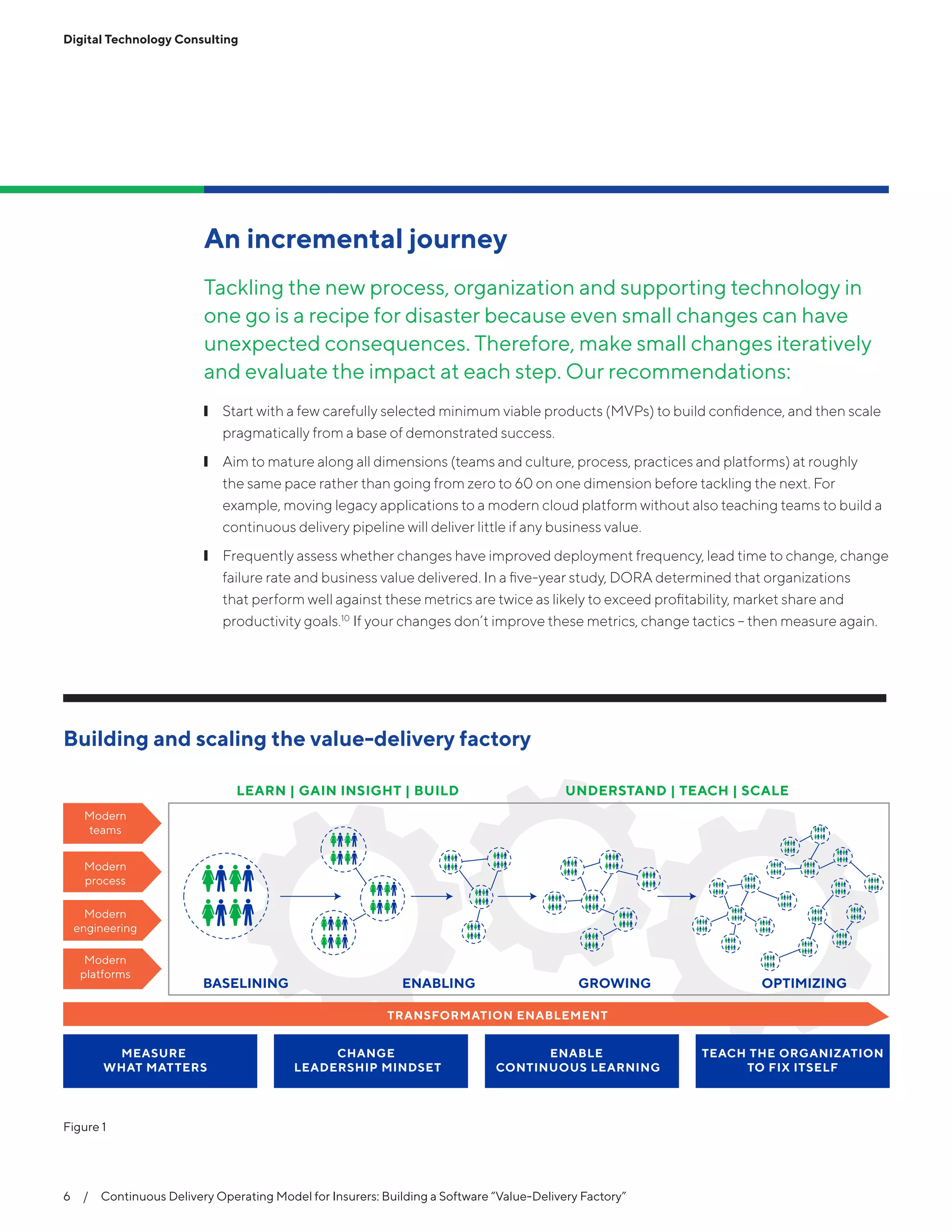
Building and scaling the value-delivery factory
LEARN | GAIN INSIGHT | BUILD UNDERSTAND | TEACH | SCALE
BASELINING ENABLING GROWING OPTIMIZING
MEASURE
WHAT MATTERS
CHANGE
LEADERSHIP MINDSET
ENABLE
CONTINUOUS LEARNING
TEACH THE ORGANIZATION
TO FIX ITSELF
Modern
teams
Modern
process
Modern
engineering
Modern
platforms
TRANSFORMATION ENABLEMENT
Figure 1
Continuous Delivery Operating Model for Insurers: Building a Software “Value-Delivery Factory”   /  7
Digital Technology Consulting
We recommend that insurers shift to a continuous delivery operating model in four steps: baselining,
forming teams, building MVPs, and scaling and optimizing. Different teams in a company often progress
along the journey at a different pace depending on the slice of the business value stream that they are
transforming. For example, a team building a new cyber insurance product might rapidly progress through
all four steps, while a team that’s evaluating an old policy administration system might decide after the first
step (baselining) to extract the data and then retire the system.
	 Conduct a baseline assessment
Compare software delivery performance to industry benchmarks. After establishing the baseline,
set targets for the future state. The target, for example, might be to accelerate deployment frequency from
months to minutes. Next, identify the impediments to reaching the future state. Impediments to deploying
in minutes, for example, can include lack of version control and work-in-progress limits, manual testing, a
monolithic application architecture and poor job satisfaction.
	 Form the first continuous delivery pipeline teams
Start with one or two Agile pod teams with six to eight members who have end-to-end ownership of
product delivery. Team members typically have expertise in product management, development, quality,
the business domain and sometimes data.
Show the pod what “good” looks like in terms of team structure and culture, Lean/Agile process,
engineering practices and platforms. Provide basic training on modern processes (Scrum, extreme
programming and the Lean Startup methodology) and modern software engineering practices such as
Build-Measure-Learn (BML), MVPs and an automated software development lifecycle.
Strive to build a culture of continual experimentation. We’ve seen good results from “gamifying” the
learning process with contests and rewards.
1
2
We recommend that insurers shift to a continuous
delivery operating model in four steps: baselining,
forming teams, building MVPs, and scaling and
optimizing.
Digital Technology Consulting
	 Build MVPs
Identify the first MVPs to deliver. It isn’t necessary to make an entire application cloud-native.
Instead, ask which parts of the legacy application portfolio will provide the greatest business value if
they’re made cloud-native. Measure value in terms of cost reduction, new policy sales, revenue per
policyholder, average time to settle a claim, renewal/retention and so on. To tease out the value of existing
software, we recommend using the Value Stream Mapping (VSM) methodology.11, 12
Give priority to frequently modified applications, as microservices can be changed more quickly. Keep
in mind that an application that costs more to migrate to the cloud, such as policy management, might
also deliver the highest lift. Conversely, an application that costs less to migrate, such as compensation
management, might deliver less lift.
	 Scale and optimize
To scale the continuous delivery operating model across the company:
❙❙ Have the initial pipeline teams transfer knowledge to new teams by working side by side on an MVP.
The new teams can then train others until the entire organization has learned Agile processes and
culture, and modern engineering practices.
❙❙ Work to continually improve along all four dimensions: culture and teams, process, engineering, and
platforms.
❙❙ Track the business value that the new software delivers. Measuring business value needs to become
just as important a part of the product backlog as functional requirements. Writing code to capture
business value metrics gives teams a solid basis to decide whether to pivot or persevere. By inserting
a few lines of code, for example, the team can measure the effect of a new feature or interface on the
number of people who click through to buy.
3
4
8  /  Continuous Delivery Operating Model for Insurers: Building a Software “Value-Delivery Factory”
Measure value in terms of cost reduction, new policy
sales, revenue per policyholder, average time to settle
a claim, renewal/retention and so on.
Going Cloud-Native with a
New Cyber Insurance Product
Challenge. The cyber insurance division of a large insurance organization wanted to
accelerate time to market, and at the same time lower software development costs and
increase uptime. The application portfolio contained 3,400 applications. Nearly 90% of
the budget went to keeping the lights on, leaving little left for innovation to improve the
customer experience or increase efficiency. What’s more, company leaders had no way to
measure the business value of software investments.
Approach. We conducted a baseline for release frequency, lead time to change,
change failure rate and mean time to recover. Then we assessed the current state across
24 capabilities related to measurement (e.g., failure notification), culture (e.g., work
satisfaction), technology (e.g., automated test and deployment) and process (e.g., breaking
work into small batches and understanding the value stream). One discovery: moving code
into production required actions from 20 different teams.
The insurer decided to start with a cloud-native system of engagement that would
interface with the existing system of record. We worked side by side with the company’s
developers in Agile pods to build an MVP. During the process the company’s staff learned
to use platform as a service (PaaS) and Lean practices. We also developed a prioritized
Agile backlog for moving the existing 3,400 applications to a public cloud and retiring on-
premises infrastructure.
Outcomes
❙❙ Faster go-to-market. The company increased the number of releases per year from 11 in
2016 to 3,700 in 2017.
❙❙ 15% - 20% ongoing IT cost reduction, the result of moving applications to the
modernized framework and improving the uptime of non-production environments.
❙❙ Scaling from one continuous delivery pipeline team to 300 in 2.5 years. (Scaling can take
shorter or longer amounts of time depending on the organization’s appetite for change.)
Quick Take
9Digital Technology Consulting
Continuous Delivery Operating Model for Insurers: Building a Software “Value-Delivery Factory”   /  9
10  /  Continuous Delivery Operating Model for Insurers: Building a Software “Value-Delivery Factory”
Digital Technology Consulting
Conclusion
Many insurers will find it helpful to work with an experienced partner to
develop a backlog and coach the first several pods.
We advise companies to:
❙❙ Start small.
❙❙ Change leadership mindset.
❙❙ Enable the team to continuously learn.
❙❙ Know what good looks like.
❙❙ Measure what matters.
❙❙ Make development decisions based on what delivers value to the customer.
❙❙ Create feedback loops, measured in minutes or hours.
❙❙ Build a community of engineering excellence.
❙❙ Continuously improve.
A successful transition to continuous delivery requires incremental modernization of teams and culture,
process, engineering and platforms. Decide whether to pivot or persevere by continually monitoring the
metrics that matter most to business success -- release frequency, lead time to change, change failure rate
and mean time to recover.
Endnotes
1	 Jon Russell, “Amazon leads $12M investment in India-based digital insurance startup Acko,” TechCrunch, May 27, 2018.
2	 Nick Wingfield, Katie Thomas and Reed Abelson, “Amazon, Berkshire Hathaway and JPMorgan Team Up to Try to Disrupt
Health Care,” The New York Times, January 30, 2018.
3	 Insurance CIO Outlook, “Top 10 Insurtech Startups - 2018.”
4	 World Economic Forum, “How to Disrupt Yourself.”
5	 Denise Johnson, “Lemonade Boasts Claims Settlement Speed Record, AI Jim Answers Questions,” Carrier Management,
January 23, 2017.
6	 DevOps Research and Assessment (DORA), 2018 State of DevOps Report.
7	 Nicole Forsgren, Jez Humble, Gene Kim, Accelerate: The Science of Lean Software and DevOps: Building and Scaling
High Performing Technology Organizations, 2018.
8	 Gene Kim, Kevin Behr, James Spafford, The Phoenix Project: A Novel About IT, DevOps, and Helping Your Business Win, IT
Revolution Press, 2013.
9	 Agile Alliance, Agile Manifesto.
10	 DevOps Research and Assessment (DORA), 2018 State of DevOps Report.
11	 Karen Martin and Mike Osterling, Value-Stream Mapping: How to Visualize Work and Align Leadership for Organizational
Transformation, McGraw-Hill Education, 2013.
12	 Mark Schwartz, The Art of Business Value, IT Revolution Press, 2016.
Continuous Delivery Operating Model for Insurers: Building a Software “Value-Delivery Factory”   /  11
Digital Technology Consulting
About the authors
Carol Houle
VP of Consulting
As the global market leader for Cognizant Digital Technology Consulting, her team
focuses on helping clients transform digitally. They advise clients on improving their
teams/culture, process, engineering practices and platforms to achieve improved
quality, time to market, customer satisfaction, productivity and morale. Her team
applies Lean principles to the value stream enabling dynamic, learning organizations
that continually reinforce high-trust cultural norms. The result is maximized business
outcomes, developer productivity and value delivered to end customers. Carol is
known for connecting people and concepts to solve complex business problems. Prior to joining Cognizant, Carol was
an IT Transformation Partner at Dell Technologies, and she currently serves on the board of directors of a banking and
insurance company. She can be reached at carol.houle@cognizant.com | linkedin.com/in/carol-houle-60aa9110.
Allen Ringel
AVP of Digital Technology Consulting
Allen leads Cognizant’s Lean/Agile practice. He brings more than 20 years of
experience in enterprise software development and more than 15 years as a thought
leader and consultant in Lean/Agile methodologies. Before joining Cognizant, Allen
served for 18 years at Intel, where he led one of the largest Agile transformations,
building an organization of 500+ global teams using the Scaled Agile Framework
(SAFe). During the process he coached thousands of Scrum teams and applied
Lean/Agile to create a sustainable, self-organizing and learning organization. Over
the course of his career, Allen has been a developer, architect, program manager, people manager, organizational
change agent, teacher, coach and consultant. He can be reached at allen.ringel@cognizant.com | linkedin.com/in/
allenringel.
Michael Wagner
AVP of Digital Transformation through Enterprise DevOps and
Modern Software Engineering
Michael has previously worked at Microsoft, start-ups, F500s and consulting
organizations for the last 30+ years. He has been an entrepreneur, enterprise
architect, software engineer, CTO, President, executive coach and writer. Working
from New York City, he helps established organizations survive then thrive where
software is eating the world. To this end, he coaches business and technology
leadership on how to execute upon the DevOps movement at scale that fuses people, process and technology
into 21st century digital economy-coded businesses. His journey spans several industries, including life sciences,
financial services, technology and media. He can be reached at michael.wagner@cognizant.com | linkedin.com/in/
michaelstevenwagner/.
Digital Systems & Technology Consulting
Cognizant’s Digital Technology Consulting (DTC) Practice provides advisory consulting infused with cross-functional capabilities to enable enter-
prise-wide digital transformation. DTC’s core capabilities span the software and platform landscape. We leverage Agile/DevOps, security and automation
to enable businesses to unlock digital capabilities across their front, middle and back offices. Our objective is to help clients eradicate release weekends
by enabling continuous delivery. This ultimately helps them to achieve improved end-customer experiences, lower operating costs, improve time to
market, enhance operational stability and create a happier workplace. To learn more, visit us at www.cognizant.com/consulting.
About Cognizant
Cognizant (Nasdaq-100: CTSH) is one of the world’s leading professional services companies, transforming clients’ business, operating and technology
models for the digital era. Our unique industry-based, consultative approach helps clients envision, build and run more innovative and efficient business-
es. Headquartered in the U.S., Cognizant is ranked 195 on the Fortune 500 and is consistently listed among the most admired companies in the world.
Learn how Cognizant helps clients lead with digital at www.cognizant.com or follow us @Cognizant.
World Headquarters
500 Frank W. Burr Blvd.
Teaneck, NJ 07666 USA
Phone: +1 201 801 0233
Fax: +1 201 801 0243
Toll Free: +1 888 937 3277
European Headquarters
1 Kingdom Street
Paddington Central
London W2 6BD England
Phone: +44 (0) 20 7297 7600
Fax: +44 (0) 20 7121 0102
India Operations Headquarters
#5/535 Old Mahabalipuram Road
Okkiyam Pettai, Thoraipakkam
Chennai, 600 096 India
Phone: +91 (0) 44 4209 6000
Fax: +91 (0) 44 4209 6060
© Copyright 2019, Cognizant. All rights reserved. No part of this document may be reproduced, stored in a retrieval system, transmitted in any form or by any means,electronic, mechanical,
photocopying, recording, or otherwise, without the express written permission from Cognizant. The information contained herein is subject to change without notice. All other trademarks
mentioned herein are the property of their respective owners.
Codex 4538

Continuous Delivery Operating Model for Insurers: Building a Software “Value-Delivery Factory”

  • 1.
    Digital Technology Consulting ContinuousDelivery Operating Model for Insurers: Building a Software “Value- Delivery Factory” To compete with digital start-ups, established insurers need to build a streamlined, waste-free pipeline for rapid software delivery. We recommend an integrated approach to the four types of change needed: culture, process, engineering practices and platforms. May 2019
  • 2.
    2  /  ContinuousDelivery Operating Model for Insurers: Building a Software “Value-Delivery Factory” Digital Technology Consulting Executive Summary To compete with digital-native insurance start-ups,1, 2, and new insurtech products,3 incumbent insurers are scrambling to deliver higher-value software, faster. The World Economic Forum projects that 30% of total revenues will come from new digital models by 2020.4 One insurtech example is Lemonade, which is winning over millennial renters by settling claims in as little as three seconds – with no paperwork.5 To make the shift to digital, insurers need to create a “value-delivery factory” – a streamlined, waste-free pipeline for rapidly delivering software with demonstrable business value. In a 2018 study, DevOps Research and Assessment (DORA) reported that elite business performers outstripped laggards on the four software-delivery metrics generally accepted as mattering most to business success:6, 7 ❙❙ Code release frequency: 46 times more frequent ❙❙ Lead time to change 2,555 times faster ❙❙ Change failure rate: 7 times lower ❙❙ Mean time to recover: 2,604 times faster Transitioning to a continuous delivery operating model is not simple. It’s a major undertaking that requires modernizing the entire insurance value chain – from the front- end system of engagement through the system of record. The complete development process, from concept to cash, must revolve around what delivers value to the customer (policy holder, distribution partner or line of business). This white paper, intended for insurance company CIOs and leaders within lines of business, presents an incremental approach to building a value-delivery factory. We explain why a successful transition requires modernizing along four dimensions in parallel: teams and culture, processes, engineering practices (including microservices and a modern data architecture) and cloud-native platforms. To illustrate what success looks like, we share the experiences of a company that engaged us to help introduce a new cyber insurance product.
  • 3.
    Continuous Delivery OperatingModel for Insurers: Building a Software “Value-Delivery Factory”   /  3 Digital Technology Consulting Why legacy IT has become a liability for insurers Insurance companies rely on hundreds or thousands of applications for customer engagement, policy management, compensation management and more. Many of these applications were written decades ago, some in the 1970s. Unlike modern applications built from reusable microservices, most legacy applications are monolithic. Adding or changing a section of code – say, to introduce a new feature or connect with a new distribution partner – can have the unexpected consequences described in The Phoenix Project:8 ❙❙ Downtime that affects customers, the workforce and partners. ❙❙ Impeded agility. Even small changes take a long time because of the need for regression testing. ❙❙ Quality issues. ❙❙ Lack of transparency. Business leaders have little insight into which software development efforts drive business value. ❙❙ High costs. Maintaining legacy applications and the infrastructure they run on squeezes IT budgets, inhibiting innovation. In our experience, the portion of IT budget spent simply keeping the lights on frequently exceeds 70% - 90% for one of our clients. (See Quick Take, page 9.)
  • 4.
    4  /  ContinuousDelivery Operating Model for Insurers: Building a Software “Value-Delivery Factory” Digital Technology Consulting Imagining a continuous delivery operating model “Our highest priority is to satisfy the customer through the early and continuous delivery of valuable software.” -- The Agile Manifesto9 Competing with digital natives takes more than one-off projects to build a better product, interface or back-end system. Success requires a strategic approach: building a factory that can regularly produce software that delivers true business value as measured by sales, retention or cost reduction. The journey from traditional operating models to continuous delivery is not simple, and the pathway is littered with face-plants (see sidebar). In our engagements with insurers around the world, we’ve found that a successful transition to a continuous delivery model requires modernizing along four dimensions in parallel: teams and culture, process, engineering, and platforms, including the data architecture. Companies advance along each dimension incrementally, starting with the simplest improvements and adding on. Roadblocks to a continuous delivery operating model ❙❙ “Bad Agile” – just the ceremonies (like Scrum meetings) without the rigor. ❙❙ High speed at the risk of quality. ❙❙ Abandonment of requirements because “We’re agile.” ❙❙ Waiting until development is complete to deploy to a production-like environment. ❙❙ Testing application code only, ignoring essential supporting services such as security and the code used to provision and de-provision environments. ❙❙ Deploying software manually. ❙❙ Creating organizational chaos by changing too much at once.
  • 5.
    5 Continuous Delivery OperatingModel for Insurers: Building a Software “Value-Delivery Factory”   /  5 Digital Technology Consulting In our engagements with insurers around the world, we’ve found that a successful transition to a continuous delivery model requires modernizing along four dimensions in parallel: teams and culture, process, engineering, and platforms, including the data architecture.
  • 6.
    6  /  ContinuousDelivery Operating Model for Insurers: Building a Software “Value-Delivery Factory” Digital Technology Consulting An incremental journey Tackling the new process, organization and supporting technology in one go is a recipe for disaster because even small changes can have unexpected consequences. Therefore, make small changes iteratively and evaluate the impact at each step. Our recommendations: ❙❙ Start with a few carefully selected minimum viable products (MVPs) to build confidence, and then scale pragmatically from a base of demonstrated success. ❙❙ Aim to mature along all dimensions (teams and culture, process, practices and platforms) at roughly the same pace rather than going from zero to 60 on one dimension before tackling the next. For example, moving legacy applications to a modern cloud platform without also teaching teams to build a continuous delivery pipeline will deliver little if any business value. ❙❙ Frequently assess whether changes have improved deployment frequency, lead time to change, change failure rate and business value delivered. In a five-year study, DORA determined that organizations that perform well against these metrics are twice as likely to exceed profitability, market share and productivity goals.10 If your changes don’t improve these metrics, change tactics -- then measure again. Building and scaling the value-delivery factory LEARN | GAIN INSIGHT | BUILD UNDERSTAND | TEACH | SCALE BASELINING ENABLING GROWING OPTIMIZING MEASURE WHAT MATTERS CHANGE LEADERSHIP MINDSET ENABLE CONTINUOUS LEARNING TEACH THE ORGANIZATION TO FIX ITSELF Modern teams Modern process Modern engineering Modern platforms TRANSFORMATION ENABLEMENT Figure 1
  • 7.
    Continuous Delivery OperatingModel for Insurers: Building a Software “Value-Delivery Factory”   /  7 Digital Technology Consulting We recommend that insurers shift to a continuous delivery operating model in four steps: baselining, forming teams, building MVPs, and scaling and optimizing. Different teams in a company often progress along the journey at a different pace depending on the slice of the business value stream that they are transforming. For example, a team building a new cyber insurance product might rapidly progress through all four steps, while a team that’s evaluating an old policy administration system might decide after the first step (baselining) to extract the data and then retire the system. Conduct a baseline assessment Compare software delivery performance to industry benchmarks. After establishing the baseline, set targets for the future state. The target, for example, might be to accelerate deployment frequency from months to minutes. Next, identify the impediments to reaching the future state. Impediments to deploying in minutes, for example, can include lack of version control and work-in-progress limits, manual testing, a monolithic application architecture and poor job satisfaction. Form the first continuous delivery pipeline teams Start with one or two Agile pod teams with six to eight members who have end-to-end ownership of product delivery. Team members typically have expertise in product management, development, quality, the business domain and sometimes data. Show the pod what “good” looks like in terms of team structure and culture, Lean/Agile process, engineering practices and platforms. Provide basic training on modern processes (Scrum, extreme programming and the Lean Startup methodology) and modern software engineering practices such as Build-Measure-Learn (BML), MVPs and an automated software development lifecycle. Strive to build a culture of continual experimentation. We’ve seen good results from “gamifying” the learning process with contests and rewards. 1 2 We recommend that insurers shift to a continuous delivery operating model in four steps: baselining, forming teams, building MVPs, and scaling and optimizing.
  • 8.
    Digital Technology Consulting Build MVPs Identify the first MVPs to deliver. It isn’t necessary to make an entire application cloud-native. Instead, ask which parts of the legacy application portfolio will provide the greatest business value if they’re made cloud-native. Measure value in terms of cost reduction, new policy sales, revenue per policyholder, average time to settle a claim, renewal/retention and so on. To tease out the value of existing software, we recommend using the Value Stream Mapping (VSM) methodology.11, 12 Give priority to frequently modified applications, as microservices can be changed more quickly. Keep in mind that an application that costs more to migrate to the cloud, such as policy management, might also deliver the highest lift. Conversely, an application that costs less to migrate, such as compensation management, might deliver less lift. Scale and optimize To scale the continuous delivery operating model across the company: ❙❙ Have the initial pipeline teams transfer knowledge to new teams by working side by side on an MVP. The new teams can then train others until the entire organization has learned Agile processes and culture, and modern engineering practices. ❙❙ Work to continually improve along all four dimensions: culture and teams, process, engineering, and platforms. ❙❙ Track the business value that the new software delivers. Measuring business value needs to become just as important a part of the product backlog as functional requirements. Writing code to capture business value metrics gives teams a solid basis to decide whether to pivot or persevere. By inserting a few lines of code, for example, the team can measure the effect of a new feature or interface on the number of people who click through to buy. 3 4 8  /  Continuous Delivery Operating Model for Insurers: Building a Software “Value-Delivery Factory” Measure value in terms of cost reduction, new policy sales, revenue per policyholder, average time to settle a claim, renewal/retention and so on.
  • 9.
    Going Cloud-Native witha New Cyber Insurance Product Challenge. The cyber insurance division of a large insurance organization wanted to accelerate time to market, and at the same time lower software development costs and increase uptime. The application portfolio contained 3,400 applications. Nearly 90% of the budget went to keeping the lights on, leaving little left for innovation to improve the customer experience or increase efficiency. What’s more, company leaders had no way to measure the business value of software investments. Approach. We conducted a baseline for release frequency, lead time to change, change failure rate and mean time to recover. Then we assessed the current state across 24 capabilities related to measurement (e.g., failure notification), culture (e.g., work satisfaction), technology (e.g., automated test and deployment) and process (e.g., breaking work into small batches and understanding the value stream). One discovery: moving code into production required actions from 20 different teams. The insurer decided to start with a cloud-native system of engagement that would interface with the existing system of record. We worked side by side with the company’s developers in Agile pods to build an MVP. During the process the company’s staff learned to use platform as a service (PaaS) and Lean practices. We also developed a prioritized Agile backlog for moving the existing 3,400 applications to a public cloud and retiring on- premises infrastructure. Outcomes ❙❙ Faster go-to-market. The company increased the number of releases per year from 11 in 2016 to 3,700 in 2017. ❙❙ 15% - 20% ongoing IT cost reduction, the result of moving applications to the modernized framework and improving the uptime of non-production environments. ❙❙ Scaling from one continuous delivery pipeline team to 300 in 2.5 years. (Scaling can take shorter or longer amounts of time depending on the organization’s appetite for change.) Quick Take 9Digital Technology Consulting Continuous Delivery Operating Model for Insurers: Building a Software “Value-Delivery Factory”   /  9
  • 10.
    10  /  ContinuousDelivery Operating Model for Insurers: Building a Software “Value-Delivery Factory” Digital Technology Consulting Conclusion Many insurers will find it helpful to work with an experienced partner to develop a backlog and coach the first several pods. We advise companies to: ❙❙ Start small. ❙❙ Change leadership mindset. ❙❙ Enable the team to continuously learn. ❙❙ Know what good looks like. ❙❙ Measure what matters. ❙❙ Make development decisions based on what delivers value to the customer. ❙❙ Create feedback loops, measured in minutes or hours. ❙❙ Build a community of engineering excellence. ❙❙ Continuously improve. A successful transition to continuous delivery requires incremental modernization of teams and culture, process, engineering and platforms. Decide whether to pivot or persevere by continually monitoring the metrics that matter most to business success -- release frequency, lead time to change, change failure rate and mean time to recover. Endnotes 1 Jon Russell, “Amazon leads $12M investment in India-based digital insurance startup Acko,” TechCrunch, May 27, 2018. 2 Nick Wingfield, Katie Thomas and Reed Abelson, “Amazon, Berkshire Hathaway and JPMorgan Team Up to Try to Disrupt Health Care,” The New York Times, January 30, 2018. 3 Insurance CIO Outlook, “Top 10 Insurtech Startups - 2018.” 4 World Economic Forum, “How to Disrupt Yourself.” 5 Denise Johnson, “Lemonade Boasts Claims Settlement Speed Record, AI Jim Answers Questions,” Carrier Management, January 23, 2017. 6 DevOps Research and Assessment (DORA), 2018 State of DevOps Report. 7 Nicole Forsgren, Jez Humble, Gene Kim, Accelerate: The Science of Lean Software and DevOps: Building and Scaling High Performing Technology Organizations, 2018. 8 Gene Kim, Kevin Behr, James Spafford, The Phoenix Project: A Novel About IT, DevOps, and Helping Your Business Win, IT Revolution Press, 2013. 9 Agile Alliance, Agile Manifesto. 10 DevOps Research and Assessment (DORA), 2018 State of DevOps Report. 11 Karen Martin and Mike Osterling, Value-Stream Mapping: How to Visualize Work and Align Leadership for Organizational Transformation, McGraw-Hill Education, 2013. 12 Mark Schwartz, The Art of Business Value, IT Revolution Press, 2016.
  • 11.
    Continuous Delivery OperatingModel for Insurers: Building a Software “Value-Delivery Factory”   /  11 Digital Technology Consulting About the authors Carol Houle VP of Consulting As the global market leader for Cognizant Digital Technology Consulting, her team focuses on helping clients transform digitally. They advise clients on improving their teams/culture, process, engineering practices and platforms to achieve improved quality, time to market, customer satisfaction, productivity and morale. Her team applies Lean principles to the value stream enabling dynamic, learning organizations that continually reinforce high-trust cultural norms. The result is maximized business outcomes, developer productivity and value delivered to end customers. Carol is known for connecting people and concepts to solve complex business problems. Prior to joining Cognizant, Carol was an IT Transformation Partner at Dell Technologies, and she currently serves on the board of directors of a banking and insurance company. She can be reached at carol.houle@cognizant.com | linkedin.com/in/carol-houle-60aa9110. Allen Ringel AVP of Digital Technology Consulting Allen leads Cognizant’s Lean/Agile practice. He brings more than 20 years of experience in enterprise software development and more than 15 years as a thought leader and consultant in Lean/Agile methodologies. Before joining Cognizant, Allen served for 18 years at Intel, where he led one of the largest Agile transformations, building an organization of 500+ global teams using the Scaled Agile Framework (SAFe). During the process he coached thousands of Scrum teams and applied Lean/Agile to create a sustainable, self-organizing and learning organization. Over the course of his career, Allen has been a developer, architect, program manager, people manager, organizational change agent, teacher, coach and consultant. He can be reached at allen.ringel@cognizant.com | linkedin.com/in/ allenringel. Michael Wagner AVP of Digital Transformation through Enterprise DevOps and Modern Software Engineering Michael has previously worked at Microsoft, start-ups, F500s and consulting organizations for the last 30+ years. He has been an entrepreneur, enterprise architect, software engineer, CTO, President, executive coach and writer. Working from New York City, he helps established organizations survive then thrive where software is eating the world. To this end, he coaches business and technology leadership on how to execute upon the DevOps movement at scale that fuses people, process and technology into 21st century digital economy-coded businesses. His journey spans several industries, including life sciences, financial services, technology and media. He can be reached at michael.wagner@cognizant.com | linkedin.com/in/ michaelstevenwagner/.
  • 12.
    Digital Systems &Technology Consulting Cognizant’s Digital Technology Consulting (DTC) Practice provides advisory consulting infused with cross-functional capabilities to enable enter- prise-wide digital transformation. DTC’s core capabilities span the software and platform landscape. We leverage Agile/DevOps, security and automation to enable businesses to unlock digital capabilities across their front, middle and back offices. Our objective is to help clients eradicate release weekends by enabling continuous delivery. This ultimately helps them to achieve improved end-customer experiences, lower operating costs, improve time to market, enhance operational stability and create a happier workplace. To learn more, visit us at www.cognizant.com/consulting. About Cognizant Cognizant (Nasdaq-100: CTSH) is one of the world’s leading professional services companies, transforming clients’ business, operating and technology models for the digital era. Our unique industry-based, consultative approach helps clients envision, build and run more innovative and efficient business- es. Headquartered in the U.S., Cognizant is ranked 195 on the Fortune 500 and is consistently listed among the most admired companies in the world. Learn how Cognizant helps clients lead with digital at www.cognizant.com or follow us @Cognizant. World Headquarters 500 Frank W. Burr Blvd. Teaneck, NJ 07666 USA Phone: +1 201 801 0233 Fax: +1 201 801 0243 Toll Free: +1 888 937 3277 European Headquarters 1 Kingdom Street Paddington Central London W2 6BD England Phone: +44 (0) 20 7297 7600 Fax: +44 (0) 20 7121 0102 India Operations Headquarters #5/535 Old Mahabalipuram Road Okkiyam Pettai, Thoraipakkam Chennai, 600 096 India Phone: +91 (0) 44 4209 6000 Fax: +91 (0) 44 4209 6060 © Copyright 2019, Cognizant. All rights reserved. No part of this document may be reproduced, stored in a retrieval system, transmitted in any form or by any means,electronic, mechanical, photocopying, recording, or otherwise, without the express written permission from Cognizant. The information contained herein is subject to change without notice. All other trademarks mentioned herein are the property of their respective owners. Codex 4538