VARIATIONAL CONTINUAL LEARNING
FOR DEEP DISCRIMINATIVE MODELS
2019. 2. 27.
Wonjun Chung
wonjunc@mli.kaist.ac.kr
CONTENTS
1. Continual Learning Backgrounds
2. Continual Learning by Approximate Bayesian
Inference
3. Variational Continual Learning and Episodic
Memory Enhancement
4. Experiments
5. Discussion
PART 1
CONTINUAL LEARNING BACKGROUNDS
- CONCEPTS, BENCHMARKS
4
• Continual Learning is a very general form of online learning
• Data continuously arrive in a non i.i.d way
• Tasks may change over time
• Entirely new tasks can emerge
• Model must adapt to perform well on the entire set of tasks in an
incremental way that avoids revisiting all previous data
CONCEPTS OF THE CONTINUAL LEARNING
5
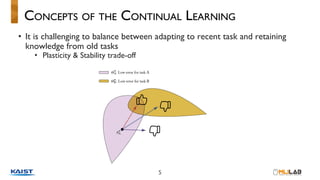
• It is challenging to balance between adapting to recent task and retaining
knowledge from old tasks
• Plasticity & Stability trade-off
CONCEPTS OF THE CONTINUAL LEARNING
6
• Permuted MNIST
• Split MNIST/CIFAR
BENCHMARKS OF THE CONTINUAL LEARNING
Task 1
Task 2
Task 3
1 2 3
7
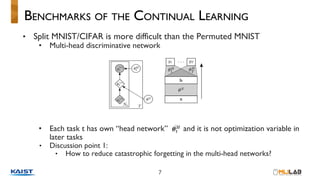
• Split MNIST/CIFAR is more difficult than the Permuted MNIST
• Multi-head discriminative network
• Each task t has own “head network” and it is not optimization variable in
later tasks
• Discussion point 1:
• How to reduce catastrophic forgetting in the multi-head networks?
BENCHMARKS OF THE CONTINUAL LEARNING
PART 2
CONTINUAL LEARNING BY
APPROXIMATE BAYESIAN INFERENCE
- VARIATIONAL INFERENCE
9
• Bayesian Inference provides a natural framework for continual learning
BAYESIAN INFERENCE IN CONTINUAL LEARNING
.
.
.
1
0
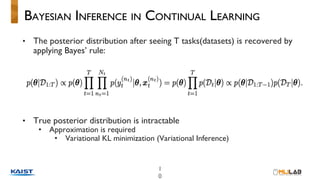
• The posterior distribution after seeing T tasks(datasets) is recovered by
applying Bayes’ rule:
• True posterior distribution is intractable
• Approximation is required
• Variational KL minimization (Variational Inference)
BAYESIAN INFERENCE IN CONTINUAL LEARNING
1
1
• Recall
VARIATIONAL INFERENCE
Variational Lower Bound (Appendix)
PART 3
VARIATIONAL CONTINUAL LEARNING AND EPISODIC
MEMORY ENHANCEMENT
- CORESET ALGORITHM
1
3
VARIATIONAL CONTINUAL LEARNING
Goal of VCL
: Set of allowed approximate posteriors (Gaussian mean-field approx.)
: Intractable normalizing constant (not required)
• Zeroth approximate distribution is defined to be the prior :
• Repeated approximation may accumulate errors causing the model to forget old
tasks.
• Gaussian mean-field approximation :
1
4
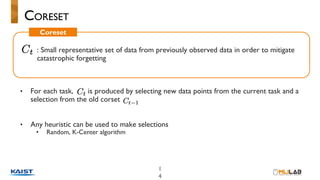
• For each task, is produced by selecting new data points from the current task and a
selection from the old corset
• Any heuristic can be used to make selections
• Random, K-Center algorithm
CORESET
Coreset
: Small representative set of data from previously observed data in order to mitigate
catastrophic forgetting
1
5
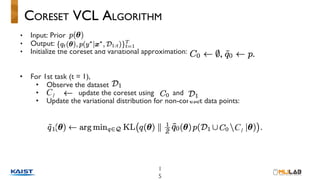
• Input: Prior
• Output:
• Initialize the coreset and variational approximation:
• For 1st task (t = 1),
• Observe the dataset
• update the coreset using and
• Update the variational distribution for non-coreset data points:
CORESET VCL ALGORITHM
1
6
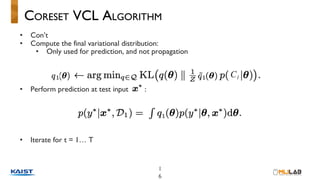
• Con’t
• Compute the final variational distribution:
• Only used for prediction, and not propagation
• Perform prediction at test input :
• Iterate for t = 1… T
CORESET VCL ALGORITHM
1
7
CORESET VCL ALGORITHM
Train
Test
• Discussion point 2 : Is it reasonable?
1
8
• Recall
OBJECTIVE OF VCL
Final objective
minimizing with respect to the variational parameter
Regularization Likelihood
1
9
• KL divergence of between two Gaussian can be computed in closed-form (Appendix)
• Expected log likelihood requires further approximation
• Monte Carlo Sampling
• Local Reparameterization trick
•
•
OBJECTIVE OF VCL
Final objective
minimizing with respect to the variational parameter
2
0
•
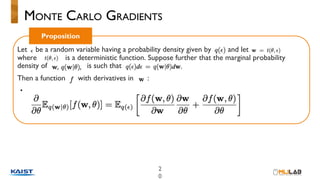
MONTE CARLO GRADIENTS
Proposition
Let be a random variable having a probability density given by and let
where is a deterministic function. Suppose further that the marginal probability
density of is such that
Then a function with derivatives in :
PART 4
EXPERIMENTS
- OVERVIEW OF RELATED WORKS, CONTRAST
2
2
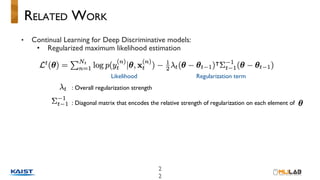
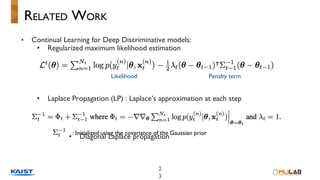
• Continual Learning for Deep Discriminative models:
• Regularized maximum likelihood estimation
RELATED WORK
Regularization termLikelihood
: Overall regularization strength
: Diagonal matrix that encodes the relative strength of regularization on each element of
2
3
• Continual Learning for Deep Discriminative models:
• Regularized maximum likelihood estimation
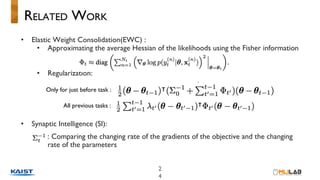
• Laplace Propagation (LP) : Laplace’s approximation at each step
• Diagonal Laplace propagation
RELATED WORK
Penalty termLikelihood
: Initialized using the covariance of the Gaussian prior
2
4
• Elastic Weight Consolidation(EWC) :
• Approximating the average Hessian of the likelihoods using the Fisher information
• Regularization:
• Synaptic Intelligence (SI):
: Comparing the changing rate of the gradients of the objective and the changing
rate of the parameters
RELATED WORK
Only for just before task :
All previous tasks :
2
5
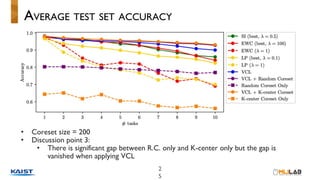
• Permuted MNIST
• Coreset size = 200
• Discussion point 3:
• There is significant gap between R.C. only and K-center only but the gap is
vanished when applying VCL
AVERAGE TEST SET ACCURACY
2
6
• There is no significant performance gap between VCL w.o coreset and large Coreset
EFFECT OF CORESET SIZE
2
7
• VCL outperforms EWC and LP but it is slightly worse than SI.
SPLIT MNIST ACCURACY
2
8
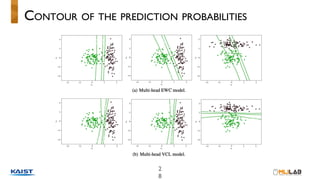
CONTOUR OF THE PREDICTION PROBABILITIES
PART 5
DISCUSSION
3
0
• Discussion point 1:
• How to reduce catastrophic forgetting in the multi-head networks?
• Discussion point 2 :
• Is it reasonable?
• Discussion point 3:
• There is significant gap between R.C. only and K-center only but the gap is
vanished when applying VCL
• They use Bayesian Neural Networks but did not mention about uncertainty.
• How does learning new task affect uncertainty of the old model?
• Uncertainty-Guided Continual Learning?
DISCUSSION
ANY QUESTIONS?
32
• Variational Continual Learning (ICLR 2018)
• Weight Uncertainty in Neural Networks (ICML 2015)
REFERENCES
33
APPENDIX
• KL divergence of two Gaussians:
where,
34
• con’t
APPENDIX

Continual learning: Variational continual learning

  • 1.
    VARIATIONAL CONTINUAL LEARNING FORDEEP DISCRIMINATIVE MODELS 2019. 2. 27. Wonjun Chung wonjunc@mli.kaist.ac.kr
  • 2.
    CONTENTS 1. Continual LearningBackgrounds 2. Continual Learning by Approximate Bayesian Inference 3. Variational Continual Learning and Episodic Memory Enhancement 4. Experiments 5. Discussion
  • 3.
    PART 1 CONTINUAL LEARNINGBACKGROUNDS - CONCEPTS, BENCHMARKS
  • 4.
    4 • Continual Learningis a very general form of online learning • Data continuously arrive in a non i.i.d way • Tasks may change over time • Entirely new tasks can emerge • Model must adapt to perform well on the entire set of tasks in an incremental way that avoids revisiting all previous data CONCEPTS OF THE CONTINUAL LEARNING
  • 5.
    5 • It ischallenging to balance between adapting to recent task and retaining knowledge from old tasks • Plasticity & Stability trade-off CONCEPTS OF THE CONTINUAL LEARNING
  • 6.
    6 • Permuted MNIST •Split MNIST/CIFAR BENCHMARKS OF THE CONTINUAL LEARNING Task 1 Task 2 Task 3 1 2 3
  • 7.
    7 • Split MNIST/CIFARis more difficult than the Permuted MNIST • Multi-head discriminative network • Each task t has own “head network” and it is not optimization variable in later tasks • Discussion point 1: • How to reduce catastrophic forgetting in the multi-head networks? BENCHMARKS OF THE CONTINUAL LEARNING
  • 8.
    PART 2 CONTINUAL LEARNINGBY APPROXIMATE BAYESIAN INFERENCE - VARIATIONAL INFERENCE
  • 9.
    9 • Bayesian Inferenceprovides a natural framework for continual learning BAYESIAN INFERENCE IN CONTINUAL LEARNING . . .
  • 10.
    1 0 • The posteriordistribution after seeing T tasks(datasets) is recovered by applying Bayes’ rule: • True posterior distribution is intractable • Approximation is required • Variational KL minimization (Variational Inference) BAYESIAN INFERENCE IN CONTINUAL LEARNING
  • 11.
  • 12.
    PART 3 VARIATIONAL CONTINUALLEARNING AND EPISODIC MEMORY ENHANCEMENT - CORESET ALGORITHM
  • 13.
    1 3 VARIATIONAL CONTINUAL LEARNING Goalof VCL : Set of allowed approximate posteriors (Gaussian mean-field approx.) : Intractable normalizing constant (not required) • Zeroth approximate distribution is defined to be the prior : • Repeated approximation may accumulate errors causing the model to forget old tasks. • Gaussian mean-field approximation :
  • 14.
    1 4 • For eachtask, is produced by selecting new data points from the current task and a selection from the old corset • Any heuristic can be used to make selections • Random, K-Center algorithm CORESET Coreset : Small representative set of data from previously observed data in order to mitigate catastrophic forgetting
  • 15.
    1 5 • Input: Prior •Output: • Initialize the coreset and variational approximation: • For 1st task (t = 1), • Observe the dataset • update the coreset using and • Update the variational distribution for non-coreset data points: CORESET VCL ALGORITHM
  • 16.
    1 6 • Con’t • Computethe final variational distribution: • Only used for prediction, and not propagation • Perform prediction at test input : • Iterate for t = 1… T CORESET VCL ALGORITHM
  • 17.
    1 7 CORESET VCL ALGORITHM Train Test •Discussion point 2 : Is it reasonable?
  • 18.
    1 8 • Recall OBJECTIVE OFVCL Final objective minimizing with respect to the variational parameter Regularization Likelihood
  • 19.
    1 9 • KL divergenceof between two Gaussian can be computed in closed-form (Appendix) • Expected log likelihood requires further approximation • Monte Carlo Sampling • Local Reparameterization trick • • OBJECTIVE OF VCL Final objective minimizing with respect to the variational parameter
  • 20.
    2 0 • MONTE CARLO GRADIENTS Proposition Letbe a random variable having a probability density given by and let where is a deterministic function. Suppose further that the marginal probability density of is such that Then a function with derivatives in :
  • 21.
    PART 4 EXPERIMENTS - OVERVIEWOF RELATED WORKS, CONTRAST
  • 22.
    2 2 • Continual Learningfor Deep Discriminative models: • Regularized maximum likelihood estimation RELATED WORK Regularization termLikelihood : Overall regularization strength : Diagonal matrix that encodes the relative strength of regularization on each element of
  • 23.
    2 3 • Continual Learningfor Deep Discriminative models: • Regularized maximum likelihood estimation • Laplace Propagation (LP) : Laplace’s approximation at each step • Diagonal Laplace propagation RELATED WORK Penalty termLikelihood : Initialized using the covariance of the Gaussian prior
  • 24.
    2 4 • Elastic WeightConsolidation(EWC) : • Approximating the average Hessian of the likelihoods using the Fisher information • Regularization: • Synaptic Intelligence (SI): : Comparing the changing rate of the gradients of the objective and the changing rate of the parameters RELATED WORK Only for just before task : All previous tasks :
  • 25.
    2 5 • Permuted MNIST •Coreset size = 200 • Discussion point 3: • There is significant gap between R.C. only and K-center only but the gap is vanished when applying VCL AVERAGE TEST SET ACCURACY
  • 26.
    2 6 • There isno significant performance gap between VCL w.o coreset and large Coreset EFFECT OF CORESET SIZE
  • 27.
    2 7 • VCL outperformsEWC and LP but it is slightly worse than SI. SPLIT MNIST ACCURACY
  • 28.
    2 8 CONTOUR OF THEPREDICTION PROBABILITIES
  • 29.
  • 30.
    3 0 • Discussion point1: • How to reduce catastrophic forgetting in the multi-head networks? • Discussion point 2 : • Is it reasonable? • Discussion point 3: • There is significant gap between R.C. only and K-center only but the gap is vanished when applying VCL • They use Bayesian Neural Networks but did not mention about uncertainty. • How does learning new task affect uncertainty of the old model? • Uncertainty-Guided Continual Learning? DISCUSSION
  • 31.
  • 32.
    32 • Variational ContinualLearning (ICLR 2018) • Weight Uncertainty in Neural Networks (ICML 2015) REFERENCES
  • 33.
    33 APPENDIX • KL divergenceof two Gaussians: where,
  • 34.