ROMBLON EAST
CENTRAL SCHOOL
Romblon
2018
Continge
ncy Plan
BACKGRO
UND
Every village and every school is
different in terms of its
inhabitants/students, its geography, its
resources and its ways of making
decisions. Therefore contingency plans
differ from school to school, village to
village, and disaster to disaster.
Disaster causes sudden disruption to
the normal life of society and causes
damage to the properties and lives such
an extent that normal social and
economic mechanism available to society
get disturbed. Those who are unaware
and unprepared generally get affected
more due to their lack of knowledge and
physiological pressure.
The school suffers continuous rainfall
throughout the year with little let-up in summer.
Flooding is the main hazards of the school as it is
located in a flood plain, making it vulnerable to
flood damage and it is also lies along the big rivers
and mountainous areas. Fire is also a potential risk
of the different schools as it is located beside the
residential and commercial areas and near the
center of the town and also the electrical gadgets,
wires used in the school can cause fire. Earthquake
is another potential hazard of the school as it is
made of hard materials or concrete. Tsunami is
The schools is exposed to many hazards,
all of which have the potential for disrupting
the school community, causing casualties, and
damaging or destroying public or private
property.
To ensure that all school members know
what to do in the event of an emergency or
disaster,all school created the School Disaster
Risk Reduction Management Committee
(SDRRMC) and Contingency Plan.
The school is exposed to many hazards,
all of which have the potential for disrupting
the school community, causing casualties, and
damaging or destroying public or private
property.
To ensure that all school members know
what to do in the event of an emergency or
disaster, the school created the School
Disaster Risk Reduction Management
Committee (SDRRMC) and Contingency Plan.
OBJECTIVE
S
This 2018 Contingency Plan covers the 260 schools
in the Division of Romblon. It focuses on the following hazards like fire,
Hydro meteorological and earthquake.
• To prepare the learners and teaching and non-teaching from the hazard of
disaster such as floods, fire,
typhoon, and earthquake.
• To minimize or avoid injuries and casualties during disaster.
• To respond immediately during disaster and/or emergencies.
• To safeguard school/ Offices records/documents and instructional materials.
• To reposition all available resources for emergency response
. To use as reference and guide at all times.
SCOPE OF
THE PLAN
Romblon East Central School Contingency Plan
outlines the expectations of teachers and staff;
High-Priority Hazards based on a disaster analysis
and common and specialized procedures to be
done during disaster, Disaster Impacts and
vulnerable classrooms, Capacities and
vulnerabilities of school, Preparedness measures,
prepositioned materials and equipment,
implementing partners, and preparation of
disability inclusive plan.
DEFINITIO
N
To provide quality and better
understanding to the readers, the
following terms are defined operationally.
Contingency Plan-refers to a document
setting out an organized, planned and
coordinated course of action to be
followed in case of a disaster.
Hazards-refers to the common or usual hazards
occur in school.
Disaster-refers to the severe calamity
happened in school.
Capacities-refers to the strong point of the
school to address/respond in a disaster.
Vulnerabilities-refers to the weaknesses of
school to address/respond in a disaster.
Preparedness Measures- refers to the safety
precautions to be done before and during
disaster/s.
Prepositioned Materials and Equipment-
refers to the available and usable materials
and equipment to be used during disaster.
Vulnerable Classroom-refers to the affected
classrooms during and after the occurrence of
disaster.
SCHOOL
POPULATIO
N
a. General Population
Romblon East Central School’s current enrolment is 1038
pupils. These pupils are supported by a committed
teachers and staff consisting of:
• 32 Teacher-Advisers
• 4 Subject Teachers
• 2 School Administrative Staff
• 2 District Personnel
• 1 School Nurse
• 1 Security Guard/Utility
• 1 School Principal
A master schedule of where classes, grade levels, and
staff are located during the day is provided to each
b. Special Needs Population
Romblon East Central School is committed to the safe
evacuation and transport of pupils and teachers with
special needs. The special needs population includes
pupils/teachers with:
• Blindness or visual disabilities
• Cognitive or emotional disabilities
• Deafness or hearing loss
• Mobility/physical disabilities (permanent and
temporary)
The school’s current enrolment of pupils with special
needs is 26 however, this number will fluctuate. Pupils
SCHOOL
BUILDING
INFORMATI
a. Location of School Building
The Romblon East Central School is located at
Barangay Capaclan Romblon, Romblon, the
passageway from the Port of Romblon towards
the PNP Provincial Command Routing to the
Provincial Capitol Building of Romblon. It is
relatively big school near the center of the
town of Romblon, bounded by the Romblon
West Central School, in its western frontier, a
Barangay Road in its northern sphere, and a
residential area in its eastern portion. The
school is also considered as the show window of
b. Name or Type of Building and Number of Classrooms
Name/Type of Building Number of Classrooms
Main Building (2-storey) 14 rooms (including office of
the Principal and Nurse office)
PAGCOR Building 5 rooms (including science
laboratory)
Imelda Type Building 2 rooms
Bagong Lipunan Building 4 rooms
SPED Building 3 rooms (including SPED
Resource Room)
Fil-Chi Building 4 rooms (including computer
room)
Marcos Type Building 2 rooms
New Building 3 rooms
Library Hub 1 room
Home Economics Building 1 room
HAZARDS
High-Priority Hazards
Flood is the school’s top priority hazards. Flooding
in school could threaten the safety of pupils and
teachers whenever storm water or other sources of
water threaten to inundate school grounds or buildings.
In our school, flooding is considered as the most
prevalent type of hazard because it is always occur
when a prolonged rainfall causes rural streams to rise.
Last year 2017, the school ground and some classrooms
as well have been severely flooded almost five times.
Here is the early warning plan of school in times of
flood.
Early Warning Plan for FLOOD
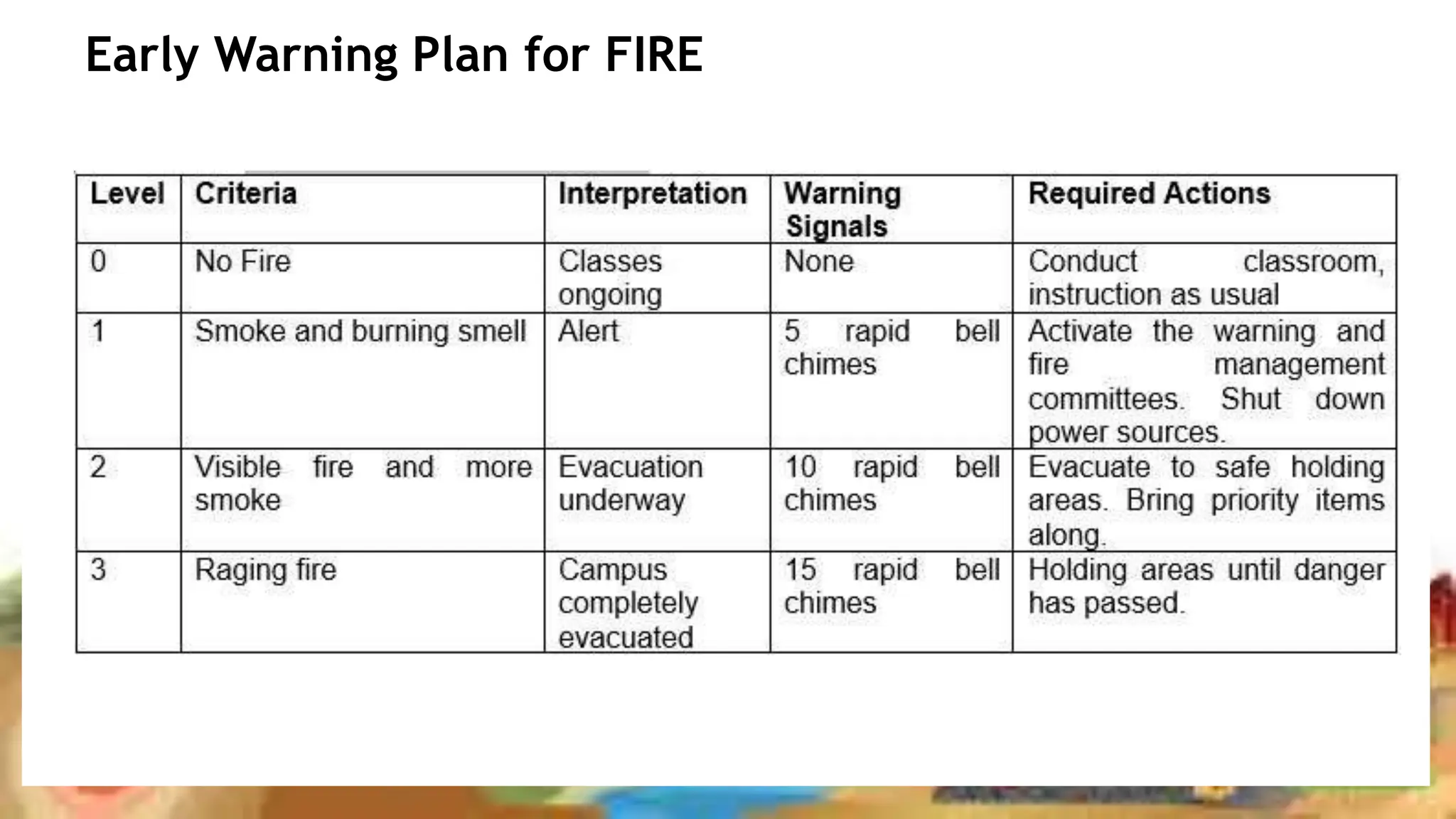
Fire hazards are the most prevalent types of
hazards mostly in rural areas cities, towns. Since
our school is located beside the residential and
commercial areas and near the center of the
town, we are not refusing the chance of this
hazard to happen. That is the purpose we develop
an early warning plan in times of fire occurrence.
Early Warning Plan for FIRE
Another potential risk we are preparing for is
the unpredictable Earthquake. This is maybe the
toughest hazards to encounter typically in rural
areas, cities, towns. Although the school has a
vast area of playground, we are not keeping in
mind the probability of damage if it case may
happen. That’s why we are habitually doing the
earthquake drill in our school because safety is
our main priority.
Here is the Basic Drill for Earthquake.
Basic Drill for EARTHQUAKE
A – Alarm (5-5-5 bells)
R – Response (Duck-Cover-Hold)
E – Evacuate the room
A – Assemble in the open area/field
Here is the Basic Drill for Earthquake.
Basic Drill for EARTHQUAKE
A – Alarm (5-5-5 bells)
R – Response (Duck-Cover-Hold)
E – Evacuate the room
A – Assemble in the open area/field
DISASTER,
IMPACTS AND
VULNERABLE
CLASSROOMS
As shown in table 1, we started at the year
2017. The typhoon name that cause severely
flooded in the school is “Urduja”. The total
number of severely flooded classrooms are twelve
(12). Fortunately, those classrooms are not totally
and even partially damaged but minor damaged
occur. A total of twelve (12) classrooms evaluated
as minor damaged with a total cost of 5,900 pesos.
Based on ranking the most vulnerable building in
times of flood is the Imelda Type Building with two
(2) classrooms.
TABLE 1: Disaster, Impacts and Ranking of Most
Vulnerable Classrooms
CAPACITIES AND
VULNERABILITIES
Table 2 reveals the capacities and gaps/vulnerabilities of
the most vulnerable classrooms when it comes to preparedness
the school has the capacity to establish and strengthened
capacities of vulnerable classrooms to anticipate cope and
recover from the negative impacts of emergency occurrence and
disasters and those classrooms are vulnerable due to unregularly
conduct of risk assessment. With regards to response the school
has the capacity to coordinate with the PDRRM, DRRM, MDRRM,
LGU’s, and Partners and it is vulnerable if incoordination
happens. Next is Rehabilitation and Recovery, the school has the
capacity to monitor of implementation of support for learning
continuity and it is vulnerable due to inadequate supply of
equipment to be used for rehabilitation and recovery. And Lastly,
The Disaster Prevention and Mitigation aspect, the school has the
capacity to avoid hazards and mitigated their potential impacts
TABLE 2: Capacities and Gaps/Vulnerabilities
PREPAREDNESS
MEASURES
One of the important tasks during
preparedness phase is formulation of a response
plan. It basically helps in quick mobilization of
manpower, resources and in performing various
duties. Table 3 reveals that the tropical cyclone
happened on December 14-18, 2017. The
vulnerable building based on overall ranking was
the Imelda Type Building. And the preparedness
measures to be addressed by the school are the
Regular conduct of Risk Assessment and Establish
linkages with LGU’s, MDRRMC, and Partners.
Table 3. Preparedness Measures
PREPOSITIONED
MATERIALS AND
EQUIPMENT
Availability of materials and equipment
helps to reduce the damage of the
hazards and it can also preserve life as
well.
Here are the list of available materials of
the school to be used when a disaster
strikes.
Table 4 PREPOSITIONED EQUIPMENT and
MATERIALS
IMPLEMENTING
PARTNERS
Establishing linkages with other agencies/offices
greatly support the school to become capacitated,
vulnerable-free, and damage less in times of
disaster/hazards.
Table 5: Collaboration with Partners
PREPARATION OF
DISABILITY
INCLUSIVE PLAN
Persons with Disabilities have difficulty in
moving hearing, seeing, communicating and/or
learning. They have the same needs and perform
the same activities as other members of the
community (eating, dressing, working etc.)
However, Persons with Disabilities (PWDs) may
need specific support related to their disability
and their living environment (assistive device1,
caregiver, a modified physical environment or
equipment) to enable them to participate fully in
these daily activities. In an emergency situation,
when all members of the community are placed in
Early warning provides a very important link
between preparedness measures and response
action, which in turn reduces the risk of exposure
and injury of community members. A
comprehensive early warning system is very
important in any community, however, even more
so in a community with PWDs as they are
frequently overlooked in disaster situations.
.
PROCESS FLOW
contingency-plan-recs.pptx

contingency-plan-recs.pptx

  • 1.
  • 2.
  • 3.
  • 4.
    Every village andevery school is different in terms of its inhabitants/students, its geography, its resources and its ways of making decisions. Therefore contingency plans differ from school to school, village to village, and disaster to disaster.
  • 5.
    Disaster causes suddendisruption to the normal life of society and causes damage to the properties and lives such an extent that normal social and economic mechanism available to society get disturbed. Those who are unaware and unprepared generally get affected more due to their lack of knowledge and physiological pressure.
  • 6.
    The school sufferscontinuous rainfall throughout the year with little let-up in summer. Flooding is the main hazards of the school as it is located in a flood plain, making it vulnerable to flood damage and it is also lies along the big rivers and mountainous areas. Fire is also a potential risk of the different schools as it is located beside the residential and commercial areas and near the center of the town and also the electrical gadgets, wires used in the school can cause fire. Earthquake is another potential hazard of the school as it is made of hard materials or concrete. Tsunami is
  • 7.
    The schools isexposed to many hazards, all of which have the potential for disrupting the school community, causing casualties, and damaging or destroying public or private property. To ensure that all school members know what to do in the event of an emergency or disaster,all school created the School Disaster Risk Reduction Management Committee (SDRRMC) and Contingency Plan.
  • 8.
    The school isexposed to many hazards, all of which have the potential for disrupting the school community, causing casualties, and damaging or destroying public or private property. To ensure that all school members know what to do in the event of an emergency or disaster, the school created the School Disaster Risk Reduction Management Committee (SDRRMC) and Contingency Plan.
  • 9.
  • 10.
    This 2018 ContingencyPlan covers the 260 schools in the Division of Romblon. It focuses on the following hazards like fire, Hydro meteorological and earthquake. • To prepare the learners and teaching and non-teaching from the hazard of disaster such as floods, fire, typhoon, and earthquake. • To minimize or avoid injuries and casualties during disaster. • To respond immediately during disaster and/or emergencies. • To safeguard school/ Offices records/documents and instructional materials. • To reposition all available resources for emergency response . To use as reference and guide at all times.
  • 11.
  • 12.
    Romblon East CentralSchool Contingency Plan outlines the expectations of teachers and staff; High-Priority Hazards based on a disaster analysis and common and specialized procedures to be done during disaster, Disaster Impacts and vulnerable classrooms, Capacities and vulnerabilities of school, Preparedness measures, prepositioned materials and equipment, implementing partners, and preparation of disability inclusive plan.
  • 13.
  • 14.
    To provide qualityand better understanding to the readers, the following terms are defined operationally. Contingency Plan-refers to a document setting out an organized, planned and coordinated course of action to be followed in case of a disaster.
  • 15.
    Hazards-refers to thecommon or usual hazards occur in school. Disaster-refers to the severe calamity happened in school. Capacities-refers to the strong point of the school to address/respond in a disaster. Vulnerabilities-refers to the weaknesses of school to address/respond in a disaster.
  • 16.
    Preparedness Measures- refersto the safety precautions to be done before and during disaster/s. Prepositioned Materials and Equipment- refers to the available and usable materials and equipment to be used during disaster. Vulnerable Classroom-refers to the affected classrooms during and after the occurrence of disaster.
  • 17.
  • 18.
    a. General Population RomblonEast Central School’s current enrolment is 1038 pupils. These pupils are supported by a committed teachers and staff consisting of: • 32 Teacher-Advisers • 4 Subject Teachers • 2 School Administrative Staff • 2 District Personnel • 1 School Nurse • 1 Security Guard/Utility • 1 School Principal A master schedule of where classes, grade levels, and staff are located during the day is provided to each
  • 19.
    b. Special NeedsPopulation Romblon East Central School is committed to the safe evacuation and transport of pupils and teachers with special needs. The special needs population includes pupils/teachers with: • Blindness or visual disabilities • Cognitive or emotional disabilities • Deafness or hearing loss • Mobility/physical disabilities (permanent and temporary) The school’s current enrolment of pupils with special needs is 26 however, this number will fluctuate. Pupils
  • 20.
  • 21.
    a. Location ofSchool Building The Romblon East Central School is located at Barangay Capaclan Romblon, Romblon, the passageway from the Port of Romblon towards the PNP Provincial Command Routing to the Provincial Capitol Building of Romblon. It is relatively big school near the center of the town of Romblon, bounded by the Romblon West Central School, in its western frontier, a Barangay Road in its northern sphere, and a residential area in its eastern portion. The school is also considered as the show window of
  • 22.
    b. Name orType of Building and Number of Classrooms Name/Type of Building Number of Classrooms Main Building (2-storey) 14 rooms (including office of the Principal and Nurse office) PAGCOR Building 5 rooms (including science laboratory) Imelda Type Building 2 rooms Bagong Lipunan Building 4 rooms SPED Building 3 rooms (including SPED Resource Room) Fil-Chi Building 4 rooms (including computer room) Marcos Type Building 2 rooms New Building 3 rooms Library Hub 1 room Home Economics Building 1 room
  • 23.
  • 24.
    High-Priority Hazards Flood isthe school’s top priority hazards. Flooding in school could threaten the safety of pupils and teachers whenever storm water or other sources of water threaten to inundate school grounds or buildings. In our school, flooding is considered as the most prevalent type of hazard because it is always occur when a prolonged rainfall causes rural streams to rise. Last year 2017, the school ground and some classrooms as well have been severely flooded almost five times. Here is the early warning plan of school in times of flood.
  • 25.
  • 26.
    Fire hazards arethe most prevalent types of hazards mostly in rural areas cities, towns. Since our school is located beside the residential and commercial areas and near the center of the town, we are not refusing the chance of this hazard to happen. That is the purpose we develop an early warning plan in times of fire occurrence.
  • 27.
  • 28.
    Another potential riskwe are preparing for is the unpredictable Earthquake. This is maybe the toughest hazards to encounter typically in rural areas, cities, towns. Although the school has a vast area of playground, we are not keeping in mind the probability of damage if it case may happen. That’s why we are habitually doing the earthquake drill in our school because safety is our main priority.
  • 29.
    Here is theBasic Drill for Earthquake. Basic Drill for EARTHQUAKE A – Alarm (5-5-5 bells) R – Response (Duck-Cover-Hold) E – Evacuate the room A – Assemble in the open area/field
  • 30.
    Here is theBasic Drill for Earthquake. Basic Drill for EARTHQUAKE A – Alarm (5-5-5 bells) R – Response (Duck-Cover-Hold) E – Evacuate the room A – Assemble in the open area/field
  • 31.
  • 32.
    As shown intable 1, we started at the year 2017. The typhoon name that cause severely flooded in the school is “Urduja”. The total number of severely flooded classrooms are twelve (12). Fortunately, those classrooms are not totally and even partially damaged but minor damaged occur. A total of twelve (12) classrooms evaluated as minor damaged with a total cost of 5,900 pesos. Based on ranking the most vulnerable building in times of flood is the Imelda Type Building with two (2) classrooms.
  • 33.
    TABLE 1: Disaster,Impacts and Ranking of Most Vulnerable Classrooms
  • 34.
  • 35.
    Table 2 revealsthe capacities and gaps/vulnerabilities of the most vulnerable classrooms when it comes to preparedness the school has the capacity to establish and strengthened capacities of vulnerable classrooms to anticipate cope and recover from the negative impacts of emergency occurrence and disasters and those classrooms are vulnerable due to unregularly conduct of risk assessment. With regards to response the school has the capacity to coordinate with the PDRRM, DRRM, MDRRM, LGU’s, and Partners and it is vulnerable if incoordination happens. Next is Rehabilitation and Recovery, the school has the capacity to monitor of implementation of support for learning continuity and it is vulnerable due to inadequate supply of equipment to be used for rehabilitation and recovery. And Lastly, The Disaster Prevention and Mitigation aspect, the school has the capacity to avoid hazards and mitigated their potential impacts
  • 36.
    TABLE 2: Capacitiesand Gaps/Vulnerabilities
  • 39.
  • 40.
    One of theimportant tasks during preparedness phase is formulation of a response plan. It basically helps in quick mobilization of manpower, resources and in performing various duties. Table 3 reveals that the tropical cyclone happened on December 14-18, 2017. The vulnerable building based on overall ranking was the Imelda Type Building. And the preparedness measures to be addressed by the school are the Regular conduct of Risk Assessment and Establish linkages with LGU’s, MDRRMC, and Partners.
  • 41.
  • 42.
  • 43.
    Availability of materialsand equipment helps to reduce the damage of the hazards and it can also preserve life as well. Here are the list of available materials of the school to be used when a disaster strikes.
  • 44.
    Table 4 PREPOSITIONEDEQUIPMENT and MATERIALS
  • 45.
  • 46.
    Establishing linkages withother agencies/offices greatly support the school to become capacitated, vulnerable-free, and damage less in times of disaster/hazards.
  • 47.
  • 48.
  • 49.
    Persons with Disabilitieshave difficulty in moving hearing, seeing, communicating and/or learning. They have the same needs and perform the same activities as other members of the community (eating, dressing, working etc.) However, Persons with Disabilities (PWDs) may need specific support related to their disability and their living environment (assistive device1, caregiver, a modified physical environment or equipment) to enable them to participate fully in these daily activities. In an emergency situation, when all members of the community are placed in
  • 50.
    Early warning providesa very important link between preparedness measures and response action, which in turn reduces the risk of exposure and injury of community members. A comprehensive early warning system is very important in any community, however, even more so in a community with PWDs as they are frequently overlooked in disaster situations.
  • 52.

Editor's Notes

  • #53 SAY: To come up with an appropriate, applicable and effective contingency plan, participation from key actors must be observed especially those that will be required to work together in the event of an emergency. Participants for the development of a contingency plan depends on the level or scope of the planning and working area. It can be national, regional or local which in the department’s end, it can be within DepEd Central Office, Regional, Division or School level.   SAY: External linkages and partner agencies or institutions also play a vital role in the contingency planning process. Moreover, inclusion of experts at different stages in the planning process is important. Their participation contribute to a more sound and well-coordinated response.