Context, Perspective, and Generalities
in a Knowledge Ontology
TM
Ontolog Forum
Michael K. Bergman
December 7, 2016
© Copyright 2016. Cognonto LLC
2
Outline
I. Genesis
II. What is KBpedia?
III. How is it Constructed?
IV. Why it Offers New Ontological Choices
V. Open Discussion
I. Genesis
TM
© Copyright 2016. Cognonto LLC
4
8 Years in Process
 2008: UMBEL – reference concepts for Web integration
 2008: mapping to Cyc
 2009: first typology design (‘SuperTypes’)
 2010: mapping to Wikipedia; Wikipedia in KR
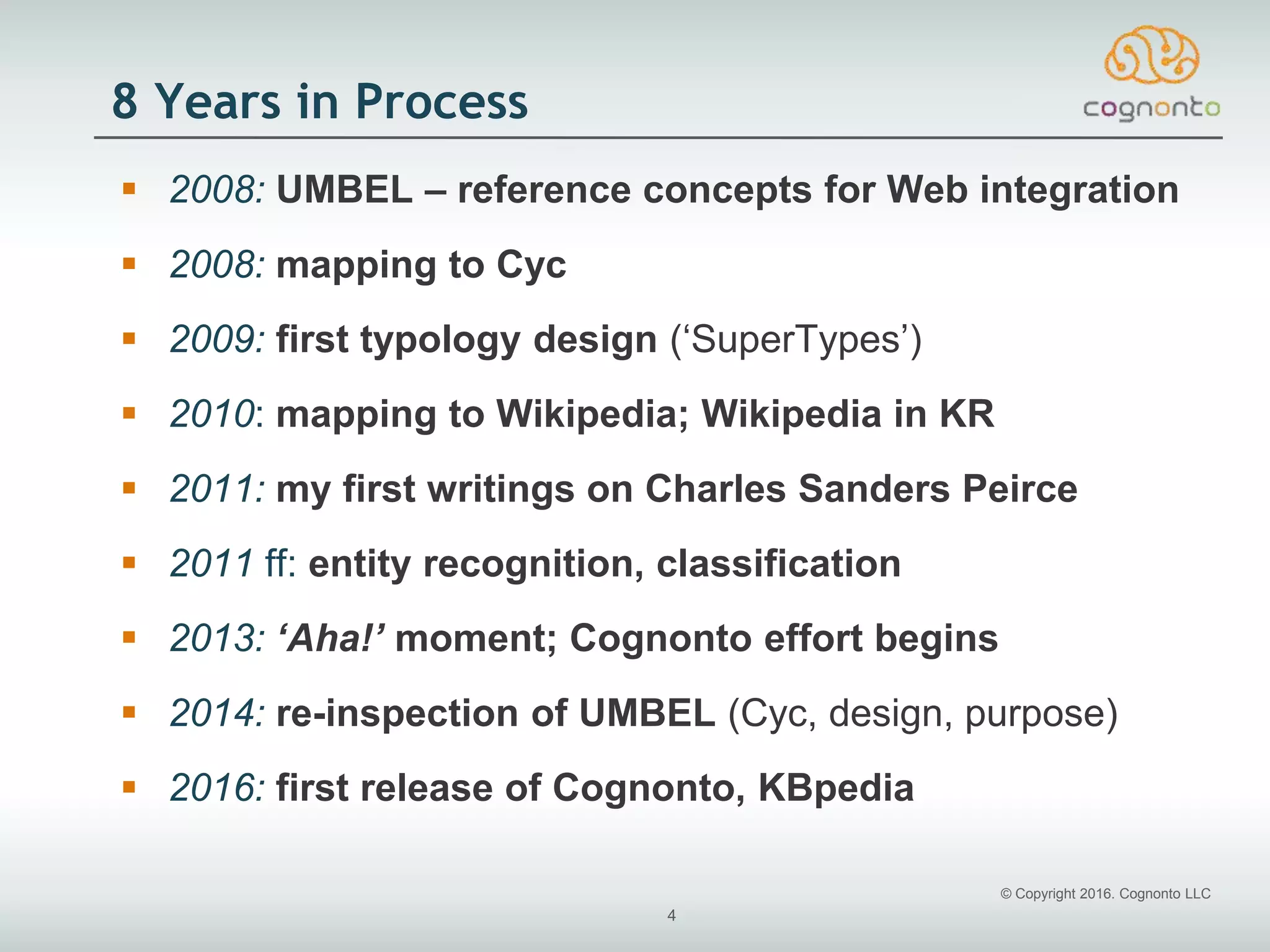
 2011: my first writings on Charles Sanders Peirce
 2011 ff: entity recognition, classification
 2013: ‘Aha!’ moment; Cognonto effort begins
 2014: re-inspection of UMBEL (Cyc, design, purpose)
 2016: first release of Cognonto, KBpedia
© Copyright 2016. Cognonto LLC
5
A Growing Fascination with Peirce
 Charles Sanders Peirce (“purse”) (1839-1914)
 Polymath, philosopher, scientist,
logician, mathematician
 John Sowa’s writings
 Key contributions (much untranscribed):
 Logic of semiosis
 Predicate logic, notations
 Classification of signs, classification (general)
 Universal categories (Firstness, Secondness, Thirdness)
 Pragmaticism (Pragmatic Maxim)
 Abductive logic
 Existential graphs
 IMO: Greatest thinker on knowledge and KR
© Copyright 2016. Cognonto LLC
6
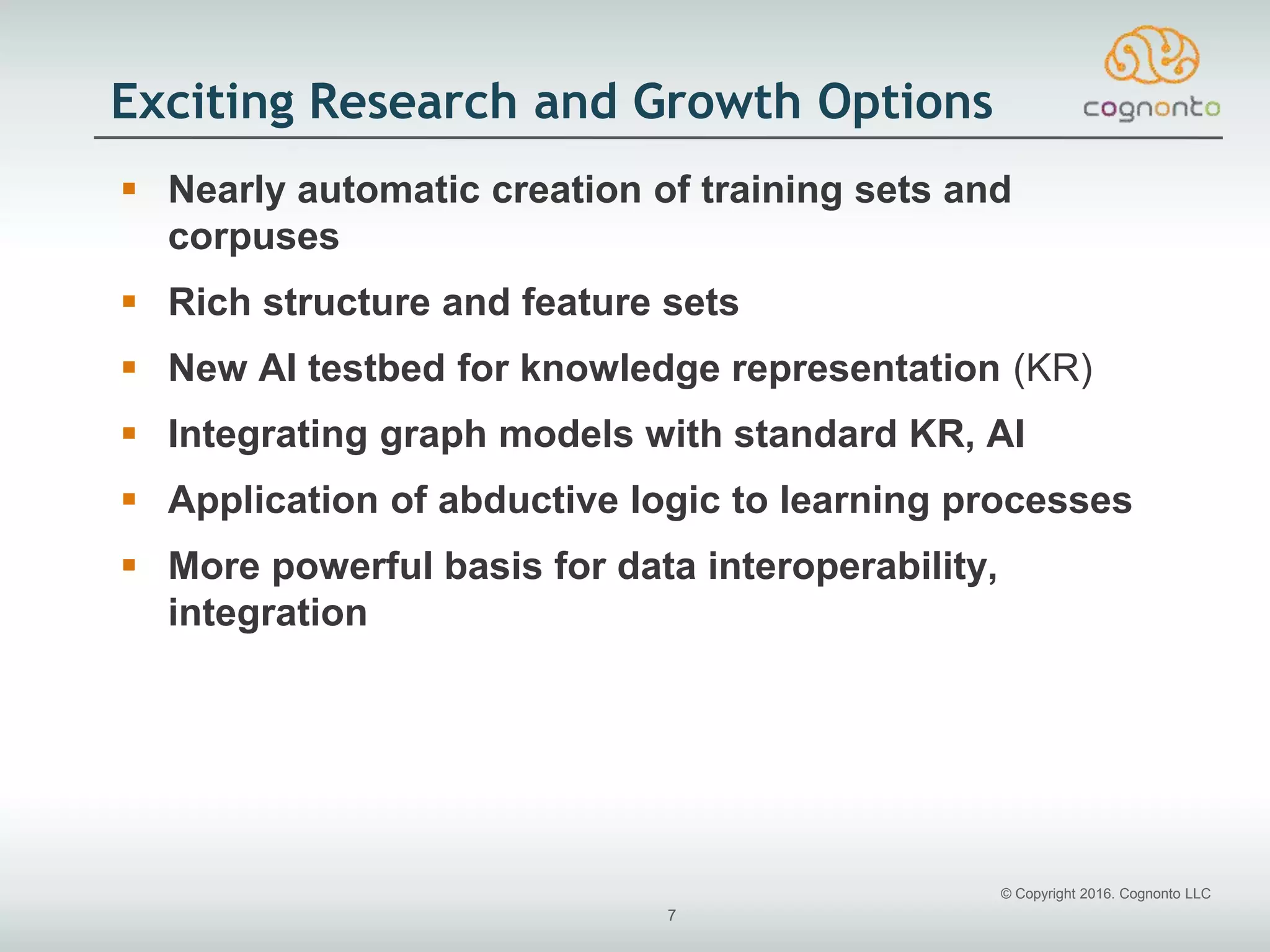
The ‘Aha!’ Moment
 Inconsistent, incoherent Wikipedia categories
 Wikipedia bespoke, core knowledge structure in:
 DBpedia
 Freebase
 Google KG, Now
 Siri
 Big data was a key driver in recent AI breakthroughs
 2013: Why not systematize knowledge bases for AI
purposes?  KBAI
 Intuition:
 Multiple KBs
 Shared foundation
 Fine-grained types (70K +)
 IBM Watson
 Cortana
 Viv
 etc.
 Need for common schema
 Design for AI (features,
structure, KR model)
© Copyright 2016. Cognonto LLC
7
Exciting Research and Growth Options
 Nearly automatic creation of training sets and
corpuses
 Rich structure and feature sets
 New AI testbed for knowledge representation (KR)
 Integrating graph models with standard KR, AI
 Application of abductive logic to learning processes
 More powerful basis for data interoperability,
integration
II. What is KBpedia?
TM
© Copyright 2016. Cognonto LLC
9
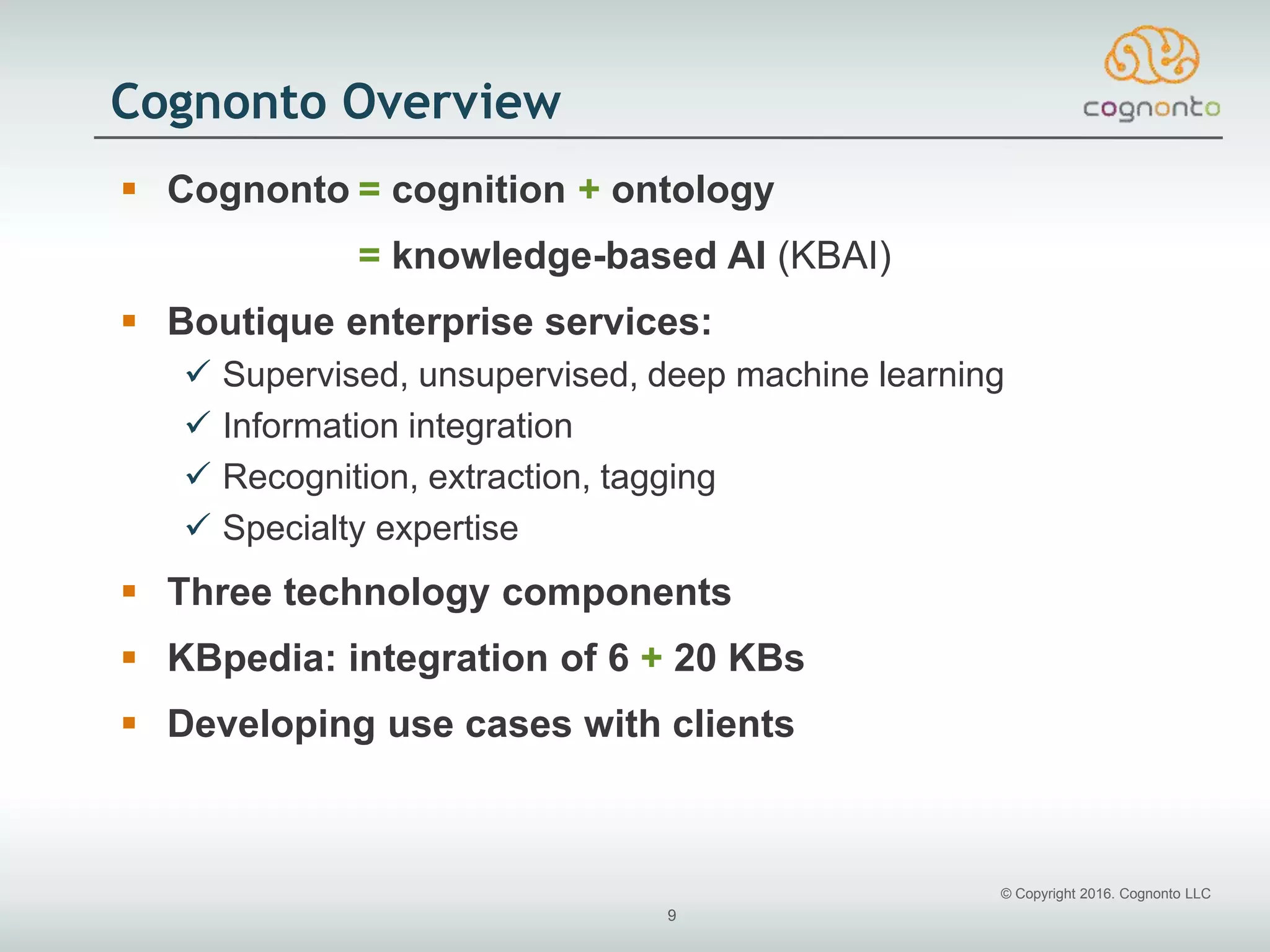
Cognonto Overview
 Cognonto = cognition + ontology
= knowledge-based AI (KBAI)
 Boutique enterprise services:
 Supervised, unsupervised, deep machine learning
 Information integration
 Recognition, extraction, tagging
 Specialty expertise
 Three technology components
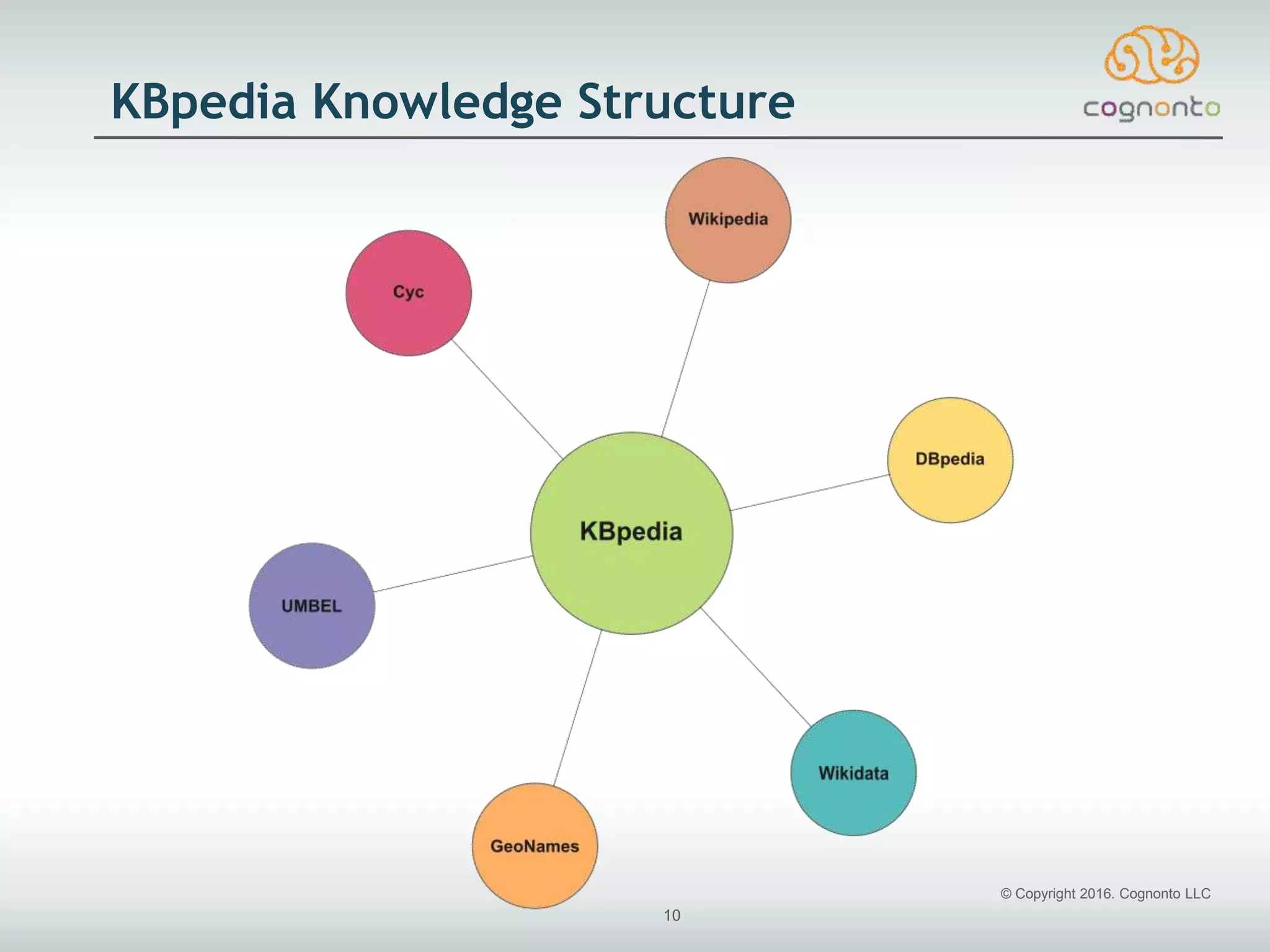
 KBpedia: integration of 6 + 20 KBs
 Developing use cases with clients
© Copyright 2016. Cognonto LLC
10
KBpedia Knowledge Structure
© Copyright 2016. Cognonto LLC
11
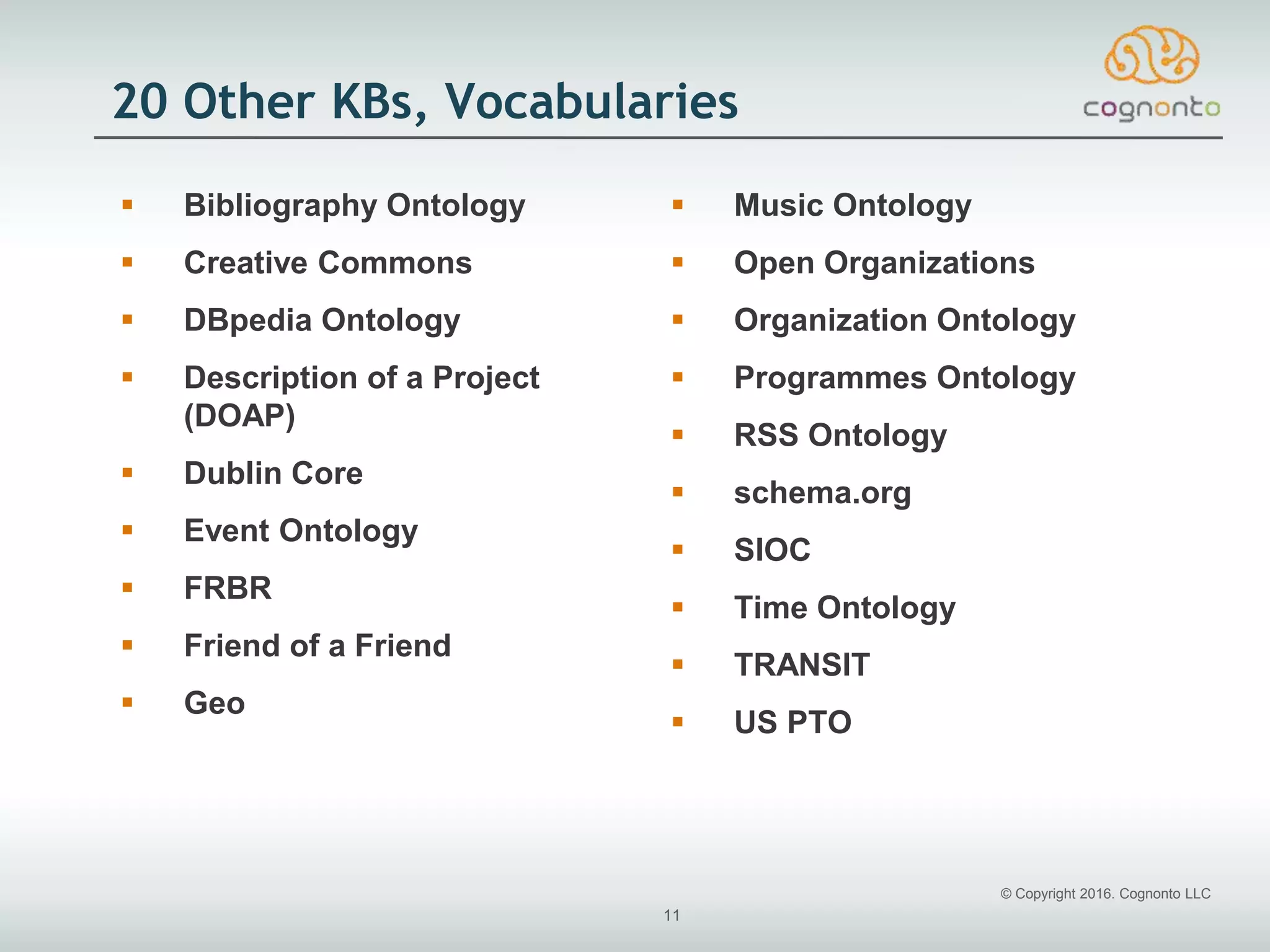
20 Other KBs, Vocabularies
 Bibliography Ontology
 Creative Commons
 DBpedia Ontology
 Description of a Project
(DOAP)
 Dublin Core
 Event Ontology
 FRBR
 Friend of a Friend
 Geo
 Music Ontology
 Open Organizations
 Organization Ontology
 Programmes Ontology
 RSS Ontology
 schema.org
 SIOC
 Time Ontology
 TRANSIT
 US PTO
© Copyright 2016. Cognonto LLC
12
KBpedia Design Basis
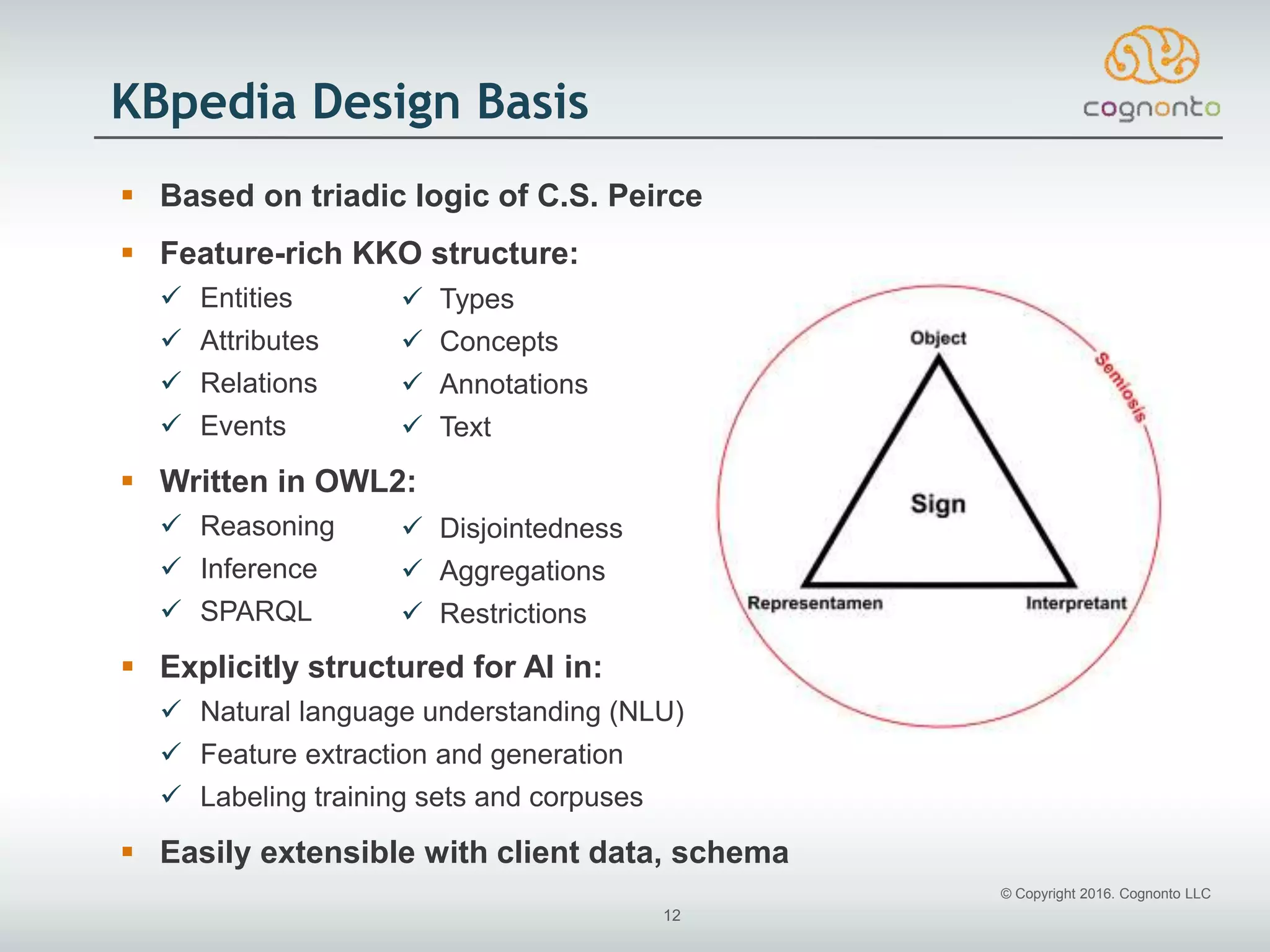
 Based on triadic logic of C.S. Peirce
 Feature-rich KKO structure:
 Entities
 Attributes
 Relations
 Events
 Written in OWL2:
 Reasoning
 Inference
 SPARQL
 Explicitly structured for AI in:
 Natural language understanding (NLU)
 Feature extraction and generation
 Labeling training sets and corpuses
 Easily extensible with client data, schema
 Types
 Concepts
 Annotations
 Text
 Disjointedness
 Aggregations
 Restrictions
© Copyright 2016. Cognonto LLC
13
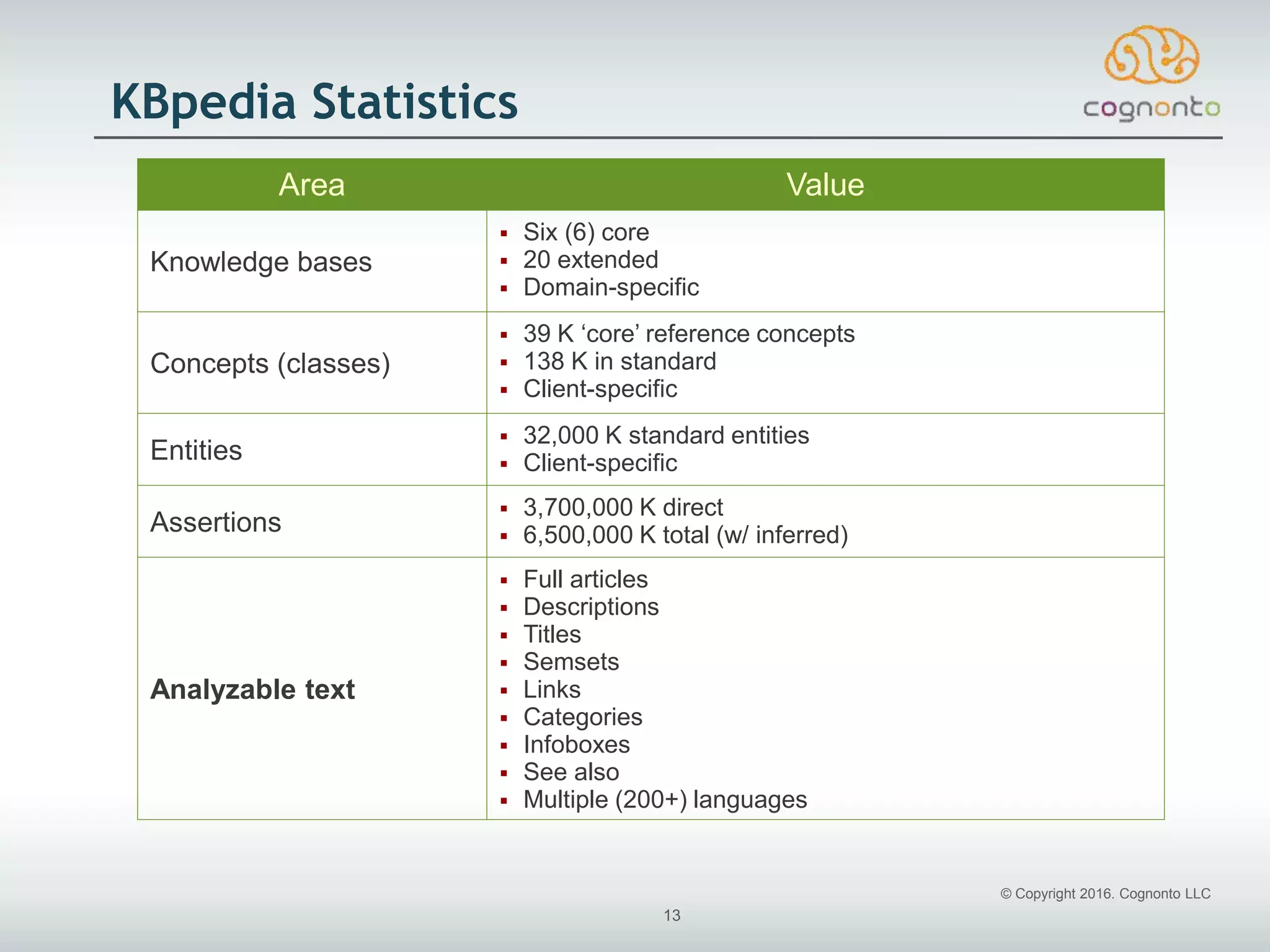
KBpedia Statistics
Area Value
Knowledge bases
 Six (6) core
 20 extended
 Domain-specific
Concepts (classes)
 39 K ‘core’ reference concepts
 138 K in standard
 Client-specific
Entities
 32,000 K standard entities
 Client-specific
Assertions
 3,700,000 K direct
 6,500,000 K total (w/ inferred)
Analyzable text
 Full articles
 Descriptions
 Titles
 Semsets
 Links
 Categories
 Infoboxes
 See also
 Multiple (200+) languages
© Copyright 2016. Cognonto LLC
14
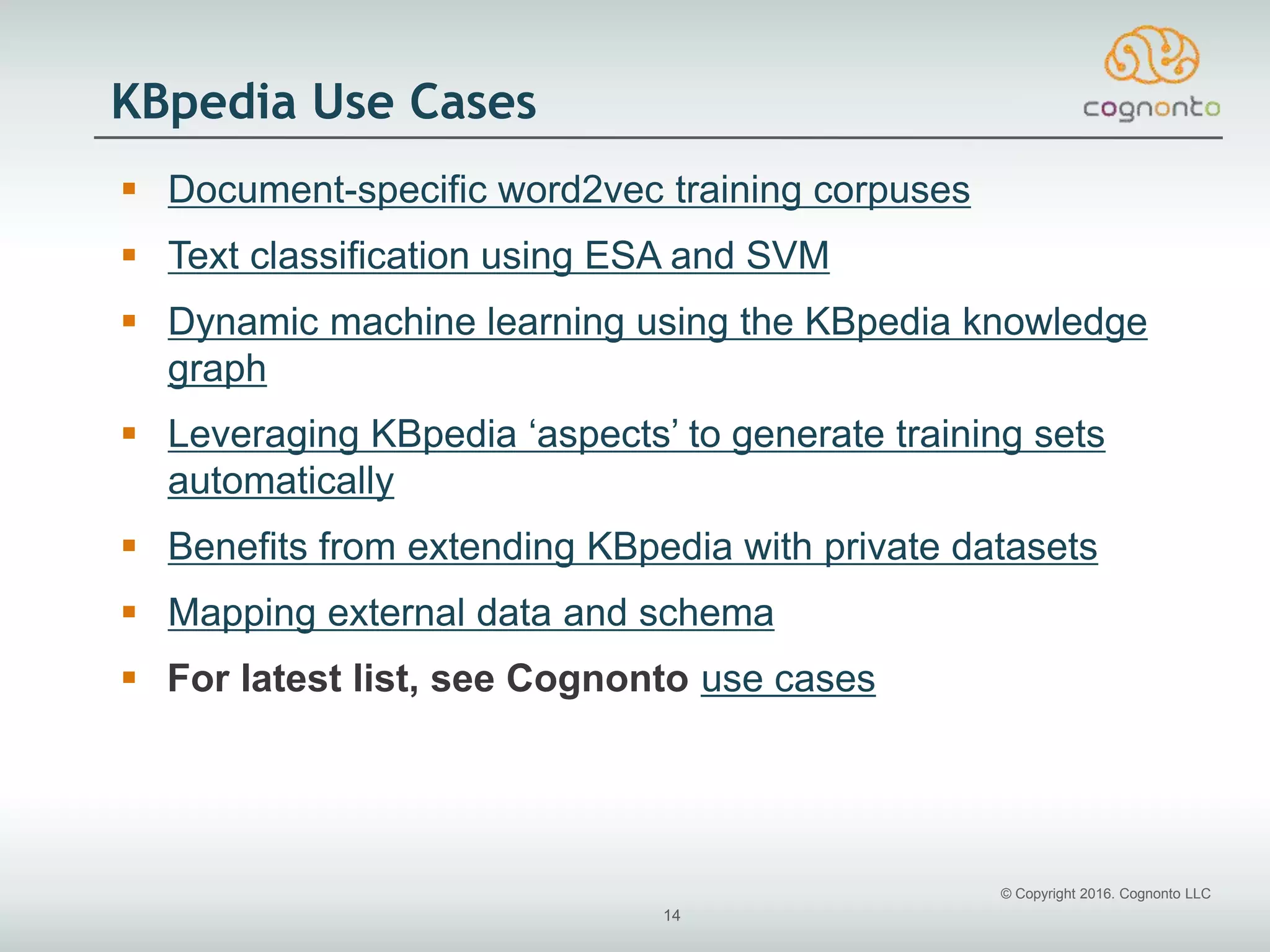
KBpedia Use Cases
 Document-specific word2vec training corpuses
 Text classification using ESA and SVM
 Dynamic machine learning using the KBpedia knowledge
graph
 Leveraging KBpedia ‘aspects’ to generate training sets
automatically
 Benefits from extending KBpedia with private datasets
 Mapping external data and schema
 For latest list, see Cognonto use cases
III. How is it Constructed?
TM
© Copyright 2016. Cognonto LLC
16
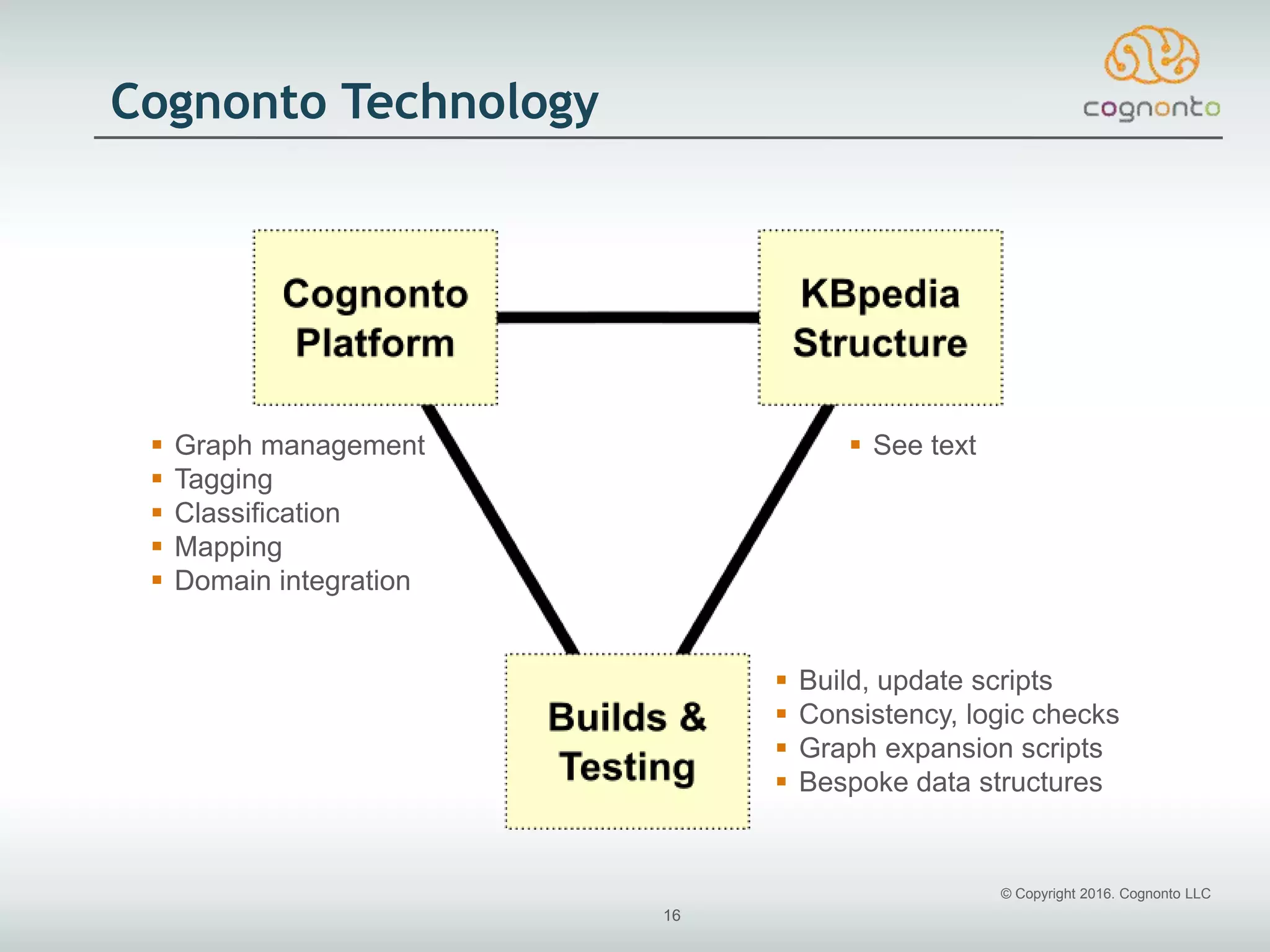
Cognonto Technology
 Graph management
 Tagging
 Classification
 Mapping
 Domain integration
 Build, update scripts
 Consistency, logic checks
 Graph expansion scripts
 Bespoke data structures
 See text
© Copyright 2016. Cognonto LLC
17
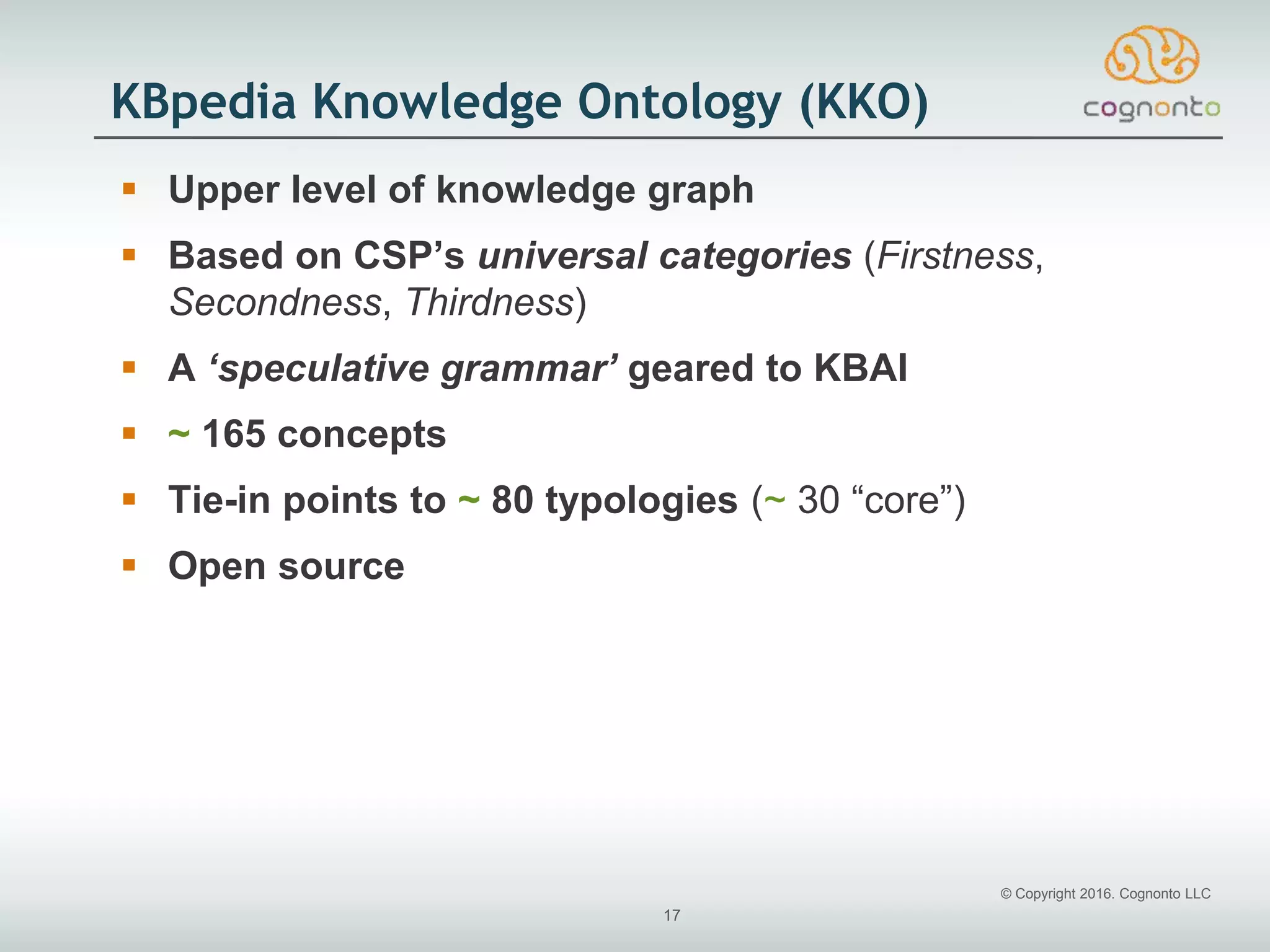
KBpedia Knowledge Ontology (KKO)
 Upper level of knowledge graph
 Based on CSP’s universal categories (Firstness,
Secondness, Thirdness)
 A ‘speculative grammar’ geared to KBAI
 ~ 165 concepts
 Tie-in points to ~ 80 typologies (~ 30 “core”)
 Open source
© Copyright 2016. Cognonto LLC
18
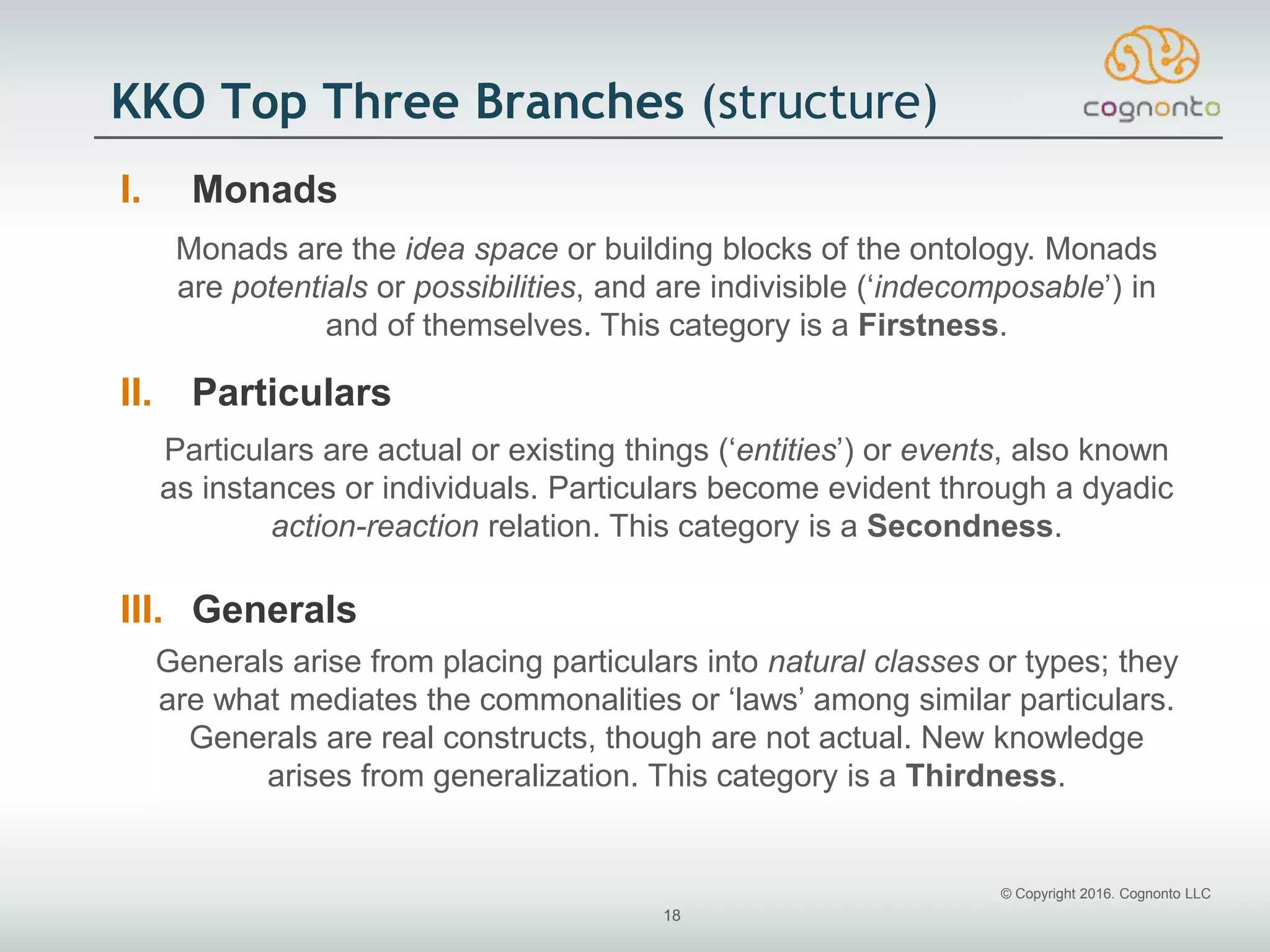
KKO Top Three Branches (structure)
I. Monads
II. Particulars
III. Generals
Monads are the idea space or building blocks of the ontology. Monads
are potentials or possibilities, and are indivisible (‘indecomposable’) in
and of themselves. This category is a Firstness.
Particulars are actual or existing things (‘entities’) or events, also known
as instances or individuals. Particulars become evident through a dyadic
action-reaction relation. This category is a Secondness.
Generals arise from placing particulars into natural classes or types; they
are what mediates the commonalities or ‘laws’ among similar particulars.
Generals are real constructs, though are not actual. New knowledge
arises from generalization. This category is a Thirdness.
© Copyright 2016. Cognonto LLC
19
KKO Monads Branch (1ns)
Monads [1ns]
FirstMonads [1ns]
Suchness [1ns]
Thisness [2ns]
Pluralness [3ns]
DyadicMonads [2ns]
Attributives [1ns]
Relatives [2ns]
Indicatives [3ns]
TriadicMonads [3ns]
Representation [1ns]
Mediation [2ns]
Mentation [3ns]
For complete branch: http://cognonto.com/docs/kko-upper-structure/
© Copyright 2016. Cognonto LLC
20
KKO Particulars Branch (2ns)
Particulars [2ns]
MonadicDyads [1ns]
MonoidalDyad [1ns]
EssentialDyad [2ns]
InherentialDyad [3ns]
Events [2ns]
Action [1ns]
Reaction [2ns]
Continuous [3ns]
Entities [3ns]
SingleEntities [1ns]
PartOfEntities [2ns]
ComplexEntities [3ns]
For complete branch: http://cognonto.com/docs/kko-upper-structure/
© Copyright 2016. Cognonto LLC
21
KKO Generals Branch (3ns)
Generals [3ns]
(== SuperTypes)
SignElements [1ns]
AttributeTypes [1ns]
RelationTypes [2ns]
Symbols [3ns]
Constituents [2ns]
NaturalPhenomena [1ns]
SpaceTypes [2ns]
TimeTypes [3ns]
Manifestations [3ns]
NaturalMatter [1ns]
OrganicMatter [2ns]
Symbolic [3ns]For complete branch: http://cognonto.com/docs/kko-upper-structure/
© Copyright 2016. Cognonto LLC
22
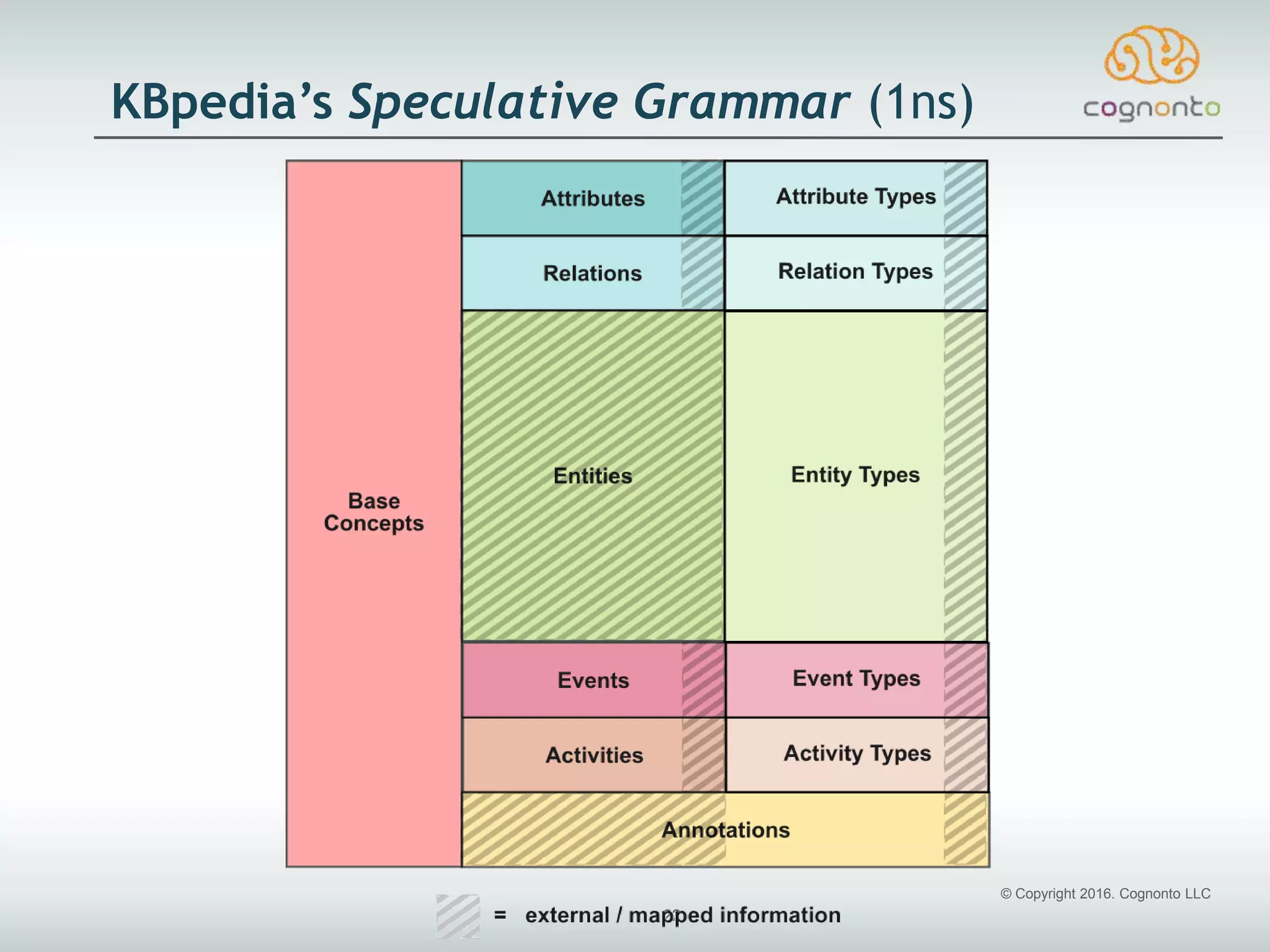
KBpedia’s Speculative Grammar (1ns)
© Copyright 2016. Cognonto LLC
23
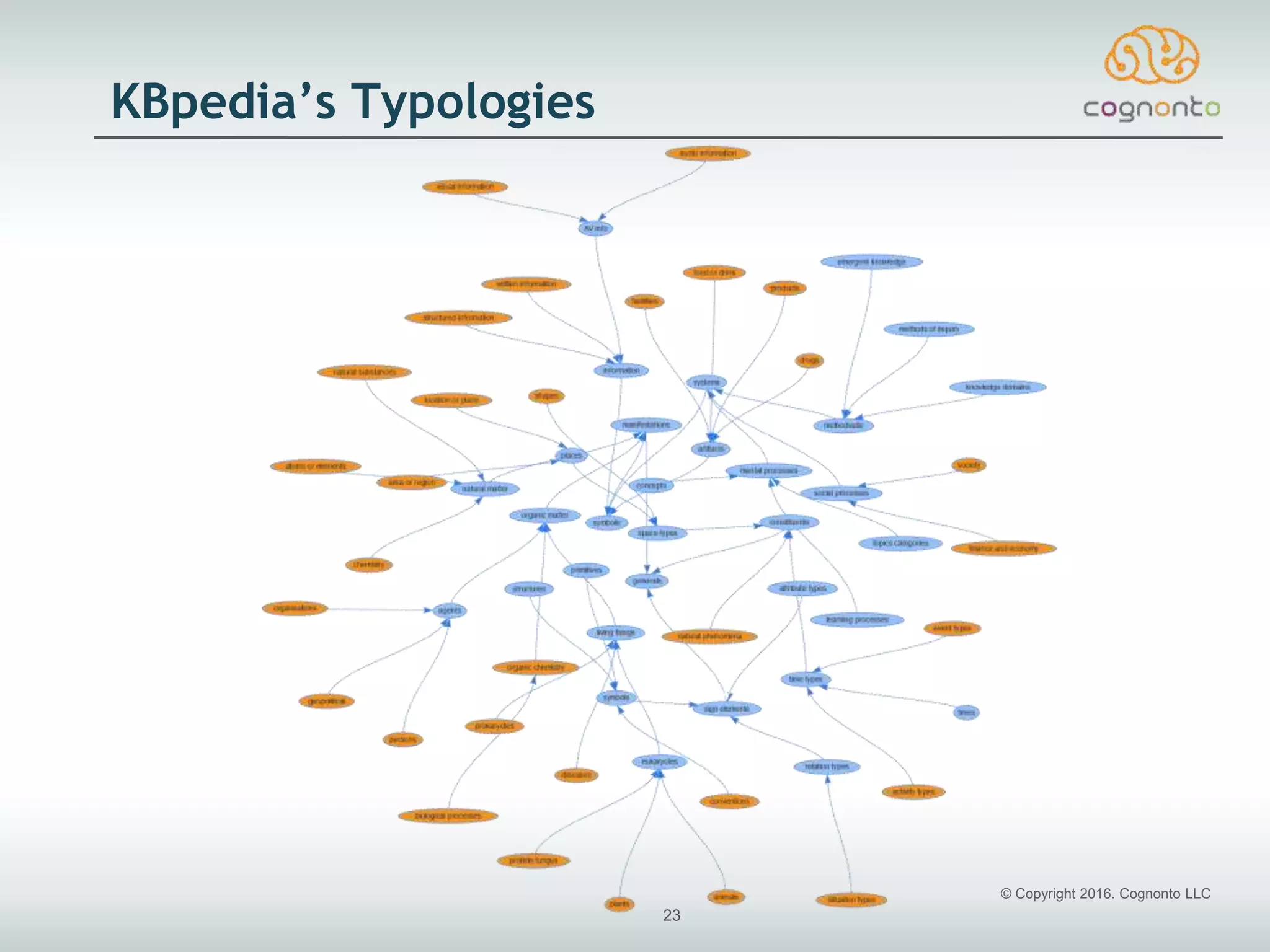
KBpedia’s Typologies
© Copyright 2016. Cognonto LLC
24
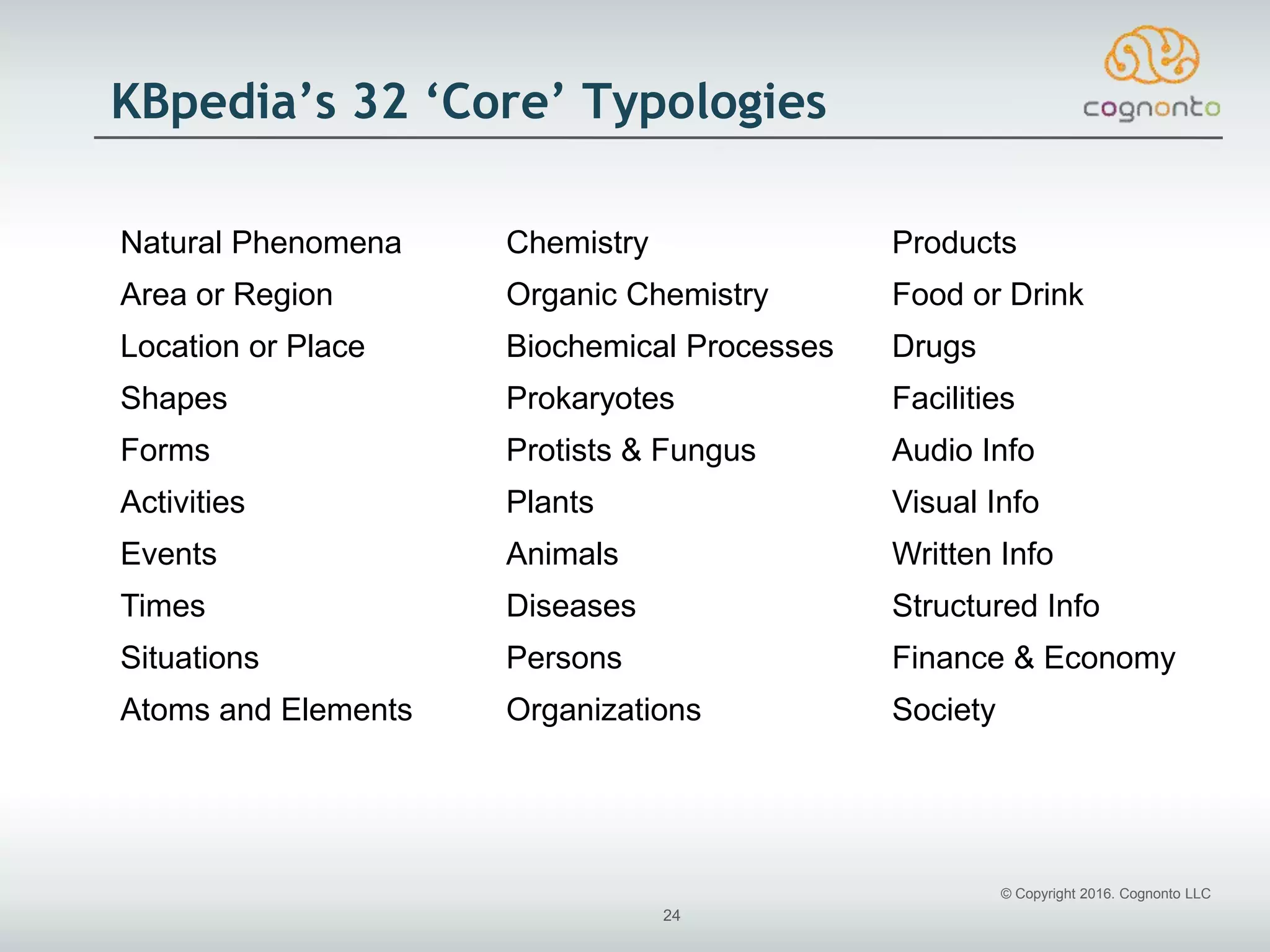
KBpedia’s 32 ‘Core’ Typologies
Natural Phenomena Chemistry Products
Area or Region Organic Chemistry Food or Drink
Location or Place Biochemical Processes Drugs
Shapes Prokaryotes Facilities
Forms Protists & Fungus Audio Info
Activities Plants Visual Info
Events Animals Written Info
Times Diseases Structured Info
Situations Persons Finance & Economy
Atoms and Elements Organizations Society
Natural Substances Geopolitical
© Copyright 2016. Cognonto LLC
25
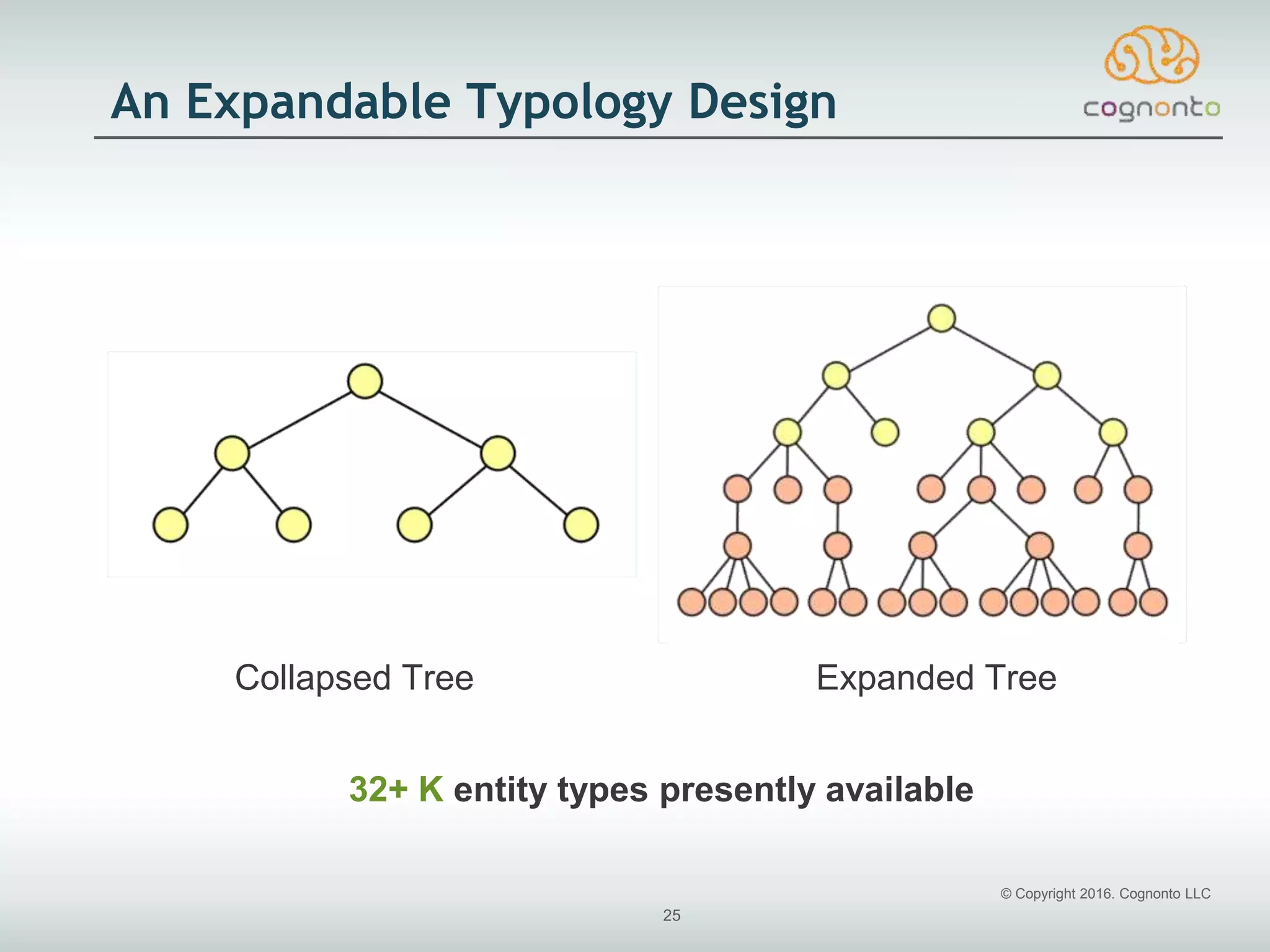
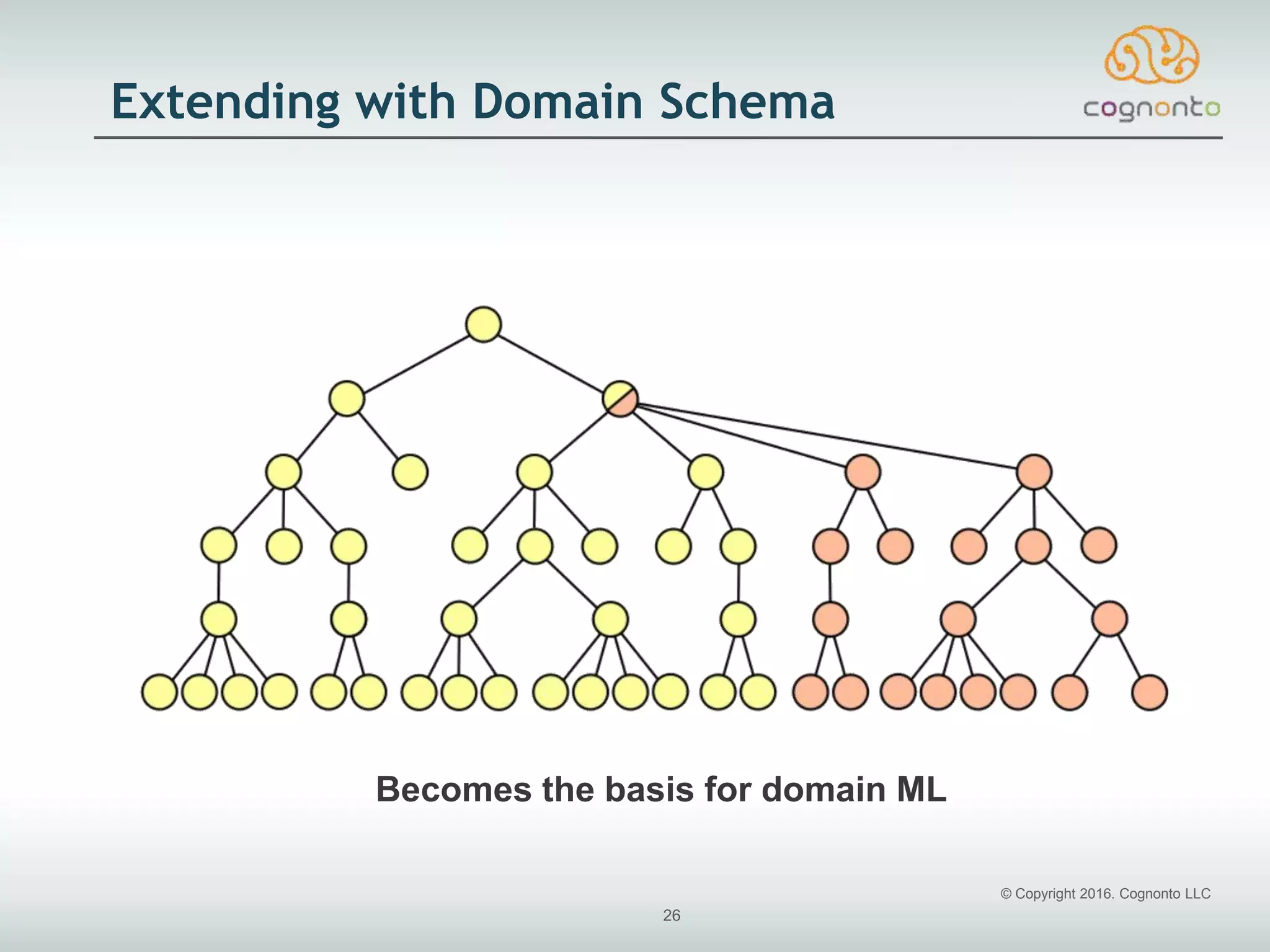
An Expandable Typology Design
Collapsed Tree Expanded Tree
32+ K entity types presently available
© Copyright 2016. Cognonto LLC
26
Extending with Domain Schema
Becomes the basis for domain ML
IV. Why it Offers New Ontological Choices
TM
© Copyright 2016. Cognonto LLC
28
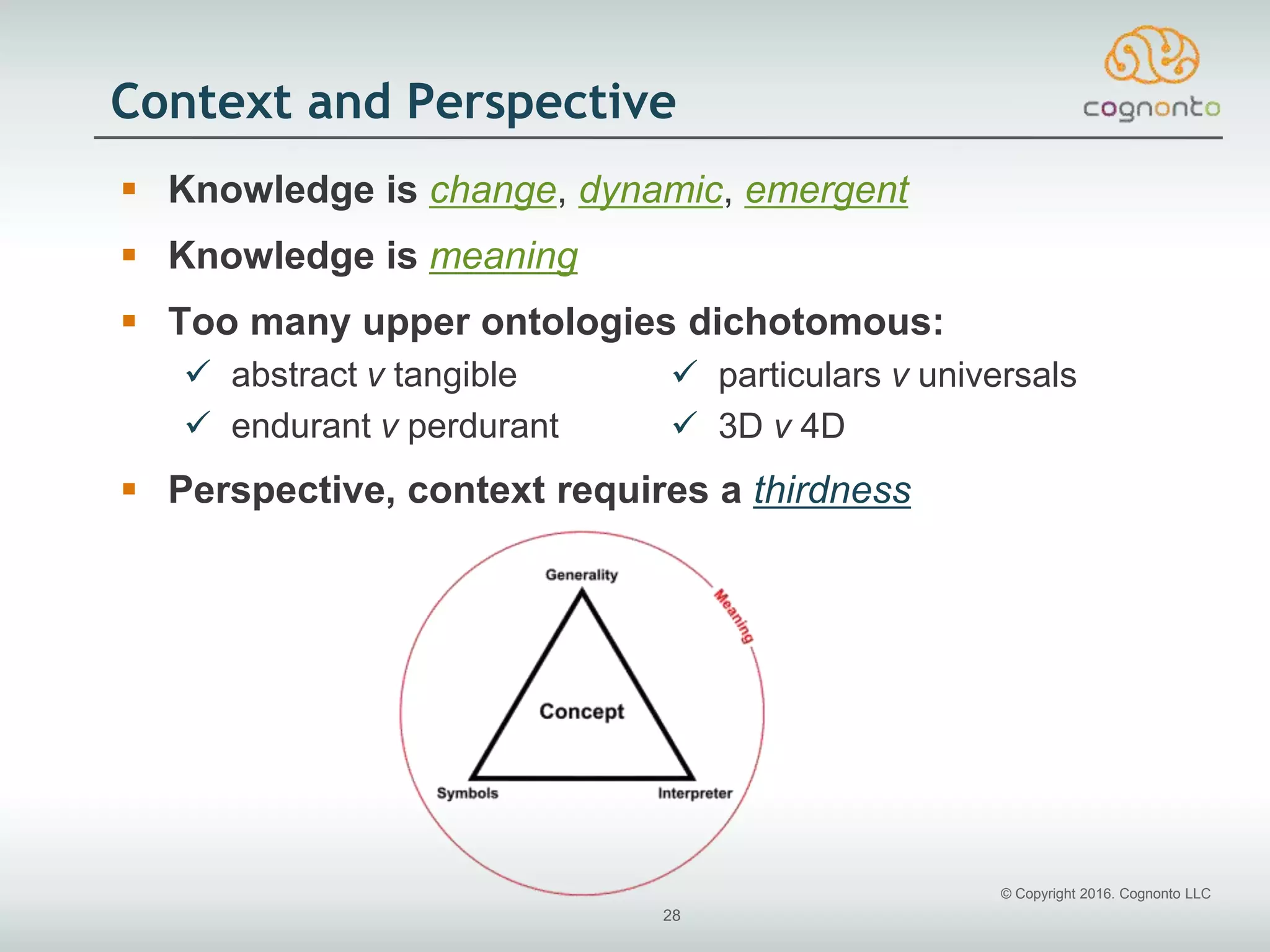
Context and Perspective
 Knowledge is change, dynamic, emergent
 Knowledge is meaning
 Too many upper ontologies dichotomous:
 abstract v tangible
 endurant v perdurant
 Perspective, context requires a thirdness
 particulars v universals
 3D v 4D
© Copyright 2016. Cognonto LLC
29
Treatment of Events
 Are events:
 actions ?
 particulars ?
 objects ?
 entities ?
 instances ?
 See Stanford Encyclopedia of Philosophy’s Events entry
 What is relationship of events to actions, activities? the
relationship to predicates?
 What is a situtation? what is a state?
 properties ?
 attributes ?
 facts ?
 perdurants ?
 times ?
© Copyright 2016. Cognonto LLC
30
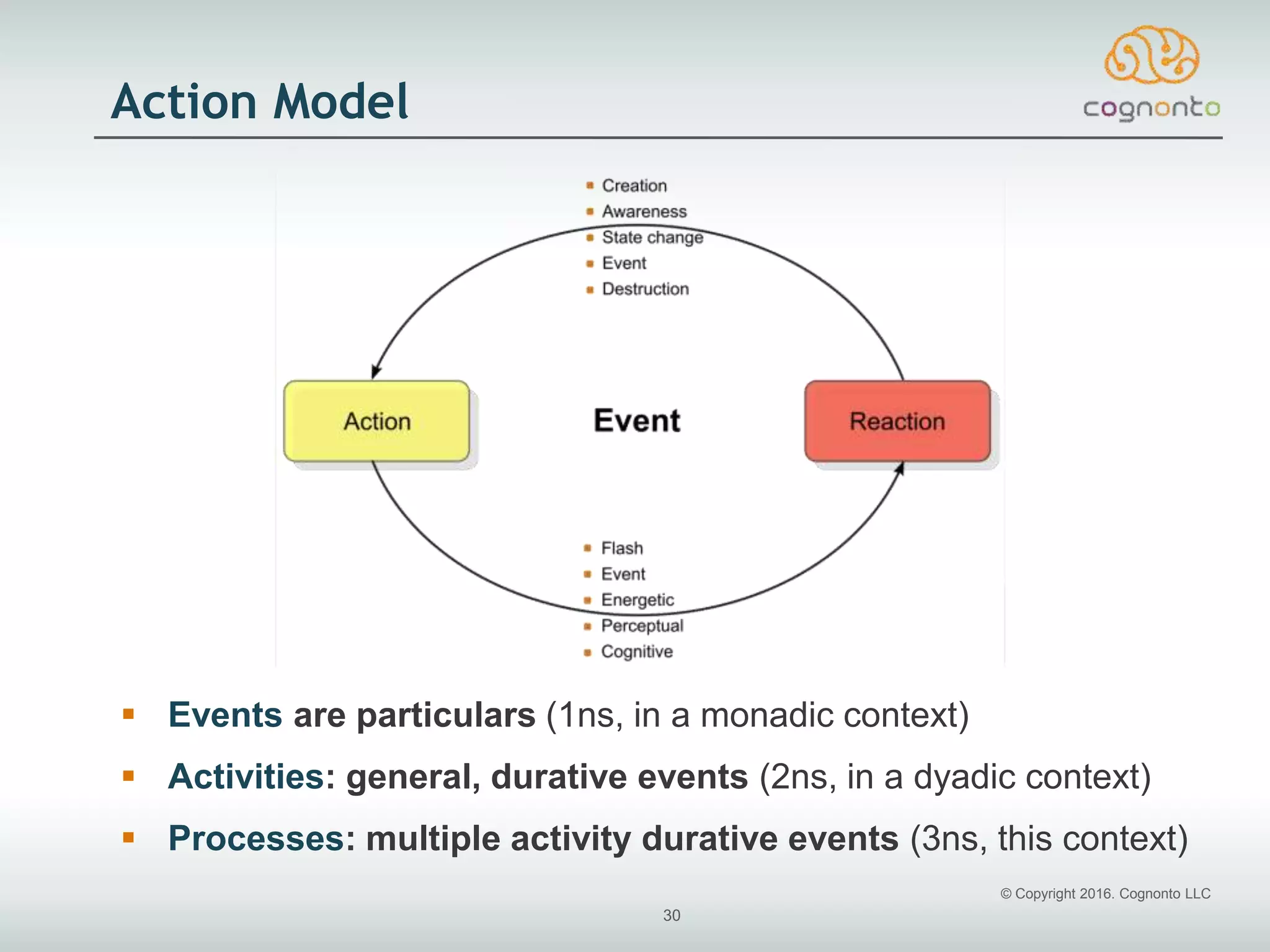
Action Model
 Events are particulars (1ns, in a monadic context)
 Activities: general, durative events (2ns, in a dyadic context)
 Processes: multiple activity durative events (3ns, this context)
© Copyright 2016. Cognonto LLC
31
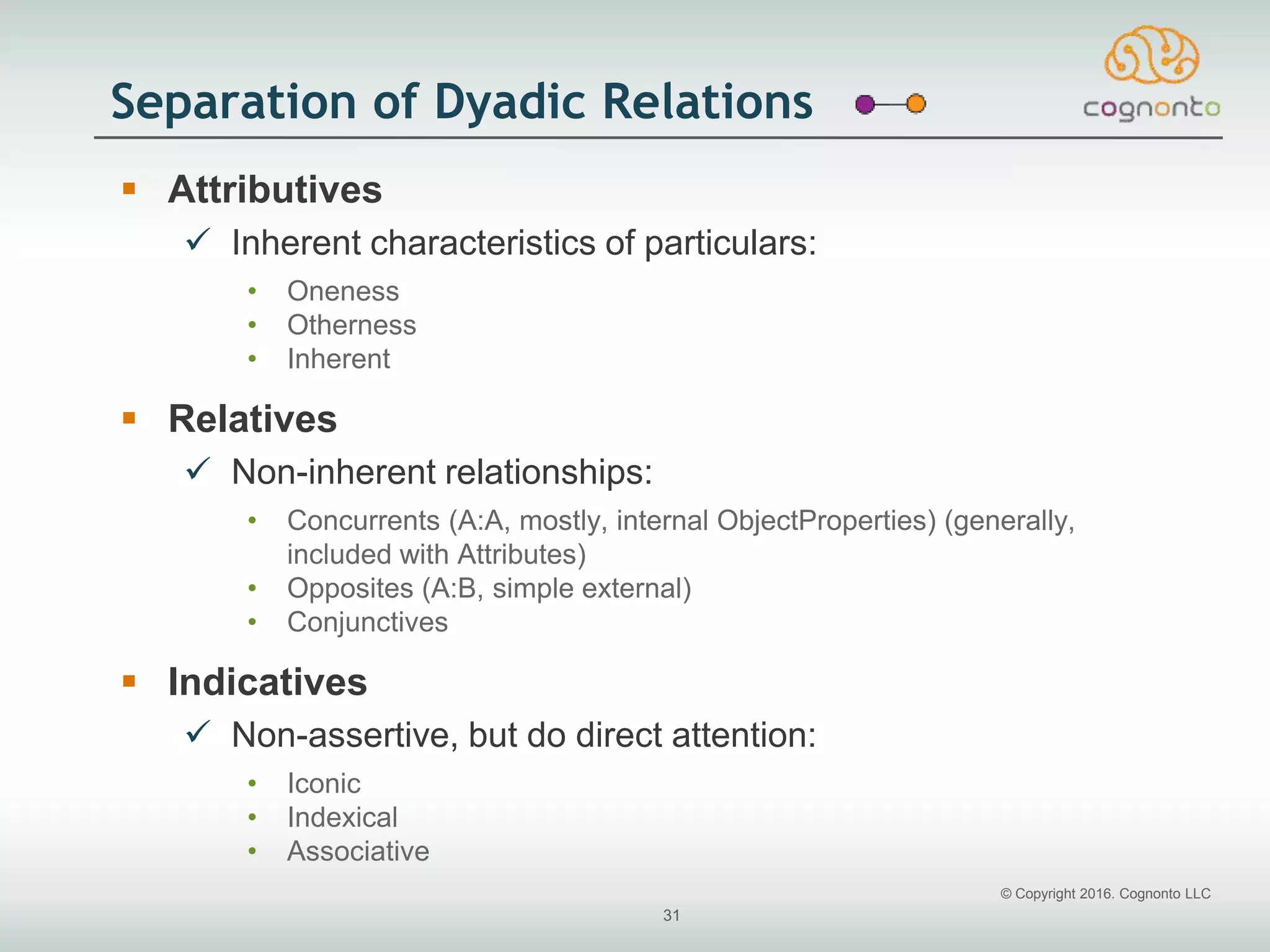
Separation of Dyadic Relations
 Attributives
 Inherent characteristics of particulars:
• Oneness
• Otherness
• Inherent
 Relatives
 Non-inherent relationships:
• Concurrents (A:A, mostly, internal ObjectProperties) (generally,
included with Attributes)
• Opposites (A:B, simple external)
• Conjunctives
 Indicatives
 Non-assertive, but do direct attention:
• Iconic
• Indexical
• Associative
© Copyright 2016. Cognonto LLC
32
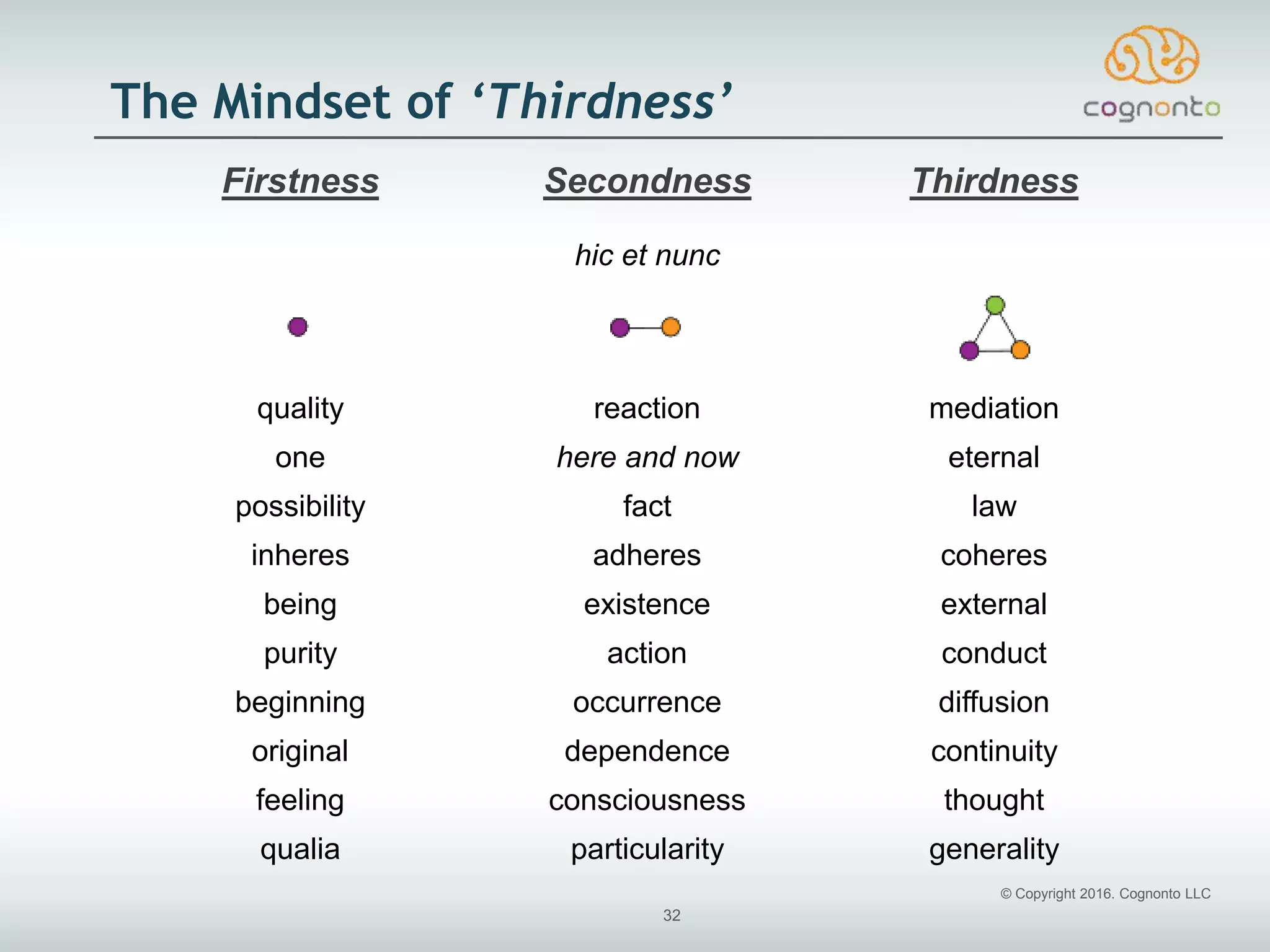
The Mindset of ‘Thirdness’
Firstness Secondness Thirdness
hic et nunc
quality reaction mediation
one here and now eternal
possibility fact law
inheres adheres coheres
being existence external
purity action conduct
beginning occurrence diffusion
original dependence continuity
feeling consciousness thought
qualia particularity generality
© Copyright 2016. Cognonto LLC
33
The Process of Categorization
 Determine if existing category needs splitting:
 imbalance in size
 emergences (!)
 If so, look to the 3ns of the category and:
1. Determine the vocabulary (“building blocks”) for the new space 
Firstness
2. Determine the particular real things and events for the space 
Secondness
3. Determine the laws, regularities, generalities for the new space 
Thirdness
4. Name and populate the three new sub-categories
“The fundamental principles of formal logic are not properly axioms, but definitions
and divisions; and the only facts which it contains relate to the identity of the
conceptions resulting from those processes with certain familiar ones.” (CP 3.149)
 new mappings
 new knowledge
V. Open Discussion
TM
© Copyright 2016. Cognonto LLC
35
Additional Potentials
 Mapping to more knowledge bases
 Exposing more structural features
 Peircean-based semantic parsers
 ML using graph structure, analytics
 Dynamic and reinforcement learning
 Continued ‘snake eating its tail’
 Further typology structuring of attributes and
relations  actual data values
© Copyright 2016. Cognonto LLC
36
Issues, Open Topics
 Qualifying types by Firstness, Secondness
 The application of Thirdness to Firstness and
Secondness
 Treatment of dyadic relatives (attributes split)
(Nomenclature and Divisions of Dyadic Relations, 1903)
 Treatment of values and quantities
 Placement, treatment of ethics and aesthetics (e.g.,
goodness and beauty)
 Continued Peircean scholarship  further
refinements
© Copyright 2016. Cognonto LLC
37
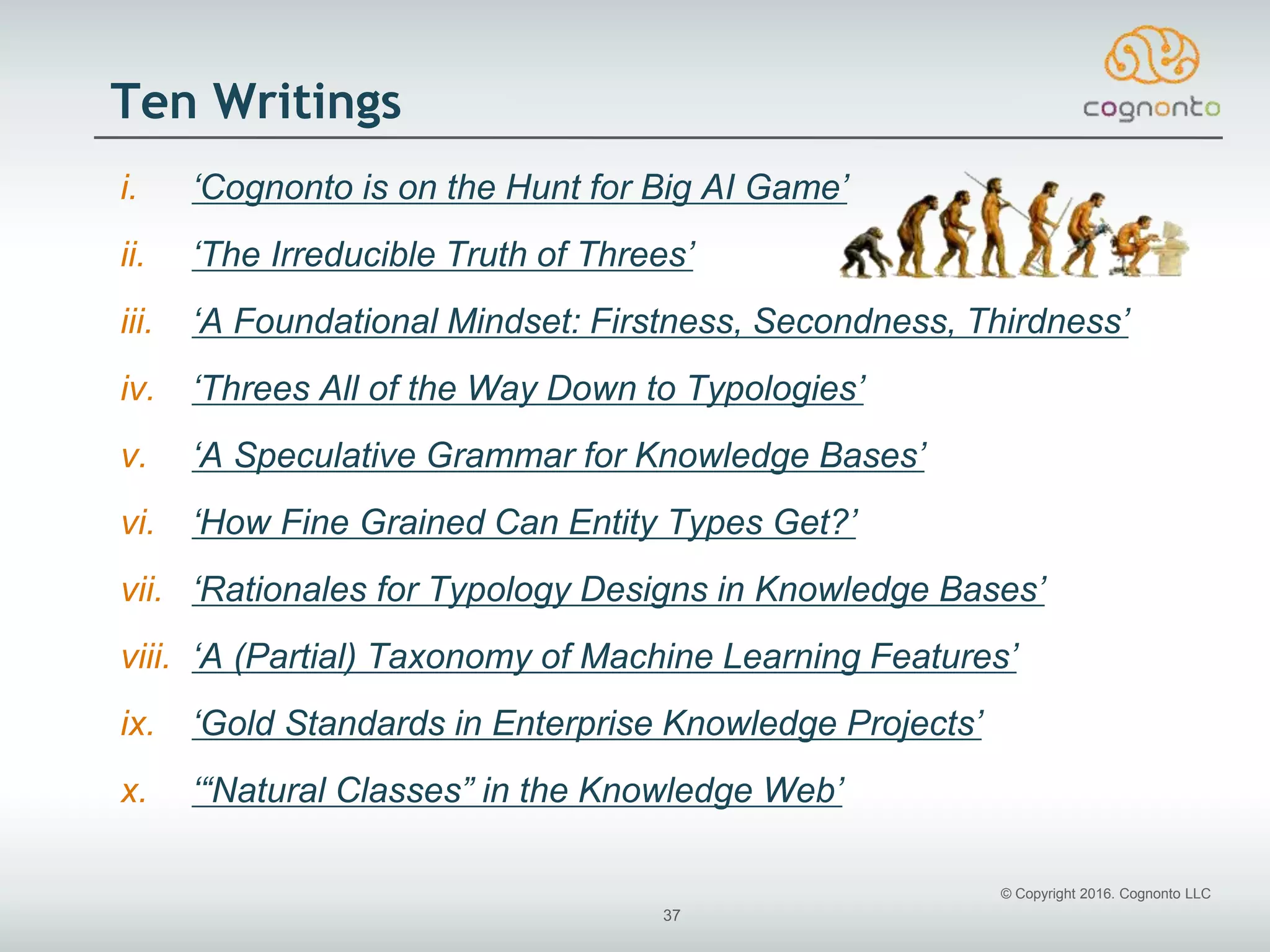
Ten Writings
i. ‘Cognonto is on the Hunt for Big AI Game’
ii. ‘The Irreducible Truth of Threes’
iii. ‘A Foundational Mindset: Firstness, Secondness, Thirdness’
iv. ‘Threes All of the Way Down to Typologies’
v. ‘A Speculative Grammar for Knowledge Bases’
vi. ‘How Fine Grained Can Entity Types Get?’
vii. ‘Rationales for Typology Designs in Knowledge Bases’
viii. ‘A (Partial) Taxonomy of Machine Learning Features’
ix. ‘Gold Standards in Enterprise Knowledge Projects’
x. ‘“Natural Classes” in the Knowledge Web’
© Copyright 2016. Cognonto LLC
38
NASCAR Stickers
 http://cognonto.com (demo + interactive knowledge graph)
 https://github.com/cognonto/kko (KKO)
 http://www.mkbergman.com/category/kbai/
 http://mkbergman.com
 http://fgiasson.com/blog
 http://structureddynamics.com

Context, Perspective, and Generalities in a Knowledge Ontology

  • 1.
    Context, Perspective, andGeneralities in a Knowledge Ontology TM Ontolog Forum Michael K. Bergman December 7, 2016
  • 2.
    © Copyright 2016.Cognonto LLC 2 Outline I. Genesis II. What is KBpedia? III. How is it Constructed? IV. Why it Offers New Ontological Choices V. Open Discussion
  • 3.
  • 4.
    © Copyright 2016.Cognonto LLC 4 8 Years in Process  2008: UMBEL – reference concepts for Web integration  2008: mapping to Cyc  2009: first typology design (‘SuperTypes’)  2010: mapping to Wikipedia; Wikipedia in KR  2011: my first writings on Charles Sanders Peirce  2011 ff: entity recognition, classification  2013: ‘Aha!’ moment; Cognonto effort begins  2014: re-inspection of UMBEL (Cyc, design, purpose)  2016: first release of Cognonto, KBpedia
  • 5.
    © Copyright 2016.Cognonto LLC 5 A Growing Fascination with Peirce  Charles Sanders Peirce (“purse”) (1839-1914)  Polymath, philosopher, scientist, logician, mathematician  John Sowa’s writings  Key contributions (much untranscribed):  Logic of semiosis  Predicate logic, notations  Classification of signs, classification (general)  Universal categories (Firstness, Secondness, Thirdness)  Pragmaticism (Pragmatic Maxim)  Abductive logic  Existential graphs  IMO: Greatest thinker on knowledge and KR
  • 6.
    © Copyright 2016.Cognonto LLC 6 The ‘Aha!’ Moment  Inconsistent, incoherent Wikipedia categories  Wikipedia bespoke, core knowledge structure in:  DBpedia  Freebase  Google KG, Now  Siri  Big data was a key driver in recent AI breakthroughs  2013: Why not systematize knowledge bases for AI purposes?  KBAI  Intuition:  Multiple KBs  Shared foundation  Fine-grained types (70K +)  IBM Watson  Cortana  Viv  etc.  Need for common schema  Design for AI (features, structure, KR model)
  • 7.
    © Copyright 2016.Cognonto LLC 7 Exciting Research and Growth Options  Nearly automatic creation of training sets and corpuses  Rich structure and feature sets  New AI testbed for knowledge representation (KR)  Integrating graph models with standard KR, AI  Application of abductive logic to learning processes  More powerful basis for data interoperability, integration
  • 8.
    II. What isKBpedia? TM
  • 9.
    © Copyright 2016.Cognonto LLC 9 Cognonto Overview  Cognonto = cognition + ontology = knowledge-based AI (KBAI)  Boutique enterprise services:  Supervised, unsupervised, deep machine learning  Information integration  Recognition, extraction, tagging  Specialty expertise  Three technology components  KBpedia: integration of 6 + 20 KBs  Developing use cases with clients
  • 10.
    © Copyright 2016.Cognonto LLC 10 KBpedia Knowledge Structure
  • 11.
    © Copyright 2016.Cognonto LLC 11 20 Other KBs, Vocabularies  Bibliography Ontology  Creative Commons  DBpedia Ontology  Description of a Project (DOAP)  Dublin Core  Event Ontology  FRBR  Friend of a Friend  Geo  Music Ontology  Open Organizations  Organization Ontology  Programmes Ontology  RSS Ontology  schema.org  SIOC  Time Ontology  TRANSIT  US PTO
  • 12.
    © Copyright 2016.Cognonto LLC 12 KBpedia Design Basis  Based on triadic logic of C.S. Peirce  Feature-rich KKO structure:  Entities  Attributes  Relations  Events  Written in OWL2:  Reasoning  Inference  SPARQL  Explicitly structured for AI in:  Natural language understanding (NLU)  Feature extraction and generation  Labeling training sets and corpuses  Easily extensible with client data, schema  Types  Concepts  Annotations  Text  Disjointedness  Aggregations  Restrictions
  • 13.
    © Copyright 2016.Cognonto LLC 13 KBpedia Statistics Area Value Knowledge bases  Six (6) core  20 extended  Domain-specific Concepts (classes)  39 K ‘core’ reference concepts  138 K in standard  Client-specific Entities  32,000 K standard entities  Client-specific Assertions  3,700,000 K direct  6,500,000 K total (w/ inferred) Analyzable text  Full articles  Descriptions  Titles  Semsets  Links  Categories  Infoboxes  See also  Multiple (200+) languages
  • 14.
    © Copyright 2016.Cognonto LLC 14 KBpedia Use Cases  Document-specific word2vec training corpuses  Text classification using ESA and SVM  Dynamic machine learning using the KBpedia knowledge graph  Leveraging KBpedia ‘aspects’ to generate training sets automatically  Benefits from extending KBpedia with private datasets  Mapping external data and schema  For latest list, see Cognonto use cases
  • 15.
    III. How isit Constructed? TM
  • 16.
    © Copyright 2016.Cognonto LLC 16 Cognonto Technology  Graph management  Tagging  Classification  Mapping  Domain integration  Build, update scripts  Consistency, logic checks  Graph expansion scripts  Bespoke data structures  See text
  • 17.
    © Copyright 2016.Cognonto LLC 17 KBpedia Knowledge Ontology (KKO)  Upper level of knowledge graph  Based on CSP’s universal categories (Firstness, Secondness, Thirdness)  A ‘speculative grammar’ geared to KBAI  ~ 165 concepts  Tie-in points to ~ 80 typologies (~ 30 “core”)  Open source
  • 18.
    © Copyright 2016.Cognonto LLC 18 KKO Top Three Branches (structure) I. Monads II. Particulars III. Generals Monads are the idea space or building blocks of the ontology. Monads are potentials or possibilities, and are indivisible (‘indecomposable’) in and of themselves. This category is a Firstness. Particulars are actual or existing things (‘entities’) or events, also known as instances or individuals. Particulars become evident through a dyadic action-reaction relation. This category is a Secondness. Generals arise from placing particulars into natural classes or types; they are what mediates the commonalities or ‘laws’ among similar particulars. Generals are real constructs, though are not actual. New knowledge arises from generalization. This category is a Thirdness.
  • 19.
    © Copyright 2016.Cognonto LLC 19 KKO Monads Branch (1ns) Monads [1ns] FirstMonads [1ns] Suchness [1ns] Thisness [2ns] Pluralness [3ns] DyadicMonads [2ns] Attributives [1ns] Relatives [2ns] Indicatives [3ns] TriadicMonads [3ns] Representation [1ns] Mediation [2ns] Mentation [3ns] For complete branch: http://cognonto.com/docs/kko-upper-structure/
  • 20.
    © Copyright 2016.Cognonto LLC 20 KKO Particulars Branch (2ns) Particulars [2ns] MonadicDyads [1ns] MonoidalDyad [1ns] EssentialDyad [2ns] InherentialDyad [3ns] Events [2ns] Action [1ns] Reaction [2ns] Continuous [3ns] Entities [3ns] SingleEntities [1ns] PartOfEntities [2ns] ComplexEntities [3ns] For complete branch: http://cognonto.com/docs/kko-upper-structure/
  • 21.
    © Copyright 2016.Cognonto LLC 21 KKO Generals Branch (3ns) Generals [3ns] (== SuperTypes) SignElements [1ns] AttributeTypes [1ns] RelationTypes [2ns] Symbols [3ns] Constituents [2ns] NaturalPhenomena [1ns] SpaceTypes [2ns] TimeTypes [3ns] Manifestations [3ns] NaturalMatter [1ns] OrganicMatter [2ns] Symbolic [3ns]For complete branch: http://cognonto.com/docs/kko-upper-structure/
  • 22.
    © Copyright 2016.Cognonto LLC 22 KBpedia’s Speculative Grammar (1ns)
  • 23.
    © Copyright 2016.Cognonto LLC 23 KBpedia’s Typologies
  • 24.
    © Copyright 2016.Cognonto LLC 24 KBpedia’s 32 ‘Core’ Typologies Natural Phenomena Chemistry Products Area or Region Organic Chemistry Food or Drink Location or Place Biochemical Processes Drugs Shapes Prokaryotes Facilities Forms Protists & Fungus Audio Info Activities Plants Visual Info Events Animals Written Info Times Diseases Structured Info Situations Persons Finance & Economy Atoms and Elements Organizations Society Natural Substances Geopolitical
  • 25.
    © Copyright 2016.Cognonto LLC 25 An Expandable Typology Design Collapsed Tree Expanded Tree 32+ K entity types presently available
  • 26.
    © Copyright 2016.Cognonto LLC 26 Extending with Domain Schema Becomes the basis for domain ML
  • 27.
    IV. Why itOffers New Ontological Choices TM
  • 28.
    © Copyright 2016.Cognonto LLC 28 Context and Perspective  Knowledge is change, dynamic, emergent  Knowledge is meaning  Too many upper ontologies dichotomous:  abstract v tangible  endurant v perdurant  Perspective, context requires a thirdness  particulars v universals  3D v 4D
  • 29.
    © Copyright 2016.Cognonto LLC 29 Treatment of Events  Are events:  actions ?  particulars ?  objects ?  entities ?  instances ?  See Stanford Encyclopedia of Philosophy’s Events entry  What is relationship of events to actions, activities? the relationship to predicates?  What is a situtation? what is a state?  properties ?  attributes ?  facts ?  perdurants ?  times ?
  • 30.
    © Copyright 2016.Cognonto LLC 30 Action Model  Events are particulars (1ns, in a monadic context)  Activities: general, durative events (2ns, in a dyadic context)  Processes: multiple activity durative events (3ns, this context)
  • 31.
    © Copyright 2016.Cognonto LLC 31 Separation of Dyadic Relations  Attributives  Inherent characteristics of particulars: • Oneness • Otherness • Inherent  Relatives  Non-inherent relationships: • Concurrents (A:A, mostly, internal ObjectProperties) (generally, included with Attributes) • Opposites (A:B, simple external) • Conjunctives  Indicatives  Non-assertive, but do direct attention: • Iconic • Indexical • Associative
  • 32.
    © Copyright 2016.Cognonto LLC 32 The Mindset of ‘Thirdness’ Firstness Secondness Thirdness hic et nunc quality reaction mediation one here and now eternal possibility fact law inheres adheres coheres being existence external purity action conduct beginning occurrence diffusion original dependence continuity feeling consciousness thought qualia particularity generality
  • 33.
    © Copyright 2016.Cognonto LLC 33 The Process of Categorization  Determine if existing category needs splitting:  imbalance in size  emergences (!)  If so, look to the 3ns of the category and: 1. Determine the vocabulary (“building blocks”) for the new space  Firstness 2. Determine the particular real things and events for the space  Secondness 3. Determine the laws, regularities, generalities for the new space  Thirdness 4. Name and populate the three new sub-categories “The fundamental principles of formal logic are not properly axioms, but definitions and divisions; and the only facts which it contains relate to the identity of the conceptions resulting from those processes with certain familiar ones.” (CP 3.149)  new mappings  new knowledge
  • 34.
  • 35.
    © Copyright 2016.Cognonto LLC 35 Additional Potentials  Mapping to more knowledge bases  Exposing more structural features  Peircean-based semantic parsers  ML using graph structure, analytics  Dynamic and reinforcement learning  Continued ‘snake eating its tail’  Further typology structuring of attributes and relations  actual data values
  • 36.
    © Copyright 2016.Cognonto LLC 36 Issues, Open Topics  Qualifying types by Firstness, Secondness  The application of Thirdness to Firstness and Secondness  Treatment of dyadic relatives (attributes split) (Nomenclature and Divisions of Dyadic Relations, 1903)  Treatment of values and quantities  Placement, treatment of ethics and aesthetics (e.g., goodness and beauty)  Continued Peircean scholarship  further refinements
  • 37.
    © Copyright 2016.Cognonto LLC 37 Ten Writings i. ‘Cognonto is on the Hunt for Big AI Game’ ii. ‘The Irreducible Truth of Threes’ iii. ‘A Foundational Mindset: Firstness, Secondness, Thirdness’ iv. ‘Threes All of the Way Down to Typologies’ v. ‘A Speculative Grammar for Knowledge Bases’ vi. ‘How Fine Grained Can Entity Types Get?’ vii. ‘Rationales for Typology Designs in Knowledge Bases’ viii. ‘A (Partial) Taxonomy of Machine Learning Features’ ix. ‘Gold Standards in Enterprise Knowledge Projects’ x. ‘“Natural Classes” in the Knowledge Web’
  • 38.
    © Copyright 2016.Cognonto LLC 38 NASCAR Stickers  http://cognonto.com (demo + interactive knowledge graph)  https://github.com/cognonto/kko (KKO)  http://www.mkbergman.com/category/kbai/  http://mkbergman.com  http://fgiasson.com/blog  http://structureddynamics.com