Content Repositories vs. Knowledge Bases… 12 November, 2009,  Gokce Banu Laleci, SRDC
Outline Content Management Systems and Content Repositories Strength of Ontologies, Reasoners, Kowledge bases Possible Synergy: How can semantic web tools can be exploited by CMSs… Possible architecture… (c) Interactive Knowledge 2009-2012 Slide
Content Management Systems Content management system is designed to support a content management cycle  creation and collection  of content the  publication of content for access by users and/or other systems the  management of these content Content Repository: a high-level information management system that is a superset of traditional data repositories, [which] implements 'content services‘: author based versioning full textual searching fine grained access control content categorization content event monitoring Content Repositories  implemented RDBMS File Systems XML DBs … . (c) Interactive Knowledge 2009-2012 Slide
How Content is Structured in Content Repositories JSR-170 :  Java Content Repository API Content Management Interoperability Services (CMIS) (c) Interactive Knowledge 2009-2012 Slide  Repository Item Property Node parent parent * * 1 0..1 child * 1 Root Node News Article News Article Title=Genetic Clues to Eating Disorders Author: John Adams Content:Attachment title= Anorexic says man need more help Author: Frank Smith Content:Attachment Repository Object Document Folder Relationship Policy Source, target Property Property Content target * Object Type -type id -parent -abstract -queryable -controllable Document Object  Type -versionable -allow content Folder Object Type Relationship Object Type -allowed source/target types Policy Object Type Property Type - property id -type -required -default value Node Type -name -supertypes -mixin ststus -orderable child node -primary item name Child Definitions -name -Required primary node types -Default primary Node Type -Auto-created -Mandatory -OnParent version -Protected -Same-name siblings Property Definitions - name -type -value constraints -default value -mandatory -protected -multiple values -on parent version -auto created
How Metadata is added, Supported search methods..  Metadata Organizing the content as hierarchies Through properties/parameters of nodes/objects/documents Free format values, or selected from a constrained vocabulary ( which can be a taxonomy) Can be used as content categories By representing relationships between nodes/objects/documents Taxonomies can be represented as t ags hierarchies  (as a hierarchy of nodes..) Node/Object/Document types XML Schemas Search Full-text Search Lucene,  SOLR, Text indices in databases F ield-based searches Structured Query methods over Repository Data Model SQL-based, XPath based S ynonym   check Through a list (c) Interactive Knowledge 2009-2012 Slide
Strength of Semantic Technologies 1 An ontology is an engineering artifact consisting of:  A  vocabulary  used to describe (a particular view of) some domain An  explicit specification  of the  intended meaning  of the vocabulary.  Almost always includes how concepts should be classified Constraints capturing  additional knowledge  about the domain Through rules Ideally, an ontology should: Capture a  shared understanding  of a domain of interest Provide a  formal  and  machine manipulable  model of the domain Aims “ machine understanding ” Understanding is closely related to reasoning Recognising  semantic   similarity  in spite of syntactic differences Recognising  implicit consequences  given explicitly stated facts An ontology together with a set of instances of its classes constitutes a knowledge base (c) Interactive Knowledge 2009-2012 Slide
Examples… (c) Interactive Knowledge 2009-2012 Slide  Workspace1 NewsSubjectCodes Health Economy Business Finance Disaster/ Accident Education NewsArticles Article2 Article1 Article3 Disease HealthTreatment Illness Cancer ViralDiseases classifiedBy classifiedBy classifiedBy -NewsSubjectCodes -ArtsCultureEntertainment -DisasterAccident -EconomyBusinessFinance -Education -EnvironmentalIssues -Health -HealthTreatment -Illness -ViralDisease -Cancer -......... -Medicine -SocialIssues instanceOf instanceOf -Disease instanceOf A. Content Repository B. Apart of the Extracted Ontology SwineFlu Rule:  If a  Disease iscausedby  PathogenicAgent  then it is an  infectiousDisease   Facts:  Virus   Is a  PathogenicAgent  Fungi  Is a  PathogenicAgent  ViralDisease iscausedby  Virus Search: Find me the “Health” related Articles Results: Article1, Article 2, Article 3  (due to subsumption relations in the ontology) Search: Find me the Articles related with “Infectious Diseases”  Results: Article 3 Article1 Article 2 Article3
How Semantic Technologies can be exploited by CMSs.. (c) Interactive Knowledge 2009-2012 Slide
Approaches for semantically enabled content management Semantic / Ontology enabled Web Portals 2,3 Using ontologies as a backbone of Web portals Designing the Schema based on Ontologies Ontology enabled Data Collection Ontology based Navigating Ontology based Search mechanisms supported through reasoning (c) Interactive Knowledge 2009-2012 Slide
Approaches for semantically enabled content management Semantic Wikis 4,5 Ontology enabled links Ontology enabled enhanced search and browsing Semantic / Ontology enabled CMS Systems 6,7 Developing a domain Ontology Ontology assisted content creation Ontology enabled navigation Ontology integrated search (c) Interactive Knowledge 2009-2012 Slide
How about already existing CMSs? Content Repositories already provide certain amount of semantics for content items Through content hierarchies, properties, taxonomies, node/object types… However this semantics is not “machine understandable”: can not be reasoned on… There is a need for an  “Integrated semantic engineering method” Enabling CMS developers to easily utilize semantic functionalities provided by ontologies, reasoners, without duplicating data and effort, and without a major change in their systems (c) Interactive Knowledge 2009-2012 Slide
IKS Approach for Extracting the Semantics from CMSs as Ontologies Nodetypes/Object types/Document Types can be automatically converted in to OWL Classes Properties as object and Data type Properties Restrictions when necessary Nodes of these nodetypes can be created as instances… A similar approach has been provided for Drupal System 8 How about the semantics other than node/object types? Links between content items Taxonomies Content hierarchies IKS should provide a generic approach for a variety of different CMS Systems…
Workspace1 Nodetype unstructured File Resource HotelDescription supertypes AsteriaTourismPortal IbisHotel Hilton NovHotel Sheroton facility=“Pool” primaryType sisterHotel < HotelDescription rdf:ID=“Novotel” > <sisterHotel rdf:about=“#IbisHotel”/> <facility rdf:dataType=“&xsd:String”>Pool </quality> </HotelDescription> …… propertyDefinition propertyDefinition Name=“sisterHotel requiredType Name=“facility”
Workspace1 Nodetype unstructured File Resource HotelDescription supertypes AsteriaTourismPortal IbisHotel Hilton NovHotel Sheroton facility=“Pool” primaryType sisterHotel propertyDefinition propertyDefinition Name=“sisterHotel requiredType TourismServicesClassification FlightBooking Tours Hotel 4StarHotel 3StarHotel type < HoteDescription rdf:ID=“Novotel” > <sisterHotel rdf:about=“#IbisHotel”/> <facility rdf:dataType=“&xsd:String”>Pool </quality> </HotelDescription> <4StarHotel rdf:about=“#Novotel”/ > …… <owl:Class rdf:ID=“ ToursismServicesClassification” > <owl:Class rdf:ID=“ Hotel > <rdfs:subClassOf rdf:resource=&quot;# TourismServicesClassification &quot;/> </owl:Class> <owl:Class rdf:ID=“ 4StarHotel > <rdfs:subClassOf rdf:resource= “Hotel &quot;/> </owl:Class> … .. Represented as Classes… Represented as Instances… How can I know the semantics of “type” What if the property was “suitableFor” And its is bound to a classification of people < HoteDescription rdf:ID=“Novotel” > <sisterHotel rdf:about=“#IbisHotel”/> <facility rdf:dataType=“&xsd:String”>Pool </quality> <suitableFor rdf:about=“#YoungCouples”/> </HotelDescription> <4StarHotel rdf:about=“#Novotel”/ > ……
Mapping GUI Content Repository Flex RIA Content Repository Model JCR ConceptBridge PropertyBridge Subsumption Bridge InstanceBridge Mapping Definition Mapping Engine
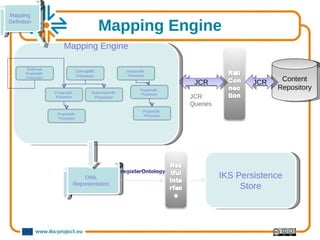
Mapping Engine Content Repository JCR Mapping Definition Mapping Engine ConceptBr. Processor PropertyBr. Processor SubsumptonBr . Processor PropertyBr. Processor Enforced PropertyBr. Processor InstanceBr. Processor PropertyBr. Processor PropertyBr. Processor JCR JCR  Queries OWL Representation IKS Persistence Store
Mapping Engine Content Repository JCR Mapping Definition Mapping   Engine ConceptBr. Processor PropertyBr. Processor SubsumptonBr . Processor PropertyBr. Processor Enforced PropertyBr. Processor InstanceBr. Processor PropertyBr . Processor PropertyBr. Processor JCR IKS Persistence Store JCR Observations -Node Added -PropertyAdded
Initially Envisioned Architecture Content Repository JCR CMIS Semantic Extractor / Synchronization Persistency Store Restful API (Ontology Administration, Query) Lifted Ontology Restful API + GUI Domain Ontology Horizontal Ontology Ontology Lifting/ Alignment GUI+Engine Harmonized Ontology  Reasoners Rule Engines DBPedia, WordNet Example  Horizontal Application: RIA Faceted Search GUI Search Building  Blocks Structured Query LuceneSAIL/ LARQ Semantic  Similarity Metrics Hybrid  Approach JCR CMIS CMS
Merging with External Domain Ontologies (c) Interactive Knowledge 2009-2012 Slide  equavilentTo instanceOf instanceOf instanceOf instanceOf MeSH Biomedical Ontology -NewsSubjectCodes -ArtsCultureEntertainment -DisasterAccident -EconomyBusinessFinance -Education -EnvironmentalIssues -Health -HealthTreatment -Illness -EatingDisorder -Obesity -Medicine -SocialIssues -Diease -Neurological Disease MotorNeuroneDiseaseGeneClue .................. ................ Professor Christopher Shaw, from the Institute of  Psychiatry  at Kings College London, said…….. GeneticCluesToEatingDisorders .................. ................ Doctors studying the causes of the eating disorders anorexia and bulimia believe it has less to do with media images of slim-figured models and more to do with biological and genetic factors…….. -NewsSubjectCodes -ArtsCultureEntertainment -DisasterAccident -EconomyBusinessFinance -Education -EnvironmentalIssues -Health -HealthTreatment -Illness -EatingDisorder -Obesity -Medicine -SocialIssues -Diease -Neurological Disease -MeSH -Anatomy -Diseases -Organisms -BehaviorMechanisms -Psychiatry -BehaviorDisciplines -MentalDisorders -AnxietyDisorders -EatingDisorders -SleepingDisorders -SomotoformDisorders Article_ED
Exploiting DBPedia relationships (c) Interactive Knowledge 2009-2012 Slide  MerkelOffersStateAidForOpel .........  German Chancellor  has given assurances that any investor in General Motors (GM) subsidiary Opel will have state support …… UKsaysMerkelbacksFiscalBoost .........  And he added that  German Chancellor  was &quot;fully engaged&quot; with the European economic debate…… Iptc:Politics Iptc:Economy Tagged By Tagged By dbp:Chancellorof_Germany dbp:Chancellorof_Germany Tagged By Tagged By GermanyAgreesBadBankScheme.........  Reports have said that  Angela Merkel's  government wants to see this achieved before the summer recess starts in early July …… dbp:Angela_Merkel Tagged By Returned by Solr dbprop:order
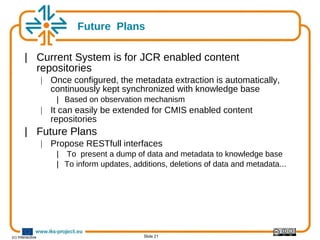
Future  Plans Current System is for JCR enabled content repositories Once configured, the metadata extraction is automatically, continuously kept synchronized with knowledge base  Based on observation mechanism It can easily be extended for CMIS enabled content repositories Future Plans Propose RESTfull interfaces To  present a dump of data and metadata to knowledge base To inform updates, additions, deletions of data and metadata... (c) Interactive Knowledge 2009-2012 Slide
Thank you, Questions… Contact Information: Gokce B. Laleci, Phd [email_address] Viewlets of Demonstration: http://www.srdc.com.tr/iks/screencast/
References.. Ian Horrocks, Ontology Reasoning: the Why and the How Y. Jin, S. Decker, G. Wiederhold. OntoWebber: Model-Driven Ontology-Based Web Site   Management S. Staab, J. Angele, S. Decker, M. Erdmann, A. Hotho, A. Maedche, H. P. Schnurr, R. Studer,  Y. Sure. Semantic community Web portals. Max Völkel, Markus Krötzsch, Denny Vrandecic, Heiko Haller, Rudi Studer ,  Semantic Wikipedia Sebastian Schaffert , IkeWiki: A SemanticWiki for Collaborative Knowledge Management DUC MINH LE,  LAU Lydia,  An Open Architecture for Ontology-Enabled Content Management Systems : A Case Study in Managing Learning Objects Roberto García, Juan Manuel Gimeno, Ferran Perdrix, Rosa Gil,  and Marta Oliv a, The Rhizomer Semantic Content Management System Stephane Corlosquet ,  Renaud Delbru, Tim Clark,   Axel Polleres, and Stefan Decker , Produce and Consume Linked Data with Drupal (c) Interactive Knowledge 2009-2012 Slide
The IKS Consortium 20.11.09 Project Lead and Coordination Salzburg Research Wernher Behrendt Salzburg Research Forschungsgesellschaft m.b.H. Jakob Haringer Straße 5/3 | 5020 Salzburg, Austria T +43.662.2288-409 | F +43.662.2288-222 [email_address] www.salzburgresearch.at Deutsches  Forschungsinstitut  für Künstliche  Intelligenz (DFKI) Universität St. Gallen Consiglio  Nationale delle  Ricerche (CNR) Software  Quality Lab Unversität Paderborn Software Research and  Development  Consultancy Ltd (SRDC) Hochschule Furtwangen Nuxeo Sa. Alkacon Software GmbH TXT Polymedia Pisano Holding GmbH Nemein Oy Day Software AG

Content Repositories vs Knowledge Bases

  • 1.
    Content Repositories vs.Knowledge Bases… 12 November, 2009, Gokce Banu Laleci, SRDC
  • 2.
    Outline Content ManagementSystems and Content Repositories Strength of Ontologies, Reasoners, Kowledge bases Possible Synergy: How can semantic web tools can be exploited by CMSs… Possible architecture… (c) Interactive Knowledge 2009-2012 Slide
  • 3.
    Content Management SystemsContent management system is designed to support a content management cycle creation and collection of content the publication of content for access by users and/or other systems the management of these content Content Repository: a high-level information management system that is a superset of traditional data repositories, [which] implements 'content services‘: author based versioning full textual searching fine grained access control content categorization content event monitoring Content Repositories implemented RDBMS File Systems XML DBs … . (c) Interactive Knowledge 2009-2012 Slide
  • 4.
    How Content isStructured in Content Repositories JSR-170 : Java Content Repository API Content Management Interoperability Services (CMIS) (c) Interactive Knowledge 2009-2012 Slide Repository Item Property Node parent parent * * 1 0..1 child * 1 Root Node News Article News Article Title=Genetic Clues to Eating Disorders Author: John Adams Content:Attachment title= Anorexic says man need more help Author: Frank Smith Content:Attachment Repository Object Document Folder Relationship Policy Source, target Property Property Content target * Object Type -type id -parent -abstract -queryable -controllable Document Object Type -versionable -allow content Folder Object Type Relationship Object Type -allowed source/target types Policy Object Type Property Type - property id -type -required -default value Node Type -name -supertypes -mixin ststus -orderable child node -primary item name Child Definitions -name -Required primary node types -Default primary Node Type -Auto-created -Mandatory -OnParent version -Protected -Same-name siblings Property Definitions - name -type -value constraints -default value -mandatory -protected -multiple values -on parent version -auto created
  • 5.
    How Metadata isadded, Supported search methods.. Metadata Organizing the content as hierarchies Through properties/parameters of nodes/objects/documents Free format values, or selected from a constrained vocabulary ( which can be a taxonomy) Can be used as content categories By representing relationships between nodes/objects/documents Taxonomies can be represented as t ags hierarchies (as a hierarchy of nodes..) Node/Object/Document types XML Schemas Search Full-text Search Lucene, SOLR, Text indices in databases F ield-based searches Structured Query methods over Repository Data Model SQL-based, XPath based S ynonym check Through a list (c) Interactive Knowledge 2009-2012 Slide
  • 6.
    Strength of SemanticTechnologies 1 An ontology is an engineering artifact consisting of: A vocabulary used to describe (a particular view of) some domain An explicit specification of the intended meaning of the vocabulary. Almost always includes how concepts should be classified Constraints capturing additional knowledge about the domain Through rules Ideally, an ontology should: Capture a shared understanding of a domain of interest Provide a formal and machine manipulable model of the domain Aims “ machine understanding ” Understanding is closely related to reasoning Recognising semantic similarity in spite of syntactic differences Recognising implicit consequences given explicitly stated facts An ontology together with a set of instances of its classes constitutes a knowledge base (c) Interactive Knowledge 2009-2012 Slide
  • 7.
    Examples… (c) InteractiveKnowledge 2009-2012 Slide Workspace1 NewsSubjectCodes Health Economy Business Finance Disaster/ Accident Education NewsArticles Article2 Article1 Article3 Disease HealthTreatment Illness Cancer ViralDiseases classifiedBy classifiedBy classifiedBy -NewsSubjectCodes -ArtsCultureEntertainment -DisasterAccident -EconomyBusinessFinance -Education -EnvironmentalIssues -Health -HealthTreatment -Illness -ViralDisease -Cancer -......... -Medicine -SocialIssues instanceOf instanceOf -Disease instanceOf A. Content Repository B. Apart of the Extracted Ontology SwineFlu Rule: If a Disease iscausedby PathogenicAgent then it is an infectiousDisease Facts: Virus Is a PathogenicAgent Fungi Is a PathogenicAgent ViralDisease iscausedby Virus Search: Find me the “Health” related Articles Results: Article1, Article 2, Article 3 (due to subsumption relations in the ontology) Search: Find me the Articles related with “Infectious Diseases” Results: Article 3 Article1 Article 2 Article3
  • 8.
    How Semantic Technologiescan be exploited by CMSs.. (c) Interactive Knowledge 2009-2012 Slide
  • 9.
    Approaches for semanticallyenabled content management Semantic / Ontology enabled Web Portals 2,3 Using ontologies as a backbone of Web portals Designing the Schema based on Ontologies Ontology enabled Data Collection Ontology based Navigating Ontology based Search mechanisms supported through reasoning (c) Interactive Knowledge 2009-2012 Slide
  • 10.
    Approaches for semanticallyenabled content management Semantic Wikis 4,5 Ontology enabled links Ontology enabled enhanced search and browsing Semantic / Ontology enabled CMS Systems 6,7 Developing a domain Ontology Ontology assisted content creation Ontology enabled navigation Ontology integrated search (c) Interactive Knowledge 2009-2012 Slide
  • 11.
    How about alreadyexisting CMSs? Content Repositories already provide certain amount of semantics for content items Through content hierarchies, properties, taxonomies, node/object types… However this semantics is not “machine understandable”: can not be reasoned on… There is a need for an “Integrated semantic engineering method” Enabling CMS developers to easily utilize semantic functionalities provided by ontologies, reasoners, without duplicating data and effort, and without a major change in their systems (c) Interactive Knowledge 2009-2012 Slide
  • 12.
    IKS Approach forExtracting the Semantics from CMSs as Ontologies Nodetypes/Object types/Document Types can be automatically converted in to OWL Classes Properties as object and Data type Properties Restrictions when necessary Nodes of these nodetypes can be created as instances… A similar approach has been provided for Drupal System 8 How about the semantics other than node/object types? Links between content items Taxonomies Content hierarchies IKS should provide a generic approach for a variety of different CMS Systems…
  • 13.
    Workspace1 Nodetype unstructuredFile Resource HotelDescription supertypes AsteriaTourismPortal IbisHotel Hilton NovHotel Sheroton facility=“Pool” primaryType sisterHotel < HotelDescription rdf:ID=“Novotel” > <sisterHotel rdf:about=“#IbisHotel”/> <facility rdf:dataType=“&xsd:String”>Pool </quality> </HotelDescription> …… propertyDefinition propertyDefinition Name=“sisterHotel requiredType Name=“facility”
  • 14.
    Workspace1 Nodetype unstructuredFile Resource HotelDescription supertypes AsteriaTourismPortal IbisHotel Hilton NovHotel Sheroton facility=“Pool” primaryType sisterHotel propertyDefinition propertyDefinition Name=“sisterHotel requiredType TourismServicesClassification FlightBooking Tours Hotel 4StarHotel 3StarHotel type < HoteDescription rdf:ID=“Novotel” > <sisterHotel rdf:about=“#IbisHotel”/> <facility rdf:dataType=“&xsd:String”>Pool </quality> </HotelDescription> <4StarHotel rdf:about=“#Novotel”/ > …… <owl:Class rdf:ID=“ ToursismServicesClassification” > <owl:Class rdf:ID=“ Hotel > <rdfs:subClassOf rdf:resource=&quot;# TourismServicesClassification &quot;/> </owl:Class> <owl:Class rdf:ID=“ 4StarHotel > <rdfs:subClassOf rdf:resource= “Hotel &quot;/> </owl:Class> … .. Represented as Classes… Represented as Instances… How can I know the semantics of “type” What if the property was “suitableFor” And its is bound to a classification of people < HoteDescription rdf:ID=“Novotel” > <sisterHotel rdf:about=“#IbisHotel”/> <facility rdf:dataType=“&xsd:String”>Pool </quality> <suitableFor rdf:about=“#YoungCouples”/> </HotelDescription> <4StarHotel rdf:about=“#Novotel”/ > ……
  • 15.
    Mapping GUI ContentRepository Flex RIA Content Repository Model JCR ConceptBridge PropertyBridge Subsumption Bridge InstanceBridge Mapping Definition Mapping Engine
  • 16.
    Mapping Engine ContentRepository JCR Mapping Definition Mapping Engine ConceptBr. Processor PropertyBr. Processor SubsumptonBr . Processor PropertyBr. Processor Enforced PropertyBr. Processor InstanceBr. Processor PropertyBr. Processor PropertyBr. Processor JCR JCR Queries OWL Representation IKS Persistence Store
  • 17.
    Mapping Engine ContentRepository JCR Mapping Definition Mapping Engine ConceptBr. Processor PropertyBr. Processor SubsumptonBr . Processor PropertyBr. Processor Enforced PropertyBr. Processor InstanceBr. Processor PropertyBr . Processor PropertyBr. Processor JCR IKS Persistence Store JCR Observations -Node Added -PropertyAdded
  • 18.
    Initially Envisioned ArchitectureContent Repository JCR CMIS Semantic Extractor / Synchronization Persistency Store Restful API (Ontology Administration, Query) Lifted Ontology Restful API + GUI Domain Ontology Horizontal Ontology Ontology Lifting/ Alignment GUI+Engine Harmonized Ontology Reasoners Rule Engines DBPedia, WordNet Example Horizontal Application: RIA Faceted Search GUI Search Building Blocks Structured Query LuceneSAIL/ LARQ Semantic Similarity Metrics Hybrid Approach JCR CMIS CMS
  • 19.
    Merging with ExternalDomain Ontologies (c) Interactive Knowledge 2009-2012 Slide equavilentTo instanceOf instanceOf instanceOf instanceOf MeSH Biomedical Ontology -NewsSubjectCodes -ArtsCultureEntertainment -DisasterAccident -EconomyBusinessFinance -Education -EnvironmentalIssues -Health -HealthTreatment -Illness -EatingDisorder -Obesity -Medicine -SocialIssues -Diease -Neurological Disease MotorNeuroneDiseaseGeneClue .................. ................ Professor Christopher Shaw, from the Institute of Psychiatry at Kings College London, said…….. GeneticCluesToEatingDisorders .................. ................ Doctors studying the causes of the eating disorders anorexia and bulimia believe it has less to do with media images of slim-figured models and more to do with biological and genetic factors…….. -NewsSubjectCodes -ArtsCultureEntertainment -DisasterAccident -EconomyBusinessFinance -Education -EnvironmentalIssues -Health -HealthTreatment -Illness -EatingDisorder -Obesity -Medicine -SocialIssues -Diease -Neurological Disease -MeSH -Anatomy -Diseases -Organisms -BehaviorMechanisms -Psychiatry -BehaviorDisciplines -MentalDisorders -AnxietyDisorders -EatingDisorders -SleepingDisorders -SomotoformDisorders Article_ED
  • 20.
    Exploiting DBPedia relationships(c) Interactive Knowledge 2009-2012 Slide MerkelOffersStateAidForOpel ......... German Chancellor has given assurances that any investor in General Motors (GM) subsidiary Opel will have state support …… UKsaysMerkelbacksFiscalBoost ......... And he added that German Chancellor was &quot;fully engaged&quot; with the European economic debate…… Iptc:Politics Iptc:Economy Tagged By Tagged By dbp:Chancellorof_Germany dbp:Chancellorof_Germany Tagged By Tagged By GermanyAgreesBadBankScheme......... Reports have said that Angela Merkel's government wants to see this achieved before the summer recess starts in early July …… dbp:Angela_Merkel Tagged By Returned by Solr dbprop:order
  • 21.
    Future PlansCurrent System is for JCR enabled content repositories Once configured, the metadata extraction is automatically, continuously kept synchronized with knowledge base Based on observation mechanism It can easily be extended for CMIS enabled content repositories Future Plans Propose RESTfull interfaces To present a dump of data and metadata to knowledge base To inform updates, additions, deletions of data and metadata... (c) Interactive Knowledge 2009-2012 Slide
  • 22.
    Thank you, Questions…Contact Information: Gokce B. Laleci, Phd [email_address] Viewlets of Demonstration: http://www.srdc.com.tr/iks/screencast/
  • 23.
    References.. Ian Horrocks,Ontology Reasoning: the Why and the How Y. Jin, S. Decker, G. Wiederhold. OntoWebber: Model-Driven Ontology-Based Web Site Management S. Staab, J. Angele, S. Decker, M. Erdmann, A. Hotho, A. Maedche, H. P. Schnurr, R. Studer, Y. Sure. Semantic community Web portals. Max Völkel, Markus Krötzsch, Denny Vrandecic, Heiko Haller, Rudi Studer , Semantic Wikipedia Sebastian Schaffert , IkeWiki: A SemanticWiki for Collaborative Knowledge Management DUC MINH LE, LAU Lydia, An Open Architecture for Ontology-Enabled Content Management Systems : A Case Study in Managing Learning Objects Roberto García, Juan Manuel Gimeno, Ferran Perdrix, Rosa Gil, and Marta Oliv a, The Rhizomer Semantic Content Management System Stephane Corlosquet , Renaud Delbru, Tim Clark, Axel Polleres, and Stefan Decker , Produce and Consume Linked Data with Drupal (c) Interactive Knowledge 2009-2012 Slide
  • 24.
    The IKS Consortium20.11.09 Project Lead and Coordination Salzburg Research Wernher Behrendt Salzburg Research Forschungsgesellschaft m.b.H. Jakob Haringer Straße 5/3 | 5020 Salzburg, Austria T +43.662.2288-409 | F +43.662.2288-222 [email_address] www.salzburgresearch.at Deutsches Forschungsinstitut für Künstliche Intelligenz (DFKI) Universität St. Gallen Consiglio Nationale delle Ricerche (CNR) Software Quality Lab Unversität Paderborn Software Research and Development Consultancy Ltd (SRDC) Hochschule Furtwangen Nuxeo Sa. Alkacon Software GmbH TXT Polymedia Pisano Holding GmbH Nemein Oy Day Software AG