What is Content
Marketing?
Content marketing is a strategic approach focused on creating and
distributing valuable, relevant, and consistent content to attract and
retain a clearly defined audience — and, ultimately, to drive profitable
customer action.
RU
by Roshana Udayakumar
The Importance of Content
Marketing
Content marketing is crucial in today's digital landscape. It fosters brand awareness, builds
trust with potential customers, establishes thought leadership, and drives organic traffic
to your website.
1 Increased Brand Awareness
Content marketing allows you to
reach a wider audience, raising
visibility and solidifying your brand's
image in the market.
2 Improved Customer
Engagement
By providing valuable information,
your content can captivate and
nurture leads, establishing a loyal
customer base.
3 Stronger Search Engine
Rankings
High-quality content plays a vital role
in boosting your website's organic
search engine rankings, driving more
qualified traffic.
4 Elevated Sales and
Conversions
Content marketing can significantly
impact your bottom line,
encouraging more customers to
convert and purchase your products
or services.
Defining Your Target Audience
Understanding your target audience is key to success. This requires thorough research into their demographics,
psychographics, interests, and pain points.
Demographics
Age, gender, location, education, and
income are important demographics
that provide a basic understanding of
your audience.
Psychographics
This delves into their lifestyle, values,
interests, and beliefs, giving you
deeper insights into their motivations
and needs.
Interests & Pain Points
Understanding what your audience
cares about and what challenges they
face allows you to create targeted
content that resonates with them.
Developing a Content Strategy
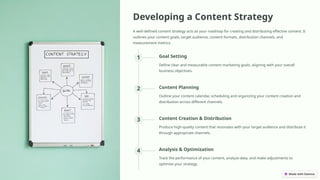
A well-defined content strategy acts as your roadmap for creating and distributing effective content. It
outlines your content goals, target audience, content formats, distribution channels, and
measurement metrics.
1 Goal Setting
Define clear and measurable content marketing goals, aligning with your overall
business objectives.
2 Content Planning
Outline your content calendar, scheduling and organizing your content creation and
distribution across different channels.
3 Content Creation & Distribution
Produce high-quality content that resonates with your target audience and distribute it
through appropriate channels.
4 Analysis & Optimization
Track the performance of your content, analyze data, and make adjustments to
optimize your strategy.
Creating Valuable and
Engaging Content
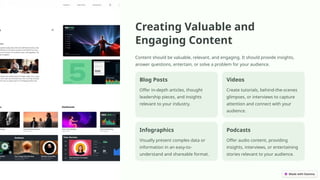
Content should be valuable, relevant, and engaging. It should provide insights,
answer questions, entertain, or solve a problem for your audience.
Blog Posts
Offer in-depth articles, thought
leadership pieces, and insights
relevant to your industry.
Videos
Create tutorials, behind-the-scenes
glimpses, or interviews to capture
attention and connect with your
audience.
Infographics
Visually present complex data or
information in an easy-to-
understand and shareable format.
Podcasts
Offer audio content, providing
insights, interviews, or entertaining
stories relevant to your audience.
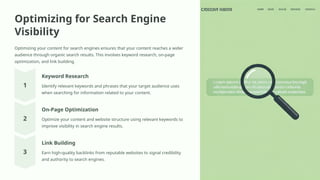
Optimizing for Search Engine
Visibility
Optimizing your content for search engines ensures that your content reaches a wider
audience through organic search results. This involves keyword research, on-page
optimization, and link building.
Keyword Research
Identify relevant keywords and phrases that your target audience uses
when searching for information related to your content.
On-Page Optimization
Optimize your content and website structure using relevant keywords to
improve visibility in search engine results.
Link Building
Earn high-quality backlinks from reputable websites to signal credibility
and authority to search engines.
Leveraging Social Media Platforms
Social media platforms are powerful channels for distributing your content and engaging with your audience. Each platform has unique
features and audiences, so tailor your approach accordingly.
Facebook
Engage with a diverse audience
through a variety of content
formats, including posts, videos,
and live streams.
Twitter
Share short, engaging content,
participate in industry
conversations, and build
relationships with influencers.
Instagram
Create visually appealing
content, leverage stories and
reels, and engage with a highly
visual and active audience.
LinkedIn
Share industry insights, thought
leadership pieces, and connect
with professionals within your
industry.
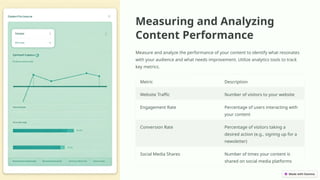
Measuring and Analyzing
Content Performance
Measure and analyze the performance of your content to identify what resonates
with your audience and what needs improvement. Utilize analytics tools to track
key metrics.
Metric Description
Website Traffic Number of visitors to your website
Engagement Rate Percentage of users interacting with
your content
Conversion Rate Percentage of visitors taking a
desired action (e.g., signing up for a
newsletter)
Social Media Shares Number of times your content is
shared on social media platforms
Adapting and Iterating Your
Approach
Content marketing is an iterative process. Continuously analyze performance data, gather
feedback, and adapt your approach based on insights. Be flexible and willing to
experiment.
1 Gather Feedback
Solicit feedback from your audience to understand their preferences and
areas for improvement.
2 Experiment with New Formats
Test different content formats, styles, and distribution channels to see
what resonates with your audience.
3 Optimize Based on Data
Use analytics to track the performance of your content and make
adjustments to optimize your strategy.
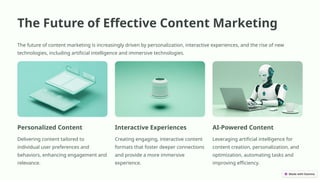
The Future of Effective Content Marketing
The future of content marketing is increasingly driven by personalization, interactive experiences, and the rise of new
technologies, including artificial intelligence and immersive technologies.
Personalized Content
Delivering content tailored to
individual user preferences and
behaviors, enhancing engagement and
relevance.
Interactive Experiences
Creating engaging, interactive content
formats that foster deeper connections
and provide a more immersive
experience.
AI-Powered Content
Leveraging artificial intelligence for
content creation, personalization, and
optimization, automating tasks and
improving efficiency.