Contemporary Philippine Arts from the Regions
UNIT 1
Integrative Art as Applied to
Philippine Contemporary Art
LEARNING TARGETS
At the end of this unit, the learners should be able to
to do the following:
● Define integrative art.
● Identify various art forms in the Philippines.
● Describe the different elements of art and principles of design
found in every work of art.
● Classify different art forms found in the Philippines.
● Understand the significance of elements of art and principles of
design in art.
VALUES AND ATTITUDES
● Reflect on the beauty of art.
● Develop powerful abilities to produce art.
● Appreciate the elements of art and principles of design to create
visually appealing art.
● Produce original artwork as a form of self-expression.
In this unit, the learners should be able to do the
following:
Art Forms in the Philippines
Lesson 03
Unit 1| Integrative Art as Applied to Philippine
Contemporary Art
Art Forms in the Philippines
1. Find a partner.
2. Discuss the following:
○ Are there any cultural practices or artistic productions you know
in your region?
○ What are the historical roots of these practices?
3. Ten pairs will present their discussion in front of the class. The rest
will submit the discussion they made with their partner.
Instructions:
THINK-PAIR-SHARE
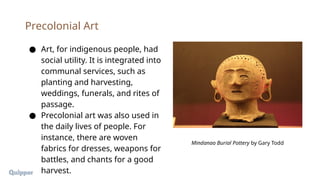
● Art, for indigenous people, had
social utility. It is integrated into
communal services, such as
planting and harvesting,
weddings, funerals, and rites of
passage.
● Precolonial art was also used in
the daily lives of people. For
instance, there are woven
fabrics for dresses, weapons for
battles, and chants for a good
harvest.
Precolonial Art
Mindanao Burial Pottery by Gary Todd
● The kashawing ritual, in Lake Lanao, is a
prayer for abundance during harvesting
season. It is a reenactment of a legendary pact
between ancestors and unseen spirits.
● Higaonon and B’laan have banog-banog, and
the Bagobos have the man-manok dance,
which imitates a bird’s movement. Ifugao’s
courtship ritual is called talip.
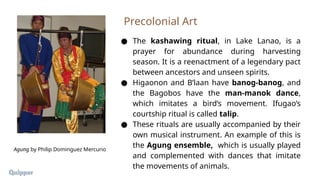
● These rituals are usually accompanied by their
own musical instrument. An example of this is
the Agung ensemble, which is usually played
and complemented with dances that imitate
the movements of animals.
Precolonial Art
Agung by Philip Dominguez Mercurio
● Indigenous arts were inspired by
animism. They created statues
to symbolize their ancestors or
the deities they worshipped.
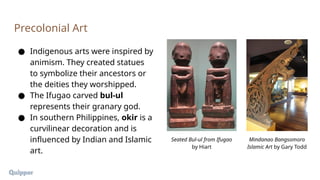
● The Ifugao carved bul-ul
represents their granary god.
● In southern Philippines, okir is a
curvilinear decoration and is
influenced by Indian and Islamic
art.
Precolonial Art
Seated Bul-ul from Ifugao
by Hiart
Mindanao Bangsomoro
Islamic Art by Gary Todd
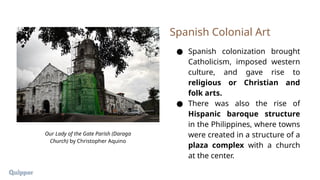
● Spanish colonization brought
Catholicism, imposed western
culture, and gave rise to
religious or Christian and
folk arts.
● There was also the rise of
Hispanic baroque structure
in the Philippines, where towns
were created in a structure of a
plaza complex with a church
at the center.
Spanish Colonial Art
Our Lady of the Gate Parish (Daraga
Church) by Christopher Aquino
● Religious icons like santos and retablos have become essential in
rituals.
● Paintings focused on representing biblical characters and narratives.
● Music was used for liturgies, where worship became essential. Pasyon
or pabasa, a narration of Christ’s passion is portrayed during the Lent
season.
● Awit and korido became popular in the provinces of Iloilo, Pampanga,
Ilocos, and Bicol.
● The Spanish colonization marked the rise of kundiman and balitao.
Even Spanish theater was adopted, which gave birth to sarsuwela,
senakulo, and komedya.
Spanish Colonial Art
● Americans introduced the public education system in the Philippines.
Thus, the learners were required to learn English.
● They also brought Philippine literature into English. Paz Marquez
Benitez’s short story Dead Stars marked the birth of modern
Philippine literature in English.
American and Japanese Colonial Art
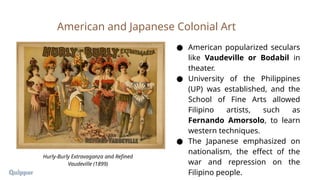
● American popularized seculars
like Vaudeville or Bodabil in
theater.
● University of the Philippines
(UP) was established, and the
School of Fine Arts allowed
Filipino artists, such as
Fernando Amorsolo, to learn
western techniques.
● The Japanese emphasized on
nationalism, the effect of the
war and repression on the
Filipino people.
American and Japanese Colonial Art
Hurly-Burly Extravaganza and Refined
Vaudeville (1899)
● Culture and arts were given more focus in line with the vision of a
“New Society” during the Marcos regime.
● Urban planning and architecture were also highlighted through the
establishment of the Cultural Center of the Philippines Complex and
other structures.
● Social realism became the leading movement in response to martial
law’s horrors.
● Literary, visual, and performing arts were used to express dissent. For
instance, the acrostic poem Prometheus Unbound by Jose Lacaba,
whose pen name is Ruben Cuevas, revealed the hidden message
“Marcos, Hitler, Diktador, Tuta,” a chant during protests.
Contemporary Arts in the Philippines
● When martial law was lifted, Filipinos were reintroduced to
democracy.
● The newfound freedom paved the way for more diverse and
expressive Filipino artworks.
● Art has now become more about self-expression. With the rise of
technology and the popularity of social media, Filipinos found more
platforms and ways to express themselves, thereby continuously
changing the art scene.
Contemporary Arts in the Philippines
Instructions
DEBATE
● Form two groups. Each group will be assigned a stand on whether
art is revolutionary or not.
● Come up with reasons to support the assigned stand.
● Choose three to five representatives to deliver the arguments the
respective groups came up with.
Art is revolutionary: Art can dramatically impact the identity of the
nation and its culture.
Art is not revolutionary: Art does not significantly contribute to the
development of the culture and identity of the nation.
ART MOVEMENT
The Philippines is an archipelagic nation, which has a diverse set of
cultures and traditions. Because of this, various art forms can be found in
the country. Different ethnic groups have their art traditions and styles
that make up their identity. Likewise, art can contribute to the
development of national identity by serving as reflections of a country’s
realities, traditions, and history. Filipino artists constantly explore unique
and resourceful ways to convey these realities and contribute to the
nation’s culture and arts.
Art movements such as realism, minimalism, conceptual art, and neo-
Expressionism are some of the common movements that Filipino artists
used in their creations. These movements help our artists create works
representing the nation’s identity.
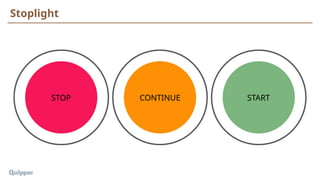
Stoplight
STOP START
CONTINUE
PHOTO CREDITS
Slide 7: Agung 11 by Philip Dominguez Mercurio is licensed under CC BY-SA 2.5 via Wikimedia Commons.
Slide 9: Our Lady of the Gate Parish (Daraga Church) by Christopher Aquino is licensed under CC BY-SA 3.0 via
Wikimedia Commons.

CONTEMPORARY-ARTS-LSON-2 about intergrative arts

  • 1.
    Contemporary Philippine Artsfrom the Regions UNIT 1 Integrative Art as Applied to Philippine Contemporary Art
  • 2.
    LEARNING TARGETS At theend of this unit, the learners should be able to to do the following: ● Define integrative art. ● Identify various art forms in the Philippines. ● Describe the different elements of art and principles of design found in every work of art. ● Classify different art forms found in the Philippines. ● Understand the significance of elements of art and principles of design in art.
  • 3.
    VALUES AND ATTITUDES ●Reflect on the beauty of art. ● Develop powerful abilities to produce art. ● Appreciate the elements of art and principles of design to create visually appealing art. ● Produce original artwork as a form of self-expression. In this unit, the learners should be able to do the following:
  • 4.
    Art Forms inthe Philippines Lesson 03 Unit 1| Integrative Art as Applied to Philippine Contemporary Art Art Forms in the Philippines
  • 5.
    1. Find apartner. 2. Discuss the following: ○ Are there any cultural practices or artistic productions you know in your region? ○ What are the historical roots of these practices? 3. Ten pairs will present their discussion in front of the class. The rest will submit the discussion they made with their partner. Instructions: THINK-PAIR-SHARE
  • 6.
    ● Art, forindigenous people, had social utility. It is integrated into communal services, such as planting and harvesting, weddings, funerals, and rites of passage. ● Precolonial art was also used in the daily lives of people. For instance, there are woven fabrics for dresses, weapons for battles, and chants for a good harvest. Precolonial Art Mindanao Burial Pottery by Gary Todd
  • 7.
    ● The kashawingritual, in Lake Lanao, is a prayer for abundance during harvesting season. It is a reenactment of a legendary pact between ancestors and unseen spirits. ● Higaonon and B’laan have banog-banog, and the Bagobos have the man-manok dance, which imitates a bird’s movement. Ifugao’s courtship ritual is called talip. ● These rituals are usually accompanied by their own musical instrument. An example of this is the Agung ensemble, which is usually played and complemented with dances that imitate the movements of animals. Precolonial Art Agung by Philip Dominguez Mercurio
  • 8.
    ● Indigenous artswere inspired by animism. They created statues to symbolize their ancestors or the deities they worshipped. ● The Ifugao carved bul-ul represents their granary god. ● In southern Philippines, okir is a curvilinear decoration and is influenced by Indian and Islamic art. Precolonial Art Seated Bul-ul from Ifugao by Hiart Mindanao Bangsomoro Islamic Art by Gary Todd
  • 9.
    ● Spanish colonizationbrought Catholicism, imposed western culture, and gave rise to religious or Christian and folk arts. ● There was also the rise of Hispanic baroque structure in the Philippines, where towns were created in a structure of a plaza complex with a church at the center. Spanish Colonial Art Our Lady of the Gate Parish (Daraga Church) by Christopher Aquino
  • 10.
    ● Religious iconslike santos and retablos have become essential in rituals. ● Paintings focused on representing biblical characters and narratives. ● Music was used for liturgies, where worship became essential. Pasyon or pabasa, a narration of Christ’s passion is portrayed during the Lent season. ● Awit and korido became popular in the provinces of Iloilo, Pampanga, Ilocos, and Bicol. ● The Spanish colonization marked the rise of kundiman and balitao. Even Spanish theater was adopted, which gave birth to sarsuwela, senakulo, and komedya. Spanish Colonial Art
  • 11.
    ● Americans introducedthe public education system in the Philippines. Thus, the learners were required to learn English. ● They also brought Philippine literature into English. Paz Marquez Benitez’s short story Dead Stars marked the birth of modern Philippine literature in English. American and Japanese Colonial Art
  • 12.
    ● American popularizedseculars like Vaudeville or Bodabil in theater. ● University of the Philippines (UP) was established, and the School of Fine Arts allowed Filipino artists, such as Fernando Amorsolo, to learn western techniques. ● The Japanese emphasized on nationalism, the effect of the war and repression on the Filipino people. American and Japanese Colonial Art Hurly-Burly Extravaganza and Refined Vaudeville (1899)
  • 13.
    ● Culture andarts were given more focus in line with the vision of a “New Society” during the Marcos regime. ● Urban planning and architecture were also highlighted through the establishment of the Cultural Center of the Philippines Complex and other structures. ● Social realism became the leading movement in response to martial law’s horrors. ● Literary, visual, and performing arts were used to express dissent. For instance, the acrostic poem Prometheus Unbound by Jose Lacaba, whose pen name is Ruben Cuevas, revealed the hidden message “Marcos, Hitler, Diktador, Tuta,” a chant during protests. Contemporary Arts in the Philippines
  • 14.
    ● When martiallaw was lifted, Filipinos were reintroduced to democracy. ● The newfound freedom paved the way for more diverse and expressive Filipino artworks. ● Art has now become more about self-expression. With the rise of technology and the popularity of social media, Filipinos found more platforms and ways to express themselves, thereby continuously changing the art scene. Contemporary Arts in the Philippines
  • 15.
    Instructions DEBATE ● Form twogroups. Each group will be assigned a stand on whether art is revolutionary or not. ● Come up with reasons to support the assigned stand. ● Choose three to five representatives to deliver the arguments the respective groups came up with. Art is revolutionary: Art can dramatically impact the identity of the nation and its culture. Art is not revolutionary: Art does not significantly contribute to the development of the culture and identity of the nation.
  • 16.
    ART MOVEMENT The Philippinesis an archipelagic nation, which has a diverse set of cultures and traditions. Because of this, various art forms can be found in the country. Different ethnic groups have their art traditions and styles that make up their identity. Likewise, art can contribute to the development of national identity by serving as reflections of a country’s realities, traditions, and history. Filipino artists constantly explore unique and resourceful ways to convey these realities and contribute to the nation’s culture and arts. Art movements such as realism, minimalism, conceptual art, and neo- Expressionism are some of the common movements that Filipino artists used in their creations. These movements help our artists create works representing the nation’s identity.
  • 17.
  • 18.
    PHOTO CREDITS Slide 7:Agung 11 by Philip Dominguez Mercurio is licensed under CC BY-SA 2.5 via Wikimedia Commons. Slide 9: Our Lady of the Gate Parish (Daraga Church) by Christopher Aquino is licensed under CC BY-SA 3.0 via Wikimedia Commons.

Editor's Notes

  • #2 Teacher’s script: “Good day, everyone! I would like to introduce to you the first unit of our subject, Contemporary Philippine Arts from the Regions. In this unit, you will be able to achieve the following learning targets.”
  • #6 Teacher’s script: “Artistic production in the Philippines started even before the colonizers reached the island. Art was often used by the people in their daily living.”
  • #7 Teacher’s script: “Rituals played a significant role in everyday life of Filipino ancestors. For our indigenous people, it symbolizes significant value to their traditions and practices.”
  • #8 Teacher’s script: “This only implies that the Philippines, even before colonization, is rich and diverse in arts and culture.”
  • #9 Teacher’s script: “The Spanish era in the Philippines focuses on the liturgical approach where practices and traditions in religions become essential. Moreover, it is the rise of the Hispanic baroque structure in architecture.”
  • #11 Teacher’s script: “Americans introduced to us a formal educational system.”
  • #12 Teacher’s script: “Vaudeville becomes more evident in theater.”
  • #13 Teacher’s script: “As the Marcos administration starts, culture and arts are more focused fulfilling the vision of a “New Society.” But due to the implementation of martial law, various art forms such as literary, visual, and performing arts have used to express dissent.”
  • #14 Teacher’s script: “As martial law ended, Filipino artists become more inspired by democracy and have more platforms to express themselves.”
  • #16 Teacher’s script: “Understanding these evolution and memovements in our arts and culture help us to appreciate more our country. We know now that as diverse as it is, we are deeply rooted in traditions and practices coming from all of these eras.”
  • #17 Teacher’s script: Randomly call learners for their key takeaways. Use the following questions as your guide: What are the things that you will stop doing? What are the things that you will continue doing? What are the things that you will start doing?