Contemporary Philippine Arts from the Regions
1
Unit 02
Classification of Art Forms in the Philippines
2
Performing Arts in the
Philippines
Lesson 01
Unit 2| Classification of Art Forms in the Philippines
Contemporary Philippine Arts from the Regions
3
LEARNING TARGETS
At the end of this unit, the learners should be able to do the following:
● Classify various art forms found in the Philippines.
● Demonstrate correct posture, breath support, and vocal projection
during a theatrical performance.
● Appreciate the beauty and value of different art forms and cultures
and develop a deeper understanding and empathy for the human
experience through artistic expression.
4
VALUES AND ATTITUDES
In this unit, the learners should be able to do the following:
● Value the importance of creativity and innovation in the
creation of art.
● Appreciate the hard work and dedication required to produce
an exceptional performance.
● Recognize the power of performance to connect with an
audience and convey emotions and messages.
5
ART IS EVERYWHERE
The Enduring Resilience and Cultural Abundance of Traditional Filipino
Performing Arts in the Modern Era
The Philippines is a treasure trove of culture and tradition, and one of its most unique
expressions is found in the realm of performing arts. From dance to music, theater to puppetry,
the country's various regions showcase an array of distinctive and captivating forms of
performance that have been preserved across generations.
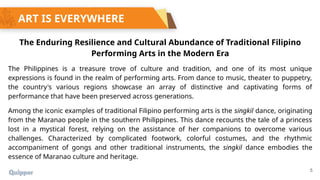
Among the iconic examples of traditional Filipino performing arts is the singkil dance, originating
from the Maranao people in the southern Philippines. This dance recounts the tale of a princess
lost in a mystical forest, relying on the assistance of her companions to overcome various
challenges. Characterized by complicated footwork, colorful costumes, and the rhythmic
accompaniment of gongs and other traditional instruments, the singkil dance embodies the
essence of Maranao culture and heritage.
6
UNIT STIMULUS
The Power of
Picture
Instructions:
Identify what classification of art form is in the picture.
10
minutes
7
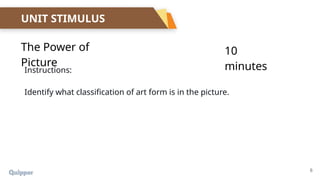
Sayaw sa Bangko from Wikimedia Commons
Picture 1
8
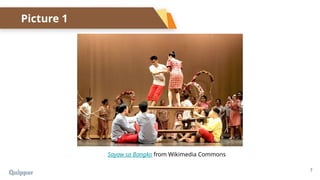
Picture 2
A Family Resting under a Mango Tree by Fernando Amorsolo from Flickr
9
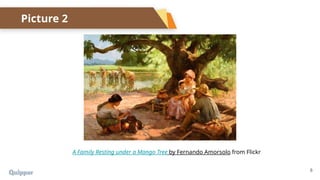
Philippine Madrigal Singers from Wikimedia Commons
Picture 3
10
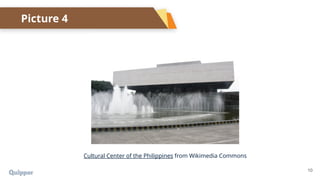
Cultural Center of the Philippines from Wikimedia Commons
Picture 4
11
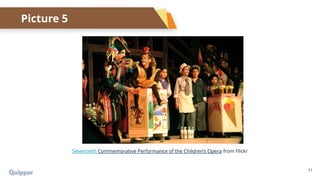
Seventieth Commemorative Performance of the Children’s Opera from Flickr
Picture 5
12
What criteria or characteristics are
used to classify different art forms, and
how does this impact the way we
perceive and value them?
CENTRAL QUESTION
13
Theater of the Mind
Activation
Instructions:
1. Form groups with four to five members each.
2. Each group must select a short story or fable from the following list:
● “The Lion and the Mouse”
● “The Fox and the Grapes”
● “Belling the Cat”
● “The Grasshopper and the Ants”
You can also choose a different short story or fable if you want.
1. Perform your chosen story without props or costumes, solely relying on your voices and
movements.
2. The performance must be at least three to five minutes long and ensure all group members
actively participate.
3. After each group performs, discuss your observations on how the group used voices and
movements to convey the story.
20 minutes
Three Kinds of Performing Art Forms according to
Material Used
Music Dance Theater
14
Three Kinds of Performing Art Forms according to
Material Used
1. The elements of music (auditory) are as follows:
15
A. Rhythm - movement, fluctuation, or variation marked by the
regular recurrence or natural flow of related elements
B. Pitch - highness or lowness of sound
C. Melody - a rhythmic succession of single tones organized as an
aesthetic whole
1. The elements of music (auditory) are as follows:
16
D. Musical Notations - the act, process, method, or an instance of
representing by a system or set of marks, signs, figures, or characters
used in music.
E. Harmony - the combination of simultaneous musical notes in a
chord.
F. Timbre - the perceived sound quality of a musical tone which sets it
apart from other tones. This may be described as soft, rough, hoarse,
cold, and other similar adjectives.
17
A. Human body - the body is the center of the performance activity. It
performs the actions and movements necessary to the piece. With that,
it is considered to be the main medium in performing arts.
B. Arrangement or pattern - the movements and steps which enable the
performers to perform in an organized manner.
C. Time and space - performing arts depend highly on time and space.
The other elements must all come together to complement the available
and selected time and space.
2. The dance (kinesthetic) has the following elements:
18
D. Arrangement or pattern - the movements and steps which enable the
performers to perform in an organized manner.
E. Time and space - performing arts depend highly on time and space.
The other elements must all come together to complement the available
and selected time and space.
2. The dance (kinesthetic) has the following elements:
19
A. Arrangement or pattern - the movements and steps which enable
the performers to perform in an organized manner.
B. Time and space - performing arts depend highly on time and space.
The other elements must all come together to complement the
available and selected time and space.
3. The following are the elements of theater (dramatic)
20
C. Stage direction - instructions indicating movement, blockings or
positions, and other nuances in the performers’ way of speaking,
moving, and acting.
D. Narratology - the narrative structure of the piece.
E. Scenic design - the artistic design that creates the background or
scene to complement the performances
3. The following are the elements of theater (dramatic)
21
In the Philippines, performing arts is shaped by the country’s long
history of colonization and characterized by the diverse cultural
practices within the nation. In general, Philippine performing arts
has its roots in the indigenous practice of rituals. It is believed that
the rituals of early Filipino ancestors were the origin of theater arts in
the country. After all, they fulfill all the necessary materials needed in
theater. The shamans or babaylans perform a ritual that involve
going through a trance; its choreography usually involves the
partaking of an animal sacrifice. This is accompanied by the chanting
of the crowd or even rhythmic playing of indigenous musical
instruments. Further, it is done usually in front of an audience or the
entire community.
22
ART LENS
"Philippine Folk Dance: A Celebration of Culture and Tradition"
encompasses the vibrant array of traditional dances originating
from diverse regions across the Philippines. These dances are
profound cultural expressions, celebrating the country's rich
history and multifaceted heritage. Each dance possesses a
distinctive style, accompanying music, and ornate costumes,
representing different aspects of Philippine culture, such as
harvest rituals, courtship traditions, and religious ceremonies.
Filipinos express their identity and showcase their talents
through these dances while preserving their cultural heritage
for future generations.
23
Choreograph Your Emotion
Demonstration
Instructions:
1. Form groups with three to four members each.
2. Each group must choose an emotion that will inspire the dance
routine.
3. Create a short dance routine expressing the chosen emotion.
4. The routine should be one to two minutes long and incorporate
various dance moves and techniques.
5. After each group performs, discuss how they conveyed the chosen
emotion through dance.
30 minutes
24
PHOTO CREDITS
Slide 7: Sayaw sa Bangko by Audioboss is licensed under CC BY-SA 4.0 via Wikimedia Commons.
Slide 8: Fernando Cueto Amorsolo - A Family Resting Under a Mango by Wlodek Glazewski is licensed under CC0 via
Flickr.
Slide 9: Philippine Madrigal Singers by Titopao is licensed under CC BY-SA 4.0 via Wikimedia Commons.
Slide 10: Cultural Center of the Philippines by Nixenzo is licensed under CC BY-SA 3.0 via Wikimedia Commons.
Slide 11: 70th Commemorative Performance of the Children’s Opera by US Embassy Jerusalem is licensed under
CC BY-SA 2.0 via Flickr.
Slide 13: Masskara Festival Dancers by Herbert Kikoy is licensed under CC BY-SA 4.0 via Wikimedia Commons.
25
Datuin, Flaudette May, Brenda Fajardo, Patrick Flores, Alice Guillermo, Rosa Maria Icagasi, Regalado, Jose,
Elena Mirano, Elenita Ordoñez and Norma Respicio. Art and Society. Quezon City: University of the
Philippines Press, 1997.
Datuin, Flaudette May, Roberto Paulino, Eileen Legaspi-Ramirez and Louise Marcelino. Contemporary
Philippine Arts from the Regions. Manila: Rex Book Store, 2016
Namiki, Kanami. "Hybridity and national identity: Different perspectives of two national folk dance companies in the Philippines." SPECIAL
ISSUE: Cultural Hybridities of the Philippines al Hybridities of the Philippines (2011): 73.
Sayseng, Ayesha. Contemporary Philippine Arts from the Regions. Pasay: JFS Publishing Services, 2016
Tiongson, Nicanor. CCP Encyclopedia of Philippine Arts. Pasay: Cultural Center of the Philippines, 1994.
Tiongson, Nicanor. Tuklas Sining: Essays on Philippine Arts. Pasay: Cultural Center of the Philippines, 1991.
REFERENCES

Classification of Art Forms contemporary.pptx

  • 1.
    Contemporary Philippine Artsfrom the Regions 1 Unit 02 Classification of Art Forms in the Philippines
  • 2.
    2 Performing Arts inthe Philippines Lesson 01 Unit 2| Classification of Art Forms in the Philippines Contemporary Philippine Arts from the Regions
  • 3.
    3 LEARNING TARGETS At theend of this unit, the learners should be able to do the following: ● Classify various art forms found in the Philippines. ● Demonstrate correct posture, breath support, and vocal projection during a theatrical performance. ● Appreciate the beauty and value of different art forms and cultures and develop a deeper understanding and empathy for the human experience through artistic expression.
  • 4.
    4 VALUES AND ATTITUDES Inthis unit, the learners should be able to do the following: ● Value the importance of creativity and innovation in the creation of art. ● Appreciate the hard work and dedication required to produce an exceptional performance. ● Recognize the power of performance to connect with an audience and convey emotions and messages.
  • 5.
    5 ART IS EVERYWHERE TheEnduring Resilience and Cultural Abundance of Traditional Filipino Performing Arts in the Modern Era The Philippines is a treasure trove of culture and tradition, and one of its most unique expressions is found in the realm of performing arts. From dance to music, theater to puppetry, the country's various regions showcase an array of distinctive and captivating forms of performance that have been preserved across generations. Among the iconic examples of traditional Filipino performing arts is the singkil dance, originating from the Maranao people in the southern Philippines. This dance recounts the tale of a princess lost in a mystical forest, relying on the assistance of her companions to overcome various challenges. Characterized by complicated footwork, colorful costumes, and the rhythmic accompaniment of gongs and other traditional instruments, the singkil dance embodies the essence of Maranao culture and heritage.
  • 6.
    6 UNIT STIMULUS The Powerof Picture Instructions: Identify what classification of art form is in the picture. 10 minutes
  • 7.
    7 Sayaw sa Bangkofrom Wikimedia Commons Picture 1
  • 8.
    8 Picture 2 A FamilyResting under a Mango Tree by Fernando Amorsolo from Flickr
  • 9.
    9 Philippine Madrigal Singersfrom Wikimedia Commons Picture 3
  • 10.
    10 Cultural Center ofthe Philippines from Wikimedia Commons Picture 4
  • 11.
    11 Seventieth Commemorative Performanceof the Children’s Opera from Flickr Picture 5
  • 12.
    12 What criteria orcharacteristics are used to classify different art forms, and how does this impact the way we perceive and value them? CENTRAL QUESTION
  • 13.
    13 Theater of theMind Activation Instructions: 1. Form groups with four to five members each. 2. Each group must select a short story or fable from the following list: ● “The Lion and the Mouse” ● “The Fox and the Grapes” ● “Belling the Cat” ● “The Grasshopper and the Ants” You can also choose a different short story or fable if you want. 1. Perform your chosen story without props or costumes, solely relying on your voices and movements. 2. The performance must be at least three to five minutes long and ensure all group members actively participate. 3. After each group performs, discuss your observations on how the group used voices and movements to convey the story. 20 minutes
  • 14.
    Three Kinds ofPerforming Art Forms according to Material Used Music Dance Theater 14
  • 15.
    Three Kinds ofPerforming Art Forms according to Material Used 1. The elements of music (auditory) are as follows: 15 A. Rhythm - movement, fluctuation, or variation marked by the regular recurrence or natural flow of related elements B. Pitch - highness or lowness of sound C. Melody - a rhythmic succession of single tones organized as an aesthetic whole
  • 16.
    1. The elementsof music (auditory) are as follows: 16 D. Musical Notations - the act, process, method, or an instance of representing by a system or set of marks, signs, figures, or characters used in music. E. Harmony - the combination of simultaneous musical notes in a chord. F. Timbre - the perceived sound quality of a musical tone which sets it apart from other tones. This may be described as soft, rough, hoarse, cold, and other similar adjectives.
  • 17.
    17 A. Human body- the body is the center of the performance activity. It performs the actions and movements necessary to the piece. With that, it is considered to be the main medium in performing arts. B. Arrangement or pattern - the movements and steps which enable the performers to perform in an organized manner. C. Time and space - performing arts depend highly on time and space. The other elements must all come together to complement the available and selected time and space. 2. The dance (kinesthetic) has the following elements:
  • 18.
    18 D. Arrangement orpattern - the movements and steps which enable the performers to perform in an organized manner. E. Time and space - performing arts depend highly on time and space. The other elements must all come together to complement the available and selected time and space. 2. The dance (kinesthetic) has the following elements:
  • 19.
    19 A. Arrangement orpattern - the movements and steps which enable the performers to perform in an organized manner. B. Time and space - performing arts depend highly on time and space. The other elements must all come together to complement the available and selected time and space. 3. The following are the elements of theater (dramatic)
  • 20.
    20 C. Stage direction- instructions indicating movement, blockings or positions, and other nuances in the performers’ way of speaking, moving, and acting. D. Narratology - the narrative structure of the piece. E. Scenic design - the artistic design that creates the background or scene to complement the performances 3. The following are the elements of theater (dramatic)
  • 21.
    21 In the Philippines,performing arts is shaped by the country’s long history of colonization and characterized by the diverse cultural practices within the nation. In general, Philippine performing arts has its roots in the indigenous practice of rituals. It is believed that the rituals of early Filipino ancestors were the origin of theater arts in the country. After all, they fulfill all the necessary materials needed in theater. The shamans or babaylans perform a ritual that involve going through a trance; its choreography usually involves the partaking of an animal sacrifice. This is accompanied by the chanting of the crowd or even rhythmic playing of indigenous musical instruments. Further, it is done usually in front of an audience or the entire community.
  • 22.
    22 ART LENS "Philippine FolkDance: A Celebration of Culture and Tradition" encompasses the vibrant array of traditional dances originating from diverse regions across the Philippines. These dances are profound cultural expressions, celebrating the country's rich history and multifaceted heritage. Each dance possesses a distinctive style, accompanying music, and ornate costumes, representing different aspects of Philippine culture, such as harvest rituals, courtship traditions, and religious ceremonies. Filipinos express their identity and showcase their talents through these dances while preserving their cultural heritage for future generations.
  • 23.
    23 Choreograph Your Emotion Demonstration Instructions: 1.Form groups with three to four members each. 2. Each group must choose an emotion that will inspire the dance routine. 3. Create a short dance routine expressing the chosen emotion. 4. The routine should be one to two minutes long and incorporate various dance moves and techniques. 5. After each group performs, discuss how they conveyed the chosen emotion through dance. 30 minutes
  • 24.
    24 PHOTO CREDITS Slide 7:Sayaw sa Bangko by Audioboss is licensed under CC BY-SA 4.0 via Wikimedia Commons. Slide 8: Fernando Cueto Amorsolo - A Family Resting Under a Mango by Wlodek Glazewski is licensed under CC0 via Flickr. Slide 9: Philippine Madrigal Singers by Titopao is licensed under CC BY-SA 4.0 via Wikimedia Commons. Slide 10: Cultural Center of the Philippines by Nixenzo is licensed under CC BY-SA 3.0 via Wikimedia Commons. Slide 11: 70th Commemorative Performance of the Children’s Opera by US Embassy Jerusalem is licensed under CC BY-SA 2.0 via Flickr. Slide 13: Masskara Festival Dancers by Herbert Kikoy is licensed under CC BY-SA 4.0 via Wikimedia Commons.
  • 25.
    25 Datuin, Flaudette May,Brenda Fajardo, Patrick Flores, Alice Guillermo, Rosa Maria Icagasi, Regalado, Jose, Elena Mirano, Elenita Ordoñez and Norma Respicio. Art and Society. Quezon City: University of the Philippines Press, 1997. Datuin, Flaudette May, Roberto Paulino, Eileen Legaspi-Ramirez and Louise Marcelino. Contemporary Philippine Arts from the Regions. Manila: Rex Book Store, 2016 Namiki, Kanami. "Hybridity and national identity: Different perspectives of two national folk dance companies in the Philippines." SPECIAL ISSUE: Cultural Hybridities of the Philippines al Hybridities of the Philippines (2011): 73. Sayseng, Ayesha. Contemporary Philippine Arts from the Regions. Pasay: JFS Publishing Services, 2016 Tiongson, Nicanor. CCP Encyclopedia of Philippine Arts. Pasay: Cultural Center of the Philippines, 1994. Tiongson, Nicanor. Tuklas Sining: Essays on Philippine Arts. Pasay: Cultural Center of the Philippines, 1991. REFERENCES

Editor's Notes

  • #1 Teacher’s script: “Good day, class. In this lesson, we will discuss the classifications of art forms in the Philippines. Can anyone name some of these art forms? That is right. There are many different art forms in the Philippines, each possessing distinct beauty and significance. By understanding these classifications, we can deepen our appreciation for the richness and diversity of our culture.”
  • #3 Teacher’s script: "At the end of this unit, you will acquired some important skills. Firstly, you will be able to interpret the significance and symbolism in a work of art using critical thinking and visual analysis skills. Secondly, you will be able to demonstrate correct posture, breath support, and vocal projection during a theatrical performance. Lastly, you will appreciate the beauty and value of different art forms and cultures and develop a deeper understanding and empathy for the human experience through artistic expression. Remember, art is a way of communicating and can help us better understand ourselves and others. Let us dive into this unit with an open mind and a willingness to learn.”
  • #4 Teacher’s script: “These are the values and attitudes of our lesson. The first objective emphasizes that creativity and innovation allow artists to express their unique perspectives and ideas through art. For the second objective, we will discuss the artists who put countless hours of practice and attention to detail to create exceptional performances. We should recognize their hard work and dedication and appreciate their craft. For the third objective, we will talk about the power of performance to connect with an audience and convey emotions and messages.”
  • #5 Teacher’s script: “The performing arts have played a pivotal role in preserving and showcasing the cultural heritage of our country, serving as a testament to the richness and diversity of our traditions. Today, we will delve into one of the most renowned traditional Filipino performing arts, the singkil dance. Can anyone provide additional insights on this captivating art form? The singkil dance is an excellent example of how these performances have been passed down through generations, demonstrating the enduring spirit of our culture amidst modernization. How can we actively appreciate and preserve these invaluable art forms as a class? By attending performances, supporting local artists, and delving into the history and significance of these art forms, we can contribute to their preservation and deepen our appreciation. Thank you for your valuable insights, class."
  • #6 Teacher’s script: Use this prompt to introduce the activity: “In this activity, you will identify pictures from different art forms in the Philippines.” Provide the following instructions to the class: Identify what classification of art form is in the picture.
  • #7 Teacher’s script: “Can anyone tell me what classification of art form is shown in this picture?"
  • #8 Teacher’s script: “What classification of art form is shown in this picture?"
  • #9 Teacher’s script: “What classification of art form is shown in this picture?"
  • #10 Teacher’s script: “What classification of art form is shown in this architectural building?"
  • #11 Teacher’s script: “What classification of art form is shown in this performance?"
  • #12 Teacher’s script: “Today, we will discuss the various criteria and characteristics used in classifying art forms. Can anyone provide an example of an art form? Art forms are categorized based on criteria and characteristics, including the medium, technique, historical context, cultural influences, and purpose. These classifications significantly influence how we perceive and value art by providing a framework for assessing its quality, significance, and relevance. For instance, understanding the materials and techniques utilized in creating a piece of art enables us to appreciate the artist's skill and expertise. Simultaneously, knowledge of its historical and cultural context enriches our comprehension of its meaning and importance. Therefore, classification is important in shaping our perception and appreciation of art, allowing us to recognize and value different art forms' unique qualities and characteristics.”
  • #13 Teacher’s script: Use this prompt to introduce the activity: “In this activity, you will participate in a creative exercise that explores the power of imagination and storytelling through performance.” Provide the following instructions to the class: Form groups with four to five members each. Each group must select a short story or fable from the following list: “The Lion and the Mouse” “The Fox and the Grapes” “Belling the Cat” “The Grasshopper and the Ants” You can also choose a different short story or fable if you want. Perform your chosen story without props or costumes, solely relying on your voices and movements. The performance must be at least three to five minutes long and ensure all group members actively participate. After each group performs, discuss your observations on how the group used voices and movements to convey the story. Ask the following questions to process the activity: What are the three performing art forms based on the materials used? Possible answer: “The three performing arts based on the materials used are music, dance, and theater.”
  • #14 Teacher’s script: “Music, dance, and theater are the there performing art forms according to material used.”
  • #15 Teacher’s script: “Under the elements of music (auditory) are rhythm, pitch and melody.”
  • #16 Teacher’s script: “Moreover, musical notations, harmony, and timbre makes it complete the elements of music.”
  • #22 Teacher’s script: “It is important to note that each dance in the Philippines possesses its distinctive style, music, and costume, representing various aspects of our rich and diverse regions across the Philippines. Can someone provide an example of a Filipino folk dance? One example is the tinikling dance, a Philippine folk dance that vividly portrays the agile movement of birds skillfully avoiding bamboo traps during the harvest season. Filipinos express their unique identity through these dances and showcase their remarkable talents while safeguarding our cultural heritage for generations to come. Why do you believe it is crucial to preserve our traditional dances? Preserving our traditional dances is important because they form a part of our history and heritage. These dances reflect our culture's depth and diversity, allowing us to pay homage to our ancestors and honor their contributions. By safeguarding and preserving our traditional dances, we ensure the continuous celebration of our identity, enabling us to pass it on to future generations. Thank you for your valuable insights, class.”
  • #23 Teacher’s script: Use this prompt to introduce the activity: “In this activity, you will express your emotions through dance and develop your creativity in the art of dance.” Provide the following instructions to the class: Form groups with three to four members each. Each group must choose an emotion that will inspire the dance routine. Create a short dance routine expressing the chosen emotion. The routine should be one to two minutes long and incorporate various dance moves and techniques. After each group performs, discuss how they conveyed the chosen emotion through dance. Ask the following questions to process the activity: How were movements and expressions utilized to convey the emotion of joy? Possible answer: “One danced in many different ways to express joy. It can begin with fluid, slow movements that progressively become more animated and expressive as the dance continues — followed by joyfully grinning and laughing the entire performance. Jumps and spins can also be incorporated to show the lightness and excitement that come with joy. It is clear that the gestures and facial expressions successfully portrayed joy.” Are traditional and folk dances still performed and celebrated in contemporary settings? Possible answer: “Yes, traditional and folk dances continue to thrive in a contemporary setting in the Philippines, preserving their cultural significance and roots. Dance troupes and cultural groups actively perform traditional and folk dances domestically and internationally, showing the country’s diverse and rich culture. They are often featured in cultural shows during festivals, school events, etc. These dances have also influenced modern dance styles, combining traditional movements with contemporary techniques. Filipino choreographers incorporate traditional and folk elements to create pieces that show the country's cultural heritage and identity. Traditional and folk dances are important in Philippine culture and integral to the country's artistic landscape.”