CONTEMPORARYARCHITECTURE
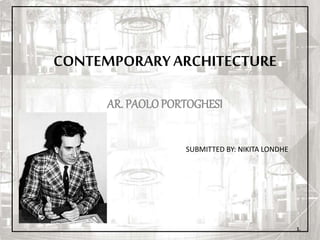
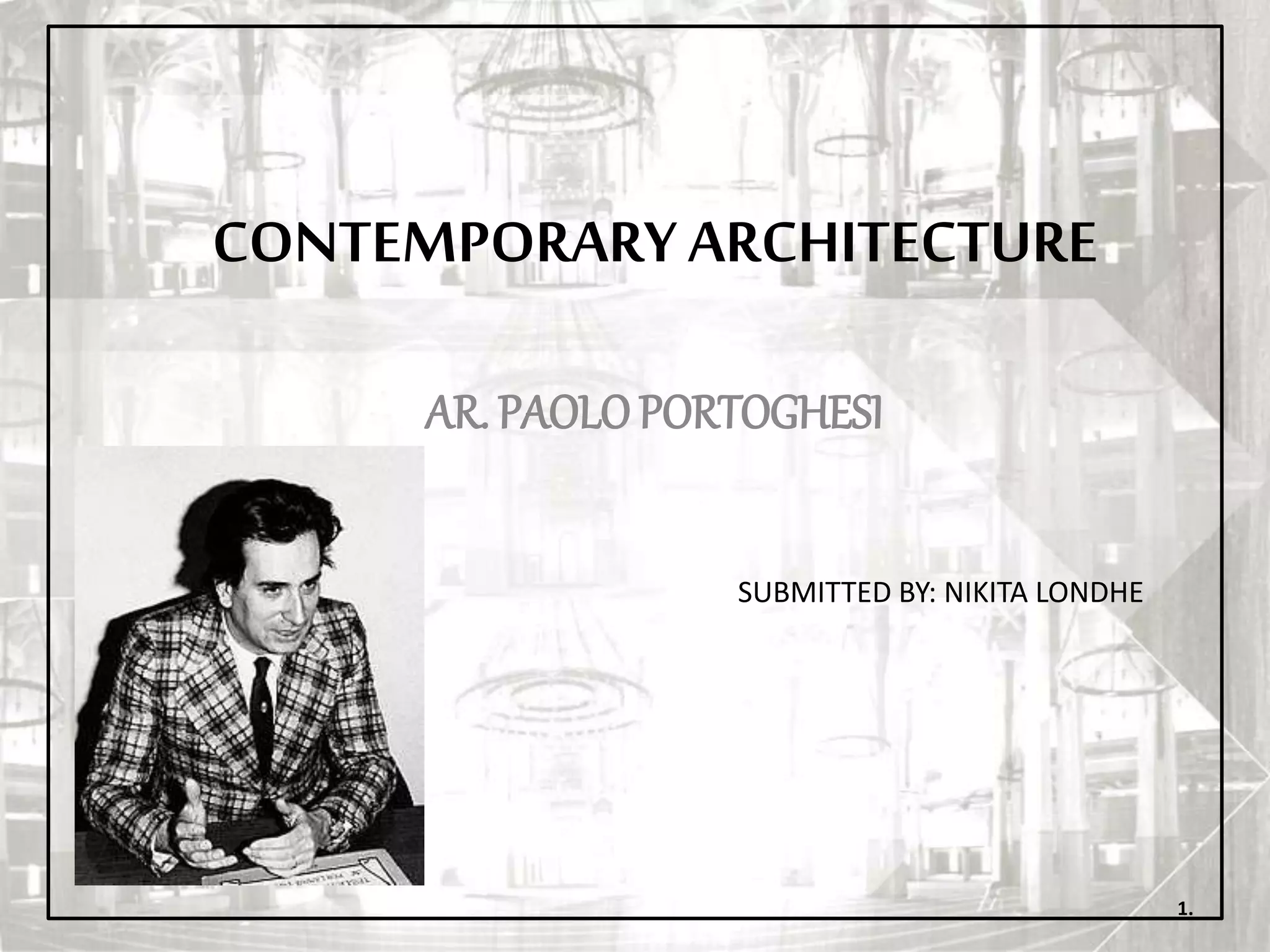
AR. PAOLOPORTOGHESI
SUBMITTED BY: NIKITA LONDHE
1.
2
WHY THIS ARCHITECT ?
His contemporary work of arches and domes inspired me .
The regular columns were modified into piers and arches.
The flat slab was converted into concentric circles emerging
downwords.
PUBLIC REVIEW :
•It is also evident in his concern for the studies of nature, brought to the fore in his
more recent book Nature and Architecture(2000).
•It is well known that in Italy, Portoghesi launched a style that has been called
“postmodern” with his Strada Novissima and a dense series of publications, and thus
joined an international circuit that includes analogous “opinion-makers” such as
Charles Jencks and Robert Stern.
•Portoghesi was different, though, in that he had a long theoretical and practical
interest in the manipulation of historical signs: as we have seen, his first neobaroque
experiments began in the late fifties. His more recent “manifestos” are linear.
3
•A hedonistic urge and a taste for citation, as well as free association and pastiche,
counterbalance each other in the proposals of Portoghesi, whose theoretical
production has been accompanied by skillful professional and promotional activities.
•The principal characteristic of the “modern” is constant self-criticism: destructive and
gnawing doubts accompanied modernity in its journey, and the critique of the
concepts of linear history and progress is intrinsic to both the nineteenth and
twentieth centuries. The protagonists of this drama of course include Blanqui,
Nietzsche, Freud, Kafka, Rosenzweig, Benjamin, and Heidegger, as well as Loos,
Le Corbusier (though certainly not the one of the vulgata), Klee, Malevich, and Mies
van der Rohe. In order to present the new theoretical proposal as “surpassing”
something, a historiographic myth was reinforced: the new research was contrasted
with a homogeneous and opaque monolith, an extremely worn
historiographic construction: the modern movement theorized by Nikolaus Pevsner in
1936.
PUBLIC REVIEW :
4
•The term postmodernas used by Lyotard has rather different coordinates, as he himself
remarked during a seminar held in Paris in April 1985, when he opposed the
homogeneity of his ideas to those
•Furthermore, Portoghesi revealed how he uses his sources in a singular lapse located at
the center of his “The Lights of Lost Paradise,” a text introducing a recent anthology of
works of “new Italian architects.”
• Evoking the Nietzschean theme of the “eternalreturn” in order to support — with the
help of fragments of Gehlen, Lacan, and Vattimo — the advent of a new sensibility,
Portoghesi cites a passage in which the animals who are Zarathustra’s friends define the
eternal return as the “curved path of Eternity.” But the passage, as it is quoted by
Portoghesi, cannot be found in the philological edition of Thus Spake Zarathustra by Colli
and Montinari. Portoghesi took the passage from a text by Löwith, and in so doing landed
in a trap: Zarathustra turns to his animal friends soon thereafter — but Löwith, and
Portoghesi with him, ignore this — and reproaches them sharply for immediately turning
their premonition of the abyss into an “organ grinder’s song.”
ABOUT ARCHITECT
ABOUT ARCHITECT
 Paolo Portoghesi (born 2 November 1931, Rome) is an Italian architect, theorist,
historian and professor of architecture at the University La Sapienza in Rome.
 He is a former President of the architectural section of the Venice Biennale (1979–
92), Editor-in-chief of the journal Controspazio (1969–83), and dean of the Faculty
of Architecture at the Politecnico di Milano university (1968–78).
 Portoghesi studied architecture at the Faculty of Architecture at the University of
Rome, completing his studies in 1957.
 He began teaching the history of criticism at the same faculty in 1961. Portoghesi
opened an architectural practice with architect-engineer Vittorio Gigliotti (born
1921) in Rome in 1964.
 He has specialized in teaching and researching Classical architecture,
especially Baroque architecture, and in particular Borromini, but
also Michelangelo.
 His interest is more in contemporary architecture coincided largely with that of his
colleague in Rome, Bruno Zevi, in championing a more organic form of modernism,
evident in, for instance, the work of Victor Horta and Frank Lloyd Wright, and in
Italy with neorealism and the Neo-Liberty style.
 It is also evident in his concern for the studies of nature, brought to the fore in his
more recent book Nature and Architecture(2000). 5
6
PHILOSOPHY :
His philosophy mainly revolves around the theme god is light.This themes
makes his structure open to sky with huge domes and courtyards.
He makes use of local material for the exterior facade.
Open flexible plans and multi-functional spaces.
Wide spread use of mosaic tiles and glass to bring the outside in.
Masters in steel and concrete constructions.
Exposed concrete work.
His interest is more in contemporary architecture coincided largely with that of
his colleague in Rome, Bruno Zevi, in championing a more organic form
of modernism, evident in, for instance, the work of Victor Horta and Frank Lloyd
Wright, and in Italy with neorealism and the Neo-Liberty style.
ARCHITECTURAL STYLE :
He has specialized in teaching and researching Classical architecture,
especially Baroque architecture, and in particular Borromini, but
also Michelangelo.
His interest is more in contemporary architecture
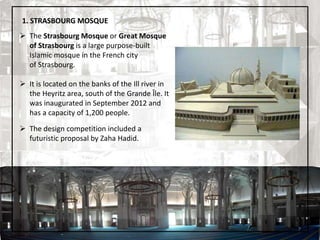
 The Strasbourg Mosque or Great Mosque
of Strasbourg is a large purpose-built
Islamic mosque in the French city
of Strasbourg.
 It is located on the banks of the Ill river in
the Heyritz area, south of the Grande Île. It
was inaugurated in September 2012 and
has a capacity of 1,200 people.
 The design competition included a
futuristic proposal by Zaha Hadid.
1. STRASBOURG MOSQUE
7
8
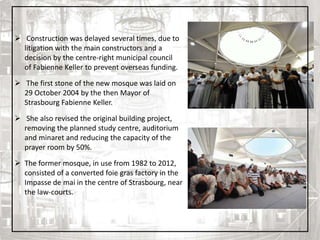
 Construction was delayed several times, due to
litigation with the main constructors and a
decision by the centre-right municipal council
of Fabienne Keller to prevent overseas funding.
 The first stone of the new mosque was laid on
29 October 2004 by the then Mayor of
Strasbourg Fabienne Keller.
 She also revised the original building project,
removing the planned study centre, auditorium
and minaret and reducing the capacity of the
prayer room by 50%.
 The former mosque, in use from 1982 to 2012,
consisted of a converted foie gras factory in the
Impasse de mai in the centre of Strasbourg, near
the law-courts.
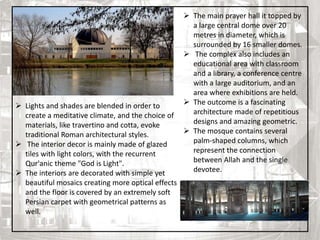
 The main prayer hall it topped by
a large central dome over 20
metres in diameter, which is
surrounded by 16 smaller domes.
 The complex also includes an
educational area with classroom
and a library, a conference centre
with a large auditorium, and an
area where exhibitions are held.
 The outcome is a fascinating
architecture made of repetitious
designs and amazing geometric.
 The mosque contains several
palm-shaped columns, which
represent the connection
between Allah and the single
devotee.
 Lights and shades are blended in order to
create a meditative climate, and the choice of
materials, like travertino and cotta, evoke
traditional Roman architectural styles.
 The interior decor is mainly made of glazed
tiles with light colors, with the recurrent
Qur'anic theme "God is Light".
 The interiors are decorated with simple yet
beautiful mosaics creating more optical effects
and the floor is covered by an extremely soft
Persian carpet with geometrical patterns as
well.
9
10
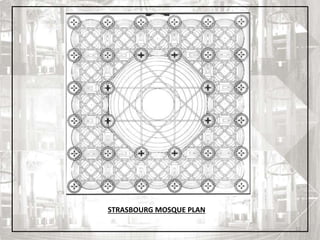
STRASBOURG MOSQUE PLAN
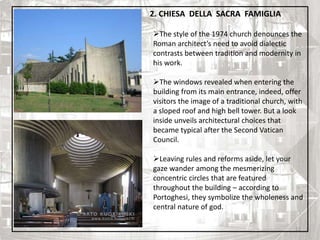
2. CHIESA DELLA SACRA FAMIGLIA
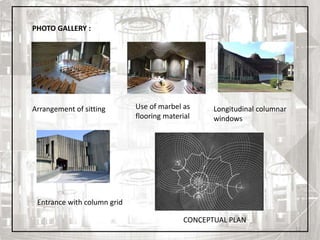
The style of the 1974 church denounces the
Roman architect’s need to avoid dialectic
contrasts between tradition and modernity in
his work.
The windows revealed when entering the
building from its main entrance, indeed, offer
visitors the image of a traditional church, with
a sloped roof and high bell tower. But a look
inside unveils architectural choices that
became typical after the Second Vatican
Council.
Leaving rules and reforms aside, let your
gaze wander among the mesmerizing
concentric circles that are featured
throughout the building – according to
Portoghesi, they symbolize the wholeness and
central nature of god.
11
12
PHOTO GALLERY :
Arrangement of sitting Use of marbel as
flooring material
Longitudinal columnar
windows
Entrance with column grid
CONCEPTUAL PLAN
13
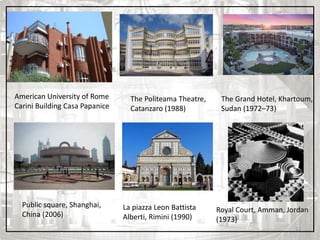
American University of Rome
Carini Building Casa Papanice
Public square, Shanghai,
China (2006)
The Politeama Theatre,
Catanzaro (1988)
La piazza Leon Battista
Alberti, Rimini (1990)
The Grand Hotel, Khartoum,
Sudan (1972–73)
Royal Court, Amman, Jordan
(1973)
 Casa Baldi, Rome (1959)
 Casa Andreis Scandriglia (1964)
 Casa Bevilacqua (1964)
 Theatre of Cagliari (1965)
 Casa Papanice Roma (1966)
 Church of Sacra Famiglia, Salerno (1969)
 The Grand Hotel, Khartoum, Sudan
(1972–73)
 Royal Court, Amman, Jordan (1973)
 Mosque of Rome (1974)
 Academy of Fine Arts, L'Aquila (1978–82)
 ENEL Condominium, Tarquinia (1981)
 Centola Palinuro (Salerno, Italy) Town
Plan (Piano Regolatore)(1984)
 Tegel residence, IBA Berlin, Germany
(1984–88) Le terme di Montecatini,
Pistoia (1987)
 The Politeama Theatre, Catanzaro (1988)
 The garden and library of Calcata (1990)
La piazza Leon Battista Alberti, Rimini (1990)
Church of Santa Maria della Pace, Terni
(1997)
Grande Mosque, Strasburg, France (2000)
The Rinascimento in Talenti park, Rome
(2001)
The Montpellier Gardens (Lattes), France
The Central American Parliament,
Esquipulas, Guatemala
The Primavera restaurant, Moscow, Russia
Town Hall square, Pirmasens, Germany.
Headquarters of the Royalties Institute, St.
Peter's College, Oxford, UK
Public square, Shanghai, China (2006)
Strasbourg Mosque, due for completion
2010
Cimitero Nuovo di Cesena,
2011
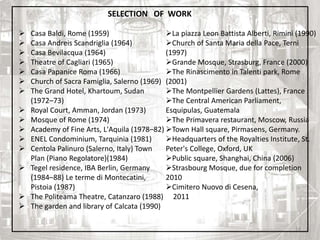
SELECTION OF WORK
14
15
AWARDS :
HONORIS CAUSA IN TECHNICAL SCIENCES
FROM THE UNIVERSITY OF LAUSANNE,
SWITZERLAND
LEGION D'HONNEUR, FRANCE.
THANK YOU

Contemporary architecture ppt

  • 1.
  • 2.
    2 WHY THIS ARCHITECT? His contemporary work of arches and domes inspired me . The regular columns were modified into piers and arches. The flat slab was converted into concentric circles emerging downwords. PUBLIC REVIEW : •It is also evident in his concern for the studies of nature, brought to the fore in his more recent book Nature and Architecture(2000). •It is well known that in Italy, Portoghesi launched a style that has been called “postmodern” with his Strada Novissima and a dense series of publications, and thus joined an international circuit that includes analogous “opinion-makers” such as Charles Jencks and Robert Stern. •Portoghesi was different, though, in that he had a long theoretical and practical interest in the manipulation of historical signs: as we have seen, his first neobaroque experiments began in the late fifties. His more recent “manifestos” are linear.
  • 3.
    3 •A hedonistic urgeand a taste for citation, as well as free association and pastiche, counterbalance each other in the proposals of Portoghesi, whose theoretical production has been accompanied by skillful professional and promotional activities. •The principal characteristic of the “modern” is constant self-criticism: destructive and gnawing doubts accompanied modernity in its journey, and the critique of the concepts of linear history and progress is intrinsic to both the nineteenth and twentieth centuries. The protagonists of this drama of course include Blanqui, Nietzsche, Freud, Kafka, Rosenzweig, Benjamin, and Heidegger, as well as Loos, Le Corbusier (though certainly not the one of the vulgata), Klee, Malevich, and Mies van der Rohe. In order to present the new theoretical proposal as “surpassing” something, a historiographic myth was reinforced: the new research was contrasted with a homogeneous and opaque monolith, an extremely worn historiographic construction: the modern movement theorized by Nikolaus Pevsner in 1936. PUBLIC REVIEW :
  • 4.
    4 •The term postmodernasused by Lyotard has rather different coordinates, as he himself remarked during a seminar held in Paris in April 1985, when he opposed the homogeneity of his ideas to those •Furthermore, Portoghesi revealed how he uses his sources in a singular lapse located at the center of his “The Lights of Lost Paradise,” a text introducing a recent anthology of works of “new Italian architects.” • Evoking the Nietzschean theme of the “eternalreturn” in order to support — with the help of fragments of Gehlen, Lacan, and Vattimo — the advent of a new sensibility, Portoghesi cites a passage in which the animals who are Zarathustra’s friends define the eternal return as the “curved path of Eternity.” But the passage, as it is quoted by Portoghesi, cannot be found in the philological edition of Thus Spake Zarathustra by Colli and Montinari. Portoghesi took the passage from a text by Löwith, and in so doing landed in a trap: Zarathustra turns to his animal friends soon thereafter — but Löwith, and Portoghesi with him, ignore this — and reproaches them sharply for immediately turning their premonition of the abyss into an “organ grinder’s song.” ABOUT ARCHITECT
  • 5.
    ABOUT ARCHITECT  PaoloPortoghesi (born 2 November 1931, Rome) is an Italian architect, theorist, historian and professor of architecture at the University La Sapienza in Rome.  He is a former President of the architectural section of the Venice Biennale (1979– 92), Editor-in-chief of the journal Controspazio (1969–83), and dean of the Faculty of Architecture at the Politecnico di Milano university (1968–78).  Portoghesi studied architecture at the Faculty of Architecture at the University of Rome, completing his studies in 1957.  He began teaching the history of criticism at the same faculty in 1961. Portoghesi opened an architectural practice with architect-engineer Vittorio Gigliotti (born 1921) in Rome in 1964.  He has specialized in teaching and researching Classical architecture, especially Baroque architecture, and in particular Borromini, but also Michelangelo.  His interest is more in contemporary architecture coincided largely with that of his colleague in Rome, Bruno Zevi, in championing a more organic form of modernism, evident in, for instance, the work of Victor Horta and Frank Lloyd Wright, and in Italy with neorealism and the Neo-Liberty style.  It is also evident in his concern for the studies of nature, brought to the fore in his more recent book Nature and Architecture(2000). 5
  • 6.
    6 PHILOSOPHY : His philosophymainly revolves around the theme god is light.This themes makes his structure open to sky with huge domes and courtyards. He makes use of local material for the exterior facade. Open flexible plans and multi-functional spaces. Wide spread use of mosaic tiles and glass to bring the outside in. Masters in steel and concrete constructions. Exposed concrete work. His interest is more in contemporary architecture coincided largely with that of his colleague in Rome, Bruno Zevi, in championing a more organic form of modernism, evident in, for instance, the work of Victor Horta and Frank Lloyd Wright, and in Italy with neorealism and the Neo-Liberty style. ARCHITECTURAL STYLE : He has specialized in teaching and researching Classical architecture, especially Baroque architecture, and in particular Borromini, but also Michelangelo. His interest is more in contemporary architecture
  • 7.
     The StrasbourgMosque or Great Mosque of Strasbourg is a large purpose-built Islamic mosque in the French city of Strasbourg.  It is located on the banks of the Ill river in the Heyritz area, south of the Grande Île. It was inaugurated in September 2012 and has a capacity of 1,200 people.  The design competition included a futuristic proposal by Zaha Hadid. 1. STRASBOURG MOSQUE 7
  • 8.
    8  Construction wasdelayed several times, due to litigation with the main constructors and a decision by the centre-right municipal council of Fabienne Keller to prevent overseas funding.  The first stone of the new mosque was laid on 29 October 2004 by the then Mayor of Strasbourg Fabienne Keller.  She also revised the original building project, removing the planned study centre, auditorium and minaret and reducing the capacity of the prayer room by 50%.  The former mosque, in use from 1982 to 2012, consisted of a converted foie gras factory in the Impasse de mai in the centre of Strasbourg, near the law-courts.
  • 9.
     The mainprayer hall it topped by a large central dome over 20 metres in diameter, which is surrounded by 16 smaller domes.  The complex also includes an educational area with classroom and a library, a conference centre with a large auditorium, and an area where exhibitions are held.  The outcome is a fascinating architecture made of repetitious designs and amazing geometric.  The mosque contains several palm-shaped columns, which represent the connection between Allah and the single devotee.  Lights and shades are blended in order to create a meditative climate, and the choice of materials, like travertino and cotta, evoke traditional Roman architectural styles.  The interior decor is mainly made of glazed tiles with light colors, with the recurrent Qur'anic theme "God is Light".  The interiors are decorated with simple yet beautiful mosaics creating more optical effects and the floor is covered by an extremely soft Persian carpet with geometrical patterns as well. 9
  • 10.
  • 11.
    2. CHIESA DELLASACRA FAMIGLIA The style of the 1974 church denounces the Roman architect’s need to avoid dialectic contrasts between tradition and modernity in his work. The windows revealed when entering the building from its main entrance, indeed, offer visitors the image of a traditional church, with a sloped roof and high bell tower. But a look inside unveils architectural choices that became typical after the Second Vatican Council. Leaving rules and reforms aside, let your gaze wander among the mesmerizing concentric circles that are featured throughout the building – according to Portoghesi, they symbolize the wholeness and central nature of god. 11
  • 12.
    12 PHOTO GALLERY : Arrangementof sitting Use of marbel as flooring material Longitudinal columnar windows Entrance with column grid CONCEPTUAL PLAN
  • 13.
    13 American University ofRome Carini Building Casa Papanice Public square, Shanghai, China (2006) The Politeama Theatre, Catanzaro (1988) La piazza Leon Battista Alberti, Rimini (1990) The Grand Hotel, Khartoum, Sudan (1972–73) Royal Court, Amman, Jordan (1973)
  • 14.
     Casa Baldi,Rome (1959)  Casa Andreis Scandriglia (1964)  Casa Bevilacqua (1964)  Theatre of Cagliari (1965)  Casa Papanice Roma (1966)  Church of Sacra Famiglia, Salerno (1969)  The Grand Hotel, Khartoum, Sudan (1972–73)  Royal Court, Amman, Jordan (1973)  Mosque of Rome (1974)  Academy of Fine Arts, L'Aquila (1978–82)  ENEL Condominium, Tarquinia (1981)  Centola Palinuro (Salerno, Italy) Town Plan (Piano Regolatore)(1984)  Tegel residence, IBA Berlin, Germany (1984–88) Le terme di Montecatini, Pistoia (1987)  The Politeama Theatre, Catanzaro (1988)  The garden and library of Calcata (1990) La piazza Leon Battista Alberti, Rimini (1990) Church of Santa Maria della Pace, Terni (1997) Grande Mosque, Strasburg, France (2000) The Rinascimento in Talenti park, Rome (2001) The Montpellier Gardens (Lattes), France The Central American Parliament, Esquipulas, Guatemala The Primavera restaurant, Moscow, Russia Town Hall square, Pirmasens, Germany. Headquarters of the Royalties Institute, St. Peter's College, Oxford, UK Public square, Shanghai, China (2006) Strasbourg Mosque, due for completion 2010 Cimitero Nuovo di Cesena, 2011 SELECTION OF WORK 14
  • 15.
    15 AWARDS : HONORIS CAUSAIN TECHNICAL SCIENCES FROM THE UNIVERSITY OF LAUSANNE, SWITZERLAND LEGION D'HONNEUR, FRANCE. THANK YOU