Countable NounsCountable nouns are easy to recognize. They are things that we can count. For example: "pen". We can count pens. We can have one, two, three or more pens. Here are some more countablenouns:dog, cat, animal, man, personbottle, box, litre coin, note, dollarcup, plate, forktable, chair, suitcase, bagCountable nouns can be singular or plural:My dogisplaying. My dogs arehungry.
We can use the indefinite article a/an with countable nouns:A dog is an animal.When a countable noun is singular, we must use a word like a/the/my/this with it: I want an orange. (not I want orange.)  Where is my bottle? (not Where is bottle?)
When a countable noun is plural, we can use it alone:I likeoranges. Bottles can break.We can use some and any with countable nouns:I'vegotsomedollars. Have you got any pens?
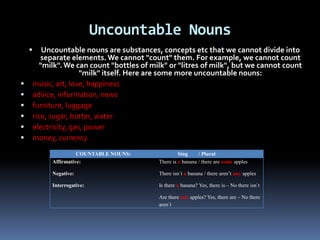
Uncountable NounsUncountable nouns are substances, concepts etc that we cannot divide into separate elements. We cannot "count" them. For example, we cannot count "milk". We can count "bottles of milk" or "litres of milk", but we cannot count "milk" itself. Here are some more uncountablenouns:music, art, love, happinessadvice, information, newsfurniture, luggagerice, sugar, butter, waterelectricity, gas, powermoney, currency
We usually treat uncountable nouns as singular. We use a singular verb. Forexample:This news is very important. Yourluggagelooks heavy.We do not usually use the indefinite article a/an with uncountable nouns. We cannot say "an information" or "a music". But we can say a something of:a piece ofnewsa bottle ofwatera grain of rice
We can use some and any with uncountable nouns:I'vegotsomemoney. Have you got any rice?
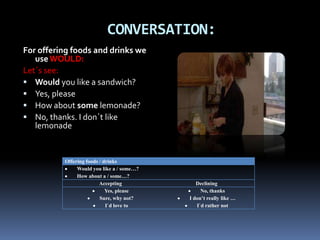
CONVERSATION:For offering foods and drinks we use WOULD:Let`s see:Would you like a sandwich?Yes, pleaseHow about some lemonade?No, thanks. I don`t like lemonade
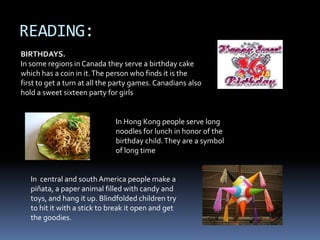
READING:BIRTHDAYS.In some regions in Canada they serve a birthday cake which has a coin in it. The person who finds it is the first to get a turn at all the party games. Canadians also hold a sweet sixteen party for girlsIn Hong Kong people serve long noodles for lunch in honor of the birthday child. They are a symbol of long timeIn  central and south America people make a piñata, a paper animal filled with candy and toys, and hang it up. Blindfolded children try to hit it with a stick to break it open and get the goodies.

contable and uncountable nouns

  • 1.
    Countable NounsCountable nounsare easy to recognize. They are things that we can count. For example: "pen". We can count pens. We can have one, two, three or more pens. Here are some more countablenouns:dog, cat, animal, man, personbottle, box, litre coin, note, dollarcup, plate, forktable, chair, suitcase, bagCountable nouns can be singular or plural:My dogisplaying. My dogs arehungry.
  • 2.
    We can usethe indefinite article a/an with countable nouns:A dog is an animal.When a countable noun is singular, we must use a word like a/the/my/this with it: I want an orange. (not I want orange.) Where is my bottle? (not Where is bottle?)
  • 3.
    When a countablenoun is plural, we can use it alone:I likeoranges. Bottles can break.We can use some and any with countable nouns:I'vegotsomedollars. Have you got any pens?
  • 4.
    Uncountable NounsUncountable nounsare substances, concepts etc that we cannot divide into separate elements. We cannot "count" them. For example, we cannot count "milk". We can count "bottles of milk" or "litres of milk", but we cannot count "milk" itself. Here are some more uncountablenouns:music, art, love, happinessadvice, information, newsfurniture, luggagerice, sugar, butter, waterelectricity, gas, powermoney, currency
  • 5.
    We usually treatuncountable nouns as singular. We use a singular verb. Forexample:This news is very important. Yourluggagelooks heavy.We do not usually use the indefinite article a/an with uncountable nouns. We cannot say "an information" or "a music". But we can say a something of:a piece ofnewsa bottle ofwatera grain of rice
  • 6.
    We can usesome and any with uncountable nouns:I'vegotsomemoney. Have you got any rice?
  • 7.
    CONVERSATION:For offering foodsand drinks we use WOULD:Let`s see:Would you like a sandwich?Yes, pleaseHow about some lemonade?No, thanks. I don`t like lemonade
  • 8.
    READING:BIRTHDAYS.In some regionsin Canada they serve a birthday cake which has a coin in it. The person who finds it is the first to get a turn at all the party games. Canadians also hold a sweet sixteen party for girlsIn Hong Kong people serve long noodles for lunch in honor of the birthday child. They are a symbol of long timeIn central and south America people make a piñata, a paper animal filled with candy and toys, and hang it up. Blindfolded children try to hit it with a stick to break it open and get the goodies.