COUNTABLE AND UNCONTABLE
NOUNS
Cristina Galán Estévez
CLASE: 6º PRIMARIA
1
COUNTABLE NOUNS
Countable nouns are things we can count – for
example, cats:
 My brother has a cat.
 My sister has two cats.
 My friend has three cats.
2
COUNTABLE NOUNS
Other examples of countable nouns:
 Things – book, table, computer, banana, shirt,
television, pen, house.
 People – man, woman, child, friend, brother, sister,
uncle, teacher, boss.
3
COUNTABLE NOUNS
With countable nouns, you can use many, a few,
some, or any:
 How many brothers do you have?
 I have a few books in my backpack.
 She bought some bananas at the store.
 Does he have any children?
4
UNCOUNTABLE NOUNS
Uncountable nouns are words that we can’t count, or
can’t divide into separate parts:
 Ideas and concepts – love, fun, sadness, work,
money, peace, safety
 Information – advice, information, news,
knowledge
 Categories – music, furniture, equipment, jewelry,
literature, meat
 Liquids and foods that can’t be counted – water,
butter, rice, flour, milk
5
UNCOUNTABLE NOUNS
With uncountable nouns, you can use much, a
little, some, or any:
 Our teacher gives us too much homework!
 Add a little butter to the recipe.
 We heard some great music on the radio this
morning.
 He doesn’t have any furniture in his new house. 6
UNCOUNTABLE NOUNS
Don’t add -s to make uncountable nouns plural:
 I need some informations about the course.
 I need some information about the course.
You can use other words to help:
 She bought three bottles of wine and five boxes
of rice.
 He gave me two pieces of advice: eat less and
exercise more.
7
COUNTABLE VS UNCOUNTABLE
A countable noun has a plural form. For example we say:
1 dog and 2 dogs. The singular form and the plural form
are different and for this reason dog is a countable
noun, like pen, car, etc.
 Note that most irregular nouns are countable. For
example 1 child, 2 children. There is no "s" in the plural
but the singular form and the plural form are different so
it is a countable noun.
 Other examples of irregular countable nouns: man -
men, woman - women, person - people.
An uncountable noun has no plural form. It is always
singular. For example money is always singular, we
can't say moneys.
 Examples of uncountable nouns:money, milk, petrol,
coffee, tea, water, traffic, furniture, bread, traffic.
8
COUNTABLE VS UNCOUNTABLE
The difference is in the negative and in the question not in the
positive sentences.
Note that in positive sentences as well as as a lot of we can also
say lots of, although it is more informal
She has lots of friends.
We've got lots of time.
9
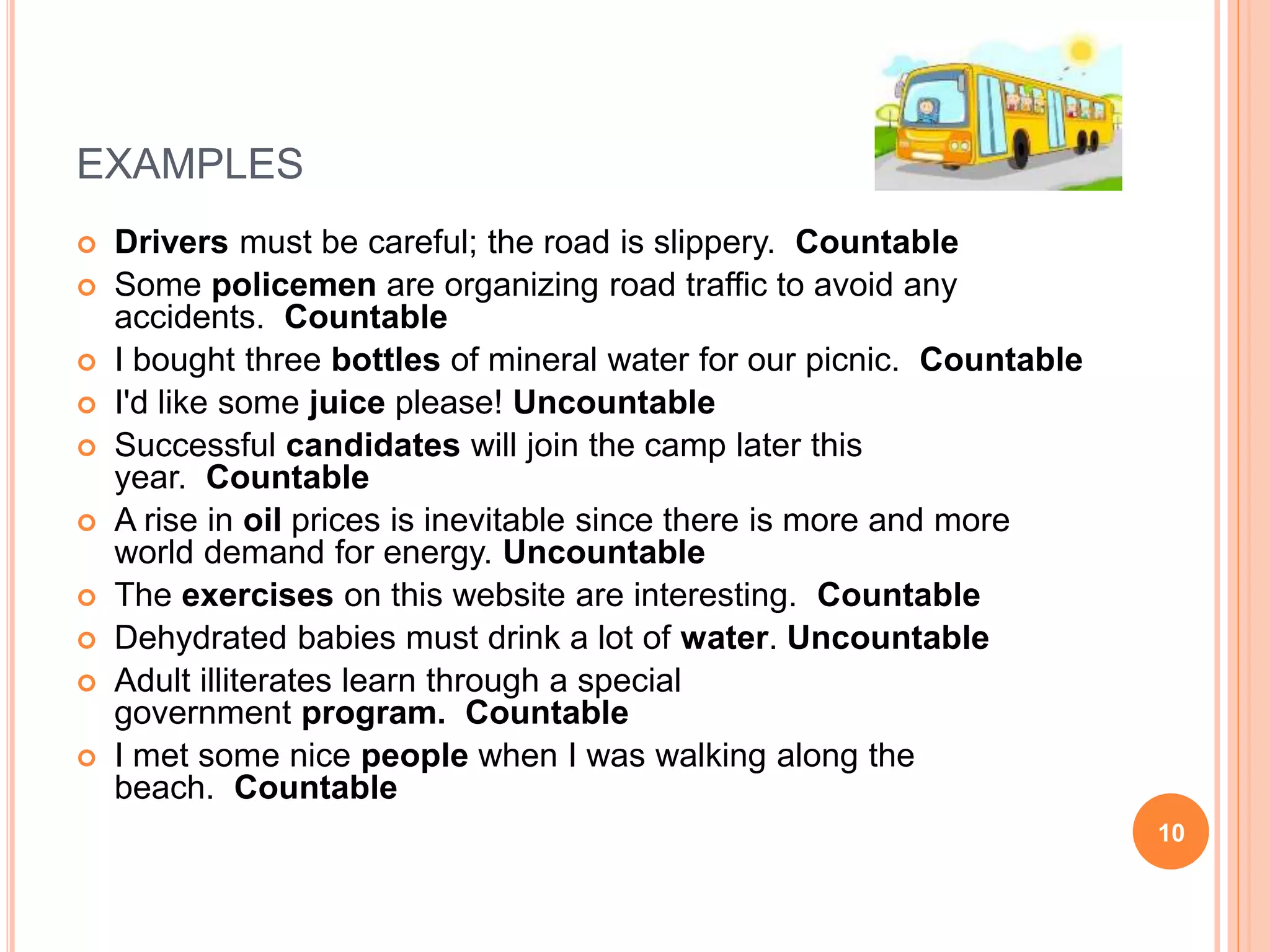
EXAMPLES
 Drivers must be careful; the road is slippery. Countable
 Some policemen are organizing road traffic to avoid any
accidents. Countable
 I bought three bottles of mineral water for our picnic. Countable
 I'd like some juice please! Uncountable
 Successful candidates will join the camp later this
year. Countable
 A rise in oil prices is inevitable since there is more and more
world demand for energy. Uncountable
 The exercises on this website are interesting. Countable
 Dehydrated babies must drink a lot of water. Uncountable
 Adult illiterates learn through a special
government program. Countable
 I met some nice people when I was walking along the
beach. Countable
10
EXERCISE
Is the underlined noun countable or uncountable?
 The children fell asleep quickly after a busy day of fun.
 Be careful! The water is deep.
 The parade included fire trucks and police cars.
 We like the large bottles of mineral water.
 My mother uses real butter in the cakes she bakes.
 How many politicians does it take to pass a simple law?
 Most kids like milk, but Joey hates it.
 Most pottery is made of clay.
 Michael can play several different musical instruments.
 I was feeling so stressed that I ate an entire box of cookies.
11
ANSWERS
 1 – countable
 2 – uncountable
 3 – countable
 4 – countable
 5 –uncountable
 6 – countable
 7 – uncountable
 8 – uncountable
 9 –countable
 10 – countable 12
A LAST TIP
13
14

Countable and uncountable nouns cristina galán

  • 1.
    COUNTABLE AND UNCONTABLE NOUNS CristinaGalán Estévez CLASE: 6º PRIMARIA 1
  • 2.
    COUNTABLE NOUNS Countable nounsare things we can count – for example, cats:  My brother has a cat.  My sister has two cats.  My friend has three cats. 2
  • 3.
    COUNTABLE NOUNS Other examplesof countable nouns:  Things – book, table, computer, banana, shirt, television, pen, house.  People – man, woman, child, friend, brother, sister, uncle, teacher, boss. 3
  • 4.
    COUNTABLE NOUNS With countablenouns, you can use many, a few, some, or any:  How many brothers do you have?  I have a few books in my backpack.  She bought some bananas at the store.  Does he have any children? 4
  • 5.
    UNCOUNTABLE NOUNS Uncountable nounsare words that we can’t count, or can’t divide into separate parts:  Ideas and concepts – love, fun, sadness, work, money, peace, safety  Information – advice, information, news, knowledge  Categories – music, furniture, equipment, jewelry, literature, meat  Liquids and foods that can’t be counted – water, butter, rice, flour, milk 5
  • 6.
    UNCOUNTABLE NOUNS With uncountablenouns, you can use much, a little, some, or any:  Our teacher gives us too much homework!  Add a little butter to the recipe.  We heard some great music on the radio this morning.  He doesn’t have any furniture in his new house. 6
  • 7.
    UNCOUNTABLE NOUNS Don’t add-s to make uncountable nouns plural:  I need some informations about the course.  I need some information about the course. You can use other words to help:  She bought three bottles of wine and five boxes of rice.  He gave me two pieces of advice: eat less and exercise more. 7
  • 8.
    COUNTABLE VS UNCOUNTABLE Acountable noun has a plural form. For example we say: 1 dog and 2 dogs. The singular form and the plural form are different and for this reason dog is a countable noun, like pen, car, etc.  Note that most irregular nouns are countable. For example 1 child, 2 children. There is no "s" in the plural but the singular form and the plural form are different so it is a countable noun.  Other examples of irregular countable nouns: man - men, woman - women, person - people. An uncountable noun has no plural form. It is always singular. For example money is always singular, we can't say moneys.  Examples of uncountable nouns:money, milk, petrol, coffee, tea, water, traffic, furniture, bread, traffic. 8
  • 9.
    COUNTABLE VS UNCOUNTABLE Thedifference is in the negative and in the question not in the positive sentences. Note that in positive sentences as well as as a lot of we can also say lots of, although it is more informal She has lots of friends. We've got lots of time. 9
  • 10.
    EXAMPLES  Drivers mustbe careful; the road is slippery. Countable  Some policemen are organizing road traffic to avoid any accidents. Countable  I bought three bottles of mineral water for our picnic. Countable  I'd like some juice please! Uncountable  Successful candidates will join the camp later this year. Countable  A rise in oil prices is inevitable since there is more and more world demand for energy. Uncountable  The exercises on this website are interesting. Countable  Dehydrated babies must drink a lot of water. Uncountable  Adult illiterates learn through a special government program. Countable  I met some nice people when I was walking along the beach. Countable 10
  • 11.
    EXERCISE Is the underlinednoun countable or uncountable?  The children fell asleep quickly after a busy day of fun.  Be careful! The water is deep.  The parade included fire trucks and police cars.  We like the large bottles of mineral water.  My mother uses real butter in the cakes she bakes.  How many politicians does it take to pass a simple law?  Most kids like milk, but Joey hates it.  Most pottery is made of clay.  Michael can play several different musical instruments.  I was feeling so stressed that I ate an entire box of cookies. 11
  • 12.
    ANSWERS  1 –countable  2 – uncountable  3 – countable  4 – countable  5 –uncountable  6 – countable  7 – uncountable  8 – uncountable  9 –countable  10 – countable 12
  • 13.
  • 14.