Countable and uncountable
Nouns.
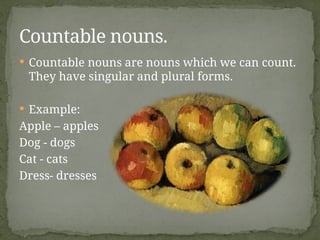
 Countable nouns are nouns which we can count.
They have singular and plural forms.
 Example:
Apple – apples
Dog - dogs
Cat - cats
Dress- dresses
Countable nouns.
 They don’t have different plural forms.
They don’t go with a, an, one, two and so on.
They can be used alone or with some/any/much
etc.
These include:
1)Many types of food.
2)liquids.
3)materials.
4)Abstract nouns.
And some other nouns.
Uncountable nouns.
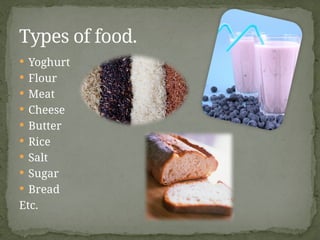
 Yoghurt
 Flour
 Meat
 Cheese
 Butter
 Rice
 Salt
 Sugar
 Bread
Etc.
Types of food.
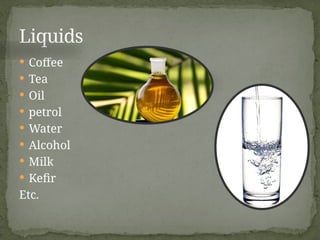
 Coffee
 Tea
 Oil
 petrol
 Water
 Alcohol
 Milk
 Kefir
Etc.
Liquids
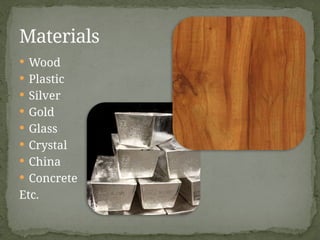
 Wood
 Plastic
 Silver
 Gold
 Glass
 Crystal
 China
 Concrete
Etc.
Materials
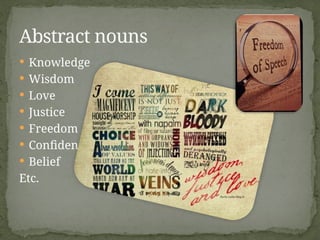
 Knowledge
 Wisdom
 Love
 Justice
 Freedom
 Confidence
 Belief
Etc.
Abstract nouns
Research, luggage, baggage, hair, weather,
behaviour, advice, news, fun, accommodation,
information, equipment, rubbish, furniture,
crockery, cutlery, money, jewellery, machinery
and so on.
Others
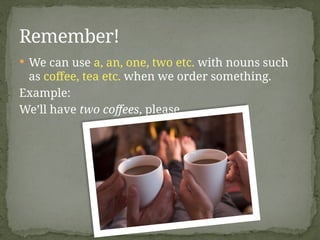
 We can use a, an, one, two etc. with nouns such
as coffee, tea etc. when we order something.
Example:
We’ll have two coffees, please.
Remember!
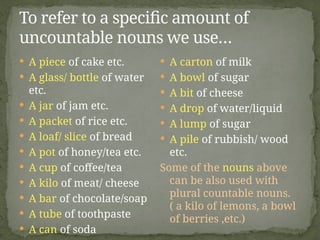
 A piece of cake etc.
 A glass/ bottle of water
etc.
 A jar of jam etc.
 A packet of rice etc.
 A loaf/ slice of bread
 A pot of honey/tea etc.
 A cup of coffee/tea
 A kilo of meat/ cheese
 A bar of chocolate/soap
 A tube of toothpaste
 A can of soda
 A carton of milk
 A bowl of sugar
 A bit of cheese
 A drop of water/liquid
 A lump of sugar
 A pile of rubbish/ wood
etc.
Some of the nouns above
can be also used with
plural countable nouns.
( a kilo of lemons, a bowl
of berries ,etc.)
To refer to a specific amount of
uncountable nouns we use…
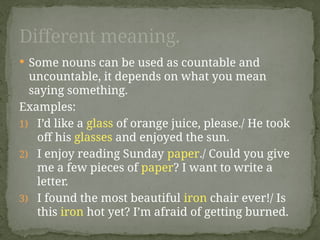
 Some nouns can be used as countable and
uncountable, it depends on what you mean
saying something.
Examples:
1) I’d like a glass of orange juice, please./ He took
off his glasses and enjoyed the sun.
2) I enjoy reading Sunday paper./ Could you give
me a few pieces of paper? I want to write a
letter.
3) I found the most beautiful iron chair ever!/ Is
this iron hot yet? I’m afraid of getting burned.
Different meaning.
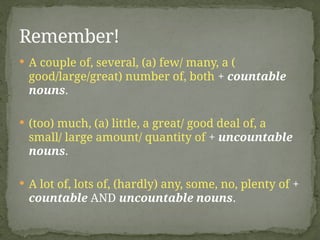
 A couple of, several, (a) few/ many, a (
good/large/great) number of, both + countable
nouns.
 (too) much, (a) little, a great/ good deal of, a
small/ large amount/ quantity of + uncountable
nouns.
 A lot of, lots of, (hardly) any, some, no, plenty of +
countable AND uncountable nouns.
Remember!
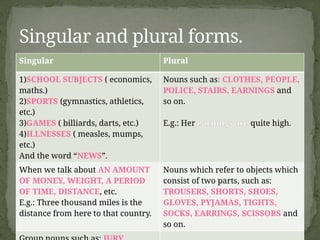
Singular Plural
1)SCHOOL SUBJECTS ( economics,
maths.)
2)SPORTS (gymnastics, athletics,
etc.)
3)GAMES ( billiards, darts, etc.)
4)ILLNESSES ( measles, mumps,
etc.)
And the word “NEWS”.
Nouns such as: CLOTHES, PEOPLE,
POLICE, STAIRS, EARNINGS and
so on.
E.g.: Her earnings are quite high.
When we talk about AN AMOUNT
OF MONEY, WEIGHT, A PERIOD
OF TIME, DISTANCE, etc.
E.g.: Three thousand miles is the
distance from here to that country.
Nouns which refer to objects which
consist of two parts, such as:
TROUSERS, SHORTS, SHOES,
GLOVES, PYJAMAS, TIGHTS,
SOCKS, EARRINGS, SCISSORS and
so on.
Singular and plural forms.

countableanduncountablenounsmypresentationforenglishclasses-120410040008-phpapp02.pptx

  • 1.
  • 2.
     Countable nounsare nouns which we can count. They have singular and plural forms.  Example: Apple – apples Dog - dogs Cat - cats Dress- dresses Countable nouns.
  • 3.
     They don’thave different plural forms. They don’t go with a, an, one, two and so on. They can be used alone or with some/any/much etc. These include: 1)Many types of food. 2)liquids. 3)materials. 4)Abstract nouns. And some other nouns. Uncountable nouns.
  • 4.
     Yoghurt  Flour Meat  Cheese  Butter  Rice  Salt  Sugar  Bread Etc. Types of food.
  • 5.
     Coffee  Tea Oil  petrol  Water  Alcohol  Milk  Kefir Etc. Liquids
  • 6.
     Wood  Plastic Silver  Gold  Glass  Crystal  China  Concrete Etc. Materials
  • 7.
     Knowledge  Wisdom Love  Justice  Freedom  Confidence  Belief Etc. Abstract nouns
  • 8.
    Research, luggage, baggage,hair, weather, behaviour, advice, news, fun, accommodation, information, equipment, rubbish, furniture, crockery, cutlery, money, jewellery, machinery and so on. Others
  • 9.
     We canuse a, an, one, two etc. with nouns such as coffee, tea etc. when we order something. Example: We’ll have two coffees, please. Remember!
  • 10.
     A pieceof cake etc.  A glass/ bottle of water etc.  A jar of jam etc.  A packet of rice etc.  A loaf/ slice of bread  A pot of honey/tea etc.  A cup of coffee/tea  A kilo of meat/ cheese  A bar of chocolate/soap  A tube of toothpaste  A can of soda  A carton of milk  A bowl of sugar  A bit of cheese  A drop of water/liquid  A lump of sugar  A pile of rubbish/ wood etc. Some of the nouns above can be also used with plural countable nouns. ( a kilo of lemons, a bowl of berries ,etc.) To refer to a specific amount of uncountable nouns we use…
  • 11.
     Some nounscan be used as countable and uncountable, it depends on what you mean saying something. Examples: 1) I’d like a glass of orange juice, please./ He took off his glasses and enjoyed the sun. 2) I enjoy reading Sunday paper./ Could you give me a few pieces of paper? I want to write a letter. 3) I found the most beautiful iron chair ever!/ Is this iron hot yet? I’m afraid of getting burned. Different meaning.
  • 12.
     A coupleof, several, (a) few/ many, a ( good/large/great) number of, both + countable nouns.  (too) much, (a) little, a great/ good deal of, a small/ large amount/ quantity of + uncountable nouns.  A lot of, lots of, (hardly) any, some, no, plenty of + countable AND uncountable nouns. Remember!
  • 13.
    Singular Plural 1)SCHOOL SUBJECTS( economics, maths.) 2)SPORTS (gymnastics, athletics, etc.) 3)GAMES ( billiards, darts, etc.) 4)ILLNESSES ( measles, mumps, etc.) And the word “NEWS”. Nouns such as: CLOTHES, PEOPLE, POLICE, STAIRS, EARNINGS and so on. E.g.: Her earnings are quite high. When we talk about AN AMOUNT OF MONEY, WEIGHT, A PERIOD OF TIME, DISTANCE, etc. E.g.: Three thousand miles is the distance from here to that country. Nouns which refer to objects which consist of two parts, such as: TROUSERS, SHORTS, SHOES, GLOVES, PYJAMAS, TIGHTS, SOCKS, EARRINGS, SCISSORS and so on. Singular and plural forms.