Name of students: Divya  suresh………………….13 Lalita mali…………………….10 Maithili sawant………………14 Sushmita  singha……………..22 Pratibha sharma ……………..19
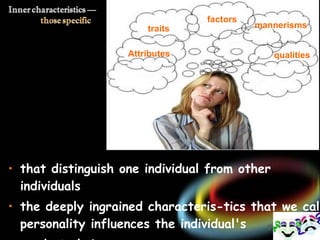
…… .Can be defined as “  T hose inner psychological characteristics that both determine & reflect how a person responds to his or her environment. ”
that distinguish one individual from other individuals  the deeply ingrained characteris­tics that we call personality influences the individual's  product choices  qualities Attributes traits factors mannerisms
 
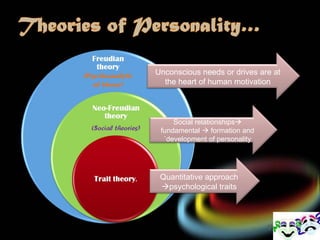
Unconscious needs or drives are at the heart of human motivation Social relationships   fundamental    formation and `development of personality Quantitative approach   psychological traits
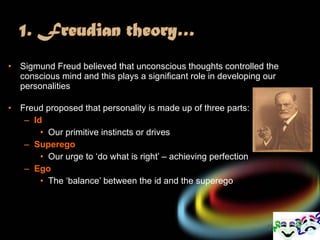
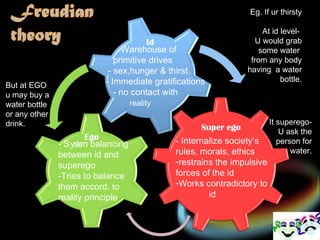
Sigmund Freud believed that unconscious thoughts controlled the conscious mind and this plays a significant role in developing our personalities Freud proposed that personality is made up of three parts: Id Our primitive instincts or drives Superego Our urge to ‘do what is right’ – achieving perfection Ego The ‘balance’ between the id and the superego
Eg. If ur thirsty At id level-  U would grab some water  from any body having  a water bottle. It superego- U ask the person for water. But at EGO u may buy a water bottle or any other drink. - Internalize society’s rules, morals, ethics restrains the impulsive forces of the id Works contradictory to  id -  System   balancing between id and superego -Tries to balance them accord. to reality principle -Warehouse of primitive drives - sex,hunger & thirst. - Immediate gratifications - no contact with  reality
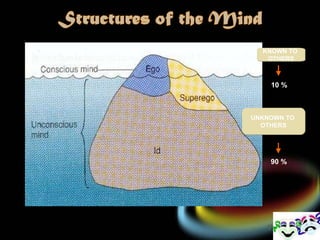
VALUES – STANDARDS – JUDGMENTS MOTIVES – ETHICS - BELIEFS KNOWN TO  OTHERS 10 % UNKNOWN TO  OTHERS 90 %
 
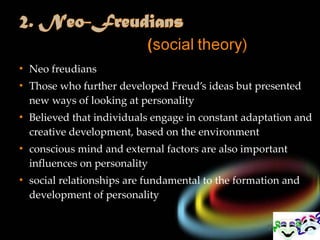
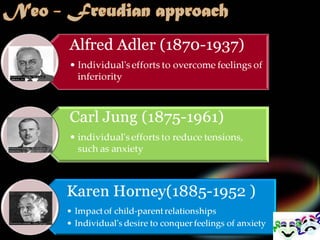
Neo freudians Those who further developed Freud’s ideas but presented new ways of looking at personality Believed that individuals engage in constant adaptation and creative development, based on the environment conscious mind and external factors are also important influences on personality social relationships are fundamental to the formation and development of personality
 
 
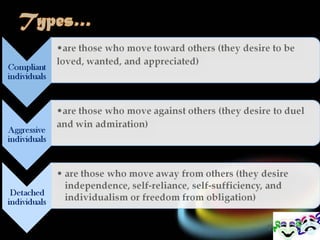
Compliant individuals
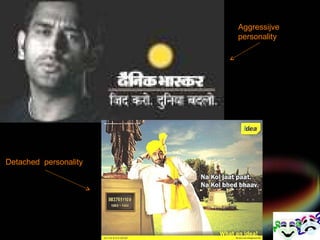
Aggressijve personality Detached  personality
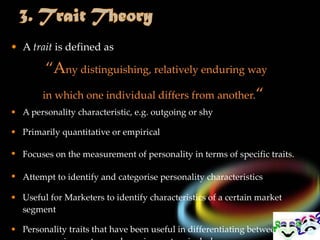
A  trait  is defined as   “ A ny distinguishing, relatively enduring way  in which one individual differs from another. “ A personality characteristic, e . g .  outgoing or shy Primarily quantitative or empirical Focuses on the measurement of personality in terms of specific traits. Attempt to identify and categorise personality characteristics   Useful for Marketers to identify characteristics of a certain market segment Personality traits that have been useful in differentiating between consumer innovators and non-innovators include
seeking
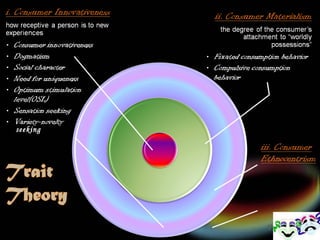
How receptive are consumers to new products, new services, or new practices? Recent consumer research indicates a positive relationship between innovative use of the Internet and buying online. consumer innovators —those who are likely to try new products. Those innovators are often crucial to the success of new products.   E.g. sony ericcson shake  phone. Degree of rigidity displayed by an individual toward the unfamiliar & information contrary to their established beliefs. Consumers low in dogmatism are more likely to prefer innovative products to established ones. Consumers high in dogmatism are more accepting of authority-based ads for new products. E.g  for high dogmatic individuals, advertisers use  testimonials n celebrity endorsments
Social character is a personality trait that ranges on a continuum from inner-directed to other-directed. Inner-directed  consumers tend to rely on their own “inner” values or standards in evaluating new products and are innovators. They also prefer ads stressing product features and personal benefits. Other-directed  consumers tend to look to others for direction and are not innovators. They prefer ads that feature social environment and social acceptance. people who seek to be unique. These people avoid conformity.
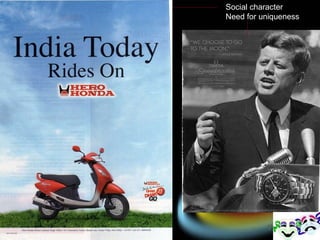
Social character Need for uniqueness
 
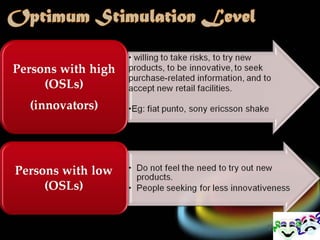
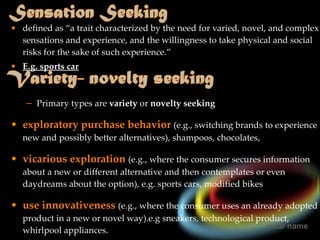
defined as “a trait characterized by the need for varied, novel, and complex sensations and experience, and the willingness to take physical and social risks for the sake of such experience.” E.g. sports car Primary types are  variety   or  novelty seeking exploratory purchase behavior   (e.g., switching brands to experience new and possibly better alternatives), shampoos, chocolates, vicarious exploration   (e.g., where the consumer secures information about a new or different alternative and then contemplates or even daydreams about the option), e.g. sports cars, modified bikes use innovativeness   (e.g., where the consumer uses an already adopted product in a new or novel way).e.g sneakers, technological product, whirlpool appliances.
 
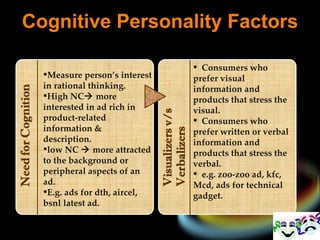
Cognitive Personality Factors Consumers who prefer visual information and products that stress the visual. Consumers who prefer written or verbal information and products that stress the verbal. e.g. zoo-zoo ad, kfc, Mcd, ads for technical gadget. Measure person’s interest in rational thinking. High NC   more interested in ad rich in product-related information & description.  low NC    more attracted to the background or peripheral aspects of an ad. E.g. ads for dth, aircel, bsnl latest ad.
 
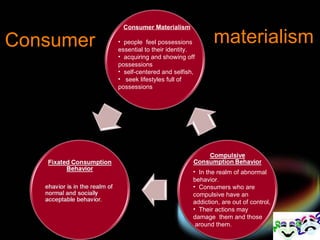
Consumer  Consumer Materialism   people  feel possessions essential to their identity. acquiring and showing off possessions self-centered and selfish,  seek lifestyles full of  possessions In the realm of abnormal behavior. Consumers who are compulsive have an addiction, are out of control,  Their actions may  damage  them and those around them. materialism
Consumer Ethnocentrism:    Consumers who are highly ethnocentric feel that it is wrong to purchase foreign-made products because it would hurt the domestic economy.  Non-ethnocentric consumers tend to evaluate foreign-made products more objectively. E.g products made in china, germany e.g
Questions????? ? ? ? ? ? ? ? ?

Consumer Behavior...Project 97 2003

  • 1.
  • 2.
    Name of students:Divya suresh………………….13 Lalita mali…………………….10 Maithili sawant………………14 Sushmita singha……………..22 Pratibha sharma ……………..19
  • 3.
    …… .Can bedefined as “ T hose inner psychological characteristics that both determine & reflect how a person responds to his or her environment. ”
  • 4.
    that distinguish oneindividual from other individuals the deeply ingrained characteris­tics that we call personality influences the individual's product choices qualities Attributes traits factors mannerisms
  • 5.
  • 6.
    Unconscious needs ordrives are at the heart of human motivation Social relationships  fundamental  formation and `development of personality Quantitative approach  psychological traits
  • 7.
    Sigmund Freud believedthat unconscious thoughts controlled the conscious mind and this plays a significant role in developing our personalities Freud proposed that personality is made up of three parts: Id Our primitive instincts or drives Superego Our urge to ‘do what is right’ – achieving perfection Ego The ‘balance’ between the id and the superego
  • 8.
    Eg. If urthirsty At id level- U would grab some water from any body having a water bottle. It superego- U ask the person for water. But at EGO u may buy a water bottle or any other drink. - Internalize society’s rules, morals, ethics restrains the impulsive forces of the id Works contradictory to id - System balancing between id and superego -Tries to balance them accord. to reality principle -Warehouse of primitive drives - sex,hunger & thirst. - Immediate gratifications - no contact with reality
  • 9.
    VALUES – STANDARDS– JUDGMENTS MOTIVES – ETHICS - BELIEFS KNOWN TO OTHERS 10 % UNKNOWN TO OTHERS 90 %
  • 10.
  • 11.
    Neo freudians Thosewho further developed Freud’s ideas but presented new ways of looking at personality Believed that individuals engage in constant adaptation and creative development, based on the environment conscious mind and external factors are also important influences on personality social relationships are fundamental to the formation and development of personality
  • 12.
  • 13.
  • 14.
  • 15.
  • 16.
    A trait is defined as “ A ny distinguishing, relatively enduring way in which one individual differs from another. “ A personality characteristic, e . g . outgoing or shy Primarily quantitative or empirical Focuses on the measurement of personality in terms of specific traits. Attempt to identify and categorise personality characteristics Useful for Marketers to identify characteristics of a certain market segment Personality traits that have been useful in differentiating between consumer innovators and non-innovators include
  • 17.
  • 18.
    How receptive areconsumers to new products, new services, or new practices? Recent consumer research indicates a positive relationship between innovative use of the Internet and buying online. consumer innovators —those who are likely to try new products. Those innovators are often crucial to the success of new products. E.g. sony ericcson shake phone. Degree of rigidity displayed by an individual toward the unfamiliar & information contrary to their established beliefs. Consumers low in dogmatism are more likely to prefer innovative products to established ones. Consumers high in dogmatism are more accepting of authority-based ads for new products. E.g for high dogmatic individuals, advertisers use testimonials n celebrity endorsments
  • 19.
    Social character isa personality trait that ranges on a continuum from inner-directed to other-directed. Inner-directed consumers tend to rely on their own “inner” values or standards in evaluating new products and are innovators. They also prefer ads stressing product features and personal benefits. Other-directed consumers tend to look to others for direction and are not innovators. They prefer ads that feature social environment and social acceptance. people who seek to be unique. These people avoid conformity.
  • 20.
    Social character Needfor uniqueness
  • 21.
  • 22.
    defined as “atrait characterized by the need for varied, novel, and complex sensations and experience, and the willingness to take physical and social risks for the sake of such experience.” E.g. sports car Primary types are variety or novelty seeking exploratory purchase behavior (e.g., switching brands to experience new and possibly better alternatives), shampoos, chocolates, vicarious exploration (e.g., where the consumer secures information about a new or different alternative and then contemplates or even daydreams about the option), e.g. sports cars, modified bikes use innovativeness (e.g., where the consumer uses an already adopted product in a new or novel way).e.g sneakers, technological product, whirlpool appliances.
  • 23.
  • 24.
    Cognitive Personality FactorsConsumers who prefer visual information and products that stress the visual. Consumers who prefer written or verbal information and products that stress the verbal. e.g. zoo-zoo ad, kfc, Mcd, ads for technical gadget. Measure person’s interest in rational thinking. High NC  more interested in ad rich in product-related information & description. low NC  more attracted to the background or peripheral aspects of an ad. E.g. ads for dth, aircel, bsnl latest ad.
  • 25.
  • 26.
    Consumer ConsumerMaterialism   people feel possessions essential to their identity. acquiring and showing off possessions self-centered and selfish, seek lifestyles full of possessions In the realm of abnormal behavior. Consumers who are compulsive have an addiction, are out of control, Their actions may damage them and those around them. materialism
  • 27.
    Consumer Ethnocentrism:   Consumers who are highly ethnocentric feel that it is wrong to purchase foreign-made products because it would hurt the domestic economy. Non-ethnocentric consumers tend to evaluate foreign-made products more objectively. E.g products made in china, germany e.g
  • 28.
    Questions????? ? ?? ? ? ? ? ?