PERSONALIT Y &
CONSUMER BEHAV IOR
- BY V I JAYALAXM I JENA
INTRODUCTION
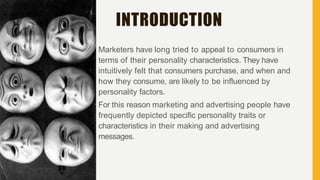
Marketers have long tried to appeal to consumers in
terms of their personality characteristics. They have
intuitively felt that consumers purchase, and when and
how they consume, are likely to be influenced by
personality factors.
For this reason marketing and advertising people have
frequently depicted specific personality traits or
characteristics in their making and advertising
messages.
CONTENTS
• Definition
• Nature
• Types
• Theories
• Personality and understanding consumer diversity
-consumer innovativeness and related personality
traits
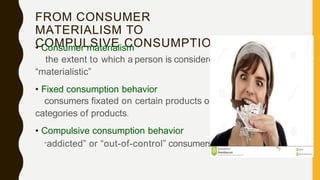
-cognitive factors
-from consumer materialism to
compulsive consumption
-consumer ethnocentrism
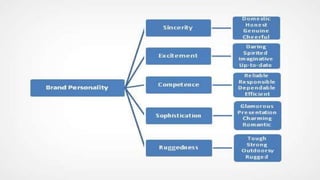
• Brand personality
-types
DEFINITION
Personality can be defined as those
inner characteristics that
determines and reflects how an
individual responds to his or her
environment.
Those characteristics said are the
attributes, traits, qualities, factors
and mannerism that distinguish
one individual from the other.
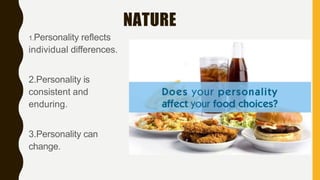
NATURE
1.Personality reflects
individual differences.
2.Personality is
consistent and
enduring.
3.Personality can
change.
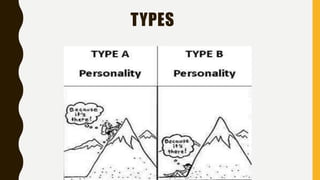
TYPES
THEORIES
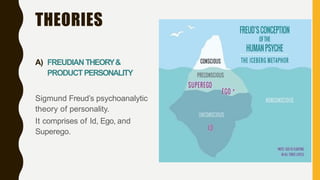
A) FREUDIANTHEORY&
PRODUCTPERSONALITY
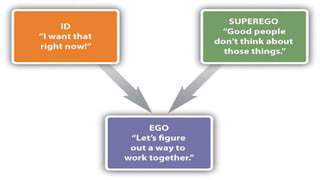
Sigmund Freud’s psychoanalytic
theory of personality.
It comprises of Id, Ego, and
Superego.
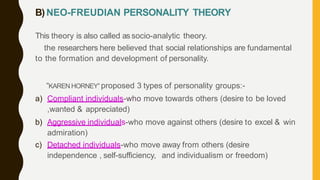
B) NEO-FREUDIAN PERSONALITY THEORY
This theory is also called as socio-analytic theory.
the researchers here believed that social relationships are fundamental
to the formation and development of personality.
“KAREN HORNEY” proposed 3 types of personality groups:-
a) Compliant individuals-who move towards others (desire to be loved
,wanted & appreciated)
b) Aggressive individuals-who move against others (desire to excel & win
admiration)
c) Detached individuals-who move away from others (desire
independence , self-sufficiency, and individualism or freedom)
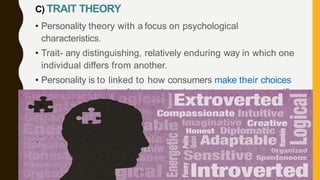
C) TRAIT THEORY
• Personality theory with a focus on psychological
characteristics.
• Trait- any distinguishing, relatively enduring way in which one
individual differs from another.
• Personality is to linked to how consumers make their choices
or to consumption of a broad product category-not aspecific
brand
PERSONALITY & UNDERSTANDING
CONSUMER DIVERSITY
RELAT
ED
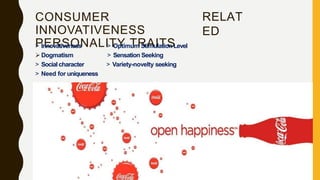
CONSUMER
INNOVATIVENESS
PERSONALITY TRAITS
> Optimum StimulationLevel
> Sensation Seeking
> Variety-novelty seeking
> Innovativeness
 Dogmatism
> Social character
> Need for uniqueness
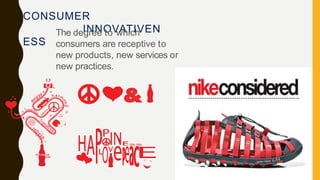
CONSUMER
INNOVATIVEN
ESS
The degree to which
consumers are receptive to
new products, new services or
new practices.
DOGMATIS
M
A personality trait that reflect the degree of rigidity a person
displays towards the unfamiliar and toward information that
is contrary to his or her own established beliefs.
Consumers low in dogmatism (open-minded) are more
likely to prefer innovative products to established or
traditional alternatives
SOCIAL
CHARACTER
Inner –directed
• Consumers who tend to rely on their on
their own inner values.
• More likely to be innovators
• Tend to prefer ads that stress product
features and benefits
Other-directed
• Consumers who tend to look to others
for direction.
• Lesslikely ot be innovators
• Tend to prefer ads that feature social
acceptance.
NEED FOR
UNIQUENESS
Consumers who avoid appearing to conform (being conventional)
to expectations or standards of others.
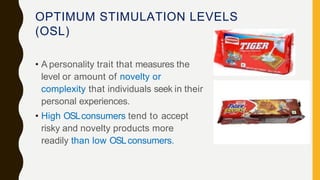
OPTIMUM STIMULATION LEVELS
(OSL)
• A personality trait that measures the
level or amount of novelty or
complexity that individuals seek in their
personal experiences.
• High OSLconsumers tend to accept
risky and novelty products more
readily than low OSLconsumers.
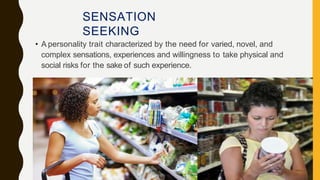
SENSATION
SEEKING
• A personality trait characterized by the need for varied, novel, and
complex sensations, experiences and willingness to take physical and
social risks for the sake of such experience.
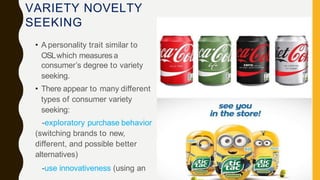
VARIETY NOVELTY
SEEKING
• A personality trait similar to
OSLwhich measuresa
consumer’s degree to variety
seeking.
• There appear to many different
types of consumer variety
seeking:
-exploratory purchase behavior
(switching brands to new,
different, and possible better
alternatives)
-use innovativeness (using an
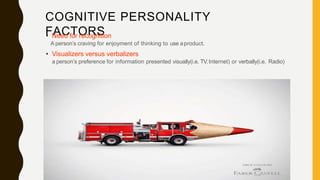
COGNITIVE PERSONALITY
FACTORS
• Need for recognition
A person’s craving for enjoyment of thinking to use aproduct.
• Visualizers versus verbalizers
a person’s preference for information presented visually(i.e. TV,Internet) or verbally(i.e. Radio)
FROM CONSUMER
MATERIALISM TO
COMPULSIVE CONSUMPTION
• Consumer materialism
the extent to which a person is considered
“materialistic”
• Fixed consumption behavior
consumers fixated on certain products or
categories of products.
• Compulsive consumption behavior
“addicted” or “out-of-control” consumers.
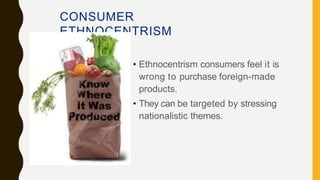
CONSUMER
ETHNOCENTRISM
• Ethnocentrism consumers feel it is
wrong to purchase foreign-made
products.
• They can be targeted by stressing
nationalistic themes.
BRAND PERSONALITY
• Brand personality is as if “making the brand alive”
• The attribution of human personality traits (seriousness, warmth, imagination,
etc.) to a brand as a way to achieve differentiation.
• Usually done through long-term advertising and appropriate packaging and
graphics.
• These traits inform brand behavior through both prepared
communication/packaging , etc.
and through the people who represent the brand- its employees.
• The way in which it speaks of its products or services shows what kind of
person it would be if it werehuman.
• A brand without a personality has trouble gaining awareness and developing
a relationship with customer.
Product personality and
Gender
• Assigning of gender aspart of personality description is fully consistent with the
marketplace reality that products and services, in general are viewed by consumers as
having a “gender-being.”
• Armed with such knowledge of the perceived gender of a product or a specific brand,
marketers are in a better position to select visual and copy-text for various marketing
messages.
• E.g.:Hero Honda Pleasure- “why should boys have all the fun”
:Gillette Venus .
Feminine products
*Cleaning, Home care products
Masculine products
*gadgets, bikes, cars, etc.
Product personality and
geography
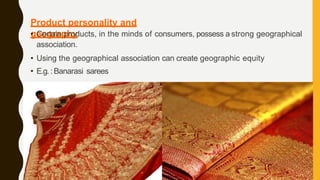
• Certain products, in the minds of consumers, possess a strong geographical
association.
• Using the geographical association can create geographic equity
• E.g.:Banarasi sarees
Personali
ty and
color
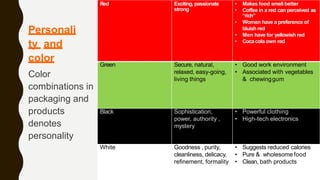
Color
combinations in
packaging and
products
denotes
personality
Red Exciting, passionate
strong
• Makes food smell better
• Coffee in a red can perceived as
“rich”
• Women have a preference of
bluishred
• Men have for yellowish red
• Cocacola own red
Green Secure, natural,
relaxed, easy-going,
living things
• Good work environment
• Associated with vegetables
& chewinggum
Black Sophistication,
power, authority ,
mystery
• Powerful clothing
• High-tech electronics
White Goodness , purity,
cleanliness, delicacy,
refinement, formality
• Suggests reduced calories
• Pure & wholesome food
• Clean, bath products
CONCLUSION
Personality are likely to
influence the individual’s
product choices. They affect the
way consumers respond to
marketers’ promotional efforts,
and when, where and how they
consume particular products or
services. Therefore, the
identification of specific
personality characteristics
associated with consumer
behavior has proven to be
highly useful in the
development of a firm’s market
Personalityconsumerbehavior 160501023233-converted

Personalityconsumerbehavior 160501023233-converted

  • 1.
    PERSONALIT Y & CONSUMERBEHAV IOR - BY V I JAYALAXM I JENA
  • 2.
    INTRODUCTION Marketers have longtried to appeal to consumers in terms of their personality characteristics. They have intuitively felt that consumers purchase, and when and how they consume, are likely to be influenced by personality factors. For this reason marketing and advertising people have frequently depicted specific personality traits or characteristics in their making and advertising messages.
  • 3.
    CONTENTS • Definition • Nature •Types • Theories • Personality and understanding consumer diversity -consumer innovativeness and related personality traits -cognitive factors -from consumer materialism to compulsive consumption -consumer ethnocentrism • Brand personality -types
  • 4.
    DEFINITION Personality can bedefined as those inner characteristics that determines and reflects how an individual responds to his or her environment. Those characteristics said are the attributes, traits, qualities, factors and mannerism that distinguish one individual from the other.
  • 5.
    NATURE 1.Personality reflects individual differences. 2.Personalityis consistent and enduring. 3.Personality can change.
  • 6.
  • 7.
    THEORIES A) FREUDIANTHEORY& PRODUCTPERSONALITY Sigmund Freud’spsychoanalytic theory of personality. It comprises of Id, Ego, and Superego.
  • 9.
    B) NEO-FREUDIAN PERSONALITYTHEORY This theory is also called as socio-analytic theory. the researchers here believed that social relationships are fundamental to the formation and development of personality. “KAREN HORNEY” proposed 3 types of personality groups:- a) Compliant individuals-who move towards others (desire to be loved ,wanted & appreciated) b) Aggressive individuals-who move against others (desire to excel & win admiration) c) Detached individuals-who move away from others (desire independence , self-sufficiency, and individualism or freedom)
  • 10.
    C) TRAIT THEORY •Personality theory with a focus on psychological characteristics. • Trait- any distinguishing, relatively enduring way in which one individual differs from another. • Personality is to linked to how consumers make their choices or to consumption of a broad product category-not aspecific brand
  • 11.
  • 12.
    RELAT ED CONSUMER INNOVATIVENESS PERSONALITY TRAITS > OptimumStimulationLevel > Sensation Seeking > Variety-novelty seeking > Innovativeness  Dogmatism > Social character > Need for uniqueness
  • 13.
    CONSUMER INNOVATIVEN ESS The degree towhich consumers are receptive to new products, new services or new practices.
  • 14.
    DOGMATIS M A personality traitthat reflect the degree of rigidity a person displays towards the unfamiliar and toward information that is contrary to his or her own established beliefs. Consumers low in dogmatism (open-minded) are more likely to prefer innovative products to established or traditional alternatives
  • 15.
    SOCIAL CHARACTER Inner –directed • Consumerswho tend to rely on their on their own inner values. • More likely to be innovators • Tend to prefer ads that stress product features and benefits Other-directed • Consumers who tend to look to others for direction. • Lesslikely ot be innovators • Tend to prefer ads that feature social acceptance.
  • 16.
    NEED FOR UNIQUENESS Consumers whoavoid appearing to conform (being conventional) to expectations or standards of others.
  • 17.
    OPTIMUM STIMULATION LEVELS (OSL) •A personality trait that measures the level or amount of novelty or complexity that individuals seek in their personal experiences. • High OSLconsumers tend to accept risky and novelty products more readily than low OSLconsumers.
  • 18.
    SENSATION SEEKING • A personalitytrait characterized by the need for varied, novel, and complex sensations, experiences and willingness to take physical and social risks for the sake of such experience.
  • 19.
    VARIETY NOVELTY SEEKING • Apersonality trait similar to OSLwhich measuresa consumer’s degree to variety seeking. • There appear to many different types of consumer variety seeking: -exploratory purchase behavior (switching brands to new, different, and possible better alternatives) -use innovativeness (using an
  • 20.
    COGNITIVE PERSONALITY FACTORS • Needfor recognition A person’s craving for enjoyment of thinking to use aproduct. • Visualizers versus verbalizers a person’s preference for information presented visually(i.e. TV,Internet) or verbally(i.e. Radio)
  • 21.
    FROM CONSUMER MATERIALISM TO COMPULSIVECONSUMPTION • Consumer materialism the extent to which a person is considered “materialistic” • Fixed consumption behavior consumers fixated on certain products or categories of products. • Compulsive consumption behavior “addicted” or “out-of-control” consumers.
  • 22.
    CONSUMER ETHNOCENTRISM • Ethnocentrism consumersfeel it is wrong to purchase foreign-made products. • They can be targeted by stressing nationalistic themes.
  • 23.
    BRAND PERSONALITY • Brandpersonality is as if “making the brand alive” • The attribution of human personality traits (seriousness, warmth, imagination, etc.) to a brand as a way to achieve differentiation. • Usually done through long-term advertising and appropriate packaging and graphics. • These traits inform brand behavior through both prepared communication/packaging , etc. and through the people who represent the brand- its employees. • The way in which it speaks of its products or services shows what kind of person it would be if it werehuman. • A brand without a personality has trouble gaining awareness and developing a relationship with customer.
  • 25.
    Product personality and Gender •Assigning of gender aspart of personality description is fully consistent with the marketplace reality that products and services, in general are viewed by consumers as having a “gender-being.” • Armed with such knowledge of the perceived gender of a product or a specific brand, marketers are in a better position to select visual and copy-text for various marketing messages. • E.g.:Hero Honda Pleasure- “why should boys have all the fun” :Gillette Venus . Feminine products *Cleaning, Home care products Masculine products *gadgets, bikes, cars, etc.
  • 26.
    Product personality and geography •Certain products, in the minds of consumers, possess a strong geographical association. • Using the geographical association can create geographic equity • E.g.:Banarasi sarees
  • 27.
    Personali ty and color Color combinations in packagingand products denotes personality Red Exciting, passionate strong • Makes food smell better • Coffee in a red can perceived as “rich” • Women have a preference of bluishred • Men have for yellowish red • Cocacola own red Green Secure, natural, relaxed, easy-going, living things • Good work environment • Associated with vegetables & chewinggum Black Sophistication, power, authority , mystery • Powerful clothing • High-tech electronics White Goodness , purity, cleanliness, delicacy, refinement, formality • Suggests reduced calories • Pure & wholesome food • Clean, bath products
  • 28.
    CONCLUSION Personality are likelyto influence the individual’s product choices. They affect the way consumers respond to marketers’ promotional efforts, and when, where and how they consume particular products or services. Therefore, the identification of specific personality characteristics associated with consumer behavior has proven to be highly useful in the development of a firm’s market