TABLE OF CONTENTS
•Introduction of Consumerism
• Types of Consumerism
• Conspicuous Consumption
• Working on Consumerism
• Consumerism and Economy
• Advantages of Consumerism
• Disadvantages of Consumerism
• Consumer Protection Act
• Need
• Features
• Objectives
• Importance
• Rights of Consumers
• Three Tier Consumer Grievances Machinery
• Latest Amendments
3.
CONSUMERISM
Consumerism is theidea that increasing the consumption of goods and services purchased in the
market is always a desirable goal and that a person’s well-being and happiness depend
fundamentally on obtaining consumer goods and material possessions. Consumerism
can be understood in two different ways: as an economic policy promoting consumer spending to
boost the economy or as a social phenomenon involving excessive materialism and consumption of
goods and services. In the political or social sense,
consumerism also involves the efforts of private and public organizations to protect the rights and
interests of consumers by improving the quality and safety of consumer goods, changing the
production methods to reduce negative impacts on human health or the environment, or eliminating
unfair or harmful business practices such as false advertising.
4.
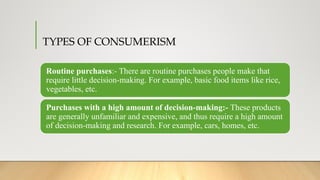
TYPES OF CONSUMERISM
Routinepurchases:- There are routine purchases people make that
require little decision-making. For example, basic food items like rice,
vegetables, etc.
Purchases with a high amount of decision-making:- These products
are generally unfamiliar and expensive, and thus require a high amount
of decision-making and research. For example, cars, homes, etc.
5.
Conspicuous consumption
The conceptof consumerism stems from conspicuous consumption.
It is a term coined by an American economist and sociologist Thorstein Veblen.
Conspicuous Consumption is the purchase of goods or services for the specific purpose of
displaying one’s wealth.
It is a means to show one’s social status or class.
It is exemplified by purchasing goods exclusively designed to serve as a symbol of wealth,
like luxury brand labels clothing, high-tech tools, toys, and vehicles.
6.
WORKING OF CONSUMERISM
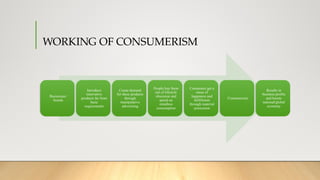
Businesses/
brands
Introduce
innovative
productsfar from
basic
requirements
Create demand
for these products
through
manipulative
advertising
People buy them
out of lifestyle
obsession and
spend on
mindless
consumption
Consumers get a
sense of
happiness and
fulfillment
through material
possession
Consumerism
Results in
business profits
and boosts
national/global
economy
7.
CONSUMERISM AND ECONOMY
Healthyconsumption is a big positive for the economy as it indicates that people are ready
to spend; this ensures that there is a circulation of money in the economy. Consumer
spending is a critical driver of economic growth. When consumers are confident and
optimistic, they tend to spend more, which can increase demand for goods and services and
create jobs. However,
if consumption drops, then it indicates underlying problems. It may be due to a high
unemployment rate, increased interest rates, and so on. If consumers are cautious and save
more, it can slow down economic growth. Hence,
consumption can be considered an indicator of the overall economic health of a country.
8.
ADVANTAGES OF CONSUMERISM
Createsjob opportunities for skilled labor
Encourages competition in business for better products
Contributes to business profits, national GDP, and global economy
Gives consumers a tremendous amount of choice in the market
9.
DISADVANTAGES OF CONSUMERISM
Leadsto an inferiority complex as consumerism does not have anything to offer poor and
less privileged people of society.
Environmental imbalances as it requires resources to fulfill increasing demand
The consumers waste money on luxury things to maintain social status that they don’t
actually need.
Leads companies to develop low quality products.
10.
CONSUMER PROTECTION ACT
Consumerprotection means safeguarding the interests and rights of consumers by giving
them the required protection from unfair trade practices.
In other words, it refers to the measures adopted for the protection of consumers from
unscrupulous and unethical malpractices by the business and to provide them with speedy
redressal of their grievances.
This Act was enacted in 1986 and came into force from 15th
April 1987.
11.
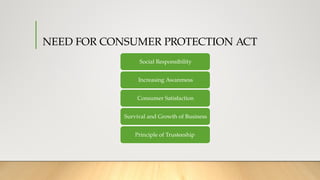
NEED FOR CONSUMERPROTECTION ACT
Social Responsibility
Increasing Awareness
Consumer Satisfaction
Survival and Growth of Business
Principle of Trusteeship
12.
FEATURES OF CONSUMERPROTECTION ACT
It applies to all goods, services, and unfair trade practices unless specifically exempted by
the Central Government.
It covers all sectors whether private, public or co-operative.
It promotes the rights of the consumers.
It provides for the establishment of consumer protection councils at the central, state and
district levels.
13.
OBJECTIVES OF CONSUMERPROTECTION ACT
To protect the consumers from immoral activities and unfair trade practices of the traders.
To protect and promote the rights of the consumers.
To set up “Consumer Protection Councils” to educate the consumers and to make them aware of their rights.
To create a framework for consumers to seek redressal.
To provide machinery for the speedy redressal of grievances.
14.
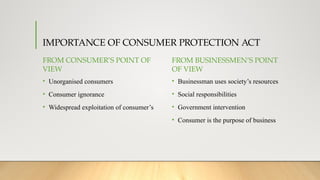
IMPORTANCE OF CONSUMERPROTECTION ACT
FROM CONSUMER’S POINT OF
VIEW
• Unorganised consumers
• Consumer ignorance
• Widespread exploitation of consumer’s
FROM BUSINESSMEN’S POINT
OF VIEW
• Businessman uses society’s resources
• Social responsibilities
• Government intervention
• Consumer is the purpose of business
15.
RIGHTS OF CONSUMER
•Right to safety:- To be protected against the marketing of goods or the provision of
services that are hazardous to health and life.
• Right to information:- To be protected against dishonest or misleading advertising and
the right to be given the facts and information needed to make an informed choice.
• Right to choice:- To choose products at competitive prices
• Right to representation:- To express consumer interests in the making and execution of
government policies.
16.
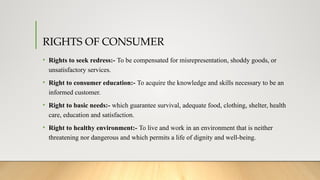
RIGHTS OF CONSUMER
•Rights to seek redress:- To be compensated for misrepresentation, shoddy goods, or
unsatisfactory services.
• Right to consumer education:- To acquire the knowledge and skills necessary to be an
informed customer.
• Right to basic needs:- which guarantee survival, adequate food, clothing, shelter, health
care, education and satisfaction.
• Right to healthy environment:- To live and work in an environment that is neither
threatening nor dangerous and which permits a life of dignity and well-being.
17.
THREE TIER CONSUMERGRIEVANCES MACHINERY
• District Forum:- A consumer can file a complaint if the value of goods/services along
with the compensation that is claimed is less than Rs 1 crore.
• State Commission:- A consumer can file a complaint in case the value of goods/services
along with the compensation claimed is more than Rs 1 crore and less than Rs 10 crore.
• National commission:- A consumer can file a complaint in case the value of
goods/services along with the compensation claimed is more than Rs 10 crore. In case
the aggrieved party is not satisfied with the order, an appeal can be filed before the
Supreme Court.
18.
LATEST AMENDMENTS
1986
• Noseparate regulator
• Complaint could be filed in a consumer
court where the seller’s office is located
• No provision for E-commerce
2019
• Central Consumer Protection Authority to
be formed
• Complaint can be filed in a consumer court
where the complainant resides or works
• All rules of direct selling extended to E-
commerce
19.
LATEST AMENDMENTS
1986
• District:-up to Rs 20 lakh
State:- Rs 20 lakh to Rs 1 crore
National:- above Rs 1 crore
• No legal provision
2019
• District:- up to Rs 1 crore
State:- Rs 1 crore to Rs 10 crore
National:- above Rs 10 crore
• The court can refer to settlement
through mediation