Rising Technologies, Jalna (MH). + 91 9423156065, http://www.RisingTechnologies.in 1
Haresh Jaiswal
Rising Technologies, Jalna.
Rising Technologies, Jalna (MH). + 91 9423156065, http://www.RisingTechnologies.in 2
Introduction
 A constructor is a special member function whose task is to
initialize the data members of an objects of its class.
 It is special because it has same name as its class name.
 It invokes automatically whenever a new object of its associated
class is created.
 It is called constructor because it constructs the initial values of
data members and build your programmatic object.
Rising Technologies, Jalna (MH). + 91 9423156065, http://www.RisingTechnologies.in 3
Introduction
 It is very common for some part of an object to require
initialization before it can be used.
 Suppose you are working on 100's of objects and the default
value of a particular data member is needed to be zero.
 Initialising all objects manually will be very tedious job.
 Instead, you can define a constructor function which initialises
that data member to zero. Then all you have to do is declare
object and constructor will initialise object automatically.
Rising Technologies, Jalna (MH). + 91 9423156065, http://www.RisingTechnologies.in 4
Constructor Example
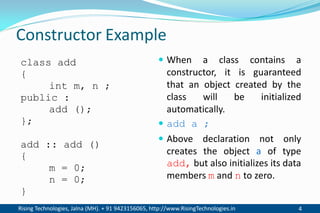
 When a class contains a
constructor, it is guaranteed
that an object created by the
class will be initialized
automatically.
 add a ;
 Above declaration not only
creates the object a of type
add, but also initializes its data
members m and n to zero.
class add
{
int m, n ;
public :
add ();
};
add :: add ()
{
m = 0;
n = 0;
}
Rising Technologies, Jalna (MH). + 91 9423156065, http://www.RisingTechnologies.in 5
Constructors
 There is no need to write any statement to invoke the constructor
function.
 If a ‘normal’ member function is defined for initialization, we
need to invoke that function for each and every objects
separately.
 A constructor that accepts no parameters is called the default
constructor.
 The default constructor for class A will be A : : A ( )
Rising Technologies, Jalna (MH). + 91 9423156065, http://www.RisingTechnologies.in 6
Characteristics of Constructor
 They must be declared in the public scope.
 They are invoked automatically when the objects are created.
 They do not have return types, not even void and they cannot
return values.
 They cannot be inherited, though a derived class can call the base
class constructor.
 Like other C++ functions, Constructors can have default
arguments.
 Constructors can not be virtual.
Rising Technologies, Jalna (MH). + 91 9423156065, http://www.RisingTechnologies.in 7
Characteristics of Constructor
 We can not refer to their addresses.
 An object with a constructor (or destructor) can not be used as a
member of a union.
 They make ‘implicit calls’ to the operators new and delete when
memory allocation is required.
Rising Technologies, Jalna (MH). + 91 9423156065, http://www.RisingTechnologies.in 8
Constructor
 The constructor function is responsible for creation of object.
 But in previous examples, we have not defined any constructor in
class, so how come the objects were created of those classes?
 The answer is, If no constructor is defined in the class in such
situation the compiler implicitly provides a constructor, which is
called as default constructor.
Rising Technologies, Jalna (MH). + 91 9423156065, http://www.RisingTechnologies.in 9
Constructor
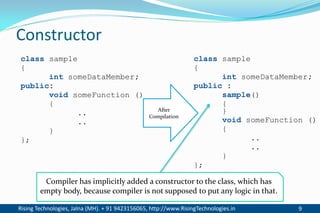
class sample
{
int someDataMember;
public:
void someFunction ()
{
..
..
}
};
class sample
{
int someDataMember;
public :
sample()
{
}
void someFunction ()
{
..
..
}
};
After
Compilation
Compiler has implicitly added a constructor to the class, which has
empty body, because compiler is not supposed to put any logic in that.
Rising Technologies, Jalna (MH). + 91 9423156065, http://www.RisingTechnologies.in 10
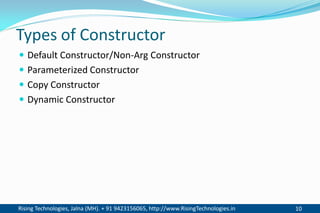
Types of Constructor
 Default Constructor/Non-Arg Constructor
 Parameterized Constructor
 Copy Constructor
 Dynamic Constructor
Rising Technologies, Jalna (MH). + 91 9423156065, http://www.RisingTechnologies.in 11
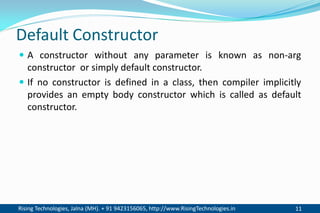
Default Constructor
 A constructor without any parameter is known as non-arg
constructor or simply default constructor.
 If no constructor is defined in a class, then compiler implicitly
provides an empty body constructor which is called as default
constructor.
Rising Technologies, Jalna (MH). + 91 9423156065, http://www.RisingTechnologies.in 12
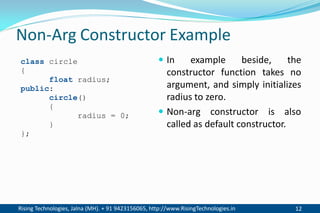
Non-Arg Constructor Example
 In example beside, the
constructor function takes no
argument, and simply initializes
radius to zero.
 Non-arg constructor is also
called as default constructor.
class circle
{
float radius;
public:
circle()
{
radius = 0;
}
};
Rising Technologies, Jalna (MH). + 91 9423156065, http://www.RisingTechnologies.in 13
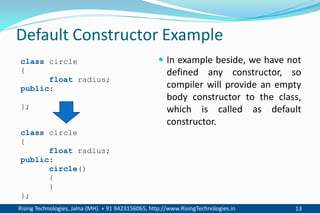
Default Constructor Example
 In example beside, we have not
defined any constructor, so
compiler will provide an empty
body constructor to the class,
which is called as default
constructor.
class circle
{
float radius;
public:
};
class circle
{
float radius;
public:
circle()
{
}
};
Rising Technologies, Jalna (MH). + 91 9423156065, http://www.RisingTechnologies.in 14
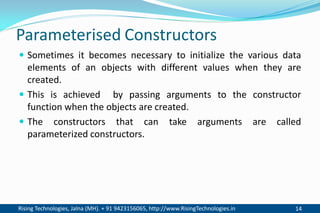
Parameterised Constructors
 Sometimes it becomes necessary to initialize the various data
elements of an objects with different values when they are
created.
 This is achieved by passing arguments to the constructor
function when the objects are created.
 The constructors that can take arguments are called
parameterized constructors.
Rising Technologies, Jalna (MH). + 91 9423156065, http://www.RisingTechnologies.in 15
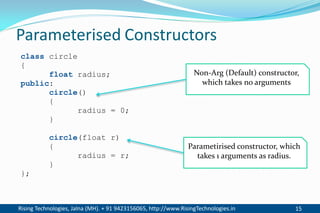
Parameterised Constructors
class circle
{
float radius;
public:
circle()
{
radius = 0;
}
circle(float r)
{
radius = r;
}
};
Non-Arg (Default) constructor,
which takes no arguments
Parametirised constructor, which
takes 1 arguments as radius.
Rising Technologies, Jalna (MH). + 91 9423156065, http://www.RisingTechnologies.in 16
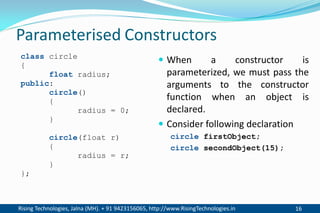
Parameterised Constructors
 When a constructor is
parameterized, we must pass the
arguments to the constructor
function when an object is
declared.
 Consider following declaration
circle firstObject;
circle secondObject(15);
class circle
{
float radius;
public:
circle()
{
radius = 0;
}
circle(float r)
{
radius = r;
}
};
Rising Technologies, Jalna (MH). + 91 9423156065, http://www.RisingTechnologies.in 17
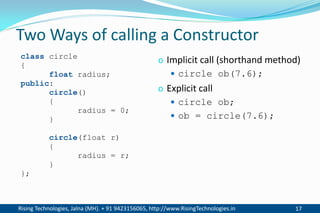
Two Ways of calling a Constructor
o Implicit call (shorthand method)
 circle ob(7.6);
o Explicit call
 circle ob;
 ob = circle(7.6);
class circle
{
float radius;
public:
circle()
{
radius = 0;
}
circle(float r)
{
radius = r;
}
};
Rising Technologies, Jalna (MH). + 91 9423156065, http://www.RisingTechnologies.in 18
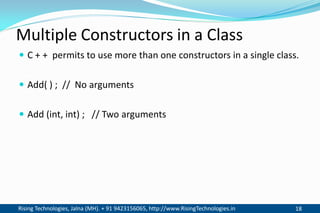
Multiple Constructors in a Class
 C + + permits to use more than one constructors in a single class.
 Add( ) ; // No arguments
 Add (int, int) ; // Two arguments
Rising Technologies, Jalna (MH). + 91 9423156065, http://www.RisingTechnologies.in 19
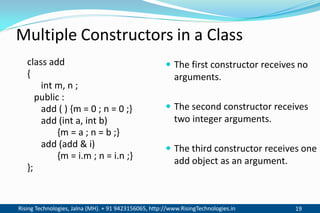
class add
{
int m, n ;
public :
add ( ) {m = 0 ; n = 0 ;}
add (int a, int b)
{m = a ; n = b ;}
add (add & i)
{m = i.m ; n = i.n ;}
};
 The first constructor receives no
arguments.
 The second constructor receives
two integer arguments.
 The third constructor receives one
add object as an argument.
Multiple Constructors in a Class
Rising Technologies, Jalna (MH). + 91 9423156065, http://www.RisingTechnologies.in 20
Multiple Constructors in a Class
class add
{
int m, n ;
public :
add ( ) {m = 0 ; n = 0 ;}
add (int a, int b)
{m = a ; n = b ;}
add (add & i)
{m = i.m ; n = i.n ;}
};
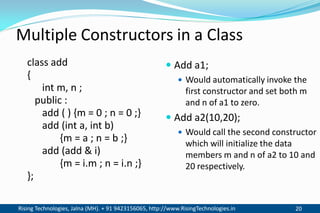
 Add a1;
 Would automatically invoke the
first constructor and set both m
and n of a1 to zero.
 Add a2(10,20);
 Would call the second constructor
which will initialize the data
members m and n of a2 to 10 and
20 respectively.
Rising Technologies, Jalna (MH). + 91 9423156065, http://www.RisingTechnologies.in 21
Multiple Constructors in a Class
class add
{
int m, n ;
public :
add ( ) {m = 0 ; n = 0 ;}
add (int a, int b)
{m = a ; n = b ;}
add (add & i)
{m = i.m ; n = i.n ;}
};
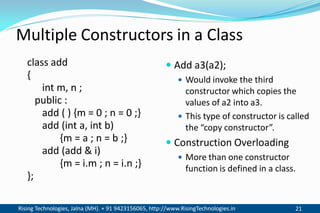
 Add a3(a2);
 Would invoke the third
constructor which copies the
values of a2 into a3.
 This type of constructor is called
the “copy constructor”.
 Construction Overloading
 More than one constructor
function is defined in a class.
Rising Technologies, Jalna (MH). + 91 9423156065, http://www.RisingTechnologies.in 22
Multiple Constructors in a Class
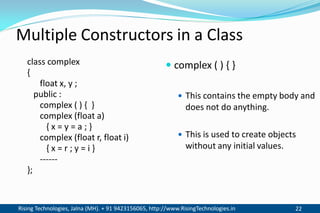
class complex
{
float x, y ;
public :
complex ( ) { }
complex (float a)
{ x = y = a ; }
complex (float r, float i)
{ x = r ; y = i }
------
};
 complex ( ) { }
 This contains the empty body and
does not do anything.
 This is used to create objects
without any initial values.
Rising Technologies, Jalna (MH). + 91 9423156065, http://www.RisingTechnologies.in 23
Multiple Constructors in a Class
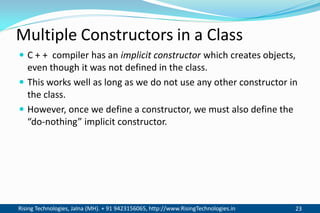
 C + + compiler has an implicit constructor which creates objects,
even though it was not defined in the class.
 This works well as long as we do not use any other constructor in
the class.
 However, once we define a constructor, we must also define the
“do-nothing” implicit constructor.
Rising Technologies, Jalna (MH). + 91 9423156065, http://www.RisingTechnologies.in 24
Constructors with Default Arguments
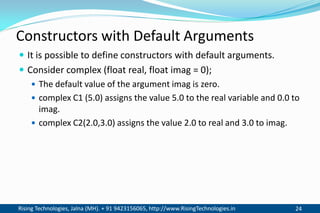
 It is possible to define constructors with default arguments.
 Consider complex (float real, float imag = 0);
 The default value of the argument imag is zero.
 complex C1 (5.0) assigns the value 5.0 to the real variable and 0.0 to
imag.
 complex C2(2.0,3.0) assigns the value 2.0 to real and 3.0 to imag.
Rising Technologies, Jalna (MH). + 91 9423156065, http://www.RisingTechnologies.in 25
Constructors with Default Arguments
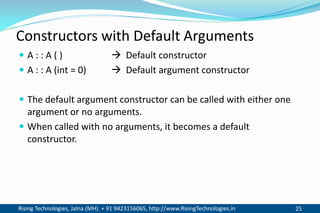
 A : : A ( )  Default constructor
 A : : A (int = 0)  Default argument constructor
 The default argument constructor can be called with either one
argument or no arguments.
 When called with no arguments, it becomes a default
constructor.
Rising Technologies, Jalna (MH). + 91 9423156065, http://www.RisingTechnologies.in 26
Dynamic Initialization of Objects
 Providing initial value to objects at run time.
 Advantage – We can provide various initialization
formats, using overloaded constructors.
This provides the flexibility of using
different format of data at run time
depending upon the situation.
Rising Technologies, Jalna (MH). + 91 9423156065, http://www.RisingTechnologies.in 27
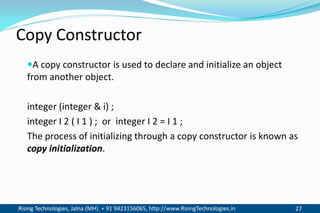
Copy Constructor
A copy constructor is used to declare and initialize an object
from another object.
integer (integer & i) ;
integer I 2 ( I 1 ) ; or integer I 2 = I 1 ;
The process of initializing through a copy constructor is known as
copy initialization.
Rising Technologies, Jalna (MH). + 91 9423156065, http://www.RisingTechnologies.in 28
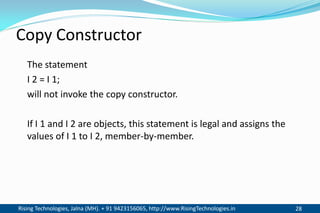
Copy Constructor
The statement
I 2 = I 1;
will not invoke the copy constructor.
If I 1 and I 2 are objects, this statement is legal and assigns the
values of I 1 to I 2, member-by-member.
Rising Technologies, Jalna (MH). + 91 9423156065, http://www.RisingTechnologies.in 29
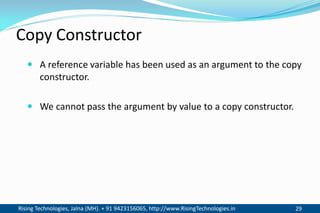
Copy Constructor
 A reference variable has been used as an argument to the copy
constructor.
 We cannot pass the argument by value to a copy constructor.
Rising Technologies, Jalna (MH). + 91 9423156065, http://www.RisingTechnologies.in 30
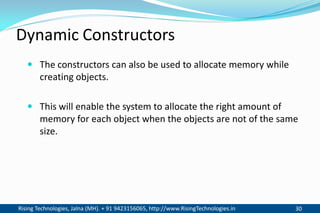
Dynamic Constructors
 The constructors can also be used to allocate memory while
creating objects.
 This will enable the system to allocate the right amount of
memory for each object when the objects are not of the same
size.
Rising Technologies, Jalna (MH). + 91 9423156065, http://www.RisingTechnologies.in 31
Dynamic Constructors
 Allocation of memory to objects at the time of their
construction is known as dynamic construction of objects.
 The memory is created with the help of the new operator.
Rising Technologies, Jalna (MH). + 91 9423156065, http://www.RisingTechnologies.in 32
Destructors
 A destructor is used to destroy the objects that have been
created by a constructor.
 Like constructor, the destructor is a member function whose
name is the same as the class name but is preceded by a tilde.
eg: ~ integer ( ) { }
Rising Technologies, Jalna (MH). + 91 9423156065, http://www.RisingTechnologies.in 33
Destructors
 A destructor never takes any argument nor does it return any
value.
 It will be invoked implicitly by the compiler upon exit from the
program – or block or function as the case may be – to clean
up storage that is no longer accessible.
Rising Technologies, Jalna (MH). + 91 9423156065, http://www.RisingTechnologies.in 34
Destructors
 It is a good practice to declare destructors in a program since it
releases memory space for further use.
 Whenever new is used to allocate memory in the constructor,
we should use delete to free that memory.

04. constructor & destructor

  • 1.
    Rising Technologies, Jalna(MH). + 91 9423156065, http://www.RisingTechnologies.in 1 Haresh Jaiswal Rising Technologies, Jalna.
  • 2.
    Rising Technologies, Jalna(MH). + 91 9423156065, http://www.RisingTechnologies.in 2 Introduction  A constructor is a special member function whose task is to initialize the data members of an objects of its class.  It is special because it has same name as its class name.  It invokes automatically whenever a new object of its associated class is created.  It is called constructor because it constructs the initial values of data members and build your programmatic object.
  • 3.
    Rising Technologies, Jalna(MH). + 91 9423156065, http://www.RisingTechnologies.in 3 Introduction  It is very common for some part of an object to require initialization before it can be used.  Suppose you are working on 100's of objects and the default value of a particular data member is needed to be zero.  Initialising all objects manually will be very tedious job.  Instead, you can define a constructor function which initialises that data member to zero. Then all you have to do is declare object and constructor will initialise object automatically.
  • 4.
    Rising Technologies, Jalna(MH). + 91 9423156065, http://www.RisingTechnologies.in 4 Constructor Example  When a class contains a constructor, it is guaranteed that an object created by the class will be initialized automatically.  add a ;  Above declaration not only creates the object a of type add, but also initializes its data members m and n to zero. class add { int m, n ; public : add (); }; add :: add () { m = 0; n = 0; }
  • 5.
    Rising Technologies, Jalna(MH). + 91 9423156065, http://www.RisingTechnologies.in 5 Constructors  There is no need to write any statement to invoke the constructor function.  If a ‘normal’ member function is defined for initialization, we need to invoke that function for each and every objects separately.  A constructor that accepts no parameters is called the default constructor.  The default constructor for class A will be A : : A ( )
  • 6.
    Rising Technologies, Jalna(MH). + 91 9423156065, http://www.RisingTechnologies.in 6 Characteristics of Constructor  They must be declared in the public scope.  They are invoked automatically when the objects are created.  They do not have return types, not even void and they cannot return values.  They cannot be inherited, though a derived class can call the base class constructor.  Like other C++ functions, Constructors can have default arguments.  Constructors can not be virtual.
  • 7.
    Rising Technologies, Jalna(MH). + 91 9423156065, http://www.RisingTechnologies.in 7 Characteristics of Constructor  We can not refer to their addresses.  An object with a constructor (or destructor) can not be used as a member of a union.  They make ‘implicit calls’ to the operators new and delete when memory allocation is required.
  • 8.
    Rising Technologies, Jalna(MH). + 91 9423156065, http://www.RisingTechnologies.in 8 Constructor  The constructor function is responsible for creation of object.  But in previous examples, we have not defined any constructor in class, so how come the objects were created of those classes?  The answer is, If no constructor is defined in the class in such situation the compiler implicitly provides a constructor, which is called as default constructor.
  • 9.
    Rising Technologies, Jalna(MH). + 91 9423156065, http://www.RisingTechnologies.in 9 Constructor class sample { int someDataMember; public: void someFunction () { .. .. } }; class sample { int someDataMember; public : sample() { } void someFunction () { .. .. } }; After Compilation Compiler has implicitly added a constructor to the class, which has empty body, because compiler is not supposed to put any logic in that.
  • 10.
    Rising Technologies, Jalna(MH). + 91 9423156065, http://www.RisingTechnologies.in 10 Types of Constructor  Default Constructor/Non-Arg Constructor  Parameterized Constructor  Copy Constructor  Dynamic Constructor
  • 11.
    Rising Technologies, Jalna(MH). + 91 9423156065, http://www.RisingTechnologies.in 11 Default Constructor  A constructor without any parameter is known as non-arg constructor or simply default constructor.  If no constructor is defined in a class, then compiler implicitly provides an empty body constructor which is called as default constructor.
  • 12.
    Rising Technologies, Jalna(MH). + 91 9423156065, http://www.RisingTechnologies.in 12 Non-Arg Constructor Example  In example beside, the constructor function takes no argument, and simply initializes radius to zero.  Non-arg constructor is also called as default constructor. class circle { float radius; public: circle() { radius = 0; } };
  • 13.
    Rising Technologies, Jalna(MH). + 91 9423156065, http://www.RisingTechnologies.in 13 Default Constructor Example  In example beside, we have not defined any constructor, so compiler will provide an empty body constructor to the class, which is called as default constructor. class circle { float radius; public: }; class circle { float radius; public: circle() { } };
  • 14.
    Rising Technologies, Jalna(MH). + 91 9423156065, http://www.RisingTechnologies.in 14 Parameterised Constructors  Sometimes it becomes necessary to initialize the various data elements of an objects with different values when they are created.  This is achieved by passing arguments to the constructor function when the objects are created.  The constructors that can take arguments are called parameterized constructors.
  • 15.
    Rising Technologies, Jalna(MH). + 91 9423156065, http://www.RisingTechnologies.in 15 Parameterised Constructors class circle { float radius; public: circle() { radius = 0; } circle(float r) { radius = r; } }; Non-Arg (Default) constructor, which takes no arguments Parametirised constructor, which takes 1 arguments as radius.
  • 16.
    Rising Technologies, Jalna(MH). + 91 9423156065, http://www.RisingTechnologies.in 16 Parameterised Constructors  When a constructor is parameterized, we must pass the arguments to the constructor function when an object is declared.  Consider following declaration circle firstObject; circle secondObject(15); class circle { float radius; public: circle() { radius = 0; } circle(float r) { radius = r; } };
  • 17.
    Rising Technologies, Jalna(MH). + 91 9423156065, http://www.RisingTechnologies.in 17 Two Ways of calling a Constructor o Implicit call (shorthand method)  circle ob(7.6); o Explicit call  circle ob;  ob = circle(7.6); class circle { float radius; public: circle() { radius = 0; } circle(float r) { radius = r; } };
  • 18.
    Rising Technologies, Jalna(MH). + 91 9423156065, http://www.RisingTechnologies.in 18 Multiple Constructors in a Class  C + + permits to use more than one constructors in a single class.  Add( ) ; // No arguments  Add (int, int) ; // Two arguments
  • 19.
    Rising Technologies, Jalna(MH). + 91 9423156065, http://www.RisingTechnologies.in 19 class add { int m, n ; public : add ( ) {m = 0 ; n = 0 ;} add (int a, int b) {m = a ; n = b ;} add (add & i) {m = i.m ; n = i.n ;} };  The first constructor receives no arguments.  The second constructor receives two integer arguments.  The third constructor receives one add object as an argument. Multiple Constructors in a Class
  • 20.
    Rising Technologies, Jalna(MH). + 91 9423156065, http://www.RisingTechnologies.in 20 Multiple Constructors in a Class class add { int m, n ; public : add ( ) {m = 0 ; n = 0 ;} add (int a, int b) {m = a ; n = b ;} add (add & i) {m = i.m ; n = i.n ;} };  Add a1;  Would automatically invoke the first constructor and set both m and n of a1 to zero.  Add a2(10,20);  Would call the second constructor which will initialize the data members m and n of a2 to 10 and 20 respectively.
  • 21.
    Rising Technologies, Jalna(MH). + 91 9423156065, http://www.RisingTechnologies.in 21 Multiple Constructors in a Class class add { int m, n ; public : add ( ) {m = 0 ; n = 0 ;} add (int a, int b) {m = a ; n = b ;} add (add & i) {m = i.m ; n = i.n ;} };  Add a3(a2);  Would invoke the third constructor which copies the values of a2 into a3.  This type of constructor is called the “copy constructor”.  Construction Overloading  More than one constructor function is defined in a class.
  • 22.
    Rising Technologies, Jalna(MH). + 91 9423156065, http://www.RisingTechnologies.in 22 Multiple Constructors in a Class class complex { float x, y ; public : complex ( ) { } complex (float a) { x = y = a ; } complex (float r, float i) { x = r ; y = i } ------ };  complex ( ) { }  This contains the empty body and does not do anything.  This is used to create objects without any initial values.
  • 23.
    Rising Technologies, Jalna(MH). + 91 9423156065, http://www.RisingTechnologies.in 23 Multiple Constructors in a Class  C + + compiler has an implicit constructor which creates objects, even though it was not defined in the class.  This works well as long as we do not use any other constructor in the class.  However, once we define a constructor, we must also define the “do-nothing” implicit constructor.
  • 24.
    Rising Technologies, Jalna(MH). + 91 9423156065, http://www.RisingTechnologies.in 24 Constructors with Default Arguments  It is possible to define constructors with default arguments.  Consider complex (float real, float imag = 0);  The default value of the argument imag is zero.  complex C1 (5.0) assigns the value 5.0 to the real variable and 0.0 to imag.  complex C2(2.0,3.0) assigns the value 2.0 to real and 3.0 to imag.
  • 25.
    Rising Technologies, Jalna(MH). + 91 9423156065, http://www.RisingTechnologies.in 25 Constructors with Default Arguments  A : : A ( )  Default constructor  A : : A (int = 0)  Default argument constructor  The default argument constructor can be called with either one argument or no arguments.  When called with no arguments, it becomes a default constructor.
  • 26.
    Rising Technologies, Jalna(MH). + 91 9423156065, http://www.RisingTechnologies.in 26 Dynamic Initialization of Objects  Providing initial value to objects at run time.  Advantage – We can provide various initialization formats, using overloaded constructors. This provides the flexibility of using different format of data at run time depending upon the situation.
  • 27.
    Rising Technologies, Jalna(MH). + 91 9423156065, http://www.RisingTechnologies.in 27 Copy Constructor A copy constructor is used to declare and initialize an object from another object. integer (integer & i) ; integer I 2 ( I 1 ) ; or integer I 2 = I 1 ; The process of initializing through a copy constructor is known as copy initialization.
  • 28.
    Rising Technologies, Jalna(MH). + 91 9423156065, http://www.RisingTechnologies.in 28 Copy Constructor The statement I 2 = I 1; will not invoke the copy constructor. If I 1 and I 2 are objects, this statement is legal and assigns the values of I 1 to I 2, member-by-member.
  • 29.
    Rising Technologies, Jalna(MH). + 91 9423156065, http://www.RisingTechnologies.in 29 Copy Constructor  A reference variable has been used as an argument to the copy constructor.  We cannot pass the argument by value to a copy constructor.
  • 30.
    Rising Technologies, Jalna(MH). + 91 9423156065, http://www.RisingTechnologies.in 30 Dynamic Constructors  The constructors can also be used to allocate memory while creating objects.  This will enable the system to allocate the right amount of memory for each object when the objects are not of the same size.
  • 31.
    Rising Technologies, Jalna(MH). + 91 9423156065, http://www.RisingTechnologies.in 31 Dynamic Constructors  Allocation of memory to objects at the time of their construction is known as dynamic construction of objects.  The memory is created with the help of the new operator.
  • 32.
    Rising Technologies, Jalna(MH). + 91 9423156065, http://www.RisingTechnologies.in 32 Destructors  A destructor is used to destroy the objects that have been created by a constructor.  Like constructor, the destructor is a member function whose name is the same as the class name but is preceded by a tilde. eg: ~ integer ( ) { }
  • 33.
    Rising Technologies, Jalna(MH). + 91 9423156065, http://www.RisingTechnologies.in 33 Destructors  A destructor never takes any argument nor does it return any value.  It will be invoked implicitly by the compiler upon exit from the program – or block or function as the case may be – to clean up storage that is no longer accessible.
  • 34.
    Rising Technologies, Jalna(MH). + 91 9423156065, http://www.RisingTechnologies.in 34 Destructors  It is a good practice to declare destructors in a program since it releases memory space for further use.  Whenever new is used to allocate memory in the constructor, we should use delete to free that memory.