Construction
Technology Quarterly
Q2, 2021 Presentation
June 24th, 2021
Today’s Agenda
• Demand
• Quick Review
• Emerging IT
• Productivity vs. Quality
• Supply
• Density of Data: Computer Vision
• Ideas
• Five Forces Analysis
• Supporters
Demand For Tech
Labor Shortage is Structural, Not Cyclical
• It is not “coming back”
• Process and Technology will have to make up for lack of people
0
50
100
150
200
250
300
350
01 02 03 04 05 06 07 08 09 10 11 12 13 14 15 16 17 18 19 20
52.0
54.0
56.0
58.0
60.0
62.0
64.0
66.0
95 96 97 98 99 00 01 02 03 04 05 06 07 08 09 10 11 12 13 14 15 16 17 18 19 20
Labor Shortage in Construction Percent of Population Working
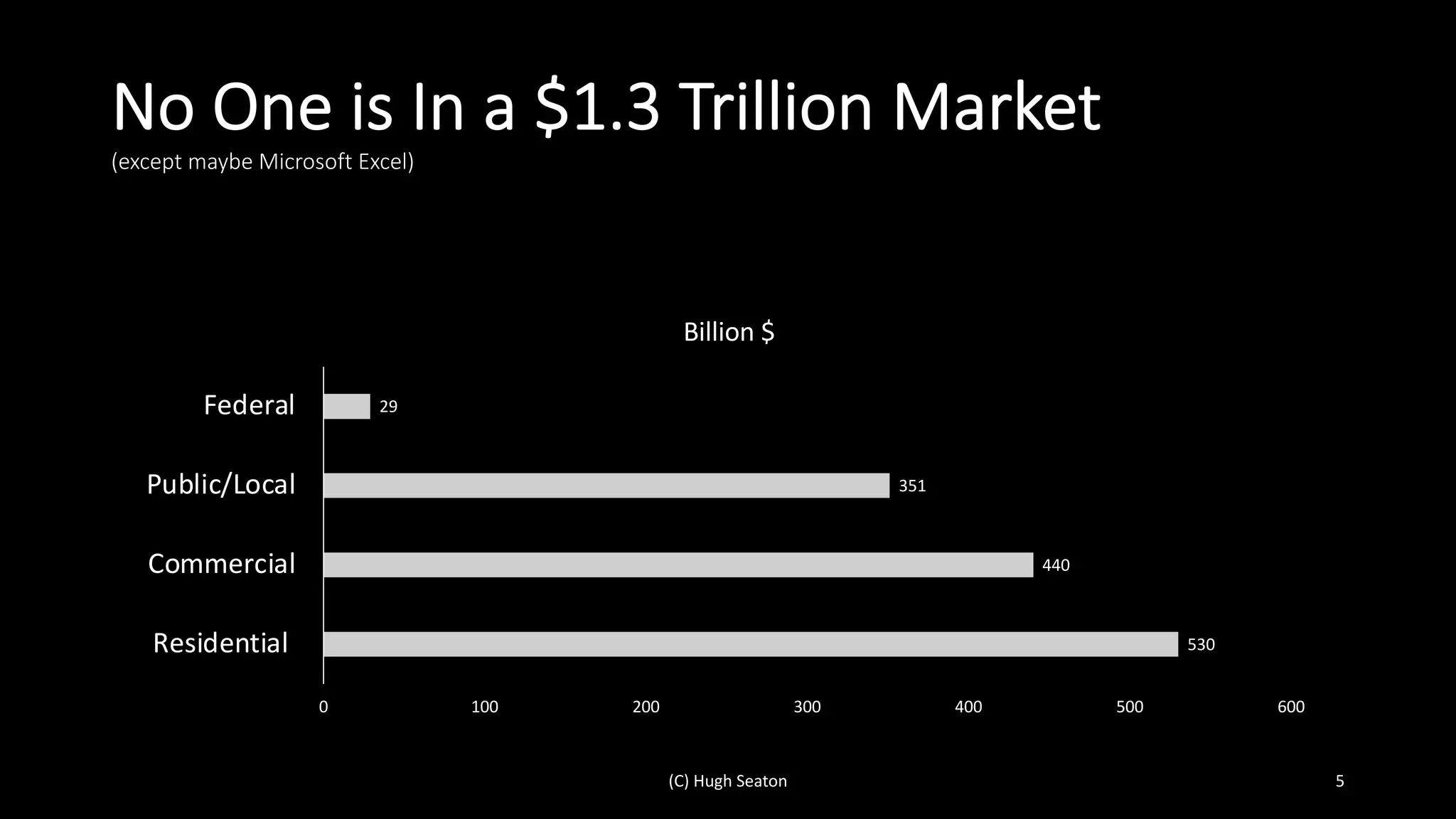
No One is In a $1.3 Trillion Market
(except maybe Microsoft Excel)
(C) Hugh Seaton 5
530
440
351
29
0 100 200 300 400 500 600
Residential
Commercial
Public/Local
Federal
Billion $
470,732
112,709
67,572
43,558
13,004 6,162 1,358 391 155
< 5 5 to9 10 to 19 20 to 49 50 to 99 100 to 249 250 to 499 500 to 999 > 1,000
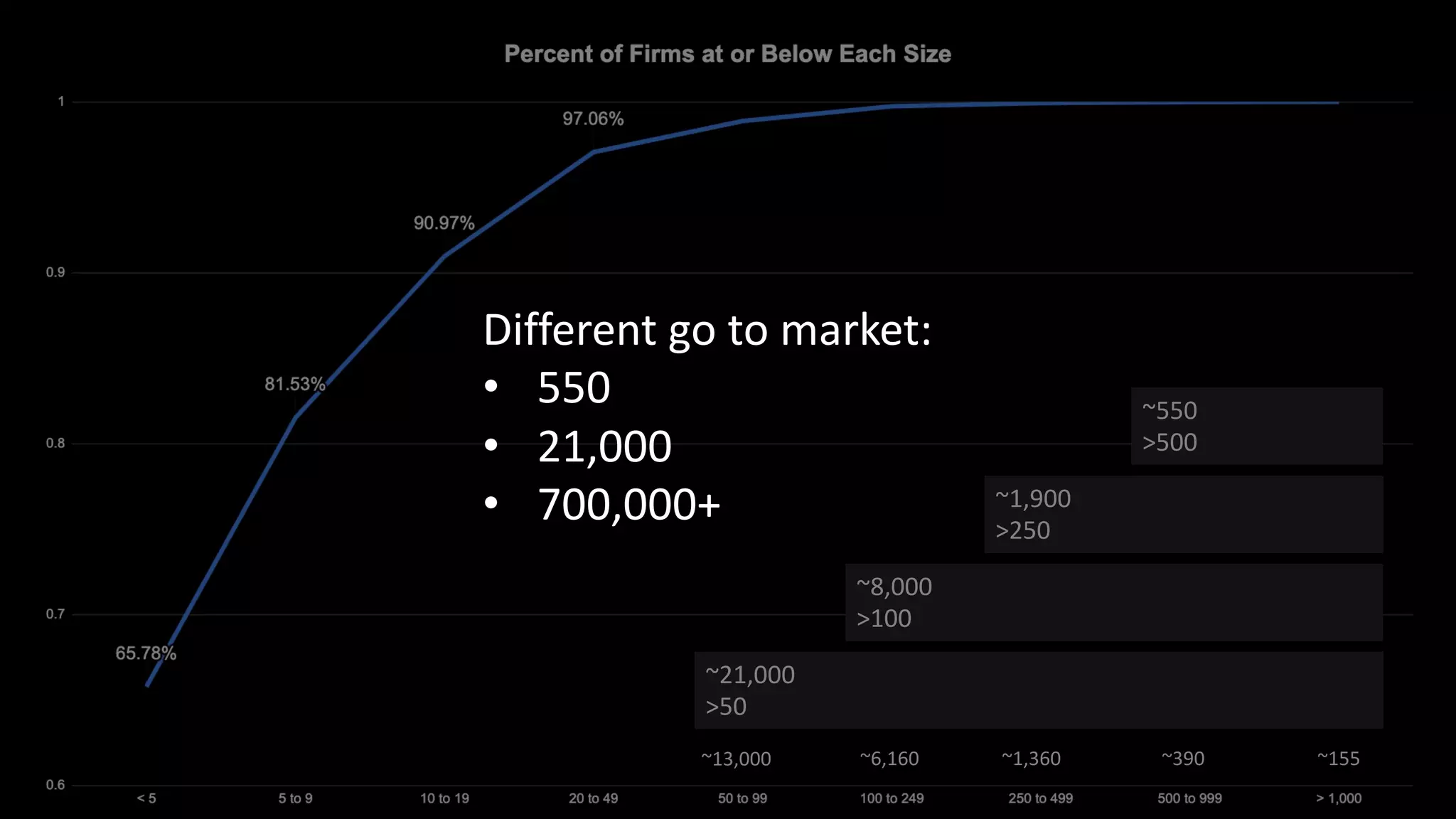
Distribution of Construction Firm Sizes
These Three Company types do not
behave the same way.
These Three Company types do not
behave the same way.
These three company
types do not behave the
same way.
6
(C) Hugh Seaton
7
~155
~390
~1,360
~6,160
~13,000
~550
>500
~1,900
>250
~8,000
>100
~21,000
>50
Different go to market:
• 550
• 21,000
• 700,000+
Total Segment Employees
0
200,000
400,000
600,000
800,000
1,000,000
1,200,000
1,400,000
1,600,000
<5 5 -> 9 10 -> 19 20 -> 49 50 -> 99 100 -> 249 250 -> 499 500 -> 999 1,000+
US Census, 2019
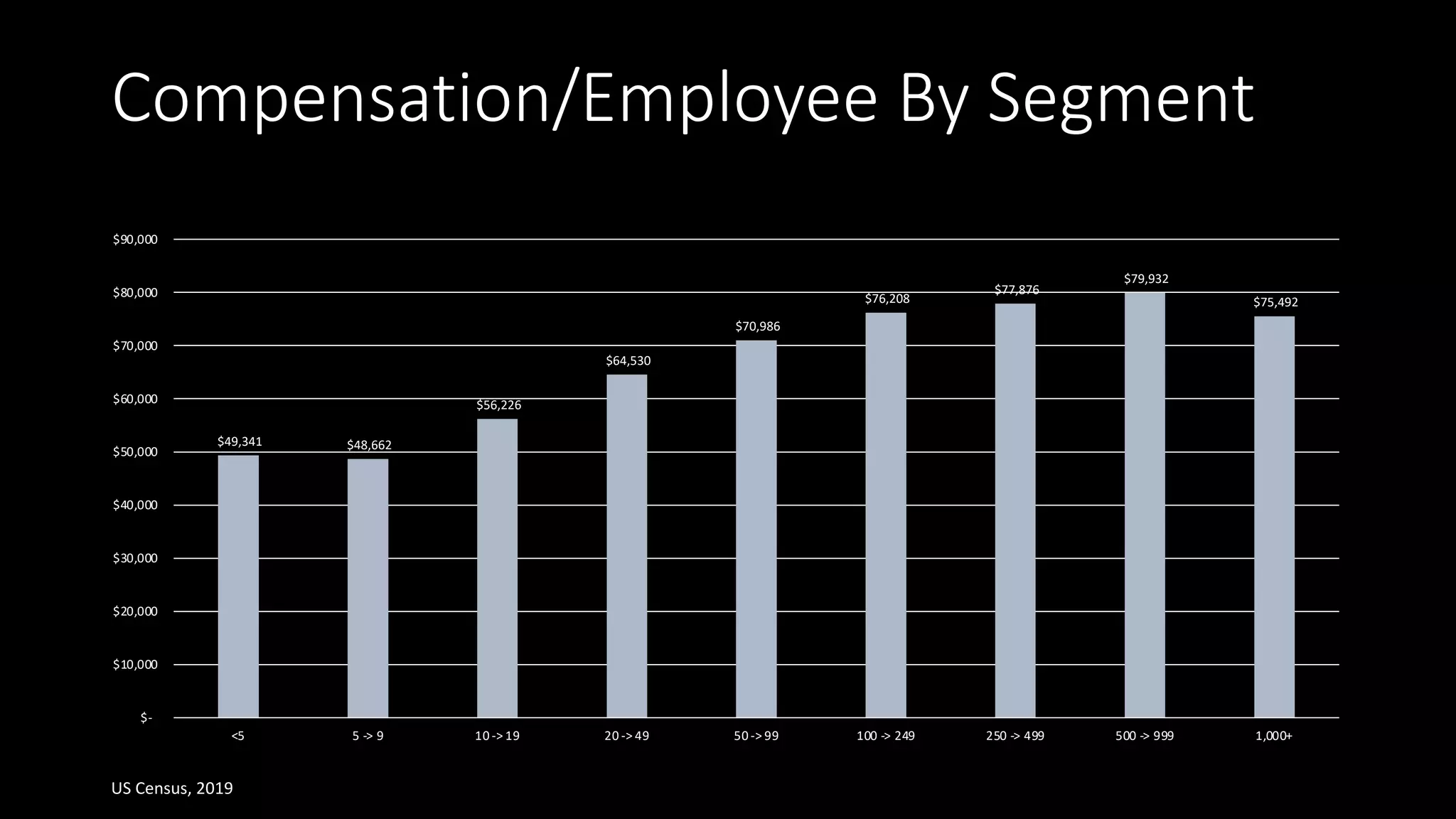
Compensation/Employee By Segment
$49,341 $48,662
$56,226
$64,530
$70,986
$76,208
$77,876
$79,932
$75,492
$-
$10,000
$20,000
$30,000
$40,000
$50,000
$60,000
$70,000
$80,000
$90,000
<5 5 -> 9 10 -> 19 20 -> 49 50 -> 99 100 -> 249 250 -> 499 500 -> 999 1,000+
US Census, 2019
Specialty Contractors (number)
0
50,000
100,000
150,000
200,000
250,000
300,000
350,000
< 5 5 -> 9 10 -> 19 20 -> 49 50 -> 99 100 -> 249 250 -> 499 500 -> 999 1000+
Chart Title
US Census, 2019
Specialty Contractor Pay/Worker
$48,087
$46,939
$53,754
$61,026
$66,044
$70,533
$72,061
$73,598
$71,121
$-
$10,000
$20,000
$30,000
$40,000
$50,000
$60,000
$70,000
$80,000
< 5 5 -> 9 10 -> 19 20 -> 49 50 -> 99 100 -> 249 250 -> 499 500 -> 999 1000+
US Census, 2019
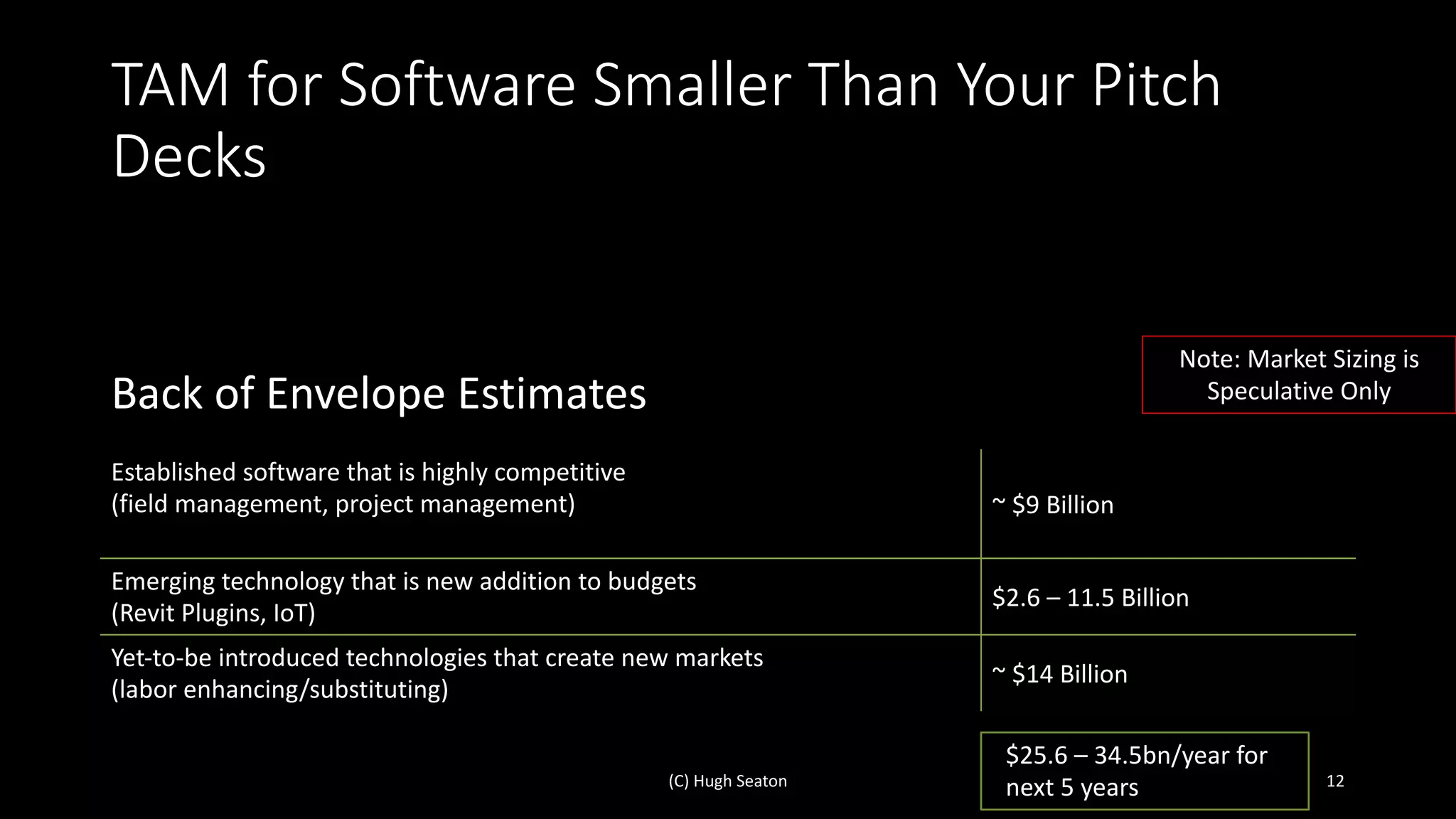
TAM for Software Smaller Than Your Pitch
Decks
Back of Envelope Estimates
(C) Hugh Seaton 12
Established software that is highly competitive
(field management, project management) ~ $9 Billion
Emerging technology that is new addition to budgets
(Revit Plugins, IoT)
$2.6 – 11.5 Billion
Yet-to-be introduced technologies that create new markets
(labor enhancing/substituting)
~ $14 Billion
Note: Market Sizing is
Speculative Only
$25.6 – 34.5bn/year for
next 5 years
Changing Dynamic:
Sophisticated
IT Departments
Construction Company IT
Departments Are Changing
• Larger firms are establishing strategic IT departments, and these will lead to a very
different sales process.
• Often not quite ‘top down’ – IT processes are coming from Innovation teams, operations
teams, etc.
• These are likely to consolidate under CIOs who will be “at the table” in a way traditional
IT was not.
Drivers of Change
• Competition
• Cybersecurity
• Owner Requirements
• Internal operational frustrations
Construction IT Is
Very Effective Only
In In Vendor
Management, And
Service Desk
Functions
Source: Info-Tech Management and
Governance Diagnostic
Modern IT Departments Are
Strategic Enablers of the
Business
Integrating
Functions,
Connecting Data
Flows, Creating and
Integrating
Applications
Source: Info-Tech Management and
Governance Diagnostic
Evolution is Underway
Functional
IT Department:
- Vendor Management
- Email
- Baseline Application
Management
Strategic
IT Department:
- Company-wide integrations
- Rigid standards for security
- In-house development
- Enterprise bus data
management
- Sophisticated cybersecurity
Why This Matters
• Purchase process changes -> new and challenging
• Data privacy requirements change
• Cybersecurity requirements change
Startups and IT
“MVP” implies technical shallowness, but doesn’t have to:
1. Document your stack
2. Make sure each layer is secure
3. Avoid open source
4. Implement internal protocols for passwords,
cybersecurity training
Cybersecurity
Partnered with Egnyte to source real-world data
> 3,000 construction customers around the world
Construction Companies Are
Twice as Likely to Have
Ransomware Attacks
From Egnyte’s
3,000 Customer Database
~ 44% of attacks were large Companies
~ 44% of attacks were small Companies
~ 10% of attacks were mid-tier Companies
From Egnyte’s
3,000 Customer Database
- Repeat Attacks Very Likely
- Up to six attacks in six months
From Egnyte’s
3,000 Customer Database
Cybersecurity isn’t only
about IT
FedRAMP, SOC II, other certifications focus on people & process, not just
tech.
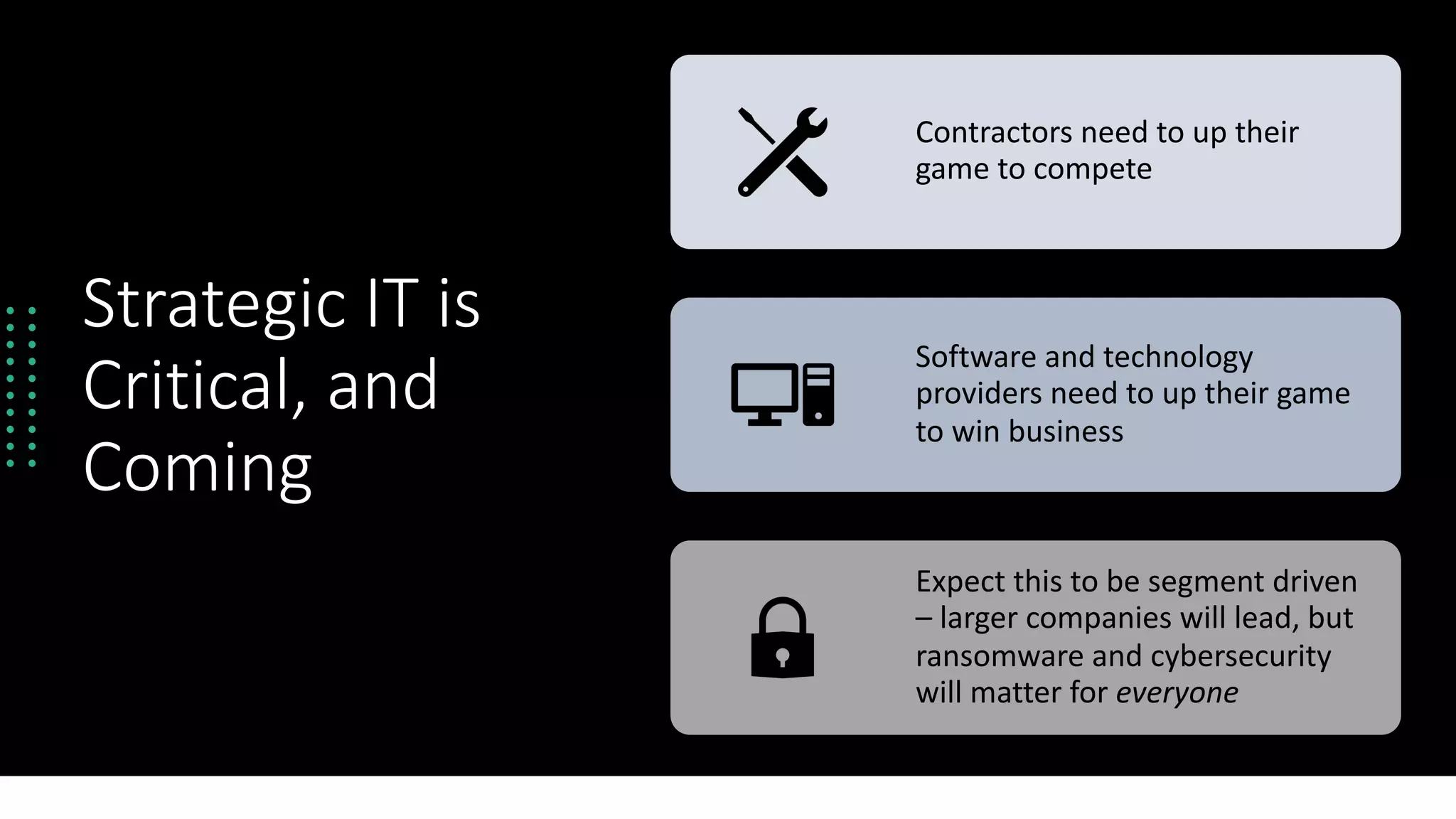
Strategic IT is
Critical, and
Coming
Contractors need to up their
game to compete
Software and technology
providers need to up their game
to win business
Expect this to be segment driven
– larger companies will lead, but
ransomware and cybersecurity
will matter for everyone
Supply of Technology
What is Technology For?
• Productivity growth?
• Cutting costs?
• Improving quality of what’s delivered?
• Accomplishing entirely new things
Productivity Paradox
• Mid-1980’s, after a decade of IT investment, no one saw productivity
improvement
• This persisted for years
• Finally saw productivity growth in the 1990s
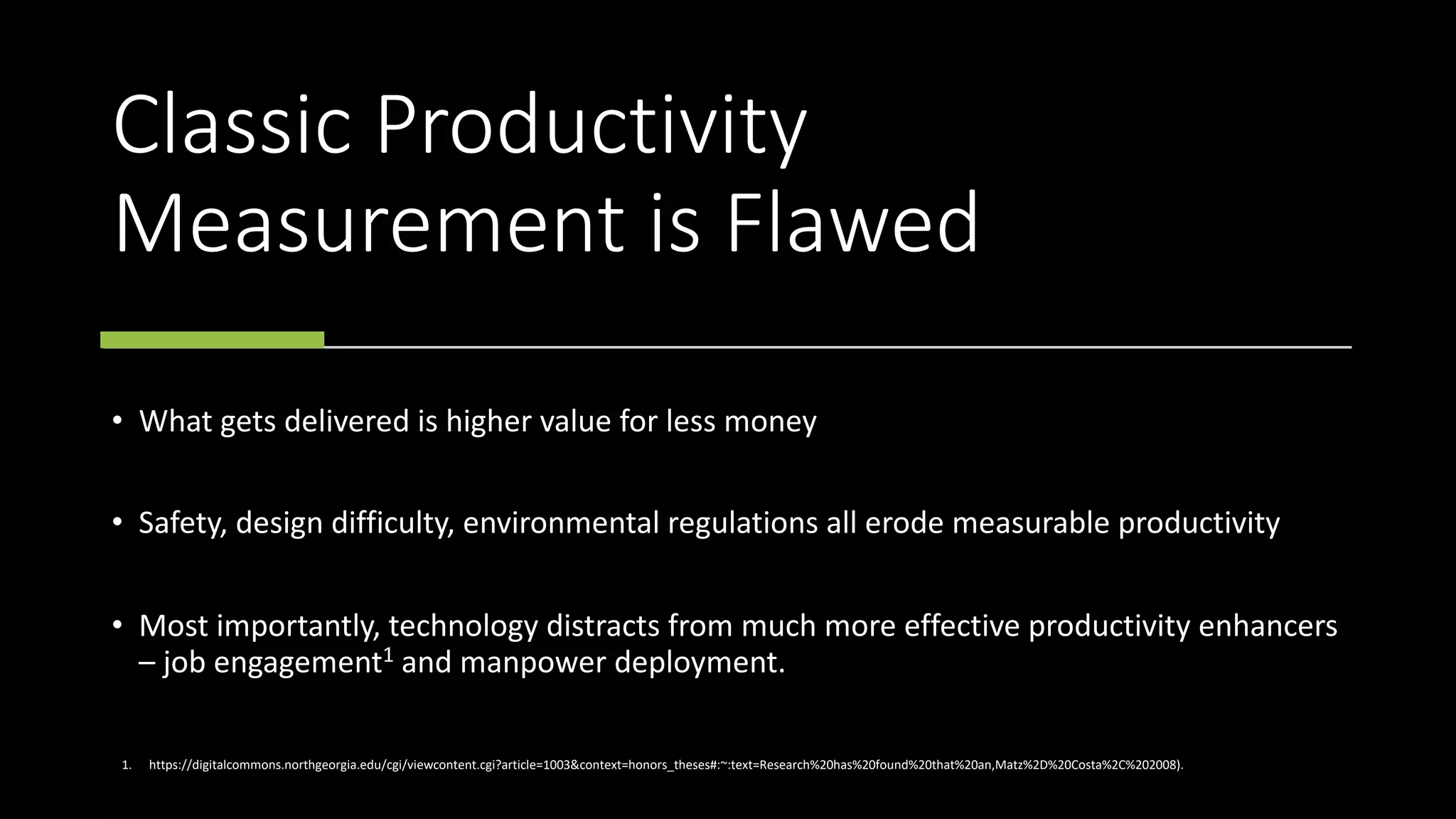
Classic Productivity
Measurement is Flawed
• What gets delivered is higher value for less money
• Safety, design difficulty, environmental regulations all erode measurable productivity
• Most importantly, technology distracts from much more effective productivity enhancers
– job engagement1 and manpower deployment.
1. https://digitalcommons.northgeorgia.edu/cgi/viewcontent.cgi?article=1003&context=honors_theses#:~:text=Research%20has%20found%20that%20an,Matz%2D%20Costa%2C%202008).
Stop Only Focusing on
Productivity
Enough with the McKinsey Article
“Once you get used to automating business processes with technologies
such as RPA, AI and machine learning, you’re not going to go back.
IT changes the way you do business. As much as doing things faster and
better, it allows you to do things that were not possible before. If you can
take a three week long mortgage application process and reduce that
task to five minutes, how can you go back?
You have changed the business model.
Suddenly it has become a differentiator for you.
- Prince Kohli, CTO, Automation Anywhere
How Can You Change The Business Model?
How Can You Differentiate?
• Compete for labor
• Compete for jobs
• Improve profitability
Deloitte Looked
at AI Spend
Companies look at technology
as a way to compete through
better decisions, better
products, better service
Efficiency Means Doing
More, Not Using Less
This is the general pattern of digital
transformation.
What Happens When
Technology Provides Orders
of Magnitude Better Data?
Supply: Machine Vision
A Wave of New Capability
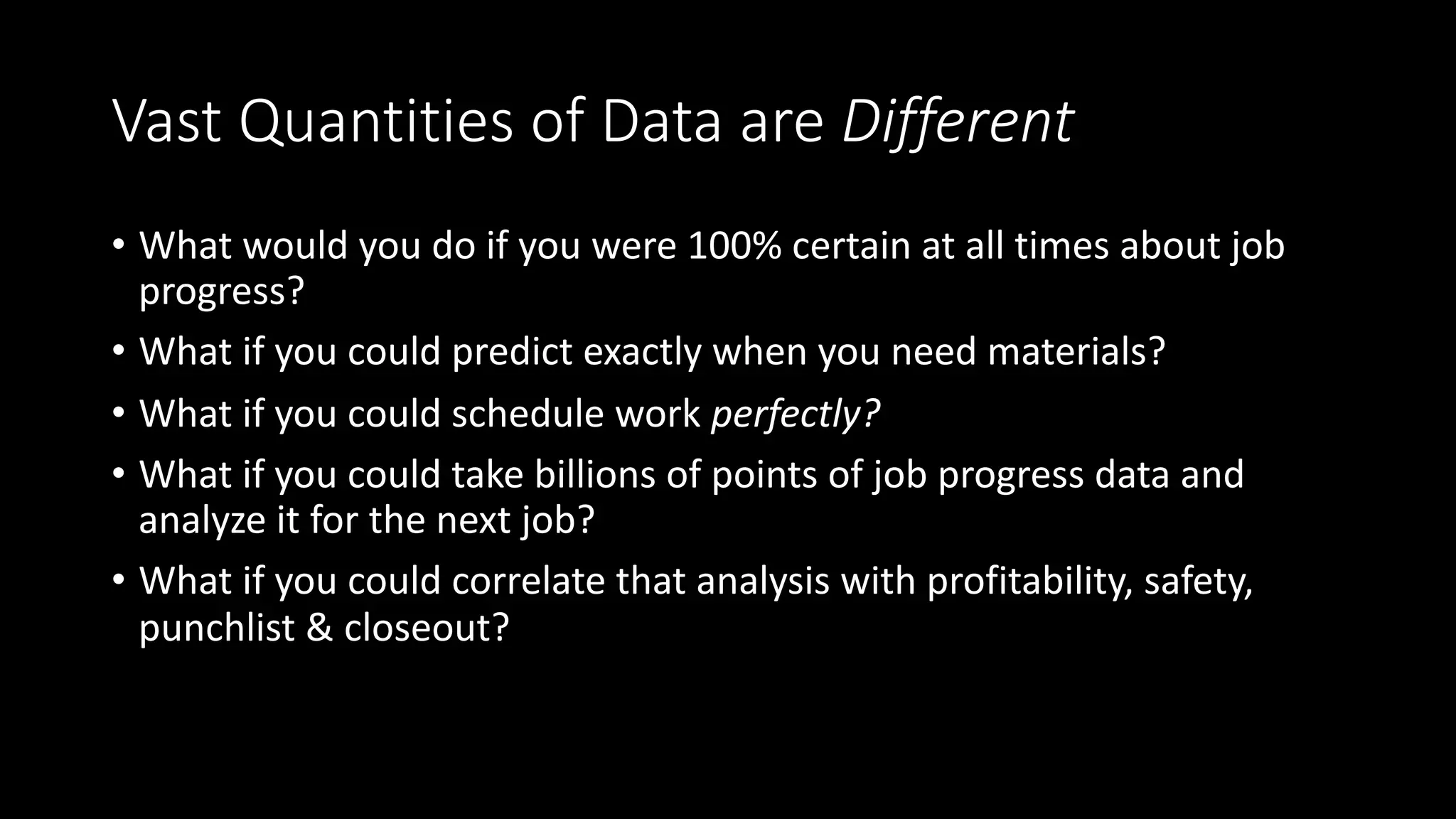
Vast Quantities of Data are Different
• What would you do if you were 100% certain at all times about job
progress?
• What if you could predict exactly when you need materials?
• What if you could schedule work perfectly?
• What if you could take billions of points of job progress data and
analyze it for the next job?
• What if you could correlate that analysis with profitability, safety,
punchlist & closeout?
Example: Versatile’s Craneview
Sparse Jobsite
Information
• Operator logs
• Basic machine telemetry
High Density Jobsite
Data
• Live image every 5 seconds (9,600/day)
• Dynamic weight from load cell
• GPS location (x,y,z) capturing pick and
drop location for each lift
Qualitative, written
A few times/day
Quantitative, machine-generated
Continuous, high frequency
Example: StructionSite
Sparse Jobsite
Information
• Daily logs
• ~3,000 photos not mapped to exact
work location
• In a folder or iPad
High Density
Jobsite Data
• Up to 300,000 images
• Auto-tagged to exact location
• Cloud-based for analysis
• Tied to machine vision
Qualitative, written
A few times/day
Quantitative, machine-generated
Continuous, high frequency
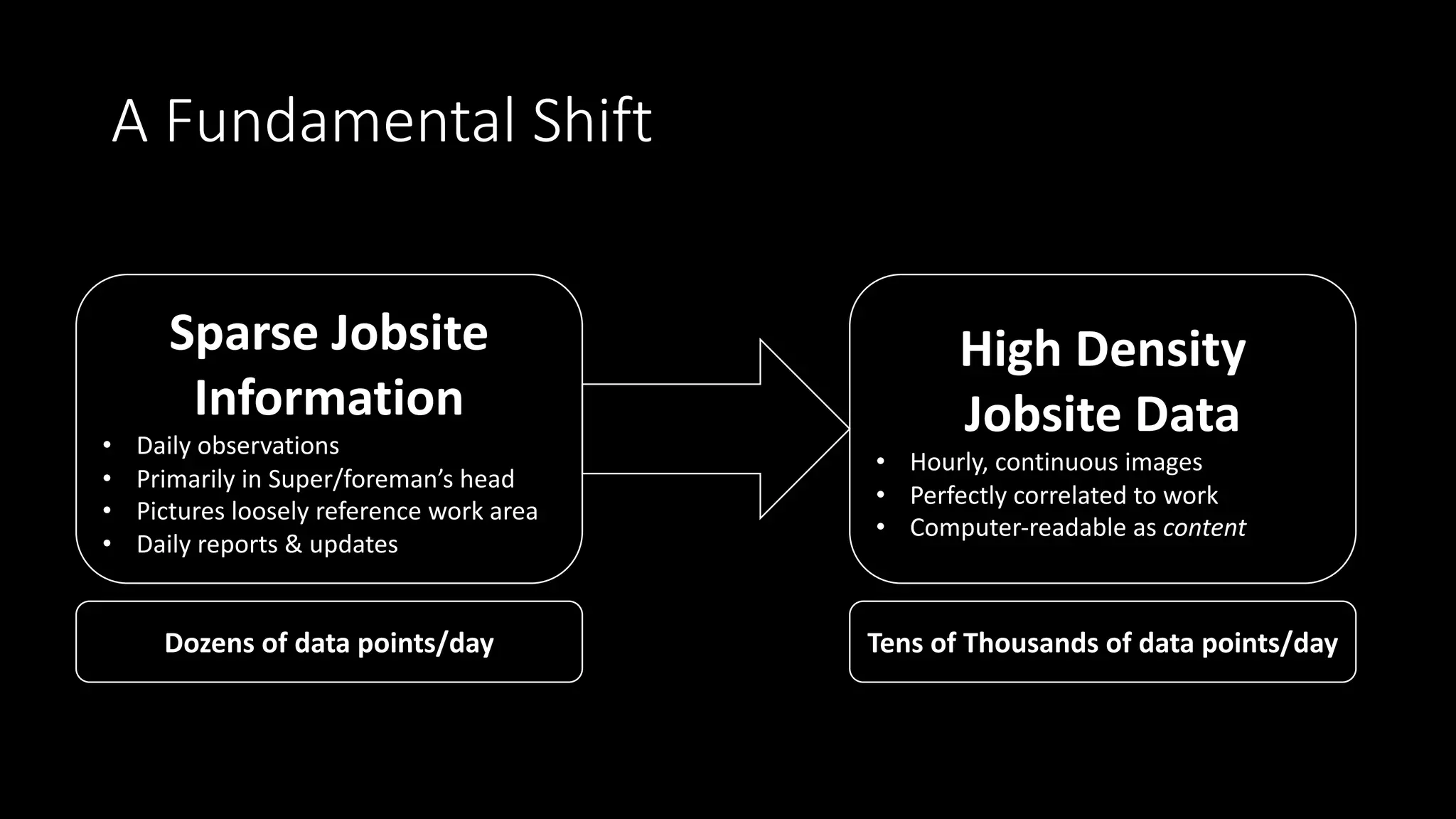
A Fundamental Shift
Sparse Jobsite
Information
• Daily observations
• Primarily in Super/foreman’s head
• Pictures loosely reference work area
• Daily reports & updates
High Density
Jobsite Data
• Hourly, continuous images
• Perfectly correlated to work
• Computer-readable as content
Dozens of data points/day Tens of Thousands of data points/day
It’s not just Machine Vision
SmartBarrel automates and
significantly locks down jobsite
check in.
This gives vastly better data.
What if you could look at patterns
across the week and know when
folks leave early, when they get
there late?
0:00
1:12
2:24
3:36
4:48
6:00
7:12
8:24
9:36
Monday Tuesday Wednesday Thursday Friday Saturday Sunday
Average Shift by Weekday (active job)
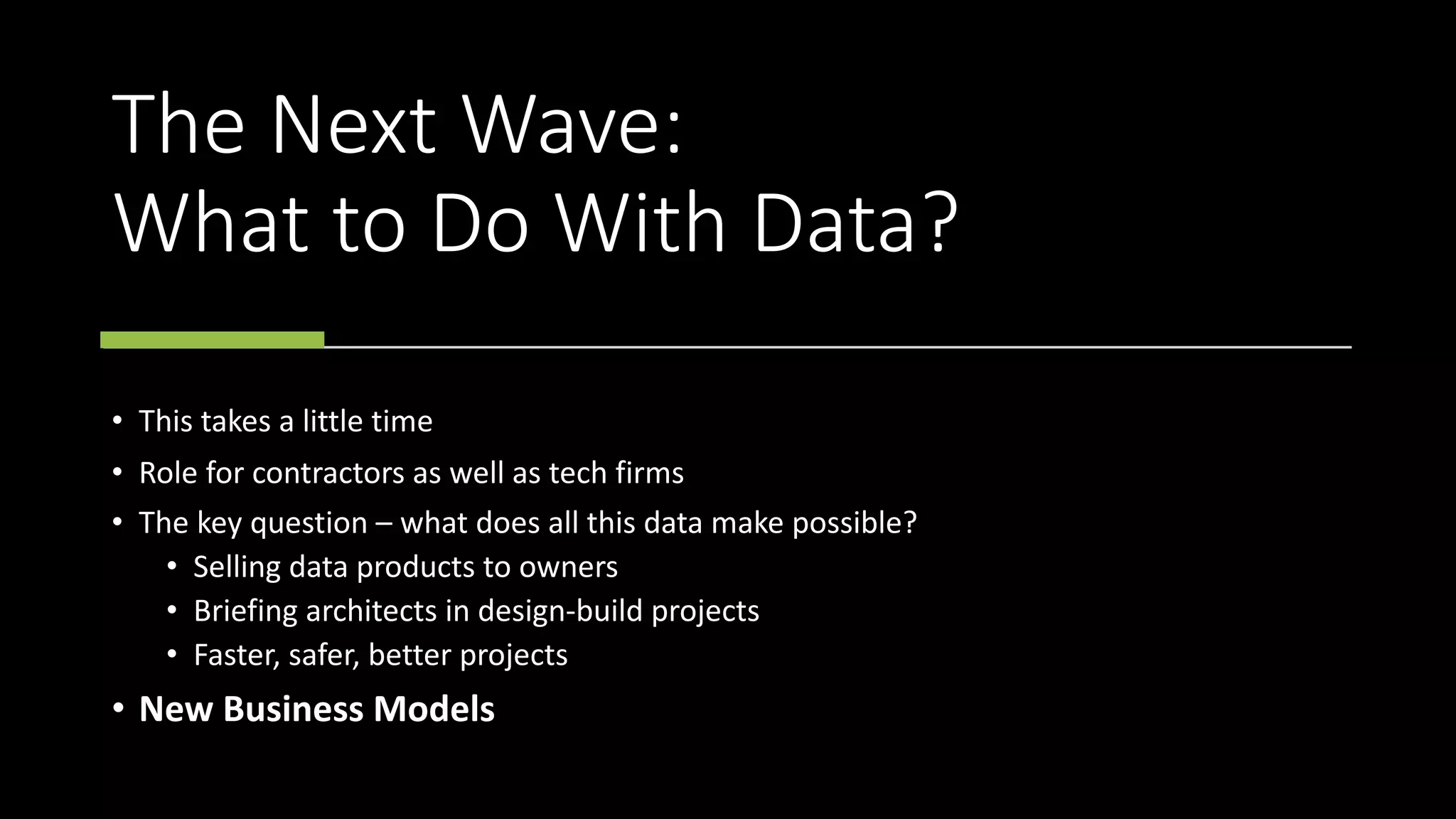
The Next Wave:
What to Do With Data?
• This takes a little time
• Role for contractors as well as tech firms
• The key question – what does all this data make possible?
• Selling data products to owners
• Briefing architects in design-build projects
• Faster, safer, better projects
• New Business Models
Briefing: Risk of Sharing
CTQ Issue Briefing:
True Risks of Sharing Images & Models
• Available for Free
• Developed with Document Crunch’s Josh Levy
• Overview of what real court decisions impact
risk
Key Outcomes
• Privacy in some cases
• Process is often a bigger risk than models
per se
• Make sure that contract covers your teams
so they can work the best way
• Look to Consensus Docs Form 301
• Check out the full and podcast at
Constructedfutures.com
Industry Analysis:
Porter’s 5-Forces
1980 – Revolutionized Business
Strategy
• Companies don’t compete for sales, they compete for profits
• This means the relative power of Five Players define the structure of an industry
and a given firm’s place in it:
• Suppliers
• Buyers
• Substitutes
• New entrants
• Existing competitors
Who Has The Most
Relative Power
Power defined by:
• How many of them and choices
counterparties have
• IP or other protections
• Uniqueness of offering
Supplier
Power
Threat of
New Entry
Buyer
Power
Threat of
Substitutes
Direct
Competition
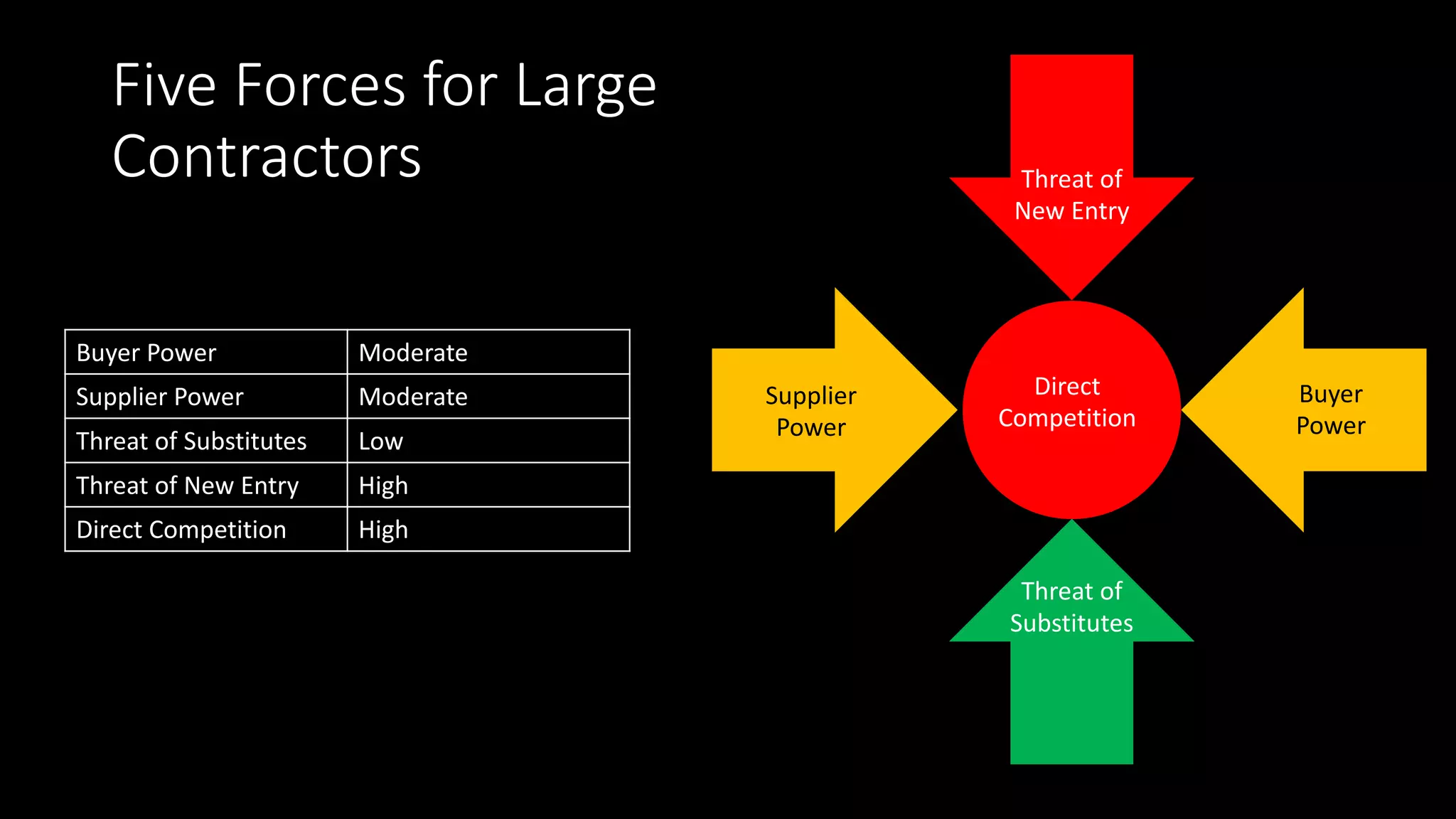
Five Forces for Large
Contractors
Buyer Power Moderate
Supplier Power Moderate
Threat of Substitutes Low
Threat of New Entry High
Direct Competition High
Supplier
Power
Threat of
New Entry
Buyer
Power
Threat of
Substitutes
Direct
Competition
Five Forces for PM Software
Buyer Power Moderate
Supplier Power Low
Threat of Substitutes High
Threat of New Entry High
Direct Competition High
Supplier
Power
Threat of
New Entry
Buyer
Power
Threat of
Substitutes
Direct
Competition
How Does This Help
• The point of differentiation is to reduce choice amongst counterparties
• The point of a value chain is to drive unique value with less unique inputs
• Strategy is creating a business model that makes competition irrelevant
• Startups – answer investors more intelligently than a X,Y map of competitors with your
company in the upper right.
• Read Joan Magretta’s work on Porter
Partners & Supporters
No sponsorships
accepted
But we love data
Check out the Book &
Podcast!
Strong Community
Doing Amazing
Things
60
Many More
(C) Hugh Seaton
Thank you
hughseaton@gmail.com
www.HughSeaton.com
Census Sourcing
TABLE ID: CB1900CBP
SURVEY/PROGRAM: Economic Surveys
VINTAGE: 2019
DATASET: CBP2019
PRODUCT: ECNSVY Business Patterns County Business Patterns
UNIVERSE: None
FTP URL: https://www2.census.gov/programs-surveys/cbp/data/2019
API URL: https://api.census.gov/data/2019/cbp
USER SELECTIONS
NAICS 23 - Construction; 236 - Construction of buildings; 237 - Heavy and civil engineering construction; 238 - Specialty trade contractors
https://data.census.gov/cedsci/table?n=23%3A236%3A237%3A238&hidePreview=true&tid=CBP201
9.CB1900CBP

Construction Technology Quarterly, Q2, 2021

  • 1.
    Construction Technology Quarterly Q2, 2021Presentation June 24th, 2021
  • 2.
    Today’s Agenda • Demand •Quick Review • Emerging IT • Productivity vs. Quality • Supply • Density of Data: Computer Vision • Ideas • Five Forces Analysis • Supporters
  • 3.
  • 4.
    Labor Shortage isStructural, Not Cyclical • It is not “coming back” • Process and Technology will have to make up for lack of people 0 50 100 150 200 250 300 350 01 02 03 04 05 06 07 08 09 10 11 12 13 14 15 16 17 18 19 20 52.0 54.0 56.0 58.0 60.0 62.0 64.0 66.0 95 96 97 98 99 00 01 02 03 04 05 06 07 08 09 10 11 12 13 14 15 16 17 18 19 20 Labor Shortage in Construction Percent of Population Working
  • 5.
    No One isIn a $1.3 Trillion Market (except maybe Microsoft Excel) (C) Hugh Seaton 5 530 440 351 29 0 100 200 300 400 500 600 Residential Commercial Public/Local Federal Billion $
  • 6.
    470,732 112,709 67,572 43,558 13,004 6,162 1,358391 155 < 5 5 to9 10 to 19 20 to 49 50 to 99 100 to 249 250 to 499 500 to 999 > 1,000 Distribution of Construction Firm Sizes These Three Company types do not behave the same way. These Three Company types do not behave the same way. These three company types do not behave the same way. 6 (C) Hugh Seaton
  • 7.
  • 8.
    Total Segment Employees 0 200,000 400,000 600,000 800,000 1,000,000 1,200,000 1,400,000 1,600,000 <55 -> 9 10 -> 19 20 -> 49 50 -> 99 100 -> 249 250 -> 499 500 -> 999 1,000+ US Census, 2019
  • 9.
    Compensation/Employee By Segment $49,341$48,662 $56,226 $64,530 $70,986 $76,208 $77,876 $79,932 $75,492 $- $10,000 $20,000 $30,000 $40,000 $50,000 $60,000 $70,000 $80,000 $90,000 <5 5 -> 9 10 -> 19 20 -> 49 50 -> 99 100 -> 249 250 -> 499 500 -> 999 1,000+ US Census, 2019
  • 10.
    Specialty Contractors (number) 0 50,000 100,000 150,000 200,000 250,000 300,000 350,000 <5 5 -> 9 10 -> 19 20 -> 49 50 -> 99 100 -> 249 250 -> 499 500 -> 999 1000+ Chart Title US Census, 2019
  • 11.
  • 12.
    TAM for SoftwareSmaller Than Your Pitch Decks Back of Envelope Estimates (C) Hugh Seaton 12 Established software that is highly competitive (field management, project management) ~ $9 Billion Emerging technology that is new addition to budgets (Revit Plugins, IoT) $2.6 – 11.5 Billion Yet-to-be introduced technologies that create new markets (labor enhancing/substituting) ~ $14 Billion Note: Market Sizing is Speculative Only $25.6 – 34.5bn/year for next 5 years
  • 13.
  • 14.
    Construction Company IT DepartmentsAre Changing • Larger firms are establishing strategic IT departments, and these will lead to a very different sales process. • Often not quite ‘top down’ – IT processes are coming from Innovation teams, operations teams, etc. • These are likely to consolidate under CIOs who will be “at the table” in a way traditional IT was not.
  • 15.
    Drivers of Change •Competition • Cybersecurity • Owner Requirements • Internal operational frustrations
  • 16.
    Construction IT Is VeryEffective Only In In Vendor Management, And Service Desk Functions Source: Info-Tech Management and Governance Diagnostic
  • 17.
    Modern IT DepartmentsAre Strategic Enablers of the Business
  • 18.
    Integrating Functions, Connecting Data Flows, Creatingand Integrating Applications Source: Info-Tech Management and Governance Diagnostic
  • 19.
    Evolution is Underway Functional ITDepartment: - Vendor Management - Email - Baseline Application Management Strategic IT Department: - Company-wide integrations - Rigid standards for security - In-house development - Enterprise bus data management - Sophisticated cybersecurity
  • 20.
    Why This Matters •Purchase process changes -> new and challenging • Data privacy requirements change • Cybersecurity requirements change
  • 21.
    Startups and IT “MVP”implies technical shallowness, but doesn’t have to: 1. Document your stack 2. Make sure each layer is secure 3. Avoid open source 4. Implement internal protocols for passwords, cybersecurity training
  • 22.
    Cybersecurity Partnered with Egnyteto source real-world data > 3,000 construction customers around the world
  • 23.
    Construction Companies Are Twiceas Likely to Have Ransomware Attacks From Egnyte’s 3,000 Customer Database
  • 24.
    ~ 44% ofattacks were large Companies ~ 44% of attacks were small Companies ~ 10% of attacks were mid-tier Companies From Egnyte’s 3,000 Customer Database
  • 25.
    - Repeat AttacksVery Likely - Up to six attacks in six months From Egnyte’s 3,000 Customer Database
  • 26.
    Cybersecurity isn’t only aboutIT FedRAMP, SOC II, other certifications focus on people & process, not just tech.
  • 27.
    Strategic IT is Critical,and Coming Contractors need to up their game to compete Software and technology providers need to up their game to win business Expect this to be segment driven – larger companies will lead, but ransomware and cybersecurity will matter for everyone
  • 28.
  • 29.
    What is TechnologyFor? • Productivity growth? • Cutting costs? • Improving quality of what’s delivered? • Accomplishing entirely new things
  • 30.
    Productivity Paradox • Mid-1980’s,after a decade of IT investment, no one saw productivity improvement • This persisted for years • Finally saw productivity growth in the 1990s
  • 31.
    Classic Productivity Measurement isFlawed • What gets delivered is higher value for less money • Safety, design difficulty, environmental regulations all erode measurable productivity • Most importantly, technology distracts from much more effective productivity enhancers – job engagement1 and manpower deployment. 1. https://digitalcommons.northgeorgia.edu/cgi/viewcontent.cgi?article=1003&context=honors_theses#:~:text=Research%20has%20found%20that%20an,Matz%2D%20Costa%2C%202008).
  • 32.
    Stop Only Focusingon Productivity Enough with the McKinsey Article
  • 33.
    “Once you getused to automating business processes with technologies such as RPA, AI and machine learning, you’re not going to go back. IT changes the way you do business. As much as doing things faster and better, it allows you to do things that were not possible before. If you can take a three week long mortgage application process and reduce that task to five minutes, how can you go back? You have changed the business model. Suddenly it has become a differentiator for you. - Prince Kohli, CTO, Automation Anywhere
  • 34.
    How Can YouChange The Business Model? How Can You Differentiate? • Compete for labor • Compete for jobs • Improve profitability
  • 35.
    Deloitte Looked at AISpend Companies look at technology as a way to compete through better decisions, better products, better service
  • 36.
    Efficiency Means Doing More,Not Using Less This is the general pattern of digital transformation.
  • 37.
    What Happens When TechnologyProvides Orders of Magnitude Better Data?
  • 38.
  • 39.
    A Wave ofNew Capability
  • 40.
    Vast Quantities ofData are Different • What would you do if you were 100% certain at all times about job progress? • What if you could predict exactly when you need materials? • What if you could schedule work perfectly? • What if you could take billions of points of job progress data and analyze it for the next job? • What if you could correlate that analysis with profitability, safety, punchlist & closeout?
  • 41.
    Example: Versatile’s Craneview SparseJobsite Information • Operator logs • Basic machine telemetry High Density Jobsite Data • Live image every 5 seconds (9,600/day) • Dynamic weight from load cell • GPS location (x,y,z) capturing pick and drop location for each lift Qualitative, written A few times/day Quantitative, machine-generated Continuous, high frequency
  • 42.
    Example: StructionSite Sparse Jobsite Information •Daily logs • ~3,000 photos not mapped to exact work location • In a folder or iPad High Density Jobsite Data • Up to 300,000 images • Auto-tagged to exact location • Cloud-based for analysis • Tied to machine vision Qualitative, written A few times/day Quantitative, machine-generated Continuous, high frequency
  • 43.
    A Fundamental Shift SparseJobsite Information • Daily observations • Primarily in Super/foreman’s head • Pictures loosely reference work area • Daily reports & updates High Density Jobsite Data • Hourly, continuous images • Perfectly correlated to work • Computer-readable as content Dozens of data points/day Tens of Thousands of data points/day
  • 44.
    It’s not justMachine Vision SmartBarrel automates and significantly locks down jobsite check in. This gives vastly better data. What if you could look at patterns across the week and know when folks leave early, when they get there late? 0:00 1:12 2:24 3:36 4:48 6:00 7:12 8:24 9:36 Monday Tuesday Wednesday Thursday Friday Saturday Sunday Average Shift by Weekday (active job)
  • 45.
    The Next Wave: Whatto Do With Data? • This takes a little time • Role for contractors as well as tech firms • The key question – what does all this data make possible? • Selling data products to owners • Briefing architects in design-build projects • Faster, safer, better projects • New Business Models
  • 46.
  • 47.
    CTQ Issue Briefing: TrueRisks of Sharing Images & Models • Available for Free • Developed with Document Crunch’s Josh Levy • Overview of what real court decisions impact risk
  • 48.
    Key Outcomes • Privacyin some cases • Process is often a bigger risk than models per se • Make sure that contract covers your teams so they can work the best way • Look to Consensus Docs Form 301 • Check out the full and podcast at Constructedfutures.com
  • 49.
  • 50.
    1980 – RevolutionizedBusiness Strategy • Companies don’t compete for sales, they compete for profits • This means the relative power of Five Players define the structure of an industry and a given firm’s place in it: • Suppliers • Buyers • Substitutes • New entrants • Existing competitors
  • 51.
    Who Has TheMost Relative Power Power defined by: • How many of them and choices counterparties have • IP or other protections • Uniqueness of offering Supplier Power Threat of New Entry Buyer Power Threat of Substitutes Direct Competition
  • 52.
    Five Forces forLarge Contractors Buyer Power Moderate Supplier Power Moderate Threat of Substitutes Low Threat of New Entry High Direct Competition High Supplier Power Threat of New Entry Buyer Power Threat of Substitutes Direct Competition
  • 53.
    Five Forces forPM Software Buyer Power Moderate Supplier Power Low Threat of Substitutes High Threat of New Entry High Direct Competition High Supplier Power Threat of New Entry Buyer Power Threat of Substitutes Direct Competition
  • 54.
    How Does ThisHelp • The point of differentiation is to reduce choice amongst counterparties • The point of a value chain is to drive unique value with less unique inputs • Strategy is creating a business model that makes competition irrelevant • Startups – answer investors more intelligently than a X,Y map of competitors with your company in the upper right. • Read Joan Magretta’s work on Porter
  • 55.
  • 56.
  • 59.
    Check out theBook & Podcast!
  • 60.
  • 61.
  • 62.
    Census Sourcing TABLE ID:CB1900CBP SURVEY/PROGRAM: Economic Surveys VINTAGE: 2019 DATASET: CBP2019 PRODUCT: ECNSVY Business Patterns County Business Patterns UNIVERSE: None FTP URL: https://www2.census.gov/programs-surveys/cbp/data/2019 API URL: https://api.census.gov/data/2019/cbp USER SELECTIONS NAICS 23 - Construction; 236 - Construction of buildings; 237 - Heavy and civil engineering construction; 238 - Specialty trade contractors https://data.census.gov/cedsci/table?n=23%3A236%3A237%3A238&hidePreview=true&tid=CBP201 9.CB1900CBP