MASONRY
• Masonry is defined as the art of construction in which building units
such as clay bricks, sand, lime, stones, pre-cast hollow concrete
blocks, concrete slabs, combination of some of these building units etc
are arranged systematically and bonded together to form a
homogeneous mass in such a manner that they can with stand the
loads.
Masonry can be classified into the following categories.
1. Stone masonry
2. Brick masonry
3. Hollow block concrete masonry
4. Reinforced masonry
5. Composite masonry
• Brick Masonry is built with bricks & is bounded together with mortar.
• For temporary structure we use mud plaster.
• For permanent structure we use cement or lime plaster.
Definitions of terms:
• Air Brick: A brick with perforations to allow the passage of air
through a wall.
• Bat: It is a portion of a brick cut across the width. ( a cut brick )
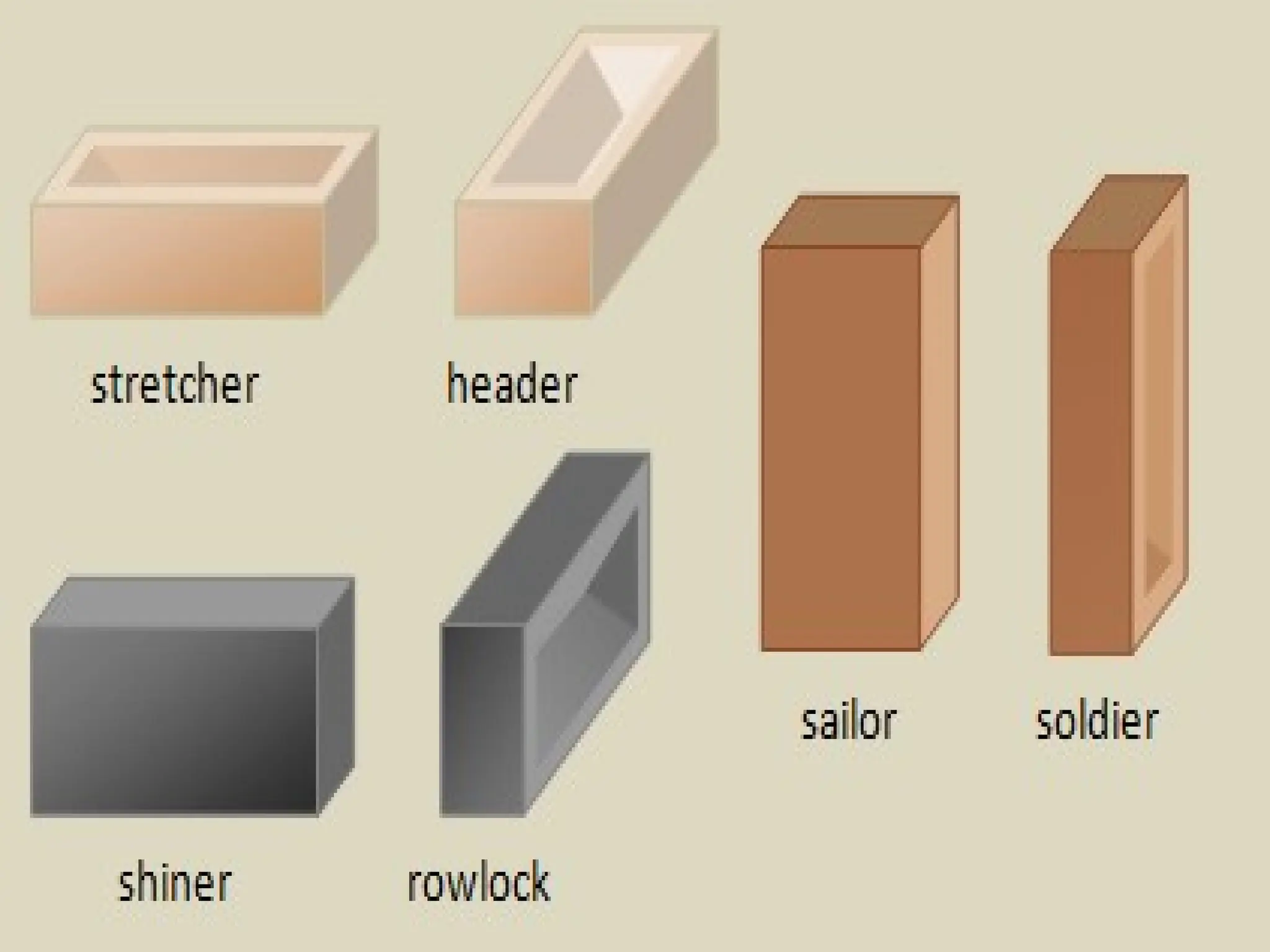
Header : Brick in width wise.
King closer: a brick that has been
cut diagonally over its length to
show a half-bat at one end.
Queen closer: It is the portion of a brick
obtained by cutting a brick length-wise into
two portions.
Quoin: The stones used for the
corners of walls of structure
Stretcher: brick in
lengthwise
BONDS IN BRICK WORK / BRICK
BONDING:
• The look of brickwork is greatly affected by the pattern the bricks
are laid in, known as ‘bonding’.
• The long face of the brick is called the ‘stretcher’and the short face
the ‘header’; the arrangement of headers and stretchers normally
follows a prescribed pattern.
• Bricks used in masonry are all of uniform size.
• If they are not arranged or bonded properly vertical joints result
which cause for little strength and stability.
• It is important that it should be started from corners
correctly when laying out any bond pattern.
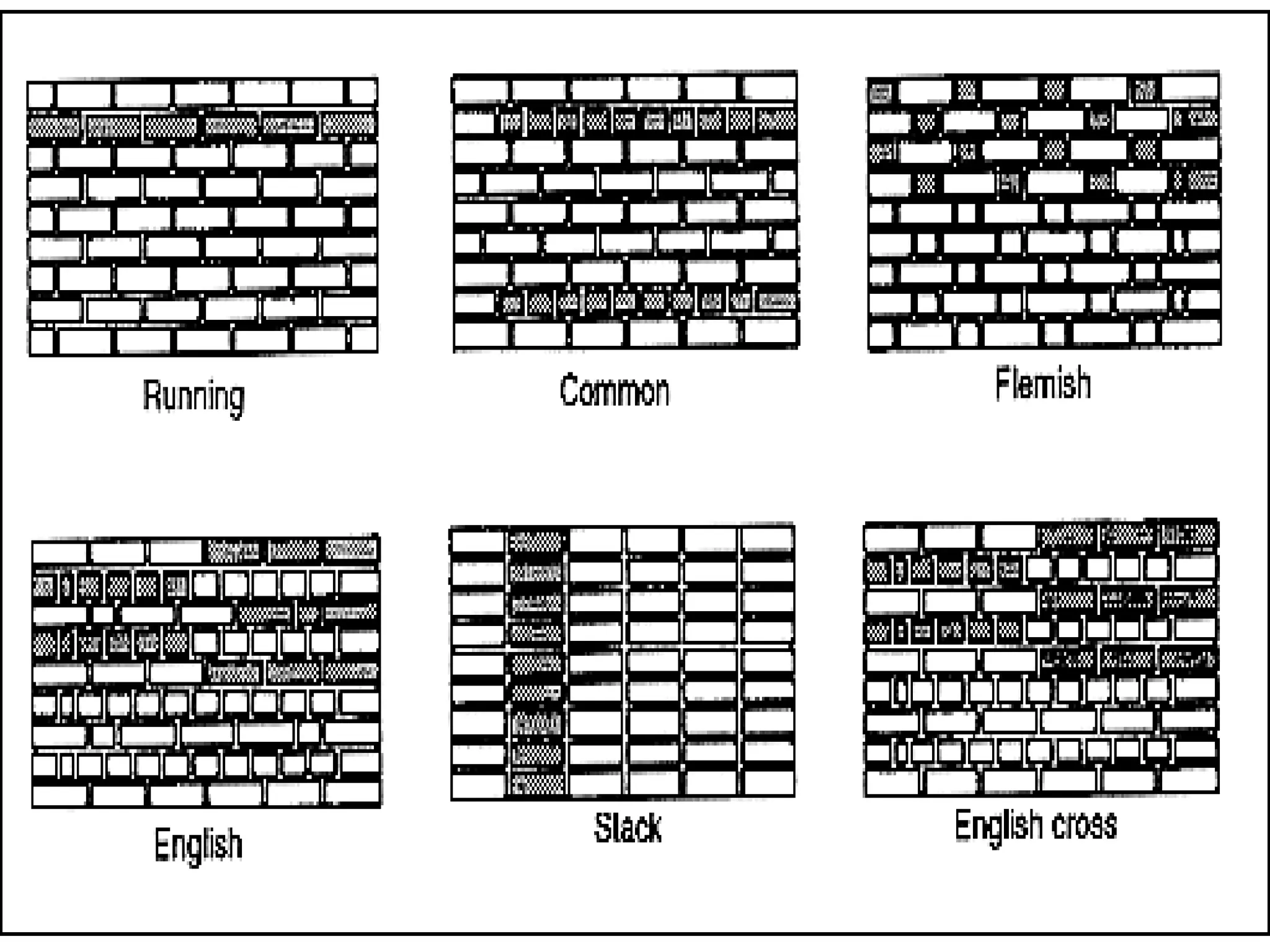
The commonly used bond patterns :
1. Running Bond / Stretcher Bond,
2. Header Bond,
3. English Bond,
4. Flemish Bond (Dutch Bond),
5. Garden wall Bond,
6. Facing Bond,
7. Raking Bond,
8. Brick on edge Bond,
9. English cross-bond,
10. Stack Bond,
11. Zig- Zig Bond,
12. Common Bond / American Bond
Running Bond / Stretcher Bond:
• The most common and simplest of pattern is the Running Bond.
• The length of the bricks are thus along the direction of the wall.
• The overlap, which is usually of half brick, is obtained by
commencing each alternate course with a half brick bat.
• This pattern is used as partition walls. The vertical mortar joints
between stretchers line up vertically.
Header bond : In this type of bonding all the bricks are laid as
headers on the faces i.e. shorter face of the brick.
• The overlap, which is usually-of half the width of the brick is
obtained by introducing a three-quarter bat in each alternate course
at quoins.
• This bond permits better alignment and as such it is used for walls
curved on plan.
• This bond is chiefly used for footings in foundations for better
transverse distribution of load.
English Bond:
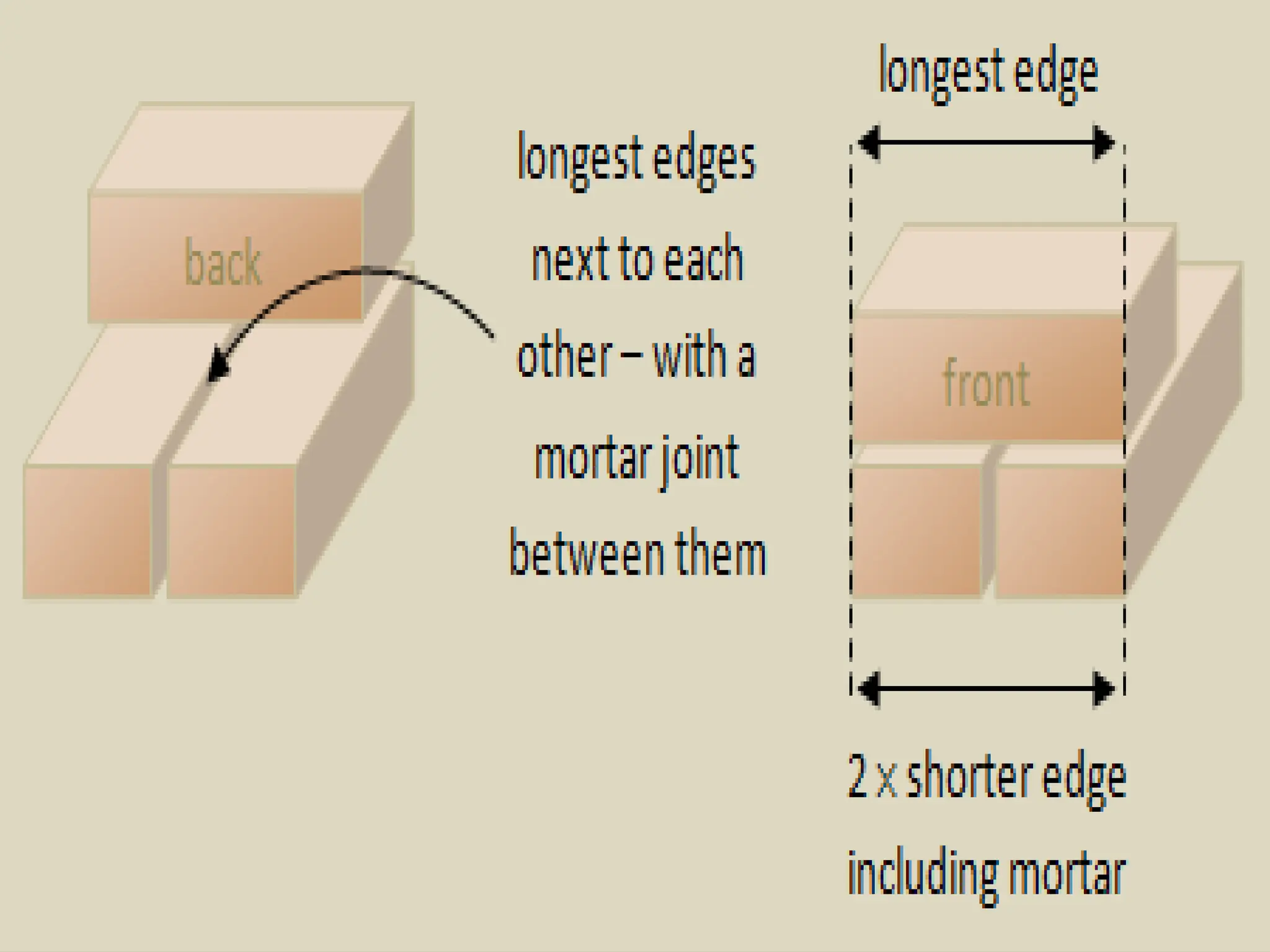
• The English Bond pattern consists of alternate courses of headers and
stretchers with the headers centered on the stretchers . In this bond
arrangement, vertical joints in the header courses come over each
other and the vertical joints in the stretcher course are also in the
same line. For the breaking of vertical joints in the successive course
it is essential to place queen closer. The following additional points
should be noted in English bond construction:
• In English bond, a header should never start with a queen closer
liable to get displaced in this position.
• In the stretcher course, the stretchers should have a minimum lap of
1/4th their length over the headers.
• Walls having their thickness equal to an even number of half bricks,
i.e., one brick thick wail, 2 brick thick wall, 3 brick thick wall and so
on, present the same appearance on both the faces, i .e. a course
consisting of headers on front face will show headers on the back face
also.
• In walls having their thickness equal to an odd number of half brick,
i.e. 1½ brick thick walls or 2½ brick thick walls and so on, the same
course will show stretchers on one face and headers on the other.
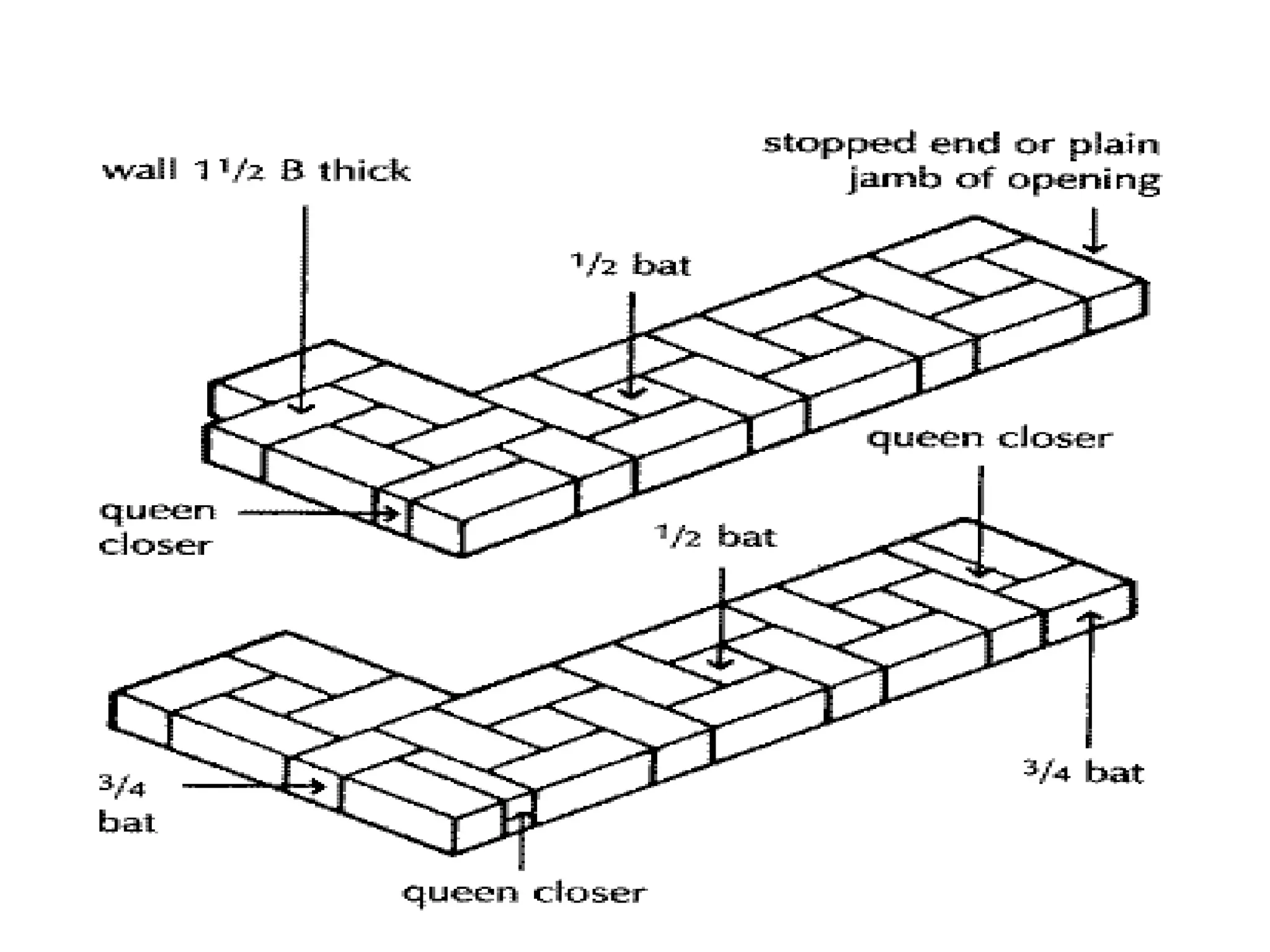
• Isometric view of 1½ brick wall in English bond is shown below,
• In thick walls the middle portion is entirely filled with header to
prevent the formation of vertical joints in the body of the wall.
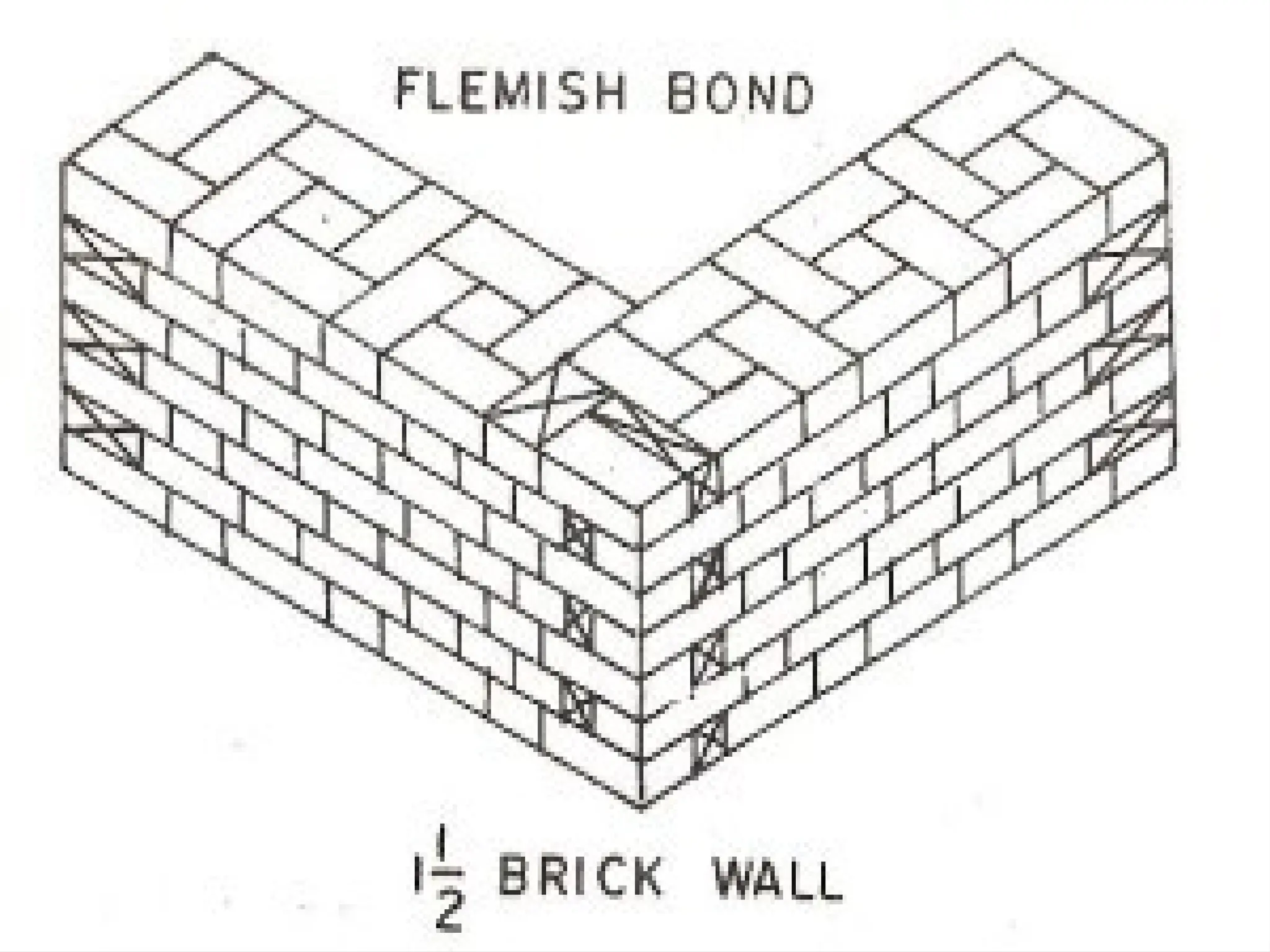
Flemish Bond / Dutch Bond :In Flemish bond, each course
consists of alternate headers and stretchers.
• The alternate headers of each course are centered over the stretchers
in the course below.
• Every alternate course starts with a header at the corner. For the
breaking of vertical joints in the successive courses, closers are
inserted in alternate courses next to the quoin header. In walls having
their thickness equal to odd number of half bricks, bats are essentially
used to achieve the bond.
• Flemish bond is further divided into two different types namely,
1. Single Flemish bond,
2. Double Flemish bond.
1. Single Flemish Bond.
• This bond is a combination of English Bond and Flemish bond. In
this work the facing of the wall consists of Flemish bond and the
backing consists of English bond in each course. This type of bonding
cannot be adopted in walls less than one and a half brick in thickness.
This bond is adopted to present the attractive appearance of Flemish
bond with an effort to ensure full strength in the brick work.
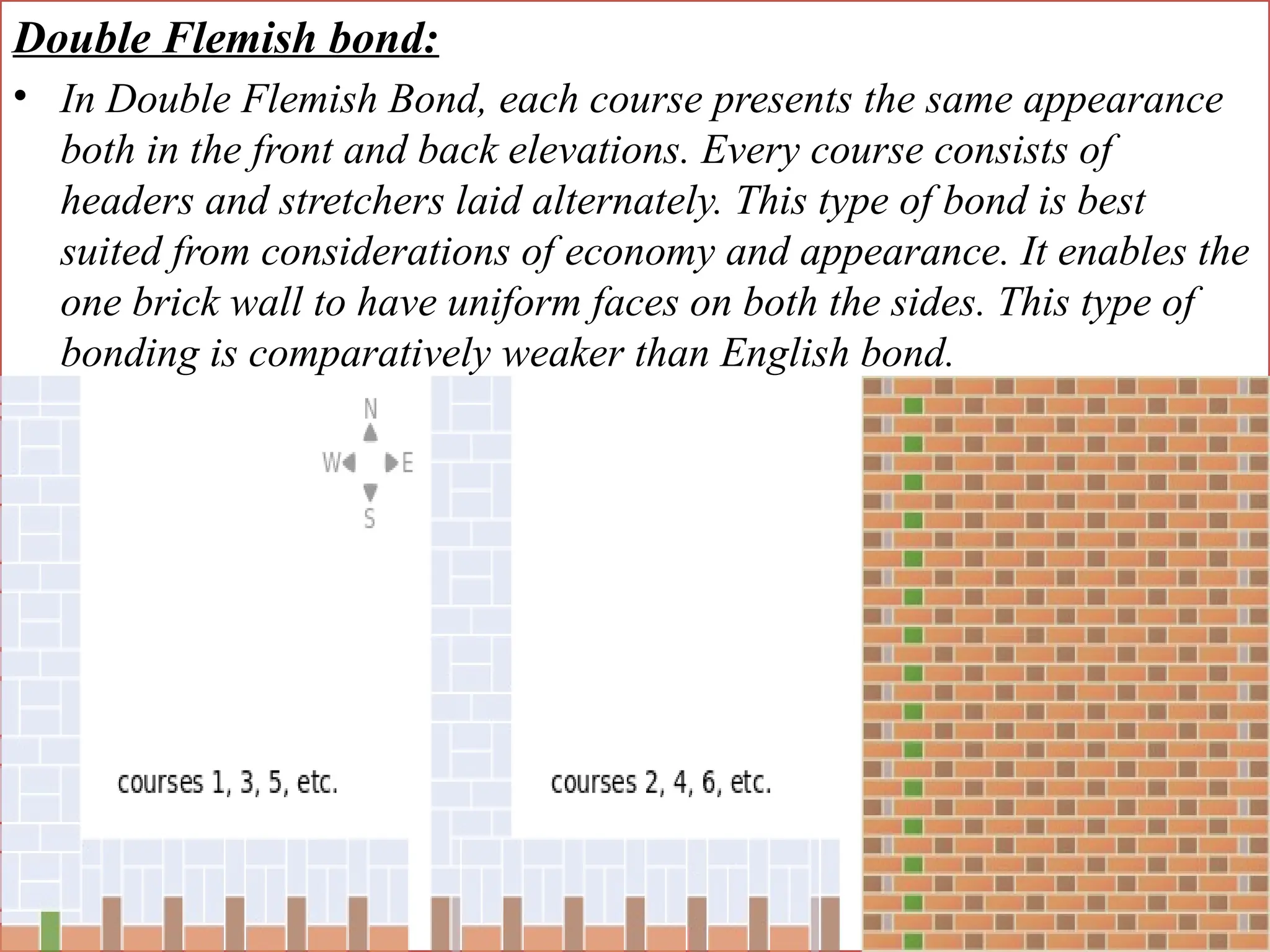
Double Flemish bond:
• In Double Flemish Bond, each course presents the same appearance
both in the front and back elevations. Every course consists of
headers and stretchers laid alternately. This type of bond is best
suited from considerations of economy and appearance. It enables the
one brick wall to have uniform faces on both the sides. This type of
bonding is comparatively weaker than English bond.
Stone Masonry
• The construction of stones bonded together with mortar is termed as
stone masonry.
• The stones are available in a abundance in nature, on cutting and
dressing to the proper shape, they provide an economical material for
the construction of various building components such as walls,
columns, footings, arches, lintels, beams etc.
Types of Stone Masonry:
• Based on the arrangement of the stone in the construction and the
type of surface finish, the stone masonry can be classified broadly in
the following two categories.
Stone Masonry
Rubble masonry
1.Randam
rubble masonry
- Coursed -
Uncoursed
2. Square
rubble masonry
- Coursed -
Uncoursed-
Regular course
3.Polygonal
rubble
masonry
4. Flint rubble
Ashlar masonry
1. Ashlar fine masonry
2. Ashlar rough tooled
3. Rock (or) quarry faced
4. Ashlar chamfered
5. Ashlar block in course
6.Ashlar Facing
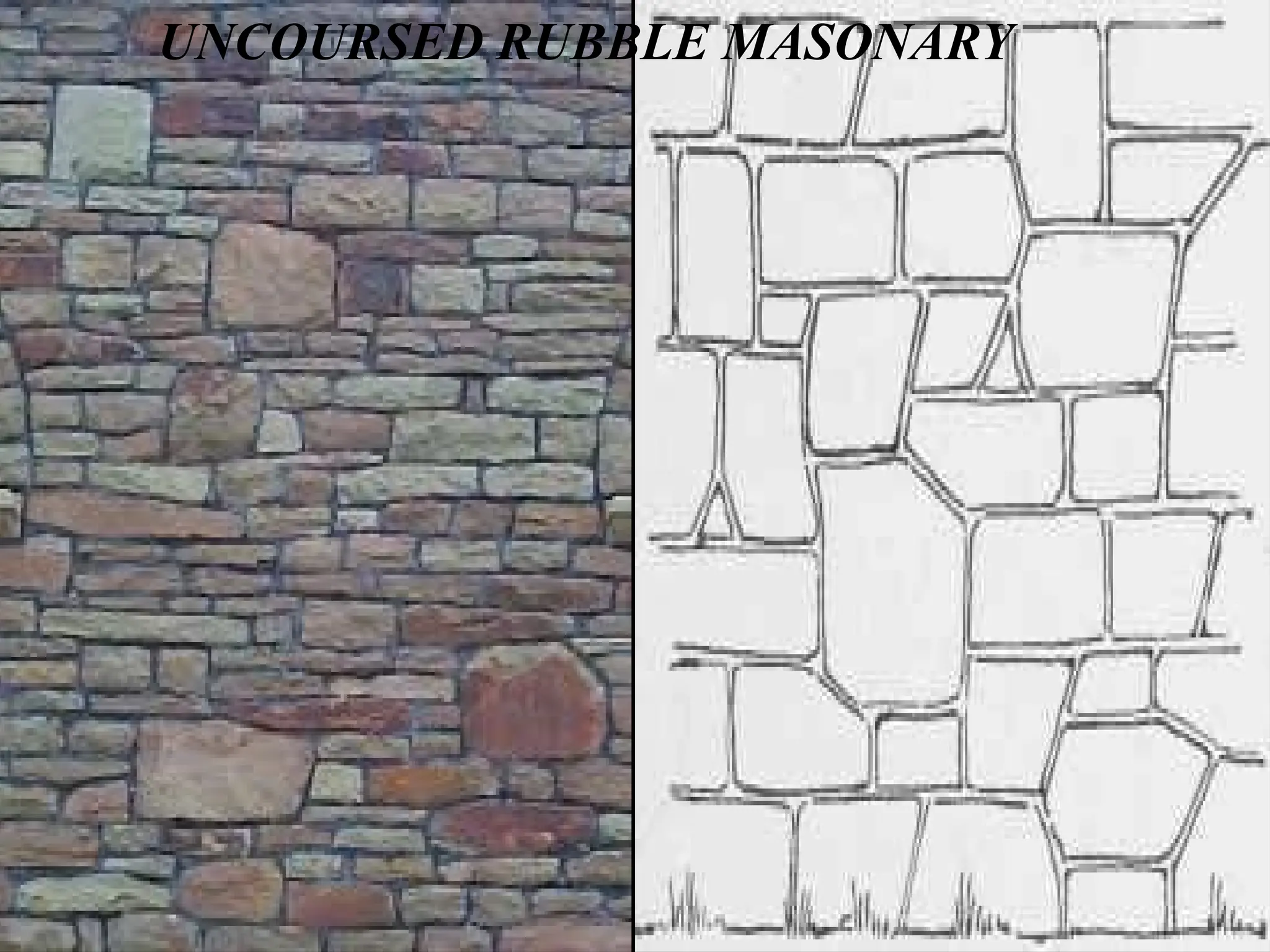
• Uncoursed rubble masonry: This is the cheapest, roughest and
poorest form of stone masonry. The stones used in this type of
masonry very much vary in their shape and size and are directly
obtained from quarry. Since they are of different size greater care
should be taken while arranging them in such a way that pressure
should adequately be distributed over area & long vertical joints are
avoided. Transverse stones are used as Headers & larger stones are
used as Quoins & Jambs which increases strength & give better
appearance.
UNCOURSED RUBBLE MASONARY
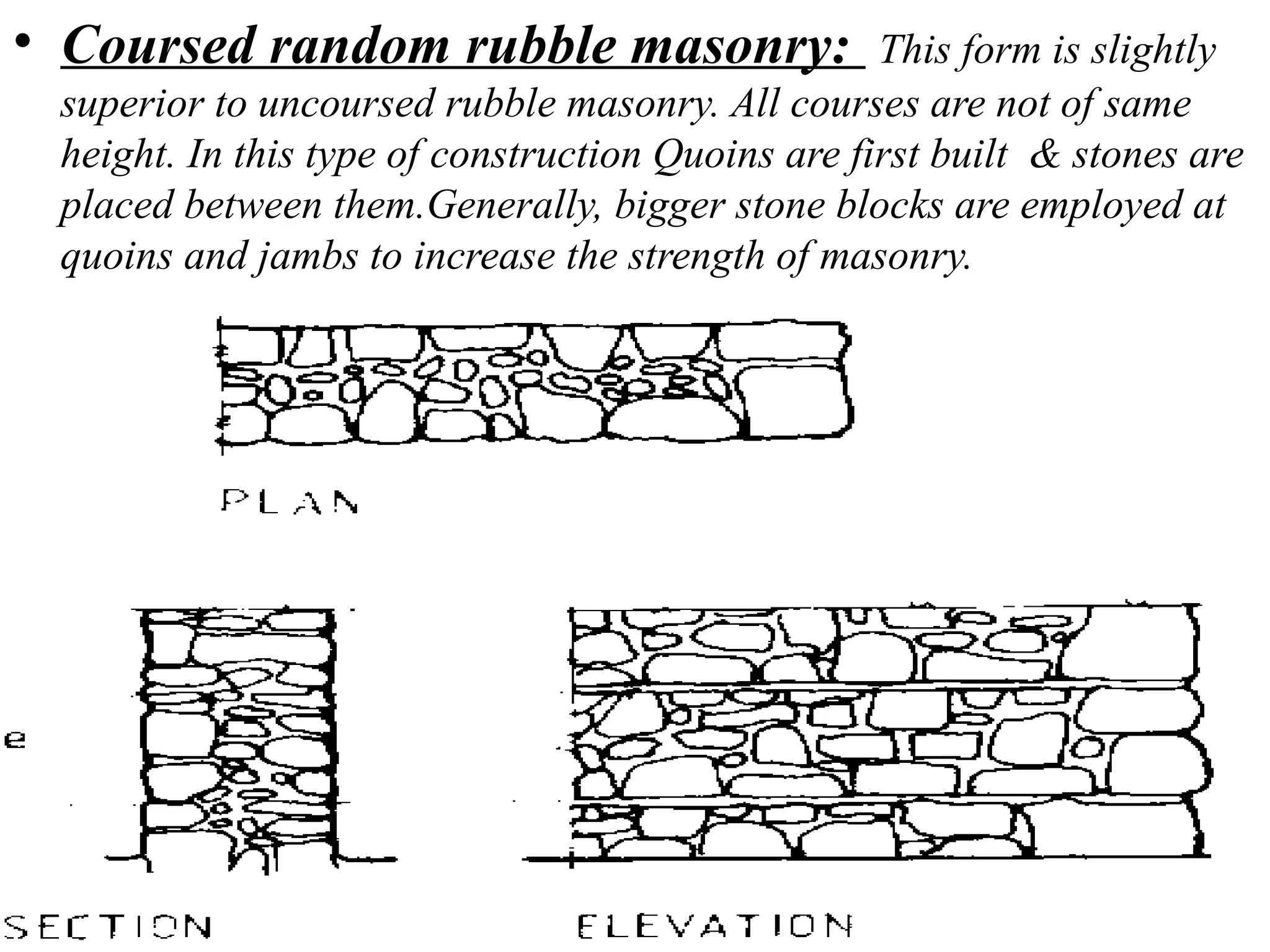
• Coursed random rubble masonry: This form is slightly
superior to uncoursed rubble masonry. All courses are not of same
height. In this type of construction Quoins are first built & stones are
placed between them.Generally, bigger stone blocks are employed at
quoins and jambs to increase the strength of masonry.
Square Rubble Masonry : Uncoursed
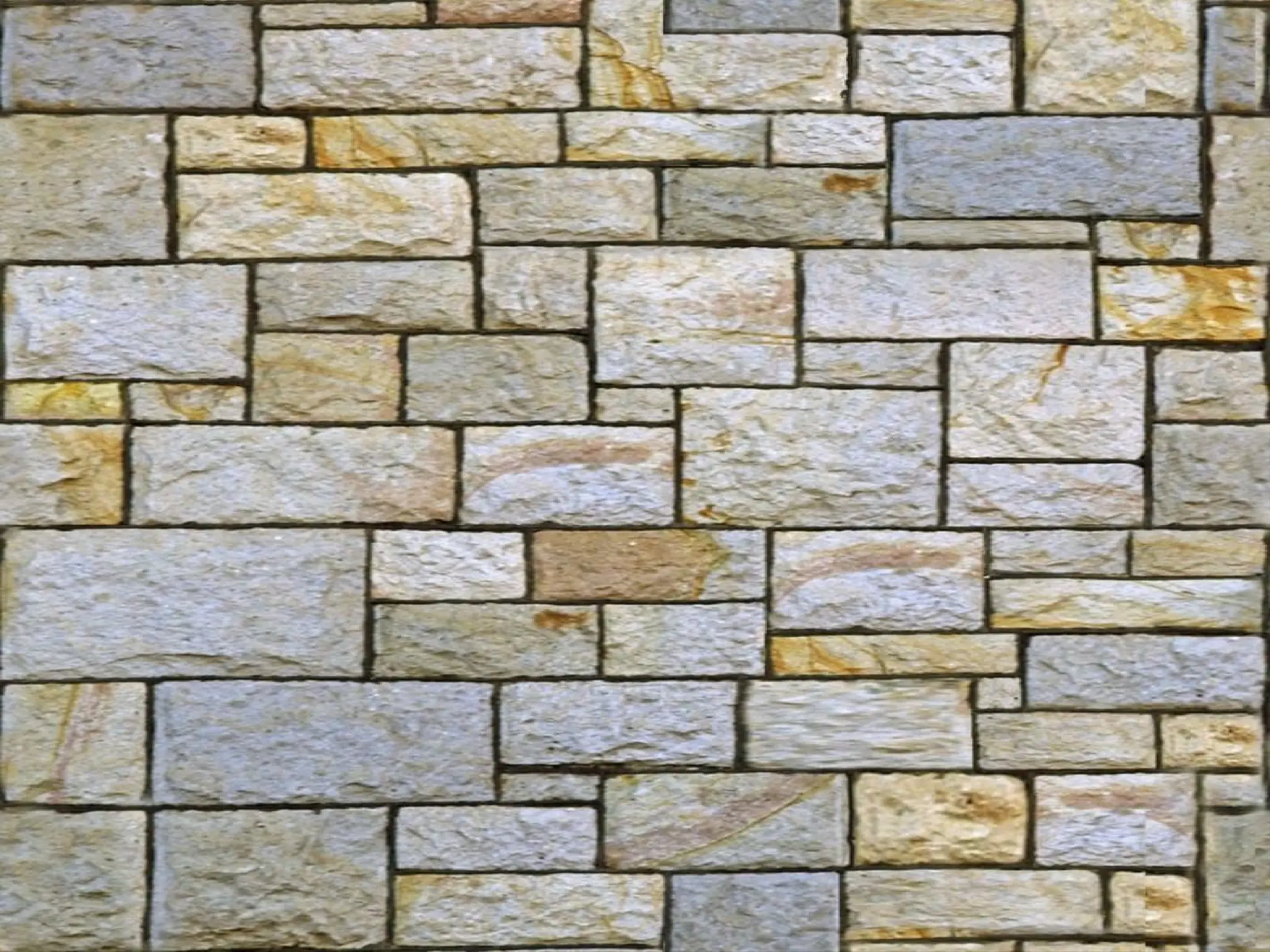
• In this type the stone blocks are made roughly square with hammer.
Generally the facing stones are given hammer-dressed.in this stones
with straight edges & sides are available with different sizes. They are
arranged in irregular patterns so to get good appearance we use
risers (large stones),levellers(thinner stone) & check(small stone) in a
pattern of ratio 3:2:1.
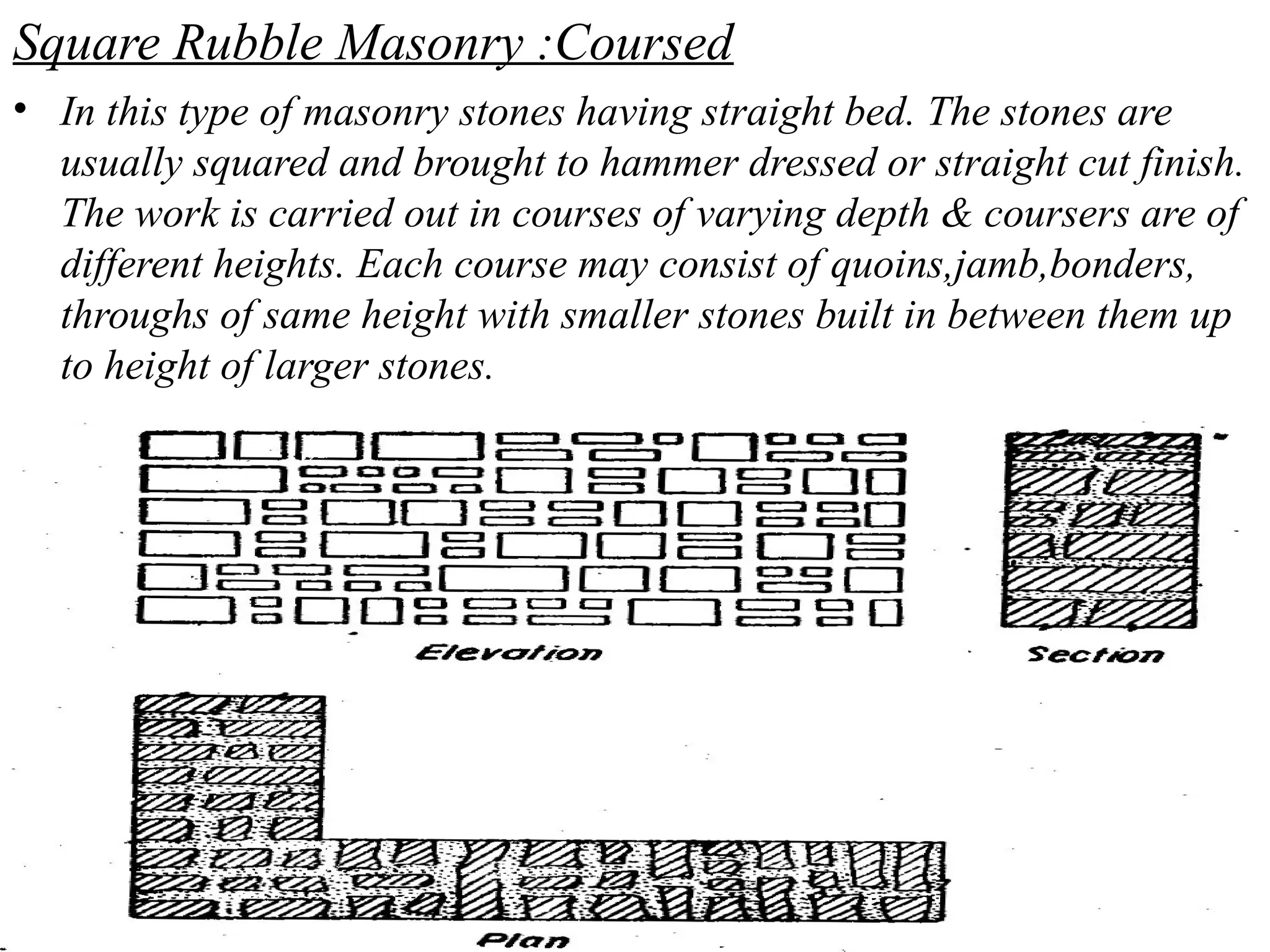
Square Rubble Masonry :Coursed
• In this type of masonry stones having straight bed. The stones are
usually squared and brought to hammer dressed or straight cut finish.
The work is carried out in courses of varying depth & coursers are of
different heights. Each course may consist of quoins,jamb,bonders,
throughs of same height with smaller stones built in between them up
to height of larger stones.
Square Rubble Masonry : Regular Coursed
• The rubble masonry in which the face stones are squared on all
joints and bedded by hammer or chisel dressing before lying
them. This is a superior type of rubble masonry. The stones to be
laid in a course should be of equal size. The joints are roughly
uniform and broken vertically. The stones are arranged in such
a manner so that the vertical joints of two consecutive curse do
not coincide with each other as shown in figure below.
Polygonal rubble masonry:
• In this type of masonry the stones are roughly dressed to an irregular
polygonal shape. The stones should be so arranged as to avoid long
vertical joints in face work and to break joints as much as possible.
Small stone chips should not be used to support the stones on the
facing as shown in the figure below.
Quoins
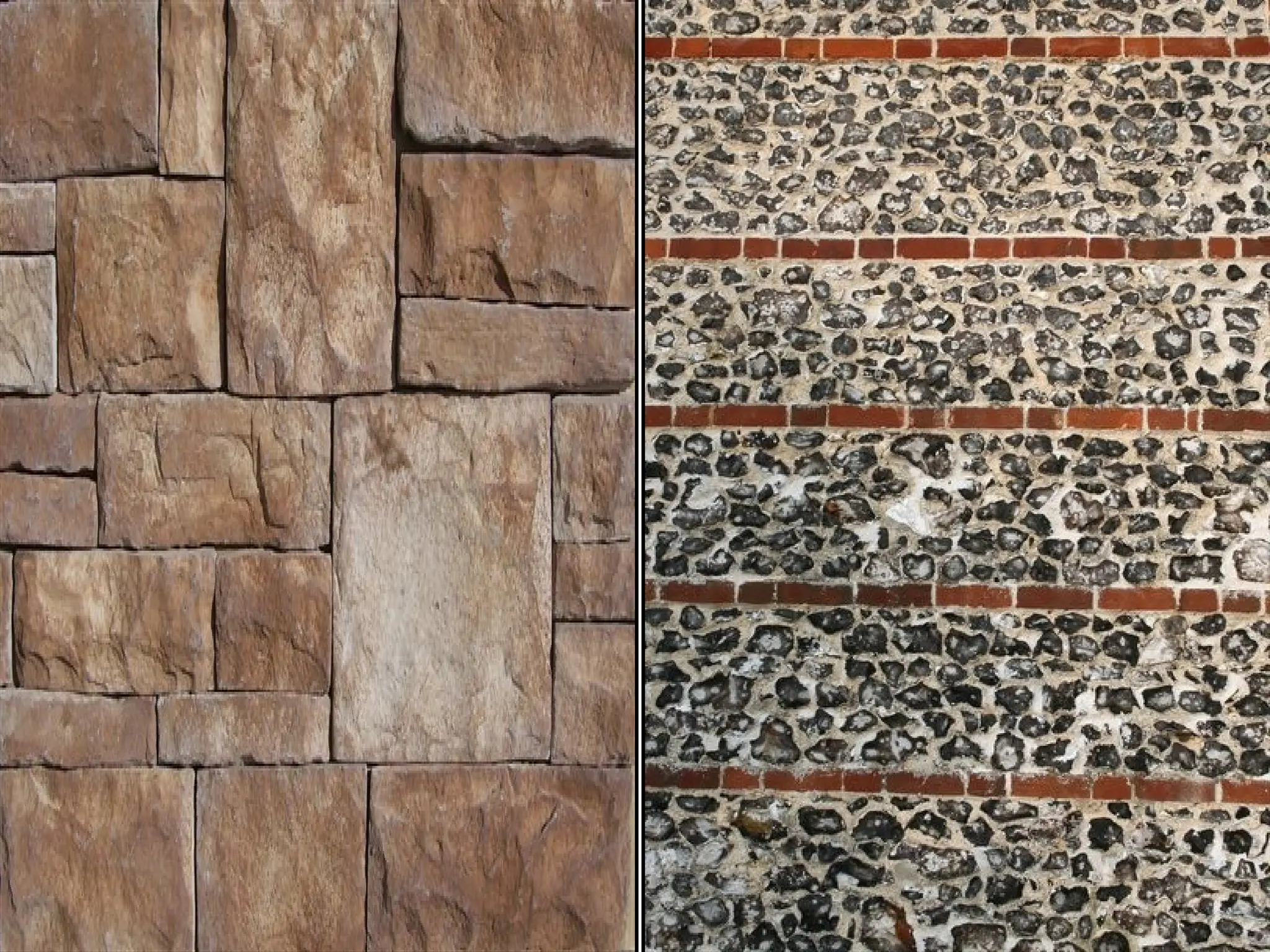
Flint rubble masonry:
• This type of masonry is used in the areas where the flint is available in
plenty. These are irregularly shaped. The stones are extremely hard.
But they are brittle and therefore they break easily. The flint stones
varying in thickness from 7.5 to 15cm and in length from 15 to 30cm
are arranged in the facing in the form of coursed or uncoursed
masonry as shown below.
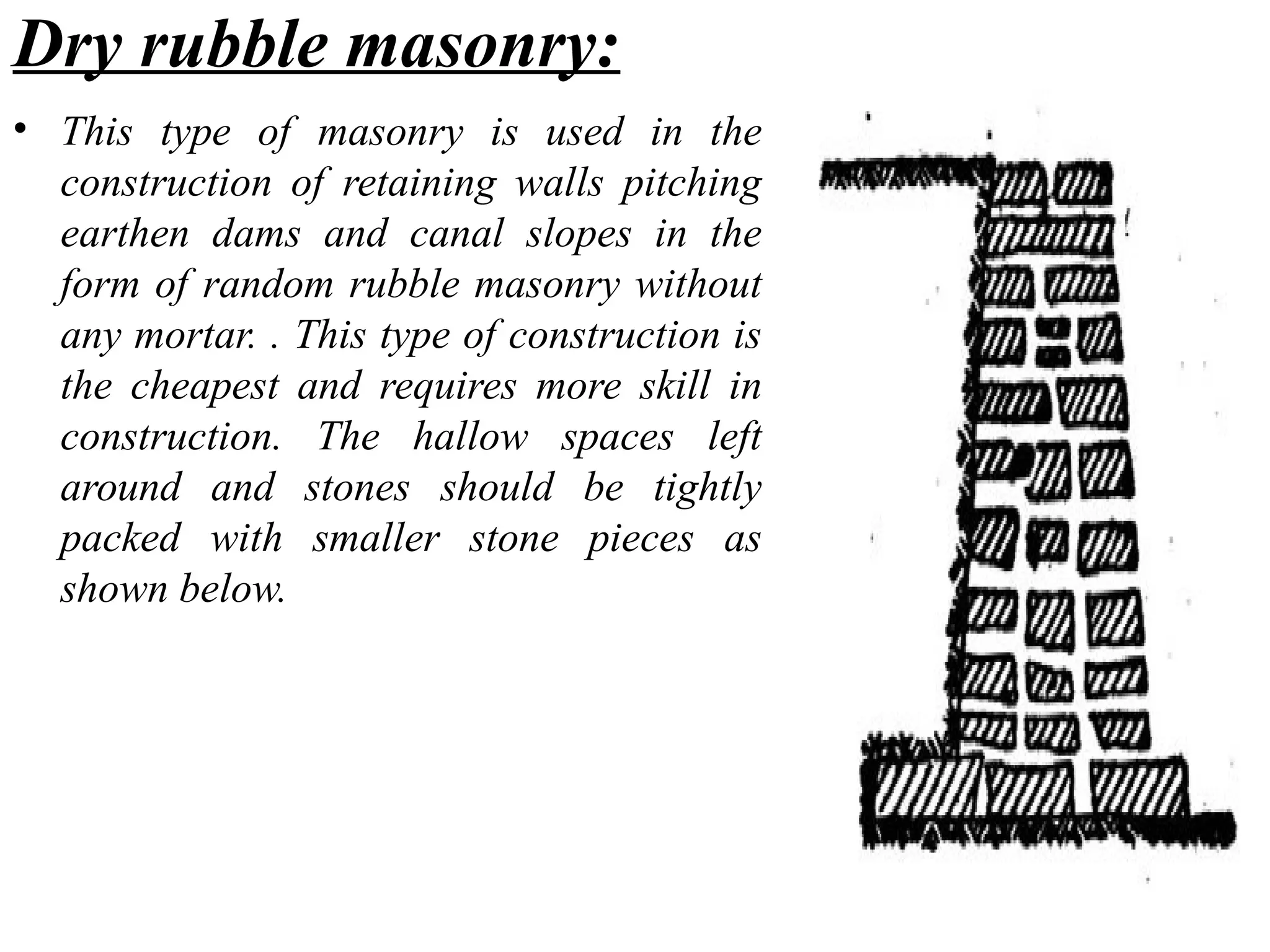
Dry rubble masonry:
• This type of masonry is used in the
construction of retaining walls pitching
earthen dams and canal slopes in the
form of random rubble masonry without
any mortar. . This type of construction is
the cheapest and requires more skill in
construction. The hallow spaces left
around and stones should be tightly
packed with smaller stone pieces as
shown below.
Ashlar Masonry
• Stone masonry having finely dressed stones laid in cement or lime
mortar is known as ashlar masonry. In this masonry all courses are of
uniform height. All the joints are regular, thin and of uniform
thickness of about 3mm thickness by arranging the stone blocks in
various patterns. The size of stones blocks should be in proportion to
wall thickness. This type of stone masonry is costlier in construction
since it involves greater dressing cost. Superior to all types of rubble
masonry in terms of strength and other qualities.
• The various types of masonry can be classified under
the following categories are
1) Ashlar fine
2) Ashlar rough
3) Ashlar rock or quarry faced
4) Ashlar chamfered
5) Ashlar block in course
6) Ashlar facing
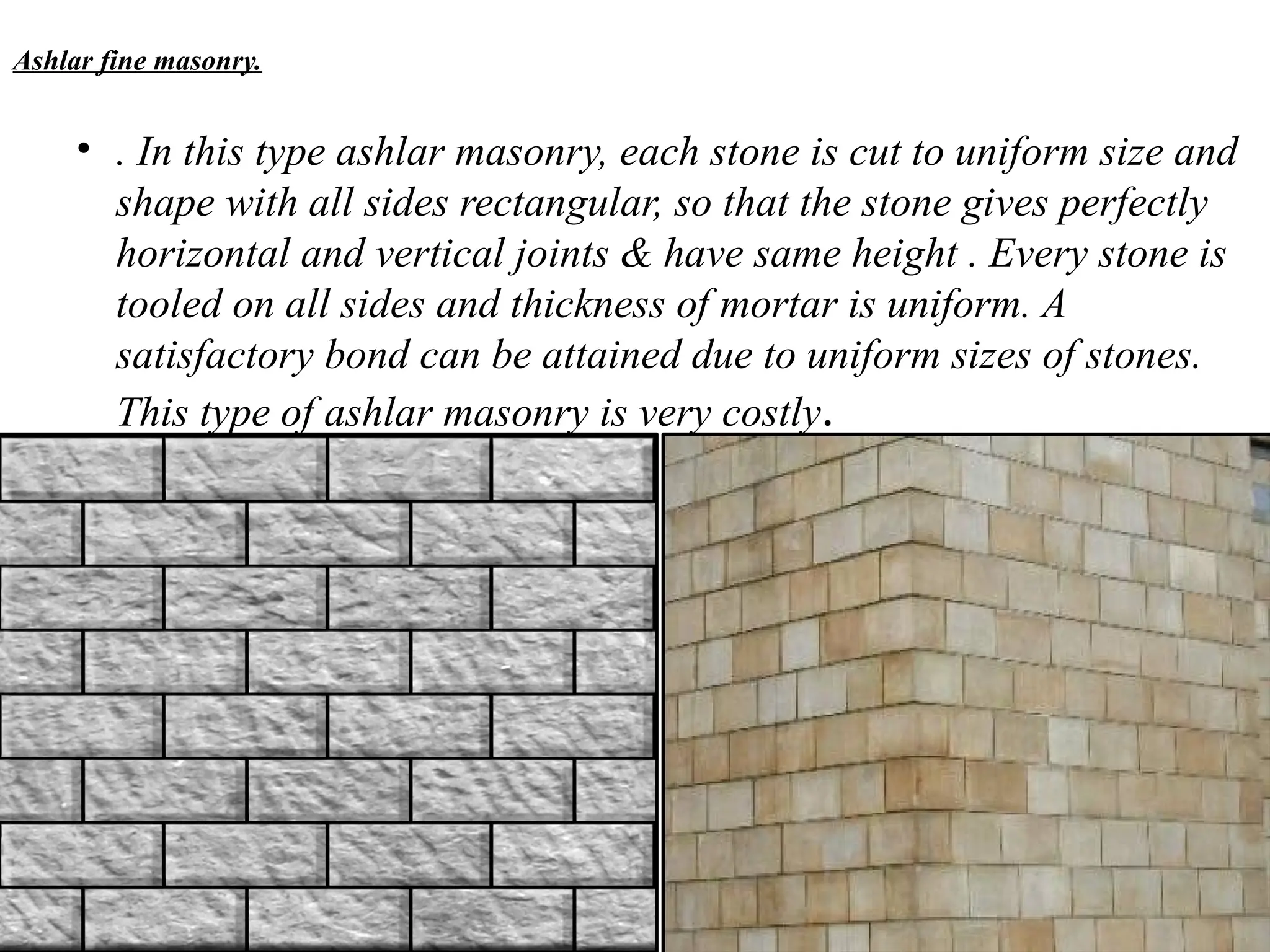
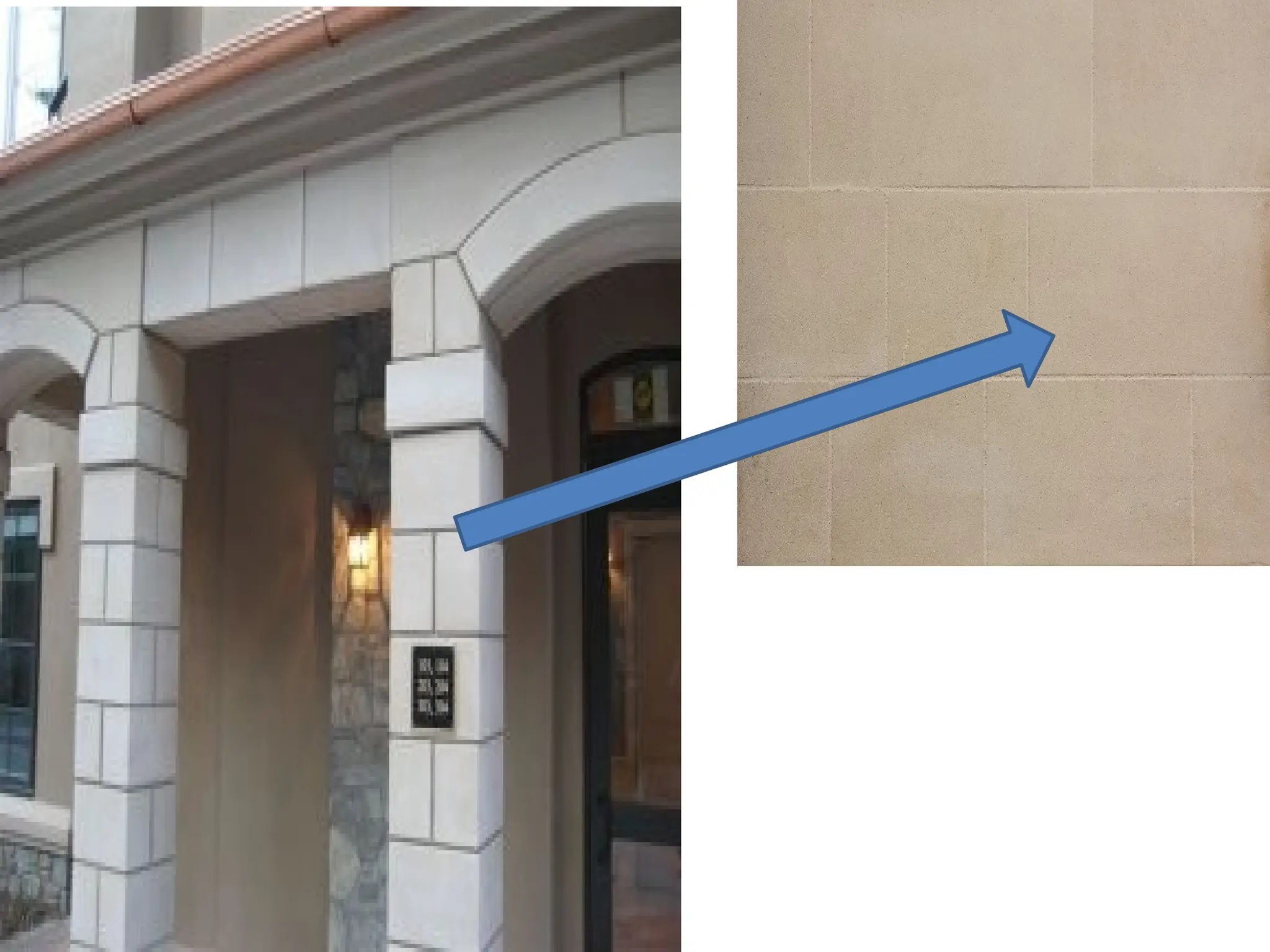
Ashlar fine masonry.
• . In this type ashlar masonry, each stone is cut to uniform size and
shape with all sides rectangular, so that the stone gives perfectly
horizontal and vertical joints & have same height . Every stone is
tooled on all sides and thickness of mortar is uniform. A
satisfactory bond can be attained due to uniform sizes of stones.
This type of ashlar masonry is very costly.
• `
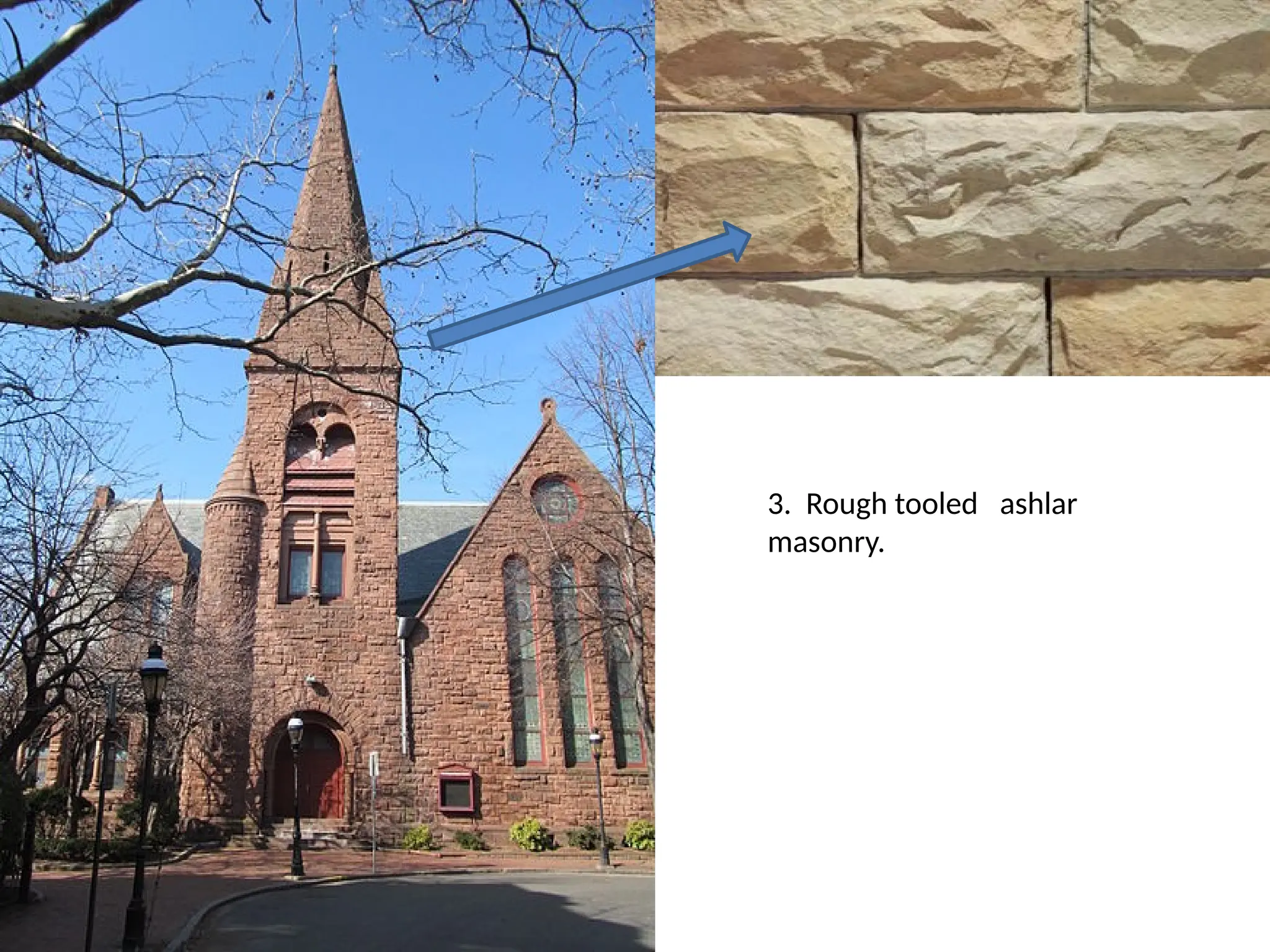
ASHLAR ROUGH TOOL:
• Sides of stones are rough tooled and dressed with chisels. thickness of
joint is uniform and not exceeding 6mm. But the face is made rough
by means of tools. A strip, about 25mm wide and made by means of
chisel is provided around the perimeter of the rough dressed face of
each stone.
3. Rough tooled ashlar
masonry.
Ashlar rock or quarry faced masonry:
• In this type of ashlar masonry, a strip about 25mm wide and made by
means of chisel is provided around the perimeter of every stone as in
case of rough-tooled ashlar masonry. But the remaining portion of the
face is left in the same form as received from quarry.
`4. Rock or quarry faced ashlar masonry.
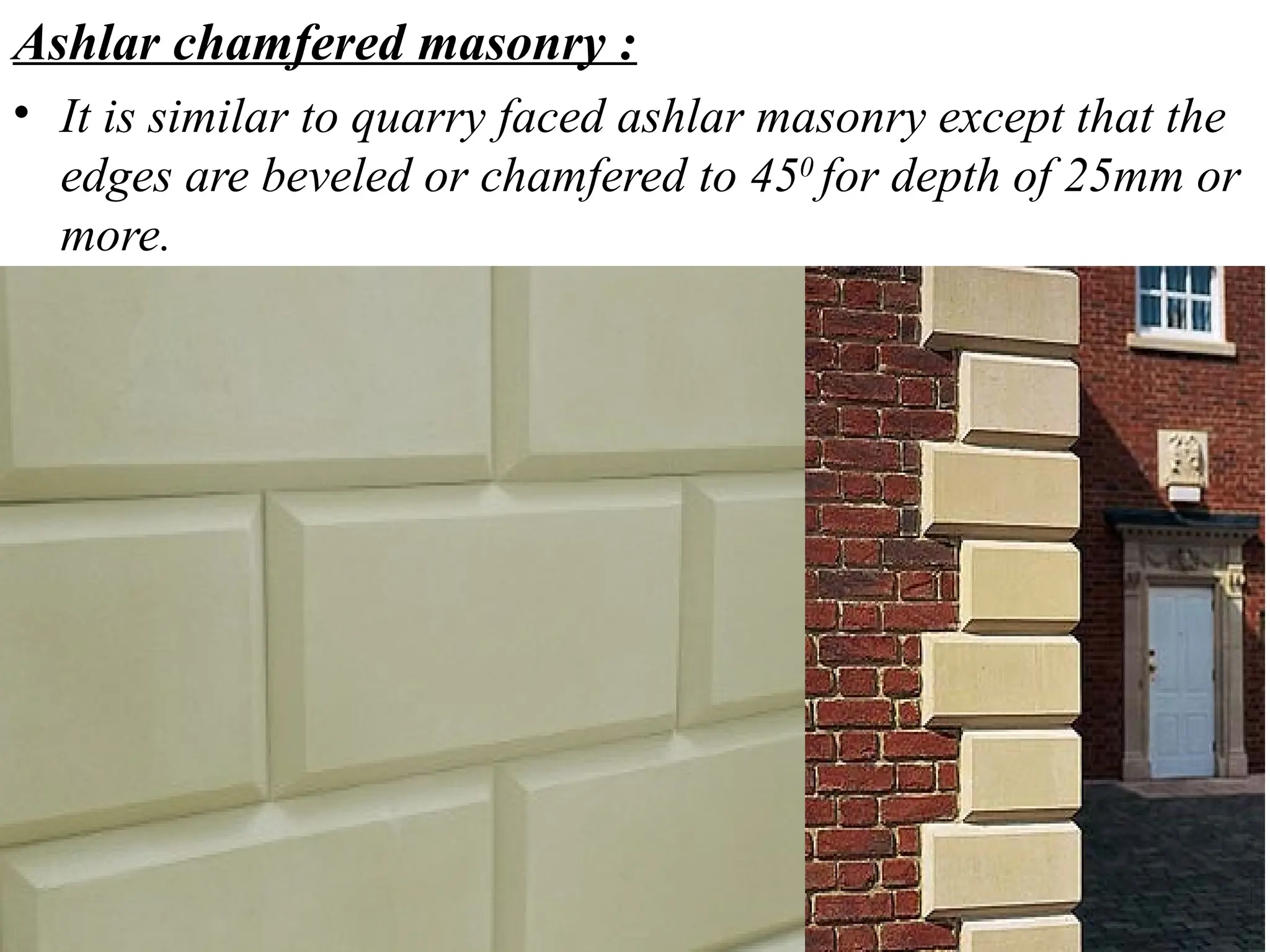
Ashlar chamfered masonry :
• It is similar to quarry faced ashlar masonry except that the
edges are beveled or chamfered to 450
for depth of 25mm or
more.
5. Chamfered ashlar masonry.
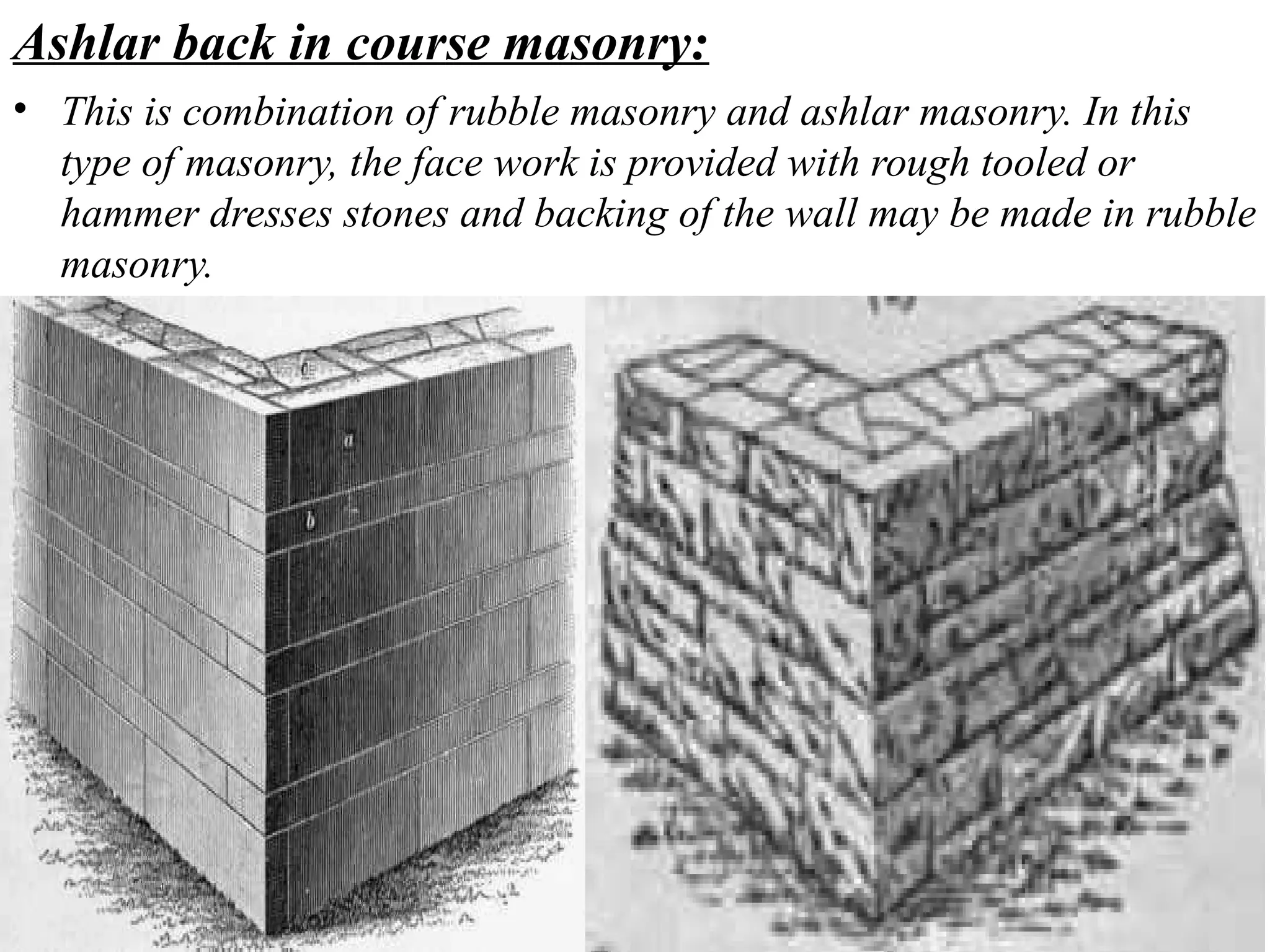
Ashlar back in course masonry:
• This is combination of rubble masonry and ashlar masonry. In this
type of masonry, the face work is provided with rough tooled or
hammer dresses stones and backing of the wall may be made in rubble
masonry.
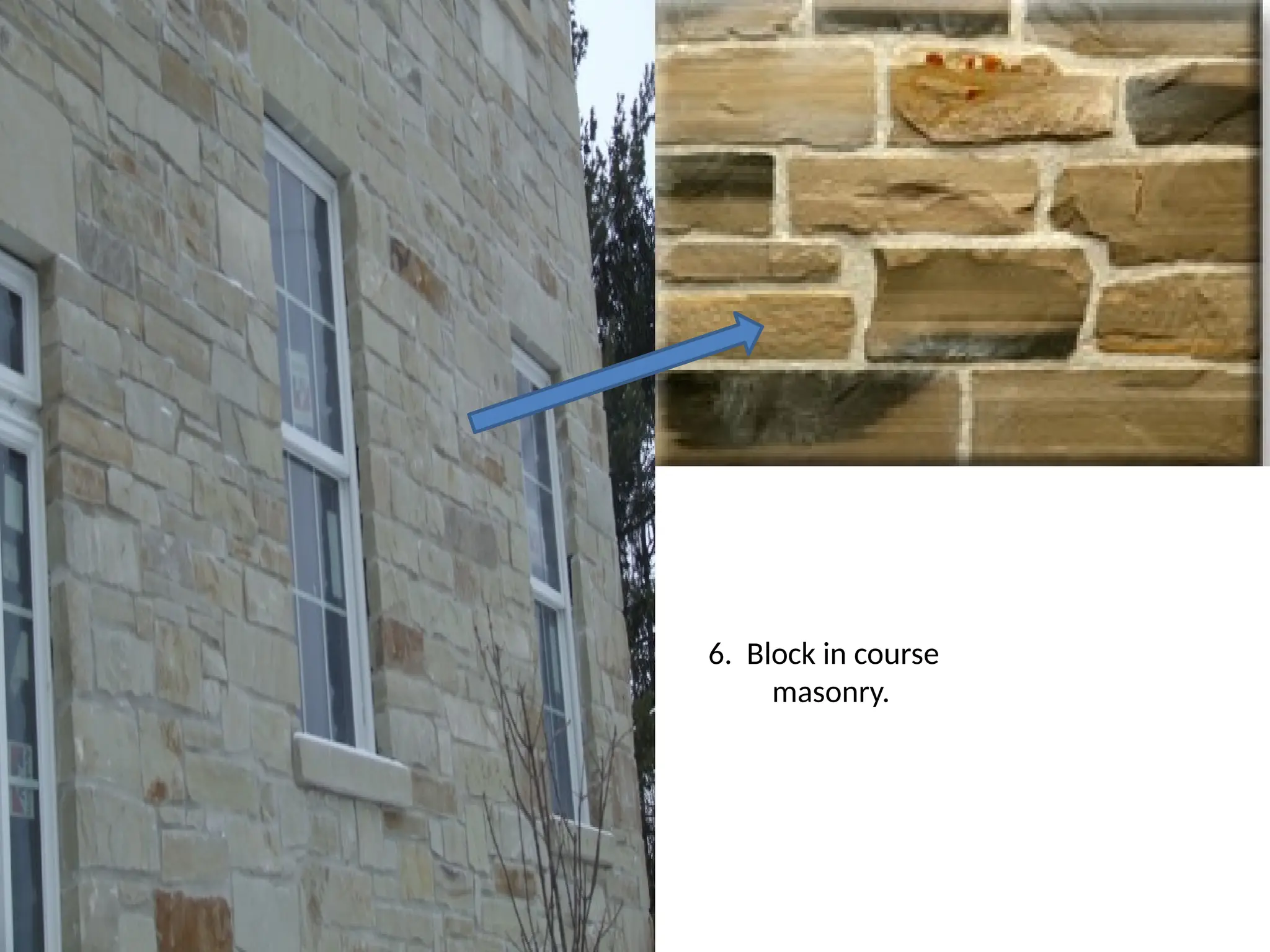
6. Block in course
masonry.
Ashlar facing masonry:
• Ashlar is the superior but expensive type of stone masonry thus in
order to reduce the cost a wall is commonly constructed with a
facing of ashlar and backing of rubble or brick masonry. masonry
the faces of stone are rough tooled, and chamfered and the stones
are provided in face work only .Such walls are also called
compound or composite masonry walls. If the backing is of rubble
masonry it is called rubble ashlar, if the backing is of brick
masonry then it is termed as brick ashlar.
``
7. Ashlar facing masonry.

MASONRY STRUCTURES IN THE FIELD OF CIVIL ENGINEERING

  • 1.
    MASONRY • Masonry isdefined as the art of construction in which building units such as clay bricks, sand, lime, stones, pre-cast hollow concrete blocks, concrete slabs, combination of some of these building units etc are arranged systematically and bonded together to form a homogeneous mass in such a manner that they can with stand the loads.
  • 2.
    Masonry can beclassified into the following categories. 1. Stone masonry 2. Brick masonry 3. Hollow block concrete masonry 4. Reinforced masonry 5. Composite masonry • Brick Masonry is built with bricks & is bounded together with mortar. • For temporary structure we use mud plaster. • For permanent structure we use cement or lime plaster.
  • 3.
    Definitions of terms: •Air Brick: A brick with perforations to allow the passage of air through a wall. • Bat: It is a portion of a brick cut across the width. ( a cut brick )
  • 5.
    Header : Brickin width wise. King closer: a brick that has been cut diagonally over its length to show a half-bat at one end.
  • 6.
    Queen closer: Itis the portion of a brick obtained by cutting a brick length-wise into two portions. Quoin: The stones used for the corners of walls of structure Stretcher: brick in lengthwise
  • 9.
    BONDS IN BRICKWORK / BRICK BONDING: • The look of brickwork is greatly affected by the pattern the bricks are laid in, known as ‘bonding’. • The long face of the brick is called the ‘stretcher’and the short face the ‘header’; the arrangement of headers and stretchers normally follows a prescribed pattern. • Bricks used in masonry are all of uniform size. • If they are not arranged or bonded properly vertical joints result which cause for little strength and stability. • It is important that it should be started from corners correctly when laying out any bond pattern.
  • 10.
    The commonly usedbond patterns : 1. Running Bond / Stretcher Bond, 2. Header Bond, 3. English Bond, 4. Flemish Bond (Dutch Bond), 5. Garden wall Bond, 6. Facing Bond, 7. Raking Bond, 8. Brick on edge Bond, 9. English cross-bond, 10. Stack Bond, 11. Zig- Zig Bond, 12. Common Bond / American Bond
  • 11.
    Running Bond /Stretcher Bond: • The most common and simplest of pattern is the Running Bond. • The length of the bricks are thus along the direction of the wall. • The overlap, which is usually of half brick, is obtained by commencing each alternate course with a half brick bat. • This pattern is used as partition walls. The vertical mortar joints between stretchers line up vertically.
  • 12.
    Header bond :In this type of bonding all the bricks are laid as headers on the faces i.e. shorter face of the brick. • The overlap, which is usually-of half the width of the brick is obtained by introducing a three-quarter bat in each alternate course at quoins. • This bond permits better alignment and as such it is used for walls curved on plan. • This bond is chiefly used for footings in foundations for better transverse distribution of load.
  • 13.
    English Bond: • TheEnglish Bond pattern consists of alternate courses of headers and stretchers with the headers centered on the stretchers . In this bond arrangement, vertical joints in the header courses come over each other and the vertical joints in the stretcher course are also in the same line. For the breaking of vertical joints in the successive course it is essential to place queen closer. The following additional points should be noted in English bond construction:
  • 14.
    • In Englishbond, a header should never start with a queen closer liable to get displaced in this position. • In the stretcher course, the stretchers should have a minimum lap of 1/4th their length over the headers. • Walls having their thickness equal to an even number of half bricks, i.e., one brick thick wail, 2 brick thick wall, 3 brick thick wall and so on, present the same appearance on both the faces, i .e. a course consisting of headers on front face will show headers on the back face also.
  • 15.
    • In wallshaving their thickness equal to an odd number of half brick, i.e. 1½ brick thick walls or 2½ brick thick walls and so on, the same course will show stretchers on one face and headers on the other. • Isometric view of 1½ brick wall in English bond is shown below, • In thick walls the middle portion is entirely filled with header to prevent the formation of vertical joints in the body of the wall.
  • 16.
    Flemish Bond /Dutch Bond :In Flemish bond, each course consists of alternate headers and stretchers. • The alternate headers of each course are centered over the stretchers in the course below. • Every alternate course starts with a header at the corner. For the breaking of vertical joints in the successive courses, closers are inserted in alternate courses next to the quoin header. In walls having their thickness equal to odd number of half bricks, bats are essentially used to achieve the bond.
  • 18.
    • Flemish bondis further divided into two different types namely, 1. Single Flemish bond, 2. Double Flemish bond. 1. Single Flemish Bond. • This bond is a combination of English Bond and Flemish bond. In this work the facing of the wall consists of Flemish bond and the backing consists of English bond in each course. This type of bonding cannot be adopted in walls less than one and a half brick in thickness. This bond is adopted to present the attractive appearance of Flemish bond with an effort to ensure full strength in the brick work.
  • 19.
    Double Flemish bond: •In Double Flemish Bond, each course presents the same appearance both in the front and back elevations. Every course consists of headers and stretchers laid alternately. This type of bond is best suited from considerations of economy and appearance. It enables the one brick wall to have uniform faces on both the sides. This type of bonding is comparatively weaker than English bond.
  • 22.
    Stone Masonry • Theconstruction of stones bonded together with mortar is termed as stone masonry. • The stones are available in a abundance in nature, on cutting and dressing to the proper shape, they provide an economical material for the construction of various building components such as walls, columns, footings, arches, lintels, beams etc.
  • 23.
    Types of StoneMasonry: • Based on the arrangement of the stone in the construction and the type of surface finish, the stone masonry can be classified broadly in the following two categories. Stone Masonry Rubble masonry 1.Randam rubble masonry - Coursed - Uncoursed 2. Square rubble masonry - Coursed - Uncoursed- Regular course 3.Polygonal rubble masonry 4. Flint rubble Ashlar masonry 1. Ashlar fine masonry 2. Ashlar rough tooled 3. Rock (or) quarry faced 4. Ashlar chamfered 5. Ashlar block in course 6.Ashlar Facing
  • 24.
    • Uncoursed rubblemasonry: This is the cheapest, roughest and poorest form of stone masonry. The stones used in this type of masonry very much vary in their shape and size and are directly obtained from quarry. Since they are of different size greater care should be taken while arranging them in such a way that pressure should adequately be distributed over area & long vertical joints are avoided. Transverse stones are used as Headers & larger stones are used as Quoins & Jambs which increases strength & give better appearance.
  • 25.
  • 26.
    • Coursed randomrubble masonry: This form is slightly superior to uncoursed rubble masonry. All courses are not of same height. In this type of construction Quoins are first built & stones are placed between them.Generally, bigger stone blocks are employed at quoins and jambs to increase the strength of masonry.
  • 28.
    Square Rubble Masonry: Uncoursed • In this type the stone blocks are made roughly square with hammer. Generally the facing stones are given hammer-dressed.in this stones with straight edges & sides are available with different sizes. They are arranged in irregular patterns so to get good appearance we use risers (large stones),levellers(thinner stone) & check(small stone) in a pattern of ratio 3:2:1.
  • 30.
    Square Rubble Masonry:Coursed • In this type of masonry stones having straight bed. The stones are usually squared and brought to hammer dressed or straight cut finish. The work is carried out in courses of varying depth & coursers are of different heights. Each course may consist of quoins,jamb,bonders, throughs of same height with smaller stones built in between them up to height of larger stones.
  • 32.
    Square Rubble Masonry: Regular Coursed • The rubble masonry in which the face stones are squared on all joints and bedded by hammer or chisel dressing before lying them. This is a superior type of rubble masonry. The stones to be laid in a course should be of equal size. The joints are roughly uniform and broken vertically. The stones are arranged in such a manner so that the vertical joints of two consecutive curse do not coincide with each other as shown in figure below.
  • 34.
    Polygonal rubble masonry: •In this type of masonry the stones are roughly dressed to an irregular polygonal shape. The stones should be so arranged as to avoid long vertical joints in face work and to break joints as much as possible. Small stone chips should not be used to support the stones on the facing as shown in the figure below. Quoins
  • 35.
    Flint rubble masonry: •This type of masonry is used in the areas where the flint is available in plenty. These are irregularly shaped. The stones are extremely hard. But they are brittle and therefore they break easily. The flint stones varying in thickness from 7.5 to 15cm and in length from 15 to 30cm are arranged in the facing in the form of coursed or uncoursed masonry as shown below.
  • 37.
    Dry rubble masonry: •This type of masonry is used in the construction of retaining walls pitching earthen dams and canal slopes in the form of random rubble masonry without any mortar. . This type of construction is the cheapest and requires more skill in construction. The hallow spaces left around and stones should be tightly packed with smaller stone pieces as shown below.
  • 39.
    Ashlar Masonry • Stonemasonry having finely dressed stones laid in cement or lime mortar is known as ashlar masonry. In this masonry all courses are of uniform height. All the joints are regular, thin and of uniform thickness of about 3mm thickness by arranging the stone blocks in various patterns. The size of stones blocks should be in proportion to wall thickness. This type of stone masonry is costlier in construction since it involves greater dressing cost. Superior to all types of rubble masonry in terms of strength and other qualities.
  • 40.
    • The varioustypes of masonry can be classified under the following categories are 1) Ashlar fine 2) Ashlar rough 3) Ashlar rock or quarry faced 4) Ashlar chamfered 5) Ashlar block in course 6) Ashlar facing
  • 41.
    Ashlar fine masonry. •. In this type ashlar masonry, each stone is cut to uniform size and shape with all sides rectangular, so that the stone gives perfectly horizontal and vertical joints & have same height . Every stone is tooled on all sides and thickness of mortar is uniform. A satisfactory bond can be attained due to uniform sizes of stones. This type of ashlar masonry is very costly. • `
  • 43.
    ASHLAR ROUGH TOOL: •Sides of stones are rough tooled and dressed with chisels. thickness of joint is uniform and not exceeding 6mm. But the face is made rough by means of tools. A strip, about 25mm wide and made by means of chisel is provided around the perimeter of the rough dressed face of each stone.
  • 44.
    3. Rough tooledashlar masonry.
  • 45.
    Ashlar rock orquarry faced masonry: • In this type of ashlar masonry, a strip about 25mm wide and made by means of chisel is provided around the perimeter of every stone as in case of rough-tooled ashlar masonry. But the remaining portion of the face is left in the same form as received from quarry.
  • 46.
    `4. Rock orquarry faced ashlar masonry.
  • 47.
    Ashlar chamfered masonry: • It is similar to quarry faced ashlar masonry except that the edges are beveled or chamfered to 450 for depth of 25mm or more.
  • 48.
  • 49.
    Ashlar back incourse masonry: • This is combination of rubble masonry and ashlar masonry. In this type of masonry, the face work is provided with rough tooled or hammer dresses stones and backing of the wall may be made in rubble masonry.
  • 50.
    6. Block incourse masonry.
  • 51.
    Ashlar facing masonry: •Ashlar is the superior but expensive type of stone masonry thus in order to reduce the cost a wall is commonly constructed with a facing of ashlar and backing of rubble or brick masonry. masonry the faces of stone are rough tooled, and chamfered and the stones are provided in face work only .Such walls are also called compound or composite masonry walls. If the backing is of rubble masonry it is called rubble ashlar, if the backing is of brick masonry then it is termed as brick ashlar.
  • 52.