UNIT I
CONCRETE MAKING
MATERIALS
CEMENT
Cement is a well-known building material and
has occupied an indispensable place in
construction works.
A cement is a binder, a substance that sets and
hardens and can bind other materials together.
There are variety of cements available in the
market and each type is used under certain
conditions due to its special properties.
A mixture of cement and sand when mixed with
water to form a paste is known as cement
mortar whereas the composite product obtained
by mixing cement, water and an inert matrix of
sand and gravel or crushed stone is called
cement concrete.
The cement commonly used is Portland
cement and the fine and coarse aggregates
used are those that are usually obtainable,
from nearby sand, gravel or rock deposits.
In order to obtain a strong, durable and
economical concrete mix, it is necessary to
understand the characteristics and behaviour
of the ingredients.
Portland cement is defined as hydraulic
cement, i.e. a cement that not only hardens by
reacting with water but also forms a water-
resistant product.
The ingredients of concrete can be classified
into two groups, namely active and inactive.
The active group consists of cement and
water, whereas the inactive group comprises
fine and coarse aggregates.
The inactive group is also sometimes called
the inert matrix.
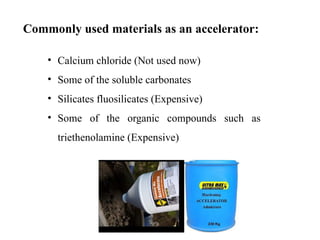
Although all materials that go into a concrete
mixture is essential, cement is by far the most
important constituent because it is usually the
delicate link in the chain.
The function of cement is, first to bind the sand
and coarse aggregates together and second to
fill the voids in between sand and coarse
aggregate particles to form a compact mass.
Although cement constitutes only about 10
percent of the volume of the concrete mix, it is
the active portion of the binding medium and
the only scientifically controlled ingredient of
concrete.
Joseph Aspdin patented a similar material,
which he called Portland cement, because the
render made from it was in color similar to the
prestigious Portland stone.
Chemical composition
The raw materials used for the manufacture of
cement consist mainly of lime, silica, alumina and
iron oxide.
These oxides interact with one another in the kiln
at high temperature to form more complex
compounds.
The relative proportions of these oxide
compositions are responsible for influencing the
various properties of cement, in addition to rate of
cooling and fineness of grinding.
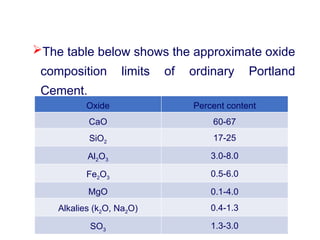
The table below shows the approximate oxide
composition limits of ordinary Portland
Cement.
Oxide Percent content
CaO 60-67
SiO2
17-25
Al2O3
3.0-8.0
Fe2O3
0.5-6.0
MgO 0.1-4.0
Alkalies (k2O, Na2O) 0.4-1.3
SO3
1.3-3.0
Functions of cement ingredients
Lime:
• Controls strength and soundness. Its deficiency
reduces strength and setting time.
Silica:
• Gives strength due to the formation of dicalcium and
tricalcium silicates. Excess of it causes slow setting.
Alumina:
• Responsible for quick setting. It acts as a flux and
lowers the clinkering temperature. If in excess it
lowers the strength.
• Calcium Sulphate: Present in the form of
gypsum and its function is to increase the initial
setting time of cement.
• Iron Oxide: Imparts color and help in fusion of
• different ingredients of cement.
• Magnesia: Imparts color and hardness. If in
excess
• causes cracks and makes cement unsound.
• Sulphur: A small amount is used in making sound
• cement. If in excess causes cement to become
• unsound.
• Alkalies: If excess in cement, causes alkali- aggregate
• reaction (aggregates having silica react with the alkali
• hydroxides in concrete, causing expansion and
• cracking ) , efflorescence and discoloration when used
• in concrete.
The oxides present in the raw materials
when subjected to high clinkering
temperature combine with each other to form
complex compounds.
The identification of the major compounds is
largely based on R.H. Bogue’s work and
hence it is called “Bogue’s Compounds”.
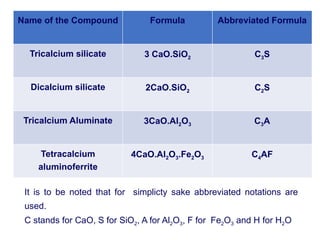
The table below lists the major compounds.
Name of the Compound Formula Abbreviated Formula
Tricalcium silicate 3 CaO.SiO2 C3S
Dicalcium silicate 2CaO.SiO2 C2S
Tricalcium Aluminate 3CaO.Al2O3 C3A
Tetracalcium
aluminoferrite
4CaO.Al2O3.Fe2O3 C4AF
It is to be noted that for simplicty sake abbreviated notations are
used.
C stands for CaO, S for SiO2, A for Al2O3, F for Fe2O3 and H for H2O
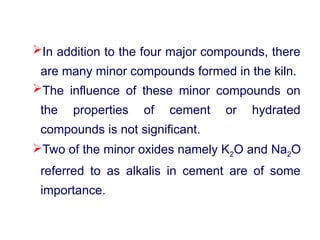
In addition to the four major compounds, there
are many minor compounds formed in the kiln.
The influence of these minor compounds on
the properties of cement or hydrated
compounds is not significant.
Two of the minor oxides namely K2O and Na2O
referred to as alkalis in cement are of some
importance.
Tricalcium silicate and dicalcium silicate are
the most important compounds responsible
for strength.
Together they constitute 70 to 80 percent of
cement.
Hydration of cement
Anhydrous cement does not bind fine and coarse
aggregate.
It acquires adhesive property only when mixed
with water.
The chemical reactions that take place between
cement and water is referred as hydration of
cement.
The chemistry of concrete is essentially the
chemistry of the reaction between cement and
water.
On account of hydration certain products are
formed.
These products are important because they
have cementing or adhesive value.
The quality, quantity, continuity, stability and the
rate of formation of the hydration products are
important.
Anhydrous cement compounds when mixed with
water, react with each other to form hydrated
compounds of very low solubility.
The hydration of cement can be visualised in two
ways.
The first is “through solution” mechanism.
In this the cement compounds dissolve to produce a
supersaturated solution from which different hydrated
products get precipitated.
The second possibility is that water attacks cement
compounds in the solid state converting the
compounds into hydrated products starting from the
surface and proceeding to the interior of the
compounds with time.
UNIT II CHEMICAL AND MINERAL
ADMIXTURES
 Accelerators – used to fast rate of setting of concrete
 Retarders - used to slow the rate of setting of concrete
 Plasticizers - to produce or promote plasticity
 Super plasticizers - high range water reducers
 Water proofers - prevent permeation by water
 Mineral admixtures like
1. Fly ash
2. Silica fume
3. Ground granulated blast furnace slag and
4. Metakaoline
• Accelerators – speed up the initial set of concrete.
• Retarders – delay the setting time of concrete mix.
• Plasticizers and Super-plasticizers - water reducers.
• Air entraining admixtures
• Water proofers Pigments
• Corrosion - inhibiters
• Chemicals Anti-fungal admixtures
ADMIXTURES
• Admixtures are ingredients other than cement,
fine aggregate and coarse aggregate to improve
the quality of concrete.
• The addition of an admixture may improve the
concrete with respect to its strength, hardness,
workability, water resisting power etc.
Needs of Admixtures
• To modify properties of fresh and hardened concrete.
• To ensure the quality of concrete during the mixing,
transporting, placing, and curing.
• To overcome certain unexpected emergencies during
concrete operations by using admixtures and etc…
• To reduce the cost of concrete construction.
• To achieve certain properties in concrete more effectively
than by other means.
• To maintain the quality of concrete during the stages of
mixing, transporting, placing, and curing in ad-verse
weather conditions.
• To overcome certain emergencies during concreting
operations
Types of Admixture
Concrete admixtures are generally divided into 2
types
1. Chemical admixture
2. Mineral admixture
Chemical Admixtures
• Chemicals mixed with concrete ingredients and spread
throughout the body of concrete to favorably modify the
molding and setting properties of concrete mix known as
chemical admixtures.
• Chemicals added to the concrete immediately or during
mixing to modify its properties in the fresh hardened state.
Accelerators – speed up the initial set of concrete.
Retarders – delay the setting time of concrete mix.
Plasticizers and Super-plasticizers - water reducers.
Air entraining admixtures
Water proofers Pigments
Corrosion - inhibiters
Chemicals Anti-fungal admixtures
Types of Chemical Admixtures
CHEMICALADMIXTURES
The following are some of the chemical admixtures:
1. Plasticizers
2. Super plasticizers
3. Accelerators
4. Retarders
5. Water proofers
MINERALADMIXTURES
some of the mineral admixtures are given below:
1. Fly Ash
2. Silica Fume
3. Ground Granulated Blast furnace Slag (GGBS)
4. Metakaolin
• Plasticizers are used during the process of making fresh
concrete. They are used to increase the workability of
concrete without adding any extra water.
• Water reducing admixtures require less water to make a
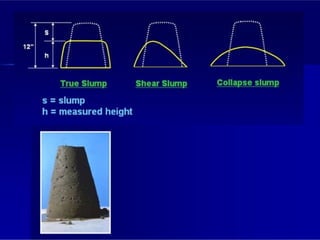
concrete of equal slump, or increase the slump of concrete at
the same water content.
• They can have the side effect of changing initial setting time.
• Water reducers are mostly used for hot weather concrete
placing and to aid pumping.
• A water reducer plasticizers, however, is a hygroscopic
powder, which can entrain air into the concrete mix that its
effects on water surface tension, thereby also obtaining some
of the benefits of air-entrainment.
PLASTICIZERS
(WATER REDUCER)
• Concrete should possess good workability. It
requires different degree of workability in different
situations like
1. Tremie concreting
2. Hot weather concreting
3. Pumping of concrete
4. Deep beams
5. Beam and Column joints
6. Ready mixed concrete industries
7. Thin walled structures, etc..,
(i). Conventional Method For High Workability
The following are the methods for increasing workability by
conventional method:
• Improving the gradation
• Using higher percentage of fine aggregate
• Increasing the content of cement
• Using extra amount of water
(ii). Effects or Use of Extra Water In Concrete
Excess of water in concrete leads to the effects given below:
• Harmful to concrete strength and durability
• Improve the consistency but not the workability of concrete
• No improvement in homogeneity and cohesiveness of the
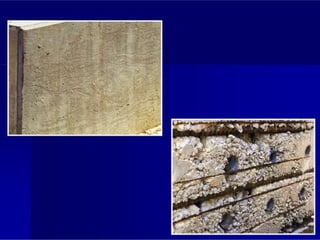
mix, reducing the tendency for segregation and bleeding.
(iii). Effects of Use of Plasticizer In Concrete
Effects due to the use of plasticizers in concrete are:
• mass concrete. Reduces water/cement ratio for the given
workability, which in turn increasing the strength.
• The reduction in water/cement ratio improves the durability
of concrete.
• Sometimes reduce it used to reduce cement content and
heat of hydration in mass concrete.
• It is used in the amount of 0.1% to 0.4% to the weight of
cement. At these stage, with constant workability the
reduction in mixing water are in the order of 5% to 15%.
• This naturally increases the strength.
• The increase in workability at the same water/cement ratio
may be from 30 mm to 150 mm slump, depending on the
dosage, initial slump of concrete cement content and type.
• Super plasticizers (High Range Water Reducers-HRWR) are
chemical admixtures used where well-dispersed particle suspension
is required.
• Super plasticizers are also known as plasticizers, include water-
reducing admixtures.
• Comparing to the commonly referred as water reducer or mid-range
water reducers, super plasticizers are called as High Range Water
Reducers.
• High range water reducers are admixtures that allow large water
reduction or greater flow ability without substantially slowing set
time or increasing air entrainment.
• Each type has defined ranges for the required quantities of concrete
mix ingredients, along with the corresponding effects.
• They can maintain a specific consistency and workability at a
greatly reduction in the amount of water.
SUPER PLASTICIZERS
• Dosages needed vary by the particular concrete mix and
type of super plasticizer used.
• They can also produce a high strength concrete.
• As with most types of admixtures, super plasticizers can
affect other concrete properties as well.
• The specific effects should be found from the manufacturer
or concrete supplier.
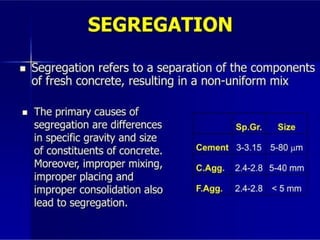
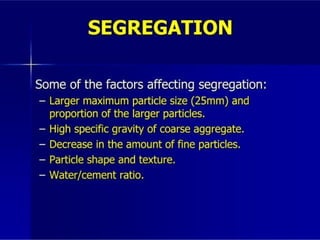
• These are used as dispersants to avoid particle segregation
(gravel, coarse and fine sands) and to improve the flow
characteristics such as in concrete applications.
• Use of super plasticizers has made it possible to use
water/cement ratio as low as 0.25 or even lower and yet to
make concrete to obtain strength of the order 120 N/mm2
or more.
Following are the effects of superplasticizer in fresh concrete:
• The dramatic improvement in workability is not showing up
when super plasticizers are added to zero slump concrete at
nominal stages.
• A mix with an initial slump of about 2 to 3 cm can only be
fluidized by super plasticizers at dosages.
• A high dosage is required to fluidize no slump concrete.
• An improvement in slump value can stained to the extent of 25
cm or more depending upon the initial slump of the mix, the
dosage and cement content.
• It is noticed that slump increases with increases in dosage but
after certain limitation of dosage there is no increase in slump.
• As a fact, that the over dosage may harm the concrete.
(1). Use of Superplasticizer in Fresh Concrete
Following are the effects of superplasticizer in hardened concrete:
• Super plasticizers does not participate in any chemical reactions with
cement or blending material used in concrete.
• The actions of superplasticizers are only physical in fluidizing the
mix made even with low water content. D The superplasticizers
fluidizing action last only as the mix is in plastic condition. D If the
effect of absorbed layer is lost, the hydration process continues
normally.
• The use of right quality of super plasticizers when used in usual small
dose of about 3% by weight of cement, there is no bad effect on the
properties of hardened concrete.
• Super plasticizers improves the workability, compactability and
reduction in water/cement ratio, and thereby increase the strength of
concrete, this gives overall improvement in the properties of hardened
concrete. The use of super plasticizer improves the properties of
hardened concrete and it became as an unavoidable material in the
high performance concrete.
(2). Use of Superplasticizer in Hardened Concrete
ACCELERATORS
Accelerating admixtures are added to concrete to increase
the rate of early strength development in concrete to
• Permit earlier removal of formwork;
• Reduce the required period of curing;
• Advance the time that a structure can be placed in service;
• Partially compensate for the retarding effect of low
temperature during cold weather concreting;
• In the emergency repair work.
Commonly used materials as an accelerator:
• Calcium chloride (Not used now)
• Some of the soluble carbonates
• Silicates fluosilicates (Expensive)
• Some of the organic compounds such as
triethenolamine (Expensive)
Advantages / Effects of accelerator
on concrete properties
 Reduced bleeding,
 Earlier finishing
 Improved protection against early exposure to freezing and thawing,
 Earlier use of structure
 Reduction of protection time to achieve a given quality,
 Early removal of form, and early load application.
 Increases the rate of gain of strength.
 Enables earlier release from precast moulds thus speeding
production.
 Reduces segregation and increase density and compressive strength.
 Cures concrete faster and therefore uniform curing in winter and
summer can be achieved.
 Early use of concrete floors by accelerating the setting of concrete.
 Reduces water requirements, bleeding, shrinkage and time required
for initial set.
• Retarders, as the name implies that the delay in setting time of
cement.
• The rate of chemical reaction gets decreased and setting time
increases.
• Calcium sulphate in the form of gypsum is generally added
during the manufacture of cement to retard the setting.
• But the amount of gypsum, if added beyond a limited quantity
produces unsoundness and other undesirable effects.
• Calcium sulphate in the form of plaster of Paris can also be
used.
• At normal temperatures, 0.2% addition of sugar can extend the
final setting time to about 72 hours or more.
• Skimmed milk powder has a retarding effect due to its sugar
content.
RETARDERS
• By the use of 0.1% of sodium hexametaphosphate, the
initial and final setting times of 12 hours and 13 hours
respectively can be obtained.
• Retarding admixtures slow down the hydration of cement,
lengthening the set time.
• Retarders are beneficially used in hot weather conditions
in order to overcome the accelerating effects of higher
temperatures and large masses of concrete on concrete
setting time.
• Most of the retarders also act as water reducers, they are
frequently called water reducing retarders.
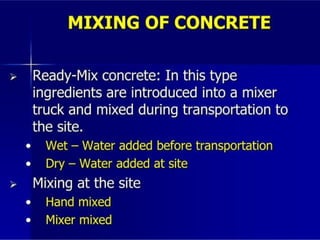
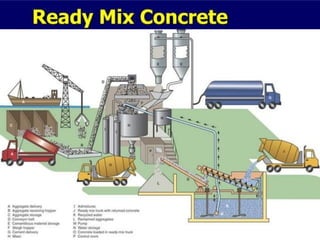
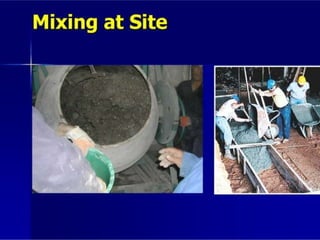
Concreting methods
and MIX design
UNIT - III
UNIT-IV
PROPERTIES OF FRESH AND
HARDENED CONCRETE
UNIT V
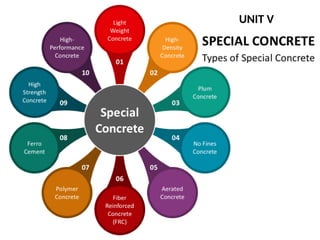
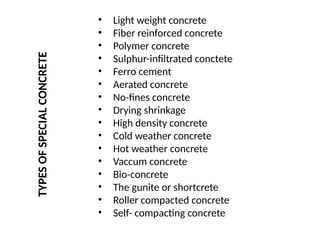
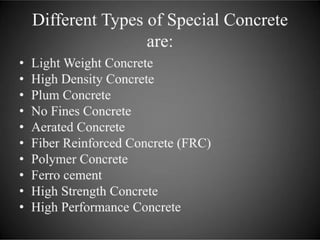
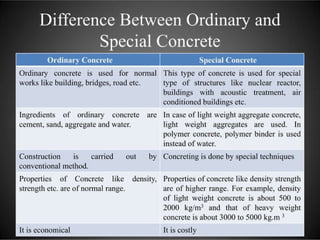
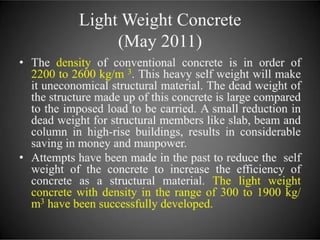
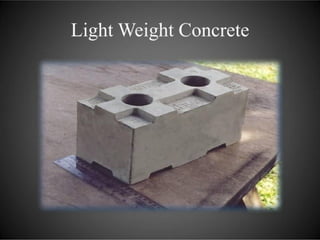
• Light weight concrete
• Fiber reinforced concrete
• Polymer concrete
• Sulphur-infiltrated conctete
• Ferro cement
• Aerated concrete
• No-fines concrete
• Drying shrinkage
• High density concrete
• Cold weather concrete
• Hot weather concrete
• Vaccum concrete
• Bio-concrete
• The gunite or shortcrete
• Roller compacted concrete
• Self- compacting concrete
TYPES
OF
SPECIAL
CONCRETE
Concrete Technology .pptx unit 1,2,3,4, & 5

Concrete Technology .pptx unit 1,2,3,4, & 5

  • 1.
  • 2.
    CEMENT Cement is awell-known building material and has occupied an indispensable place in construction works. A cement is a binder, a substance that sets and hardens and can bind other materials together. There are variety of cements available in the market and each type is used under certain conditions due to its special properties.
  • 3.
    A mixture ofcement and sand when mixed with water to form a paste is known as cement mortar whereas the composite product obtained by mixing cement, water and an inert matrix of sand and gravel or crushed stone is called cement concrete.
  • 4.
    The cement commonlyused is Portland cement and the fine and coarse aggregates used are those that are usually obtainable, from nearby sand, gravel or rock deposits. In order to obtain a strong, durable and economical concrete mix, it is necessary to understand the characteristics and behaviour of the ingredients.
  • 5.
    Portland cement isdefined as hydraulic cement, i.e. a cement that not only hardens by reacting with water but also forms a water- resistant product. The ingredients of concrete can be classified into two groups, namely active and inactive.
  • 6.
    The active groupconsists of cement and water, whereas the inactive group comprises fine and coarse aggregates. The inactive group is also sometimes called the inert matrix. Although all materials that go into a concrete mixture is essential, cement is by far the most important constituent because it is usually the delicate link in the chain.
  • 7.
    The function ofcement is, first to bind the sand and coarse aggregates together and second to fill the voids in between sand and coarse aggregate particles to form a compact mass. Although cement constitutes only about 10 percent of the volume of the concrete mix, it is the active portion of the binding medium and the only scientifically controlled ingredient of concrete.
  • 8.
    Joseph Aspdin patenteda similar material, which he called Portland cement, because the render made from it was in color similar to the prestigious Portland stone.
  • 9.
    Chemical composition The rawmaterials used for the manufacture of cement consist mainly of lime, silica, alumina and iron oxide. These oxides interact with one another in the kiln at high temperature to form more complex compounds. The relative proportions of these oxide compositions are responsible for influencing the various properties of cement, in addition to rate of cooling and fineness of grinding.
  • 10.
    The table belowshows the approximate oxide composition limits of ordinary Portland Cement. Oxide Percent content CaO 60-67 SiO2 17-25 Al2O3 3.0-8.0 Fe2O3 0.5-6.0 MgO 0.1-4.0 Alkalies (k2O, Na2O) 0.4-1.3 SO3 1.3-3.0
  • 11.
    Functions of cementingredients Lime: • Controls strength and soundness. Its deficiency reduces strength and setting time. Silica: • Gives strength due to the formation of dicalcium and tricalcium silicates. Excess of it causes slow setting. Alumina: • Responsible for quick setting. It acts as a flux and lowers the clinkering temperature. If in excess it lowers the strength.
  • 12.
    • Calcium Sulphate:Present in the form of gypsum and its function is to increase the initial setting time of cement. • Iron Oxide: Imparts color and help in fusion of • different ingredients of cement. • Magnesia: Imparts color and hardness. If in excess • causes cracks and makes cement unsound.
  • 13.
    • Sulphur: Asmall amount is used in making sound • cement. If in excess causes cement to become • unsound. • Alkalies: If excess in cement, causes alkali- aggregate • reaction (aggregates having silica react with the alkali • hydroxides in concrete, causing expansion and • cracking ) , efflorescence and discoloration when used • in concrete.
  • 14.
    The oxides presentin the raw materials when subjected to high clinkering temperature combine with each other to form complex compounds. The identification of the major compounds is largely based on R.H. Bogue’s work and hence it is called “Bogue’s Compounds”. The table below lists the major compounds.
  • 15.
    Name of theCompound Formula Abbreviated Formula Tricalcium silicate 3 CaO.SiO2 C3S Dicalcium silicate 2CaO.SiO2 C2S Tricalcium Aluminate 3CaO.Al2O3 C3A Tetracalcium aluminoferrite 4CaO.Al2O3.Fe2O3 C4AF It is to be noted that for simplicty sake abbreviated notations are used. C stands for CaO, S for SiO2, A for Al2O3, F for Fe2O3 and H for H2O
  • 16.
    In addition tothe four major compounds, there are many minor compounds formed in the kiln. The influence of these minor compounds on the properties of cement or hydrated compounds is not significant. Two of the minor oxides namely K2O and Na2O referred to as alkalis in cement are of some importance.
  • 17.
    Tricalcium silicate anddicalcium silicate are the most important compounds responsible for strength. Together they constitute 70 to 80 percent of cement.
  • 18.
    Hydration of cement Anhydrouscement does not bind fine and coarse aggregate. It acquires adhesive property only when mixed with water. The chemical reactions that take place between cement and water is referred as hydration of cement. The chemistry of concrete is essentially the chemistry of the reaction between cement and water.
  • 19.
    On account ofhydration certain products are formed. These products are important because they have cementing or adhesive value. The quality, quantity, continuity, stability and the rate of formation of the hydration products are important. Anhydrous cement compounds when mixed with water, react with each other to form hydrated compounds of very low solubility.
  • 20.
    The hydration ofcement can be visualised in two ways. The first is “through solution” mechanism. In this the cement compounds dissolve to produce a supersaturated solution from which different hydrated products get precipitated. The second possibility is that water attacks cement compounds in the solid state converting the compounds into hydrated products starting from the surface and proceeding to the interior of the compounds with time.
  • 21.
    UNIT II CHEMICALAND MINERAL ADMIXTURES  Accelerators – used to fast rate of setting of concrete  Retarders - used to slow the rate of setting of concrete  Plasticizers - to produce or promote plasticity  Super plasticizers - high range water reducers  Water proofers - prevent permeation by water  Mineral admixtures like 1. Fly ash 2. Silica fume 3. Ground granulated blast furnace slag and 4. Metakaoline
  • 22.
    • Accelerators –speed up the initial set of concrete. • Retarders – delay the setting time of concrete mix. • Plasticizers and Super-plasticizers - water reducers. • Air entraining admixtures • Water proofers Pigments • Corrosion - inhibiters • Chemicals Anti-fungal admixtures
  • 23.
    ADMIXTURES • Admixtures areingredients other than cement, fine aggregate and coarse aggregate to improve the quality of concrete. • The addition of an admixture may improve the concrete with respect to its strength, hardness, workability, water resisting power etc.
  • 24.
    Needs of Admixtures •To modify properties of fresh and hardened concrete. • To ensure the quality of concrete during the mixing, transporting, placing, and curing. • To overcome certain unexpected emergencies during concrete operations by using admixtures and etc… • To reduce the cost of concrete construction. • To achieve certain properties in concrete more effectively than by other means. • To maintain the quality of concrete during the stages of mixing, transporting, placing, and curing in ad-verse weather conditions. • To overcome certain emergencies during concreting operations
  • 25.
    Types of Admixture Concreteadmixtures are generally divided into 2 types 1. Chemical admixture 2. Mineral admixture Chemical Admixtures • Chemicals mixed with concrete ingredients and spread throughout the body of concrete to favorably modify the molding and setting properties of concrete mix known as chemical admixtures. • Chemicals added to the concrete immediately or during mixing to modify its properties in the fresh hardened state.
  • 26.
    Accelerators – speedup the initial set of concrete. Retarders – delay the setting time of concrete mix. Plasticizers and Super-plasticizers - water reducers. Air entraining admixtures Water proofers Pigments Corrosion - inhibiters Chemicals Anti-fungal admixtures Types of Chemical Admixtures
  • 27.
    CHEMICALADMIXTURES The following aresome of the chemical admixtures: 1. Plasticizers 2. Super plasticizers 3. Accelerators 4. Retarders 5. Water proofers MINERALADMIXTURES some of the mineral admixtures are given below: 1. Fly Ash 2. Silica Fume 3. Ground Granulated Blast furnace Slag (GGBS) 4. Metakaolin
  • 28.
    • Plasticizers areused during the process of making fresh concrete. They are used to increase the workability of concrete without adding any extra water. • Water reducing admixtures require less water to make a concrete of equal slump, or increase the slump of concrete at the same water content. • They can have the side effect of changing initial setting time. • Water reducers are mostly used for hot weather concrete placing and to aid pumping. • A water reducer plasticizers, however, is a hygroscopic powder, which can entrain air into the concrete mix that its effects on water surface tension, thereby also obtaining some of the benefits of air-entrainment. PLASTICIZERS (WATER REDUCER)
  • 29.
    • Concrete shouldpossess good workability. It requires different degree of workability in different situations like 1. Tremie concreting 2. Hot weather concreting 3. Pumping of concrete 4. Deep beams 5. Beam and Column joints 6. Ready mixed concrete industries 7. Thin walled structures, etc..,
  • 30.
    (i). Conventional MethodFor High Workability The following are the methods for increasing workability by conventional method: • Improving the gradation • Using higher percentage of fine aggregate • Increasing the content of cement • Using extra amount of water (ii). Effects or Use of Extra Water In Concrete Excess of water in concrete leads to the effects given below: • Harmful to concrete strength and durability • Improve the consistency but not the workability of concrete • No improvement in homogeneity and cohesiveness of the mix, reducing the tendency for segregation and bleeding.
  • 31.
    (iii). Effects ofUse of Plasticizer In Concrete Effects due to the use of plasticizers in concrete are: • mass concrete. Reduces water/cement ratio for the given workability, which in turn increasing the strength. • The reduction in water/cement ratio improves the durability of concrete. • Sometimes reduce it used to reduce cement content and heat of hydration in mass concrete. • It is used in the amount of 0.1% to 0.4% to the weight of cement. At these stage, with constant workability the reduction in mixing water are in the order of 5% to 15%. • This naturally increases the strength. • The increase in workability at the same water/cement ratio may be from 30 mm to 150 mm slump, depending on the dosage, initial slump of concrete cement content and type.
  • 32.
    • Super plasticizers(High Range Water Reducers-HRWR) are chemical admixtures used where well-dispersed particle suspension is required. • Super plasticizers are also known as plasticizers, include water- reducing admixtures. • Comparing to the commonly referred as water reducer or mid-range water reducers, super plasticizers are called as High Range Water Reducers. • High range water reducers are admixtures that allow large water reduction or greater flow ability without substantially slowing set time or increasing air entrainment. • Each type has defined ranges for the required quantities of concrete mix ingredients, along with the corresponding effects. • They can maintain a specific consistency and workability at a greatly reduction in the amount of water. SUPER PLASTICIZERS
  • 33.
    • Dosages neededvary by the particular concrete mix and type of super plasticizer used. • They can also produce a high strength concrete. • As with most types of admixtures, super plasticizers can affect other concrete properties as well. • The specific effects should be found from the manufacturer or concrete supplier. • These are used as dispersants to avoid particle segregation (gravel, coarse and fine sands) and to improve the flow characteristics such as in concrete applications. • Use of super plasticizers has made it possible to use water/cement ratio as low as 0.25 or even lower and yet to make concrete to obtain strength of the order 120 N/mm2 or more.
  • 34.
    Following are theeffects of superplasticizer in fresh concrete: • The dramatic improvement in workability is not showing up when super plasticizers are added to zero slump concrete at nominal stages. • A mix with an initial slump of about 2 to 3 cm can only be fluidized by super plasticizers at dosages. • A high dosage is required to fluidize no slump concrete. • An improvement in slump value can stained to the extent of 25 cm or more depending upon the initial slump of the mix, the dosage and cement content. • It is noticed that slump increases with increases in dosage but after certain limitation of dosage there is no increase in slump. • As a fact, that the over dosage may harm the concrete. (1). Use of Superplasticizer in Fresh Concrete
  • 35.
    Following are theeffects of superplasticizer in hardened concrete: • Super plasticizers does not participate in any chemical reactions with cement or blending material used in concrete. • The actions of superplasticizers are only physical in fluidizing the mix made even with low water content. D The superplasticizers fluidizing action last only as the mix is in plastic condition. D If the effect of absorbed layer is lost, the hydration process continues normally. • The use of right quality of super plasticizers when used in usual small dose of about 3% by weight of cement, there is no bad effect on the properties of hardened concrete. • Super plasticizers improves the workability, compactability and reduction in water/cement ratio, and thereby increase the strength of concrete, this gives overall improvement in the properties of hardened concrete. The use of super plasticizer improves the properties of hardened concrete and it became as an unavoidable material in the high performance concrete. (2). Use of Superplasticizer in Hardened Concrete
  • 36.
    ACCELERATORS Accelerating admixtures areadded to concrete to increase the rate of early strength development in concrete to • Permit earlier removal of formwork; • Reduce the required period of curing; • Advance the time that a structure can be placed in service; • Partially compensate for the retarding effect of low temperature during cold weather concreting; • In the emergency repair work.
  • 37.
    Commonly used materialsas an accelerator: • Calcium chloride (Not used now) • Some of the soluble carbonates • Silicates fluosilicates (Expensive) • Some of the organic compounds such as triethenolamine (Expensive)
  • 38.
    Advantages / Effectsof accelerator on concrete properties  Reduced bleeding,  Earlier finishing  Improved protection against early exposure to freezing and thawing,  Earlier use of structure  Reduction of protection time to achieve a given quality,  Early removal of form, and early load application.  Increases the rate of gain of strength.  Enables earlier release from precast moulds thus speeding production.  Reduces segregation and increase density and compressive strength.  Cures concrete faster and therefore uniform curing in winter and summer can be achieved.  Early use of concrete floors by accelerating the setting of concrete.  Reduces water requirements, bleeding, shrinkage and time required for initial set.
  • 39.
    • Retarders, asthe name implies that the delay in setting time of cement. • The rate of chemical reaction gets decreased and setting time increases. • Calcium sulphate in the form of gypsum is generally added during the manufacture of cement to retard the setting. • But the amount of gypsum, if added beyond a limited quantity produces unsoundness and other undesirable effects. • Calcium sulphate in the form of plaster of Paris can also be used. • At normal temperatures, 0.2% addition of sugar can extend the final setting time to about 72 hours or more. • Skimmed milk powder has a retarding effect due to its sugar content. RETARDERS
  • 40.
    • By theuse of 0.1% of sodium hexametaphosphate, the initial and final setting times of 12 hours and 13 hours respectively can be obtained. • Retarding admixtures slow down the hydration of cement, lengthening the set time. • Retarders are beneficially used in hot weather conditions in order to overcome the accelerating effects of higher temperatures and large masses of concrete on concrete setting time. • Most of the retarders also act as water reducers, they are frequently called water reducing retarders.
  • 41.
    Concreting methods and MIXdesign UNIT - III
  • 61.
    UNIT-IV PROPERTIES OF FRESHAND HARDENED CONCRETE
  • 82.
  • 83.
    • Light weightconcrete • Fiber reinforced concrete • Polymer concrete • Sulphur-infiltrated conctete • Ferro cement • Aerated concrete • No-fines concrete • Drying shrinkage • High density concrete • Cold weather concrete • Hot weather concrete • Vaccum concrete • Bio-concrete • The gunite or shortcrete • Roller compacted concrete • Self- compacting concrete TYPES OF SPECIAL CONCRETE