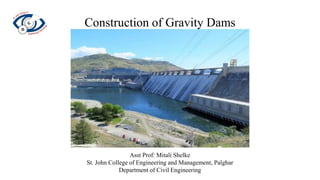
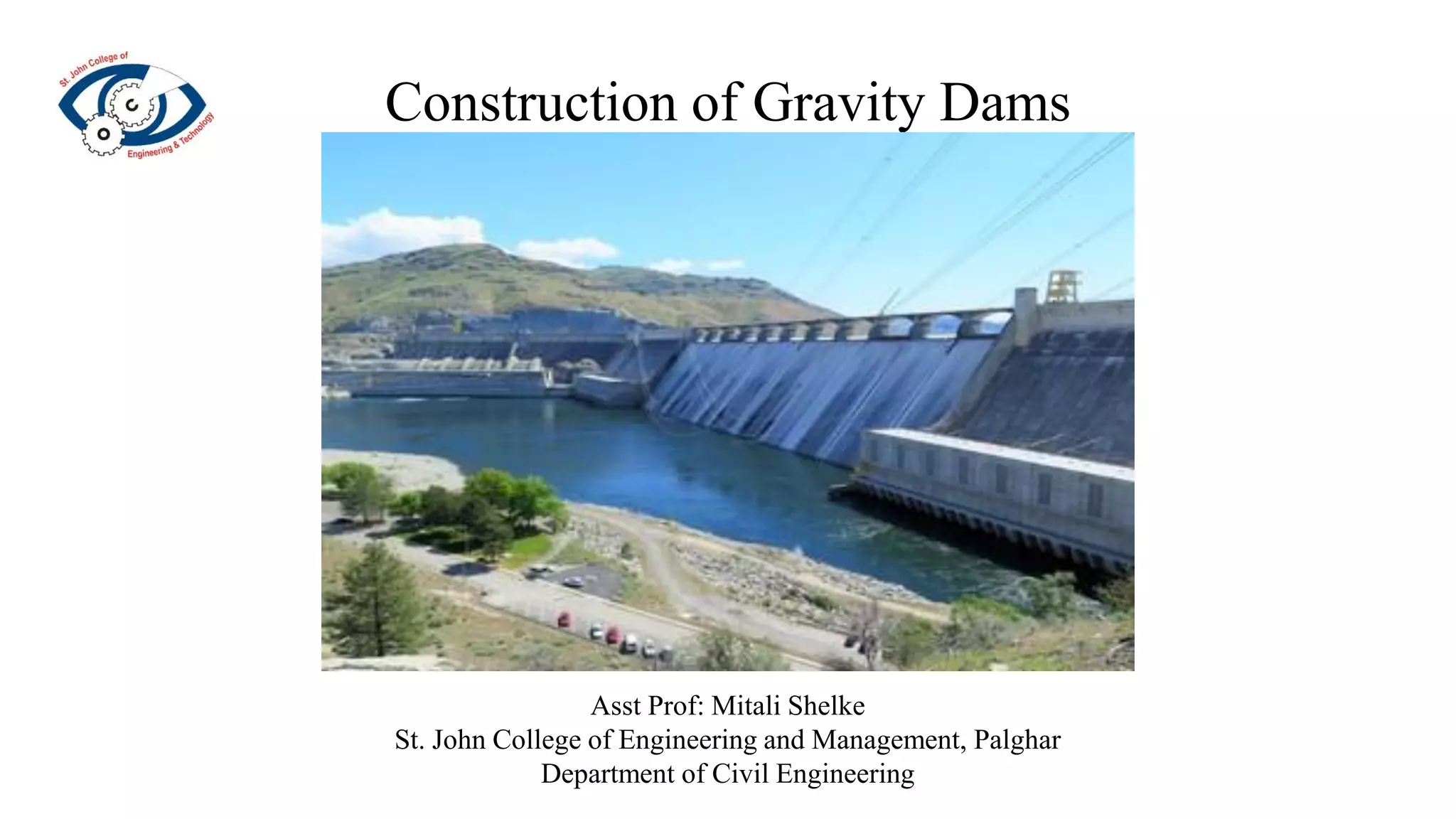
Construction of Gravity Dams
Asst Prof: Mitali Shelke
St. John College of Engineering and Management, Palghar
Department of Civil Engineering
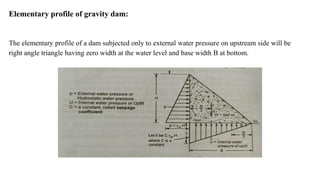
Elementary profile of gravity dam:
The elementary profile of a dam subjected only to external water pressure on upstream side will be
right angle triangle having zero width at the water level and base width B at bottom.
When the reservoir is empty the only single force acting on it is self weight W of the dam and it acts
at a distance B/3 from the heel.
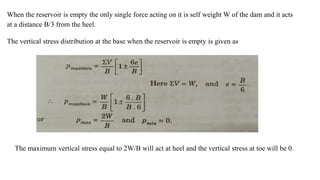
The vertical stress distribution at the base when the reservoir is empty is given as
The maximum vertical stress equal to 2W/B will act at heel and the vertical stress at toe will be 0.
When the reservoir is full the base width his governed by:
1. The resultant of all forces that is P, W and U passes through the outermost middle third point.
2. The dam is safe in sliding.
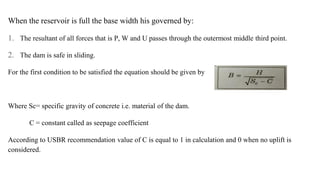
For the first condition to be satisfied the equation should be given by
Where Sc= specific gravity of concrete i.e. material of the dam.
C = constant called as seepage coefficient
According to USBR recommendation value of C is equal to 1 in calculation and 0 when no uplift is
considered.
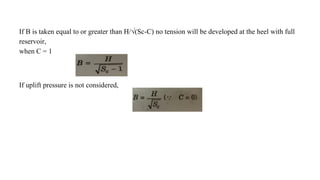
If B is taken equal to or greater than H/√(Sc-C) no tension will be developed at the heel with full
reservoir,
when C = 1
If uplift pressure is not considered,
For second condition to be satisfied (the dam is safe in sliding) the frictional resistance should be
equal to or more than the horizontal forces
Equation can be given as:
From the above two equations of B the greater value should be chosen for design purpose.
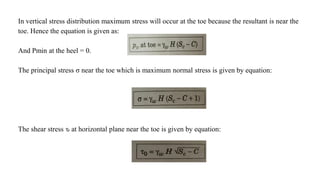
In vertical stress distribution maximum stress will occur at the toe because the resultant is near the
toe. Hence the equation is given as:
And Pmin at the heel = 0.
The principal stress σ near the toe which is maximum normal stress is given by equation:
The shear stress ԏ at horizontal plane near the toe is given by equation:
Design considerations and fixing the section of dam:
1. Freeboard:
The margin between the maximum reservoir level and top of the dam is known as freeboard.
This must be provided in order to to avoid the possibility of water spilling over the dam top due to
wave action. This can also help as a safety for unforeseen floods higher than the designed flood.
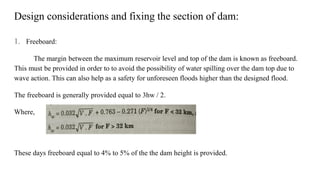
The freeboard is generally provided equal to 3hw / 2.
Where,
These days freeboard equal to 4% to 5% of the the dam height is provided.
2. Top width:
The effects produced by the addition of of top width at the apex of elementary dam profile and their
remedies are explaind below:
Let AEF with the triangular profile of dam of height H1.
Let element ABQA be added at the apex for providing top width ‘a’ for road construction.
Let M1 and M2 be the inner third and outer third points on base. Thus AM1 and AM2 are the inner
third and outer third lines.
The weight of element W1 will act through the CG of
this triangle i.e. along CM.
Let CM and AM1 cross at H, and CM and AM2 cross at
K.
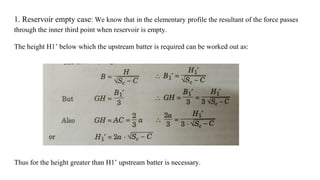
1. Reservoir empty case: We know that in the elementary profile the resultant of the force passes
through the inner third point when reservoir is empty.
The height H1’ below which the upstream batter is required can be worked out as:
Thus for the height greater than H1’ upstream batter is necessary.
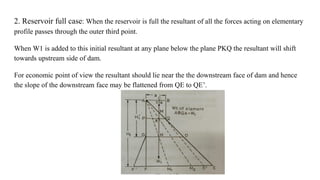
2. Reservoir full case: When the reservoir is full the resultant of all the forces acting on elementary
profile passes through the outer third point.
When W1 is added to this initial resultant at any plane below the plane PKQ the resultant will shift
towards upstream side of dam.
For economic point of view the resultant should lie near the the downstream face of dam and hence
the slope of the downstream face may be flattened from QE to QE’.
Thus an increase in top width will increase the masonry or concrete in the added element and increase
it on upstream face, but shall reduce it on downstream face.
The most economical top width without considering earthquake forces has been found by Creager to
be equal to 14% of the dam height.
It's useful value varies between 6m to 10m and is generally taken approximately equal to √H, where
H is the height of maximum water level above the bed.
Diversion problem in dam construction -
Before the actual construction of dam can start in a river channel the water of river channel must be
temporarily diverted.
It is advantageous to schedule the construction of lower portion of the dam during normal periods of
low flow so as to minimize the diversion problem. The diversion of river water can be accomplished
in following two ways:
1. Provision of a Diversion tunnel
2. By constructing the dam in two stages.
Construction of gravity dams:
1. Diversion before construction 2. Cracking of concrete in dam
3. Joints in dam 4. Foundation treatment.
5. Construction of galleries in dam
Provision of a Diversion tunnel:
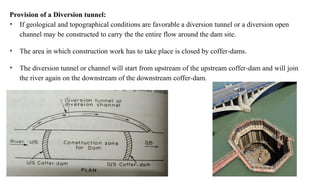
• If geological and topographical conditions are favorable a diversion tunnel or a diversion open
channel may be constructed to carry the the entire flow around the dam site.
• The area in which construction work has to take place is closed by coffer-dams.
• The diversion tunnel or channel will start from upstream of the upstream coffer-dam and will join
the river again on the downstream of the downstream coffer-dam.
By constructing the dam in two stages:
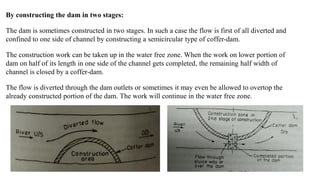
The dam is sometimes constructed in two stages. In such a case the flow is first of all diverted and
confined to one side of channel by constructing a semicircular type of coffer-dam.
The construction work can be taken up in the water free zone. When the work on lower portion of
dam on half of its length in one side of the channel gets completed, the remaining half width of
channel is closed by a coffer-dam.
The flow is diverted through the dam outlets or sometimes it may even be allowed to overtop the
already constructed portion of the dam. The work will continue in the water free zone.
Thank You.

construction of gravity dams

  • 1.
    Construction of GravityDams Asst Prof: Mitali Shelke St. John College of Engineering and Management, Palghar Department of Civil Engineering
  • 2.
    Elementary profile ofgravity dam: The elementary profile of a dam subjected only to external water pressure on upstream side will be right angle triangle having zero width at the water level and base width B at bottom.
  • 3.
    When the reservoiris empty the only single force acting on it is self weight W of the dam and it acts at a distance B/3 from the heel. The vertical stress distribution at the base when the reservoir is empty is given as The maximum vertical stress equal to 2W/B will act at heel and the vertical stress at toe will be 0.
  • 4.
    When the reservoiris full the base width his governed by: 1. The resultant of all forces that is P, W and U passes through the outermost middle third point. 2. The dam is safe in sliding. For the first condition to be satisfied the equation should be given by Where Sc= specific gravity of concrete i.e. material of the dam. C = constant called as seepage coefficient According to USBR recommendation value of C is equal to 1 in calculation and 0 when no uplift is considered.
  • 5.
    If B istaken equal to or greater than H/√(Sc-C) no tension will be developed at the heel with full reservoir, when C = 1 If uplift pressure is not considered,
  • 6.
    For second conditionto be satisfied (the dam is safe in sliding) the frictional resistance should be equal to or more than the horizontal forces Equation can be given as: From the above two equations of B the greater value should be chosen for design purpose.
  • 7.
    In vertical stressdistribution maximum stress will occur at the toe because the resultant is near the toe. Hence the equation is given as: And Pmin at the heel = 0. The principal stress σ near the toe which is maximum normal stress is given by equation: The shear stress ԏ at horizontal plane near the toe is given by equation:
  • 8.
    Design considerations andfixing the section of dam: 1. Freeboard: The margin between the maximum reservoir level and top of the dam is known as freeboard. This must be provided in order to to avoid the possibility of water spilling over the dam top due to wave action. This can also help as a safety for unforeseen floods higher than the designed flood. The freeboard is generally provided equal to 3hw / 2. Where, These days freeboard equal to 4% to 5% of the the dam height is provided.
  • 9.
    2. Top width: Theeffects produced by the addition of of top width at the apex of elementary dam profile and their remedies are explaind below: Let AEF with the triangular profile of dam of height H1. Let element ABQA be added at the apex for providing top width ‘a’ for road construction. Let M1 and M2 be the inner third and outer third points on base. Thus AM1 and AM2 are the inner third and outer third lines. The weight of element W1 will act through the CG of this triangle i.e. along CM. Let CM and AM1 cross at H, and CM and AM2 cross at K.
  • 10.
    1. Reservoir emptycase: We know that in the elementary profile the resultant of the force passes through the inner third point when reservoir is empty. The height H1’ below which the upstream batter is required can be worked out as: Thus for the height greater than H1’ upstream batter is necessary.
  • 11.
    2. Reservoir fullcase: When the reservoir is full the resultant of all the forces acting on elementary profile passes through the outer third point. When W1 is added to this initial resultant at any plane below the plane PKQ the resultant will shift towards upstream side of dam. For economic point of view the resultant should lie near the the downstream face of dam and hence the slope of the downstream face may be flattened from QE to QE’.
  • 12.
    Thus an increasein top width will increase the masonry or concrete in the added element and increase it on upstream face, but shall reduce it on downstream face. The most economical top width without considering earthquake forces has been found by Creager to be equal to 14% of the dam height. It's useful value varies between 6m to 10m and is generally taken approximately equal to √H, where H is the height of maximum water level above the bed.
  • 13.
    Diversion problem indam construction - Before the actual construction of dam can start in a river channel the water of river channel must be temporarily diverted. It is advantageous to schedule the construction of lower portion of the dam during normal periods of low flow so as to minimize the diversion problem. The diversion of river water can be accomplished in following two ways: 1. Provision of a Diversion tunnel 2. By constructing the dam in two stages. Construction of gravity dams: 1. Diversion before construction 2. Cracking of concrete in dam 3. Joints in dam 4. Foundation treatment. 5. Construction of galleries in dam
  • 14.
    Provision of aDiversion tunnel: • If geological and topographical conditions are favorable a diversion tunnel or a diversion open channel may be constructed to carry the the entire flow around the dam site. • The area in which construction work has to take place is closed by coffer-dams. • The diversion tunnel or channel will start from upstream of the upstream coffer-dam and will join the river again on the downstream of the downstream coffer-dam.
  • 15.
    By constructing thedam in two stages: The dam is sometimes constructed in two stages. In such a case the flow is first of all diverted and confined to one side of channel by constructing a semicircular type of coffer-dam. The construction work can be taken up in the water free zone. When the work on lower portion of dam on half of its length in one side of the channel gets completed, the remaining half width of channel is closed by a coffer-dam. The flow is diverted through the dam outlets or sometimes it may even be allowed to overtop the already constructed portion of the dam. The work will continue in the water free zone.
  • 16.