Metals are versatile housing materials because they can
be shaped in so many ways. They are available in a variety
of natural colors or can be coated for a wider array of
colors and for added protection. Metals are strong,
decorative, and good conductors of heat and electricity.
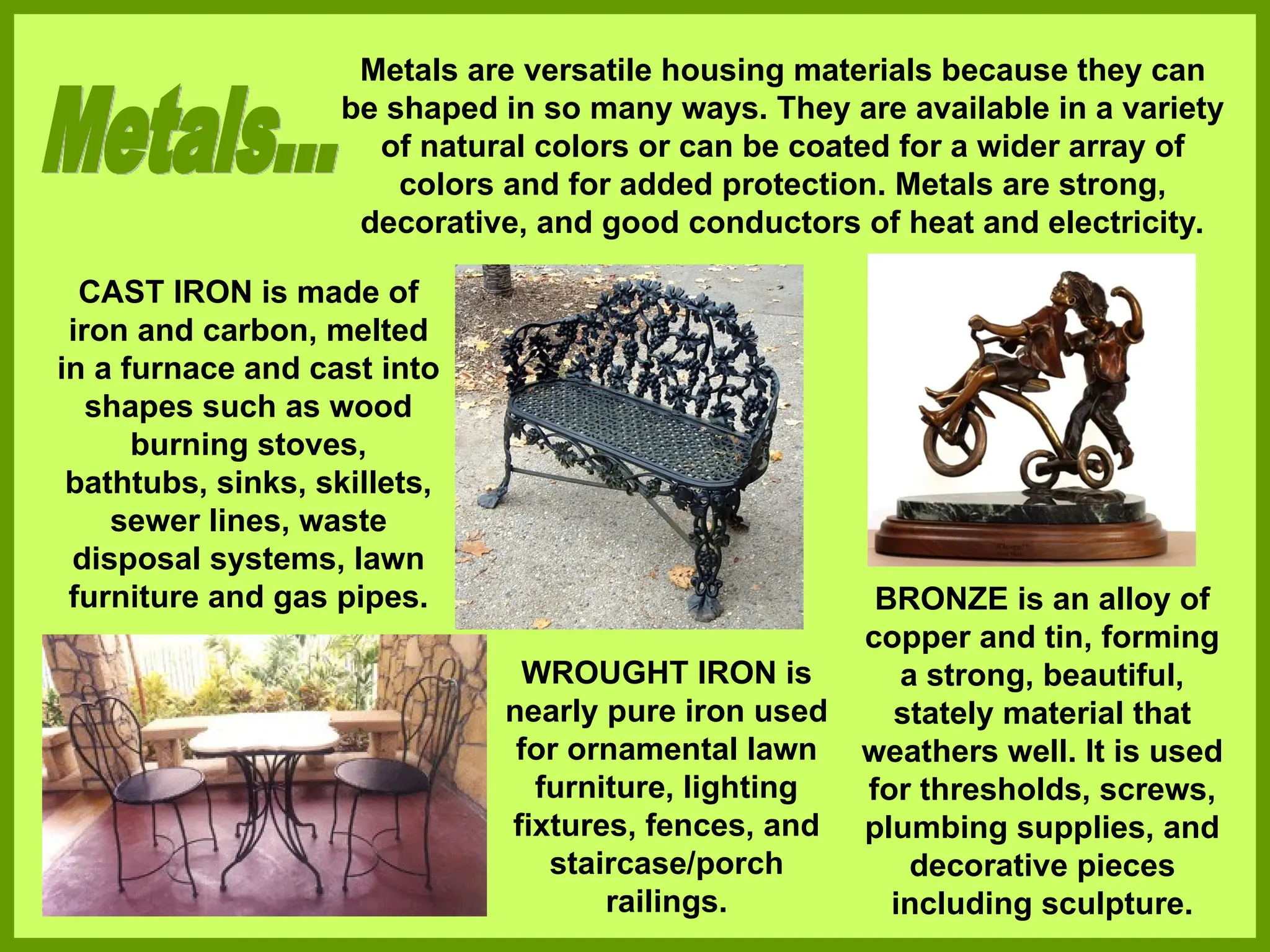
CAST IRON is made of
iron and carbon, melted
in a furnace and cast into
shapes such as wood
burning stoves,
bathtubs, sinks, skillets,
sewer lines, waste
disposal systems, lawn
furniture and gas pipes.
WROUGHT IRON is
nearly pure iron used
for ornamental lawn
furniture, lighting
fixtures, fences, and
staircase/porch
railings.
BRONZE is an alloy of
copper and tin, forming
a strong, beautiful,
stately material that
weathers well. It is used
for thresholds, screws,
plumbing supplies, and
decorative pieces
including sculpture.
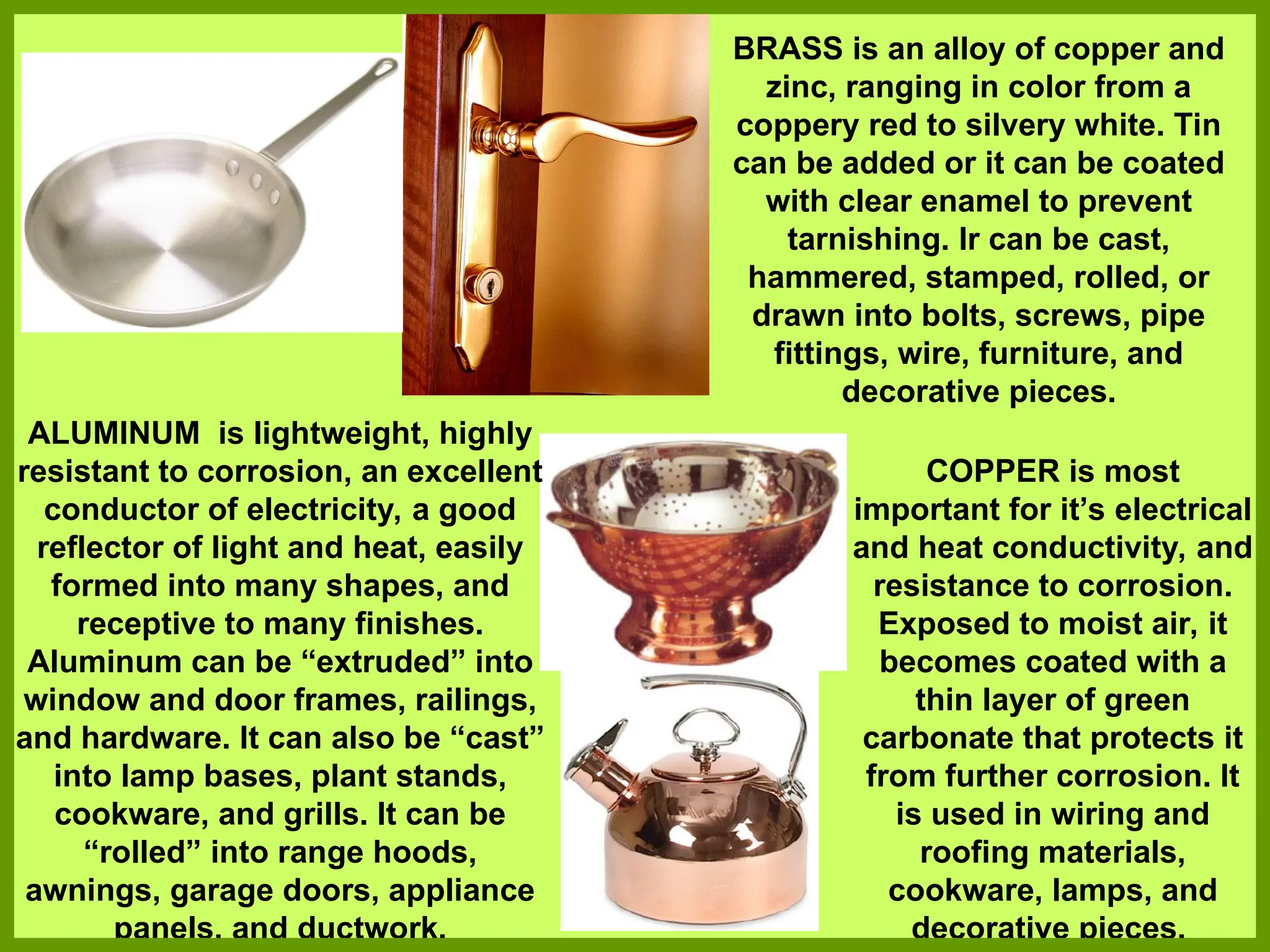
ALUMINUM is lightweight, highly
resistant to corrosion, an excellent
conductor of electricity, a good
reflector of light and heat, easily
formed into many shapes, and
receptive to many finishes.
Aluminum can be ā€œextrudedā€ into
window and door frames, railings,
and hardware. It can also be ā€œcastā€
into lamp bases, plant stands,
cookware, and grills. It can be
ā€œrolledā€ into range hoods,
awnings, garage doors, appliance
panels, and ductwork.
COPPER is most
important for it’s electrical
and heat conductivity, and
resistance to corrosion.
Exposed to moist air, it
becomes coated with a
thin layer of green
carbonate that protects it
from further corrosion. It
is used in wiring and
roofing materials,
cookware, lamps, and
decorative pieces.
BRASS is an alloy of copper and
zinc, ranging in color from a
coppery red to silvery white. Tin
can be added or it can be coated
with clear enamel to prevent
tarnishing. Ir can be cast,
hammered, stamped, rolled, or
drawn into bolts, screws, pipe
fittings, wire, furniture, and
decorative pieces.
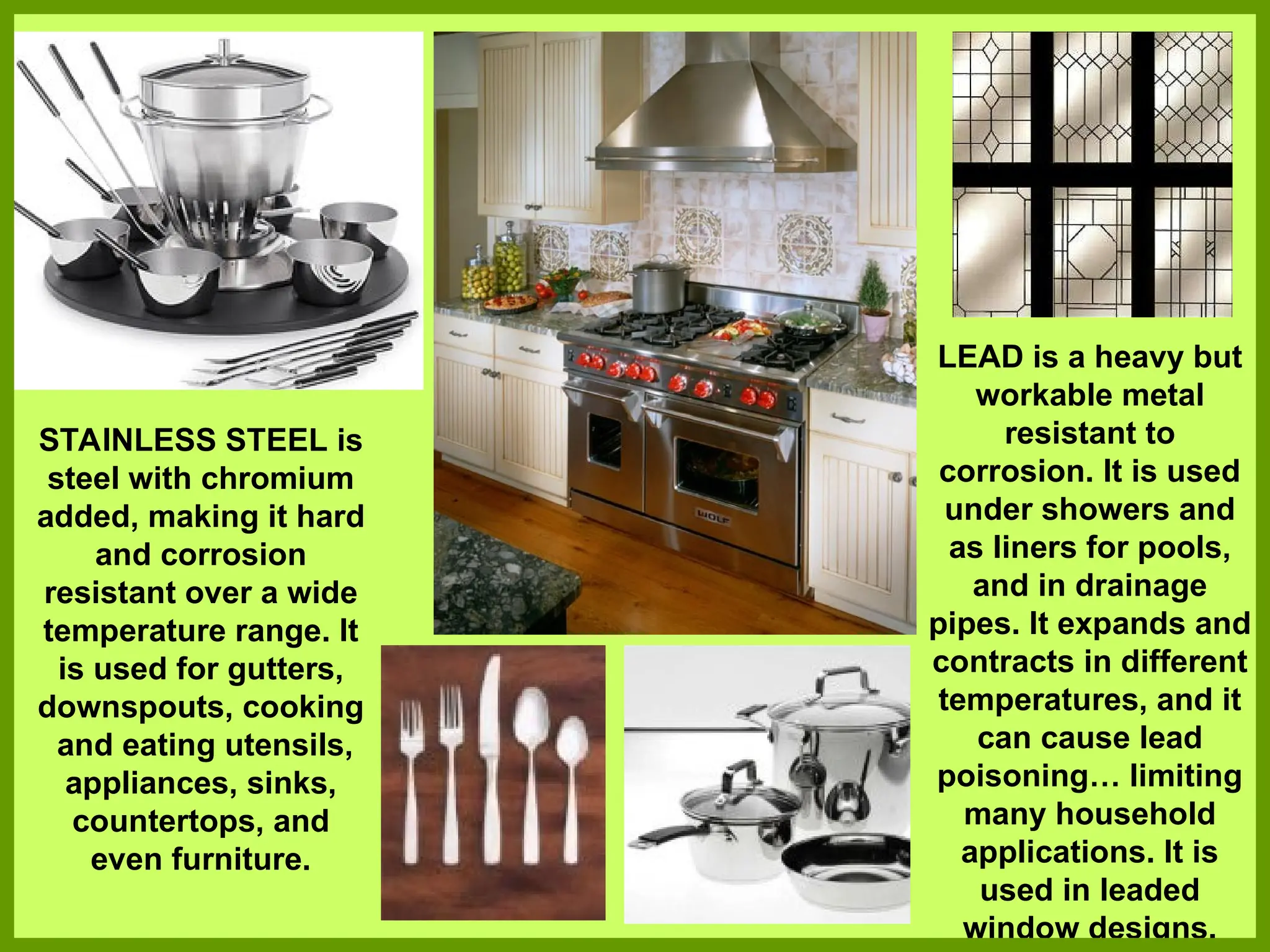
STAINLESS STEEL is
steel with chromium
added, making it hard
and corrosion
resistant over a wide
temperature range. It
is used for gutters,
downspouts, cooking
and eating utensils,
appliances, sinks,
countertops, and
even furniture.
LEAD is a heavy but
workable metal
resistant to
corrosion. It is used
under showers and
as liners for pools,
and in drainage
pipes. It expands and
contracts in different
temperatures, and it
can cause lead
poisoning… limiting
many household
applications. It is
used in leaded
window designs.
Glass is the only housing construction material that
allows the passage of light and permits a clear view.
It does not conduct electricity and is almost
completely corrosion resistant.
The ā€œtensile strengthā€ of glass
refers to the amount of force that
glass can withstand without
breaking. Tensile strength can be
increased by increasing
thickness or by applying certain
production techniques. It is
decreased by scratches,
imperfections, and rapid
temperature changes.
Float glass is a flat glass, less
expensive and better quality than
sheet glass or plate glass. It is
distortion-free, can be made in
various strengths and thicknesses,
and in very large sheets. It can be
tinted to reduce heat transmission
and glare.
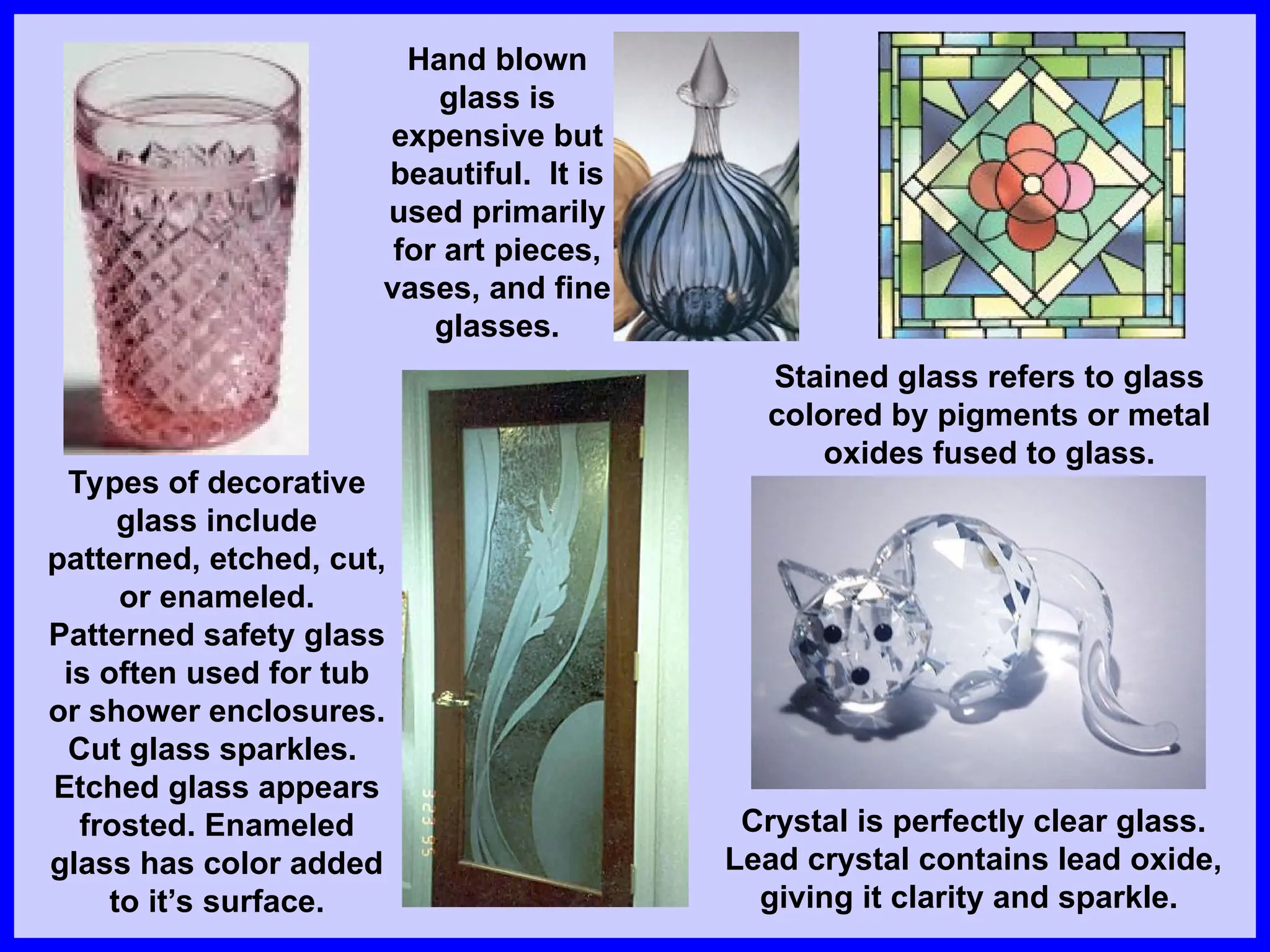
Types of decorative
glass include
patterned, etched, cut,
or enameled.
Patterned safety glass
is often used for tub
or shower enclosures.
Cut glass sparkles.
Etched glass appears
frosted. Enameled
glass has color added
to it’s surface.
Hand blown
glass is
expensive but
beautiful. It is
used primarily
for art pieces,
vases, and fine
glasses.
Stained glass refers to glass
colored by pigments or metal
oxides fused to glass.
Crystal is perfectly clear glass.
Lead crystal contains lead oxide,
giving it clarity and sparkle.
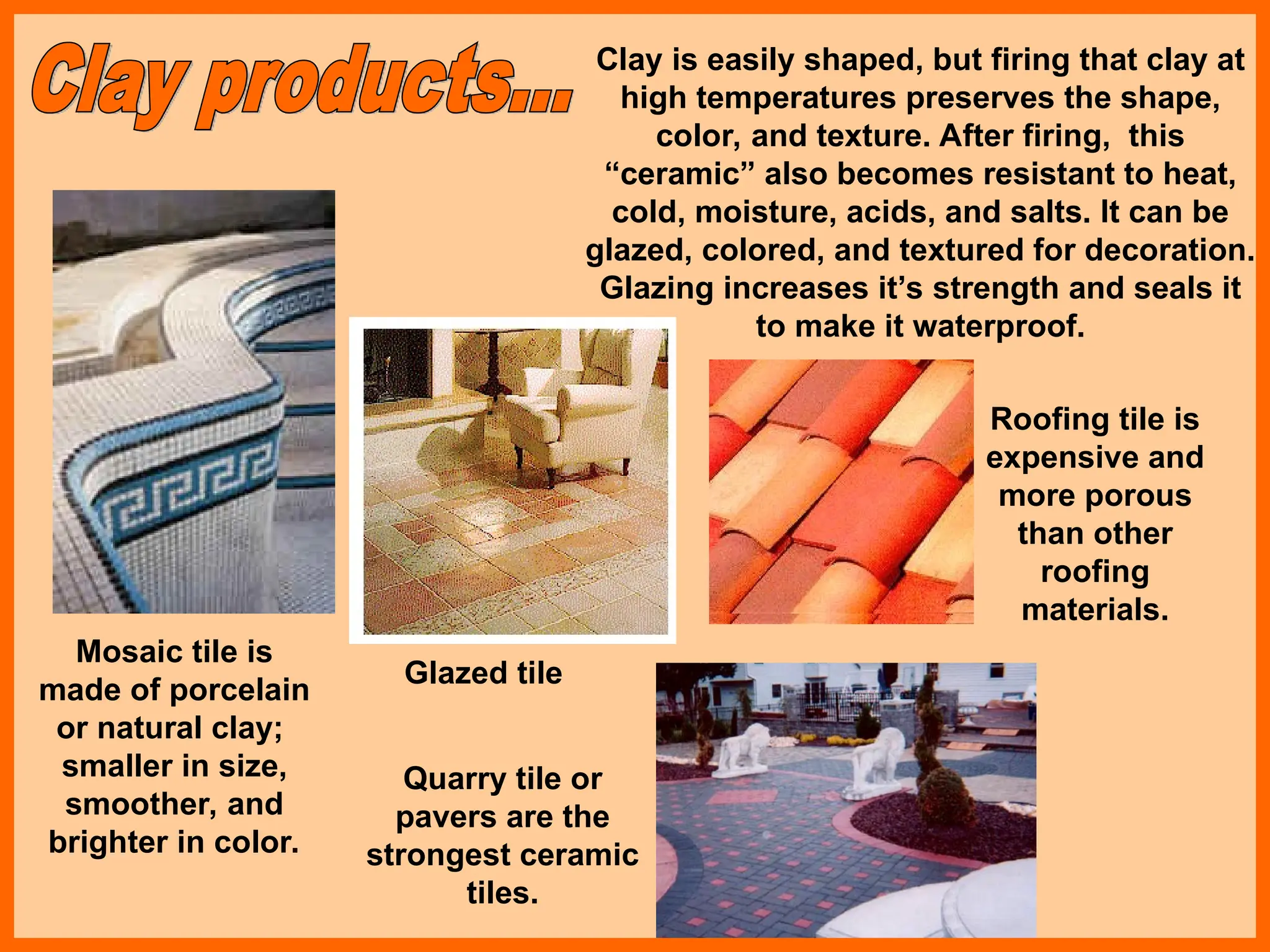
Clay is easily shaped, but firing that clay at
high temperatures preserves the shape,
color, and texture. After firing, this
ā€œceramicā€ also becomes resistant to heat,
cold, moisture, acids, and salts. It can be
glazed, colored, and textured for decoration.
Glazing increases it’s strength and seals it
to make it waterproof.
Mosaic tile is
made of porcelain
or natural clay;
smaller in size,
smoother, and
brighter in color.
Glazed tile
Quarry tile or
pavers are the
strongest ceramic
tiles.
Roofing tile is
expensive and
more porous
than other
roofing
materials.
Pottery refers to ceramic
objects such as dinnerware,
cookware, and vases. There are
three types…
Earthenware products are casual,
porous, fragile, and opaque.
Generally red or brown, it is used for
flower pots, casual dinnerware, and
folk pottery.
Stoneware is made of
finer clay than
earthenware, usually
light brown or gray in
color. It is fired at
higher temperatures,
making it waterproof
and durable. It
accepts subtle colors
with a matte finish.
Porcelain is fired at very
high temperatures to a
white, finely textured finish.
It is completely ā€œvitrifiedā€
(made into glass) and very
hard. It has a delicate
appearance, and is used
for fine dinnerware or for
sinks and bathtubs.
Plastics are usually reasonable in cost, moisture
and corrosion resistant, lightweight, tough, and
easily molded into complex shapes. Plastics are
replacing many natural building materials due to
low maintenance requirements.
Wood is a hard, fibrous substance that forms
the trunk, stems, and branches of trees. It
can be processed to make lumber, plywood,
or other wood products used in construction.
Wood can be generally
classified as either a hardwood
or a softwood. Softwoods are
strong and resilient, but they
do not accept finishes as well
as most hardwoods. They are
most commonly used in
construction. Examples are
cedar, cypress, fir, pine, and
redwood.
Hardwoods tend to be more expensive than softwoods. They resist denting
and scratching better and their surfaces yield smooth finishes with
attractive grain patterns. Hardwoods are most often used for flooring and
furniture. Examples are ash, beech, birch, cherry, elm, mahogany, maple,
oak, poplar, and walnut.
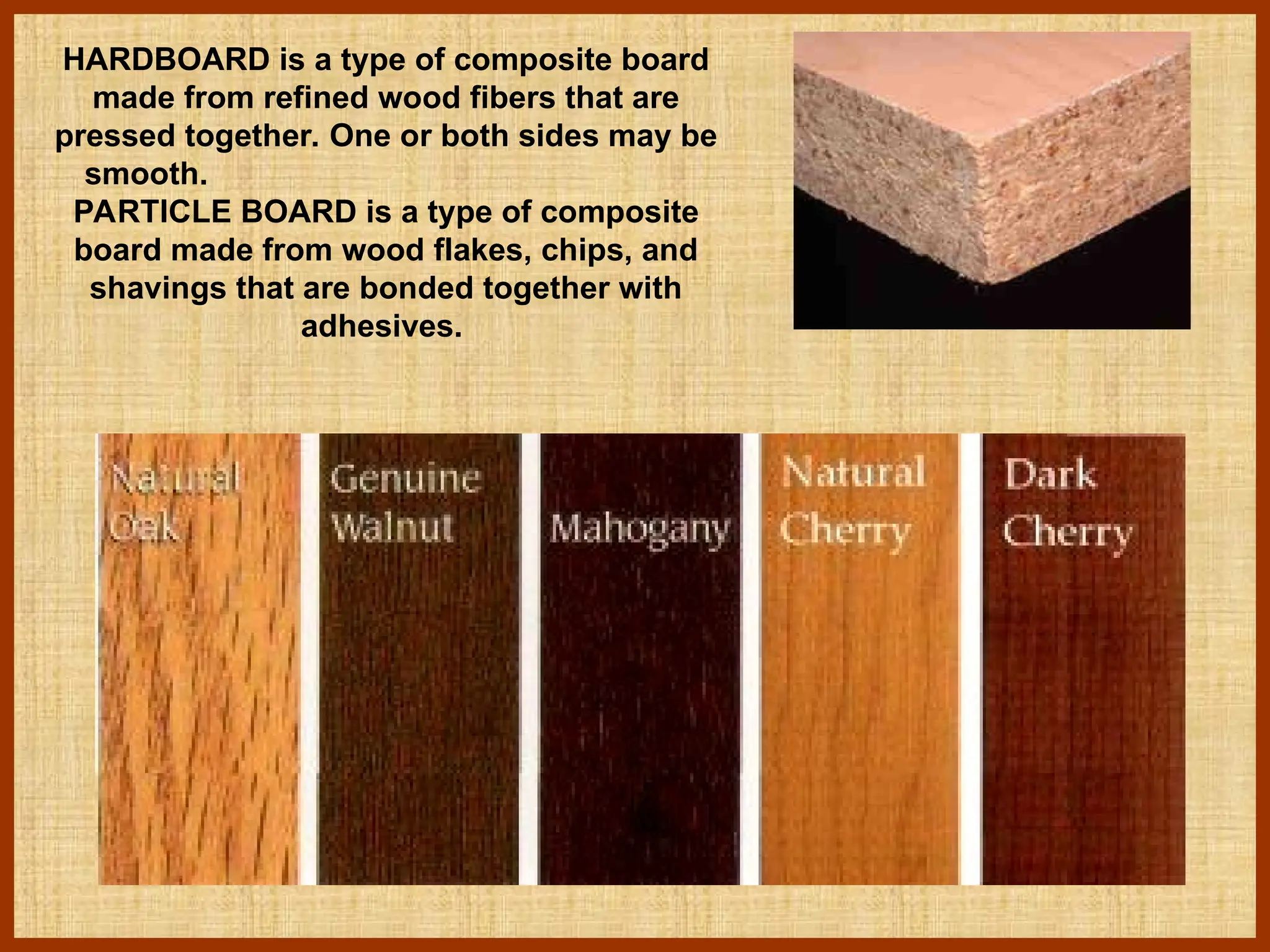
HARDBOARD is a type of composite board
made from refined wood fibers that are
pressed together. One or both sides may be
smooth.
PARTICLE BOARD is a type of composite
board made from wood flakes, chips, and
shavings that are bonded together with
adhesives.
Masonry materials are versatile, durable, and
beautiful. They are more expensive than wood
products, but require less maintenance.
BRICK is fireproof, weather-resistant,
and easy to maintain. It is popular for
fireplaces, chimneys, walls, and floors.
Bricks come in a variety of colors and sizes. Colors vary with
the chemical make up of the clay used to make them and the
time and temperature used to fire them. Mortar is used
between the bricks to bond them together and seal the spaces
between them.
Stone is difficult to work with in building, so is labor
intensive and therefore expensive. It has varied
colors and textures to provide visual interest. It is
fireproof and resistant to decay, and gives a feeling of
permanence and stability.
Types of natural stone
include granite (hard and
durable), sandstone (porous
and prone to dampness, with
poor insulation value) ,
limestone (weathers rapidly in
humid climates), marble
(expensive and luxurious but
not as durable as granite), and
slate (hard and brittle, made
from compressed clay or
shale). Manufactured stone
(made from lightweight
concrete or fiberglass) and
terrazzo (durable material
made from marble chips
bonded together with cement)
are stone-like materials.
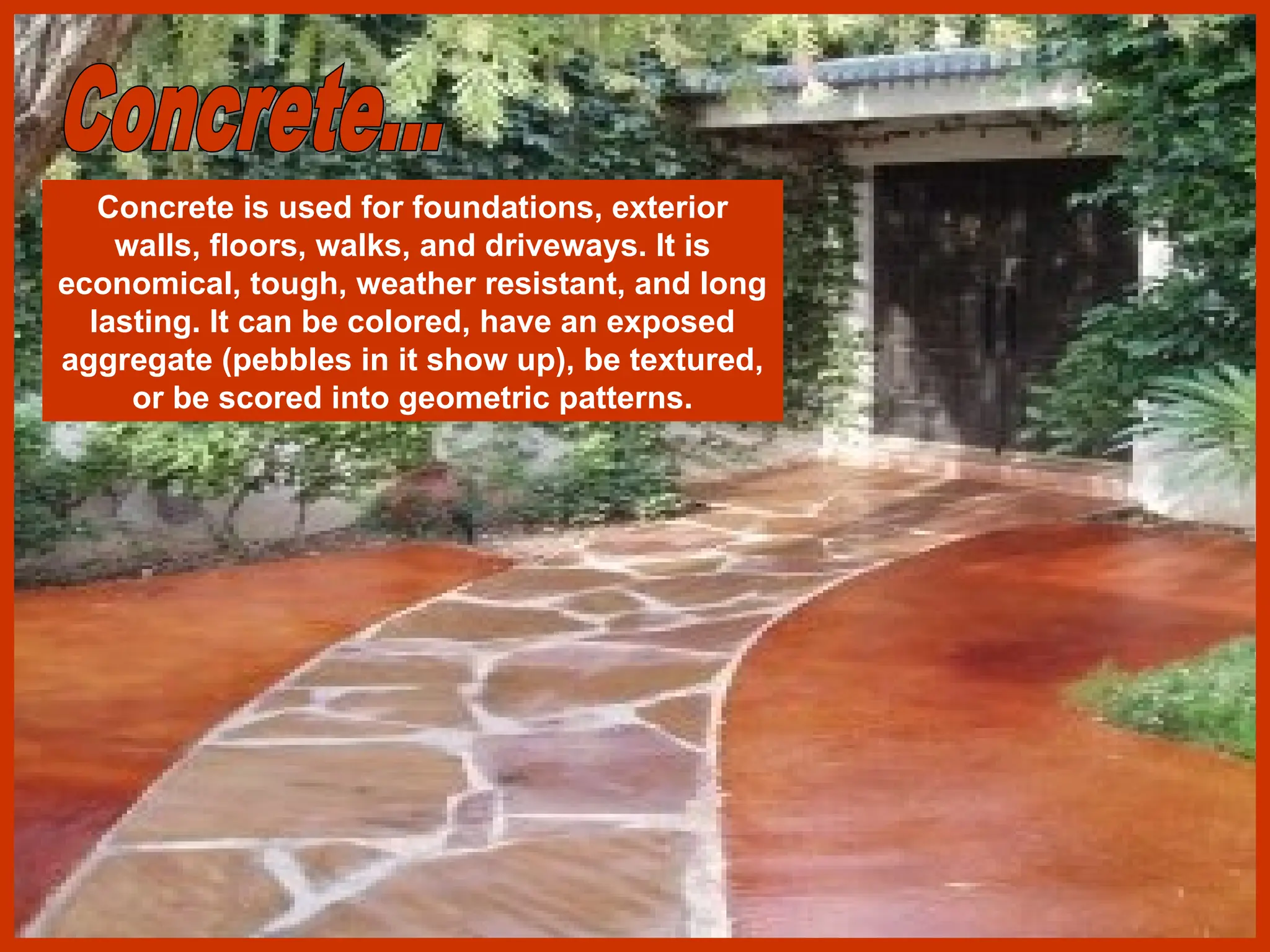
Concrete is used for foundations, exterior
walls, floors, walks, and driveways. It is
economical, tough, weather resistant, and long
lasting. It can be colored, have an exposed
aggregate (pebbles in it show up), be textured,
or be scored into geometric patterns.

Construction Materials.ppt

  • 2.
    Metals are versatilehousing materials because they can be shaped in so many ways. They are available in a variety of natural colors or can be coated for a wider array of colors and for added protection. Metals are strong, decorative, and good conductors of heat and electricity. CAST IRON is made of iron and carbon, melted in a furnace and cast into shapes such as wood burning stoves, bathtubs, sinks, skillets, sewer lines, waste disposal systems, lawn furniture and gas pipes. WROUGHT IRON is nearly pure iron used for ornamental lawn furniture, lighting fixtures, fences, and staircase/porch railings. BRONZE is an alloy of copper and tin, forming a strong, beautiful, stately material that weathers well. It is used for thresholds, screws, plumbing supplies, and decorative pieces including sculpture.
  • 3.
    ALUMINUM is lightweight,highly resistant to corrosion, an excellent conductor of electricity, a good reflector of light and heat, easily formed into many shapes, and receptive to many finishes. Aluminum can be ā€œextrudedā€ into window and door frames, railings, and hardware. It can also be ā€œcastā€ into lamp bases, plant stands, cookware, and grills. It can be ā€œrolledā€ into range hoods, awnings, garage doors, appliance panels, and ductwork. COPPER is most important for it’s electrical and heat conductivity, and resistance to corrosion. Exposed to moist air, it becomes coated with a thin layer of green carbonate that protects it from further corrosion. It is used in wiring and roofing materials, cookware, lamps, and decorative pieces. BRASS is an alloy of copper and zinc, ranging in color from a coppery red to silvery white. Tin can be added or it can be coated with clear enamel to prevent tarnishing. Ir can be cast, hammered, stamped, rolled, or drawn into bolts, screws, pipe fittings, wire, furniture, and decorative pieces.
  • 4.
    STAINLESS STEEL is steelwith chromium added, making it hard and corrosion resistant over a wide temperature range. It is used for gutters, downspouts, cooking and eating utensils, appliances, sinks, countertops, and even furniture. LEAD is a heavy but workable metal resistant to corrosion. It is used under showers and as liners for pools, and in drainage pipes. It expands and contracts in different temperatures, and it can cause lead poisoning… limiting many household applications. It is used in leaded window designs.
  • 5.
    Glass is theonly housing construction material that allows the passage of light and permits a clear view. It does not conduct electricity and is almost completely corrosion resistant. The ā€œtensile strengthā€ of glass refers to the amount of force that glass can withstand without breaking. Tensile strength can be increased by increasing thickness or by applying certain production techniques. It is decreased by scratches, imperfections, and rapid temperature changes. Float glass is a flat glass, less expensive and better quality than sheet glass or plate glass. It is distortion-free, can be made in various strengths and thicknesses, and in very large sheets. It can be tinted to reduce heat transmission and glare.
  • 6.
    Types of decorative glassinclude patterned, etched, cut, or enameled. Patterned safety glass is often used for tub or shower enclosures. Cut glass sparkles. Etched glass appears frosted. Enameled glass has color added to it’s surface. Hand blown glass is expensive but beautiful. It is used primarily for art pieces, vases, and fine glasses. Stained glass refers to glass colored by pigments or metal oxides fused to glass. Crystal is perfectly clear glass. Lead crystal contains lead oxide, giving it clarity and sparkle.
  • 7.
    Clay is easilyshaped, but firing that clay at high temperatures preserves the shape, color, and texture. After firing, this ā€œceramicā€ also becomes resistant to heat, cold, moisture, acids, and salts. It can be glazed, colored, and textured for decoration. Glazing increases it’s strength and seals it to make it waterproof. Mosaic tile is made of porcelain or natural clay; smaller in size, smoother, and brighter in color. Glazed tile Quarry tile or pavers are the strongest ceramic tiles. Roofing tile is expensive and more porous than other roofing materials.
  • 8.
    Pottery refers toceramic objects such as dinnerware, cookware, and vases. There are three types… Earthenware products are casual, porous, fragile, and opaque. Generally red or brown, it is used for flower pots, casual dinnerware, and folk pottery. Stoneware is made of finer clay than earthenware, usually light brown or gray in color. It is fired at higher temperatures, making it waterproof and durable. It accepts subtle colors with a matte finish. Porcelain is fired at very high temperatures to a white, finely textured finish. It is completely ā€œvitrifiedā€ (made into glass) and very hard. It has a delicate appearance, and is used for fine dinnerware or for sinks and bathtubs.
  • 9.
    Plastics are usuallyreasonable in cost, moisture and corrosion resistant, lightweight, tough, and easily molded into complex shapes. Plastics are replacing many natural building materials due to low maintenance requirements.
  • 10.
    Wood is ahard, fibrous substance that forms the trunk, stems, and branches of trees. It can be processed to make lumber, plywood, or other wood products used in construction. Wood can be generally classified as either a hardwood or a softwood. Softwoods are strong and resilient, but they do not accept finishes as well as most hardwoods. They are most commonly used in construction. Examples are cedar, cypress, fir, pine, and redwood. Hardwoods tend to be more expensive than softwoods. They resist denting and scratching better and their surfaces yield smooth finishes with attractive grain patterns. Hardwoods are most often used for flooring and furniture. Examples are ash, beech, birch, cherry, elm, mahogany, maple, oak, poplar, and walnut.
  • 11.
    HARDBOARD is atype of composite board made from refined wood fibers that are pressed together. One or both sides may be smooth. PARTICLE BOARD is a type of composite board made from wood flakes, chips, and shavings that are bonded together with adhesives.
  • 12.
    Masonry materials areversatile, durable, and beautiful. They are more expensive than wood products, but require less maintenance. BRICK is fireproof, weather-resistant, and easy to maintain. It is popular for fireplaces, chimneys, walls, and floors. Bricks come in a variety of colors and sizes. Colors vary with the chemical make up of the clay used to make them and the time and temperature used to fire them. Mortar is used between the bricks to bond them together and seal the spaces between them.
  • 13.
    Stone is difficultto work with in building, so is labor intensive and therefore expensive. It has varied colors and textures to provide visual interest. It is fireproof and resistant to decay, and gives a feeling of permanence and stability. Types of natural stone include granite (hard and durable), sandstone (porous and prone to dampness, with poor insulation value) , limestone (weathers rapidly in humid climates), marble (expensive and luxurious but not as durable as granite), and slate (hard and brittle, made from compressed clay or shale). Manufactured stone (made from lightweight concrete or fiberglass) and terrazzo (durable material made from marble chips bonded together with cement) are stone-like materials.
  • 14.
    Concrete is usedfor foundations, exterior walls, floors, walks, and driveways. It is economical, tough, weather resistant, and long lasting. It can be colored, have an exposed aggregate (pebbles in it show up), be textured, or be scored into geometric patterns.