Construction
Materials
Construction Materials
◆ Identify the basic components of
concrete
◆ Explain different types of
masonry brick, block, and mortar
◆ Classify wood as hardwood or
softwood
Learning Objectives
Construction Materials
◆ Describe various types of glass,
plastic, and insulation
◆ Identify symbols representing
materials on a drawing
Learning Objectives continued
◆ Recognize different structural
steel shapes
Concrete
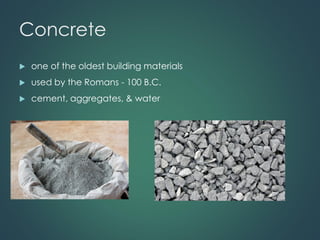
 one of the oldest building materials
 used by the Romans - 100 B.C.
 cement, aggregates, & water
Concrete
 hardening caused by chemical reaction between the cement
when water is added
 set in 2 - 12 hours
 held in place by forms
Types of Cement
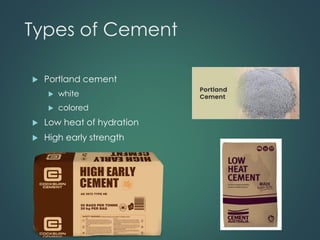
 Portland cement
 white
 colored
 Low heat of hydration
 High early strength
CEMENT TYPES
ASTM C 150
 TYPE I
 TYPE II
 TYPE III
 TYPE IV
 TYPE V
normal cement
moderate sulfate resistance
high early strength
low heat of hydration
high sulfate resistance
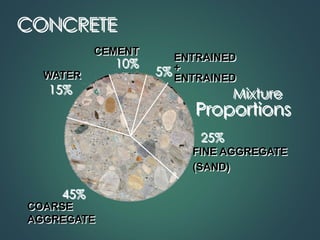
CONCRETE
45%
25%
5%
10%
15%
Proportions
COARSE
AGGREGATE
CEMENT
FINE AGGREGATE
(SAND)
WATER
Mixture
ENTRAINED
+
ENTRAINED
Concrete Mixes
 produced to meet a desired result
 mixed by volume with enough water to make the
concrete flow into the forms
 too much water will reduce the strength of the concrete
 water / cement - w/c ratio
Reinforced Concrete
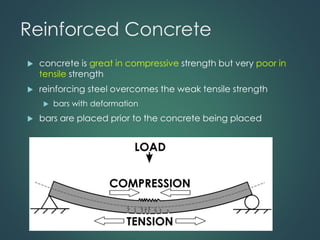
 concrete is great in compressive strength but very poor in
tensile strength
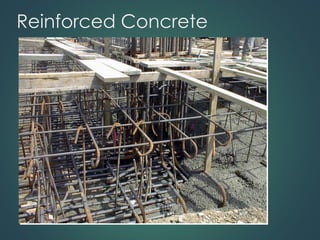
 reinforcing steel overcomes the weak tensile strength
 bars with deformation
 bars are placed prior to the concrete being placed
Reinforced Concrete
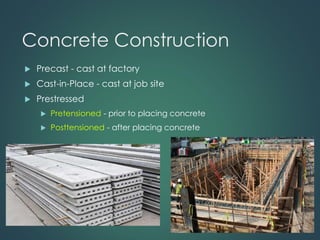
Concrete Construction
 Precast - cast at factory
 Cast-in-Place - cast at job site
 Prestressed
 Pretensioned - prior to placing concrete
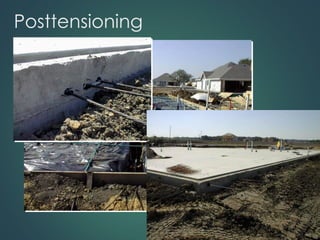
 Posttensioned - after placing concrete
Posttensioning
Masonry
 building modular units
 brick
 tile
 glass
 gypsum
 stone - not always modular
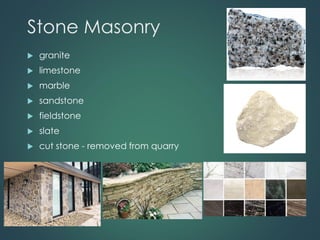
Stone Masonry
 granite
 limestone
 marble
 sandstone
 fieldstone
 slate
 cut stone - removed from quarry
Brick Masonry
 adobe
 kiln-burned
 sand-lime
 concrete
 building brick
 face brick
 glazed brick
 fire brick
 paving brick
Mortar
 Type M
 high compressive good durability
 Type S
 high strength, strong bond
 Type N
 medium strength, general use
 Type O
 low strength, interior use
 Type K
 very low strength, interior use
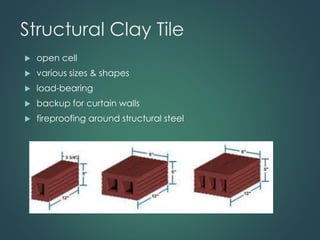
Structural Clay Tile
 open cell
 various sizes & shapes
 load-bearing
 backup for curtain walls
 fireproofing around structural steel
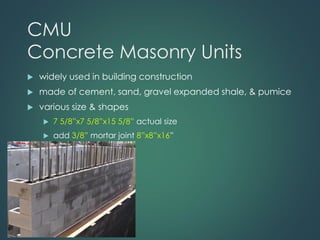
CMU
Concrete Masonry Units
 widely used in building construction
 made of cement, sand, gravel expanded shale, & pumice
 various size & shapes
 7 5/8”x7 5/8”x15 5/8” actual size
 add 3/8” mortar joint 8”x8”x16”
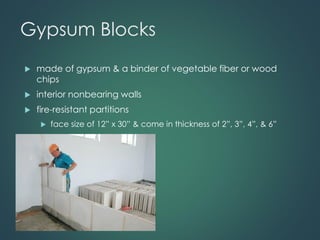
Gypsum Blocks
 made of gypsum & a binder of vegetable fiber or wood
chips
 interior nonbearing walls
 fire-resistant partitions
 face size of 12” x 30” & come in thickness of 2”, 3”, 4”, & 6”
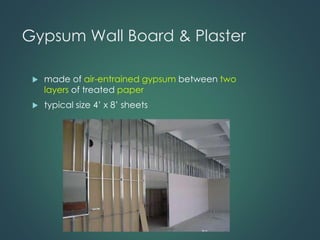
Gypsum Wall Board & Plaster
 made of air-entrained gypsum between two
layers of treated paper
 typical size 4’ x 8’ sheets
Wood Products
 chief building material used today
 wood classifications
 hardwoods
 softwoods
Hardwoods
 ash
 ash-white
 beech
 birch
 cherry
 elm
 gum
◆ hickory
◆ mahogany
◆ maple
◆ oak
◆ walnut
Softwoods
◆ cypress
◆ fir, douglas
◆ fir, white
◆ hemlock
◆ pine,
ponderosa
◆ pine, southern
◆ pine, white
◆ poplar, yellow
◆ red cedar, eastern
◆ red cedar, western
◆ redwood
◆ spruce
Lumber
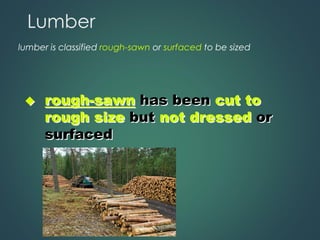
lumber is classified rough-sawn or surfaced to be sized
◆ rough-sawn has been cut to
rough size but not dressed or
surfaced
Lumber continued
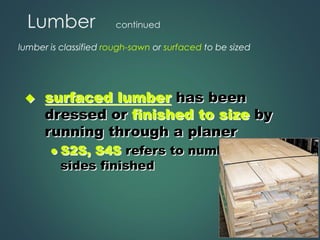
lumber is classified rough-sawn or surfaced to be sized
◆ surfaced lumber has been
dressed or finished to size by
running through a planer
⚫ S2S, S4S refers to number of
sides finished
Plywood
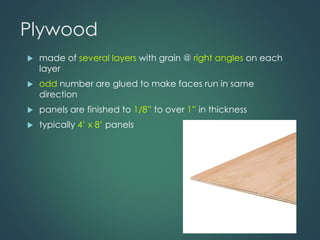
 made of several layers with grain @ right angles on each
layer
 odd number are glued to make faces run in same
direction
 panels are finished to 1/8” to over 1” in thickness
 typically 4’ x 8’ panels
Plywood
 interior plywood
 water-resistant glue
 cabinets, interior flooring
 exterior plywood
 waterproof glue
 exterior wall sheathing
 roof sheathing
 concrete forms
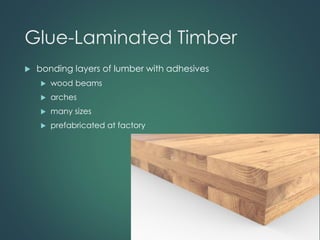
Glue-Laminated Timber
 bonding layers of lumber with adhesives
 wood beams
 arches
 many sizes
 prefabricated at factory
Metal Products
 used extensively in construction
 structural steel
 metal windows
 doors
 metal studs
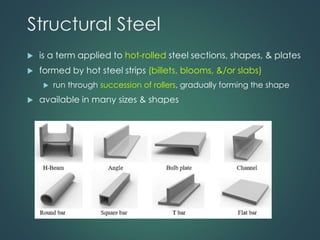
Structural Steel
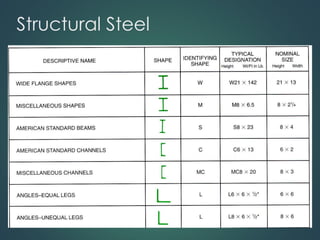
 is a term applied to hot-rolled steel sections, shapes, & plates
 formed by hot steel strips (billets, blooms, &/or slabs)
 run through succession of rollers, gradually forming the shape
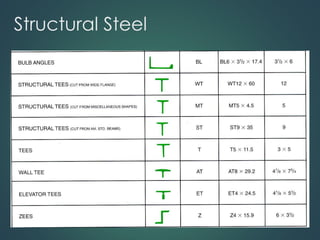
 available in many sizes & shapes
Structural Steel
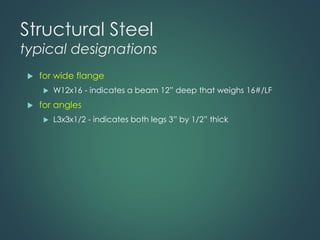
typical designations
 for wide flange
 W12x16 - indicates a beam 12” deep that weighs 16#/LF
 for angles
 L3x3x1/2 - indicates both legs 3” by 1/2” thick
Structural Steel
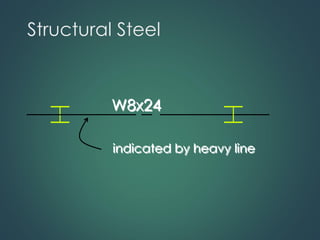
W8x24
indicated by heavy line
Structural Steel
Structural Steel
Welded Wire Fabric
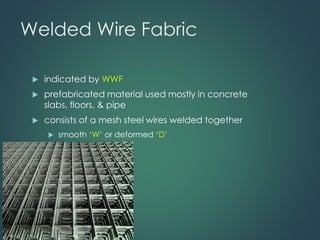
 indicated by WWF
 prefabricated material used mostly in concrete
slabs, floors, & pipe
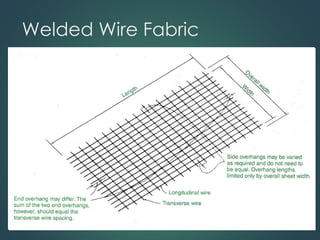
 consists of a mesh steel wires welded together
 smooth ‘W’ or deformed ‘D’
Welded Wire Fabric
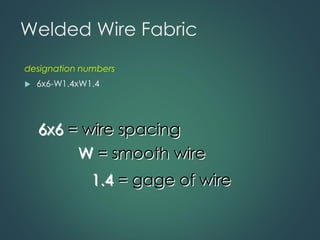
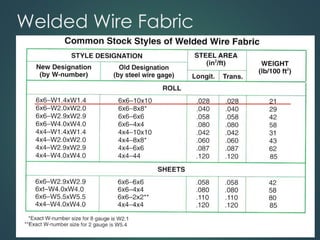
designation numbers
 6x6-W1.4xW1.4
6x6 = wire spacing
W = smooth wire
1.4 = gage of wire
Welded Wire Fabric
Welded Wire Fabric
Glass
 ceramic material formed at temperatures above 2300ºF
 made from sand (silica) soda (sodium oxide) and lime (calcium
oxide)
Glass
float glass
 continuous ribbon of molten glass flows out of furnace
 and floats on a bath of molten tin
 fire polished & annealed
 90% of the glass is float
Glass
 sheet glass - window glass
 SS - single strength 3/32” or 1/8”
 DS - double strength 3/16” - 7/16”
 plate glass - heat treated & polished
 bent glass - heated and pressed over a form
Glass
safety glass
 tempered glass - heat annealed glass to near melting
point & then chill rapidly …
 creating high compression on the exterior surface & high
tension internally
 shatters into small pieces
 can not be cut, drilled, or ground
Glass
safety glass
 laminated glass - consist of layers of vinyl between sheets
of glass. . .bonded by heat & pressure
 the glass when struck & broken is held together by the plastic
Glass
safety glass
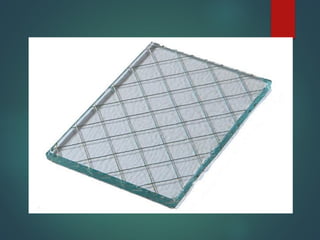
◆ wire glass - wire mesh molded
into the center
⚫ when broken the wire holds the
glass together
⚫ can be obtained with etched
finish, sandblasted, or patterned
Glass
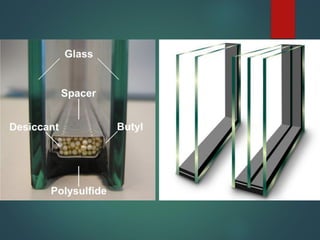
◆ insulated glass - glass
separated by an air space that
is dehydrated & sealed.
⚫ good insulators against heat or
cold
Glass
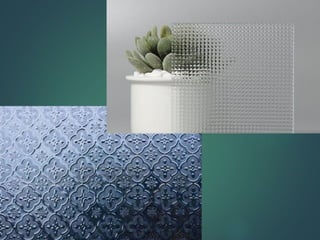
◆ patterned glass - sheet glass
with pattern rolled into one or
both sides
⚫ used to diffuse light or provide
privacy
Glass
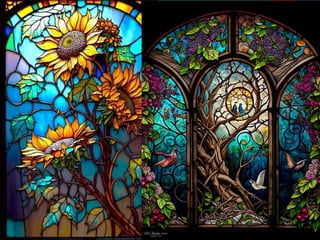
◆ stained glass - sometimes
called art or cathedral glass
◆ produced by adding metallic
oxides to the glass while in its
molten state
⚫ cut to design & leaded together to
create stained glass windows
Ceramic Tile
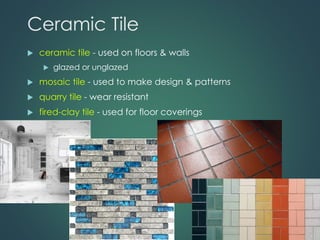
 ceramic tile - used on floors & walls
 glazed or unglazed
 mosaic tile - used to make design & patterns
 quarry tile - wear resistant
 fired-clay tile - used for floor coverings
Ceramic Tile
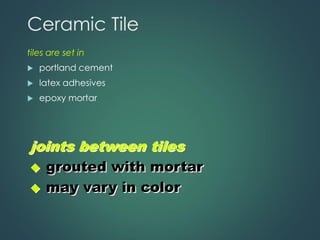
tiles are set in
 portland cement
 latex adhesives
 epoxy mortar
joints between tiles
◆ grouted with mortar
◆ may vary in color
Plastics
 have many uses
 counter tops
 door veneer
 texture on surfaces
 gutters
 pipes
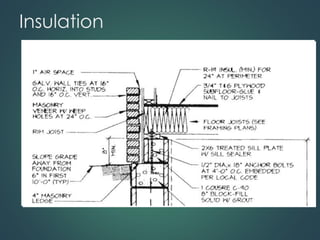
Insulation
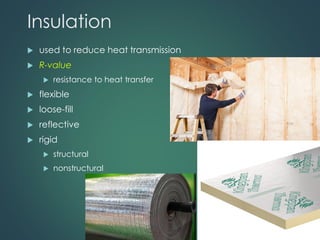
 used to reduce heat transmission
 R-value
 resistance to heat transfer
 flexible
 loose-fill
 reflective
 rigid
 structural
 nonstructural
Insulation
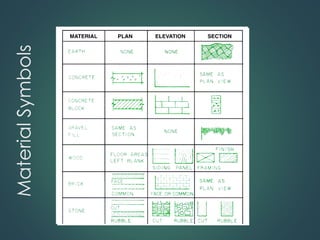
Material
Symbols
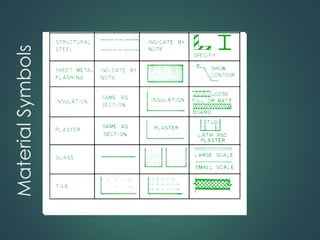
Material
Symbols
Thank you!

introduction to building materials.pdf

  • 1.
  • 2.
    Construction Materials ◆ Identifythe basic components of concrete ◆ Explain different types of masonry brick, block, and mortar ◆ Classify wood as hardwood or softwood Learning Objectives
  • 3.
    Construction Materials ◆ Describevarious types of glass, plastic, and insulation ◆ Identify symbols representing materials on a drawing Learning Objectives continued ◆ Recognize different structural steel shapes
  • 4.
    Concrete  one ofthe oldest building materials  used by the Romans - 100 B.C.  cement, aggregates, & water
  • 5.
    Concrete  hardening causedby chemical reaction between the cement when water is added  set in 2 - 12 hours  held in place by forms
  • 6.
    Types of Cement Portland cement  white  colored  Low heat of hydration  High early strength
  • 7.
    CEMENT TYPES ASTM C150  TYPE I  TYPE II  TYPE III  TYPE IV  TYPE V normal cement moderate sulfate resistance high early strength low heat of hydration high sulfate resistance
  • 8.
  • 9.
    Concrete Mixes  producedto meet a desired result  mixed by volume with enough water to make the concrete flow into the forms  too much water will reduce the strength of the concrete  water / cement - w/c ratio
  • 10.
    Reinforced Concrete  concreteis great in compressive strength but very poor in tensile strength  reinforcing steel overcomes the weak tensile strength  bars with deformation  bars are placed prior to the concrete being placed
  • 11.
  • 12.
    Concrete Construction  Precast- cast at factory  Cast-in-Place - cast at job site  Prestressed  Pretensioned - prior to placing concrete  Posttensioned - after placing concrete
  • 13.
  • 14.
    Masonry  building modularunits  brick  tile  glass  gypsum  stone - not always modular
  • 15.
    Stone Masonry  granite limestone  marble  sandstone  fieldstone  slate  cut stone - removed from quarry
  • 16.
    Brick Masonry  adobe kiln-burned  sand-lime  concrete  building brick  face brick  glazed brick  fire brick  paving brick
  • 17.
    Mortar  Type M high compressive good durability  Type S  high strength, strong bond  Type N  medium strength, general use  Type O  low strength, interior use  Type K  very low strength, interior use
  • 18.
    Structural Clay Tile open cell  various sizes & shapes  load-bearing  backup for curtain walls  fireproofing around structural steel
  • 19.
    CMU Concrete Masonry Units widely used in building construction  made of cement, sand, gravel expanded shale, & pumice  various size & shapes  7 5/8”x7 5/8”x15 5/8” actual size  add 3/8” mortar joint 8”x8”x16”
  • 20.
    Gypsum Blocks  madeof gypsum & a binder of vegetable fiber or wood chips  interior nonbearing walls  fire-resistant partitions  face size of 12” x 30” & come in thickness of 2”, 3”, 4”, & 6”
  • 21.
    Gypsum Wall Board& Plaster  made of air-entrained gypsum between two layers of treated paper  typical size 4’ x 8’ sheets
  • 22.
    Wood Products  chiefbuilding material used today  wood classifications  hardwoods  softwoods
  • 23.
    Hardwoods  ash  ash-white beech  birch  cherry  elm  gum ◆ hickory ◆ mahogany ◆ maple ◆ oak ◆ walnut
  • 24.
    Softwoods ◆ cypress ◆ fir,douglas ◆ fir, white ◆ hemlock ◆ pine, ponderosa ◆ pine, southern ◆ pine, white ◆ poplar, yellow ◆ red cedar, eastern ◆ red cedar, western ◆ redwood ◆ spruce
  • 25.
    Lumber lumber is classifiedrough-sawn or surfaced to be sized ◆ rough-sawn has been cut to rough size but not dressed or surfaced
  • 26.
    Lumber continued lumber isclassified rough-sawn or surfaced to be sized ◆ surfaced lumber has been dressed or finished to size by running through a planer ⚫ S2S, S4S refers to number of sides finished
  • 27.
    Plywood  made ofseveral layers with grain @ right angles on each layer  odd number are glued to make faces run in same direction  panels are finished to 1/8” to over 1” in thickness  typically 4’ x 8’ panels
  • 28.
    Plywood  interior plywood water-resistant glue  cabinets, interior flooring  exterior plywood  waterproof glue  exterior wall sheathing  roof sheathing  concrete forms
  • 29.
    Glue-Laminated Timber  bondinglayers of lumber with adhesives  wood beams  arches  many sizes  prefabricated at factory
  • 30.
    Metal Products  usedextensively in construction  structural steel  metal windows  doors  metal studs
  • 31.
    Structural Steel  isa term applied to hot-rolled steel sections, shapes, & plates  formed by hot steel strips (billets, blooms, &/or slabs)  run through succession of rollers, gradually forming the shape  available in many sizes & shapes
  • 32.
    Structural Steel typical designations for wide flange  W12x16 - indicates a beam 12” deep that weighs 16#/LF  for angles  L3x3x1/2 - indicates both legs 3” by 1/2” thick
  • 33.
  • 34.
  • 35.
  • 36.
    Welded Wire Fabric indicated by WWF  prefabricated material used mostly in concrete slabs, floors, & pipe  consists of a mesh steel wires welded together  smooth ‘W’ or deformed ‘D’
  • 37.
    Welded Wire Fabric designationnumbers  6x6-W1.4xW1.4 6x6 = wire spacing W = smooth wire 1.4 = gage of wire
  • 38.
  • 39.
  • 40.
    Glass  ceramic materialformed at temperatures above 2300ºF  made from sand (silica) soda (sodium oxide) and lime (calcium oxide)
  • 41.
    Glass float glass  continuousribbon of molten glass flows out of furnace  and floats on a bath of molten tin  fire polished & annealed  90% of the glass is float
  • 42.
    Glass  sheet glass- window glass  SS - single strength 3/32” or 1/8”  DS - double strength 3/16” - 7/16”  plate glass - heat treated & polished  bent glass - heated and pressed over a form
  • 43.
    Glass safety glass  temperedglass - heat annealed glass to near melting point & then chill rapidly …  creating high compression on the exterior surface & high tension internally  shatters into small pieces  can not be cut, drilled, or ground
  • 44.
    Glass safety glass  laminatedglass - consist of layers of vinyl between sheets of glass. . .bonded by heat & pressure  the glass when struck & broken is held together by the plastic
  • 45.
    Glass safety glass ◆ wireglass - wire mesh molded into the center ⚫ when broken the wire holds the glass together ⚫ can be obtained with etched finish, sandblasted, or patterned
  • 47.
    Glass ◆ insulated glass- glass separated by an air space that is dehydrated & sealed. ⚫ good insulators against heat or cold
  • 49.
    Glass ◆ patterned glass- sheet glass with pattern rolled into one or both sides ⚫ used to diffuse light or provide privacy
  • 51.
    Glass ◆ stained glass- sometimes called art or cathedral glass ◆ produced by adding metallic oxides to the glass while in its molten state ⚫ cut to design & leaded together to create stained glass windows
  • 53.
    Ceramic Tile  ceramictile - used on floors & walls  glazed or unglazed  mosaic tile - used to make design & patterns  quarry tile - wear resistant  fired-clay tile - used for floor coverings
  • 54.
    Ceramic Tile tiles areset in  portland cement  latex adhesives  epoxy mortar joints between tiles ◆ grouted with mortar ◆ may vary in color
  • 55.
    Plastics  have manyuses  counter tops  door veneer  texture on surfaces  gutters  pipes
  • 56.
    Insulation  used toreduce heat transmission  R-value  resistance to heat transfer  flexible  loose-fill  reflective  rigid  structural  nonstructural
  • 57.
  • 58.
  • 59.
  • 60.