National 5 History: Hitler & Nazi
Germany
The Spartacist Revolt/Communism
Today’s lesson – The Spartacist Revolt
We are developing our knowledge and understanding of
the Spartacist Revolt which took place in 1919
By the end of today’s lesson I should be able to:
1) Describe events at the 1919 Spartacist Revolt
2) Describe the key principles of Communism
3) Explain why the Spartacist Revolt helped the Nazis take power.
Today’s lesson involves:
Note taking
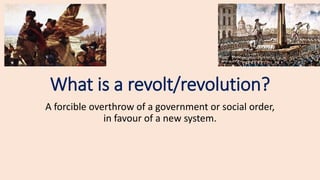
What is a revolt/revolution?
A forcible overthrow of a government or social order,
in favour of a new system.
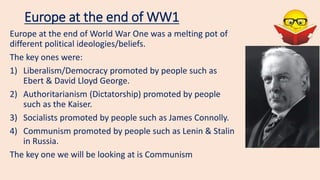
Europe at the end of WW1
Europe at the end of World War One was a melting pot of
different political ideologies/beliefs.
The key ones were:
1) Liberalism/Democracy promoted by people such as
Ebert & David Lloyd George.
2) Authoritarianism (Dictatorship) promoted by people
such as the Kaiser.
3) Socialists promoted by people such as James Connolly.
4) Communism promoted by people such as Lenin & Stalin
in Russia.
The key one we will be looking at is Communism
Communism
Communism is a political and ideological systems used to run a
country.
An ideology is a system of beliefs that shapes how an individual or
government thinks and acts.
What is Communism?
Economic system – based on the sharing of wealth.​
Belief in collective (group) ownership and a planned economy –
private business is not allowed.
The theory is that everybody pools their resources and labour to
evenly distribute everything.
The idea is everybody has a good and equal standard of living.
Questions
1) What do you think is one benefit of Communism?
2) What do you think is one drawback of Communism?
EXTENSION
3) Why do you think ordinary Germans were attracted to Communism?
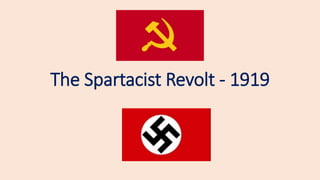
The Spartacist Revolt - 1919
What was the Spartacist Revolt?
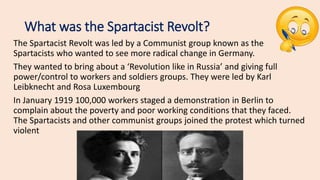
The Spartacist Revolt was led by a Communist group known as the
Spartacists who wanted to see more radical change in Germany.
They wanted to bring about a ‘Revolution like in Russia’ and giving full
power/control to workers and soldiers groups. They were led by Karl
Leibknecht and Rosa Luxembourg
In January 1919 100,000 workers staged a demonstration in Berlin to
complain about the poverty and poor working conditions that they faced.
The Spartacists and other communist groups joined the protest which turned
violent
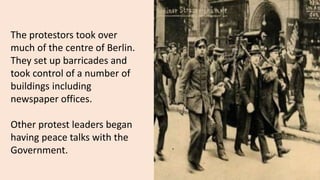
The protestors took over
much of the centre of Berlin.
They set up barricades and
took control of a number of
buildings including
newspaper offices.
Other protest leaders began
having peace talks with the
Government.
Reaction of the Government
The new Chancellor of Germany – Friedrich Ebert was a member of the
liberal Social Democratic Party (SDP)
Although he believed that all parties should be represented in the
Reichstag (Parliament) he was opposed to a Communist system of
Government.
Ebert was worried that Communists would try to overthrow his
government. As a result he reached a secret deal with Willhelm
Groener (the head of Germany’s army) to support the new
government, in exchange for the army’s leaders keeping their jobs.
Reaction of the Government
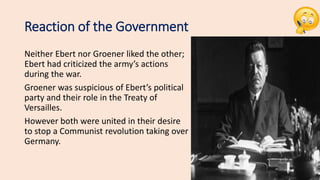
Neither Ebert nor Groener liked the other;
Ebert had criticized the army’s actions
during the war.
Groener was suspicious of Ebert’s political
party and their role in the Treaty of
Versailles.
However both were united in their desire
to stop a Communist revolution taking over
Germany.
Role of the Army
The German Army was sent in to tackle the Spartacists
and end the revolt. They used a group of former
soldiers called the Freikorps.
This group were known for their violence and blamed
Communist groups for Germany’s defeat in World War
One.
Aftermath
During a ‘Bloody week’ of violence, hundreds of protestors were killed
including the Spartacist leaders Karl Liebknecht and Rosa Luxembourg.
Luxembourgs’s body was dumped in a canal; Liebknecht’s body was left
at a morgue to rot.
Why did the revolt lead to the rise of the Nazis?
The Social Democrats decision to use the Freikorps would later help
Hitler gain power. This is because the Communists refused to ever
with the Social Democrats.
This limited possible obstacles and coalitions to stop the Nazis taking
control of Germany.
Task(s)
1) Describe the events of the Spartacist revolt of January 1919 – 5
marks.
EXTENSION
1) Create a comic strip detailing events of the Spartacist revolt.

spartacist revolt

  • 1.
    National 5 History:Hitler & Nazi Germany The Spartacist Revolt/Communism
  • 2.
    Today’s lesson –The Spartacist Revolt We are developing our knowledge and understanding of the Spartacist Revolt which took place in 1919 By the end of today’s lesson I should be able to: 1) Describe events at the 1919 Spartacist Revolt 2) Describe the key principles of Communism 3) Explain why the Spartacist Revolt helped the Nazis take power. Today’s lesson involves: Note taking
  • 3.
    What is arevolt/revolution? A forcible overthrow of a government or social order, in favour of a new system.
  • 4.
    Europe at theend of WW1 Europe at the end of World War One was a melting pot of different political ideologies/beliefs. The key ones were: 1) Liberalism/Democracy promoted by people such as Ebert & David Lloyd George. 2) Authoritarianism (Dictatorship) promoted by people such as the Kaiser. 3) Socialists promoted by people such as James Connolly. 4) Communism promoted by people such as Lenin & Stalin in Russia. The key one we will be looking at is Communism
  • 5.
    Communism Communism is apolitical and ideological systems used to run a country. An ideology is a system of beliefs that shapes how an individual or government thinks and acts. What is Communism? Economic system – based on the sharing of wealth.​ Belief in collective (group) ownership and a planned economy – private business is not allowed. The theory is that everybody pools their resources and labour to evenly distribute everything. The idea is everybody has a good and equal standard of living.
  • 6.
    Questions 1) What doyou think is one benefit of Communism? 2) What do you think is one drawback of Communism? EXTENSION 3) Why do you think ordinary Germans were attracted to Communism?
  • 7.
  • 8.
    What was theSpartacist Revolt? The Spartacist Revolt was led by a Communist group known as the Spartacists who wanted to see more radical change in Germany. They wanted to bring about a ‘Revolution like in Russia’ and giving full power/control to workers and soldiers groups. They were led by Karl Leibknecht and Rosa Luxembourg In January 1919 100,000 workers staged a demonstration in Berlin to complain about the poverty and poor working conditions that they faced. The Spartacists and other communist groups joined the protest which turned violent
  • 9.
    The protestors tookover much of the centre of Berlin. They set up barricades and took control of a number of buildings including newspaper offices. Other protest leaders began having peace talks with the Government.
  • 10.
    Reaction of theGovernment The new Chancellor of Germany – Friedrich Ebert was a member of the liberal Social Democratic Party (SDP) Although he believed that all parties should be represented in the Reichstag (Parliament) he was opposed to a Communist system of Government. Ebert was worried that Communists would try to overthrow his government. As a result he reached a secret deal with Willhelm Groener (the head of Germany’s army) to support the new government, in exchange for the army’s leaders keeping their jobs.
  • 11.
    Reaction of theGovernment Neither Ebert nor Groener liked the other; Ebert had criticized the army’s actions during the war. Groener was suspicious of Ebert’s political party and their role in the Treaty of Versailles. However both were united in their desire to stop a Communist revolution taking over Germany.
  • 12.
    Role of theArmy The German Army was sent in to tackle the Spartacists and end the revolt. They used a group of former soldiers called the Freikorps. This group were known for their violence and blamed Communist groups for Germany’s defeat in World War One.
  • 13.
    Aftermath During a ‘Bloodyweek’ of violence, hundreds of protestors were killed including the Spartacist leaders Karl Liebknecht and Rosa Luxembourg. Luxembourgs’s body was dumped in a canal; Liebknecht’s body was left at a morgue to rot. Why did the revolt lead to the rise of the Nazis? The Social Democrats decision to use the Freikorps would later help Hitler gain power. This is because the Communists refused to ever with the Social Democrats. This limited possible obstacles and coalitions to stop the Nazis taking control of Germany.
  • 14.
    Task(s) 1) Describe theevents of the Spartacist revolt of January 1919 – 5 marks. EXTENSION 1) Create a comic strip detailing events of the Spartacist revolt.