
Constitution of Man
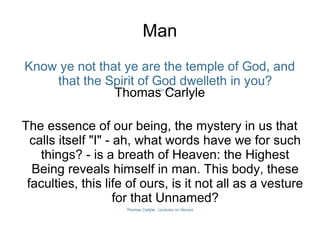
Know ye not that ye are the temple of God, and
that the Spirit of God dwelleth in you?I Cor. iii 16
Thomas Carlyle
The essence of our being, the mystery in us that
calls itself "I" - ah, what words have we for such
things? - is a breath of Heaven: the Highest
Being reveals himself in man. This body, these
faculties, this life of ours, is it not all as a vesture
for that Unnamed?
Thomas Carlyle, Lectures on Heroes
Man
Man
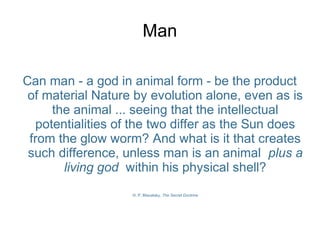
Can man - a god in animal form - be the product
of material Nature by evolution alone, even as is
the animal ... seeing that the intellectual
potentialities of the two differ as the Sun does
from the glow worm? And what is it that creates
such difference, unless man is an animal plus a
living god within his physical shell?
H. P. Blavatsky, The Secret Doctrine

WHAT IS MAN? - An Ancient Question
MAN, KNOW THYSELF! an ancient injunction!
The way in which the complex constitution of
man is described and analysed will depend in
part on the purpose of the analysis and on the
manner in which the different aspects of his
nature are grouped together.
Thus he may be described as twofold, threefold,
fourfold, fivefold, sixfold and sevenfold. Such
divisions, however, are but aspects or modes of
functioning of the one real man, the embodied
Consciousness, enduring through the cycle of
life and immortal in essence.
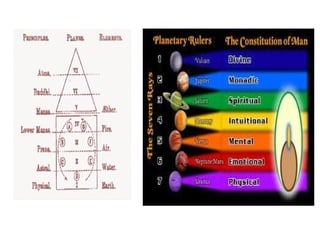
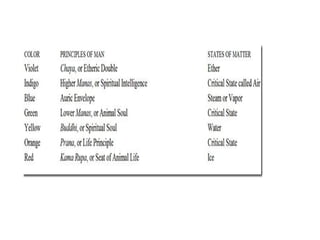
THE SEVENFOLD NATURE OF MAN
ATMA.
Self or Spirit.
It is not an individual but a universal Principle.
Atma, the 'Higher Self', is neither your Spirit nor
mine but like sunlight shines on all.
It is the universally diffused 'divine principle', and
is inseparable from its one and absolute Meta-
Spirit, as the sunbeam is inseparable from
sunlight.
BUDDHI.
Spiritual Soul, the vehicle of Atma. Buddhi, from a
root meaning to know, denotes Wisdom, the
faculty of discernment of good and evil; it also
connotes intuition and 'divine conscience'
.Atma-Buddhi is the Divine Unit, the MONAD.
THE SEVENFOLD NATURE OF MAN
MANAS
Mind, Intelligence.
When united with Atma-Buddhi, it is called the Spiritual Ego, the
real individuality, which may therefore be designated Atma-
Buddhi-Manas, the Higher Triad. Manas is "The mental faculty
which makes of man an intelligent and moral being, and
distinguishes him from the mere animal".
In incarnation, Manas is dual, for it projects itself into the Personality that
it must use during the period of the earth life: hence the terms Higher
and Lower Manas. Here, in the association of Manas with Kama, the
principle of desire, is the battleground of our experience, justly called
the drama of the soul in exile: on the one hand, the spiritual impulses
of the higher nature, on the other the pull of the passional animal
nature.
The future state and the karmic destiny of man depend on whether
Manas gravitates more downward to Kama rupa, the seat of the
animal passions, or upward to Buddhi, the Spiritual Ego.
THE SEVENFOLD NATURE OF MAN
KAMA.
The principle of Desire. Kama and Manas should be
studied in conjunction with one another, for although
thought and feeling can be separated as concepts, they
are functionally indivisible. Kama may be directed
towards either spiritual or selfish purposes, towards
helping others or the satisfaction of personal goals.
THE SEVENFOLD NATURE OF MAN
PRANA.
The Life-principle, or principle of vitality.
Being derived from the ONE LIFE, it is
omnipresent, eternal and indestructible.
Prana, or life, is the active power
producing all vital phenomena.
THE SEVENFOLD NATURE OF MAN
LlNGA-SHARIRA
. Various terms are used for this, the vehicle
of Prana, the most appropriate being the
model body (from linga, meaning model
and sharira, a form easily dissolved). It
provides the model round which the
physical body is formed. It is also called
the astral body or the etheric double, both
terms; indicating the material of which it is
made.
THE SEVENFOLD NATURE OF MAN
STHULA-SHARIRA.
The physical body (sthula, coarse or
bulky), the vehicle of all the other
principles during life and the means by
which man is able to function on earth.
THE SEVENFOLD NATURE OF MAN
MAN A FUNCTIONING WHOLE
-
aspects and divisions
Just as the human body can be analysed in
terms of limbs, organs, chemical
components, yet remains a functioning
whole, so the several aspects of the inner
man may be grouped together in different
ways for the better understanding of the
individual in life and in death.
MAN as twofold.This is the simplest and perhaps the most immediately practical
division. It recognizes man as a Self or Consciousness acting
through a complex vehicle. In theosophical literature the Self,
the immortal Spirit in man, is termed the Individuality; the
complex vehicle with which we commonly identify ourselves is
the mortal Personality. The Individuality is the reincarnating Ego,
described as the golden thread on which are strung the beads of
its successive incarnations. In common experience there is often
a conflict between the two, epitomized in the words of St. Paul,
"the good that I would I do not, but the evil which I would not,
that I do". (Rom. vii 19)
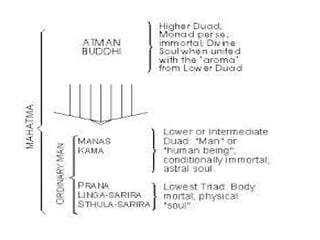
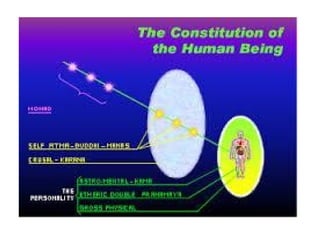
This twofold division is a simplification of the sevenfold picture of
man, for the Individuality is the immortal Triad, consisting
of Atman(Pure Spirit), Buddhi {Spiritual Soul)
and Manas (Mind); the Personality is the Lower Quarternary ,
transitory and mortal, composed of Kama (Desire), Linga-
Sharira (Astral Body), Prana (Life or Vitality) and Sthula-
Sharira (Physical Body).
MAN as threefold
This division into "spirit, soul and body" is used by St. Paul (I
Thess. V23). The distinction between spirit and soul, clearly
shown in the text by the use of the Greek
terms pneuma (breath, spirit) and psyche (soul), has
been largely lost from sight in popular usage, spirit and soul
being regarded as interchangeable terms, to the confusion
and impoverishment of the Christian conception of man. In
theosophical studies, Spirit is the immortal Individuality,
soul the personal psychic vehicle composed of thought and
feeling which, together with the physical body, "the house
of the householder", constitute the mortal Personality.
MAN as fourfold
The Brahmanical system divides man into the four principles that
are capable of a separate existence. These are the sthula-
sharira (physical body, including prana and the etheric
double); sukshma-sharira (corresponding roughly to soul);
karana-sharira (causal body) and atma (spirit). The significance
of this division may be illustrated as follows: Imagine the sun
shining into a mirror; from the mirror the light reflects onto a
metal disc; and from there it falls on a wall. The sun represents
the Divine Self, the mirror the Ego or causal body, the metal disc
the soul and the wall the body. At each remove from its source
the brightness of the light is reduced, being further dimmed
according to the reflective quality of the surface on which it falls.
Nevertheless, however much reduced in brightness, the light is
always that of the sun. (This illustration is given by T. Subba
Row in his lectures on the Bhagavad Gita.)
MAN as fivefold
The Katha Upanishad gives a picturesque description of the
human constitution: The Self or Spirit rides in the chariot, the
body; the controlling agent, the charioteer, is the illumined or
Spiritual Mind; the reins are the mind functioning in the
Personality; the: senses are the horses that pull the chariot
along the roads of the material world; The practical application of
this analysis is made evident: When the Illumined Mind, the
agent of the Spirit, is in charge, controlling the reins of mind,
which in turn controls the senses, the journey towards the goal
is made swiftly and smoothly and the man is born no more. But if
the Illumined Mind has not been awakened, the reins are
uncontrolled and the senses drag the man wherever they will:
this man, says the Scripture, never reaches the end of the
journey but is born again and again.
MAN as sixfold
This classification is given in the Taittiriya
Upanishad. Here the different aspects or
principles of man are described as sheaths, the
coverings or encasements of the Divine Spirit.
The sheaths are listed as: the sheath of food,
the sheath ofvitality , the sheath of mind, the
sheath of understanding, the sheath of bliss,
and finally "beyond all sheaths is the Self'.
MAN as sevenfold
This is the classification most used in the
theosophical literature. Like everything else in
Nature, man's constitution is rooted in the
septenary law, that is, man the microcosm
reflects in his nature the sevenfold constitution
of the macrocosm, the universe. The concept of
man as a seven-principled being is one of the
keys to the understanding of the processes in
which, as an individual, he is involved - birth and
death, reincarnation, spiritual progress.
Therefore
A man is one and the same man on whatever plane he may be
functioning, and his triumph is when he functions on all the five
planes in unbroken consciousness. Those whom we call the
Masters, the "Men made perfect," function in Their waking
consciousness, not only on the three lower planes, but on the
fourth plane - that plane of unity spoken of in the
Mândûkyopanishad as the Turîya, and on that yet above it, the
plane of Nirvana. In them evolution is completed, this cycle has
been trodden to its close, and what they are, all in time [113]
shall be who are climbing slowly upwards. This is the unification
of consciousness; the vehicles remain for use, but no longer are
able to imprison, and the man uses any one of his bodies
according to the work that he has to do.
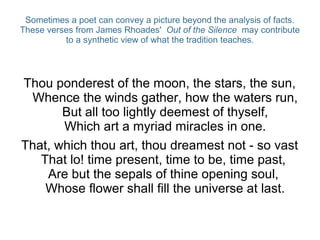
Sometimes a poet can convey a picture beyond the analysis of facts.
These verses from James Rhoades' Out of the Silence may contribute
to a synthetic view of what the tradition teaches.
Thou ponderest of the moon, the stars, the sun,
Whence the winds gather, how the waters run,
But all too lightly deemest of thyself,
Which art a myriad miracles in one.
That, which thou art, thou dreamest not - so vast
That lo! time present, time to be, time past,
Are but the sepals of thine opening soul,
Whose flower shall fill the universe at last.
The End
Discussed by: Lisa Montero
August 3, 2014

Constitution of man iii

  • 1.
  • 2.
    Know ye notthat ye are the temple of God, and that the Spirit of God dwelleth in you?I Cor. iii 16 Thomas Carlyle The essence of our being, the mystery in us that calls itself "I" - ah, what words have we for such things? - is a breath of Heaven: the Highest Being reveals himself in man. This body, these faculties, this life of ours, is it not all as a vesture for that Unnamed? Thomas Carlyle, Lectures on Heroes Man
  • 3.
    Man Can man -a god in animal form - be the product of material Nature by evolution alone, even as is the animal ... seeing that the intellectual potentialities of the two differ as the Sun does from the glow worm? And what is it that creates such difference, unless man is an animal plus a living god within his physical shell? H. P. Blavatsky, The Secret Doctrine
  • 4.
     WHAT IS MAN?- An Ancient Question MAN, KNOW THYSELF! an ancient injunction! The way in which the complex constitution of man is described and analysed will depend in part on the purpose of the analysis and on the manner in which the different aspects of his nature are grouped together. Thus he may be described as twofold, threefold, fourfold, fivefold, sixfold and sevenfold. Such divisions, however, are but aspects or modes of functioning of the one real man, the embodied Consciousness, enduring through the cycle of life and immortal in essence.
  • 6.
    THE SEVENFOLD NATUREOF MAN ATMA. Self or Spirit. It is not an individual but a universal Principle. Atma, the 'Higher Self', is neither your Spirit nor mine but like sunlight shines on all. It is the universally diffused 'divine principle', and is inseparable from its one and absolute Meta- Spirit, as the sunbeam is inseparable from sunlight.
  • 7.
    BUDDHI. Spiritual Soul, thevehicle of Atma. Buddhi, from a root meaning to know, denotes Wisdom, the faculty of discernment of good and evil; it also connotes intuition and 'divine conscience' .Atma-Buddhi is the Divine Unit, the MONAD. THE SEVENFOLD NATURE OF MAN
  • 8.
    MANAS Mind, Intelligence. When unitedwith Atma-Buddhi, it is called the Spiritual Ego, the real individuality, which may therefore be designated Atma- Buddhi-Manas, the Higher Triad. Manas is "The mental faculty which makes of man an intelligent and moral being, and distinguishes him from the mere animal". In incarnation, Manas is dual, for it projects itself into the Personality that it must use during the period of the earth life: hence the terms Higher and Lower Manas. Here, in the association of Manas with Kama, the principle of desire, is the battleground of our experience, justly called the drama of the soul in exile: on the one hand, the spiritual impulses of the higher nature, on the other the pull of the passional animal nature. The future state and the karmic destiny of man depend on whether Manas gravitates more downward to Kama rupa, the seat of the animal passions, or upward to Buddhi, the Spiritual Ego. THE SEVENFOLD NATURE OF MAN
  • 9.
    KAMA. The principle ofDesire. Kama and Manas should be studied in conjunction with one another, for although thought and feeling can be separated as concepts, they are functionally indivisible. Kama may be directed towards either spiritual or selfish purposes, towards helping others or the satisfaction of personal goals. THE SEVENFOLD NATURE OF MAN
  • 10.
    PRANA. The Life-principle, orprinciple of vitality. Being derived from the ONE LIFE, it is omnipresent, eternal and indestructible. Prana, or life, is the active power producing all vital phenomena. THE SEVENFOLD NATURE OF MAN
  • 11.
    LlNGA-SHARIRA . Various termsare used for this, the vehicle of Prana, the most appropriate being the model body (from linga, meaning model and sharira, a form easily dissolved). It provides the model round which the physical body is formed. It is also called the astral body or the etheric double, both terms; indicating the material of which it is made. THE SEVENFOLD NATURE OF MAN
  • 12.
    STHULA-SHARIRA. The physical body(sthula, coarse or bulky), the vehicle of all the other principles during life and the means by which man is able to function on earth. THE SEVENFOLD NATURE OF MAN
  • 16.
    MAN A FUNCTIONINGWHOLE - aspects and divisions Just as the human body can be analysed in terms of limbs, organs, chemical components, yet remains a functioning whole, so the several aspects of the inner man may be grouped together in different ways for the better understanding of the individual in life and in death.
  • 17.
    MAN as twofold.Thisis the simplest and perhaps the most immediately practical division. It recognizes man as a Self or Consciousness acting through a complex vehicle. In theosophical literature the Self, the immortal Spirit in man, is termed the Individuality; the complex vehicle with which we commonly identify ourselves is the mortal Personality. The Individuality is the reincarnating Ego, described as the golden thread on which are strung the beads of its successive incarnations. In common experience there is often a conflict between the two, epitomized in the words of St. Paul, "the good that I would I do not, but the evil which I would not, that I do". (Rom. vii 19) This twofold division is a simplification of the sevenfold picture of man, for the Individuality is the immortal Triad, consisting of Atman(Pure Spirit), Buddhi {Spiritual Soul) and Manas (Mind); the Personality is the Lower Quarternary , transitory and mortal, composed of Kama (Desire), Linga- Sharira (Astral Body), Prana (Life or Vitality) and Sthula- Sharira (Physical Body).
  • 18.
    MAN as threefold Thisdivision into "spirit, soul and body" is used by St. Paul (I Thess. V23). The distinction between spirit and soul, clearly shown in the text by the use of the Greek terms pneuma (breath, spirit) and psyche (soul), has been largely lost from sight in popular usage, spirit and soul being regarded as interchangeable terms, to the confusion and impoverishment of the Christian conception of man. In theosophical studies, Spirit is the immortal Individuality, soul the personal psychic vehicle composed of thought and feeling which, together with the physical body, "the house of the householder", constitute the mortal Personality.
  • 19.
    MAN as fourfold TheBrahmanical system divides man into the four principles that are capable of a separate existence. These are the sthula- sharira (physical body, including prana and the etheric double); sukshma-sharira (corresponding roughly to soul); karana-sharira (causal body) and atma (spirit). The significance of this division may be illustrated as follows: Imagine the sun shining into a mirror; from the mirror the light reflects onto a metal disc; and from there it falls on a wall. The sun represents the Divine Self, the mirror the Ego or causal body, the metal disc the soul and the wall the body. At each remove from its source the brightness of the light is reduced, being further dimmed according to the reflective quality of the surface on which it falls. Nevertheless, however much reduced in brightness, the light is always that of the sun. (This illustration is given by T. Subba Row in his lectures on the Bhagavad Gita.)
  • 20.
    MAN as fivefold TheKatha Upanishad gives a picturesque description of the human constitution: The Self or Spirit rides in the chariot, the body; the controlling agent, the charioteer, is the illumined or Spiritual Mind; the reins are the mind functioning in the Personality; the: senses are the horses that pull the chariot along the roads of the material world; The practical application of this analysis is made evident: When the Illumined Mind, the agent of the Spirit, is in charge, controlling the reins of mind, which in turn controls the senses, the journey towards the goal is made swiftly and smoothly and the man is born no more. But if the Illumined Mind has not been awakened, the reins are uncontrolled and the senses drag the man wherever they will: this man, says the Scripture, never reaches the end of the journey but is born again and again.
  • 21.
    MAN as sixfold Thisclassification is given in the Taittiriya Upanishad. Here the different aspects or principles of man are described as sheaths, the coverings or encasements of the Divine Spirit. The sheaths are listed as: the sheath of food, the sheath ofvitality , the sheath of mind, the sheath of understanding, the sheath of bliss, and finally "beyond all sheaths is the Self'.
  • 22.
    MAN as sevenfold Thisis the classification most used in the theosophical literature. Like everything else in Nature, man's constitution is rooted in the septenary law, that is, man the microcosm reflects in his nature the sevenfold constitution of the macrocosm, the universe. The concept of man as a seven-principled being is one of the keys to the understanding of the processes in which, as an individual, he is involved - birth and death, reincarnation, spiritual progress.
  • 23.
    Therefore A man isone and the same man on whatever plane he may be functioning, and his triumph is when he functions on all the five planes in unbroken consciousness. Those whom we call the Masters, the "Men made perfect," function in Their waking consciousness, not only on the three lower planes, but on the fourth plane - that plane of unity spoken of in the Mândûkyopanishad as the Turîya, and on that yet above it, the plane of Nirvana. In them evolution is completed, this cycle has been trodden to its close, and what they are, all in time [113] shall be who are climbing slowly upwards. This is the unification of consciousness; the vehicles remain for use, but no longer are able to imprison, and the man uses any one of his bodies according to the work that he has to do.
  • 24.
    Sometimes a poetcan convey a picture beyond the analysis of facts. These verses from James Rhoades' Out of the Silence may contribute to a synthetic view of what the tradition teaches. Thou ponderest of the moon, the stars, the sun, Whence the winds gather, how the waters run, But all too lightly deemest of thyself, Which art a myriad miracles in one. That, which thou art, thou dreamest not - so vast That lo! time present, time to be, time past, Are but the sepals of thine opening soul, Whose flower shall fill the universe at last.
  • 25.
    The End Discussed by:Lisa Montero August 3, 2014