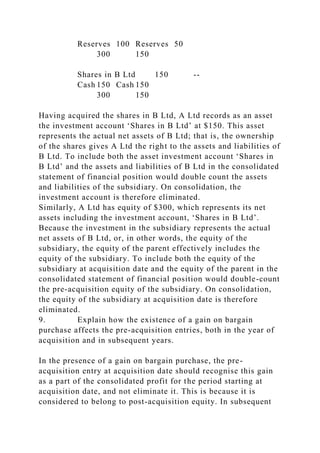
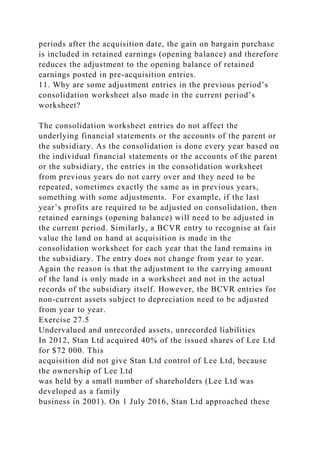
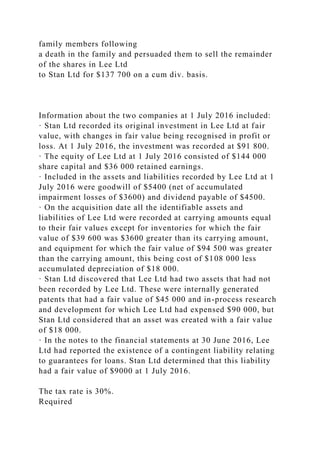
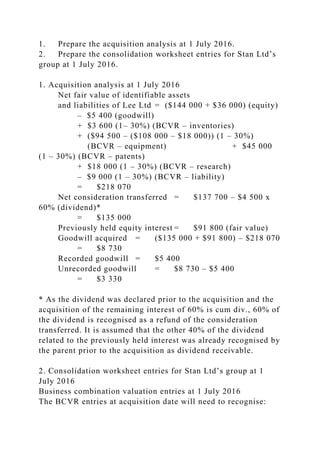
Consolidation– Intragroup Transactions
WORKSHOP
Corporate Reporting
La Trobe Business School
Ch 26 & 27.
1
Topic intended learning outcomes
explain the need for making adjustments for intragroup
transactions
prepare worksheet entries for intragroup sales of inventory
prepare worksheet entries for intragroup sales of property, plant
and equipment
prepare worksheet entries for intragroup services
prepare worksheet entries for intragroup dividends
prepare worksheet entries for intragroup borrowings
La Trobe Business School
Consolidated financial statements are statements of the group
presented as a single economic entity.
These financial statements show only transactions with external
parties.
Adjustments are required to eliminate the effects of intragroup
transactions so that financial position and performance are not
under or overstated in the consolidated statements.
The need for intragroup adjustments
La Trobe Business School
LO1
3
Intragroup transactions - transactions that occur between
entities in the group.
The purpose of consolidated financials is to provide information
on the group as a result of its dealings with external parties.
AASB 10/IFRS 10 requires:
Intragroup balances, transactions, income and expenses to be
eliminated in full.
Tax effect accounting to be applied where temporary differences
arise due to the elimination of profits and losses.
The adjustment process
La Trobe Business School
LO2
4
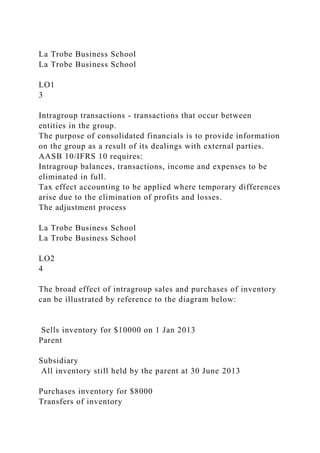
The broad effect of intragroup sales and purchases of inventory
can be illustrated by reference to the diagram below:
Sells inventory for $10000 on 1 Jan 2013
Parent
Subsidiary
All inventory still held by the parent at 30 June 2013
Purchases inventory for $8000
Transfers of inventory
La Trobe Business School
LO3
5
Sales of inventories in the current period:
current period accounts will be affected in the worksheet
adjustment entries
from group perspective, no sale made to external parties
tax effect adjustment required.
Realisation of profits:
profit will only be recognised by the group when inventory has
been sold to external parties.
Inventories
La Trobe Business School
LO3
6
Sales of inventories in the prior period:
opening retained earnings contains profit relating to inventories
on hand at beginning of period
the group would report sales to external parties and COS
adjustments
zero effect on retained earnings (closing balance) so no
consolidated adjustment to inventories in future periods
required
tax effect of the adjustment is recorded.
Inventories
La Trobe Business School
LO3
7
Realisation of profits for sales of inventories in the prior
period:
group’s retained earnings (op bal) less than retained earnings of
legal entities (unrealised profit in beginning inventories
eliminated from prior period profits)
group’s current period after tax profit greater than current year
after tax profit of legal entity (unrealised profit in beginning
inventories realised in current period)
no unrealised profit remaining so no need for future period
worksheet adjustments.
Inventories
La Trobe Business School
LO3
8
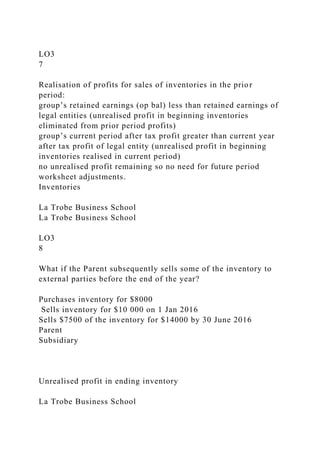
What if the Parent subsequently sells some of the inventory to
external parties before the end of the year?
Purchases inventory for $8000
Sells inventory for $10 000 on 1 Jan 2016
Sells $7500 of the inventory for $14000 by 30 June 2016
Parent
Subsidiary
Unrealised profit in ending inventory
La Trobe Business School
LO3
9
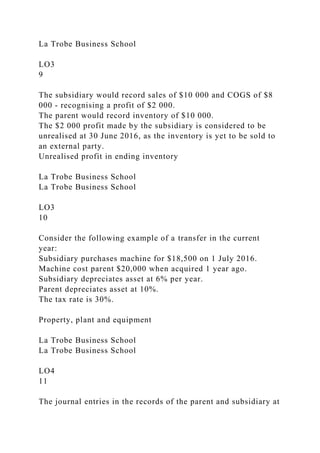
The subsidiary would record sales of $10 000 and COGS of $8
000 - recognising a profit of $2 000.
The parent would record inventory of $10 000.
The $2 000 profit made by the subsidiary is considered to be
unrealised at 30 June 2016, as the inventory is yet to be sold to
an external party.
Unrealised profit in ending inventory
La Trobe Business School
LO3
10
Consider the following example of a transfer in the current
year:
Subsidiary purchases machine for $18,500 on 1 July 2016.
Machine cost parent $20,000 when acquired 1 year ago.
Subsidiary depreciates asset at 6% per year.
Parent depreciates asset at 10%.
The tax rate is 30%.
Property, plant and equipment
La Trobe Business School
LO4
11
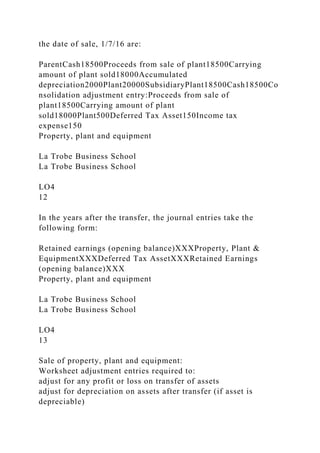
The journal entries in the records of the parent and subsidiary at
the date of sale, 1/7/16 are:
ParentCash18500Proceeds from sale of plant18500Carrying
amount of plant sold18000Accumulated
depreciation2000Plant20000SubsidiaryPlant18500Cash18500Co
nsolidation adjustment entry:Proceeds from sale of
plant18500Carrying amount of plant
sold18000Plant500Deferred Tax Asset150Income tax
expense150
Property, plant and equipment
La Trobe Business School
LO4
12
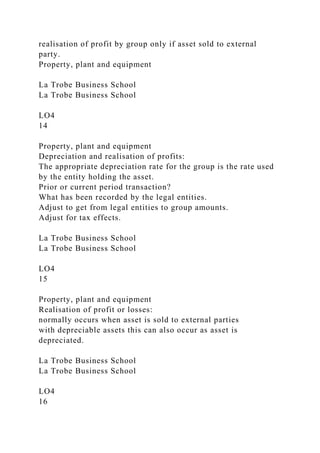
In the years after the transfer, the journal entries take the
following form:
Retained earnings (opening balance)XXXProperty, Plant &
EquipmentXXXDeferred Tax AssetXXXRetained Earnings
(opening balance)XXX
Property, plant and equipment
La Trobe Business School
LO4
13
Sale of property, plant and equipment:
Worksheet adjustment entries required to:
adjust for any profit or loss on transfer of assets
adjust for depreciation on assets after transfer (if asset is
depreciable)
realisation of profit by group only if asset sold to external
party.
Property, plant and equipment
La Trobe Business School
LO4
14
Property, plant and equipment
Depreciation and realisation of profits:
The appropriate depreciation rate for the group is the rate used
by the entity holding the asset.
Prior or current period transaction?
What has been recorded by the legal entities.
Adjust to get from legal entities to group amounts.
Adjust for tax effects.
La Trobe Business School
LO4
15
Property, plant and equipment
Realisation of profit or losses:
normally occurs when asset is sold to external parties
with depreciable assets this can also occur as asset is
depreciated.
La Trobe Business School
LO4
16
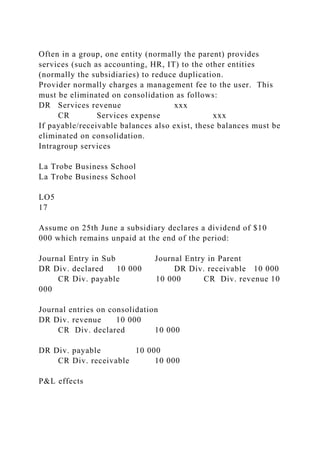
Often in a group, one entity (normally the parent) provides
services (such as accounting, HR, IT) to the other entities
(normally the subsidiaries) to reduce duplication.
Provider normally charges a management fee to the user. This
must be eliminated on consolidation as follows:
DR Services revenue xxx
CR Services expense xxx
If payable/receivable balances also exist, these balances must be
eliminated on consolidation.
Intragroup services
La Trobe Business School
LO5
17
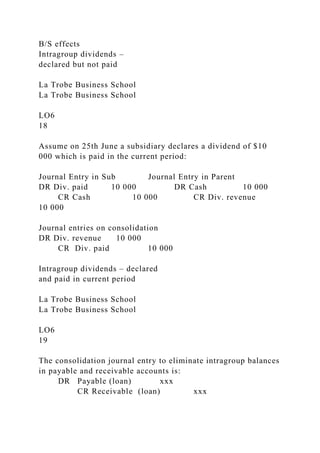
Assume on 25th June a subsidiary declares a dividend of $10
000 which remains unpaid at the end of the period:
Journal Entry in Sub Journal Entry in Parent
DR Div. declared 10 000 DR Div. receivable 10 000
CR Div. payable 10 000 CR Div. revenue 10
000
Journal entries on consolidation
DR Div. revenue 10 000
CR Div. declared 10 000
DR Div. payable 10 000
CR Div. receivable 10 000
P&L effects
B/S effects
Intragroup dividends –
declared but not paid
La Trobe Business School
LO6
18
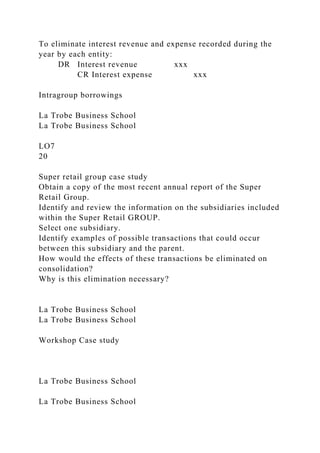
Assume on 25th June a subsidiary declares a dividend of $10
000 which is paid in the current period:
Journal Entry in Sub Journal Entry in Parent
DR Div. paid 10 000 DR Cash 10 000
CR Cash 10 000 CR Div. revenue
10 000
Journal entries on consolidation
DR Div. revenue 10 000
CR Div. paid 10 000
Intragroup dividends – declared
and paid in current period
La Trobe Business School
LO6
19
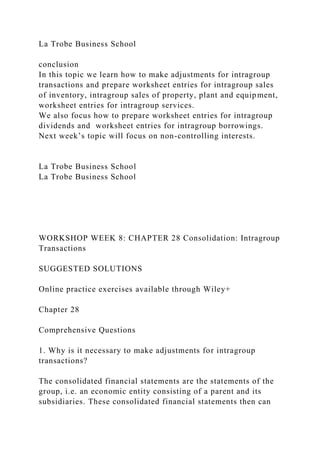
The consolidation journal entry to eliminate intragroup balances
in payable and receivable accounts is:
DR Payable (loan) xxx
CR Receivable (loan) xxx
To eliminate interest revenue and expense recorded during the
year by each entity:
DR Interest revenue xxx
CR Interest expense xxx
Intragroup borrowings
La Trobe Business School
LO7
20
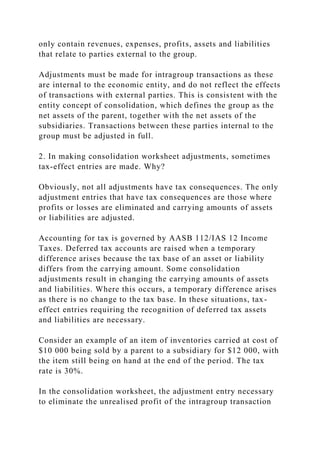
Super retail group case study
Obtain a copy of the most recent annual report of the Super
Retail Group.
Identify and review the information on the subsidiaries included
within the Super Retail GROUP.
Select one subsidiary.
Identify examples of possible transactions that could occur
between this subsidiary and the parent.
How would the effects of these transactions be eliminated on
consolidation?
Why is this elimination necessary?
La Trobe Business School
Workshop Case study
La Trobe Business School
conclusion
In this topic we learn how to make adjustments for intragroup
transactions and prepare worksheet entries for intragroup sales
of inventory, intragroup sales of property, plant and equipment,
worksheet entries for intragroup services.
We also focus how to prepare worksheet entries for intragroup
dividends and worksheet entries for intragroup borrowings.
Next week’s topic will focus on non-controlling interests.
La Trobe Business School
WORKSHOP WEEK 8: CHAPTER 28 Consolidation: Intragroup
Transactions
SUGGESTED SOLUTIONS
Online practice exercises available through Wiley+
Chapter 28
Comprehensive Questions
1. Why is it necessary to make adjustments for intragroup
transactions?
The consolidated financial statements are the statements of the
group, i.e. an economic entity consisting of a parent and its
subsidiaries. These consolidated financial statements then can
only contain revenues, expenses, profits, assets and liabilities
that relate to parties external to the group.
Adjustments must be made for intragroup transactions as these
are internal to the economic entity, and do not reflect the effects
of transactions with external parties. This is consistent with the
entity concept of consolidation, which defines the group as the
net assets of the parent, together with the net assets of the
subsidiaries. Transactions between these parties internal to the
group must be adjusted in full.
2. In making consolidation worksheet adjustments, sometimes
tax-effect entries are made. Why?
Obviously, not all adjustments have tax consequences. The only
adjustment entries that have tax consequences are those where
profits or losses are eliminated and carrying amounts of assets
or liabilities are adjusted.
Accounting for tax is governed by AASB 112/IAS 12 Income
Taxes. Deferred tax accounts are raised when a temporary
difference arises because the tax base of an asset or liability
differs from the carrying amount. Some consolidation
adjustments result in changing the carrying amounts of assets
and liabilities. Where this occurs, a temporary difference arises
as there is no change to the tax base. In these situations, tax-
effect entries requiring the recognition of deferred tax assets
and liabilities are necessary.
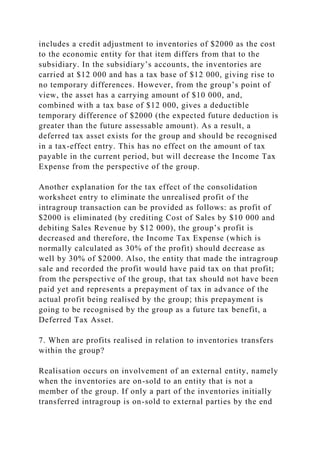
Consider an example of an item of inventories carried at cost of
$10 000 being sold by a parent to a subsidiary for $12 000, with
the item still being on hand at the end of the period. The tax
rate is 30%.
In the consolidation worksheet, the adjustment entry necessary
to eliminate the unrealised profit of the intragroup transaction
includes a credit adjustment to inventories of $2000 as the cost
to the economic entity for that item differs from that to the
subsidiary. In the subsidiary’s accounts, the inventories are
carried at $12 000 and has a tax base of $12 000, giving rise to
no temporary differences. However, from the group’s point of
view, the asset has a carrying amount of $10 000, and,
combined with a tax base of $12 000, gives a deductible
temporary difference of $2000 (the expected future deduction is
greater than the future assessable amount). As a result, a
deferred tax asset exists for the group and should be recognised
in a tax-effect entry. This has no effect on the amount of tax
payable in the current period, but will decrease the Income Tax
Expense from the perspective of the group.
Another explanation for the tax effect of the consolidation
worksheet entry to eliminate the unrealised profit of the
intragroup transaction can be provided as follows: as profit of
$2000 is eliminated (by crediting Cost of Sales by $10 000 and
debiting Sales Revenue by $12 000), the group’s profit is
decreased and therefore, the Income Tax Expense (which is
normally calculated as 30% of the profit) should decrease as
well by 30% of $2000. Also, the entity that made the intragroup
sale and recorded the profit would have paid tax on that profit;
from the perspective of the group, that tax should not have been
paid yet and represents a prepayment of tax in advance of the
actual profit being realised by the group; this prepayment is
going to be recognised by the group as a future tax benefit, a
Deferred Tax Asset.
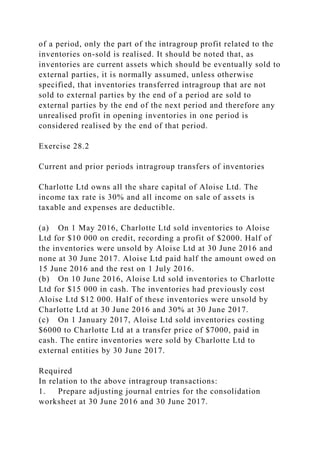
7. When are profits realised in relation to inventories transfers
within the group?
Realisation occurs on involvement of an external entity, namely
when the inventories are on-sold to an entity that is not a
member of the group. If only a part of the inventories initially
transferred intragroup is on-sold to external parties by the end
of a period, only the part of the intragroup profit related to the
inventories on-sold is realised. It should be noted that, as
inventories are current assets which should be eventually sold to
external parties, it is normally assumed, unless otherwise
specified, that inventories transferred intragroup that are not
sold to external parties by the end of a period are sold to
external parties by the end of the next period and therefore any
unrealised profit in opening inventories in one period is
considered realised by the end of that period.
Exercise 28.2
Current and prior periods intragroup transfers of inventories
Charlotte Ltd owns all the share capital of Aloise Ltd. The
income tax rate is 30% and all income on sale of assets is
taxable and expenses are deductible.
(a) On 1 May 2016, Charlotte Ltd sold inventories to Aloise
Ltd for $10 000 on credit, recording a profit of $2000. Half of
the inventories were unsold by Aloise Ltd at 30 June 2016 and
none at 30 June 2017. Aloise Ltd paid half the amount owed on
15 June 2016 and the rest on 1 July 2016.
(b) On 10 June 2016, Aloise Ltd sold inventories to Charlotte
Ltd for $15 000 in cash. The inventories had previously cost
Aloise Ltd $12 000. Half of these inventories were unsold by
Charlotte Ltd at 30 June 2016 and 30% at 30 June 2017.
(c) On 1 January 2017, Aloise Ltd sold inventories costing
$6000 to Charlotte Ltd at a transfer price of $7000, paid in
cash. The entire inventories were sold by Charlotte Ltd to
external entities by 30 June 2017.
Required
In relation to the above intragroup transactions:
1. Prepare adjusting journal entries for the consolidation
worksheet at 30 June 2016 and 30 June 2017.
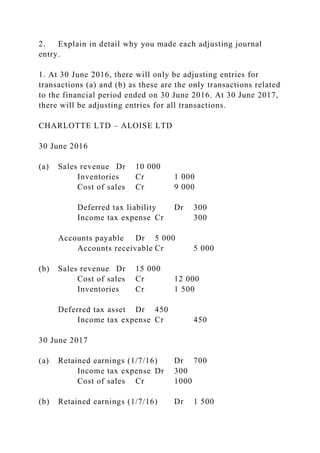
2. Explain in detail why you made each adjusting journal
entry.
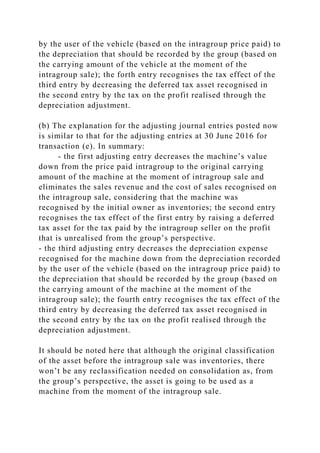
1. At 30 June 2016, there will only be adjusting entries for
transactions (a) and (b) as these are the only transactions related
to the financial period ended on 30 June 2016. At 30 June 2017,
there will be adjusting entries for all transactions.
CHARLOTTE LTD – ALOISE LTD
30 June 2016
(a) Sales revenue Dr 10 000
Inventories Cr 1 000
Cost of sales Cr 9 000
Deferred tax liability Dr 300
Income tax expense Cr 300
Accounts payable Dr 5 000
Accounts receivable Cr 5 000
(b) Sales revenue Dr 15 000
Cost of sales Cr 12 000
Inventories Cr 1 500
Deferred tax asset Dr 450
Income tax expense Cr 450
30 June 2017
(a) Retained earnings (1/7/16) Dr 700
Income tax expense Dr 300
Cost of sales Cr 1000
(b) Retained earnings (1/7/16) Dr 1 500
Cost of sales Cr 600
Inventories Cr 900
Deferred tax asset Dr 270
Income tax expense Dr 180
Retained earnings (1/7/16) Cr 450
(c) Sales revenue Dr 7 000
Cost of sales Cr 7 000
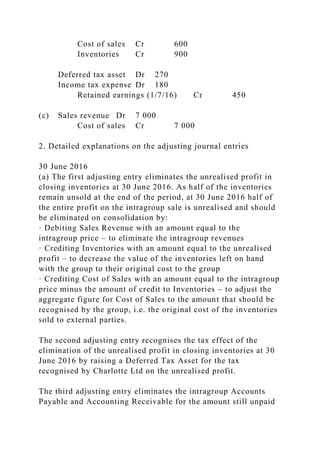
2. Detailed explanations on the adjusting journal entries
30 June 2016
(a) The first adjusting entry eliminates the unrealised profit in
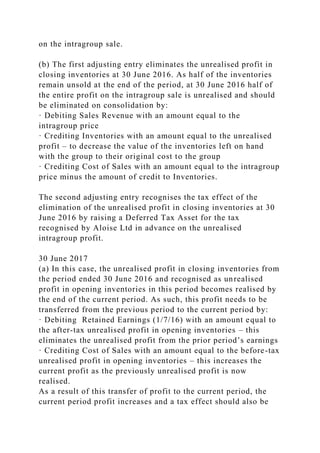
closing inventories at 30 June 2016. As half of the inventories
remain unsold at the end of the period, at 30 June 2016 half of
the entire profit on the intragroup sale is unrealised and should
be eliminated on consolidation by:
· Debiting Sales Revenue with an amount equal to the
intragroup price – to eliminate the intragroup revenues
· Crediting Inventories with an amount equal to the unrealised
profit – to decrease the value of the inventories left on hand
with the group to their original cost to the group
· Crediting Cost of Sales with an amount equal to the intragroup
price minus the amount of credit to Inventories – to adjust the
aggregate figure for Cost of Sales to the amount that should be
recognised by the group, i.e. the original cost of the inventories
sold to external parties.
The second adjusting entry recognises the tax effect of the
elimination of the unrealised profit in closing inventories at 30
June 2016 by raising a Deferred Tax Asset for the tax
recognised by Charlotte Ltd on the unrealised profit.
The third adjusting entry eliminates the intragroup Accounts
Payable and Accounting Receivable for the amount still unpaid
on the intragroup sale.
(b) The first adjusting entry eliminates the unrealised profit in
closing inventories at 30 June 2016. As half of the inventories
remain unsold at the end of the period, at 30 June 2016 half of
the entire profit on the intragroup sale is unrealised and should
be eliminated on consolidation by:
· Debiting Sales Revenue with an amount equal to the
intragroup price
· Crediting Inventories with an amount equal to the unrealised
profit – to decrease the value of the inventories left on hand
with the group to their original cost to the group
· Crediting Cost of Sales with an amount equal to the intragroup
price minus the amount of credit to Inventories.
The second adjusting entry recognises the tax effect of the
elimination of the unrealised profit in closing inventories at 30
June 2016 by raising a Deferred Tax Asset for the tax
recognised by Aloise Ltd in advance on the unrealised
intragroup profit.
30 June 2017
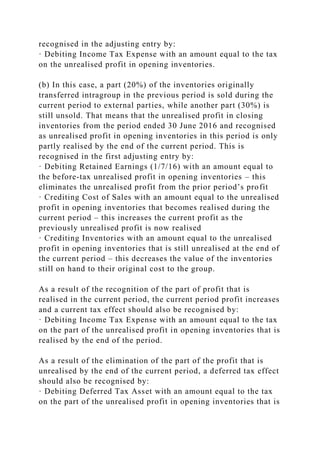
(a) In this case, the unrealised profit in closing inventories from
the period ended 30 June 2016 and recognised as unrealised
profit in opening inventories in this period becomes realised by
the end of the current period. As such, this profit needs to be
transferred from the previous period to the current period by:
· Debiting Retained Earnings (1/7/16) with an amount equal to
the after-tax unrealised profit in opening inventories – this
eliminates the unrealised profit from the prior period’s earnings
· Crediting Cost of Sales with an amount equal to the before-tax
unrealised profit in opening inventories – this increases the
current profit as the previously unrealised profit is now
realised.
As a result of this transfer of profit to the current period, the
current period profit increases and a tax effect should also be
recognised in the adjusting entry by:
· Debiting Income Tax Expense with an amount equal to the tax
on the unrealised profit in opening inventories.
(b) In this case, a part (20%) of the inventories originally
transferred intragroup in the previous period is sold during the
current period to external parties, while another part (30%) is
still unsold. That means that the unrealised profit in closing
inventories from the period ended 30 June 2016 and recognised
as unrealised profit in opening inventories in this period is only
partly realised by the end of the current period. This is
recognised in the first adjusting entry by:
· Debiting Retained Earnings (1/7/16) with an amount equal to
the before-tax unrealised profit in opening inventories – this
eliminates the unrealised profit from the prior period’s profit
· Crediting Cost of Sales with an amount equal to the unrealised
profit in opening inventories that becomes realised during the
current period – this increases the current profit as the
previously unrealised profit is now realised
· Crediting Inventories with an amount equal to the unrealised
profit in opening inventories that is still unrealised at the end of
the current period – this decreases the value of the inventories
still on hand to their original cost to the group.
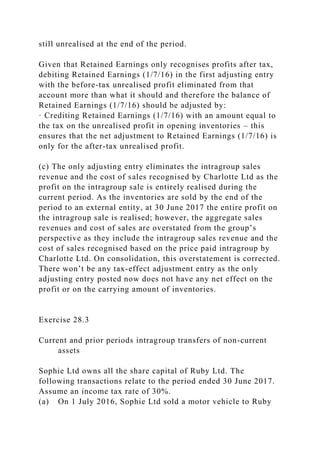
As a result of the recognition of the part of profit that is
realised in the current period, the current period profit increases
and a current tax effect should also be recognised by:
· Debiting Income Tax Expense with an amount equal to the tax
on the part of the unrealised profit in opening inventories that is
realised by the end of the period.
As a result of the elimination of the part of the profit that is
unrealised by the end of the current period, a deferred tax effect
should also be recognised by:
· Debiting Deferred Tax Asset with an amount equal to the tax
on the part of the unrealised profit in opening inventories that is
still unrealised at the end of the period.
Given that Retained Earnings only recognises profits after tax,
debiting Retained Earnings (1/7/16) in the first adjusting entry
with the before-tax unrealised profit eliminated from that
account more than what it should and therefore the balance of
Retained Earnings (1/7/16) should be adjusted by:
· Crediting Retained Earnings (1/7/16) with an amount equal to
the tax on the unrealised profit in opening inventories – this
ensures that the net adjustment to Retained Earnings (1/7/16) is
only for the after-tax unrealised profit.
(c) The only adjusting entry eliminates the intragroup sales
revenue and the cost of sales recognised by Charlotte Ltd as the
profit on the intragroup sale is entirely realised during the
current period. As the inventories are sold by the end of the
period to an external entity, at 30 June 2017 the entire profit on
the intragroup sale is realised; however, the aggregate sales
revenues and cost of sales are overstated from the group’s
perspective as they include the intragroup sales revenue and the
cost of sales recognised based on the price paid intragroup by
Charlotte Ltd. On consolidation, this overstatement is corrected.
There won’t be any tax-effect adjustment entry as the only
adjusting entry posted now does not have any net effect on the
profit or on the carrying amount of inventories.
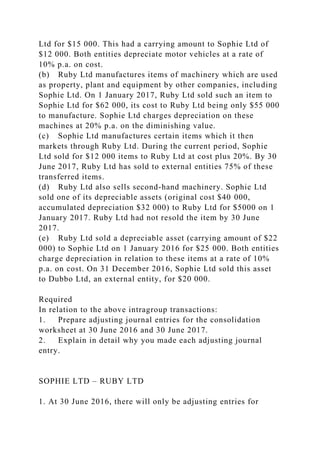
Exercise 28.3
Current and prior periods intragroup transfers of non-current
assets
Sophie Ltd owns all the share capital of Ruby Ltd. The
following transactions relate to the period ended 30 June 2017.
Assume an income tax rate of 30%.
(a) On 1 July 2016, Sophie Ltd sold a motor vehicle to Ruby
Ltd for $15 000. This had a carrying amount to Sophie Ltd of
$12 000. Both entities depreciate motor vehicles at a rate of
10% p.a. on cost.
(b) Ruby Ltd manufactures items of machinery which are used
as property, plant and equipment by other companies, including
Sophie Ltd. On 1 January 2017, Ruby Ltd sold such an item to
Sophie Ltd for $62 000, its cost to Ruby Ltd being only $55 000
to manufacture. Sophie Ltd charges depreciation on these
machines at 20% p.a. on the diminishing value.
(c) Sophie Ltd manufactures certain items which it then
markets through Ruby Ltd. During the current period, Sophie
Ltd sold for $12 000 items to Ruby Ltd at cost plus 20%. By 30
June 2017, Ruby Ltd has sold to external entities 75% of these
transferred items.
(d) Ruby Ltd also sells second-hand machinery. Sophie Ltd
sold one of its depreciable assets (original cost $40 000,
accumulated depreciation $32 000) to Ruby Ltd for $5000 on 1
January 2017. Ruby Ltd had not resold the item by 30 June
2017.
(e) Ruby Ltd sold a depreciable asset (carrying amount of $22
000) to Sophie Ltd on 1 January 2016 for $25 000. Both entities
charge depreciation in relation to these items at a rate of 10%
p.a. on cost. On 31 December 2016, Sophie Ltd sold this asset
to Dubbo Ltd, an external entity, for $20 000.
Required
In relation to the above intragroup transactions:
1. Prepare adjusting journal entries for the consolidation
worksheet at 30 June 2016 and 30 June 2017.
2. Explain in detail why you made each adjusting journal
entry.
SOPHIE LTD – RUBY LTD
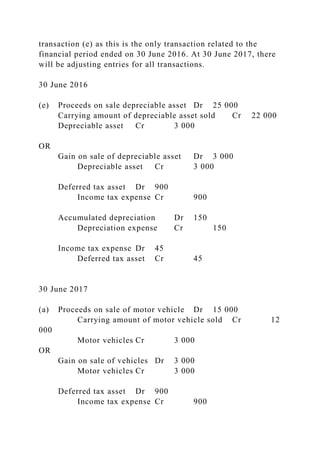
1. At 30 June 2016, there will only be adjusting entries for
transaction (e) as this is the only transaction related to the
financial period ended on 30 June 2016. At 30 June 2017, there
will be adjusting entries for all transactions.
30 June 2016
(e) Proceeds on sale depreciable asset Dr 25 000
Carrying amount of depreciable asset sold Cr 22 000
Depreciable asset Cr 3 000
OR
Gain on sale of depreciable asset Dr 3 000
Depreciable asset Cr 3 000
Deferred tax asset Dr 900
Income tax expense Cr 900
Accumulated depreciation Dr 150
Depreciation expense Cr 150
Income tax expense Dr 45
Deferred tax asset Cr 45
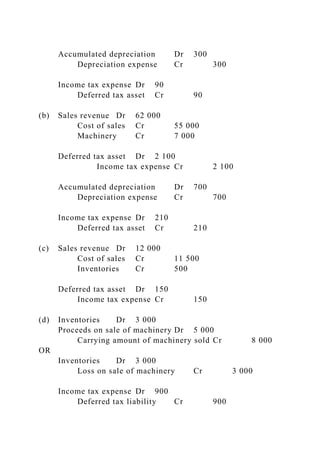
30 June 2017
(a) Proceeds on sale of motor vehicle Dr 15 000
Carrying amount of motor vehicle sold Cr 12
000
Motor vehicles Cr 3 000
OR
Gain on sale of vehicles Dr 3 000
Motor vehicles Cr 3 000
Deferred tax asset Dr 900
Income tax expense Cr 900
Accumulated depreciation Dr 300
Depreciation expense Cr 300
Income tax expense Dr 90
Deferred tax asset Cr 90
(b) Sales revenue Dr 62 000
Cost of sales Cr 55 000
Machinery Cr 7 000
Deferred tax asset Dr 2 100
Income tax expense Cr 2 100
Accumulated depreciation Dr 700
Depreciation expense Cr 700
Income tax expense Dr 210
Deferred tax asset Cr 210
(c) Sales revenue Dr 12 000
Cost of sales Cr 11 500
Inventories Cr 500
Deferred tax asset Dr 150
Income tax expense Cr 150
(d) Inventories Dr 3 000
Proceeds on sale of machinery Dr 5 000
Carrying amount of machinery sold Cr 8 000
OR
Inventories Dr 3 000
Loss on sale of machinery Cr 3 000
Income tax expense Dr 900
Deferred tax liability Cr 900
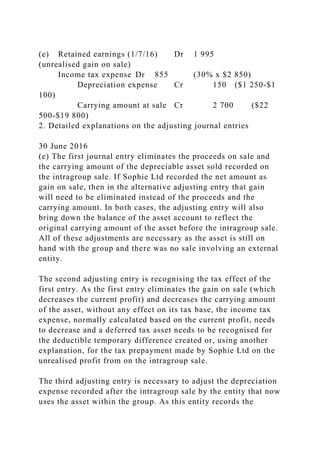
(e) Retained earnings (1/7/16) Dr 1 995
(unrealised gain on sale)
Income tax expense Dr 855 (30% x $2 850)
Depreciation expense Cr 150 ($1 250-$1
100)
Carrying amount at sale Cr 2 700 ($22
500-$19 800)
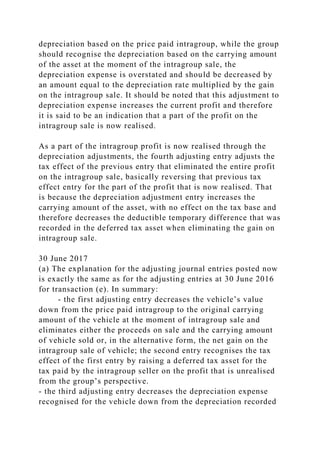
2. Detailed explanations on the adjusting journal entries
30 June 2016
(e) The first journal entry eliminates the proceeds on sale and
the carrying amount of the depreciable asset sold recorded on
the intragroup sale. If Sophie Ltd recorded the net amount as
gain on sale, then in the alternative adjusting entry that gain
will need to be eliminated instead of the proceeds and the
carrying amount. In both cases, the adjusting entry will also
bring down the balance of the asset account to reflect the
original carrying amount of the asset before the intragroup sale.
All of these adjustments are necessary as the asset is still on
hand with the group and there was no sale involving an external
entity.
The second adjusting entry is recognising the tax effect of the
first entry. As the first entry eliminates the gain on sale (which
decreases the current profit) and decreases the carrying amount
of the asset, without any effect on its tax base, the income tax
expense, normally calculated based on the current profit, needs
to decrease and a deferred tax asset needs to be recognised for
the deductible temporary difference created or, using another
explanation, for the tax prepayment made by Sophie Ltd on the
unrealised profit from on the intragroup sale.
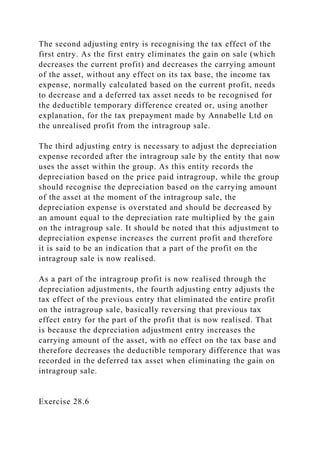
The third adjusting entry is necessary to adjust the depreciation
expense recorded after the intragroup sale by the entity that now
uses the asset within the group. As this entity records the
depreciation based on the price paid intragroup, while the group
should recognise the depreciation based on the carrying amount
of the asset at the moment of the intragroup sale, the
depreciation expense is overstated and should be decreased by
an amount equal to the depreciation rate multiplied by the gain
on the intragroup sale. It should be noted that this adjustment to
depreciation expense increases the current profit and therefore
it is said to be an indication that a part of the profit on the
intragroup sale is now realised.
As a part of the intragroup profit is now realised through the
depreciation adjustments, the fourth adjusting entry adjusts the
tax effect of the previous entry that eliminated the entire profit
on the intragroup sale, basically reversing that previous tax
effect entry for the part of the profit that is now realised. That
is because the depreciation adjustment entry increases the
carrying amount of the asset, with no effect on the tax base and
therefore decreases the deductible temporary difference that was
recorded in the deferred tax asset when eliminating the gain on
intragroup sale.
30 June 2017
(a) The explanation for the adjusting journal entries posted now
is exactly the same as for the adjusting entries at 30 June 2016
for transaction (e). In summary:
- the first adjusting entry decreases the vehicle’s value
down from the price paid intragroup to the original carrying
amount of the vehicle at the moment of intragroup sale and
eliminates either the proceeds on sale and the carrying amount
of vehicle sold or, in the alternative form, the net gain on the
intragroup sale of vehicle; the second entry recognises the tax
effect of the first entry by raising a deferred tax asset for the
tax paid by the intragroup seller on the profit that is unrealised
from the group’s perspective.
- the third adjusting entry decreases the depreciation expense
recognised for the vehicle down from the depreciation recorded
by the user of the vehicle (based on the intragroup price paid) to
the depreciation that should be recorded by the group (based on
the carrying amount of the vehicle at the moment of the
intragroup sale); the forth entry recognises the tax effect of the
third entry by decreasing the deferred tax asset recognised in
the second entry by the tax on the profit realised through the
depreciation adjustment.
(b) The explanation for the adjusting journal entries posted now
is similar to that for the adjusting entries at 30 June 2016 for
transaction (e). In summary:
- the first adjusting entry decreases the machine’s value
down from the price paid intragroup to the original carrying
amount of the machine at the moment of intragroup sale and
eliminates the sales revenue and the cost of sales recognised on
the intragroup sale, considering that the machine was
recognised by the initial owner as inventories; the second entry
recognises the tax effect of the first entry by raising a deferred
tax asset for the tax paid by the intragroup seller on the profit
that is unrealised from the group’s perspective.
- the third adjusting entry decreases the depreciation expense
recognised for the machine down from the depreciation recorded
by the user of the vehicle (based on the intragroup price paid) to
the depreciation that should be recorded by the group (based on
the carrying amount of the machine at the moment of the
intragroup sale); the fourth entry recognises the tax effect of the
third entry by decreasing the deferred tax asset recognised in
the second entry by the tax on the profit realised through the
depreciation adjustment.
It should be noted here that although the original classification
of the asset before the intragroup sale was inventories, there
won’t be any reclassification needed on consolidation as, from
the group’s perspective, the asset is going to be used as a
machine from the moment of the intragroup sale.
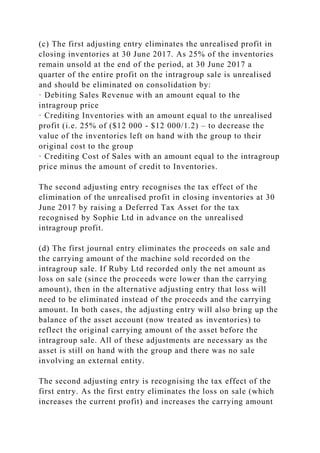
(c) The first adjusting entry eliminates the unrealised profit in
closing inventories at 30 June 2017. As 25% of the inventories
remain unsold at the end of the period, at 30 June 2017 a
quarter of the entire profit on the intragroup sale is unrealised
and should be eliminated on consolidation by:
· Debiting Sales Revenue with an amount equal to the
intragroup price
· Crediting Inventories with an amount equal to the unrealised
profit (i.e. 25% of ($12 000 - $12 000/1.2) – to decrease the
value of the inventories left on hand with the group to their
original cost to the group
· Crediting Cost of Sales with an amount equal to the intragroup
price minus the amount of credit to Inventories.
The second adjusting entry recognises the tax effect of the
elimination of the unrealised profit in closing inventories at 30
June 2017 by raising a Deferred Tax Asset for the tax
recognised by Sophie Ltd in advance on the unrealised
intragroup profit.
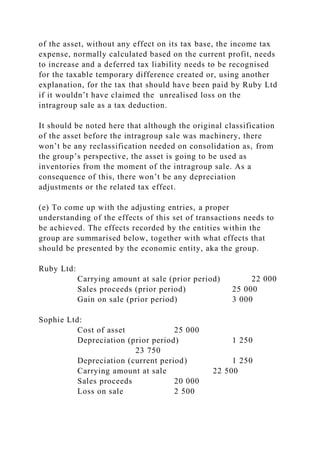
(d) The first journal entry eliminates the proceeds on sale and
the carrying amount of the machine sold recorded on the
intragroup sale. If Ruby Ltd recorded only the net amount as
loss on sale (since the proceeds were lower than the carrying
amount), then in the alternative adjusting entry that loss will
need to be eliminated instead of the proceeds and the carrying
amount. In both cases, the adjusting entry will also bring up the
balance of the asset account (now treated as inventories) to
reflect the original carrying amount of the asset before the
intragroup sale. All of these adjustments are necessary as the
asset is still on hand with the group and there was no sale
involving an external entity.
The second adjusting entry is recognising the tax effect of the
first entry. As the first entry eliminates the loss on sale (which
increases the current profit) and increases the carrying amount
of the asset, without any effect on its tax base, the income tax
expense, normally calculated based on the current profit, needs
to increase and a deferred tax liability needs to be recognised
for the taxable temporary difference created or, using another
explanation, for the tax that should have been paid by Ruby Ltd
if it wouldn’t have claimed the unrealised loss on the
intragroup sale as a tax deduction.
It should be noted here that although the original classification
of the asset before the intragroup sale was machinery, there
won’t be any reclassification needed on consolidation as, from
the group’s perspective, the asset is going to be used as
inventories from the moment of the intragroup sale. As a
consequence of this, there won’t be any depreciation
adjustments or the related tax effect.
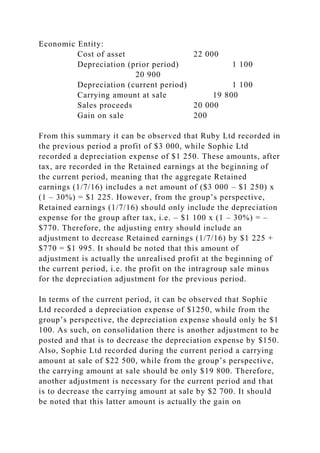
(e) To come up with the adjusting entries, a proper
understanding of the effects of this set of transactions needs to
be achieved. The effects recorded by the entities within the
group are summarised below, together with what effects that
should be presented by the economic entity, aka the group.
Ruby Ltd:
Carrying amount at sale (prior period) 22 000
Sales proceeds (prior period) 25 000
Gain on sale (prior period) 3 000
Sophie Ltd:
Cost of asset 25 000
Depreciation (prior period) 1 250
23 750
Depreciation (current period) 1 250
Carrying amount at sale 22 500
Sales proceeds 20 000
Loss on sale 2 500
Economic Entity:
Cost of asset 22 000
Depreciation (prior period) 1 100
20 900
Depreciation (current period) 1 100
Carrying amount at sale 19 800
Sales proceeds 20 000
Gain on sale 200
From this summary it can be observed that Ruby Ltd recorded in
the previous period a profit of $3 000, while Sophie Ltd
recorded a depreciation expense of $1 250. These amounts, after
tax, are recorded in the Retained earnings at the beginning of
the current period, meaning that the aggregate Retained
earnings (1/7/16) includes a net amount of ($3 000 – $1 250) x
(1 – 30%) = $1 225. However, from the group’s perspective,
Retained earnings (1/7/16) should only include the depreciation
expense for the group after tax, i.e. – $1 100 x (1 – 30%) = –
$770. Therefore, the adjusting entry should include an
adjustment to decrease Retained earnings (1/7/16) by $1 225 +
$770 = $1 995. It should be noted that this amount of
adjustment is actually the unrealised profit at the beginning of
the current period, i.e. the profit on the intragroup sale minus
for the depreciation adjustment for the previous period.
In terms of the current period, it can be observed that Sophie
Ltd recorded a depreciation expense of $1250, while from the
group’s perspective, the depreciation expense should only be $1
100. As such, on consolidation there is another adjustment to be
posted and that is to decrease the depreciation expense by $150.
Also, Sophie Ltd recorded during the current period a carrying
amount at sale of $22 500, while from the group’s perspective,
the carrying amount at sale should be only $19 800. Therefore,
another adjustment is necessary for the current period and that
is to decrease the carrying amount at sale by $2 700. It should
be noted that this latter amount is actually the gain on
intergroup sale that was not realised through the depreciation
adjustments ($150 during the prior period and $150 during the
current period), but it is realised through the sale to the external
entity during the current period.
In the end, considering that the adjustments for the current
period (to the depreciation expense and carrying amount at sale)
increase the current profit (by the realised profit), a tax effect
should be recognised as increasing the income tax expense for
the current period.
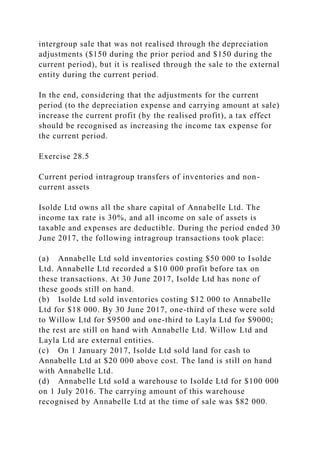
Exercise 28.5
Current period intragroup transfers of inventories and non-
current assets
Isolde Ltd owns all the share capital of Annabelle Ltd. The
income tax rate is 30%, and all income on sale of assets is
taxable and expenses are deductible. During the period ended 30
June 2017, the following intragroup transactions took place:
(a) Annabelle Ltd sold inventories costing $50 000 to Isolde
Ltd. Annabelle Ltd recorded a $10 000 profit before tax on
these transactions. At 30 June 2017, Isolde Ltd has none of
these goods still on hand.
(b) Isolde Ltd sold inventories costing $12 000 to Annabelle
Ltd for $18 000. By 30 June 2017, one-third of these were sold
to Willow Ltd for $9500 and one-third to Layla Ltd for $9000;
the rest are still on hand with Annabelle Ltd. Willow Ltd and
Layla Ltd are external entities.
(c) On 1 January 2017, Isolde Ltd sold land for cash to
Annabelle Ltd at $20 000 above cost. The land is still on hand
with Annabelle Ltd.
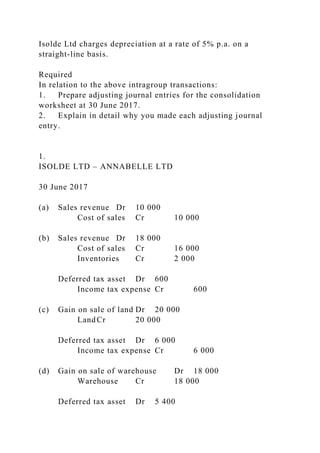
(d) Annabelle Ltd sold a warehouse to Isolde Ltd for $100 000
on 1 July 2016. The carrying amount of this warehouse
recognised by Annabelle Ltd at the time of sale was $82 000.
Isolde Ltd charges depreciation at a rate of 5% p.a. on a
straight-line basis.
Required
In relation to the above intragroup transactions:
1. Prepare adjusting journal entries for the consolidation
worksheet at 30 June 2017.
2. Explain in detail why you made each adjusting journal
entry.
1.
ISOLDE LTD – ANNABELLE LTD
30 June 2017
(a) Sales revenue Dr 10 000
Cost of sales Cr 10 000
(b) Sales revenue Dr 18 000
Cost of sales Cr 16 000
Inventories Cr 2 000
Deferred tax asset Dr 600
Income tax expense Cr 600
(c) Gain on sale of land Dr 20 000
Land Cr 20 000
Deferred tax asset Dr 6 000
Income tax expense Cr 6 000
(d) Gain on sale of warehouse Dr 18 000
Warehouse Cr 18 000
Deferred tax asset Dr 5 400
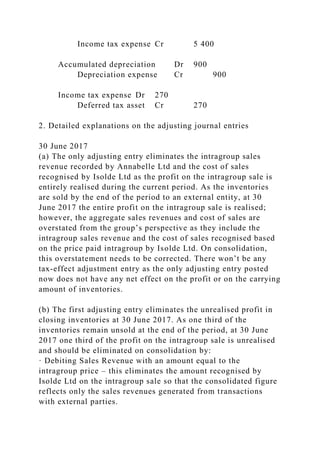
Income tax expense Cr 5 400
Accumulated depreciation Dr 900
Depreciation expense Cr 900
Income tax expense Dr 270
Deferred tax asset Cr 270
2. Detailed explanations on the adjusting journal entries
30 June 2017
(a) The only adjusting entry eliminates the intragroup sales
revenue recorded by Annabelle Ltd and the cost of sales
recognised by Isolde Ltd as the profit on the intragroup sale is
entirely realised during the current period. As the inventories
are sold by the end of the period to an external entity, at 30
June 2017 the entire profit on the intragroup sale is realised;
however, the aggregate sales revenues and cost of sales are
overstated from the group’s perspective as they include the
intragroup sales revenue and the cost of sales recognised based
on the price paid intragroup by Isolde Ltd. On consolidation,
this overstatement needs to be corrected. There won’t be any
tax-effect adjustment entry as the only adjusting entry posted
now does not have any net effect on the profit or on the carrying
amount of inventories.
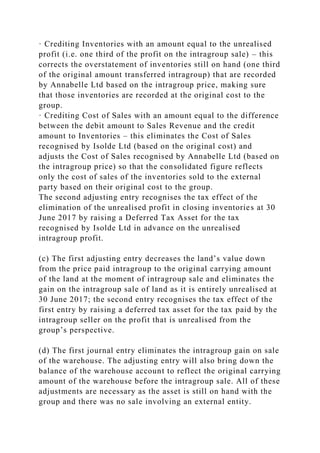
(b) The first adjusting entry eliminates the unrealised profit in
closing inventories at 30 June 2017. As one third of the
inventories remain unsold at the end of the period, at 30 June
2017 one third of the profit on the intragroup sale is unrealised
and should be eliminated on consolidation by:
· Debiting Sales Revenue with an amount equal to the
intragroup price – this eliminates the amount recognised by
Isolde Ltd on the intragroup sale so that the consolidated figure
reflects only the sales revenues generated from transactions
with external parties.
· Crediting Inventories with an amount equal to the unrealised
profit (i.e. one third of the profit on the intragroup sale) – this
corrects the overstatement of inventories still on hand (one third
of the original amount transferred intragroup) that are recorded
by Annabelle Ltd based on the intragroup price, making sure
that those inventories are recorded at the original cost to the
group.
· Crediting Cost of Sales with an amount equal to the difference
between the debit amount to Sales Revenue and the credit
amount to Inventories – this eliminates the Cost of Sales
recognised by Isolde Ltd (based on the original cost) and
adjusts the Cost of Sales recognised by Annabelle Ltd (based on
the intragroup price) so that the consolidated figure reflects
only the cost of sales of the inventories sold to the external
party based on their original cost to the group.
The second adjusting entry recognises the tax effect of the
elimination of the unrealised profit in closing inventories at 30
June 2017 by raising a Deferred Tax Asset for the tax
recognised by Isolde Ltd in advance on the unrealised
intragroup profit.
(c) The first adjusting entry decreases the land’s value down
from the price paid intragroup to the original carrying amount
of the land at the moment of intragroup sale and eliminates the
gain on the intragroup sale of land as it is entirely unrealised at
30 June 2017; the second entry recognises the tax effect of the
first entry by raising a deferred tax asset for the tax paid by the
intragroup seller on the profit that is unrealised from the
group’s perspective.
(d) The first journal entry eliminates the intragroup gain on sale
of the warehouse. The adjusting entry will also bring down the
balance of the warehouse account to reflect the original carrying
amount of the warehouse before the intragroup sale. All of these
adjustments are necessary as the asset is still on hand with the
group and there was no sale involving an external entity.
The second adjusting entry is recognising the tax effect of the
first entry. As the first entry eliminates the gain on sale (which
decreases the current profit) and decreases the carrying amount
of the asset, without any effect on its tax base, the income tax
expense, normally calculated based on the current profit, needs
to decrease and a deferred tax asset needs to be recognised for
the deductible temporary difference created or, using another
explanation, for the tax prepayment made by Annabelle Ltd on
the unrealised profit from the intragroup sale.
The third adjusting entry is necessary to adjust the depreciation
expense recorded after the intragroup sale by the entity that now
uses the asset within the group. As this entity records the
depreciation based on the price paid intragroup, while the group
should recognise the depreciation based on the carrying amount
of the asset at the moment of the intragroup sale, the
depreciation expense is overstated and should be decreased by
an amount equal to the depreciation rate multiplied by the gain
on the intragroup sale. It should be noted that this adjustment to
depreciation expense increases the current profit and therefore
it is said to be an indication that a part of the profit on the
intragroup sale is now realised.
As a part of the intragroup profit is now realised through the
depreciation adjustments, the fourth adjusting entry adjusts the
tax effect of the previous entry that eliminated the entire profit
on the intragroup sale, basically reversing that previous tax
effect entry for the part of the profit that is now realised. That
is because the depreciation adjustment entry increases the
carrying amount of the asset, with no effect on the tax base and
therefore decreases the deductible temporary difference that was
recorded in the deferred tax asset when eliminating the gain on
intragroup sale.
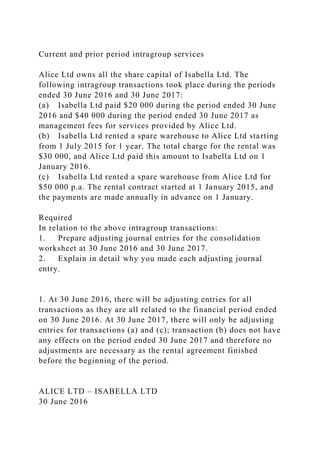
Exercise 28.6
Current and prior period intragroup services
Alice Ltd owns all the share capital of Isabella Ltd. The
following intragroup transactions took place during the periods
ended 30 June 2016 and 30 June 2017:
(a) Isabella Ltd paid $20 000 during the period ended 30 June
2016 and $40 000 during the period ended 30 June 2017 as
management fees for services provided by Alice Ltd.
(b) Isabella Ltd rented a spare warehouse to Alice Ltd starting
from 1 July 2015 for 1 year. The total charge for the rental was
$30 000, and Alice Ltd paid this amount to Isabella Ltd on 1
January 2016.
(c) Isabella Ltd rented a spare warehouse from Alice Ltd for
$50 000 p.a. The rental contract started at 1 January 2015, and
the payments are made annually in advance on 1 January.
Required
In relation to the above intragroup transactions:
1. Prepare adjusting journal entries for the consolidation
worksheet at 30 June 2016 and 30 June 2017.
2. Explain in detail why you made each adjusting journal
entry.
1. At 30 June 2016, there will be adjusting entries for all
transactions as they are all related to the financial period ended
on 30 June 2016. At 30 June 2017, there will only be adjusting
entries for transactions (a) and (c); transaction (b) does not have
any effects on the period ended 30 June 2017 and therefore no
adjustments are necessary as the rental agreement finished
before the beginning of the period.
ALICE LTD – ISABELLA LTD
30 June 2016
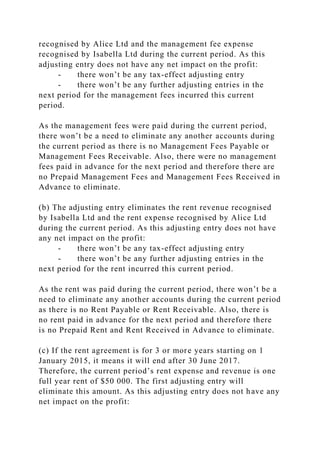
(a) Management fees revenues Dr 20 000
Management fee expenses Cr 20 000
(b) Rent revenues Dr 30 000
Rent expenses Cr 30 000
(c) Rent revenues Dr 50 000
Rent expenses Cr 50 000
Rent received in advance Dr 25 000
Prepaid rent Cr 25 000
30 June 2017
(a) Management fees revenues Dr 40 000
Management fee expenses Cr 40 000
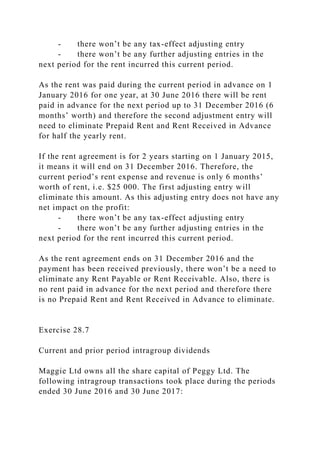
(c) If the rental agreement is for 3 or more years, the adjusting
entries would be:
Rent revenues Dr 50 000
Rent expenses Cr 50 000
Rent received in advance Dr 25 000
Prepaid rent Cr 25 000
If the rental agreement is only for 2 years and ends on 31
December 2016, the adjusting entries would be:
Rent revenues Dr 25 000
Rent expenses Cr 25 000
2. Detailed explanations on the adjusting journal entries
30 June 2016
(a) The adjusting entry eliminates the management fee revenue
recognised by Alice Ltd and the management fee expense
recognised by Isabella Ltd during the current period. As this
adjusting entry does not have any net impact on the profit:
- there won’t be any tax-effect adjusting entry
- there won’t be any further adjusting entries in the
next period for the management fees incurred this current
period.
As the management fees were paid during the current period,
there won’t be a need to eliminate any another accounts during
the current period as there is no Management Fees Payable or
Management Fees Receivable. Also, there were no management
fees paid in advance for the next period and therefore there are
no Prepaid Management Fees and Management Fees Received in
Advance to eliminate.
(b) The adjusting entry eliminates the rent revenue recognised
by Isabella Ltd and the rent expense recognised by Alice Ltd
during the current period. As this adjusting entry does not have
any net impact on the profit:
- there won’t be any tax-effect adjusting entry
- there won’t be any further adjusting entries in the
next period for the rent incurred this current period.
As the rent was paid during the current period, there won’t be a
need to eliminate any another accounts during the current period
as there is no Rent Payable or Rent Receivable. Also, there is
no rent paid in advance for the next period and therefore there
is no Prepaid Rent and Rent Received in Advance to eliminate.
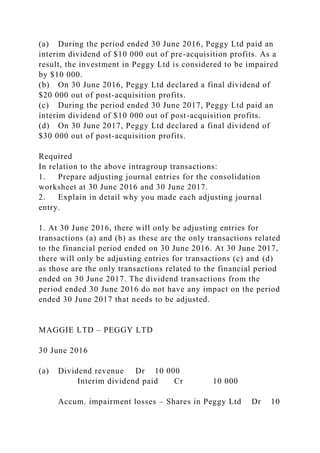
(c) If the rent agreement is for 3 or more years starting on 1
January 2015, it means it will end after 30 June 2017.
Therefore, the current period’s rent expense and revenue is one
full year rent of $50 000. The first adjusting entry will
eliminate this amount. As this adjusting entry does not have any
net impact on the profit:
- there won’t be any tax-effect adjusting entry
- there won’t be any further adjusting entries in the
next period for the rent incurred this current period.
As the rent was paid during the current period in advance on 1
January 2016 for one year, at 30 June 2016 there will be rent
paid in advance for the next period up to 31 December 2016 (6
months’ worth) and therefore the second adjustment entry will
need to eliminate Prepaid Rent and Rent Received in Advance
for half the yearly rent.
If the rent agreement is for 2 years starting on 1 January 2015,
it means it will end on 31 December 2016. Therefore, the
current period’s rent expense and revenue is only 6 months’
worth of rent, i.e. $25 000. The first adjusting entry will
eliminate this amount. As this adjusting entry does not have any
net impact on the profit:
- there won’t be any tax-effect adjusting entry
- there won’t be any further adjusting entries in the
next period for the rent incurred this current period.
As the rent agreement ends on 31 December 2016 and the
payment has been received previously, there won’t be a need to
eliminate any Rent Payable or Rent Receivable. Also, there is
no rent paid in advance for the next period and therefore there
is no Prepaid Rent and Rent Received in Advance to eliminate.
Exercise 28.7
Current and prior period intragroup dividends
Maggie Ltd owns all the share capital of Peggy Ltd. The
following intragroup transactions took place during the periods
ended 30 June 2016 and 30 June 2017:
(a) During the period ended 30 June 2016, Peggy Ltd paid an
interim dividend of $10 000 out of pre-acquisition profits. As a
result, the investment in Peggy Ltd is considered to be impaired
by $10 000.
(b) On 30 June 2016, Peggy Ltd declared a final dividend of
$20 000 out of post-acquisition profits.
(c) During the period ended 30 June 2017, Peggy Ltd paid an
interim dividend of $10 000 out of post-acquisition profits.
(d) On 30 June 2017, Peggy Ltd declared a final dividend of
$30 000 out of post-acquisition profits.
Required
In relation to the above intragroup transactions:
1. Prepare adjusting journal entries for the consolidation
worksheet at 30 June 2016 and 30 June 2017.
2. Explain in detail why you made each adjusting journal
entry.
1. At 30 June 2016, there will only be adjusting entries for
transactions (a) and (b) as these are the only transactions related
to the financial period ended on 30 June 2016. At 30 June 2017,
there will only be adjusting entries for transactions (c) and (d)
as those are the only transactions related to the financial period
ended on 30 June 2017. The dividend transactions from the
period ended 30 June 2016 do not have any impact on the period
ended 30 June 2017 that needs to be adjusted.
MAGGIE LTD – PEGGY LTD
30 June 2016
(a) Dividend revenue Dr 10 000
Interim dividend paid Cr 10 000
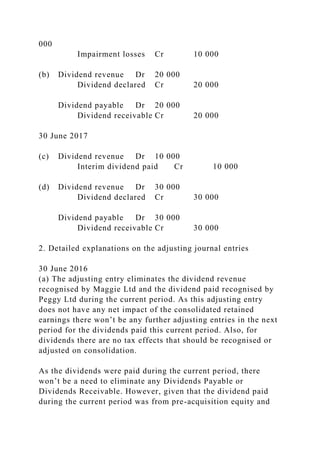
Accum. impairment losses – Shares in Peggy Ltd Dr 10
000
Impairment losses Cr 10 000
(b) Dividend revenue Dr 20 000
Dividend declared Cr 20 000
Dividend payable Dr 20 000
Dividend receivable Cr 20 000
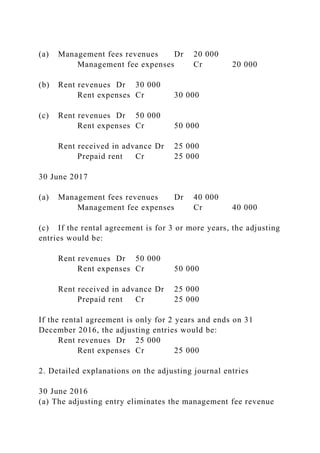
30 June 2017
(c) Dividend revenue Dr 10 000
Interim dividend paid Cr 10 000
(d) Dividend revenue Dr 30 000
Dividend declared Cr 30 000
Dividend payable Dr 30 000
Dividend receivable Cr 30 000
2. Detailed explanations on the adjusting journal entries
30 June 2016
(a) The adjusting entry eliminates the dividend revenue
recognised by Maggie Ltd and the dividend paid recognised by
Peggy Ltd during the current period. As this adjusting entry
does not have any net impact of the consolidated retained
earnings there won’t be any further adjusting entries in the next
period for the dividends paid this current period. Also, for
dividends there are no tax effects that should be recognised or
adjusted on consolidation.
As the dividends were paid during the current period, there
won’t be a need to eliminate any Dividends Payable or
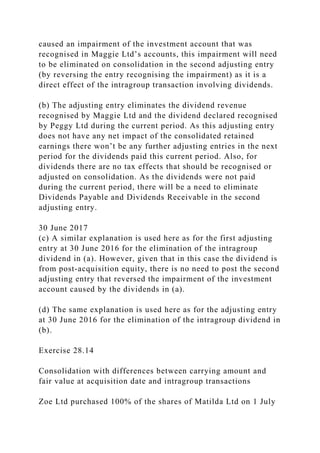
Dividends Receivable. However, given that the dividend paid
during the current period was from pre-acquisition equity and
caused an impairment of the investment account that was
recognised in Maggie Ltd’s accounts, this impairment will need
to be eliminated on consolidation in the second adjusting entry
(by reversing the entry recognising the impairment) as it is a
direct effect of the intragroup transaction involving dividends.
(b) The adjusting entry eliminates the dividend revenue
recognised by Maggie Ltd and the dividend declared recognised
by Peggy Ltd during the current period. As this adjusting entry
does not have any net impact of the consolidated retained
earnings there won’t be any further adjusting entries in the next
period for the dividends paid this current period. Also, for
dividends there are no tax effects that should be recognised or
adjusted on consolidation. As the dividends were not paid
during the current period, there will be a need to eliminate
Dividends Payable and Dividends Receivable in the second
adjusting entry.
30 June 2017
(c) A similar explanation is used here as for the first adjusting
entry at 30 June 2016 for the elimination of the intragroup
dividend in (a). However, given that in this case the dividend is
from post-acquisition equity, there is no need to post the second
adjusting entry that reversed the impairment of the investment
account caused by the dividends in (a).
(d) The same explanation is used here as for the adjusting entry
at 30 June 2016 for the elimination of the intragroup dividend in
(b).
Exercise 28.14
Consolidation with differences between carrying amount and
fair value at acquisition date and intragroup transactions
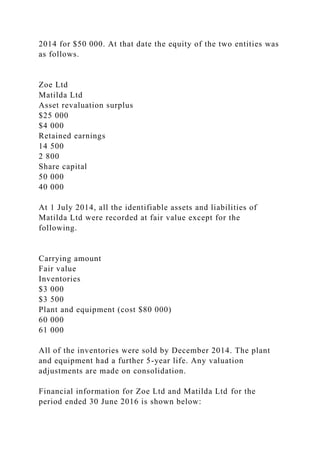
Zoe Ltd purchased 100% of the shares of Matilda Ltd on 1 July
2014 for $50 000. At that date the equity of the two entities was
as follows.
Zoe Ltd
Matilda Ltd
Asset revaluation surplus
$25 000
$4 000
Retained earnings
14 500
2 800
Share capital
50 000
40 000
At 1 July 2014, all the identifiable assets and liabilities of
Matilda Ltd were recorded at fair value except for the
following.
Carrying amount
Fair value
Inventories
$3 000
$3 500
Plant and equipment (cost $80 000)
60 000
61 000
All of the inventories were sold by December 2014. The plant
and equipment had a further 5-year life. Any valuation
adjustments are made on consolidation.
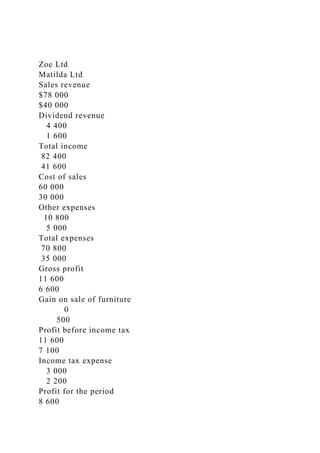
Financial information for Zoe Ltd and Matilda Ltd for the
period ended 30 June 2016 is shown below:
Zoe Ltd
Matilda Ltd
Sales revenue
$78 000
$40 000
Dividend revenue
4 400
1 600
Total income
82 400
41 600
Cost of sales
60 000
30 000
Other expenses
10 800
5 000
Total expenses
70 800
35 000
Gross profit
11 600
6 600
Gain on sale of furniture
0
500
Profit before income tax
11 600
7 100
Income tax expense
3 000
2 200
Profit for the period
8 600
4 900
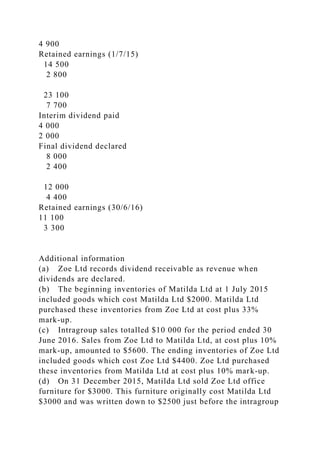
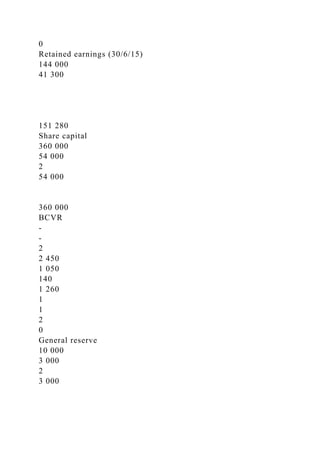
Retained earnings (1/7/15)
14 500
2 800
23 100
7 700
Interim dividend paid
4 000
2 000
Final dividend declared
8 000
2 400
12 000
4 400
Retained earnings (30/6/16)
11 100
3 300
Additional information
(a) Zoe Ltd records dividend receivable as revenue when
dividends are declared.
(b) The beginning inventories of Matilda Ltd at 1 July 2015
included goods which cost Matilda Ltd $2000. Matilda Ltd
purchased these inventories from Zoe Ltd at cost plus 33%
mark-up.
(c) Intragroup sales totalled $10 000 for the period ended 30
June 2016. Sales from Zoe Ltd to Matilda Ltd, at cost plus 10%
mark-up, amounted to $5600. The ending inventories of Zoe Ltd
included goods which cost Zoe Ltd $4400. Zoe Ltd purchased
these inventories from Matilda Ltd at cost plus 10% mark-up.
(d) On 31 December 2015, Matilda Ltd sold Zoe Ltd office
furniture for $3000. This furniture originally cost Matilda Ltd
$3000 and was written down to $2500 just before the intragroup
sale. Zoe Ltd depreciates furniture at the rate of 10% p.a. on
cost.
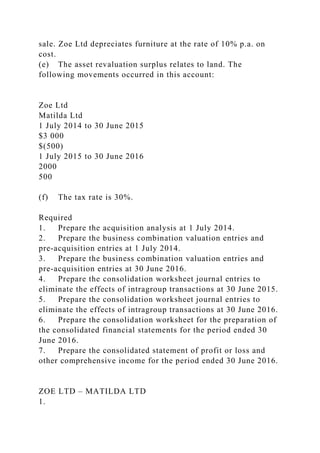
(e) The asset revaluation surplus relates to land. The
following movements occurred in this account:
Zoe Ltd
Matilda Ltd
1 July 2014 to 30 June 2015
$3 000
$(500)
1 July 2015 to 30 June 2016
2000
500
(f) The tax rate is 30%.
Required
1. Prepare the acquisition analysis at 1 July 2014.
2. Prepare the business combination valuation entries and
pre-acquisition entries at 1 July 2014.
3. Prepare the business combination valuation entries and
pre-acquisition entries at 30 June 2016.
4. Prepare the consolidation worksheet journal entries to
eliminate the effects of intragroup transactions at 30 June 2015.
5. Prepare the consolidation worksheet journal entries to
eliminate the effects of intragroup transactions at 30 June 2016.
6. Prepare the consolidation worksheet for the preparation of
the consolidated financial statements for the period ended 30
June 2016.
7. Prepare the consolidated statement of profit or loss and
other comprehensive income for the period ended 30 June 2016.
ZOE LTD – MATILDA LTD
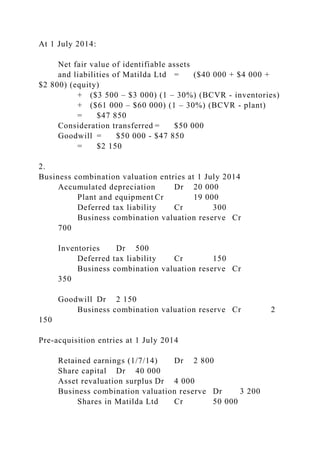
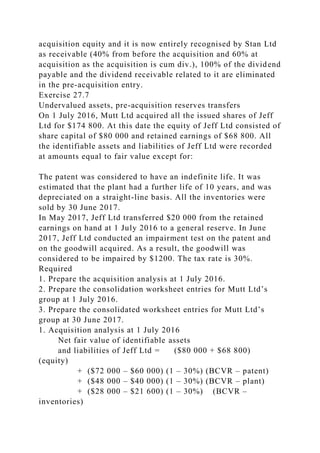
1.
At 1 July 2014:
Net fair value of identifiable assets
and liabilities of Matilda Ltd = ($40 000 + $4 000 +
$2 800) (equity)
+ ($3 500 – $3 000) (1 – 30%) (BCVR - inventories)
+ ($61 000 – $60 000) (1 – 30%) (BCVR - plant)
= $47 850
Consideration transferred = $50 000
Goodwill = $50 000 - $47 850
= $2 150
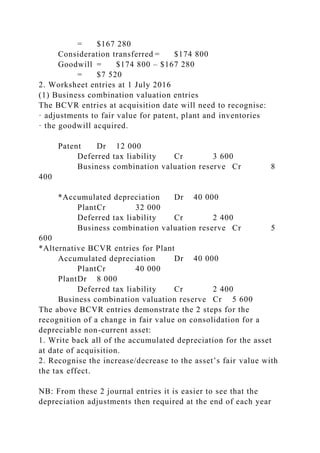
2.
Business combination valuation entries at 1 July 2014
Accumulated depreciation Dr 20 000
Plant and equipment Cr 19 000
Deferred tax liability Cr 300
Business combination valuation reserve Cr
700
Inventories Dr 500
Deferred tax liability Cr 150
Business combination valuation reserve Cr
350
Goodwill Dr 2 150
Business combination valuation reserve Cr 2
150
Pre-acquisition entries at 1 July 2014
Retained earnings (1/7/14) Dr 2 800
Share capital Dr 40 000
Asset revaluation surplus Dr 4 000
Business combination valuation reserve Dr 3 200
Shares in Matilda Ltd Cr 50 000
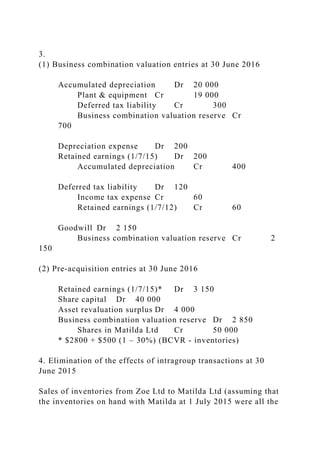
3.
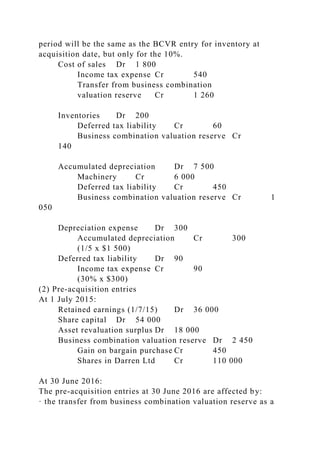
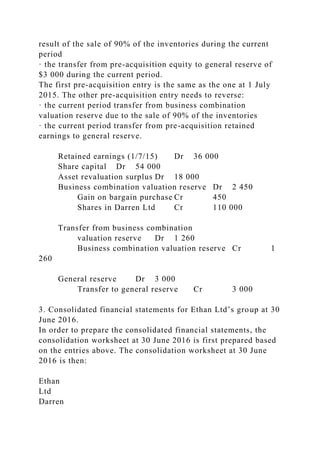
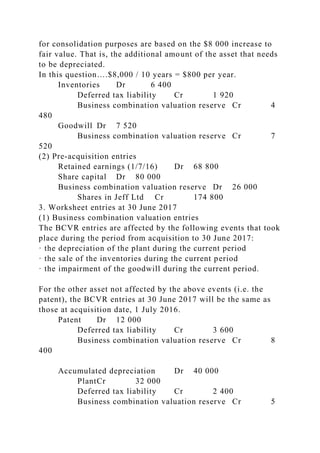
(1) Business combination valuation entries at 30 June 2016
Accumulated depreciation Dr 20 000
Plant & equipment Cr 19 000
Deferred tax liability Cr 300
Business combination valuation reserve Cr
700
Depreciation expense Dr 200
Retained earnings (1/7/15) Dr 200
Accumulated depreciation Cr 400
Deferred tax liability Dr 120
Income tax expense Cr 60
Retained earnings (1/7/12) Cr 60
Goodwill Dr 2 150
Business combination valuation reserve Cr 2
150
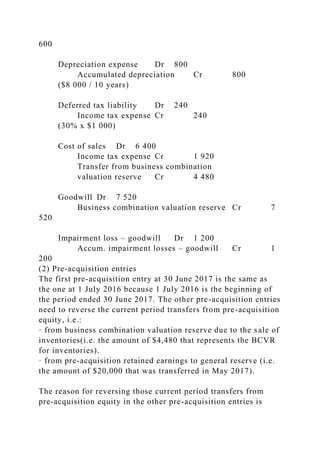
(2) Pre-acquisition entries at 30 June 2016
Retained earnings (1/7/15)* Dr 3 150
Share capital Dr 40 000
Asset revaluation surplus Dr 4 000
Business combination valuation reserve Dr 2 850
Shares in Matilda Ltd Cr 50 000
* $2800 + $500 (1 – 30%) (BCVR - inventories)
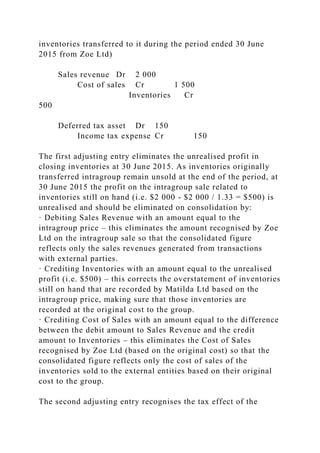
4. Elimination of the effects of intragroup transactions at 30
June 2015
Sales of inventories from Zoe Ltd to Matilda Ltd (assuming that
the inventories on hand with Matilda at 1 July 2015 were all the
inventories transferred to it during the period ended 30 June
2015 from Zoe Ltd)
Sales revenue Dr 2 000
Cost of sales Cr 1 500
Inventories Cr
500
Deferred tax asset Dr 150
Income tax expense Cr 150
The first adjusting entry eliminates the unrealised profit in
closing inventories at 30 June 2015. As inventories originally
transferred intragroup remain unsold at the end of the period, at
30 June 2015 the profit on the intragroup sale related to
inventories still on hand (i.e. $2 000 - $2 000 / 1.33 = $500) is
unrealised and should be eliminated on consolidation by:
· Debiting Sales Revenue with an amount equal to the
intragroup price – this eliminates the amount recognised by Zoe
Ltd on the intragroup sale so that the consolidated figure
reflects only the sales revenues generated from transactions
with external parties.
· Crediting Inventories with an amount equal to the unrealised
profit (i.e. $500) – this corrects the overstatement of inventories
still on hand that are recorded by Matilda Ltd based on the
intragroup price, making sure that those inventories are
recorded at the original cost to the group.
· Crediting Cost of Sales with an amount equal to the difference
between the debit amount to Sales Revenue and the credit
amount to Inventories – this eliminates the Cost of Sales
recognised by Zoe Ltd (based on the original cost) so that the
consolidated figure reflects only the cost of sales of the
inventories sold to the external entities based on their original
cost to the group.
The second adjusting entry recognises the tax effect of the
elimination of the unrealised profit in closing inventories at 30
June 2015 by raising a Deferred Tax Asset for the tax
recognised by Zoe Ltd in advance on the unrealised intragroup
profit.
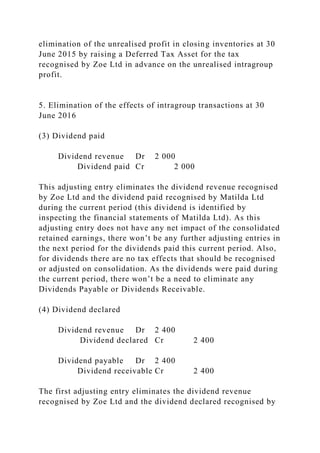
5. Elimination of the effects of intragroup transactions at 30
June 2016
(3) Dividend paid
Dividend revenue Dr 2 000
Dividend paid Cr 2 000
This adjusting entry eliminates the dividend revenue recognised
by Zoe Ltd and the dividend paid recognised by Matilda Ltd
during the current period (this dividend is identified by
inspecting the financial statements of Matilda Ltd). As this
adjusting entry does not have any net impact of the consolidated
retained earnings, there won’t be any further adjusting entries in
the next period for the dividends paid this current period. Also,
for dividends there are no tax effects that should be recognised
or adjusted on consolidation. As the dividends were paid during
the current period, there won’t be a need to eliminate any
Dividends Payable or Dividends Receivable.
(4) Dividend declared
Dividend revenue Dr 2 400
Dividend declared Cr 2 400
Dividend payable Dr 2 400
Dividend receivable Cr 2 400
The first adjusting entry eliminates the dividend revenue
recognised by Zoe Ltd and the dividend declared recognised by
Matilda Ltd during the current period (this dividend is also
identified by inspecting the financial statements of Matilda
Ltd). As this adjusting entry does not have any net impact of the
consolidated retained earnings there won’t be any further
adjusting entries in the next period for the dividends paid this
current period. Also, for dividends there are no tax effects that
should be recognised or adjusted on consolidation. As the
dividends were not paid during the current period, there will be
a need to eliminate Dividends Payable and Dividends
Receivable in the second adjusting entry.
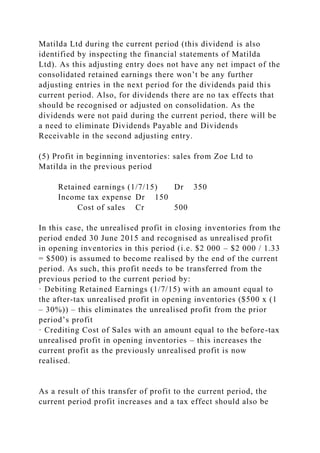
(5) Profit in beginning inventories: sales from Zoe Ltd to
Matilda in the previous period
Retained earnings (1/7/15) Dr 350
Income tax expense Dr 150
Cost of sales Cr 500
In this case, the unrealised profit in closing inventories from the
period ended 30 June 2015 and recognised as unrealised profit
in opening inventories in this period (i.e. $2 000 – $2 000 / 1.33
= $500) is assumed to become realised by the end of the current
period. As such, this profit needs to be transferred from the
previous period to the current period by:
· Debiting Retained Earnings (1/7/15) with an amount equal to
the after-tax unrealised profit in opening inventories ($500 x (1
– 30%)) – this eliminates the unrealised profit from the prior
period’s profit
· Crediting Cost of Sales with an amount equal to the before-tax
unrealised profit in opening inventories – this increases the
current profit as the previously unrealised profit is now
realised.
As a result of this transfer of profit to the current period, the
current period profit increases and a tax effect should also be
recognised in the adjusting entry by:
· Debiting Income Tax Expense with an amount equal to the tax
on the unrealised profit in opening inventories.
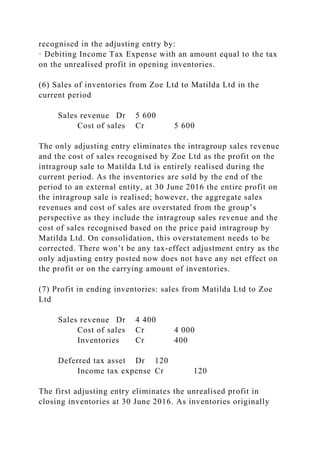
(6) Sales of inventories from Zoe Ltd to Matilda Ltd in the
current period
Sales revenue Dr 5 600
Cost of sales Cr 5 600
The only adjusting entry eliminates the intragroup sales revenue
and the cost of sales recognised by Zoe Ltd as the profit on the
intragroup sale to Matilda Ltd is entirely realised during the
current period. As the inventories are sold by the end of the
period to an external entity, at 30 June 2016 the entire profit on
the intragroup sale is realised; however, the aggregate sales
revenues and cost of sales are overstated from the group’s
perspective as they include the intragroup sales revenue and the
cost of sales recognised based on the price paid intragroup by
Matilda Ltd. On consolidation, this overstatement needs to be
corrected. There won’t be any tax-effect adjustment entry as the
only adjusting entry posted now does not have any net effect on
the profit or on the carrying amount of inventories.
(7) Profit in ending inventories: sales from Matilda Ltd to Zoe
Ltd
Sales revenue Dr 4 400
Cost of sales Cr 4 000
Inventories Cr 400
Deferred tax asset Dr 120
Income tax expense Cr 120
The first adjusting entry eliminates the unrealised profit in
closing inventories at 30 June 2016. As inventories originally
transferred intragroup by Matilda Ltd remain unsold at the end
of the period, at 30 June 2016 the profit on the intragroup sale
related to inventories still on hand (i.e. $4 400 - $4 400 / 1.1 =
$400) is unrealised and should be eliminated on consolidation
by:
· Debiting Sales Revenue with an amount equal to the
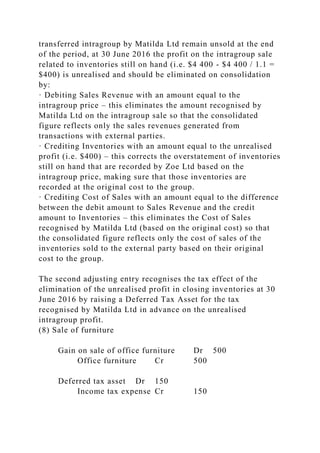
intragroup price – this eliminates the amount recognised by
Matilda Ltd on the intragroup sale so that the consolidated
figure reflects only the sales revenues generated from
transactions with external parties.
· Crediting Inventories with an amount equal to the unrealised
profit (i.e. $400) – this corrects the overstatement of inventories
still on hand that are recorded by Zoe Ltd based on the
intragroup price, making sure that those inventories are
recorded at the original cost to the group.
· Crediting Cost of Sales with an amount equal to the difference
between the debit amount to Sales Revenue and the credit
amount to Inventories – this eliminates the Cost of Sales
recognised by Matilda Ltd (based on the original cost) so that
the consolidated figure reflects only the cost of sales of the
inventories sold to the external party based on their original
cost to the group.
The second adjusting entry recognises the tax effect of the
elimination of the unrealised profit in closing inventories at 30
June 2016 by raising a Deferred Tax Asset for the tax
recognised by Matilda Ltd in advance on the unrealised
intragroup profit.
(8) Sale of furniture
Gain on sale of office furniture Dr 500
Office furniture Cr 500
Deferred tax asset Dr 150
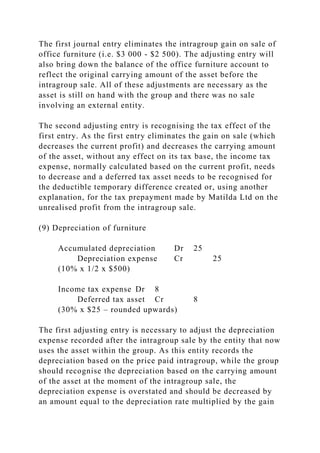
Income tax expense Cr 150
The first journal entry eliminates the intragroup gain on sale of
office furniture (i.e. $3 000 - $2 500). The adjusting entry will
also bring down the balance of the office furniture account to
reflect the original carrying amount of the asset before the
intragroup sale. All of these adjustments are necessary as the
asset is still on hand with the group and there was no sale
involving an external entity.
The second adjusting entry is recognising the tax effect of the
first entry. As the first entry eliminates the gain on sale (which
decreases the current profit) and decreases the carrying amount
of the asset, without any effect on its tax base, the income tax
expense, normally calculated based on the current profit, needs
to decrease and a deferred tax asset needs to be recognised for
the deductible temporary difference created or, using another
explanation, for the tax prepayment made by Matilda Ltd on the
unrealised profit from the intragroup sale.
(9) Depreciation of furniture
Accumulated depreciation Dr 25
Depreciation expense Cr 25
(10% x 1/2 x $500)
Income tax expense Dr 8
Deferred tax asset Cr 8
(30% x $25 – rounded upwards)
The first adjusting entry is necessary to adjust the depreciation
expense recorded after the intragroup sale by the entity that now
uses the asset within the group. As this entity records the
depreciation based on the price paid intragroup, while the group
should recognise the depreciation based on the carrying amount
of the asset at the moment of the intragroup sale, the
depreciation expense is overstated and should be decreased by
an amount equal to the depreciation rate multiplied by the gain
on the intragroup sale but only for the 6 months since the
intragroup sale. It should be noted that this adjustment to
depreciation expense increases the current profit and therefore
it is said to be an indication that a part of the profit on the
intragroup sale is now realised.
As a part of the intragroup profit is now realised through the
depreciation adjustments, the second adjusting entry adjusts the
tax effect of the previous entry that eliminated the entire profit
on the intragroup sale (see worksheet entry (8)), basically
reversing that previous tax effect entry for the part of the profit
that is now realised. That is because the depreciation adjustment
entry increases the carrying amount of the asset, with no effect
on the tax base and therefore decreases the deductible
temporary difference that was recorded in the deferred tax asset
when eliminating the gain on intragroup sale in worksheet entry
(8).
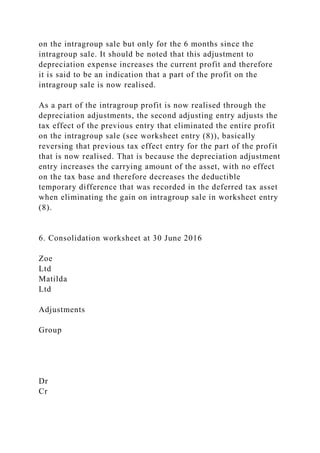
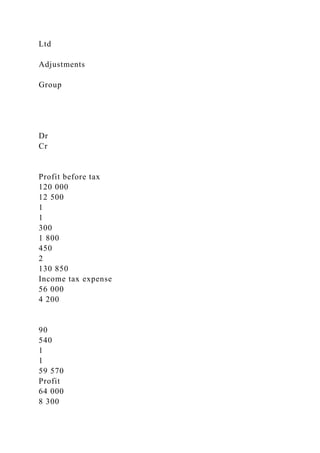
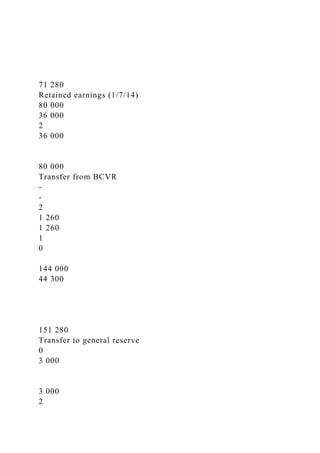
6. Consolidation worksheet at 30 June 2016
Zoe
Ltd
Matilda
Ltd
Adjustments
Group
Dr
Cr
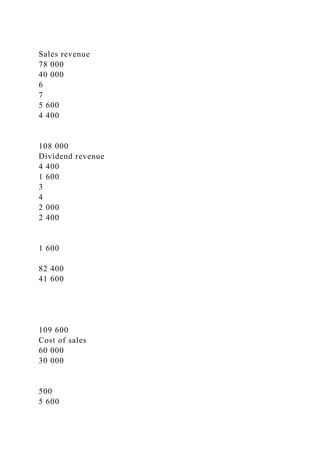
Sales revenue
78 000
40 000
6
7
5 600
4 400
108 000
Dividend revenue
4 400
1 600
3
4
2 000
2 400
1 600
82 400
41 600
109 600
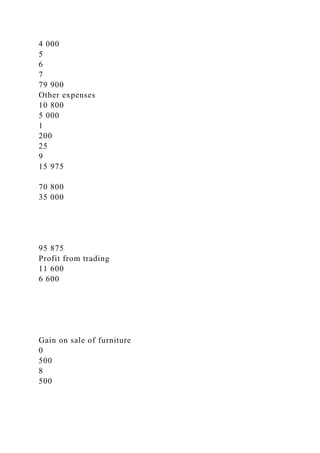
Cost of sales
60 000
30 000
500
5 600
4 000
5
6
7
79 900
Other expenses
10 800
5 000
1
200
25
9
15 975
70 800
35 000
95 875
Profit from trading
11 600
6 600
Gain on sale of furniture
0
500
8
500
0
Profit before tax
11 600
7 100
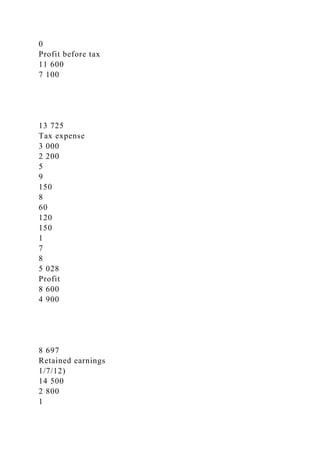
13 725
Tax expense
3 000
2 200
5
9
150
8
60
120
150
1
7
8
5 028
Profit
8 600
4 900
8 697
Retained earnings
1/7/12)
14 500
2 800
1
2
5
200
3 150
350
60
1
13 660
23 100
7 700
22 357
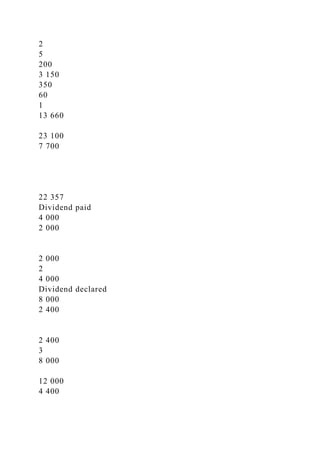
Dividend paid
4 000
2 000
2 000
2
4 000
Dividend declared
8 000
2 400
2 400
3
8 000
12 000
4 400
12 000
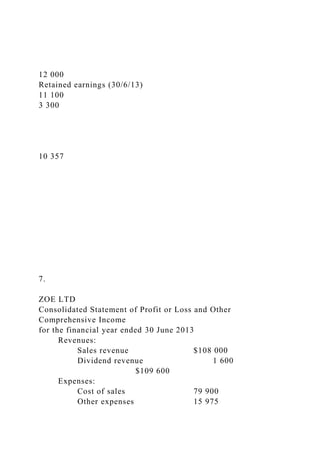
Retained earnings (30/6/13)
11 100
3 300
10 357
7.
ZOE LTD
Consolidated Statement of Profit or Loss and Other
Comprehensive Income
for the financial year ended 30 June 2013
Revenues:
Sales revenue $108 000
Dividend revenue 1 600
$109 600
Expenses:
Cost of sales 79 900
Other expenses 15 975
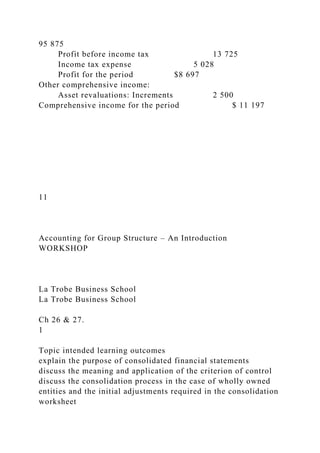
95 875
Profit before income tax 13 725
Income tax expense 5 028
Profit for the period $8 697
Other comprehensive income:
Asset revaluations: Increments 2 500
Comprehensive income for the period $ 11 197
11
Accounting for Group Structure – An Introduction
WORKSHOP
La Trobe Business School
Ch 26 & 27.
1
Topic intended learning outcomes
explain the purpose of consolidated financial statements
discuss the meaning and application of the criterion of control
discuss the consolidation process in the case of wholly owned
entities and the initial adjustments required in the consolidation
worksheet
prepare an acquisition analysis for the parent’s acquisition of a
subsidiary
prepare the consolidation worksheet entries at the acquisition
date, being the business combination valuation entries and the
pre-acquisition entries
prepare the consolidation worksheet entries in periods
subsequent to the acquisition date
La Trobe Business School
Consolidated financial statements:
Involves the preparation of a single set of financial statements.
Involves combining the financial statements of the individual
entities in a group.
So that they show the financial position and financial
performance of the group of entities.
Presented as if they were a single economic entity.
Consolidated financial statements
La Trobe Business School
LO1
3
Consolidated financial statements are ‘…the financial
statements of a group in which the assets, liabilities, equity,
income, expenses and cash flows of the parent and its
subsidiaries are presented as those of a single economic entity’.
Relevant standards:
AASB 10/IFRS 10 Consolidated Financial Statements
AASB 3/IFRS 3 Business Combinations.
Consolidated financial statements
La Trobe Business School
LO1
4
Group – a parent and its subsidiaries
Parent – an entity that controls one or more entities
Subsidiaries
– an entity that is controlled by another entity
Consolidated financial statements
La Trobe Business School
LO1
5
A Ltd
B Ltd
Parent
“control” must exist (more on this later)
Subsidiary
The group is referred to as the “A Ltd Group”
Consolidated financial statements
La Trobe Business School
LO1
6
A parent is an entity that controls one or more entities.
Control is the criterion for identifying when a parent-subsidiary
relationship exists.
Significant judgement is often required in determining whether
control exists.
Control
La Trobe Business School
LO2
7
Control
The following three elements are required in order for an
investor to have control:
power over the investee
exposure, or rights, to variable returns from its involvement
with the investee
the ability to use its power over the investee to affect the
amount of the investor’s returns.
All three elements must be present for control to exist.
La Trobe Business School
LO2
8
Power is defined as ‘…existing rights that give the current
ability to direct the relevant activities’.
Control – Power
La Trobe Business School
LO2
9
Power arises from rights
Most rights arise from a legal contract. Examples in AASB
10/IFRS 10 include:
voting rights
rights to appoint, reassign or remove members of the investee’s
key management personnel
rights to appoint or remove another entity that participates in
management decisions
rights to direct the investee to enter into, or veto any changes
to, transactions that affect the investee’s returns.
Control – Power
La Trobe Business School
LO2
10
Power arises from rights
Rights must be substantive – the holder must have the practical
ability to exercise the rights.
Control – Power
La Trobe Business School
LO2
11
Power arises from rights
Judgment is required in determining whether rights are
substantive. Factors to consider per AASB 10/IFRS 10 are:
Whether the party that holds the rights would benefit from
exercising the rights – e.g. potential voting rights.
Whether there are any barriers that prevent a holder from
exercising rights.
Where multiple parties are involved, whether there is a
mechanism in place to enable those parties to practically
exercise the rights.
Control – Power
La Trobe Business School
LO2
12
Control – Power
Power arises from rights
If a right is purely protective, then the holder does not have
power.
Protective rights are designed to protect the interest of the party
holding those rights without giving the party power over the
entity to which the rights relate.
La Trobe Business School
LO2
13
Power arises from rights
Example of protective rights include the following:
a lenders’ right to restrict a borrower from undertaking certain
activities
the right of a party holding a non-controlling interest to approve
various transactions
the rights of a lender to seize the assets of a borrower in the
event of default.
Control – Power
La Trobe Business School
LO2
14
Power is the ability to direct – rather than actually directing.
The ability to direct must be current.
e. g. consider the impact of an investor that holds call options.
It must be relevant activities that are being directed:
that is activities of the investee that significantly affect the
investee’s returns.
Control – Power
La Trobe Business School
LO2
15
Voting rights
Where the investor holds more than 50%, power is assumed if:
relevant activities are directed by a vote of the holder of the
majority of shares, or
a majority of the members of the governing body that directs the
relevant activities are appointed by a vote of the holder of the
majority of shares.
Control – Power
La Trobe Business School
LO2
16
Voting rights
Where the investor holds less than 50% of voting shares of
investee, determining whether investor has control requires
examining potential actions of holders of other shares in
investee:
attendance at AGM
level of dilution and disorganisation or apathy of remaining
shareholders
existence of a contracts.
Control – Power
La Trobe Business School
LO2
17
Examples of returns that can exist in parent-subsidiary
relationship include:
dividends
obtaining scarce raw materials on priority basis
gaining access to subsidiary’s distribution network, patents
economies of scale
denying or regulating access to subsidiary’s assets to
competitors.
The returns must have the potential to vary according to the
performance of the entity
Exposure or rights to variable returns
La Trobe Business School
LO2
18
The third element requires that the parent has the ability to
increase its benefits and limit its losses from the subsidiary’s
activities.
Remember, all three elements must be present for control to
exist.
Ability to use the power to
affect returns
La Trobe Business School
LO2
19
No Control
No parent –subsidiary relationship
No consolidation
Consolidation involves combining financial statements of
individual entities to show financial position and performance
of group as if it were single entity.
Consolidated financial statements are prepared by:
(i) Aggregating (combining), line by line, like items of assets,
liabilities, equity, income and expenses.
(ii) Adjusting these combined figures for inter-group
transactions between entities within the group (covered in
following chapters).
Consolidated process
La Trobe Business School
LO3
20
Simple consolidation worksheet for the A Ltd groupA LtdB
LtdConsolidationCurrent assets50 000+20 000=70 000Non
current assets150 000+120 000=270 000Total assets200 000 140
000340 000Total liabilities(80 000)+(30 000)=(110 000)Net
assets120 000110 000230 000
Consolidation does not involve adjustments in the accounts of
the entities. Consolidated financial statements are an additional
set of financial statements and are prepared in a consolidation
worksheet.
Consolidated financial statements
La Trobe Business School
LO3
21
Consolidation involves adding together the financial statements
of the parent and subsidiaries and making a number of
adjustments:
Business combination valuation entries – required to adjust the
carrying amount of the identifiable assets acquired and the
liabilities assumed of the subsidiary to fair value.
Pre-acquisitions entries – required to eliminate the carrying
amount of the parent’s investment in each subsidiary against the
pre-acquisition equity of that subsidiary.
Consolidation process in the case of
wholly owned entities
La Trobe Business School
LO1
22
Consolidation involves adding together the financial statements
of the parent and subsidiaries and making a number of
adjustments:
Transactions between entities within the group subsequent to
acquisition date (chapter 28).
Consolidation process in the case of
wholly owned entities
La Trobe Business School
LO1
23
To facilitate the addition process a consolidation worksheet is
used:
No adjustments are made in the accounting records of the
individual entities
Therefore the entries must be made each time a cons. worksheet
is prepared
Consolidation worksheets
La Trobe Business School
LO2
24
An acquisition analysis compares the cost of acquisition with
the fair value of the identifiable net assets and contingent
liabilities (FVINA) that exist at acquisition to determine
whether there is:
Goodwill on acquisition (where cost > FVINA).
Bargain purchase (where cost < FVINA).
NOT the book value
The acquisition analysis
La Trobe Business School
LO3
25
Hitech Ltd acquired all of the issued share capital of Lotech Ltd
on 30 June 2016 for a cash consideration of $400,000.
At that time the net assets of Lotech Ltd were represented as
follows:
$Share capital300,000Retained earnings50,000Net
assets350,000
Book value of identifiable net assets (BVINA)
Lecture example – background
information
La Trobe Business School
LO3
26
When Hitech acquired its investment in Lotech the following
information applied:
Land held by Lotech was undervalued by $10,000.
A building held by Lotech was undervalued by $45,000. The
building had originally cost $100,000 2 years ago and was being
depreciated at 10% per year.
A contingent liability relating to an unsettled legal claim with a
fair value of $3,000 was recorded in the notes to Lotech’s
financial statements.
The tax rate is 30%.
Lecture example – background
information
La Trobe Business School
LO3
27
$Cost of acquisition400,000Book value of net assets - Share
capital300,000 - Retained earnings50,000Total book value of
net assets350,000Fair value adjustments - After tax increase
in land7,000 - After tax increase in building31,500 - After
tax recognition of provision for legal claim(2,100)Total fair
value adjustments36,400FVINA386,400X %age
acquired100%386,400Goodwill/(bargain purchase) on
acquisition 13,600
A
Cash consideration
B
BVINA
Adjust to fair value & add. of cont. liability
10,000 x (1 – 30%) = 7,000
45,000 x (1 – 30%) = 31,500
(3,000) x (1-30%) = (2,100)
C
B + C = D
A – D
If +ve = Goodwill
If –ve = Bargain Purchase
No previously held equity interest
La Trobe Business School
Example facts as per slide 15
Hitech Ltd acquired all of the issued share capital of Lotech Ltd
on 30 June 2016 for a cash consideration of $400,000
Net assets = $350,000 as Share capital $300,000 + Retained
earnings $50,000
Slide 16 information
Land held by Lotech was undervalued by $10,000
A building held by Lotech was undervalued by $45,000.
The building had originally cost $100,000 2 years ago and was
being depreciated at 10% per year
A contingent liability relating to an unsettled legal claim with a
fair value of $3,000 was recorded in the notes to Lotech’s
financial statements
28
Parent has previously held equity interest in the subsidiary
Where control is achieved in stages:
the previously held equity instruments in the acquiree.
must be adjusted to fair value prior to performing the
acquisition analysis.
Example:
Hitech acquired 15% of Lotech on 30 June 2010 and the
remaining 85% on 30 June 2016.
Acquisition analysis
La Trobe Business School
LO3
29
Parent has previously held equity interest in the subsidiary
Additional entries are required in the parents books in
accordance with AASB 9/IFRS 9 Financial Instruments:
recognising the increase (decrease) to fair value FV in profit or
loss
unless the parent has elected to recognise changes in fair value
as other comprehensive income.
Acquisition analysis and consolidation entries remain
unchanged.
Acquisition analysis
La Trobe Business School
LO3
30
Business combination valuation entries
If the BV of subsidiary assets and liabilities > < FV.
Or, if a contingent liability exists, then “business combination
valuation” adjustments are required:
to increase or decrease subsidiary’s recorded assets and
liabilities book values to fair value;
to recognise previously unrecognised assets (e.g. internally
generated intangibles) at fair value; or
to recognise subsidiary’s contingent liabilities as liabilities at
fair value.
Consolidation worksheet entries at
the acquisition date
La Trobe Business School
LO4
31
Business combination valuation entries
Business Combination Valuation Reserve (BCVR) account is
used to record these adjustments.
The BCVR is similar to the Asset Revaluation Surplus (ARS)
account.
Consolidation worksheet entries at
the acquisition date
La Trobe Business School
LO4
32
Where the BCVR entry is done in the ARS account in the
subsidiary’s books:
it is recorded in the G/L and
therefore automatically carries forward to future periods once
entered.
BUT
Where the entry is done in the BCVR on consolidation (i.e.
on the worksheet) it must be manually carried forward to future
periods.
Consolidation worksheet entries at
the acquisition date
La Trobe Business School
LO4
33
Equity balances that existed in the subsidiary prior to
acquisition date are referred to as pre-acquisition equity:
all movements after the date of acquisition are referred to as
post-acquisition.
You cannot have an investment in yourself, nor can you have
equity in yourself.
From a consolidated viewpoint, these items should not exist i.e.
they must be eliminated to avoid double counting.
Pre-acquisition entries
La Trobe Business School
LO4
34
The pre-acquisition entry:
Eliminates the asset “Investment in subsidiary” (in the parent’s
books)
Against the pre-acquisition equity (in the subsidiary’s books)
The pre-acquisition entry required for the lecture example is:
DR Share capital 300,000
DR Retained earnings 50,000
DR BCVR 50,000
CR Investment in Lotech 400,000
These figures are taken from the acquisition analysis (refer to
slide 15 earlier)
Pre-acquisition entries
La Trobe Business School
LO4
35
Hitech Ltd.Lotech
Ltd.AdjustmentsGroup$’000$’000DRCR$’000Cash in
bank460200660Deferred Tax Asset0.90.9Land -
20010210Building10025125Accumulated Depreciation--2020-
Investment in Lotech Ltd400-4000Goodwill--
13.613.68604801,009.50Creditors160130290Deferred Tax
Liability3 +
13.516.5Provision for legal claim33Share
capital600300300600Retained earnings1005050100BCVR2.1 +
507 +
31.5 +13.608604801,009.50
Note
these
values
Pre-acquisition entry
In the equity section of the statement of financial position the
subsidiary’s balances have been eliminated in full, so the group
balances = parent’s balances
Example: pre-acquisition entry at
acquisition date
La Trobe Business School
LO4
The consolidation journals will be posted onto the consolidation
worksheet at 30 June 2016 (the date of acquisition)
36
So far, we have considered the consolidation journals required
if a consolidation was being prepared on the acquisition date.
How do these journals change if a consolidation is being
prepared on a later date?
How do transactions and events occurring post-acquisition
impact on the business combination valuation adjustment
entries?
How do post-acquisition transactions and events impact on the
pre-acquisition entry?
Worksheet entries subsequent to
acquisition date
La Trobe Business School
LO5
37
Super retail group case study
Obtain a copy of the most recent annual report of the Super
Retail Group.
Identify and review the information on the subsidiaries included
within the Super Retail GROUP.
How many subsidiaries are there? Where are they located? What
do they do? How does the parent company CONTROL these
subsidiaries?
Do the consolidated accounts provide a relevant and reliable
measure of the group’s performance and position? In the
absence of consolidated accounts, how could you review how
well the group was performing?
La Trobe Business School
Workshop Case study
La Trobe Business School
conclusion
This topic has reviewed the nature of group structures and
explored the basic consolidation procedures.
What is a subsidiary?
What are the key steps to consolidate?
Next week, we continue our study of consolidation procedures
and explore how to eliminate the effects of transactions between
members of a group.
La Trobe Business School
WORKSHOP WEEK 7: CHAPTER 26 AASB3 BUSINESS
COMBINATIONS AND CHAPTER 27 AASB3 AND AASB12
SUGGESTED SOLUTIONS
Online practice exercises available through Wiley+
Chapter 26
Comprehensive Questions
1. What is a group, a parent and a subsidiary?
According to Appendix A of AASB 10/IFRS 10 Consolidated
Financial Statements:
· A group is formed by a parent and all its subsidiaries.
· A parent is an entity that controls one or more entities.
· A subsidiary is an entity that is controlled by another entity, a
parent.
3. What are the key elements of control?
Based on the definition of control from Appendix A of AASB
10/IFRS 10, paragraph 7 of AASB 10/IFRS 10 identifies three
elements that must be held by an investor in order for it to have
control:
· Power over the investee
· Exposure or rights to variable returns from the parent’s
involvement with the subsidiary
· The ability to use the power over the subsidiary to affect the
amount of the parent’s returns.
8. What is the link between ownership interest and
control?
As paragraph B35 of AASB 10/IFRS 10 states, where an
investor holds more than half of the voting rights of the
investee, the investor has power over the investee in the absence
of other evidence. Different classes of shares may have
different voting rights. However, unless otherwise specified in
the company’s constitution, each shareholder has one vote for
each share held. Therefore, it is normally assumed that the
percentage of ownership interest of an investor is equivalent to
the percentage of voting rights that this investor holds in the
investee. As such, it is normally assumed that an investor that
has more than 50% ownership interest in an investee has the
power over the investee. Given that the shares give to the
shareholders the right to receive dividends, it is further assumed
that an investor holding more 50% ownership interest has
control. Of course, a shareholder with less than 50% ownership
interest may still have control if there is any other evidence that
the shareholder is exposed, or has rights, to variable returns
from its involvement with the investee and has the ability to
affect those returns through its power over the investee. Also, a
shareholder with more than 50% ownership interest may not
have control, especially if most of the shares held are non-
voting shares.
11. What are the reasons for preparing consolidated
financial statements?
Some of the reasons for which the regulators require the parent
entity to prepare consolidated financial statements are as
follows:
i.To supply relevant information to investors in the parent
entity. The information obtained from the consolidated financial
statements is relevant to investors in the parent entity. A
shareholder’s wealth in the parent is dependent not only on how
that entity performs, but also on the performance of the other
entities controlled by the parent. To require these investors in
analysing their investment to source their information from the
financial statements of each of the entities comprising the group
would place a large cost burden on those investors.
ii.To allow comparison of the group with similar entities. Some
entities are organised into a group structure such that different
activities are undertaken by separate entities within the group.
Other entities are organised differently, with some having all
activities conducted within the one entity. Access to
consolidated financial statements makes comparisons across the
group an easier task for the users of financial statements.
iii.To assist in the discharge of accountability by management
of the group. A key purpose of financial reporting is the
discharge of accountability by management. Entities that are
responsible or accountable for managing a pool of resources —
being the recipients of economic benefits and responsible for
payment of obligations — are generally required to report on
their activities and are held accountable for the management of
those activities. The consolidated financial statements report the
assets under the control of the group management as well as the
claims on those assets.
iv.To report the risks and benefits of the group as a single
economic entity. There are risks associated with managing an
entity, and an entity rarely obtains control of another without
also obtaining significant opportunities to benefit from that
control. The consolidated financial statements allow an
assessment of these risks and benefits. Note, however, that the
benefits from intragroup transactions are eliminated when
preparing consolidated financial statements, as those statements
should only reflect the effects of transactions with external
parties.
Exercise 26.8
Determining subsidiary status
In the following independent situations, determine whether a
parent–subsidiary relationship exists, and which entity, if any,
is a parent required to prepare consolidated financial statements
under AASB 10/IFRS 10.
1. Road Ltd is a company that was hurt by the global financial
crisis. As a result, it experienced major trading difficulties. It
previously obtained a significant loan from Wile E. Bank, and
when Road Ltd was unable to make its loan repayments, the
bank made an agreement with Road Ltd to become involved in
the management of that company. Under the agreement between
the two entities, the bank had authority for spending within
Road Ltd. Road Ltd’s managers had to obtain authority from the
bank for acquisitions over $10 000, and was required to have
bank approval for its budgets.
2. Runner Ltd owns 80% of the equity shares of Beep Beep Ltd,
which owns 100% of the shares of Looney Ltd. All companies
prepare reports under Australian accounting standards.
Although the shares of Beep Beep Ltd are not traded on any
stock exchange, its debt instruments are publicly traded.
3. Coyote Ltd is a major financing company whose interest in
investing is return on the investment. Coyote Ltd does not get
involved in the management of its investments. If the investees
are not managed properly, Coyote Ltd sells its shares in that
investee and selects a more profitable investee to invest in. It
previously held a 35% interest in Tunes Ltd as well as providing
substantial convertible debt finance to that entity. Recently,
Tunes Ltd was having cash flow difficulties and persuaded
Coyote Ltd to convert some of the convertible debt into equity
so as to ease the effects of interest payments on cash flow. As a
result, Coyote Ltd’s equity interest in Tunes Ltd increased to
52%. Coyote Ltd still wanted to remain as a passive investor,
with no changes in the directors on the board of Tunes Ltd.
These directors were appointed by the holders of the 48% of
shares not held by Coyote Ltd.
In each of these circumstances the following principle from the
Basis of Conclusions to AASB 10/IFRS 10 should be used:
BC41 The definition of control includes three elements,
namely an investor’s:
(a) power over the investee;
(b) exposure, or rights, to variable returns from its
involvement with the investee; and
(c) the ability to use its power over the investee to affect
the amount of the investor’s returns.
Note also that paragraph 4 of AASB 10/IFRS 10 states that an
entity that is a parent shall present consolidated financial
statements except:
(a) a parent need not present consolidated financial statements
if it meets all the following conditions:
(i) it is a wholly-owned subsidiary or is a partially-owned
subsidiary of another entity and all its other owners, including
those not otherwise entitled to vote, have been informed about,
and do not object to, the parent not presenting consolidated
financial statements;
(ii) its debt or equity instruments are not traded in a public
market (a domestic or foreign stock exchange or an over-the-
counter market, including local and regional markets);
(iii) it did not file, nor is it in the process of filing, its financial
statements with a securities commission or other regulatory
organisation for the purpose of issuing any class of instruments
in a public market; and
(iv) its ultimate or any intermediate parent produces
consolidated financial statements that are available for public
use and comply with International Financial Reporting
Standards (IFRSs).
1. This question will be looked at under two scenarios:
(i) Road Ltd is not a subsidiary of any other entity.
The key issue is whether the fact that the bank has authority in
relation to acquisitions and approval of budgets is sufficient to
give the bank the status of a parent.
The bank will receive a return from Road Ltd in the form of
interest on the loan.
Wile E. Bank
Has:
· Power over Road Ltd, as it has rights arising from the legal
contract
· It can affect some of the relevant activities e.g. acquisitions,
but not others such as appointment of key management
personnel.
Road Ltd will not be a subsidiary of Wile E. Bank because:
· The bank is not exposed to variable returns from its
involvement with Road Ltd. The interest payments are not
affected by the profitability of Road Ltd.
· It cannot use its power over Road Ltd to affect the amount of
its returns, as the returns are fixed interest payments.
(ii) Road Ltd is a wholly owned subsidiary of another entity,
Chuck Jones Ltd.
The key issue in this scenario is whether the authority given to
the bank in relation to acquisitions and budget approval is
sufficient to state that Chuck Jones Ltd does not control Road
Ltd.
The key issue is whether Chuck Jones Ltd still has power over
Road Ltd given the arrangements with the bank.
Relevant activities over which a parent should have power
include:
(a) selling and purchasing of goods or services;
(b) managing financial assets during their life (including upon
default);
(c) selecting, acquiring or disposing of assets;
(d) researching and developing new products or processes; and
(e) determining a funding structure or obtaining funding.
Decisions about relevant activities include:
(a) establishing operating and capital decisions of the investee,
including budgets; and
(b) appointing and remunerating an investee’s key management
personnel or service providers and terminating their services or
employment.
The key issue then is whether Chuck Jones Ltd has the ability to
direct the relevant activities i.e. those activities that most
significantly affect the investee’s returns.
It is probable that Chuck Jones Ltd no longer controls Road Ltd
as the bank can: veto any changes to significant transactions for
the benefit of Chuck Jones Ltd. It can deny the company its
ability to make acquisitions, and it can reject moves within a
budget to undertake changes in inventory production.
In conclusion, a parent-subsidiary relationship does not exist in
this case and therefore no one needs to prepare consolidated
financial statements.
2.
Beep Beep Ltd
80% 100%
Looney Ltd
Runner Ltd
The issue is whether Beep Beep Ltd needs to prepare a set of
consolidated financial statements for itself and Looney Ltd, as
Beep Beep Ltd is the parent of Looney Ltd (by virtue of owning
100% of the shares in Looney Ltd), but at the same time Beep
Beep Ltd is a subsidiary of Runner Ltd, the ultimate parent..
Note all criteria from paragraph 4 of AASB 10/IFRS 10 are
required to be met. In this example:
(i) Looney Ltd is a wholly owned subsidiary of Beep Beep Ltd
(ii) The ultimate parent, Runner Ltd, prepares reports under
AASBs, which comply with IFRSs
However, the debt instruments of Beep Beep Ltd are traded
publicly which means that it breaches 4(a)(iii) above. Hence
Beep Beep Ltd is not exempt from preparing consolidated
financial statements.
Both Runner Ltd and Beep Beep Ltd would be required to
prepare consolidated financial statements.
3. Coyote Ltd currently holds 52% of the shares of Tunes
Ltd. It does not want to become involved in the management of
Tunes Ltd, and the directors are appointed by the non-
controlling interest (NCI).
Control is not based on actual control but on the capacity to
control. Coyote Ltd
· has power over the investee via its share ownership
· is exposed to variable returns via dividends arising from its
share ownership
· has the ability to affect those returns as it can become
involved in management whenever it wishes, given its superior
voting power.
Coyote Ltd is a parent of Tunes Ltd and hence must prepare
consolidated financial statements unless the criteria from
paragraph 4 of AASB 10/IFRS 10 are all met.
Further, when Coyote Ltd held a 35% interest in Tunes Ltd it
also held convertible debt in that entity which could, if
converted, give it an equity interest of 52%. In this situation,
Coyote Ltd was a parent of Tunes Ltd and should have prepared
consolidated financial statements unless the criteria from
paragraph 4 of AASB 10/IFRS 10 are all met. It would appear
under the circumstances that the conversion was substantive i.e.
economically feasible, and currently exercisable.
Chapter 27
Comprehensive Questions
1. Explain the purpose of the acquisition analysis in the
preparation of consolidated financial statements.
According to AASB 3/IFRS 3 and as described in chapter 25,
entities need to account for business combinations using the
acquisition method. As part of the acquisition method, an
acquisition analysis is conducted at acquisition date because it
is necessary to recognise all the identifiable assets and
liabilities of the subsidiary at fair value (including those
previously not recorded by the subsidiary), and to determine
whether there has been any goodwill acquired or whether a gain
on bargain purchase has occurred. The acquisition analysis is
considered the first step in the consolidation process as it
identifies the information necessary for making both the
business combination valuation and pre-acquisition entry
adjustments for the consolidation worksheet. The end result of
the acquisition analysis will be the determination of whether
there is any goodwill acquired or gain on bargain purchase.
4. Explain the purpose of the business combination
valuation entries in the preparation of consolidated financial
statements.
The purpose of these entries is to make consolidation
adjustments so that in the consolidated statement of financial
position the identifiable assets, liabilities and contingent
liabilities of the subsidiary are reported at fair value. This is to
fulfil step 3 of the acquisition method required to account for
business combinations by AASB 3/IFRS 3.
5. Explain the purpose of the pre-acquisition entries in
the preparation of consolidated financial statements.
The purpose of the pre-acquisition entry is to:
· prevent double counting of the assets of the economic entity
· prevent double counting of the equity of the economic entity
· recognise any gain on bargain purchase
A simple example such as that below could be used to illustrate
these points:
A Ltd has acquired all the issued shares of B Ltd for $150. The
balance sheets of both companies immediately after acquisition
are as follows:
Share capital $200 Share capital $100
Reserves 100 Reserves 50
300 150
Shares in B Ltd 150 --
Cash 150 Cash 150
300 150
Having acquired the shares in B Ltd, A Ltd records as an asset
the investment account ‘Shares in B Ltd’ at $150. This asset
represents the actual net assets of B Ltd; that is, the ownership
of the shares gives A Ltd the right to the assets and liabilities of
B Ltd. To include both the asset investment account ‘Shares in
B Ltd’ and the assets and liabilities of B Ltd in the consolidated
statement of financial position would double count the assets
and liabilities of the subsidiary. On consolidation, the
investment account is therefore eliminated.
Similarly, A Ltd has equity of $300, which represents its net
assets including the investment account, ‘Shares in B Ltd’.
Because the investment in the subsidiary represents the actual
net assets of B Ltd, or, in other words, the equity of the
subsidiary, the equity of the parent effectively includes the
equity of the subsidiary. To include both the equity of the
subsidiary at acquisition date and the equity of the parent in the
consolidated statement of financial position would double-count
the pre-acquisition equity of the subsidiary. On consolidation,
the equity of the subsidiary at acquisition date is therefore
eliminated.
9. Explain how the existence of a gain on bargain
purchase affects the pre-acquisition entries, both in the year of
acquisition and in subsequent years.
In the presence of a gain on bargain purchase, the pre-
acquisition entry at acquisition date should recognise this gain
as a part of the consolidated profit for the period starting at
acquisition date, and not eliminate it. This is because it is
considered to belong to post-acquisition equity. In subsequent
periods after the acquisition date, the gain on bargain purchase
is included in retained earnings (opening balance) and therefore
reduces the adjustment to the opening balance of retained
earnings posted in pre-acquisition entries.
11. Why are some adjustment entries in the previous period’s
consolidation worksheet also made in the current period’s
worksheet?
The consolidation worksheet entries do not affect the
underlying financial statements or the accounts of the parent or
the subsidiary. As the consolidation is done every year based on
the individual financial statements or the accounts of the parent
or the subsidiary, the entries in the consolidation worksheet
from previous years do not carry over and they need to be
repeated, sometimes exactly the same as in previous years,
something with some adjustments. For example, if the last
year’s profits are required to be adjusted on consolidation, then
retained earnings (opening balance) will need to be adjusted in
the current period. Similarly, a BCVR entry to recognise at fair
value the land on hand at acquisition is made in the
consolidation worksheet for each year that the land remains in
the subsidiary. The entry does not change from year to year.
Again the reason is that the adjustment to the carrying amount
of the land is only made in a worksheet and not in the actual
records of the subsidiary itself. However, the BCVR entries for
non-current assets subject to depreciation need to be adjusted
from year to year.
Exercise 27.5
Undervalued and unrecorded assets, unrecorded liabilities
In 2012, Stan Ltd acquired 40% of the issued shares of Lee Ltd
for $72 000. This
acquisition did not give Stan Ltd control of Lee Ltd, because
the ownership of Lee Ltd
was held by a small number of shareholders (Lee Ltd was
developed as a family
business in 2001). On 1 July 2016, Stan Ltd approached these
family members following
a death in the family and persuaded them to sell the remainder
of the shares in Lee Ltd
to Stan Ltd for $137 700 on a cum div. basis.
Information about the two companies at 1 July 2016 included:
· Stan Ltd recorded its original investment in Lee Ltd at fair
value, with changes in fair value being recognised in profit or
loss. At 1 July 2016, the investment was recorded at $91 800.
· The equity of Lee Ltd at 1 July 2016 consisted of $144 000
share capital and $36 000 retained earnings.
· Included in the assets and liabilities recorded by Lee Ltd at 1
July 2016 were goodwill of $5400 (net of accumulated
impairment losses of $3600) and dividend payable of $4500.
· On the acquisition date all the identifiable assets and
liabilities of Lee Ltd were recorded at carrying amounts equal
to their fair values except for inventories for which the fair
value of $39 600 was $3600 greater than its carrying amount,
and equipment for which the fair value of $94 500 was greater
than the carrying amount, this being cost of $108 000 less
accumulated depreciation of $18 000.
· Stan Ltd discovered that Lee Ltd had two assets that had not
been recorded by Lee Ltd. These were internally generated
patents that had a fair value of $45 000 and in-process research
and development for which Lee Ltd had expensed $90 000, but
Stan Ltd considered that an asset was created with a fair value
of $18 000.
· In the notes to the financial statements at 30 June 2016, Lee
Ltd had reported the existence of a contingent liability relating
to guarantees for loans. Stan Ltd determined that this liability
had a fair value of $9000 at 1 July 2016.
The tax rate is 30%.
Required
1. Prepare the acquisition analysis at 1 July 2016.
2. Prepare the consolidation worksheet entries for Stan Ltd’s
group at 1 July 2016.
1. Acquisition analysis at 1 July 2016
Net fair value of identifiable assets
and liabilities of Lee Ltd = ($144 000 + $36 000) (equity)
– $5 400 (goodwill)
+ $3 600 (1– 30%) (BCVR – inventories)
+ ($94 500 – ($108 000 – $18 000)) (1 – 30%)
(BCVR – equipment) + $45 000
(1 – 30%) (BCVR – patents)
+ $18 000 (1 – 30%) (BCVR – research)
– $9 000 (1 – 30%) (BCVR – liability)
= $218 070
Net consideration transferred = $137 700 – $4 500 x
60% (dividend)*
= $135 000
Previously held equity interest = $91 800 (fair value)
Goodwill acquired = ($135 000 + $91 800) – $218 070
= $8 730
Recorded goodwill = $5 400
Unrecorded goodwill = $8 730 – $5 400
= $3 330
* As the dividend was declared prior to the acquisition and the
acquisition of the remaining interest of 60% is cum div., 60% of
the dividend is recognised as a refund of the consideration
transferred. It is assumed that the other 40% of the dividend
related to the previously held interest was already recognised by
the parent prior to the acquisition as dividend receivable.
2. Consolidation worksheet entries for Stan Ltd’s group at 1
July 2016
Business combination valuation entries at 1 July 2016
The BCVR entries at acquisition date will need to recognise:
· adjustments to fair value for inventories and equipment
· the previously not recognised patents and in-process research
at fair value
· the previously not recognised contingent liability at fair value
· the unrecorded part of the goodwill acquired.
Inventories Dr 3 600
Deferred tax liability Cr 1 080
Business combination valuation reserve Cr 2
520
Accumulated depreciation Dr 18 000
Equipment Cr 13 500
Deferred tax liability Cr 1 350
Business combination valuation reserve Cr 3
150
*Alternative BCVR entries for Equipment
Accumulated depreciation Dr 18 000
Equipment Cr 18 000
Equipment Dr 4 500
Deferred tax liability Cr 1 350
Business combination valuation reserve Cr 3
150
The above alternative BCVR entries for equipment demonstrate
the 2 steps for the recognition of a change in fair value on
consolidation for a depreciable non-current asset:
1. Write back all of the accumulated depreciation for the asset
at date of acquisition.
2. Recognise the increase/decrease to the asset’s fair value with
the tax effect.
Patents Dr 45 000
Deferred tax liability Cr 13 500
Business combination valuation reserve Cr 31
500
In-process research Dr 18 000
Deferred tax liability Cr 5 400
Business combination valuation reserve Cr 12
600
Business combination valuation reserve Dr 6 300
Deferred tax asset Dr 2 700
Guarantee payable Cr 9 000
Accumulated impairment losses – goodwill Dr 3 600
Goodwill Cr 3 600
Goodwill Dr 3 330
Business combination valuation reserve Cr 3
330
Pre-acquisition entries at 1 July 2016
Retained earnings (1/7/16) Dr 36 000
Share capital Dr 144 000
Business combination valuation reserve Dr 46 800*
Shares in Lee Ltd Cr 226 800**
*$2 520 (BCVR – inventories) + $3 150 (BCVR – equipment) +
$31 500 (BCVR – patents) + $12 600 (BCVR – research) – $6
300 (BCVR – contingent liability) + $3 330 (BCVR –
unrecorded goodwill)
** $91 800 (previously held interest) + $135 000 (net
consideration transferred)
Dividend payable Dr 4 500
Dividend receivable Cr 4 500
As the dividend was declared prior to the acquisition out of pre-
acquisition equity and it is now entirely recognised by Stan Ltd
as receivable (40% from before the acquisition and 60% at
acquisition as the acquisition is cum div.), 100% of the dividend
payable and the dividend receivable related to it are eliminated
in the pre-acquisition entry.
Exercise 27.7
Undervalued assets, pre-acquisition reserves transfers
On 1 July 2016, Mutt Ltd acquired all the issued shares of Jeff
Ltd for $174 800. At this date the equity of Jeff Ltd consisted of
share capital of $80 000 and retained earnings of $68 800. All
the identifiable assets and liabilities of Jeff Ltd were recorded
at amounts equal to fair value except for:
The patent was considered to have an indefinite life. It was
estimated that the plant had a further life of 10 years, and was
depreciated on a straight-line basis. All the inventories were
sold by 30 June 2017.
In May 2017, Jeff Ltd transferred $20 000 from the retained
earnings on hand at 1 July 2016 to a general reserve. In June
2017, Jeff Ltd conducted an impairment test on the patent and
on the goodwill acquired. As a result, the goodwill was
considered to be impaired by $1200. The tax rate is 30%.
Required
1. Prepare the acquisition analysis at 1 July 2016.
2. Prepare the consolidation worksheet entries for Mutt Ltd’s
group at 1 July 2016.
3. Prepare the consolidated worksheet entries for Mutt Ltd’s
group at 30 June 2017.
1. Acquisition analysis at 1 July 2016
Net fair value of identifiable assets
and liabilities of Jeff Ltd = ($80 000 + $68 800)
(equity)
+ ($72 000 – $60 000) (1 – 30%) (BCVR – patent)
+ ($48 000 – $40 000) (1 – 30%) (BCVR – plant)
+ ($28 000 – $21 600) (1 – 30%) (BCVR –
inventories)
= $167 280
Consideration transferred = $174 800
Goodwill = $174 800 – $167 280
= $7 520
2. Worksheet entries at 1 July 2016
(1) Business combination valuation entries
The BCVR entries at acquisition date will need to recognise:
· adjustments to fair value for patent, plant and inventories
· the goodwill acquired.
Patent Dr 12 000
Deferred tax liability Cr 3 600
Business combination valuation reserve Cr 8
400
*Accumulated depreciation Dr 40 000
PlantCr 32 000
Deferred tax liability Cr 2 400
Business combination valuation reserve Cr 5
600
*Alternative BCVR entries for Plant
Accumulated depreciation Dr 40 000
PlantCr 40 000
PlantDr 8 000
Deferred tax liability Cr 2 400
Business combination valuation reserve Cr 5 600
The above BCVR entries demonstrate the 2 steps for the
recognition of a change in fair value on consolidation for a
depreciable non-current asset:
1. Write back all of the accumulated depreciation for the asset
at date of acquisition.
2. Recognise the increase/decrease to the asset’s fair value with
the tax effect.
NB: From these 2 journal entries it is easier to see that the
depreciation adjustments then required at the end of each year
for consolidation purposes are based on the $8 000 increase to
fair value. That is, the additional amount of the asset that needs
to be depreciated.
In this question….$8,000 / 10 years = $800 per year.
Inventories Dr 6 400
Deferred tax liability Cr 1 920
Business combination valuation reserve Cr 4
480
Goodwill Dr 7 520
Business combination valuation reserve Cr 7
520
(2) Pre-acquisition entries
Retained earnings (1/7/16) Dr 68 800
Share capital Dr 80 000
Business combination valuation reserve Dr 26 000
Shares in Jeff Ltd Cr 174 800
3. Worksheet entries at 30 June 2017
(1) Business combination valuation entries
The BCVR entries are affected by the following events that took
place during the period from acquisition to 30 June 2017:
· the depreciation of the plant during the current period
· the sale of the inventories during the current period
· the impairment of the goodwill during the current period.
For the other asset not affected by the above events (i.e. the
patent), the BCVR entries at 30 June 2017 will be the same as
those at acquisition date, 1 July 2016.
Patent Dr 12 000
Deferred tax liability Cr 3 600
Business combination valuation reserve Cr 8
400
Accumulated depreciation Dr 40 000
PlantCr 32 000
Deferred tax liability Cr 2 400
Business combination valuation reserve Cr 5
600
Depreciation expense Dr 800
Accumulated depreciation Cr 800
($8 000 / 10 years)
Deferred tax liability Dr 240
Income tax expense Cr 240
(30% x $1 000)
Cost of sales Dr 6 400
Income tax expense Cr 1 920
Transfer from business combination
valuation reserve Cr 4 480
Goodwill Dr 7 520
Business combination valuation reserve Cr 7
520
Impairment loss – goodwill Dr 1 200
Accum. impairment losses – goodwill Cr 1
200
(2) Pre-acquisition entries
The first pre-acquisition entry at 30 June 2017 is the same as
the one at 1 July 2016 because 1 July 2016 is the beginning of
the period ended 30 June 2017. The other pre-acquisition entries
need to reverse the current period transfers from pre-acquisition
equity, i.e.:
· from business combination valuation reserve due to the sale of
inventories(i.e. the amount of $4,480 that represents the BCVR
for inventories).
· from pre-acquisition retained earnings to general reserve (i.e.
the amount of $20,000 that was transferred in May 2017).
The reason for reversing those current period transfers from
pre-acquisition equity in the other pre-acquisition entries is
because the first pre-acquisition entry eliminates the amounts
that were in the equity accounts at the beginning of the current
period, but some of the equity is not in the same accounts as at
the beginning of the current period – by reversing those current
period transfers and having that together with the first pre-
acquisition entry we make sure all pre-acquisition equity is
eliminated.
Retained earnings (1/7/16) Dr 68 800
Share capital Dr 80 000
Business combination valuation reserve Dr 26 000
Shares in Jeff Ltd Cr 174 800
Transfer from business comb. valuation reserve Dr 4
480
Business combination valuation reserve Cr 4
480
General reserve Dr 20 000
Transfer to general reserve Cr 20 000
Exercise 27.9
Undervalued assets, pre-acquisition reserves transfers
Ethan Ltd acquired all the issued shares (ex div.) of Darren Ltd
on 1 July 2015 for $110 000. At this date Darren Ltd recorded a
dividend payable of $10 000 and equity of:
All the identifiable assets and liabilities of Darren Ltd were
recorded at amounts equal to their fair values at acquisition date
except for:
Of the inventories, 90% was sold by 30 June 2016. The
remainder was sold by 30 June 2017. The machinery was
considered to have a further 5-year life and it is depreciated on
a straight-line basis.
Both Darren Ltd and Ethan Ltd use the revaluation model for
land. At 1 July 2015, the balance of Ethan Ltd’s asset
revaluation surplus was $13 500.
In May 2016, Darren Ltd transferred $3000 from the retained
earnings at 1 July 2015 to a general reserve.
The tax rate is 30%.
The following information was provided by the two companies
at 30 June 2016.
Required
1. Prepare the acquisition analysis at 1 July 2015.
2. Prepare the consolidation worksheet entries for Ethan Ltd’s
group at 30 June 2016.
3. Prepare the consolidated financial statements for Ethan Ltd’s
group at 30 June 2016.
1. Acquisition analysis at 30 June 2015
Net fair value of identifiable assets
and liabilities of Darren Ltd = ($54 000 + $36 000 +
$18 000) (equity)
+ ($16 000 – $14 000) (1 – 30%) (BCVR –
inventories)
+ ($94 000 – $92 500) (1 – 30%) (BCVR –
machinery)
= $110 450
Consideration transferred = $110 000
Gain on bargain purchase = $110 450 – $110 000
= $450
As the acquisition of shares is ex div., the dividend declared by
the subsidiary prior to the acquisition is not considered in the
acquisition analysis.
2. Worksheet entries at 30 June 2016
(1) Business combination valuation entries
The BCVR entries are affected by the following events that took
place during the period from acquisition to 30 June 2016:
· the sale of 90% of the inventories during the current period
· the depreciation of the machinery during the current period.
The BCVR entry for the inventory unsold during the current
period will be the same as the BCVR entry for inventory at
acquisition date, but only for the 10%.
Cost of sales Dr 1 800
Income tax expense Cr 540
Transfer from business combination
valuation reserve Cr 1 260
Inventories Dr 200
Deferred tax liability Cr 60
Business combination valuation reserve Cr
140
Accumulated depreciation Dr 7 500
Machinery Cr 6 000
Deferred tax liability Cr 450
Business combination valuation reserve Cr 1
050
Depreciation expense Dr 300
Accumulated depreciation Cr 300
(1/5 x $1 500)
Deferred tax liability Dr 90
Income tax expense Cr 90
(30% x $300)
(2) Pre-acquisition entries
At 1 July 2015:
Retained earnings (1/7/15) Dr 36 000
Share capital Dr 54 000
Asset revaluation surplus Dr 18 000
Business combination valuation reserve Dr 2 450
Gain on bargain purchase Cr 450
Shares in Darren Ltd Cr 110 000
At 30 June 2016:
The pre-acquisition entries at 30 June 2016 are affected by:
· the transfer from business combination valuation reserve as a
result of the sale of 90% of the inventories during the current
period
· the transfer from pre-acquisition equity to general reserve of
$3 000 during the current period.
The first pre-acquisition entry is the same as the one at 1 July
2015. The other pre-acquisition entry needs to reverse:
· the current period transfer from business combination
valuation reserve due to the sale of 90% of the inventories
· the current period transfer from pre-acquisition retained
earnings to general reserve.
Retained earnings (1/7/15) Dr 36 000
Share capital Dr 54 000
Asset revaluation surplus Dr 18 000
Business combination valuation reserve Dr 2 450
Gain on bargain purchase Cr 450
Shares in Darren Ltd Cr 110 000
Transfer from business combination
valuation reserve Dr 1 260
Business combination valuation reserve Cr 1
260
General reserve Dr 3 000
Transfer to general reserve Cr 3 000
3. Consolidated financial statements for Ethan Ltd’s group at 30
June 2016.
In order to prepare the consolidated financial statements, the
consolidation worksheet at 30 June 2016 is first prepared based
on the entries above. The consolidation worksheet at 30 June
2016 is then:
Ethan
Ltd
Darren
Ltd
Adjustments
Group
Dr
Cr
Profit before tax
120 000
12 500
1
1
300
1 800
450
2
130 850
Income tax expense
56 000
4 200
90
540
1
1
59 570
Profit
64 000
8 300
71 280
Retained earnings (1/7/14)
80 000
36 000
2
36 000
80 000
Transfer from BCVR
-
-
2
1 260
1 260
1
0
144 000
44 300
151 280
Transfer to general reserve
0
3 000
3 000
2
0
Retained earnings (30/6/15)
144 000
41 300
151 280
Share capital
360 000
54 000
2
54 000
360 000
BCVR
-
-
2
2 450
1 050
140
1 260
1
1
2
0
General reserve
10 000
3 000
2
3 000
10 000
514 000
98 300
521 280
Asset revaluation surplus (1/7/14)
13 500
18 000
2
18 000
13 500
Gains
5 000
2 000
7 000
Asset revaluation surplus (30/6/15)
18 500
20 000
20 500
532 500
118 300
541 780
Liabilities
42 500
13 000
1
90
450
60
1
1
55 920
575 000
131 300
597 700
Land
160 000
20 000
180 000
Plant and machinery
360 000
125 600
6 000
1
479 600
Accumulated depreciation
(110 000)
(33 000)
1
7 500
300
1
(135 800)
Inventories
55 000
18 700
1
200
73 900
Shares in Darren Ltd
110 000
-
110 000
2
0
575 000
131 300
124 600
124 600
597 700
ETHAN LTD
Consolidated Statement of Profit or Loss and Other
Comprehensive Income
for the financial year ended 30 June 2015
Profit before income tax $130
850
Income tax expense 59 570
Profit for the period $71 280
Other comprehensive income
Gains on revaluation of assets 7 000
Total comprehensive income $78 280
ETHAN LTD
Consolidated Statement of Changes in Equity
for the financial year ended 30 June 2015
Comprehensive income for the period $78 280
Retained earnings at 1 July 2014 $80 000
Profit for the period 71 280
Retained earnings at 30 June 2015 $151 280
Share capital at 1 July 2014 $360 000
Share capital at 30 June 2015 $360 000
Asset revaluation surplus at 1 July 2014 $13 500
Increments 7 000
Asset revaluation surplus at 30 June 2015 $20 500
General reserve at 1 July 2014 $10 000
General reserve at 30 June 2015 $10 000
ETHAN LTD
Consolidated Statement of Financial Position
as at 30 June 2015
Current Assets
Inventories $73 900
Non-current Assets
Property, plant and equipment:
Land 180 000
Plant & machinery $479 600
Accumulated depreciation (135 800) 343 800
Total Non-current Assets $523 800
Total Assets $597 700
Equity
Share capital $360 000
Retained earnings 151 280
General reserve 10 000
Asset revaluation surplus 20 500
Total Equity $541 780
Liabilities $55 920
Total Equity and Liabilities $597 700
Exercise 27.11
Undervalued and unrecorded assets, unrecorded liabilities, pre-
acquisition reserves transfers
On 1 August 2013, Erik Ltd acquired 10% of the shares in Finn
Ltd for $8000. Erik Ltd used the fair value method to measure
this investment with movements in fair value being recognised
in profit or loss. At 1 July 2015, the fair value of this
investment was $15 400. The original investment in Finn Ltd
was due to the fact that Finn Ltd was undertaking research into
particular microbiological elements that could influence the
profitability of Erik Ltd. With the continuing success of this
research, Erik Ltd decided to acquire the remaining shares (cum
div.) in Finn Ltd.
On 1 July 2015, Erik Ltd made an offer to buy the remaining
shares in Finn Ltd for $151 000 cash. This offer was accepted
by the shareholders of Finn Ltd. On 1 July 2015, immediately
after the business combination, the statement of financial
position of Finn Ltd was as follows.
On analysing the financial statements of Finn Ltd, Erik Ltd
determined that all the assets and liabilities recorded by Finn
Ltd were shown at amounts equal to their fair values except for:
The plant and equipment is expected to have a further 4-year
useful life and is depreciated on a straight-line basis. The
inventories were all sold by 30 June 2016.
Finn Ltd had expensed all the outlays on research and
development. Erik Ltd considered that an asset was created and
placed a fair value of $12 000 on this asset. The research and
development is amortised evenly over a 10-year period. Finn
Ltd also had reported a contingent liability at 30 June 2015 in
relation to claims by customers for damaged goods. Erik Ltd
placed a fair value of $3000 on these claims. The claims by
customers were settled in May 2016 for $2800.
The tax rate is 30%.
Required
1. Prepare the consolidated financial statements for Erik Ltd’s
group at 1 July 2015.
2. Prepare the consolidation worksheet entries for Erik Ltd’s
group at 30 June 2016.
1. Consolidated financial statements for Erik Ltd’s group at 1
July 2015
Acquisition analysis at 1 July 2015
Net fair value of identifiable assets
and liabilities of Finn Ltd = ($90 000 + $12 000 + $36
000) (equity)
+ ($43 000 – $35 000) (1 – 30%) (BCVR – plant)
+ ($46 000 – $42 000) (1 – 30%) (BCVR –
inventories) + $12 000 (1 – 30%) (BCVR – R&D)
– $3 000 (1 – 30%) (BCVR – claims)
= $152 700
Net consideration transferred = $151 000 – $12 600
(dividend)
= $138 400
Previously acquired equity interest = $15 400
Goodwill = ($138 400 + $15 400) – $152 700
= $1 100
*Note that the net consideration transferred (that together with
the fair value of previously held interest gives the balance of
the ‘Shares in Finn Ltd’ account at of 1 July 2015, i.e. $153
800) is calculated after subtracting 100% the dividend declared
by the subsidiary prior to the acquisition from the fair value of
the consideration transferred as it is assumed that prior to the
acquisition of the remaining shares Erik Ltd did not recognise
the 10% of the dividend declared by the subsidiary and the fair
value of the previously held investment is not affected by it.
Consolidation worksheet entries at 1 July 2015
(1) Business combination valuation entries
The BCVR entries at acquisition date will need to recognise:
· adjustments to fair value for plant and inventories
· the previously not recognised research and development at fair
value
· the previously not recognised contingent liability at fair value
· the goodwill acquired.
Accumulated depreciation Dr 11 000
PlantCr 3 000
Deferred tax liability Cr 2 400
Business combination valuation reserve Cr 5
600
Inventories Dr 4 000
Deferred tax liability Cr 1 200
Business combination valuation reserve Cr 2
800
Deferred research and development Dr 12 000
Deferred tax liability Cr 3 600
Business combination valuation reserve Cr 8
400
Business combination valuation reserve Dr 2 100
Deferred tax asset Dr 900
Provision for customer claims Cr 3 000
Goodwill Dr 1 100
Business combination valuation reserve Cr 1
100
(2) Pre-acquisition entries
Retained earnings (1/7/15) Dr 36 000
Share capital Dr 90 000
General reserve Dr 12 000
Business combination valuation reserve Dr 15 800
Shares in Finn Ltd Cr 153 800
Dividend payable Dr 12 600*
Dividend receivable Cr 12 600
*this entry needs to be posted here to eliminate the dividend
declared by the subsidiary prior to the acquisition and
recognised entirely (100%) by the parent at acquisition date as
this dividend is part of pre-acquisition equity.
Consolidation worksheet at 1 July 2015
Erik
Ltd
Finn
Ltd
Adjustments
Group
Dr
Cr
Cash
11 000
20 600
31 600
Receivables
25 200
20 000
12 600
2
32 600
Other assets
10 000
8 000
1
1
1
12 000
900
1 100
32 000
Inventories
55 000
42 000
1
4 000
101 000
Shares in Finn Ltd
153 800
0
153 800
2
0
Plant
210 000
107 000
3 000
1
314 000
Accumulated depreciation
(85 000)
(22 000)
1
11 000
(96 000)
380 000
175 600
415 200
Dividend payable
25 000
12 600
2
12 600
25 000
Other liabilities
75 000
25 000
3 000
2 400
1 200
3 600
1
1
1
1
110 200
Share capital
130 000
90 000
90 000
130 000
Retained earnings
93 500
36 000
36 000
93 500
General reserve
56 500
12 000
12 000
56 500
Business combination valuation reserve
-
-
1
2
2 100
15 800
5 600
2 800
8 400
1 100
1
1
1
1
0
380 000
175 600
197 500
197 500
415 200
Consolidated financial statements at 1 July 2015
Only the consolidation statement of financial position can be
prepared as at 1 July 2015.
FINN LTD
Consolidated Statement of Financial Position
as at 1 July 2015
Current assets:
Cash and equivalents $31 600
Receivables 32 600
Inventories 101 000
Total current assets $165 200
Non-current assets:
Plant and equipment 314 000
Accumulated depreciation (96 000)
218 000
Other assets 32 000
Total non-current assets $250 000
Total assets $415 200
Equity
Share capital 130 000
Retained earnings 93 500
General reserve 56 500
Total equity $280 000
Current liabilities:
Dividend payable 25 000
Other liabilities 110 200
Total liabilities $135 200
Total equity and liabilities $415 200
2. Consolidation worksheet entries at 30 June 2016
(1) Business combination valuation entries
The BCVR entries are affected by the following events that took
place during the period from acquisition to 30 June 2016:
· the depreciation of the plant during the current period
· the sale of the inventories during the current period
· the amortisation of the research and development during the
current period
· the settlement of the contingent liability.
The BCVR entry for goodwill is repeated as at acquisition date
because there are no events that impact on goodwill.
Accumulated depreciation Dr 11 000
PlantCr 3 000
Deferred tax liability Cr 2 400
Business combination valuation reserve Cr 5
600
Depreciation expense Dr 2 000
Accumulated depreciation Cr 2 000
(1/4 x $8 000)
Deferred tax liability Dr 600
Income tax expense Cr 600
Cost of sales Dr 4 000
Income tax expense Cr 1 200
Transfer from business combination
valuation reserve Cr 2 800
Deferred research and development Dr 12 000
Deferred tax liability Cr 3 600
Business combination valuation reserve Cr 8
400
Amortisation expense Dr 1 200
Accumulated amortisation Cr 1 200
Deferred tax liability Dr 360
Income tax expense Cr 360
Transfer from business combination valuation
reserve Dr 2 100
Income tax expense Dr 900
Damages expense Cr 2 800
Gain on claims settlement Cr 200
Goodwill Dr 1 100
Business combination valuation reserve Cr 1
100
(2) Pre-acquisition entries
The first pre-acquisition entry is the same as the pre-acquisition
entry on 1 July 2015 because 1 July 2015 is the beginning of the
current period. The further pre-acquisition entries reverse the
current period transfers from pre-acquisition equity caused by
the sale of inventories and settlement of the claims.
Retained earnings (1/7/15) Dr 36 000
Share capital Dr 90 000
General reserve Dr 12 000
Business combination valuation reserve Dr 15 800
Shares in Finn Ltd Cr 153 800
Transfer from business combination
valuation reserve Dr 2 800
Business combination valuation reserve Cr 2
800
Business combination valuation reserve Dr 2 100
Transfer from business combination
valuation reserve Cr 2 100
2. Consolidation worksheet entries at 30 June 2016
(1) Business combination valuation entries
Accumulated depreciation Dr 11 000
PlantCr 3 000
Deferred tax liability Cr 2 400
Business combination valuation reserve Cr 5
600
Depreciation expense Dr 2 000
Accumulated depreciation Cr 2 000
(1/4 x $8 000)
Deferred tax liability Dr 600
Income tax expense Cr 600
Cost of sales Dr 4 000
Income tax expense Cr 1 200
Transfer from business combination
valuation reserve Cr 2 800
Deferred research and development Dr 12 000
Deferred tax liability Cr 3 600
Business combination valuation reserve Cr 8
400
Amortisation expense Dr 1 200
Accumulated amortisation Cr 1 200
Deferred tax liability Dr 360
Income tax expense Cr 360
Transfer from business combination valuation
reserve Dr 2 100
Income tax expense Dr 900
Damages expense Cr 2 800
Gain on claims settlement Cr 200
Goodwill Dr 2 360
Business combination valuation reserve Cr 2
360
(2) Pre-acquisition entries
Retained earnings (1/7/15) Dr 36 000
Share capital Dr 90 000
General reserve Dr 12 000
Business combination valuation reserve Dr 17 060
Shares in Finn Ltd Cr 155 060
Transfer from business combination
valuation reserve Dr 2 800
Business combination valuation reserve Cr 2
800
Business combination valuation reserve Dr 2 100
Transfer from business combination
valuation reserve Cr 2 100
Exercise 27.15
Undervalued assets, unrecorded liabilities, pre-acquisitions
transfers
On 1 July 2015, Zack Ltd acquired all the issued shares (ex
div.) of William Ltd for $227 500. At this date the equity of
William Ltd consisted of:
At acquisition date, William Ltd reported a dividend payable of
$8000. All the identifiable assets and liabilities of William Ltd
were recorded at amounts equal to their fair values except for
the following:
The plant was considered to have a further 3-year useful life.
The land was sold in January 2016 for $170 000. Of the above
inventories, 90% was sold by 30 June 2016 and the remainder
was sold by 30 June 2017. William Ltd had recorded goodwill
of $2000 (net of accumulated impairment losses of $12 000).
William Ltd was involved in a court case that could potentially
result in the company paying damages to customers. Zack Ltd
calculated the fair value of this liability to be $8000, but
William Ltd had not recorded any liability.
The following events occurred in the year ending 30 June 2016:
· On 12 August 2015, William Ltd paid the dividend that existed
at 1 July 2015.
· On 1 December 2015, William Ltd transferred $17 000 from
the general reserve existing at 1 July 2015 to retained earnings.
· On 1 January 2016, William Ltd made a call of 10c per share
on its issued shares. All call money was received by 31 January
2016.
· On 29 June 2016 Zack Ltd reassessed the liability of William
Ltd in relation to the court case as the chances of winning the
case had improved. The fair value was now considered to be
$2000.
Required
Prepare the consolidation worksheet entries for Zack Ltd’s
group at 30 June 2016.
Acquisition analysis at 1 July 2015
Net fair value of identifiable assets
and liabilities of William Ltd = ($150 000 + $34 000 + $20
000) (equity)
– $2 000 (goodwill)
+ ($190 000 – $175 000) (1 – 30%) (BCVR –
plant)
+ ($155 000 – $150 000) (1 – 30%) (BCVR –
land)
+ ($40 000 – $32 000) (1 – 30%) (BCVR –
inventories)
– $8 000 (1 – 30%) (BCVR – provision for
damages) = $216 000
Consideration transferred = $227 500
Goodwill acquired = $227 500 – $216 000
= $11 500
Goodwill recorded = $2 000
Unrecorded goodwill = $11 500 – $2 000
= $9 500
Worksheet entries at 30 June 2016
(1) Business combination valuation entries
The BCVR entries are affected by the following events that took
place during the period from acquisition to 30 June 2016:
· the depreciation of the plant during the current period
· the sale of the land during the current period
· the sale of 90% of the inventories during the current period
· the re-measurement of the contingent liability during the
current period.
10% of the inventories are still on hand and therefore the BCVR
entry for those inventories will be the same as the one posted at
acquisition date, but only for the 10% of the value of
inventories. The goodwill was not affected by any events, so the
BCVR entry for goodwill will be the same as the one posted at
acquisition date.
Accumulated depreciation – plant Dr 25 000
PlantCr 10 000
Deferred tax liability Cr 4 500
Business combination valuation reserve Cr 10
500
Depreciation expense Dr 5 000
Accumulated depreciation Cr 5 000
(1/3 x $15 000)
Deferred tax liability Dr 1 500
Income tax expense Cr 1 500
Gain on sale of land Dr 5 000
Income tax expense Cr 1 500
Transfer from business combination
valuation reserve Cr 3 500
Cost of sales Dr 7 200
Income tax expense Cr 2 160
Transfer from business combination
valuation reserve Cr 5 040
Inventories Dr 800
Deferred tax liability Cr 240
Business combination valuation reserve Cr
560
*Transfer from business combination valuation
reserve Dr 4 200
Income tax expense Dr 1 800
Gain on settlement of claim Cr 6 000
Business combination valuation reserve Dr 1 400
Deferred tax asset Dr 600
Provision for damages Cr 2 000
*If the value of the claim decreased by $6 000, that is
equivalent to the settlement of a part of the contingent liability
that had a fair value of $8 000 at acquisition date that is
recognised by:
· recording a gain on re-measurement of the liability of $6 000
and a negative transfer from business combination valuation
reserve to retained earnings
· recording the provision of only $2 000 remaining.
Accumulated impairment losses Dr 12 000
Goodwill Cr 12 000
Goodwill Cr 9 500
Business combination valuation reserve Cr 9
500
(2) Pre-acquisition entries
At 1 July 2015:
Retained earnings (1/7/15) Dr 20 000
Share capital Dr 150 000
General reserve Dr 34 000
Business combination valuation reserve Dr 23 500
Shares in William Ltd Cr 227 500
At 30 June 2016:
The pre-acquisition entries at 30 June 2016 are affected by the
following events that took place during the current period:
- the sale of land
- the sale of 90% of inventories
- the transfer from pre-acquisition general reserve
- the call of 10c per share on 100 000 shares
- re-measurement of liability.
The first pre-acquisition entry will be the same as the one
prepared at acquisition date. Further pre-acquisition entries will
be prepared to reverse the effects of the above events in the
current period. The pre-acquisition dividend declared prior to
the acquisition was paid to external parties and therefore it does
not have any impact on the consolidation worksheet entries.
Retained earnings (1/7/15) Dr 20 000
Share capital Dr 150 000
General reserve Dr 34 000
Business combination valuation reserve Dr 23 500
Shares in William Ltd Cr 227 500
Transfer from business combination
valuation reserve Dr 3 500
Business combination valuation reserve Cr 3
500
(Sale of land)
Transfer from business combination
valuation reserve Dr 5 040
Business combination valuation reserve Cr 5
040
(Sale of inventories)
Transfer from general reserve Dr 17 000
General reserve Cr 17 000
Share capital Dr 10 000
Shares in William Ltd Cr 10 000
Business combination valuation reserve Dr 4 200
Transfer from business combination
valuation reserve Cr 4 200
(Re-measurement of liability)
1
Corporate Reporting (ACC2CRE)
1
Consolidation– Intragroup Transactions WORKSHOPCorporate R.docx

Consolidation– Intragroup Transactions WORKSHOPCorporate R.docx

  • 1.
    Consolidation– Intragroup Transactions WORKSHOP CorporateReporting La Trobe Business School La Trobe Business School Ch 26 & 27. 1 Topic intended learning outcomes explain the need for making adjustments for intragroup transactions prepare worksheet entries for intragroup sales of inventory prepare worksheet entries for intragroup sales of property, plant and equipment prepare worksheet entries for intragroup services prepare worksheet entries for intragroup dividends prepare worksheet entries for intragroup borrowings La Trobe Business School La Trobe Business School Consolidated financial statements are statements of the group presented as a single economic entity. These financial statements show only transactions with external parties. Adjustments are required to eliminate the effects of intragroup transactions so that financial position and performance are not under or overstated in the consolidated statements. The need for intragroup adjustments
  • 2.
    La Trobe BusinessSchool La Trobe Business School LO1 3 Intragroup transactions - transactions that occur between entities in the group. The purpose of consolidated financials is to provide information on the group as a result of its dealings with external parties. AASB 10/IFRS 10 requires: Intragroup balances, transactions, income and expenses to be eliminated in full. Tax effect accounting to be applied where temporary differences arise due to the elimination of profits and losses. The adjustment process La Trobe Business School La Trobe Business School LO2 4 The broad effect of intragroup sales and purchases of inventory can be illustrated by reference to the diagram below: Sells inventory for $10000 on 1 Jan 2013 Parent Subsidiary All inventory still held by the parent at 30 June 2013 Purchases inventory for $8000 Transfers of inventory
  • 3.
    La Trobe BusinessSchool La Trobe Business School LO3 5 Sales of inventories in the current period: current period accounts will be affected in the worksheet adjustment entries from group perspective, no sale made to external parties tax effect adjustment required. Realisation of profits: profit will only be recognised by the group when inventory has been sold to external parties. Inventories La Trobe Business School La Trobe Business School LO3 6 Sales of inventories in the prior period: opening retained earnings contains profit relating to inventories on hand at beginning of period the group would report sales to external parties and COS adjustments zero effect on retained earnings (closing balance) so no consolidated adjustment to inventories in future periods required tax effect of the adjustment is recorded. Inventories La Trobe Business School La Trobe Business School
  • 4.
    LO3 7 Realisation of profitsfor sales of inventories in the prior period: group’s retained earnings (op bal) less than retained earnings of legal entities (unrealised profit in beginning inventories eliminated from prior period profits) group’s current period after tax profit greater than current year after tax profit of legal entity (unrealised profit in beginning inventories realised in current period) no unrealised profit remaining so no need for future period worksheet adjustments. Inventories La Trobe Business School La Trobe Business School LO3 8 What if the Parent subsequently sells some of the inventory to external parties before the end of the year? Purchases inventory for $8000 Sells inventory for $10 000 on 1 Jan 2016 Sells $7500 of the inventory for $14000 by 30 June 2016 Parent Subsidiary Unrealised profit in ending inventory La Trobe Business School
  • 5.
    La Trobe BusinessSchool LO3 9 The subsidiary would record sales of $10 000 and COGS of $8 000 - recognising a profit of $2 000. The parent would record inventory of $10 000. The $2 000 profit made by the subsidiary is considered to be unrealised at 30 June 2016, as the inventory is yet to be sold to an external party. Unrealised profit in ending inventory La Trobe Business School La Trobe Business School LO3 10 Consider the following example of a transfer in the current year: Subsidiary purchases machine for $18,500 on 1 July 2016. Machine cost parent $20,000 when acquired 1 year ago. Subsidiary depreciates asset at 6% per year. Parent depreciates asset at 10%. The tax rate is 30%. Property, plant and equipment La Trobe Business School La Trobe Business School LO4 11 The journal entries in the records of the parent and subsidiary at
  • 6.
    the date ofsale, 1/7/16 are: ParentCash18500Proceeds from sale of plant18500Carrying amount of plant sold18000Accumulated depreciation2000Plant20000SubsidiaryPlant18500Cash18500Co nsolidation adjustment entry:Proceeds from sale of plant18500Carrying amount of plant sold18000Plant500Deferred Tax Asset150Income tax expense150 Property, plant and equipment La Trobe Business School La Trobe Business School LO4 12 In the years after the transfer, the journal entries take the following form: Retained earnings (opening balance)XXXProperty, Plant & EquipmentXXXDeferred Tax AssetXXXRetained Earnings (opening balance)XXX Property, plant and equipment La Trobe Business School La Trobe Business School LO4 13 Sale of property, plant and equipment: Worksheet adjustment entries required to: adjust for any profit or loss on transfer of assets adjust for depreciation on assets after transfer (if asset is depreciable)
  • 7.
    realisation of profitby group only if asset sold to external party. Property, plant and equipment La Trobe Business School La Trobe Business School LO4 14 Property, plant and equipment Depreciation and realisation of profits: The appropriate depreciation rate for the group is the rate used by the entity holding the asset. Prior or current period transaction? What has been recorded by the legal entities. Adjust to get from legal entities to group amounts. Adjust for tax effects. La Trobe Business School La Trobe Business School LO4 15 Property, plant and equipment Realisation of profit or losses: normally occurs when asset is sold to external parties with depreciable assets this can also occur as asset is depreciated. La Trobe Business School La Trobe Business School LO4 16
  • 8.
    Often in agroup, one entity (normally the parent) provides services (such as accounting, HR, IT) to the other entities (normally the subsidiaries) to reduce duplication. Provider normally charges a management fee to the user. This must be eliminated on consolidation as follows: DR Services revenue xxx CR Services expense xxx If payable/receivable balances also exist, these balances must be eliminated on consolidation. Intragroup services La Trobe Business School La Trobe Business School LO5 17 Assume on 25th June a subsidiary declares a dividend of $10 000 which remains unpaid at the end of the period: Journal Entry in Sub Journal Entry in Parent DR Div. declared 10 000 DR Div. receivable 10 000 CR Div. payable 10 000 CR Div. revenue 10 000 Journal entries on consolidation DR Div. revenue 10 000 CR Div. declared 10 000 DR Div. payable 10 000 CR Div. receivable 10 000 P&L effects
  • 9.
    B/S effects Intragroup dividends– declared but not paid La Trobe Business School La Trobe Business School LO6 18 Assume on 25th June a subsidiary declares a dividend of $10 000 which is paid in the current period: Journal Entry in Sub Journal Entry in Parent DR Div. paid 10 000 DR Cash 10 000 CR Cash 10 000 CR Div. revenue 10 000 Journal entries on consolidation DR Div. revenue 10 000 CR Div. paid 10 000 Intragroup dividends – declared and paid in current period La Trobe Business School La Trobe Business School LO6 19 The consolidation journal entry to eliminate intragroup balances in payable and receivable accounts is: DR Payable (loan) xxx CR Receivable (loan) xxx
  • 10.
    To eliminate interestrevenue and expense recorded during the year by each entity: DR Interest revenue xxx CR Interest expense xxx Intragroup borrowings La Trobe Business School La Trobe Business School LO7 20 Super retail group case study Obtain a copy of the most recent annual report of the Super Retail Group. Identify and review the information on the subsidiaries included within the Super Retail GROUP. Select one subsidiary. Identify examples of possible transactions that could occur between this subsidiary and the parent. How would the effects of these transactions be eliminated on consolidation? Why is this elimination necessary? La Trobe Business School La Trobe Business School Workshop Case study La Trobe Business School La Trobe Business School
  • 11.
    La Trobe BusinessSchool conclusion In this topic we learn how to make adjustments for intragroup transactions and prepare worksheet entries for intragroup sales of inventory, intragroup sales of property, plant and equipment, worksheet entries for intragroup services. We also focus how to prepare worksheet entries for intragroup dividends and worksheet entries for intragroup borrowings. Next week’s topic will focus on non-controlling interests. La Trobe Business School La Trobe Business School WORKSHOP WEEK 8: CHAPTER 28 Consolidation: Intragroup Transactions SUGGESTED SOLUTIONS Online practice exercises available through Wiley+ Chapter 28 Comprehensive Questions 1. Why is it necessary to make adjustments for intragroup transactions? The consolidated financial statements are the statements of the group, i.e. an economic entity consisting of a parent and its subsidiaries. These consolidated financial statements then can
  • 12.
    only contain revenues,expenses, profits, assets and liabilities that relate to parties external to the group. Adjustments must be made for intragroup transactions as these are internal to the economic entity, and do not reflect the effects of transactions with external parties. This is consistent with the entity concept of consolidation, which defines the group as the net assets of the parent, together with the net assets of the subsidiaries. Transactions between these parties internal to the group must be adjusted in full. 2. In making consolidation worksheet adjustments, sometimes tax-effect entries are made. Why? Obviously, not all adjustments have tax consequences. The only adjustment entries that have tax consequences are those where profits or losses are eliminated and carrying amounts of assets or liabilities are adjusted. Accounting for tax is governed by AASB 112/IAS 12 Income Taxes. Deferred tax accounts are raised when a temporary difference arises because the tax base of an asset or liability differs from the carrying amount. Some consolidation adjustments result in changing the carrying amounts of assets and liabilities. Where this occurs, a temporary difference arises as there is no change to the tax base. In these situations, tax- effect entries requiring the recognition of deferred tax assets and liabilities are necessary. Consider an example of an item of inventories carried at cost of $10 000 being sold by a parent to a subsidiary for $12 000, with the item still being on hand at the end of the period. The tax rate is 30%. In the consolidation worksheet, the adjustment entry necessary to eliminate the unrealised profit of the intragroup transaction
  • 13.
    includes a creditadjustment to inventories of $2000 as the cost to the economic entity for that item differs from that to the subsidiary. In the subsidiary’s accounts, the inventories are carried at $12 000 and has a tax base of $12 000, giving rise to no temporary differences. However, from the group’s point of view, the asset has a carrying amount of $10 000, and, combined with a tax base of $12 000, gives a deductible temporary difference of $2000 (the expected future deduction is greater than the future assessable amount). As a result, a deferred tax asset exists for the group and should be recognised in a tax-effect entry. This has no effect on the amount of tax payable in the current period, but will decrease the Income Tax Expense from the perspective of the group. Another explanation for the tax effect of the consolidation worksheet entry to eliminate the unrealised profit of the intragroup transaction can be provided as follows: as profit of $2000 is eliminated (by crediting Cost of Sales by $10 000 and debiting Sales Revenue by $12 000), the group’s profit is decreased and therefore, the Income Tax Expense (which is normally calculated as 30% of the profit) should decrease as well by 30% of $2000. Also, the entity that made the intragroup sale and recorded the profit would have paid tax on that profit; from the perspective of the group, that tax should not have been paid yet and represents a prepayment of tax in advance of the actual profit being realised by the group; this prepayment is going to be recognised by the group as a future tax benefit, a Deferred Tax Asset. 7. When are profits realised in relation to inventories transfers within the group? Realisation occurs on involvement of an external entity, namely when the inventories are on-sold to an entity that is not a member of the group. If only a part of the inventories initially transferred intragroup is on-sold to external parties by the end
  • 14.
    of a period,only the part of the intragroup profit related to the inventories on-sold is realised. It should be noted that, as inventories are current assets which should be eventually sold to external parties, it is normally assumed, unless otherwise specified, that inventories transferred intragroup that are not sold to external parties by the end of a period are sold to external parties by the end of the next period and therefore any unrealised profit in opening inventories in one period is considered realised by the end of that period. Exercise 28.2 Current and prior periods intragroup transfers of inventories Charlotte Ltd owns all the share capital of Aloise Ltd. The income tax rate is 30% and all income on sale of assets is taxable and expenses are deductible. (a) On 1 May 2016, Charlotte Ltd sold inventories to Aloise Ltd for $10 000 on credit, recording a profit of $2000. Half of the inventories were unsold by Aloise Ltd at 30 June 2016 and none at 30 June 2017. Aloise Ltd paid half the amount owed on 15 June 2016 and the rest on 1 July 2016. (b) On 10 June 2016, Aloise Ltd sold inventories to Charlotte Ltd for $15 000 in cash. The inventories had previously cost Aloise Ltd $12 000. Half of these inventories were unsold by Charlotte Ltd at 30 June 2016 and 30% at 30 June 2017. (c) On 1 January 2017, Aloise Ltd sold inventories costing $6000 to Charlotte Ltd at a transfer price of $7000, paid in cash. The entire inventories were sold by Charlotte Ltd to external entities by 30 June 2017. Required In relation to the above intragroup transactions: 1. Prepare adjusting journal entries for the consolidation worksheet at 30 June 2016 and 30 June 2017.
  • 15.
    2. Explain indetail why you made each adjusting journal entry. 1. At 30 June 2016, there will only be adjusting entries for transactions (a) and (b) as these are the only transactions related to the financial period ended on 30 June 2016. At 30 June 2017, there will be adjusting entries for all transactions. CHARLOTTE LTD – ALOISE LTD 30 June 2016 (a) Sales revenue Dr 10 000 Inventories Cr 1 000 Cost of sales Cr 9 000 Deferred tax liability Dr 300 Income tax expense Cr 300 Accounts payable Dr 5 000 Accounts receivable Cr 5 000 (b) Sales revenue Dr 15 000 Cost of sales Cr 12 000 Inventories Cr 1 500 Deferred tax asset Dr 450 Income tax expense Cr 450 30 June 2017 (a) Retained earnings (1/7/16) Dr 700 Income tax expense Dr 300 Cost of sales Cr 1000 (b) Retained earnings (1/7/16) Dr 1 500
  • 16.
    Cost of salesCr 600 Inventories Cr 900 Deferred tax asset Dr 270 Income tax expense Dr 180 Retained earnings (1/7/16) Cr 450 (c) Sales revenue Dr 7 000 Cost of sales Cr 7 000 2. Detailed explanations on the adjusting journal entries 30 June 2016 (a) The first adjusting entry eliminates the unrealised profit in closing inventories at 30 June 2016. As half of the inventories remain unsold at the end of the period, at 30 June 2016 half of the entire profit on the intragroup sale is unrealised and should be eliminated on consolidation by: · Debiting Sales Revenue with an amount equal to the intragroup price – to eliminate the intragroup revenues · Crediting Inventories with an amount equal to the unrealised profit – to decrease the value of the inventories left on hand with the group to their original cost to the group · Crediting Cost of Sales with an amount equal to the intragroup price minus the amount of credit to Inventories – to adjust the aggregate figure for Cost of Sales to the amount that should be recognised by the group, i.e. the original cost of the inventories sold to external parties. The second adjusting entry recognises the tax effect of the elimination of the unrealised profit in closing inventories at 30 June 2016 by raising a Deferred Tax Asset for the tax recognised by Charlotte Ltd on the unrealised profit. The third adjusting entry eliminates the intragroup Accounts Payable and Accounting Receivable for the amount still unpaid
  • 17.
    on the intragroupsale. (b) The first adjusting entry eliminates the unrealised profit in closing inventories at 30 June 2016. As half of the inventories remain unsold at the end of the period, at 30 June 2016 half of the entire profit on the intragroup sale is unrealised and should be eliminated on consolidation by: · Debiting Sales Revenue with an amount equal to the intragroup price · Crediting Inventories with an amount equal to the unrealised profit – to decrease the value of the inventories left on hand with the group to their original cost to the group · Crediting Cost of Sales with an amount equal to the intragroup price minus the amount of credit to Inventories. The second adjusting entry recognises the tax effect of the elimination of the unrealised profit in closing inventories at 30 June 2016 by raising a Deferred Tax Asset for the tax recognised by Aloise Ltd in advance on the unrealised intragroup profit. 30 June 2017 (a) In this case, the unrealised profit in closing inventories from the period ended 30 June 2016 and recognised as unrealised profit in opening inventories in this period becomes realised by the end of the current period. As such, this profit needs to be transferred from the previous period to the current period by: · Debiting Retained Earnings (1/7/16) with an amount equal to the after-tax unrealised profit in opening inventories – this eliminates the unrealised profit from the prior period’s earnings · Crediting Cost of Sales with an amount equal to the before-tax unrealised profit in opening inventories – this increases the current profit as the previously unrealised profit is now realised. As a result of this transfer of profit to the current period, the current period profit increases and a tax effect should also be
  • 18.
    recognised in theadjusting entry by: · Debiting Income Tax Expense with an amount equal to the tax on the unrealised profit in opening inventories. (b) In this case, a part (20%) of the inventories originally transferred intragroup in the previous period is sold during the current period to external parties, while another part (30%) is still unsold. That means that the unrealised profit in closing inventories from the period ended 30 June 2016 and recognised as unrealised profit in opening inventories in this period is only partly realised by the end of the current period. This is recognised in the first adjusting entry by: · Debiting Retained Earnings (1/7/16) with an amount equal to the before-tax unrealised profit in opening inventories – this eliminates the unrealised profit from the prior period’s profit · Crediting Cost of Sales with an amount equal to the unrealised profit in opening inventories that becomes realised during the current period – this increases the current profit as the previously unrealised profit is now realised · Crediting Inventories with an amount equal to the unrealised profit in opening inventories that is still unrealised at the end of the current period – this decreases the value of the inventories still on hand to their original cost to the group. As a result of the recognition of the part of profit that is realised in the current period, the current period profit increases and a current tax effect should also be recognised by: · Debiting Income Tax Expense with an amount equal to the tax on the part of the unrealised profit in opening inventories that is realised by the end of the period. As a result of the elimination of the part of the profit that is unrealised by the end of the current period, a deferred tax effect should also be recognised by: · Debiting Deferred Tax Asset with an amount equal to the tax on the part of the unrealised profit in opening inventories that is
  • 19.
    still unrealised atthe end of the period. Given that Retained Earnings only recognises profits after tax, debiting Retained Earnings (1/7/16) in the first adjusting entry with the before-tax unrealised profit eliminated from that account more than what it should and therefore the balance of Retained Earnings (1/7/16) should be adjusted by: · Crediting Retained Earnings (1/7/16) with an amount equal to the tax on the unrealised profit in opening inventories – this ensures that the net adjustment to Retained Earnings (1/7/16) is only for the after-tax unrealised profit. (c) The only adjusting entry eliminates the intragroup sales revenue and the cost of sales recognised by Charlotte Ltd as the profit on the intragroup sale is entirely realised during the current period. As the inventories are sold by the end of the period to an external entity, at 30 June 2017 the entire profit on the intragroup sale is realised; however, the aggregate sales revenues and cost of sales are overstated from the group’s perspective as they include the intragroup sales revenue and the cost of sales recognised based on the price paid intragroup by Charlotte Ltd. On consolidation, this overstatement is corrected. There won’t be any tax-effect adjustment entry as the only adjusting entry posted now does not have any net effect on the profit or on the carrying amount of inventories. Exercise 28.3 Current and prior periods intragroup transfers of non-current assets Sophie Ltd owns all the share capital of Ruby Ltd. The following transactions relate to the period ended 30 June 2017. Assume an income tax rate of 30%. (a) On 1 July 2016, Sophie Ltd sold a motor vehicle to Ruby
  • 20.
    Ltd for $15000. This had a carrying amount to Sophie Ltd of $12 000. Both entities depreciate motor vehicles at a rate of 10% p.a. on cost. (b) Ruby Ltd manufactures items of machinery which are used as property, plant and equipment by other companies, including Sophie Ltd. On 1 January 2017, Ruby Ltd sold such an item to Sophie Ltd for $62 000, its cost to Ruby Ltd being only $55 000 to manufacture. Sophie Ltd charges depreciation on these machines at 20% p.a. on the diminishing value. (c) Sophie Ltd manufactures certain items which it then markets through Ruby Ltd. During the current period, Sophie Ltd sold for $12 000 items to Ruby Ltd at cost plus 20%. By 30 June 2017, Ruby Ltd has sold to external entities 75% of these transferred items. (d) Ruby Ltd also sells second-hand machinery. Sophie Ltd sold one of its depreciable assets (original cost $40 000, accumulated depreciation $32 000) to Ruby Ltd for $5000 on 1 January 2017. Ruby Ltd had not resold the item by 30 June 2017. (e) Ruby Ltd sold a depreciable asset (carrying amount of $22 000) to Sophie Ltd on 1 January 2016 for $25 000. Both entities charge depreciation in relation to these items at a rate of 10% p.a. on cost. On 31 December 2016, Sophie Ltd sold this asset to Dubbo Ltd, an external entity, for $20 000. Required In relation to the above intragroup transactions: 1. Prepare adjusting journal entries for the consolidation worksheet at 30 June 2016 and 30 June 2017. 2. Explain in detail why you made each adjusting journal entry. SOPHIE LTD – RUBY LTD 1. At 30 June 2016, there will only be adjusting entries for
  • 21.
    transaction (e) asthis is the only transaction related to the financial period ended on 30 June 2016. At 30 June 2017, there will be adjusting entries for all transactions. 30 June 2016 (e) Proceeds on sale depreciable asset Dr 25 000 Carrying amount of depreciable asset sold Cr 22 000 Depreciable asset Cr 3 000 OR Gain on sale of depreciable asset Dr 3 000 Depreciable asset Cr 3 000 Deferred tax asset Dr 900 Income tax expense Cr 900 Accumulated depreciation Dr 150 Depreciation expense Cr 150 Income tax expense Dr 45 Deferred tax asset Cr 45 30 June 2017 (a) Proceeds on sale of motor vehicle Dr 15 000 Carrying amount of motor vehicle sold Cr 12 000 Motor vehicles Cr 3 000 OR Gain on sale of vehicles Dr 3 000 Motor vehicles Cr 3 000 Deferred tax asset Dr 900 Income tax expense Cr 900
  • 22.
    Accumulated depreciation Dr300 Depreciation expense Cr 300 Income tax expense Dr 90 Deferred tax asset Cr 90 (b) Sales revenue Dr 62 000 Cost of sales Cr 55 000 Machinery Cr 7 000 Deferred tax asset Dr 2 100 Income tax expense Cr 2 100 Accumulated depreciation Dr 700 Depreciation expense Cr 700 Income tax expense Dr 210 Deferred tax asset Cr 210 (c) Sales revenue Dr 12 000 Cost of sales Cr 11 500 Inventories Cr 500 Deferred tax asset Dr 150 Income tax expense Cr 150 (d) Inventories Dr 3 000 Proceeds on sale of machinery Dr 5 000 Carrying amount of machinery sold Cr 8 000 OR Inventories Dr 3 000 Loss on sale of machinery Cr 3 000 Income tax expense Dr 900 Deferred tax liability Cr 900
  • 23.
    (e) Retained earnings(1/7/16) Dr 1 995 (unrealised gain on sale) Income tax expense Dr 855 (30% x $2 850) Depreciation expense Cr 150 ($1 250-$1 100) Carrying amount at sale Cr 2 700 ($22 500-$19 800) 2. Detailed explanations on the adjusting journal entries 30 June 2016 (e) The first journal entry eliminates the proceeds on sale and the carrying amount of the depreciable asset sold recorded on the intragroup sale. If Sophie Ltd recorded the net amount as gain on sale, then in the alternative adjusting entry that gain will need to be eliminated instead of the proceeds and the carrying amount. In both cases, the adjusting entry will also bring down the balance of the asset account to reflect the original carrying amount of the asset before the intragroup sale. All of these adjustments are necessary as the asset is still on hand with the group and there was no sale involving an external entity. The second adjusting entry is recognising the tax effect of the first entry. As the first entry eliminates the gain on sale (which decreases the current profit) and decreases the carrying amount of the asset, without any effect on its tax base, the income tax expense, normally calculated based on the current profit, needs to decrease and a deferred tax asset needs to be recognised for the deductible temporary difference created or, using another explanation, for the tax prepayment made by Sophie Ltd on the unrealised profit from on the intragroup sale. The third adjusting entry is necessary to adjust the depreciation expense recorded after the intragroup sale by the entity that now uses the asset within the group. As this entity records the
  • 24.
    depreciation based onthe price paid intragroup, while the group should recognise the depreciation based on the carrying amount of the asset at the moment of the intragroup sale, the depreciation expense is overstated and should be decreased by an amount equal to the depreciation rate multiplied by the gain on the intragroup sale. It should be noted that this adjustment to depreciation expense increases the current profit and therefore it is said to be an indication that a part of the profit on the intragroup sale is now realised. As a part of the intragroup profit is now realised through the depreciation adjustments, the fourth adjusting entry adjusts the tax effect of the previous entry that eliminated the entire profit on the intragroup sale, basically reversing that previous tax effect entry for the part of the profit that is now realised. That is because the depreciation adjustment entry increases the carrying amount of the asset, with no effect on the tax base and therefore decreases the deductible temporary difference that was recorded in the deferred tax asset when eliminating the gain on intragroup sale. 30 June 2017 (a) The explanation for the adjusting journal entries posted now is exactly the same as for the adjusting entries at 30 June 2016 for transaction (e). In summary: - the first adjusting entry decreases the vehicle’s value down from the price paid intragroup to the original carrying amount of the vehicle at the moment of intragroup sale and eliminates either the proceeds on sale and the carrying amount of vehicle sold or, in the alternative form, the net gain on the intragroup sale of vehicle; the second entry recognises the tax effect of the first entry by raising a deferred tax asset for the tax paid by the intragroup seller on the profit that is unrealised from the group’s perspective. - the third adjusting entry decreases the depreciation expense recognised for the vehicle down from the depreciation recorded
  • 25.
    by the userof the vehicle (based on the intragroup price paid) to the depreciation that should be recorded by the group (based on the carrying amount of the vehicle at the moment of the intragroup sale); the forth entry recognises the tax effect of the third entry by decreasing the deferred tax asset recognised in the second entry by the tax on the profit realised through the depreciation adjustment. (b) The explanation for the adjusting journal entries posted now is similar to that for the adjusting entries at 30 June 2016 for transaction (e). In summary: - the first adjusting entry decreases the machine’s value down from the price paid intragroup to the original carrying amount of the machine at the moment of intragroup sale and eliminates the sales revenue and the cost of sales recognised on the intragroup sale, considering that the machine was recognised by the initial owner as inventories; the second entry recognises the tax effect of the first entry by raising a deferred tax asset for the tax paid by the intragroup seller on the profit that is unrealised from the group’s perspective. - the third adjusting entry decreases the depreciation expense recognised for the machine down from the depreciation recorded by the user of the vehicle (based on the intragroup price paid) to the depreciation that should be recorded by the group (based on the carrying amount of the machine at the moment of the intragroup sale); the fourth entry recognises the tax effect of the third entry by decreasing the deferred tax asset recognised in the second entry by the tax on the profit realised through the depreciation adjustment. It should be noted here that although the original classification of the asset before the intragroup sale was inventories, there won’t be any reclassification needed on consolidation as, from the group’s perspective, the asset is going to be used as a machine from the moment of the intragroup sale.
  • 26.
    (c) The firstadjusting entry eliminates the unrealised profit in closing inventories at 30 June 2017. As 25% of the inventories remain unsold at the end of the period, at 30 June 2017 a quarter of the entire profit on the intragroup sale is unrealised and should be eliminated on consolidation by: · Debiting Sales Revenue with an amount equal to the intragroup price · Crediting Inventories with an amount equal to the unrealised profit (i.e. 25% of ($12 000 - $12 000/1.2) – to decrease the value of the inventories left on hand with the group to their original cost to the group · Crediting Cost of Sales with an amount equal to the intragroup price minus the amount of credit to Inventories. The second adjusting entry recognises the tax effect of the elimination of the unrealised profit in closing inventories at 30 June 2017 by raising a Deferred Tax Asset for the tax recognised by Sophie Ltd in advance on the unrealised intragroup profit. (d) The first journal entry eliminates the proceeds on sale and the carrying amount of the machine sold recorded on the intragroup sale. If Ruby Ltd recorded only the net amount as loss on sale (since the proceeds were lower than the carrying amount), then in the alternative adjusting entry that loss will need to be eliminated instead of the proceeds and the carrying amount. In both cases, the adjusting entry will also bring up the balance of the asset account (now treated as inventories) to reflect the original carrying amount of the asset before the intragroup sale. All of these adjustments are necessary as the asset is still on hand with the group and there was no sale involving an external entity. The second adjusting entry is recognising the tax effect of the first entry. As the first entry eliminates the loss on sale (which increases the current profit) and increases the carrying amount
  • 27.
    of the asset,without any effect on its tax base, the income tax expense, normally calculated based on the current profit, needs to increase and a deferred tax liability needs to be recognised for the taxable temporary difference created or, using another explanation, for the tax that should have been paid by Ruby Ltd if it wouldn’t have claimed the unrealised loss on the intragroup sale as a tax deduction. It should be noted here that although the original classification of the asset before the intragroup sale was machinery, there won’t be any reclassification needed on consolidation as, from the group’s perspective, the asset is going to be used as inventories from the moment of the intragroup sale. As a consequence of this, there won’t be any depreciation adjustments or the related tax effect. (e) To come up with the adjusting entries, a proper understanding of the effects of this set of transactions needs to be achieved. The effects recorded by the entities within the group are summarised below, together with what effects that should be presented by the economic entity, aka the group. Ruby Ltd: Carrying amount at sale (prior period) 22 000 Sales proceeds (prior period) 25 000 Gain on sale (prior period) 3 000 Sophie Ltd: Cost of asset 25 000 Depreciation (prior period) 1 250 23 750 Depreciation (current period) 1 250 Carrying amount at sale 22 500 Sales proceeds 20 000 Loss on sale 2 500
  • 28.
    Economic Entity: Cost ofasset 22 000 Depreciation (prior period) 1 100 20 900 Depreciation (current period) 1 100 Carrying amount at sale 19 800 Sales proceeds 20 000 Gain on sale 200 From this summary it can be observed that Ruby Ltd recorded in the previous period a profit of $3 000, while Sophie Ltd recorded a depreciation expense of $1 250. These amounts, after tax, are recorded in the Retained earnings at the beginning of the current period, meaning that the aggregate Retained earnings (1/7/16) includes a net amount of ($3 000 – $1 250) x (1 – 30%) = $1 225. However, from the group’s perspective, Retained earnings (1/7/16) should only include the depreciation expense for the group after tax, i.e. – $1 100 x (1 – 30%) = – $770. Therefore, the adjusting entry should include an adjustment to decrease Retained earnings (1/7/16) by $1 225 + $770 = $1 995. It should be noted that this amount of adjustment is actually the unrealised profit at the beginning of the current period, i.e. the profit on the intragroup sale minus for the depreciation adjustment for the previous period. In terms of the current period, it can be observed that Sophie Ltd recorded a depreciation expense of $1250, while from the group’s perspective, the depreciation expense should only be $1 100. As such, on consolidation there is another adjustment to be posted and that is to decrease the depreciation expense by $150. Also, Sophie Ltd recorded during the current period a carrying amount at sale of $22 500, while from the group’s perspective, the carrying amount at sale should be only $19 800. Therefore, another adjustment is necessary for the current period and that is to decrease the carrying amount at sale by $2 700. It should be noted that this latter amount is actually the gain on
  • 29.
    intergroup sale thatwas not realised through the depreciation adjustments ($150 during the prior period and $150 during the current period), but it is realised through the sale to the external entity during the current period. In the end, considering that the adjustments for the current period (to the depreciation expense and carrying amount at sale) increase the current profit (by the realised profit), a tax effect should be recognised as increasing the income tax expense for the current period. Exercise 28.5 Current period intragroup transfers of inventories and non- current assets Isolde Ltd owns all the share capital of Annabelle Ltd. The income tax rate is 30%, and all income on sale of assets is taxable and expenses are deductible. During the period ended 30 June 2017, the following intragroup transactions took place: (a) Annabelle Ltd sold inventories costing $50 000 to Isolde Ltd. Annabelle Ltd recorded a $10 000 profit before tax on these transactions. At 30 June 2017, Isolde Ltd has none of these goods still on hand. (b) Isolde Ltd sold inventories costing $12 000 to Annabelle Ltd for $18 000. By 30 June 2017, one-third of these were sold to Willow Ltd for $9500 and one-third to Layla Ltd for $9000; the rest are still on hand with Annabelle Ltd. Willow Ltd and Layla Ltd are external entities. (c) On 1 January 2017, Isolde Ltd sold land for cash to Annabelle Ltd at $20 000 above cost. The land is still on hand with Annabelle Ltd. (d) Annabelle Ltd sold a warehouse to Isolde Ltd for $100 000 on 1 July 2016. The carrying amount of this warehouse recognised by Annabelle Ltd at the time of sale was $82 000.
  • 30.
    Isolde Ltd chargesdepreciation at a rate of 5% p.a. on a straight-line basis. Required In relation to the above intragroup transactions: 1. Prepare adjusting journal entries for the consolidation worksheet at 30 June 2017. 2. Explain in detail why you made each adjusting journal entry. 1. ISOLDE LTD – ANNABELLE LTD 30 June 2017 (a) Sales revenue Dr 10 000 Cost of sales Cr 10 000 (b) Sales revenue Dr 18 000 Cost of sales Cr 16 000 Inventories Cr 2 000 Deferred tax asset Dr 600 Income tax expense Cr 600 (c) Gain on sale of land Dr 20 000 Land Cr 20 000 Deferred tax asset Dr 6 000 Income tax expense Cr 6 000 (d) Gain on sale of warehouse Dr 18 000 Warehouse Cr 18 000 Deferred tax asset Dr 5 400
  • 31.
    Income tax expenseCr 5 400 Accumulated depreciation Dr 900 Depreciation expense Cr 900 Income tax expense Dr 270 Deferred tax asset Cr 270 2. Detailed explanations on the adjusting journal entries 30 June 2017 (a) The only adjusting entry eliminates the intragroup sales revenue recorded by Annabelle Ltd and the cost of sales recognised by Isolde Ltd as the profit on the intragroup sale is entirely realised during the current period. As the inventories are sold by the end of the period to an external entity, at 30 June 2017 the entire profit on the intragroup sale is realised; however, the aggregate sales revenues and cost of sales are overstated from the group’s perspective as they include the intragroup sales revenue and the cost of sales recognised based on the price paid intragroup by Isolde Ltd. On consolidation, this overstatement needs to be corrected. There won’t be any tax-effect adjustment entry as the only adjusting entry posted now does not have any net effect on the profit or on the carrying amount of inventories. (b) The first adjusting entry eliminates the unrealised profit in closing inventories at 30 June 2017. As one third of the inventories remain unsold at the end of the period, at 30 June 2017 one third of the profit on the intragroup sale is unrealised and should be eliminated on consolidation by: · Debiting Sales Revenue with an amount equal to the intragroup price – this eliminates the amount recognised by Isolde Ltd on the intragroup sale so that the consolidated figure reflects only the sales revenues generated from transactions with external parties.
  • 32.
    · Crediting Inventorieswith an amount equal to the unrealised profit (i.e. one third of the profit on the intragroup sale) – this corrects the overstatement of inventories still on hand (one third of the original amount transferred intragroup) that are recorded by Annabelle Ltd based on the intragroup price, making sure that those inventories are recorded at the original cost to the group. · Crediting Cost of Sales with an amount equal to the difference between the debit amount to Sales Revenue and the credit amount to Inventories – this eliminates the Cost of Sales recognised by Isolde Ltd (based on the original cost) and adjusts the Cost of Sales recognised by Annabelle Ltd (based on the intragroup price) so that the consolidated figure reflects only the cost of sales of the inventories sold to the external party based on their original cost to the group. The second adjusting entry recognises the tax effect of the elimination of the unrealised profit in closing inventories at 30 June 2017 by raising a Deferred Tax Asset for the tax recognised by Isolde Ltd in advance on the unrealised intragroup profit. (c) The first adjusting entry decreases the land’s value down from the price paid intragroup to the original carrying amount of the land at the moment of intragroup sale and eliminates the gain on the intragroup sale of land as it is entirely unrealised at 30 June 2017; the second entry recognises the tax effect of the first entry by raising a deferred tax asset for the tax paid by the intragroup seller on the profit that is unrealised from the group’s perspective. (d) The first journal entry eliminates the intragroup gain on sale of the warehouse. The adjusting entry will also bring down the balance of the warehouse account to reflect the original carrying amount of the warehouse before the intragroup sale. All of these adjustments are necessary as the asset is still on hand with the group and there was no sale involving an external entity.
  • 33.
    The second adjustingentry is recognising the tax effect of the first entry. As the first entry eliminates the gain on sale (which decreases the current profit) and decreases the carrying amount of the asset, without any effect on its tax base, the income tax expense, normally calculated based on the current profit, needs to decrease and a deferred tax asset needs to be recognised for the deductible temporary difference created or, using another explanation, for the tax prepayment made by Annabelle Ltd on the unrealised profit from the intragroup sale. The third adjusting entry is necessary to adjust the depreciation expense recorded after the intragroup sale by the entity that now uses the asset within the group. As this entity records the depreciation based on the price paid intragroup, while the group should recognise the depreciation based on the carrying amount of the asset at the moment of the intragroup sale, the depreciation expense is overstated and should be decreased by an amount equal to the depreciation rate multiplied by the gain on the intragroup sale. It should be noted that this adjustment to depreciation expense increases the current profit and therefore it is said to be an indication that a part of the profit on the intragroup sale is now realised. As a part of the intragroup profit is now realised through the depreciation adjustments, the fourth adjusting entry adjusts the tax effect of the previous entry that eliminated the entire profit on the intragroup sale, basically reversing that previous tax effect entry for the part of the profit that is now realised. That is because the depreciation adjustment entry increases the carrying amount of the asset, with no effect on the tax base and therefore decreases the deductible temporary difference that was recorded in the deferred tax asset when eliminating the gain on intragroup sale. Exercise 28.6
  • 34.
    Current and priorperiod intragroup services Alice Ltd owns all the share capital of Isabella Ltd. The following intragroup transactions took place during the periods ended 30 June 2016 and 30 June 2017: (a) Isabella Ltd paid $20 000 during the period ended 30 June 2016 and $40 000 during the period ended 30 June 2017 as management fees for services provided by Alice Ltd. (b) Isabella Ltd rented a spare warehouse to Alice Ltd starting from 1 July 2015 for 1 year. The total charge for the rental was $30 000, and Alice Ltd paid this amount to Isabella Ltd on 1 January 2016. (c) Isabella Ltd rented a spare warehouse from Alice Ltd for $50 000 p.a. The rental contract started at 1 January 2015, and the payments are made annually in advance on 1 January. Required In relation to the above intragroup transactions: 1. Prepare adjusting journal entries for the consolidation worksheet at 30 June 2016 and 30 June 2017. 2. Explain in detail why you made each adjusting journal entry. 1. At 30 June 2016, there will be adjusting entries for all transactions as they are all related to the financial period ended on 30 June 2016. At 30 June 2017, there will only be adjusting entries for transactions (a) and (c); transaction (b) does not have any effects on the period ended 30 June 2017 and therefore no adjustments are necessary as the rental agreement finished before the beginning of the period. ALICE LTD – ISABELLA LTD 30 June 2016
  • 35.
    (a) Management feesrevenues Dr 20 000 Management fee expenses Cr 20 000 (b) Rent revenues Dr 30 000 Rent expenses Cr 30 000 (c) Rent revenues Dr 50 000 Rent expenses Cr 50 000 Rent received in advance Dr 25 000 Prepaid rent Cr 25 000 30 June 2017 (a) Management fees revenues Dr 40 000 Management fee expenses Cr 40 000 (c) If the rental agreement is for 3 or more years, the adjusting entries would be: Rent revenues Dr 50 000 Rent expenses Cr 50 000 Rent received in advance Dr 25 000 Prepaid rent Cr 25 000 If the rental agreement is only for 2 years and ends on 31 December 2016, the adjusting entries would be: Rent revenues Dr 25 000 Rent expenses Cr 25 000 2. Detailed explanations on the adjusting journal entries 30 June 2016 (a) The adjusting entry eliminates the management fee revenue
  • 36.
    recognised by AliceLtd and the management fee expense recognised by Isabella Ltd during the current period. As this adjusting entry does not have any net impact on the profit: - there won’t be any tax-effect adjusting entry - there won’t be any further adjusting entries in the next period for the management fees incurred this current period. As the management fees were paid during the current period, there won’t be a need to eliminate any another accounts during the current period as there is no Management Fees Payable or Management Fees Receivable. Also, there were no management fees paid in advance for the next period and therefore there are no Prepaid Management Fees and Management Fees Received in Advance to eliminate. (b) The adjusting entry eliminates the rent revenue recognised by Isabella Ltd and the rent expense recognised by Alice Ltd during the current period. As this adjusting entry does not have any net impact on the profit: - there won’t be any tax-effect adjusting entry - there won’t be any further adjusting entries in the next period for the rent incurred this current period. As the rent was paid during the current period, there won’t be a need to eliminate any another accounts during the current period as there is no Rent Payable or Rent Receivable. Also, there is no rent paid in advance for the next period and therefore there is no Prepaid Rent and Rent Received in Advance to eliminate. (c) If the rent agreement is for 3 or more years starting on 1 January 2015, it means it will end after 30 June 2017. Therefore, the current period’s rent expense and revenue is one full year rent of $50 000. The first adjusting entry will eliminate this amount. As this adjusting entry does not have any net impact on the profit:
  • 37.
    - there won’tbe any tax-effect adjusting entry - there won’t be any further adjusting entries in the next period for the rent incurred this current period. As the rent was paid during the current period in advance on 1 January 2016 for one year, at 30 June 2016 there will be rent paid in advance for the next period up to 31 December 2016 (6 months’ worth) and therefore the second adjustment entry will need to eliminate Prepaid Rent and Rent Received in Advance for half the yearly rent. If the rent agreement is for 2 years starting on 1 January 2015, it means it will end on 31 December 2016. Therefore, the current period’s rent expense and revenue is only 6 months’ worth of rent, i.e. $25 000. The first adjusting entry will eliminate this amount. As this adjusting entry does not have any net impact on the profit: - there won’t be any tax-effect adjusting entry - there won’t be any further adjusting entries in the next period for the rent incurred this current period. As the rent agreement ends on 31 December 2016 and the payment has been received previously, there won’t be a need to eliminate any Rent Payable or Rent Receivable. Also, there is no rent paid in advance for the next period and therefore there is no Prepaid Rent and Rent Received in Advance to eliminate. Exercise 28.7 Current and prior period intragroup dividends Maggie Ltd owns all the share capital of Peggy Ltd. The following intragroup transactions took place during the periods ended 30 June 2016 and 30 June 2017:
  • 38.
    (a) During theperiod ended 30 June 2016, Peggy Ltd paid an interim dividend of $10 000 out of pre-acquisition profits. As a result, the investment in Peggy Ltd is considered to be impaired by $10 000. (b) On 30 June 2016, Peggy Ltd declared a final dividend of $20 000 out of post-acquisition profits. (c) During the period ended 30 June 2017, Peggy Ltd paid an interim dividend of $10 000 out of post-acquisition profits. (d) On 30 June 2017, Peggy Ltd declared a final dividend of $30 000 out of post-acquisition profits. Required In relation to the above intragroup transactions: 1. Prepare adjusting journal entries for the consolidation worksheet at 30 June 2016 and 30 June 2017. 2. Explain in detail why you made each adjusting journal entry. 1. At 30 June 2016, there will only be adjusting entries for transactions (a) and (b) as these are the only transactions related to the financial period ended on 30 June 2016. At 30 June 2017, there will only be adjusting entries for transactions (c) and (d) as those are the only transactions related to the financial period ended on 30 June 2017. The dividend transactions from the period ended 30 June 2016 do not have any impact on the period ended 30 June 2017 that needs to be adjusted. MAGGIE LTD – PEGGY LTD 30 June 2016 (a) Dividend revenue Dr 10 000 Interim dividend paid Cr 10 000 Accum. impairment losses – Shares in Peggy Ltd Dr 10
  • 39.
    000 Impairment losses Cr10 000 (b) Dividend revenue Dr 20 000 Dividend declared Cr 20 000 Dividend payable Dr 20 000 Dividend receivable Cr 20 000 30 June 2017 (c) Dividend revenue Dr 10 000 Interim dividend paid Cr 10 000 (d) Dividend revenue Dr 30 000 Dividend declared Cr 30 000 Dividend payable Dr 30 000 Dividend receivable Cr 30 000 2. Detailed explanations on the adjusting journal entries 30 June 2016 (a) The adjusting entry eliminates the dividend revenue recognised by Maggie Ltd and the dividend paid recognised by Peggy Ltd during the current period. As this adjusting entry does not have any net impact of the consolidated retained earnings there won’t be any further adjusting entries in the next period for the dividends paid this current period. Also, for dividends there are no tax effects that should be recognised or adjusted on consolidation. As the dividends were paid during the current period, there won’t be a need to eliminate any Dividends Payable or Dividends Receivable. However, given that the dividend paid during the current period was from pre-acquisition equity and
  • 40.
    caused an impairmentof the investment account that was recognised in Maggie Ltd’s accounts, this impairment will need to be eliminated on consolidation in the second adjusting entry (by reversing the entry recognising the impairment) as it is a direct effect of the intragroup transaction involving dividends. (b) The adjusting entry eliminates the dividend revenue recognised by Maggie Ltd and the dividend declared recognised by Peggy Ltd during the current period. As this adjusting entry does not have any net impact of the consolidated retained earnings there won’t be any further adjusting entries in the next period for the dividends paid this current period. Also, for dividends there are no tax effects that should be recognised or adjusted on consolidation. As the dividends were not paid during the current period, there will be a need to eliminate Dividends Payable and Dividends Receivable in the second adjusting entry. 30 June 2017 (c) A similar explanation is used here as for the first adjusting entry at 30 June 2016 for the elimination of the intragroup dividend in (a). However, given that in this case the dividend is from post-acquisition equity, there is no need to post the second adjusting entry that reversed the impairment of the investment account caused by the dividends in (a). (d) The same explanation is used here as for the adjusting entry at 30 June 2016 for the elimination of the intragroup dividend in (b). Exercise 28.14 Consolidation with differences between carrying amount and fair value at acquisition date and intragroup transactions Zoe Ltd purchased 100% of the shares of Matilda Ltd on 1 July
  • 41.
    2014 for $50000. At that date the equity of the two entities was as follows. Zoe Ltd Matilda Ltd Asset revaluation surplus $25 000 $4 000 Retained earnings 14 500 2 800 Share capital 50 000 40 000 At 1 July 2014, all the identifiable assets and liabilities of Matilda Ltd were recorded at fair value except for the following. Carrying amount Fair value Inventories $3 000 $3 500 Plant and equipment (cost $80 000) 60 000 61 000 All of the inventories were sold by December 2014. The plant and equipment had a further 5-year life. Any valuation adjustments are made on consolidation. Financial information for Zoe Ltd and Matilda Ltd for the period ended 30 June 2016 is shown below:
  • 42.
    Zoe Ltd Matilda Ltd Salesrevenue $78 000 $40 000 Dividend revenue 4 400 1 600 Total income 82 400 41 600 Cost of sales 60 000 30 000 Other expenses 10 800 5 000 Total expenses 70 800 35 000 Gross profit 11 600 6 600 Gain on sale of furniture 0 500 Profit before income tax 11 600 7 100 Income tax expense 3 000 2 200 Profit for the period 8 600
  • 43.
    4 900 Retained earnings(1/7/15) 14 500 2 800 23 100 7 700 Interim dividend paid 4 000 2 000 Final dividend declared 8 000 2 400 12 000 4 400 Retained earnings (30/6/16) 11 100 3 300 Additional information (a) Zoe Ltd records dividend receivable as revenue when dividends are declared. (b) The beginning inventories of Matilda Ltd at 1 July 2015 included goods which cost Matilda Ltd $2000. Matilda Ltd purchased these inventories from Zoe Ltd at cost plus 33% mark-up. (c) Intragroup sales totalled $10 000 for the period ended 30 June 2016. Sales from Zoe Ltd to Matilda Ltd, at cost plus 10% mark-up, amounted to $5600. The ending inventories of Zoe Ltd included goods which cost Zoe Ltd $4400. Zoe Ltd purchased these inventories from Matilda Ltd at cost plus 10% mark-up. (d) On 31 December 2015, Matilda Ltd sold Zoe Ltd office furniture for $3000. This furniture originally cost Matilda Ltd $3000 and was written down to $2500 just before the intragroup
  • 44.
    sale. Zoe Ltddepreciates furniture at the rate of 10% p.a. on cost. (e) The asset revaluation surplus relates to land. The following movements occurred in this account: Zoe Ltd Matilda Ltd 1 July 2014 to 30 June 2015 $3 000 $(500) 1 July 2015 to 30 June 2016 2000 500 (f) The tax rate is 30%. Required 1. Prepare the acquisition analysis at 1 July 2014. 2. Prepare the business combination valuation entries and pre-acquisition entries at 1 July 2014. 3. Prepare the business combination valuation entries and pre-acquisition entries at 30 June 2016. 4. Prepare the consolidation worksheet journal entries to eliminate the effects of intragroup transactions at 30 June 2015. 5. Prepare the consolidation worksheet journal entries to eliminate the effects of intragroup transactions at 30 June 2016. 6. Prepare the consolidation worksheet for the preparation of the consolidated financial statements for the period ended 30 June 2016. 7. Prepare the consolidated statement of profit or loss and other comprehensive income for the period ended 30 June 2016. ZOE LTD – MATILDA LTD 1.
  • 45.
    At 1 July2014: Net fair value of identifiable assets and liabilities of Matilda Ltd = ($40 000 + $4 000 + $2 800) (equity) + ($3 500 – $3 000) (1 – 30%) (BCVR - inventories) + ($61 000 – $60 000) (1 – 30%) (BCVR - plant) = $47 850 Consideration transferred = $50 000 Goodwill = $50 000 - $47 850 = $2 150 2. Business combination valuation entries at 1 July 2014 Accumulated depreciation Dr 20 000 Plant and equipment Cr 19 000 Deferred tax liability Cr 300 Business combination valuation reserve Cr 700 Inventories Dr 500 Deferred tax liability Cr 150 Business combination valuation reserve Cr 350 Goodwill Dr 2 150 Business combination valuation reserve Cr 2 150 Pre-acquisition entries at 1 July 2014 Retained earnings (1/7/14) Dr 2 800 Share capital Dr 40 000 Asset revaluation surplus Dr 4 000 Business combination valuation reserve Dr 3 200 Shares in Matilda Ltd Cr 50 000
  • 46.
    3. (1) Business combinationvaluation entries at 30 June 2016 Accumulated depreciation Dr 20 000 Plant & equipment Cr 19 000 Deferred tax liability Cr 300 Business combination valuation reserve Cr 700 Depreciation expense Dr 200 Retained earnings (1/7/15) Dr 200 Accumulated depreciation Cr 400 Deferred tax liability Dr 120 Income tax expense Cr 60 Retained earnings (1/7/12) Cr 60 Goodwill Dr 2 150 Business combination valuation reserve Cr 2 150 (2) Pre-acquisition entries at 30 June 2016 Retained earnings (1/7/15)* Dr 3 150 Share capital Dr 40 000 Asset revaluation surplus Dr 4 000 Business combination valuation reserve Dr 2 850 Shares in Matilda Ltd Cr 50 000 * $2800 + $500 (1 – 30%) (BCVR - inventories) 4. Elimination of the effects of intragroup transactions at 30 June 2015 Sales of inventories from Zoe Ltd to Matilda Ltd (assuming that the inventories on hand with Matilda at 1 July 2015 were all the
  • 47.
    inventories transferred toit during the period ended 30 June 2015 from Zoe Ltd) Sales revenue Dr 2 000 Cost of sales Cr 1 500 Inventories Cr 500 Deferred tax asset Dr 150 Income tax expense Cr 150 The first adjusting entry eliminates the unrealised profit in closing inventories at 30 June 2015. As inventories originally transferred intragroup remain unsold at the end of the period, at 30 June 2015 the profit on the intragroup sale related to inventories still on hand (i.e. $2 000 - $2 000 / 1.33 = $500) is unrealised and should be eliminated on consolidation by: · Debiting Sales Revenue with an amount equal to the intragroup price – this eliminates the amount recognised by Zoe Ltd on the intragroup sale so that the consolidated figure reflects only the sales revenues generated from transactions with external parties. · Crediting Inventories with an amount equal to the unrealised profit (i.e. $500) – this corrects the overstatement of inventories still on hand that are recorded by Matilda Ltd based on the intragroup price, making sure that those inventories are recorded at the original cost to the group. · Crediting Cost of Sales with an amount equal to the difference between the debit amount to Sales Revenue and the credit amount to Inventories – this eliminates the Cost of Sales recognised by Zoe Ltd (based on the original cost) so that the consolidated figure reflects only the cost of sales of the inventories sold to the external entities based on their original cost to the group. The second adjusting entry recognises the tax effect of the
  • 48.
    elimination of theunrealised profit in closing inventories at 30 June 2015 by raising a Deferred Tax Asset for the tax recognised by Zoe Ltd in advance on the unrealised intragroup profit. 5. Elimination of the effects of intragroup transactions at 30 June 2016 (3) Dividend paid Dividend revenue Dr 2 000 Dividend paid Cr 2 000 This adjusting entry eliminates the dividend revenue recognised by Zoe Ltd and the dividend paid recognised by Matilda Ltd during the current period (this dividend is identified by inspecting the financial statements of Matilda Ltd). As this adjusting entry does not have any net impact of the consolidated retained earnings, there won’t be any further adjusting entries in the next period for the dividends paid this current period. Also, for dividends there are no tax effects that should be recognised or adjusted on consolidation. As the dividends were paid during the current period, there won’t be a need to eliminate any Dividends Payable or Dividends Receivable. (4) Dividend declared Dividend revenue Dr 2 400 Dividend declared Cr 2 400 Dividend payable Dr 2 400 Dividend receivable Cr 2 400 The first adjusting entry eliminates the dividend revenue recognised by Zoe Ltd and the dividend declared recognised by
  • 49.
    Matilda Ltd duringthe current period (this dividend is also identified by inspecting the financial statements of Matilda Ltd). As this adjusting entry does not have any net impact of the consolidated retained earnings there won’t be any further adjusting entries in the next period for the dividends paid this current period. Also, for dividends there are no tax effects that should be recognised or adjusted on consolidation. As the dividends were not paid during the current period, there will be a need to eliminate Dividends Payable and Dividends Receivable in the second adjusting entry. (5) Profit in beginning inventories: sales from Zoe Ltd to Matilda in the previous period Retained earnings (1/7/15) Dr 350 Income tax expense Dr 150 Cost of sales Cr 500 In this case, the unrealised profit in closing inventories from the period ended 30 June 2015 and recognised as unrealised profit in opening inventories in this period (i.e. $2 000 – $2 000 / 1.33 = $500) is assumed to become realised by the end of the current period. As such, this profit needs to be transferred from the previous period to the current period by: · Debiting Retained Earnings (1/7/15) with an amount equal to the after-tax unrealised profit in opening inventories ($500 x (1 – 30%)) – this eliminates the unrealised profit from the prior period’s profit · Crediting Cost of Sales with an amount equal to the before-tax unrealised profit in opening inventories – this increases the current profit as the previously unrealised profit is now realised. As a result of this transfer of profit to the current period, the current period profit increases and a tax effect should also be
  • 50.
    recognised in theadjusting entry by: · Debiting Income Tax Expense with an amount equal to the tax on the unrealised profit in opening inventories. (6) Sales of inventories from Zoe Ltd to Matilda Ltd in the current period Sales revenue Dr 5 600 Cost of sales Cr 5 600 The only adjusting entry eliminates the intragroup sales revenue and the cost of sales recognised by Zoe Ltd as the profit on the intragroup sale to Matilda Ltd is entirely realised during the current period. As the inventories are sold by the end of the period to an external entity, at 30 June 2016 the entire profit on the intragroup sale is realised; however, the aggregate sales revenues and cost of sales are overstated from the group’s perspective as they include the intragroup sales revenue and the cost of sales recognised based on the price paid intragroup by Matilda Ltd. On consolidation, this overstatement needs to be corrected. There won’t be any tax-effect adjustment entry as the only adjusting entry posted now does not have any net effect on the profit or on the carrying amount of inventories. (7) Profit in ending inventories: sales from Matilda Ltd to Zoe Ltd Sales revenue Dr 4 400 Cost of sales Cr 4 000 Inventories Cr 400 Deferred tax asset Dr 120 Income tax expense Cr 120 The first adjusting entry eliminates the unrealised profit in closing inventories at 30 June 2016. As inventories originally
  • 51.
    transferred intragroup byMatilda Ltd remain unsold at the end of the period, at 30 June 2016 the profit on the intragroup sale related to inventories still on hand (i.e. $4 400 - $4 400 / 1.1 = $400) is unrealised and should be eliminated on consolidation by: · Debiting Sales Revenue with an amount equal to the intragroup price – this eliminates the amount recognised by Matilda Ltd on the intragroup sale so that the consolidated figure reflects only the sales revenues generated from transactions with external parties. · Crediting Inventories with an amount equal to the unrealised profit (i.e. $400) – this corrects the overstatement of inventories still on hand that are recorded by Zoe Ltd based on the intragroup price, making sure that those inventories are recorded at the original cost to the group. · Crediting Cost of Sales with an amount equal to the difference between the debit amount to Sales Revenue and the credit amount to Inventories – this eliminates the Cost of Sales recognised by Matilda Ltd (based on the original cost) so that the consolidated figure reflects only the cost of sales of the inventories sold to the external party based on their original cost to the group. The second adjusting entry recognises the tax effect of the elimination of the unrealised profit in closing inventories at 30 June 2016 by raising a Deferred Tax Asset for the tax recognised by Matilda Ltd in advance on the unrealised intragroup profit. (8) Sale of furniture Gain on sale of office furniture Dr 500 Office furniture Cr 500 Deferred tax asset Dr 150 Income tax expense Cr 150
  • 52.
    The first journalentry eliminates the intragroup gain on sale of office furniture (i.e. $3 000 - $2 500). The adjusting entry will also bring down the balance of the office furniture account to reflect the original carrying amount of the asset before the intragroup sale. All of these adjustments are necessary as the asset is still on hand with the group and there was no sale involving an external entity. The second adjusting entry is recognising the tax effect of the first entry. As the first entry eliminates the gain on sale (which decreases the current profit) and decreases the carrying amount of the asset, without any effect on its tax base, the income tax expense, normally calculated based on the current profit, needs to decrease and a deferred tax asset needs to be recognised for the deductible temporary difference created or, using another explanation, for the tax prepayment made by Matilda Ltd on the unrealised profit from the intragroup sale. (9) Depreciation of furniture Accumulated depreciation Dr 25 Depreciation expense Cr 25 (10% x 1/2 x $500) Income tax expense Dr 8 Deferred tax asset Cr 8 (30% x $25 – rounded upwards) The first adjusting entry is necessary to adjust the depreciation expense recorded after the intragroup sale by the entity that now uses the asset within the group. As this entity records the depreciation based on the price paid intragroup, while the group should recognise the depreciation based on the carrying amount of the asset at the moment of the intragroup sale, the depreciation expense is overstated and should be decreased by an amount equal to the depreciation rate multiplied by the gain
  • 53.
    on the intragroupsale but only for the 6 months since the intragroup sale. It should be noted that this adjustment to depreciation expense increases the current profit and therefore it is said to be an indication that a part of the profit on the intragroup sale is now realised. As a part of the intragroup profit is now realised through the depreciation adjustments, the second adjusting entry adjusts the tax effect of the previous entry that eliminated the entire profit on the intragroup sale (see worksheet entry (8)), basically reversing that previous tax effect entry for the part of the profit that is now realised. That is because the depreciation adjustment entry increases the carrying amount of the asset, with no effect on the tax base and therefore decreases the deductible temporary difference that was recorded in the deferred tax asset when eliminating the gain on intragroup sale in worksheet entry (8). 6. Consolidation worksheet at 30 June 2016 Zoe Ltd Matilda Ltd Adjustments Group Dr Cr
  • 54.
    Sales revenue 78 000 40000 6 7 5 600 4 400 108 000 Dividend revenue 4 400 1 600 3 4 2 000 2 400 1 600 82 400 41 600 109 600 Cost of sales 60 000 30 000 500 5 600
  • 55.
    4 000 5 6 7 79 900 Otherexpenses 10 800 5 000 1 200 25 9 15 975 70 800 35 000 95 875 Profit from trading 11 600 6 600 Gain on sale of furniture 0 500 8 500
  • 56.
    0 Profit before tax 11600 7 100 13 725 Tax expense 3 000 2 200 5 9 150 8 60 120 150 1 7 8 5 028 Profit 8 600 4 900 8 697 Retained earnings 1/7/12) 14 500 2 800 1
  • 57.
    2 5 200 3 150 350 60 1 13 660 23100 7 700 22 357 Dividend paid 4 000 2 000 2 000 2 4 000 Dividend declared 8 000 2 400 2 400 3 8 000 12 000 4 400
  • 58.
    12 000 Retained earnings(30/6/13) 11 100 3 300 10 357 7. ZOE LTD Consolidated Statement of Profit or Loss and Other Comprehensive Income for the financial year ended 30 June 2013 Revenues: Sales revenue $108 000 Dividend revenue 1 600 $109 600 Expenses: Cost of sales 79 900 Other expenses 15 975
  • 59.
    95 875 Profit beforeincome tax 13 725 Income tax expense 5 028 Profit for the period $8 697 Other comprehensive income: Asset revaluations: Increments 2 500 Comprehensive income for the period $ 11 197 11 Accounting for Group Structure – An Introduction WORKSHOP La Trobe Business School La Trobe Business School Ch 26 & 27. 1 Topic intended learning outcomes explain the purpose of consolidated financial statements discuss the meaning and application of the criterion of control discuss the consolidation process in the case of wholly owned entities and the initial adjustments required in the consolidation worksheet
  • 60.
    prepare an acquisitionanalysis for the parent’s acquisition of a subsidiary prepare the consolidation worksheet entries at the acquisition date, being the business combination valuation entries and the pre-acquisition entries prepare the consolidation worksheet entries in periods subsequent to the acquisition date La Trobe Business School La Trobe Business School Consolidated financial statements: Involves the preparation of a single set of financial statements. Involves combining the financial statements of the individual entities in a group. So that they show the financial position and financial performance of the group of entities. Presented as if they were a single economic entity. Consolidated financial statements La Trobe Business School La Trobe Business School LO1 3 Consolidated financial statements are ‘…the financial statements of a group in which the assets, liabilities, equity, income, expenses and cash flows of the parent and its subsidiaries are presented as those of a single economic entity’. Relevant standards: AASB 10/IFRS 10 Consolidated Financial Statements AASB 3/IFRS 3 Business Combinations.
  • 61.
    Consolidated financial statements LaTrobe Business School La Trobe Business School LO1 4 Group – a parent and its subsidiaries Parent – an entity that controls one or more entities Subsidiaries – an entity that is controlled by another entity Consolidated financial statements La Trobe Business School La Trobe Business School LO1 5 A Ltd B Ltd Parent “control” must exist (more on this later) Subsidiary The group is referred to as the “A Ltd Group” Consolidated financial statements La Trobe Business School La Trobe Business School LO1
  • 62.
    6 A parent isan entity that controls one or more entities. Control is the criterion for identifying when a parent-subsidiary relationship exists. Significant judgement is often required in determining whether control exists. Control La Trobe Business School La Trobe Business School LO2 7 Control The following three elements are required in order for an investor to have control: power over the investee exposure, or rights, to variable returns from its involvement with the investee the ability to use its power over the investee to affect the amount of the investor’s returns. All three elements must be present for control to exist. La Trobe Business School La Trobe Business School LO2 8 Power is defined as ‘…existing rights that give the current ability to direct the relevant activities’. Control – Power
  • 63.
    La Trobe BusinessSchool La Trobe Business School LO2 9 Power arises from rights Most rights arise from a legal contract. Examples in AASB 10/IFRS 10 include: voting rights rights to appoint, reassign or remove members of the investee’s key management personnel rights to appoint or remove another entity that participates in management decisions rights to direct the investee to enter into, or veto any changes to, transactions that affect the investee’s returns. Control – Power La Trobe Business School La Trobe Business School LO2 10 Power arises from rights Rights must be substantive – the holder must have the practical ability to exercise the rights. Control – Power La Trobe Business School La Trobe Business School LO2 11
  • 64.
    Power arises fromrights Judgment is required in determining whether rights are substantive. Factors to consider per AASB 10/IFRS 10 are: Whether the party that holds the rights would benefit from exercising the rights – e.g. potential voting rights. Whether there are any barriers that prevent a holder from exercising rights. Where multiple parties are involved, whether there is a mechanism in place to enable those parties to practically exercise the rights. Control – Power La Trobe Business School La Trobe Business School LO2 12 Control – Power Power arises from rights If a right is purely protective, then the holder does not have power. Protective rights are designed to protect the interest of the party holding those rights without giving the party power over the entity to which the rights relate. La Trobe Business School La Trobe Business School LO2 13
  • 65.
    Power arises fromrights Example of protective rights include the following: a lenders’ right to restrict a borrower from undertaking certain activities the right of a party holding a non-controlling interest to approve various transactions the rights of a lender to seize the assets of a borrower in the event of default. Control – Power La Trobe Business School La Trobe Business School LO2 14 Power is the ability to direct – rather than actually directing. The ability to direct must be current. e. g. consider the impact of an investor that holds call options. It must be relevant activities that are being directed: that is activities of the investee that significantly affect the investee’s returns. Control – Power La Trobe Business School La Trobe Business School LO2 15 Voting rights Where the investor holds more than 50%, power is assumed if: relevant activities are directed by a vote of the holder of the majority of shares, or
  • 66.
    a majority ofthe members of the governing body that directs the relevant activities are appointed by a vote of the holder of the majority of shares. Control – Power La Trobe Business School La Trobe Business School LO2 16 Voting rights Where the investor holds less than 50% of voting shares of investee, determining whether investor has control requires examining potential actions of holders of other shares in investee: attendance at AGM level of dilution and disorganisation or apathy of remaining shareholders existence of a contracts. Control – Power La Trobe Business School La Trobe Business School LO2 17 Examples of returns that can exist in parent-subsidiary relationship include: dividends obtaining scarce raw materials on priority basis
  • 67.
    gaining access tosubsidiary’s distribution network, patents economies of scale denying or regulating access to subsidiary’s assets to competitors. The returns must have the potential to vary according to the performance of the entity Exposure or rights to variable returns La Trobe Business School La Trobe Business School LO2 18 The third element requires that the parent has the ability to increase its benefits and limit its losses from the subsidiary’s activities. Remember, all three elements must be present for control to exist. Ability to use the power to affect returns La Trobe Business School La Trobe Business School LO2 19 No Control No parent –subsidiary relationship No consolidation
  • 68.
    Consolidation involves combiningfinancial statements of individual entities to show financial position and performance of group as if it were single entity. Consolidated financial statements are prepared by: (i) Aggregating (combining), line by line, like items of assets, liabilities, equity, income and expenses. (ii) Adjusting these combined figures for inter-group transactions between entities within the group (covered in following chapters). Consolidated process La Trobe Business School La Trobe Business School LO3 20 Simple consolidation worksheet for the A Ltd groupA LtdB LtdConsolidationCurrent assets50 000+20 000=70 000Non current assets150 000+120 000=270 000Total assets200 000 140 000340 000Total liabilities(80 000)+(30 000)=(110 000)Net assets120 000110 000230 000 Consolidation does not involve adjustments in the accounts of the entities. Consolidated financial statements are an additional set of financial statements and are prepared in a consolidation worksheet. Consolidated financial statements La Trobe Business School La Trobe Business School
  • 69.
    LO3 21 Consolidation involves addingtogether the financial statements of the parent and subsidiaries and making a number of adjustments: Business combination valuation entries – required to adjust the carrying amount of the identifiable assets acquired and the liabilities assumed of the subsidiary to fair value. Pre-acquisitions entries – required to eliminate the carrying amount of the parent’s investment in each subsidiary against the pre-acquisition equity of that subsidiary. Consolidation process in the case of wholly owned entities La Trobe Business School La Trobe Business School LO1 22 Consolidation involves adding together the financial statements of the parent and subsidiaries and making a number of adjustments: Transactions between entities within the group subsequent to acquisition date (chapter 28). Consolidation process in the case of wholly owned entities La Trobe Business School La Trobe Business School LO1
  • 70.
    23 To facilitate theaddition process a consolidation worksheet is used: No adjustments are made in the accounting records of the individual entities Therefore the entries must be made each time a cons. worksheet is prepared Consolidation worksheets La Trobe Business School La Trobe Business School LO2 24 An acquisition analysis compares the cost of acquisition with the fair value of the identifiable net assets and contingent liabilities (FVINA) that exist at acquisition to determine whether there is: Goodwill on acquisition (where cost > FVINA). Bargain purchase (where cost < FVINA). NOT the book value The acquisition analysis La Trobe Business School La Trobe Business School LO3 25 Hitech Ltd acquired all of the issued share capital of Lotech Ltd on 30 June 2016 for a cash consideration of $400,000.
  • 71.
    At that timethe net assets of Lotech Ltd were represented as follows: $Share capital300,000Retained earnings50,000Net assets350,000 Book value of identifiable net assets (BVINA) Lecture example – background information La Trobe Business School La Trobe Business School LO3 26 When Hitech acquired its investment in Lotech the following information applied: Land held by Lotech was undervalued by $10,000. A building held by Lotech was undervalued by $45,000. The building had originally cost $100,000 2 years ago and was being depreciated at 10% per year. A contingent liability relating to an unsettled legal claim with a fair value of $3,000 was recorded in the notes to Lotech’s financial statements. The tax rate is 30%. Lecture example – background information La Trobe Business School La Trobe Business School LO3 27 $Cost of acquisition400,000Book value of net assets - Share capital300,000 - Retained earnings50,000Total book value of
  • 72.
    net assets350,000Fair valueadjustments - After tax increase in land7,000 - After tax increase in building31,500 - After tax recognition of provision for legal claim(2,100)Total fair value adjustments36,400FVINA386,400X %age acquired100%386,400Goodwill/(bargain purchase) on acquisition 13,600 A Cash consideration B BVINA Adjust to fair value & add. of cont. liability 10,000 x (1 – 30%) = 7,000 45,000 x (1 – 30%) = 31,500 (3,000) x (1-30%) = (2,100) C B + C = D A – D If +ve = Goodwill If –ve = Bargain Purchase No previously held equity interest La Trobe Business School La Trobe Business School Example facts as per slide 15 Hitech Ltd acquired all of the issued share capital of Lotech Ltd on 30 June 2016 for a cash consideration of $400,000 Net assets = $350,000 as Share capital $300,000 + Retained earnings $50,000 Slide 16 information Land held by Lotech was undervalued by $10,000 A building held by Lotech was undervalued by $45,000. The building had originally cost $100,000 2 years ago and was
  • 73.
    being depreciated at10% per year A contingent liability relating to an unsettled legal claim with a fair value of $3,000 was recorded in the notes to Lotech’s financial statements 28 Parent has previously held equity interest in the subsidiary Where control is achieved in stages: the previously held equity instruments in the acquiree. must be adjusted to fair value prior to performing the acquisition analysis. Example: Hitech acquired 15% of Lotech on 30 June 2010 and the remaining 85% on 30 June 2016. Acquisition analysis La Trobe Business School La Trobe Business School LO3 29 Parent has previously held equity interest in the subsidiary Additional entries are required in the parents books in accordance with AASB 9/IFRS 9 Financial Instruments: recognising the increase (decrease) to fair value FV in profit or loss unless the parent has elected to recognise changes in fair value as other comprehensive income. Acquisition analysis and consolidation entries remain unchanged. Acquisition analysis La Trobe Business School
  • 74.
    La Trobe BusinessSchool LO3 30 Business combination valuation entries If the BV of subsidiary assets and liabilities > < FV. Or, if a contingent liability exists, then “business combination valuation” adjustments are required: to increase or decrease subsidiary’s recorded assets and liabilities book values to fair value; to recognise previously unrecognised assets (e.g. internally generated intangibles) at fair value; or to recognise subsidiary’s contingent liabilities as liabilities at fair value. Consolidation worksheet entries at the acquisition date La Trobe Business School La Trobe Business School LO4 31 Business combination valuation entries Business Combination Valuation Reserve (BCVR) account is used to record these adjustments. The BCVR is similar to the Asset Revaluation Surplus (ARS) account. Consolidation worksheet entries at the acquisition date La Trobe Business School La Trobe Business School
  • 75.
    LO4 32 Where the BCVRentry is done in the ARS account in the subsidiary’s books: it is recorded in the G/L and therefore automatically carries forward to future periods once entered. BUT Where the entry is done in the BCVR on consolidation (i.e. on the worksheet) it must be manually carried forward to future periods. Consolidation worksheet entries at the acquisition date La Trobe Business School La Trobe Business School LO4 33 Equity balances that existed in the subsidiary prior to acquisition date are referred to as pre-acquisition equity: all movements after the date of acquisition are referred to as post-acquisition. You cannot have an investment in yourself, nor can you have equity in yourself. From a consolidated viewpoint, these items should not exist i.e. they must be eliminated to avoid double counting. Pre-acquisition entries
  • 76.
    La Trobe BusinessSchool La Trobe Business School LO4 34 The pre-acquisition entry: Eliminates the asset “Investment in subsidiary” (in the parent’s books) Against the pre-acquisition equity (in the subsidiary’s books) The pre-acquisition entry required for the lecture example is: DR Share capital 300,000 DR Retained earnings 50,000 DR BCVR 50,000 CR Investment in Lotech 400,000 These figures are taken from the acquisition analysis (refer to slide 15 earlier) Pre-acquisition entries La Trobe Business School La Trobe Business School LO4 35 Hitech Ltd.Lotech Ltd.AdjustmentsGroup$’000$’000DRCR$’000Cash in bank460200660Deferred Tax Asset0.90.9Land - 20010210Building10025125Accumulated Depreciation--2020- Investment in Lotech Ltd400-4000Goodwill-- 13.613.68604801,009.50Creditors160130290Deferred Tax Liability3 + 13.516.5Provision for legal claim33Share capital600300300600Retained earnings1005050100BCVR2.1 + 507 +
  • 77.
    31.5 +13.608604801,009.50 Note these values Pre-acquisition entry Inthe equity section of the statement of financial position the subsidiary’s balances have been eliminated in full, so the group balances = parent’s balances Example: pre-acquisition entry at acquisition date La Trobe Business School La Trobe Business School LO4 The consolidation journals will be posted onto the consolidation worksheet at 30 June 2016 (the date of acquisition) 36 So far, we have considered the consolidation journals required if a consolidation was being prepared on the acquisition date. How do these journals change if a consolidation is being prepared on a later date? How do transactions and events occurring post-acquisition impact on the business combination valuation adjustment entries? How do post-acquisition transactions and events impact on the pre-acquisition entry? Worksheet entries subsequent to acquisition date
  • 78.
    La Trobe BusinessSchool La Trobe Business School LO5 37 Super retail group case study Obtain a copy of the most recent annual report of the Super Retail Group. Identify and review the information on the subsidiaries included within the Super Retail GROUP. How many subsidiaries are there? Where are they located? What do they do? How does the parent company CONTROL these subsidiaries? Do the consolidated accounts provide a relevant and reliable measure of the group’s performance and position? In the absence of consolidated accounts, how could you review how well the group was performing? La Trobe Business School La Trobe Business School Workshop Case study La Trobe Business School La Trobe Business School La Trobe Business School conclusion This topic has reviewed the nature of group structures and explored the basic consolidation procedures.
  • 79.
    What is asubsidiary? What are the key steps to consolidate? Next week, we continue our study of consolidation procedures and explore how to eliminate the effects of transactions between members of a group. La Trobe Business School La Trobe Business School WORKSHOP WEEK 7: CHAPTER 26 AASB3 BUSINESS COMBINATIONS AND CHAPTER 27 AASB3 AND AASB12 SUGGESTED SOLUTIONS Online practice exercises available through Wiley+ Chapter 26 Comprehensive Questions 1. What is a group, a parent and a subsidiary? According to Appendix A of AASB 10/IFRS 10 Consolidated Financial Statements: · A group is formed by a parent and all its subsidiaries. · A parent is an entity that controls one or more entities. · A subsidiary is an entity that is controlled by another entity, a parent. 3. What are the key elements of control? Based on the definition of control from Appendix A of AASB 10/IFRS 10, paragraph 7 of AASB 10/IFRS 10 identifies three elements that must be held by an investor in order for it to have
  • 80.
    control: · Power overthe investee · Exposure or rights to variable returns from the parent’s involvement with the subsidiary · The ability to use the power over the subsidiary to affect the amount of the parent’s returns. 8. What is the link between ownership interest and control? As paragraph B35 of AASB 10/IFRS 10 states, where an investor holds more than half of the voting rights of the investee, the investor has power over the investee in the absence of other evidence. Different classes of shares may have different voting rights. However, unless otherwise specified in the company’s constitution, each shareholder has one vote for each share held. Therefore, it is normally assumed that the percentage of ownership interest of an investor is equivalent to the percentage of voting rights that this investor holds in the investee. As such, it is normally assumed that an investor that has more than 50% ownership interest in an investee has the power over the investee. Given that the shares give to the shareholders the right to receive dividends, it is further assumed that an investor holding more 50% ownership interest has control. Of course, a shareholder with less than 50% ownership interest may still have control if there is any other evidence that the shareholder is exposed, or has rights, to variable returns from its involvement with the investee and has the ability to affect those returns through its power over the investee. Also, a shareholder with more than 50% ownership interest may not have control, especially if most of the shares held are non- voting shares. 11. What are the reasons for preparing consolidated financial statements?
  • 81.
    Some of thereasons for which the regulators require the parent entity to prepare consolidated financial statements are as follows: i.To supply relevant information to investors in the parent entity. The information obtained from the consolidated financial statements is relevant to investors in the parent entity. A shareholder’s wealth in the parent is dependent not only on how that entity performs, but also on the performance of the other entities controlled by the parent. To require these investors in analysing their investment to source their information from the financial statements of each of the entities comprising the group would place a large cost burden on those investors. ii.To allow comparison of the group with similar entities. Some entities are organised into a group structure such that different activities are undertaken by separate entities within the group. Other entities are organised differently, with some having all activities conducted within the one entity. Access to consolidated financial statements makes comparisons across the group an easier task for the users of financial statements. iii.To assist in the discharge of accountability by management of the group. A key purpose of financial reporting is the discharge of accountability by management. Entities that are responsible or accountable for managing a pool of resources — being the recipients of economic benefits and responsible for payment of obligations — are generally required to report on their activities and are held accountable for the management of those activities. The consolidated financial statements report the assets under the control of the group management as well as the claims on those assets. iv.To report the risks and benefits of the group as a single economic entity. There are risks associated with managing an entity, and an entity rarely obtains control of another without
  • 82.
    also obtaining significantopportunities to benefit from that control. The consolidated financial statements allow an assessment of these risks and benefits. Note, however, that the benefits from intragroup transactions are eliminated when preparing consolidated financial statements, as those statements should only reflect the effects of transactions with external parties. Exercise 26.8 Determining subsidiary status In the following independent situations, determine whether a parent–subsidiary relationship exists, and which entity, if any, is a parent required to prepare consolidated financial statements under AASB 10/IFRS 10. 1. Road Ltd is a company that was hurt by the global financial crisis. As a result, it experienced major trading difficulties. It previously obtained a significant loan from Wile E. Bank, and when Road Ltd was unable to make its loan repayments, the bank made an agreement with Road Ltd to become involved in the management of that company. Under the agreement between the two entities, the bank had authority for spending within Road Ltd. Road Ltd’s managers had to obtain authority from the bank for acquisitions over $10 000, and was required to have bank approval for its budgets. 2. Runner Ltd owns 80% of the equity shares of Beep Beep Ltd, which owns 100% of the shares of Looney Ltd. All companies prepare reports under Australian accounting standards. Although the shares of Beep Beep Ltd are not traded on any stock exchange, its debt instruments are publicly traded. 3. Coyote Ltd is a major financing company whose interest in investing is return on the investment. Coyote Ltd does not get
  • 83.
    involved in themanagement of its investments. If the investees are not managed properly, Coyote Ltd sells its shares in that investee and selects a more profitable investee to invest in. It previously held a 35% interest in Tunes Ltd as well as providing substantial convertible debt finance to that entity. Recently, Tunes Ltd was having cash flow difficulties and persuaded Coyote Ltd to convert some of the convertible debt into equity so as to ease the effects of interest payments on cash flow. As a result, Coyote Ltd’s equity interest in Tunes Ltd increased to 52%. Coyote Ltd still wanted to remain as a passive investor, with no changes in the directors on the board of Tunes Ltd. These directors were appointed by the holders of the 48% of shares not held by Coyote Ltd. In each of these circumstances the following principle from the Basis of Conclusions to AASB 10/IFRS 10 should be used: BC41 The definition of control includes three elements, namely an investor’s: (a) power over the investee; (b) exposure, or rights, to variable returns from its involvement with the investee; and (c) the ability to use its power over the investee to affect the amount of the investor’s returns. Note also that paragraph 4 of AASB 10/IFRS 10 states that an entity that is a parent shall present consolidated financial statements except: (a) a parent need not present consolidated financial statements if it meets all the following conditions: (i) it is a wholly-owned subsidiary or is a partially-owned subsidiary of another entity and all its other owners, including those not otherwise entitled to vote, have been informed about, and do not object to, the parent not presenting consolidated
  • 84.
    financial statements; (ii) itsdebt or equity instruments are not traded in a public market (a domestic or foreign stock exchange or an over-the- counter market, including local and regional markets); (iii) it did not file, nor is it in the process of filing, its financial statements with a securities commission or other regulatory organisation for the purpose of issuing any class of instruments in a public market; and (iv) its ultimate or any intermediate parent produces consolidated financial statements that are available for public use and comply with International Financial Reporting Standards (IFRSs). 1. This question will be looked at under two scenarios: (i) Road Ltd is not a subsidiary of any other entity. The key issue is whether the fact that the bank has authority in relation to acquisitions and approval of budgets is sufficient to give the bank the status of a parent. The bank will receive a return from Road Ltd in the form of interest on the loan. Wile E. Bank Has: · Power over Road Ltd, as it has rights arising from the legal contract · It can affect some of the relevant activities e.g. acquisitions, but not others such as appointment of key management personnel. Road Ltd will not be a subsidiary of Wile E. Bank because: · The bank is not exposed to variable returns from its involvement with Road Ltd. The interest payments are not affected by the profitability of Road Ltd. · It cannot use its power over Road Ltd to affect the amount of its returns, as the returns are fixed interest payments. (ii) Road Ltd is a wholly owned subsidiary of another entity,
  • 85.
    Chuck Jones Ltd. Thekey issue in this scenario is whether the authority given to the bank in relation to acquisitions and budget approval is sufficient to state that Chuck Jones Ltd does not control Road Ltd. The key issue is whether Chuck Jones Ltd still has power over Road Ltd given the arrangements with the bank. Relevant activities over which a parent should have power include: (a) selling and purchasing of goods or services; (b) managing financial assets during their life (including upon default); (c) selecting, acquiring or disposing of assets; (d) researching and developing new products or processes; and (e) determining a funding structure or obtaining funding. Decisions about relevant activities include: (a) establishing operating and capital decisions of the investee, including budgets; and (b) appointing and remunerating an investee’s key management personnel or service providers and terminating their services or employment. The key issue then is whether Chuck Jones Ltd has the ability to direct the relevant activities i.e. those activities that most significantly affect the investee’s returns. It is probable that Chuck Jones Ltd no longer controls Road Ltd as the bank can: veto any changes to significant transactions for the benefit of Chuck Jones Ltd. It can deny the company its ability to make acquisitions, and it can reject moves within a budget to undertake changes in inventory production. In conclusion, a parent-subsidiary relationship does not exist in this case and therefore no one needs to prepare consolidated financial statements.
  • 86.
    2. Beep Beep Ltd 80%100% Looney Ltd Runner Ltd The issue is whether Beep Beep Ltd needs to prepare a set of consolidated financial statements for itself and Looney Ltd, as Beep Beep Ltd is the parent of Looney Ltd (by virtue of owning 100% of the shares in Looney Ltd), but at the same time Beep Beep Ltd is a subsidiary of Runner Ltd, the ultimate parent.. Note all criteria from paragraph 4 of AASB 10/IFRS 10 are required to be met. In this example: (i) Looney Ltd is a wholly owned subsidiary of Beep Beep Ltd (ii) The ultimate parent, Runner Ltd, prepares reports under AASBs, which comply with IFRSs However, the debt instruments of Beep Beep Ltd are traded publicly which means that it breaches 4(a)(iii) above. Hence Beep Beep Ltd is not exempt from preparing consolidated financial statements. Both Runner Ltd and Beep Beep Ltd would be required to prepare consolidated financial statements. 3. Coyote Ltd currently holds 52% of the shares of Tunes Ltd. It does not want to become involved in the management of Tunes Ltd, and the directors are appointed by the non- controlling interest (NCI). Control is not based on actual control but on the capacity to
  • 87.
    control. Coyote Ltd ·has power over the investee via its share ownership · is exposed to variable returns via dividends arising from its share ownership · has the ability to affect those returns as it can become involved in management whenever it wishes, given its superior voting power. Coyote Ltd is a parent of Tunes Ltd and hence must prepare consolidated financial statements unless the criteria from paragraph 4 of AASB 10/IFRS 10 are all met. Further, when Coyote Ltd held a 35% interest in Tunes Ltd it also held convertible debt in that entity which could, if converted, give it an equity interest of 52%. In this situation, Coyote Ltd was a parent of Tunes Ltd and should have prepared consolidated financial statements unless the criteria from paragraph 4 of AASB 10/IFRS 10 are all met. It would appear under the circumstances that the conversion was substantive i.e. economically feasible, and currently exercisable. Chapter 27 Comprehensive Questions 1. Explain the purpose of the acquisition analysis in the preparation of consolidated financial statements. According to AASB 3/IFRS 3 and as described in chapter 25, entities need to account for business combinations using the acquisition method. As part of the acquisition method, an acquisition analysis is conducted at acquisition date because it is necessary to recognise all the identifiable assets and liabilities of the subsidiary at fair value (including those previously not recorded by the subsidiary), and to determine whether there has been any goodwill acquired or whether a gain on bargain purchase has occurred. The acquisition analysis is
  • 88.
    considered the firststep in the consolidation process as it identifies the information necessary for making both the business combination valuation and pre-acquisition entry adjustments for the consolidation worksheet. The end result of the acquisition analysis will be the determination of whether there is any goodwill acquired or gain on bargain purchase. 4. Explain the purpose of the business combination valuation entries in the preparation of consolidated financial statements. The purpose of these entries is to make consolidation adjustments so that in the consolidated statement of financial position the identifiable assets, liabilities and contingent liabilities of the subsidiary are reported at fair value. This is to fulfil step 3 of the acquisition method required to account for business combinations by AASB 3/IFRS 3. 5. Explain the purpose of the pre-acquisition entries in the preparation of consolidated financial statements. The purpose of the pre-acquisition entry is to: · prevent double counting of the assets of the economic entity · prevent double counting of the equity of the economic entity · recognise any gain on bargain purchase A simple example such as that below could be used to illustrate these points: A Ltd has acquired all the issued shares of B Ltd for $150. The balance sheets of both companies immediately after acquisition are as follows: Share capital $200 Share capital $100
  • 89.
    Reserves 100 Reserves50 300 150 Shares in B Ltd 150 -- Cash 150 Cash 150 300 150 Having acquired the shares in B Ltd, A Ltd records as an asset the investment account ‘Shares in B Ltd’ at $150. This asset represents the actual net assets of B Ltd; that is, the ownership of the shares gives A Ltd the right to the assets and liabilities of B Ltd. To include both the asset investment account ‘Shares in B Ltd’ and the assets and liabilities of B Ltd in the consolidated statement of financial position would double count the assets and liabilities of the subsidiary. On consolidation, the investment account is therefore eliminated. Similarly, A Ltd has equity of $300, which represents its net assets including the investment account, ‘Shares in B Ltd’. Because the investment in the subsidiary represents the actual net assets of B Ltd, or, in other words, the equity of the subsidiary, the equity of the parent effectively includes the equity of the subsidiary. To include both the equity of the subsidiary at acquisition date and the equity of the parent in the consolidated statement of financial position would double-count the pre-acquisition equity of the subsidiary. On consolidation, the equity of the subsidiary at acquisition date is therefore eliminated. 9. Explain how the existence of a gain on bargain purchase affects the pre-acquisition entries, both in the year of acquisition and in subsequent years. In the presence of a gain on bargain purchase, the pre- acquisition entry at acquisition date should recognise this gain as a part of the consolidated profit for the period starting at acquisition date, and not eliminate it. This is because it is considered to belong to post-acquisition equity. In subsequent
  • 90.
    periods after theacquisition date, the gain on bargain purchase is included in retained earnings (opening balance) and therefore reduces the adjustment to the opening balance of retained earnings posted in pre-acquisition entries. 11. Why are some adjustment entries in the previous period’s consolidation worksheet also made in the current period’s worksheet? The consolidation worksheet entries do not affect the underlying financial statements or the accounts of the parent or the subsidiary. As the consolidation is done every year based on the individual financial statements or the accounts of the parent or the subsidiary, the entries in the consolidation worksheet from previous years do not carry over and they need to be repeated, sometimes exactly the same as in previous years, something with some adjustments. For example, if the last year’s profits are required to be adjusted on consolidation, then retained earnings (opening balance) will need to be adjusted in the current period. Similarly, a BCVR entry to recognise at fair value the land on hand at acquisition is made in the consolidation worksheet for each year that the land remains in the subsidiary. The entry does not change from year to year. Again the reason is that the adjustment to the carrying amount of the land is only made in a worksheet and not in the actual records of the subsidiary itself. However, the BCVR entries for non-current assets subject to depreciation need to be adjusted from year to year. Exercise 27.5 Undervalued and unrecorded assets, unrecorded liabilities In 2012, Stan Ltd acquired 40% of the issued shares of Lee Ltd for $72 000. This acquisition did not give Stan Ltd control of Lee Ltd, because the ownership of Lee Ltd was held by a small number of shareholders (Lee Ltd was developed as a family business in 2001). On 1 July 2016, Stan Ltd approached these
  • 91.
    family members following adeath in the family and persuaded them to sell the remainder of the shares in Lee Ltd to Stan Ltd for $137 700 on a cum div. basis. Information about the two companies at 1 July 2016 included: · Stan Ltd recorded its original investment in Lee Ltd at fair value, with changes in fair value being recognised in profit or loss. At 1 July 2016, the investment was recorded at $91 800. · The equity of Lee Ltd at 1 July 2016 consisted of $144 000 share capital and $36 000 retained earnings. · Included in the assets and liabilities recorded by Lee Ltd at 1 July 2016 were goodwill of $5400 (net of accumulated impairment losses of $3600) and dividend payable of $4500. · On the acquisition date all the identifiable assets and liabilities of Lee Ltd were recorded at carrying amounts equal to their fair values except for inventories for which the fair value of $39 600 was $3600 greater than its carrying amount, and equipment for which the fair value of $94 500 was greater than the carrying amount, this being cost of $108 000 less accumulated depreciation of $18 000. · Stan Ltd discovered that Lee Ltd had two assets that had not been recorded by Lee Ltd. These were internally generated patents that had a fair value of $45 000 and in-process research and development for which Lee Ltd had expensed $90 000, but Stan Ltd considered that an asset was created with a fair value of $18 000. · In the notes to the financial statements at 30 June 2016, Lee Ltd had reported the existence of a contingent liability relating to guarantees for loans. Stan Ltd determined that this liability had a fair value of $9000 at 1 July 2016. The tax rate is 30%. Required
  • 92.
    1. Prepare theacquisition analysis at 1 July 2016. 2. Prepare the consolidation worksheet entries for Stan Ltd’s group at 1 July 2016. 1. Acquisition analysis at 1 July 2016 Net fair value of identifiable assets and liabilities of Lee Ltd = ($144 000 + $36 000) (equity) – $5 400 (goodwill) + $3 600 (1– 30%) (BCVR – inventories) + ($94 500 – ($108 000 – $18 000)) (1 – 30%) (BCVR – equipment) + $45 000 (1 – 30%) (BCVR – patents) + $18 000 (1 – 30%) (BCVR – research) – $9 000 (1 – 30%) (BCVR – liability) = $218 070 Net consideration transferred = $137 700 – $4 500 x 60% (dividend)* = $135 000 Previously held equity interest = $91 800 (fair value) Goodwill acquired = ($135 000 + $91 800) – $218 070 = $8 730 Recorded goodwill = $5 400 Unrecorded goodwill = $8 730 – $5 400 = $3 330 * As the dividend was declared prior to the acquisition and the acquisition of the remaining interest of 60% is cum div., 60% of the dividend is recognised as a refund of the consideration transferred. It is assumed that the other 40% of the dividend related to the previously held interest was already recognised by the parent prior to the acquisition as dividend receivable. 2. Consolidation worksheet entries for Stan Ltd’s group at 1 July 2016 Business combination valuation entries at 1 July 2016 The BCVR entries at acquisition date will need to recognise:
  • 93.
    · adjustments tofair value for inventories and equipment · the previously not recognised patents and in-process research at fair value · the previously not recognised contingent liability at fair value · the unrecorded part of the goodwill acquired. Inventories Dr 3 600 Deferred tax liability Cr 1 080 Business combination valuation reserve Cr 2 520 Accumulated depreciation Dr 18 000 Equipment Cr 13 500 Deferred tax liability Cr 1 350 Business combination valuation reserve Cr 3 150 *Alternative BCVR entries for Equipment Accumulated depreciation Dr 18 000 Equipment Cr 18 000 Equipment Dr 4 500 Deferred tax liability Cr 1 350 Business combination valuation reserve Cr 3 150 The above alternative BCVR entries for equipment demonstrate the 2 steps for the recognition of a change in fair value on consolidation for a depreciable non-current asset: 1. Write back all of the accumulated depreciation for the asset at date of acquisition. 2. Recognise the increase/decrease to the asset’s fair value with the tax effect.
  • 94.
    Patents Dr 45000 Deferred tax liability Cr 13 500 Business combination valuation reserve Cr 31 500 In-process research Dr 18 000 Deferred tax liability Cr 5 400 Business combination valuation reserve Cr 12 600 Business combination valuation reserve Dr 6 300 Deferred tax asset Dr 2 700 Guarantee payable Cr 9 000 Accumulated impairment losses – goodwill Dr 3 600 Goodwill Cr 3 600 Goodwill Dr 3 330 Business combination valuation reserve Cr 3 330 Pre-acquisition entries at 1 July 2016 Retained earnings (1/7/16) Dr 36 000 Share capital Dr 144 000 Business combination valuation reserve Dr 46 800* Shares in Lee Ltd Cr 226 800** *$2 520 (BCVR – inventories) + $3 150 (BCVR – equipment) + $31 500 (BCVR – patents) + $12 600 (BCVR – research) – $6 300 (BCVR – contingent liability) + $3 330 (BCVR – unrecorded goodwill) ** $91 800 (previously held interest) + $135 000 (net consideration transferred) Dividend payable Dr 4 500 Dividend receivable Cr 4 500 As the dividend was declared prior to the acquisition out of pre-
  • 95.
    acquisition equity andit is now entirely recognised by Stan Ltd as receivable (40% from before the acquisition and 60% at acquisition as the acquisition is cum div.), 100% of the dividend payable and the dividend receivable related to it are eliminated in the pre-acquisition entry. Exercise 27.7 Undervalued assets, pre-acquisition reserves transfers On 1 July 2016, Mutt Ltd acquired all the issued shares of Jeff Ltd for $174 800. At this date the equity of Jeff Ltd consisted of share capital of $80 000 and retained earnings of $68 800. All the identifiable assets and liabilities of Jeff Ltd were recorded at amounts equal to fair value except for: The patent was considered to have an indefinite life. It was estimated that the plant had a further life of 10 years, and was depreciated on a straight-line basis. All the inventories were sold by 30 June 2017. In May 2017, Jeff Ltd transferred $20 000 from the retained earnings on hand at 1 July 2016 to a general reserve. In June 2017, Jeff Ltd conducted an impairment test on the patent and on the goodwill acquired. As a result, the goodwill was considered to be impaired by $1200. The tax rate is 30%. Required 1. Prepare the acquisition analysis at 1 July 2016. 2. Prepare the consolidation worksheet entries for Mutt Ltd’s group at 1 July 2016. 3. Prepare the consolidated worksheet entries for Mutt Ltd’s group at 30 June 2017. 1. Acquisition analysis at 1 July 2016 Net fair value of identifiable assets and liabilities of Jeff Ltd = ($80 000 + $68 800) (equity) + ($72 000 – $60 000) (1 – 30%) (BCVR – patent) + ($48 000 – $40 000) (1 – 30%) (BCVR – plant) + ($28 000 – $21 600) (1 – 30%) (BCVR – inventories)
  • 96.
    = $167 280 Considerationtransferred = $174 800 Goodwill = $174 800 – $167 280 = $7 520 2. Worksheet entries at 1 July 2016 (1) Business combination valuation entries The BCVR entries at acquisition date will need to recognise: · adjustments to fair value for patent, plant and inventories · the goodwill acquired. Patent Dr 12 000 Deferred tax liability Cr 3 600 Business combination valuation reserve Cr 8 400 *Accumulated depreciation Dr 40 000 PlantCr 32 000 Deferred tax liability Cr 2 400 Business combination valuation reserve Cr 5 600 *Alternative BCVR entries for Plant Accumulated depreciation Dr 40 000 PlantCr 40 000 PlantDr 8 000 Deferred tax liability Cr 2 400 Business combination valuation reserve Cr 5 600 The above BCVR entries demonstrate the 2 steps for the recognition of a change in fair value on consolidation for a depreciable non-current asset: 1. Write back all of the accumulated depreciation for the asset at date of acquisition. 2. Recognise the increase/decrease to the asset’s fair value with the tax effect. NB: From these 2 journal entries it is easier to see that the depreciation adjustments then required at the end of each year
  • 97.
    for consolidation purposesare based on the $8 000 increase to fair value. That is, the additional amount of the asset that needs to be depreciated. In this question….$8,000 / 10 years = $800 per year. Inventories Dr 6 400 Deferred tax liability Cr 1 920 Business combination valuation reserve Cr 4 480 Goodwill Dr 7 520 Business combination valuation reserve Cr 7 520 (2) Pre-acquisition entries Retained earnings (1/7/16) Dr 68 800 Share capital Dr 80 000 Business combination valuation reserve Dr 26 000 Shares in Jeff Ltd Cr 174 800 3. Worksheet entries at 30 June 2017 (1) Business combination valuation entries The BCVR entries are affected by the following events that took place during the period from acquisition to 30 June 2017: · the depreciation of the plant during the current period · the sale of the inventories during the current period · the impairment of the goodwill during the current period. For the other asset not affected by the above events (i.e. the patent), the BCVR entries at 30 June 2017 will be the same as those at acquisition date, 1 July 2016. Patent Dr 12 000 Deferred tax liability Cr 3 600 Business combination valuation reserve Cr 8 400 Accumulated depreciation Dr 40 000 PlantCr 32 000 Deferred tax liability Cr 2 400 Business combination valuation reserve Cr 5
  • 98.
    600 Depreciation expense Dr800 Accumulated depreciation Cr 800 ($8 000 / 10 years) Deferred tax liability Dr 240 Income tax expense Cr 240 (30% x $1 000) Cost of sales Dr 6 400 Income tax expense Cr 1 920 Transfer from business combination valuation reserve Cr 4 480 Goodwill Dr 7 520 Business combination valuation reserve Cr 7 520 Impairment loss – goodwill Dr 1 200 Accum. impairment losses – goodwill Cr 1 200 (2) Pre-acquisition entries The first pre-acquisition entry at 30 June 2017 is the same as the one at 1 July 2016 because 1 July 2016 is the beginning of the period ended 30 June 2017. The other pre-acquisition entries need to reverse the current period transfers from pre-acquisition equity, i.e.: · from business combination valuation reserve due to the sale of inventories(i.e. the amount of $4,480 that represents the BCVR for inventories). · from pre-acquisition retained earnings to general reserve (i.e. the amount of $20,000 that was transferred in May 2017). The reason for reversing those current period transfers from pre-acquisition equity in the other pre-acquisition entries is
  • 99.
    because the firstpre-acquisition entry eliminates the amounts that were in the equity accounts at the beginning of the current period, but some of the equity is not in the same accounts as at the beginning of the current period – by reversing those current period transfers and having that together with the first pre- acquisition entry we make sure all pre-acquisition equity is eliminated. Retained earnings (1/7/16) Dr 68 800 Share capital Dr 80 000 Business combination valuation reserve Dr 26 000 Shares in Jeff Ltd Cr 174 800 Transfer from business comb. valuation reserve Dr 4 480 Business combination valuation reserve Cr 4 480 General reserve Dr 20 000 Transfer to general reserve Cr 20 000 Exercise 27.9 Undervalued assets, pre-acquisition reserves transfers Ethan Ltd acquired all the issued shares (ex div.) of Darren Ltd on 1 July 2015 for $110 000. At this date Darren Ltd recorded a dividend payable of $10 000 and equity of: All the identifiable assets and liabilities of Darren Ltd were recorded at amounts equal to their fair values at acquisition date except for: Of the inventories, 90% was sold by 30 June 2016. The remainder was sold by 30 June 2017. The machinery was considered to have a further 5-year life and it is depreciated on a straight-line basis. Both Darren Ltd and Ethan Ltd use the revaluation model for land. At 1 July 2015, the balance of Ethan Ltd’s asset revaluation surplus was $13 500.
  • 100.
    In May 2016,Darren Ltd transferred $3000 from the retained earnings at 1 July 2015 to a general reserve. The tax rate is 30%. The following information was provided by the two companies at 30 June 2016. Required 1. Prepare the acquisition analysis at 1 July 2015. 2. Prepare the consolidation worksheet entries for Ethan Ltd’s group at 30 June 2016. 3. Prepare the consolidated financial statements for Ethan Ltd’s group at 30 June 2016. 1. Acquisition analysis at 30 June 2015 Net fair value of identifiable assets and liabilities of Darren Ltd = ($54 000 + $36 000 + $18 000) (equity) + ($16 000 – $14 000) (1 – 30%) (BCVR – inventories) + ($94 000 – $92 500) (1 – 30%) (BCVR – machinery) = $110 450 Consideration transferred = $110 000 Gain on bargain purchase = $110 450 – $110 000 = $450 As the acquisition of shares is ex div., the dividend declared by the subsidiary prior to the acquisition is not considered in the acquisition analysis. 2. Worksheet entries at 30 June 2016 (1) Business combination valuation entries The BCVR entries are affected by the following events that took place during the period from acquisition to 30 June 2016: · the sale of 90% of the inventories during the current period · the depreciation of the machinery during the current period. The BCVR entry for the inventory unsold during the current
  • 101.
    period will bethe same as the BCVR entry for inventory at acquisition date, but only for the 10%. Cost of sales Dr 1 800 Income tax expense Cr 540 Transfer from business combination valuation reserve Cr 1 260 Inventories Dr 200 Deferred tax liability Cr 60 Business combination valuation reserve Cr 140 Accumulated depreciation Dr 7 500 Machinery Cr 6 000 Deferred tax liability Cr 450 Business combination valuation reserve Cr 1 050 Depreciation expense Dr 300 Accumulated depreciation Cr 300 (1/5 x $1 500) Deferred tax liability Dr 90 Income tax expense Cr 90 (30% x $300) (2) Pre-acquisition entries At 1 July 2015: Retained earnings (1/7/15) Dr 36 000 Share capital Dr 54 000 Asset revaluation surplus Dr 18 000 Business combination valuation reserve Dr 2 450 Gain on bargain purchase Cr 450 Shares in Darren Ltd Cr 110 000 At 30 June 2016: The pre-acquisition entries at 30 June 2016 are affected by: · the transfer from business combination valuation reserve as a
  • 102.
    result of thesale of 90% of the inventories during the current period · the transfer from pre-acquisition equity to general reserve of $3 000 during the current period. The first pre-acquisition entry is the same as the one at 1 July 2015. The other pre-acquisition entry needs to reverse: · the current period transfer from business combination valuation reserve due to the sale of 90% of the inventories · the current period transfer from pre-acquisition retained earnings to general reserve. Retained earnings (1/7/15) Dr 36 000 Share capital Dr 54 000 Asset revaluation surplus Dr 18 000 Business combination valuation reserve Dr 2 450 Gain on bargain purchase Cr 450 Shares in Darren Ltd Cr 110 000 Transfer from business combination valuation reserve Dr 1 260 Business combination valuation reserve Cr 1 260 General reserve Dr 3 000 Transfer to general reserve Cr 3 000 3. Consolidated financial statements for Ethan Ltd’s group at 30 June 2016. In order to prepare the consolidated financial statements, the consolidation worksheet at 30 June 2016 is first prepared based on the entries above. The consolidation worksheet at 30 June 2016 is then: Ethan Ltd Darren
  • 103.
    Ltd Adjustments Group Dr Cr Profit before tax 120000 12 500 1 1 300 1 800 450 2 130 850 Income tax expense 56 000 4 200 90 540 1 1 59 570 Profit 64 000 8 300
  • 104.
    71 280 Retained earnings(1/7/14) 80 000 36 000 2 36 000 80 000 Transfer from BCVR - - 2 1 260 1 260 1 0 144 000 44 300 151 280 Transfer to general reserve 0 3 000 3 000 2
  • 105.
    0 Retained earnings (30/6/15) 144000 41 300 151 280 Share capital 360 000 54 000 2 54 000 360 000 BCVR - - 2 2 450 1 050 140 1 260 1 1 2 0 General reserve 10 000 3 000 2 3 000
  • 106.
    10 000 514 000 98300 521 280 Asset revaluation surplus (1/7/14) 13 500 18 000 2 18 000 13 500 Gains 5 000 2 000 7 000 Asset revaluation surplus (30/6/15) 18 500 20 000 20 500 532 500 118 300
  • 107.
    541 780 Liabilities 42 500 13000 1 90 450 60 1 1 55 920 575 000 131 300 597 700 Land 160 000 20 000
  • 108.
    180 000 Plant andmachinery 360 000 125 600 6 000 1 479 600 Accumulated depreciation (110 000) (33 000) 1 7 500 300 1 (135 800) Inventories 55 000 18 700 1 200 73 900 Shares in Darren Ltd 110 000 - 110 000 2 0
  • 109.
    575 000 131 300 124600 124 600 597 700 ETHAN LTD Consolidated Statement of Profit or Loss and Other Comprehensive Income for the financial year ended 30 June 2015 Profit before income tax $130 850 Income tax expense 59 570 Profit for the period $71 280 Other comprehensive income Gains on revaluation of assets 7 000 Total comprehensive income $78 280 ETHAN LTD Consolidated Statement of Changes in Equity for the financial year ended 30 June 2015 Comprehensive income for the period $78 280 Retained earnings at 1 July 2014 $80 000 Profit for the period 71 280 Retained earnings at 30 June 2015 $151 280 Share capital at 1 July 2014 $360 000 Share capital at 30 June 2015 $360 000 Asset revaluation surplus at 1 July 2014 $13 500
  • 110.
    Increments 7 000 Assetrevaluation surplus at 30 June 2015 $20 500 General reserve at 1 July 2014 $10 000 General reserve at 30 June 2015 $10 000 ETHAN LTD Consolidated Statement of Financial Position as at 30 June 2015 Current Assets Inventories $73 900 Non-current Assets Property, plant and equipment: Land 180 000 Plant & machinery $479 600 Accumulated depreciation (135 800) 343 800 Total Non-current Assets $523 800 Total Assets $597 700 Equity Share capital $360 000 Retained earnings 151 280 General reserve 10 000 Asset revaluation surplus 20 500 Total Equity $541 780 Liabilities $55 920 Total Equity and Liabilities $597 700 Exercise 27.11 Undervalued and unrecorded assets, unrecorded liabilities, pre- acquisition reserves transfers
  • 111.
    On 1 August2013, Erik Ltd acquired 10% of the shares in Finn Ltd for $8000. Erik Ltd used the fair value method to measure this investment with movements in fair value being recognised in profit or loss. At 1 July 2015, the fair value of this investment was $15 400. The original investment in Finn Ltd was due to the fact that Finn Ltd was undertaking research into particular microbiological elements that could influence the profitability of Erik Ltd. With the continuing success of this research, Erik Ltd decided to acquire the remaining shares (cum div.) in Finn Ltd. On 1 July 2015, Erik Ltd made an offer to buy the remaining shares in Finn Ltd for $151 000 cash. This offer was accepted by the shareholders of Finn Ltd. On 1 July 2015, immediately after the business combination, the statement of financial position of Finn Ltd was as follows. On analysing the financial statements of Finn Ltd, Erik Ltd determined that all the assets and liabilities recorded by Finn Ltd were shown at amounts equal to their fair values except for: The plant and equipment is expected to have a further 4-year useful life and is depreciated on a straight-line basis. The inventories were all sold by 30 June 2016. Finn Ltd had expensed all the outlays on research and development. Erik Ltd considered that an asset was created and placed a fair value of $12 000 on this asset. The research and development is amortised evenly over a 10-year period. Finn Ltd also had reported a contingent liability at 30 June 2015 in relation to claims by customers for damaged goods. Erik Ltd placed a fair value of $3000 on these claims. The claims by customers were settled in May 2016 for $2800.
  • 112.
    The tax rateis 30%. Required 1. Prepare the consolidated financial statements for Erik Ltd’s group at 1 July 2015. 2. Prepare the consolidation worksheet entries for Erik Ltd’s group at 30 June 2016. 1. Consolidated financial statements for Erik Ltd’s group at 1 July 2015 Acquisition analysis at 1 July 2015 Net fair value of identifiable assets and liabilities of Finn Ltd = ($90 000 + $12 000 + $36 000) (equity) + ($43 000 – $35 000) (1 – 30%) (BCVR – plant) + ($46 000 – $42 000) (1 – 30%) (BCVR – inventories) + $12 000 (1 – 30%) (BCVR – R&D) – $3 000 (1 – 30%) (BCVR – claims) = $152 700 Net consideration transferred = $151 000 – $12 600 (dividend) = $138 400 Previously acquired equity interest = $15 400 Goodwill = ($138 400 + $15 400) – $152 700 = $1 100 *Note that the net consideration transferred (that together with the fair value of previously held interest gives the balance of the ‘Shares in Finn Ltd’ account at of 1 July 2015, i.e. $153 800) is calculated after subtracting 100% the dividend declared by the subsidiary prior to the acquisition from the fair value of the consideration transferred as it is assumed that prior to the acquisition of the remaining shares Erik Ltd did not recognise the 10% of the dividend declared by the subsidiary and the fair
  • 113.
    value of thepreviously held investment is not affected by it. Consolidation worksheet entries at 1 July 2015 (1) Business combination valuation entries The BCVR entries at acquisition date will need to recognise: · adjustments to fair value for plant and inventories · the previously not recognised research and development at fair value · the previously not recognised contingent liability at fair value · the goodwill acquired. Accumulated depreciation Dr 11 000 PlantCr 3 000 Deferred tax liability Cr 2 400 Business combination valuation reserve Cr 5 600 Inventories Dr 4 000 Deferred tax liability Cr 1 200 Business combination valuation reserve Cr 2 800 Deferred research and development Dr 12 000 Deferred tax liability Cr 3 600 Business combination valuation reserve Cr 8 400 Business combination valuation reserve Dr 2 100 Deferred tax asset Dr 900 Provision for customer claims Cr 3 000 Goodwill Dr 1 100 Business combination valuation reserve Cr 1 100
  • 114.
    (2) Pre-acquisition entries Retainedearnings (1/7/15) Dr 36 000 Share capital Dr 90 000 General reserve Dr 12 000 Business combination valuation reserve Dr 15 800 Shares in Finn Ltd Cr 153 800 Dividend payable Dr 12 600* Dividend receivable Cr 12 600 *this entry needs to be posted here to eliminate the dividend declared by the subsidiary prior to the acquisition and recognised entirely (100%) by the parent at acquisition date as this dividend is part of pre-acquisition equity. Consolidation worksheet at 1 July 2015 Erik Ltd Finn Ltd Adjustments Group Dr Cr Cash
  • 115.
    11 000 20 600 31600 Receivables 25 200 20 000 12 600 2 32 600 Other assets 10 000 8 000 1 1 1 12 000 900 1 100 32 000 Inventories 55 000 42 000 1 4 000 101 000 Shares in Finn Ltd
  • 116.
    153 800 0 153 800 2 0 Plant 210000 107 000 3 000 1 314 000 Accumulated depreciation (85 000) (22 000) 1 11 000 (96 000) 380 000 175 600 415 200
  • 117.
    Dividend payable 25 000 12600 2 12 600 25 000 Other liabilities 75 000 25 000 3 000 2 400 1 200 3 600 1 1 1 1 110 200 Share capital 130 000 90 000 90 000 130 000 Retained earnings 93 500 36 000
  • 118.
    36 000 93 500 Generalreserve 56 500 12 000 12 000 56 500 Business combination valuation reserve - - 1 2 2 100 15 800 5 600 2 800 8 400 1 100 1 1 1 1 0 380 000 175 600 197 500 197 500
  • 119.
    415 200 Consolidated financialstatements at 1 July 2015 Only the consolidation statement of financial position can be prepared as at 1 July 2015. FINN LTD Consolidated Statement of Financial Position as at 1 July 2015 Current assets: Cash and equivalents $31 600 Receivables 32 600 Inventories 101 000 Total current assets $165 200 Non-current assets: Plant and equipment 314 000 Accumulated depreciation (96 000) 218 000 Other assets 32 000 Total non-current assets $250 000 Total assets $415 200 Equity Share capital 130 000 Retained earnings 93 500 General reserve 56 500 Total equity $280 000 Current liabilities: Dividend payable 25 000 Other liabilities 110 200
  • 120.
    Total liabilities $135200 Total equity and liabilities $415 200 2. Consolidation worksheet entries at 30 June 2016 (1) Business combination valuation entries The BCVR entries are affected by the following events that took place during the period from acquisition to 30 June 2016: · the depreciation of the plant during the current period · the sale of the inventories during the current period · the amortisation of the research and development during the current period · the settlement of the contingent liability. The BCVR entry for goodwill is repeated as at acquisition date because there are no events that impact on goodwill. Accumulated depreciation Dr 11 000 PlantCr 3 000 Deferred tax liability Cr 2 400 Business combination valuation reserve Cr 5 600 Depreciation expense Dr 2 000 Accumulated depreciation Cr 2 000 (1/4 x $8 000) Deferred tax liability Dr 600 Income tax expense Cr 600 Cost of sales Dr 4 000 Income tax expense Cr 1 200 Transfer from business combination valuation reserve Cr 2 800 Deferred research and development Dr 12 000 Deferred tax liability Cr 3 600 Business combination valuation reserve Cr 8 400
  • 121.
    Amortisation expense Dr1 200 Accumulated amortisation Cr 1 200 Deferred tax liability Dr 360 Income tax expense Cr 360 Transfer from business combination valuation reserve Dr 2 100 Income tax expense Dr 900 Damages expense Cr 2 800 Gain on claims settlement Cr 200 Goodwill Dr 1 100 Business combination valuation reserve Cr 1 100 (2) Pre-acquisition entries The first pre-acquisition entry is the same as the pre-acquisition entry on 1 July 2015 because 1 July 2015 is the beginning of the current period. The further pre-acquisition entries reverse the current period transfers from pre-acquisition equity caused by the sale of inventories and settlement of the claims. Retained earnings (1/7/15) Dr 36 000 Share capital Dr 90 000 General reserve Dr 12 000 Business combination valuation reserve Dr 15 800 Shares in Finn Ltd Cr 153 800 Transfer from business combination valuation reserve Dr 2 800 Business combination valuation reserve Cr 2 800
  • 122.
    Business combination valuationreserve Dr 2 100 Transfer from business combination valuation reserve Cr 2 100 2. Consolidation worksheet entries at 30 June 2016 (1) Business combination valuation entries Accumulated depreciation Dr 11 000 PlantCr 3 000 Deferred tax liability Cr 2 400 Business combination valuation reserve Cr 5 600 Depreciation expense Dr 2 000 Accumulated depreciation Cr 2 000 (1/4 x $8 000) Deferred tax liability Dr 600 Income tax expense Cr 600 Cost of sales Dr 4 000 Income tax expense Cr 1 200 Transfer from business combination valuation reserve Cr 2 800 Deferred research and development Dr 12 000 Deferred tax liability Cr 3 600 Business combination valuation reserve Cr 8 400 Amortisation expense Dr 1 200 Accumulated amortisation Cr 1 200 Deferred tax liability Dr 360 Income tax expense Cr 360 Transfer from business combination valuation reserve Dr 2 100
  • 123.
    Income tax expenseDr 900 Damages expense Cr 2 800 Gain on claims settlement Cr 200 Goodwill Dr 2 360 Business combination valuation reserve Cr 2 360 (2) Pre-acquisition entries Retained earnings (1/7/15) Dr 36 000 Share capital Dr 90 000 General reserve Dr 12 000 Business combination valuation reserve Dr 17 060 Shares in Finn Ltd Cr 155 060 Transfer from business combination valuation reserve Dr 2 800 Business combination valuation reserve Cr 2 800 Business combination valuation reserve Dr 2 100 Transfer from business combination valuation reserve Cr 2 100 Exercise 27.15 Undervalued assets, unrecorded liabilities, pre-acquisitions transfers On 1 July 2015, Zack Ltd acquired all the issued shares (ex div.) of William Ltd for $227 500. At this date the equity of William Ltd consisted of:
  • 124.
    At acquisition date,William Ltd reported a dividend payable of $8000. All the identifiable assets and liabilities of William Ltd were recorded at amounts equal to their fair values except for the following: The plant was considered to have a further 3-year useful life. The land was sold in January 2016 for $170 000. Of the above inventories, 90% was sold by 30 June 2016 and the remainder was sold by 30 June 2017. William Ltd had recorded goodwill of $2000 (net of accumulated impairment losses of $12 000). William Ltd was involved in a court case that could potentially result in the company paying damages to customers. Zack Ltd calculated the fair value of this liability to be $8000, but William Ltd had not recorded any liability. The following events occurred in the year ending 30 June 2016: · On 12 August 2015, William Ltd paid the dividend that existed at 1 July 2015. · On 1 December 2015, William Ltd transferred $17 000 from the general reserve existing at 1 July 2015 to retained earnings. · On 1 January 2016, William Ltd made a call of 10c per share on its issued shares. All call money was received by 31 January 2016. · On 29 June 2016 Zack Ltd reassessed the liability of William Ltd in relation to the court case as the chances of winning the case had improved. The fair value was now considered to be $2000. Required Prepare the consolidation worksheet entries for Zack Ltd’s group at 30 June 2016. Acquisition analysis at 1 July 2015 Net fair value of identifiable assets
  • 125.
    and liabilities ofWilliam Ltd = ($150 000 + $34 000 + $20 000) (equity) – $2 000 (goodwill) + ($190 000 – $175 000) (1 – 30%) (BCVR – plant) + ($155 000 – $150 000) (1 – 30%) (BCVR – land) + ($40 000 – $32 000) (1 – 30%) (BCVR – inventories) – $8 000 (1 – 30%) (BCVR – provision for damages) = $216 000 Consideration transferred = $227 500 Goodwill acquired = $227 500 – $216 000 = $11 500 Goodwill recorded = $2 000 Unrecorded goodwill = $11 500 – $2 000 = $9 500 Worksheet entries at 30 June 2016 (1) Business combination valuation entries The BCVR entries are affected by the following events that took place during the period from acquisition to 30 June 2016: · the depreciation of the plant during the current period · the sale of the land during the current period · the sale of 90% of the inventories during the current period · the re-measurement of the contingent liability during the current period. 10% of the inventories are still on hand and therefore the BCVR entry for those inventories will be the same as the one posted at acquisition date, but only for the 10% of the value of inventories. The goodwill was not affected by any events, so the BCVR entry for goodwill will be the same as the one posted at acquisition date.
  • 126.
    Accumulated depreciation –plant Dr 25 000 PlantCr 10 000 Deferred tax liability Cr 4 500 Business combination valuation reserve Cr 10 500 Depreciation expense Dr 5 000 Accumulated depreciation Cr 5 000 (1/3 x $15 000) Deferred tax liability Dr 1 500 Income tax expense Cr 1 500 Gain on sale of land Dr 5 000 Income tax expense Cr 1 500 Transfer from business combination valuation reserve Cr 3 500 Cost of sales Dr 7 200 Income tax expense Cr 2 160 Transfer from business combination valuation reserve Cr 5 040 Inventories Dr 800 Deferred tax liability Cr 240 Business combination valuation reserve Cr 560 *Transfer from business combination valuation reserve Dr 4 200 Income tax expense Dr 1 800 Gain on settlement of claim Cr 6 000 Business combination valuation reserve Dr 1 400 Deferred tax asset Dr 600 Provision for damages Cr 2 000 *If the value of the claim decreased by $6 000, that is equivalent to the settlement of a part of the contingent liability that had a fair value of $8 000 at acquisition date that is
  • 127.
    recognised by: · recordinga gain on re-measurement of the liability of $6 000 and a negative transfer from business combination valuation reserve to retained earnings · recording the provision of only $2 000 remaining. Accumulated impairment losses Dr 12 000 Goodwill Cr 12 000 Goodwill Cr 9 500 Business combination valuation reserve Cr 9 500 (2) Pre-acquisition entries At 1 July 2015: Retained earnings (1/7/15) Dr 20 000 Share capital Dr 150 000 General reserve Dr 34 000 Business combination valuation reserve Dr 23 500 Shares in William Ltd Cr 227 500 At 30 June 2016: The pre-acquisition entries at 30 June 2016 are affected by the following events that took place during the current period: - the sale of land - the sale of 90% of inventories - the transfer from pre-acquisition general reserve - the call of 10c per share on 100 000 shares - re-measurement of liability. The first pre-acquisition entry will be the same as the one prepared at acquisition date. Further pre-acquisition entries will be prepared to reverse the effects of the above events in the current period. The pre-acquisition dividend declared prior to the acquisition was paid to external parties and therefore it does not have any impact on the consolidation worksheet entries. Retained earnings (1/7/15) Dr 20 000 Share capital Dr 150 000
  • 128.
    General reserve Dr34 000 Business combination valuation reserve Dr 23 500 Shares in William Ltd Cr 227 500 Transfer from business combination valuation reserve Dr 3 500 Business combination valuation reserve Cr 3 500 (Sale of land) Transfer from business combination valuation reserve Dr 5 040 Business combination valuation reserve Cr 5 040 (Sale of inventories) Transfer from general reserve Dr 17 000 General reserve Cr 17 000 Share capital Dr 10 000 Shares in William Ltd Cr 10 000 Business combination valuation reserve Dr 4 200 Transfer from business combination valuation reserve Cr 4 200 (Re-measurement of liability) 1 Corporate Reporting (ACC2CRE) 1