Presented By:
Mahesh
Shailaja A G
Shanish
Nikhil
Bimami
Zeeshan
Aquib
What is annual report?
An annual report is a comprehensive report on a company’s
activities throughout the preceding year.
Annual reports are intended to give share holders and other
interested people information about company’s activities and
financial performance.
Importance of annual report
 Communicating with investors : An annual report is an
important element of a financial communication strategy to attract
and retain investors.
 Building customers’ confidence : Annual reports keep
customers informed on the status of a company and help build
confidence in it as a long-term suppliers.
 Attracting and retaining employees : Employees want to know
that are working for a progressive company that can offer them
secure future and strong job opportunities.
 Informing and influencing the media : Journalists monitor
companies’ activities to report on financial and business
performance. They pay particular attention to company’s results
and its prospects.
CONTENTS OF ANNUAL REPORTS
 Directors and Management
 Annual general meeting
 Report of board of directors to members
 Management report
 Auditors report
 CAG report
 Financial statement
 Shareholder’s fund and policy holder’s fund details
 Significant accounting policies, notes and disclosure
 Segment reporting schedule
 Balance sheet abstract
Directors and management:
• The director’s role is to represent and serve the interests of
shareholders by overseeing and appraising the Company’s
strategy, policies and performance.
• The Management Board are responsible for management decisions
and operations across the Company's brands.
Annual general meeting:
• Gathering of the directors and stockholders of every incorporated
firm, required by law to be held each calendar year.
Report of board of directors to members:
• Board of directors issue a report quarterly, half yearly and annually
giving details about the companies, policies, programs, and
formulating strategies about the company to members.
Management report:
• Management report is a statement made by management and it is
used to compare the actual results achieved with the budgeted
forecast levels. This report helps the management to see where
they went wrong and they apply other measures to improve the
business.
Auditors report:
• An auditor's report provides an opinion of the validity and
reliability of a company or organization’s financial statements.
• The goal of an auditor's report is ultimately to document
reasonable assurance that a company’s financial statements are
free from material error.
CAG report:
• CAG report shows all receipts and expenditure of the government
of India and the state government.
Financial statement:
• It is prepared to know profit or loss and also the financial position
of the business.
Shareholder’s fund and policy holder’s fund:
• Shareholder's funds are usually the shares in the company, any
share issue premium, retained profits and possibly other reserved
that have been accumulated.
• Policyholders funds represent customer deposits plus interest
credited at contract rates.
Significant accounting policies, notes and disclosure:
• The disclosure of some of the accounting policies followed in the
preparation and presentation of the financial statements is
required by law in some cases.
Segment reporting schedule:
• In an annual report, the purpose of business segment reporting is
to provide an accurate picture of a public company's performance
to its shareholders. For upper management, business segment
reporting is used to evaluate each segment's income, expenses,
assets, liabilities and so on in order to assess profitability and
riskiness.
Balance sheet abstract:
• An abstract balance sheet is a kind of financial statement that
shows what the business is worth at one point in time. A standard
company’s balance sheet has three parts, assets, liabilities and
ownership equity or capital.
particulars Current
year’s(rs)
Privious
years’s(rs)
I. EQUITY AND LIABILITIES
Shareholders’ funds
(a) Share capital
(b) Reserves and surplus
Minority interest Non-current liabilities
(a) Long-term borrowings
(b) Deferred tax liabilities (net)
(c) Other long-term liabilities
(d) Long-term provisions
Current liabilities
(a) Short-term borrowings
(b) Trade payables
(c) Other current liabilities
(d) Short-term provisions
TOTAL
xxx
xxx
xxx
xxx
xxx
xxx
xxx
xxx
xxx
xxx
XXX
xxx
xxx
xxx
xxx
xxx
xxx
xxx
xxx
xxx
xxx
XXX
Balance sheet Proforma
Balance sheet Proforma(contd.)
II. ASSETS
Non-current assets
(a) Fixed assets
(b) Non-current investments
(c) Deferred tax assets
(d) Long-term loans and advances
(e) Other non-current assets
(f) Goodwill
Current assets
(a) Current investments
(b) Inventories
(c) Unbilled revenue
(d) Trade receivables
(e) Cash and bank balances
(f) Short-term loans and advances
(g) Other current assets
TOTAL
xxx
xxx
xxx
xxx
xxx
xxx
xxx
xxx
xxx
xxx
xxx
xxx
xxx
XXX
xxx
xxx
xxx
xxx
xxx
xxx
xxx
xxx
xxx
xxx
xxx
xxx
xxx
XXX
Cash Flow Statement
• Cash flows are inflows and outflows of cash and cash equivalents.
• Inflows refers to receipts.
• outflow refers to payments.
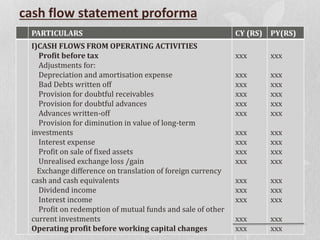
cash flow statement proforma
PARTICULARS CY (RS) PY(RS)
I)CASH FLOWS FROM OPERATING ACTIVITIES
Profit before tax
Adjustments for:
Depreciation and amortisation expense
Bad Debts written off
Provision for doubtful receivables
Provision for doubtful advances
Advances written-off
Provision for diminution in value of long-term
investments
Interest expense
Profit on sale of fixed assets
Unrealised exchange loss /gain
Exchange difference on translation of foreign currency
cash and cash equivalents
Dividend income
Interest income
Profit on redemption of mutual funds and sale of other
current investments
Operating profit before working capital changes
xxx
xxx
xxx
xxx
xxx
xxx
xxx
xxx
xxx
xxx
xxx
xxx
xxx
xxx
xxx
xxx
xxx
xxx
xxx
xxx
xxx
xxx
xxx
xxx
xxx
xxx
xxx
xxx
xxx
xxx
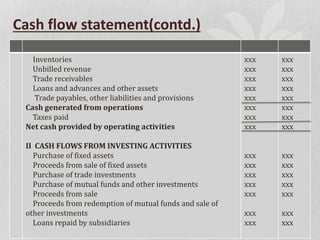
Cash flow statement(contd.)
Inventories
Unbilled revenue
Trade receivables
Loans and advances and other assets
Trade payables, other liabilities and provisions
Cash generated from operations
Taxes paid
Net cash provided by operating activities
II CASH FLOWS FROM INVESTING ACTIVITIES
Purchase of fixed assets
Proceeds from sale of fixed assets
Purchase of trade investments
Purchase of mutual funds and other investments
Proceeds from sale
Proceeds from redemption of mutual funds and sale of
other investments
Loans repaid by subsidiaries
xxx
xxx
xxx
xxx
xxx
xxx
xxx
xxx
xxx
xxx
xxx
xxx
xxx
xxx
xxx
xxx
xxx
xxx
xxx
xxx
xxx
xxx
xxx
xxx
xxx
xxx
xxx
xxx
xxx
xxx
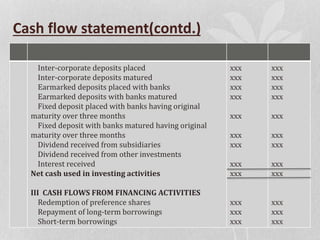
Cash flow statement(contd.)
Inter-corporate deposits placed
Inter-corporate deposits matured
Earmarked deposits placed with banks
Earmarked deposits with banks matured
Fixed deposit placed with banks having original
maturity over three months
Fixed deposit with banks matured having original
maturity over three months
Dividend received from subsidiaries
Dividend received from other investments
Interest received
Net cash used in investing activities
III CASH FLOWS FROM FINANCING ACTIVITIES
Redemption of preference shares
Repayment of long-term borrowings
Short-term borrowings
xxx
xxx
xxx
xxx
xxx
xxx
xxx
xxx
xxx
xxx
xxx
xxx
xxx
xxx
xxx
xxx
xxx
xxx
xxx
xxx
xxx
xxx
xxx
xxx
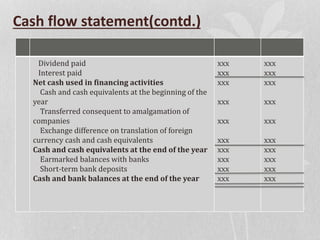
Cash flow statement(contd.)
Dividend paid
Interest paid
Net cash used in financing activities
Cash and cash equivalents at the beginning of the
year
Transferred consequent to amalgamation of
companies
Exchange difference on translation of foreign
currency cash and cash equivalents
Cash and cash equivalents at the end of the year
Earmarked balances with banks
Short-term bank deposits
Cash and bank balances at the end of the year
xxx
xxx
xxx
xxx
xxx
xxx
xxx
xxx
xxx
xxx
xxx
xxx
xxx
xxx
xxx
xxx
xxx
xxx
xxx
xxx
Profit and loss account
• The profit and loss statement is a summary of the financial
performance of a business over time (monthly, quarterly or
annually is most common). It reflects the past performance of the
business and is the report most often used by small business
owners to track how their business is performing.
• As the name indicates the profit and loss statement (also known as
a statement of financial performance or an income statement)
measures the profit or loss of a business over a specified period. A
profit and loss statement summarises the income for a period and
subtracts the expenses incurred for the same period to calculate
the profit or loss for the business.
Profit and loss account proforma
PARTICULARS Current
year (rs)
Previous
year (rs)
Revenue
(+)Net income
TOTAL REVENUE
Expenses:
(a) Employee benefit expense
(b) Operation and other expenses
(c) Finance costs
(d) Depreciation and amortisation expense
(-)TOTAL EXPENSES
PROFIT BEFORE TAX
(-)Tax
PROFIT FOR THE YEAR
xxx
xxx
xxx
xxx
xxx
xxx
xxx
xxx
xxx
xxx
XXX
xxx
xxx
xxx
xxx
xxx
xxx
xxx
xxx
xxx
xxx
XXX
Accounting annual report

Accounting annual report

  • 1.
    Presented By: Mahesh Shailaja AG Shanish Nikhil Bimami Zeeshan Aquib
  • 2.
    What is annualreport? An annual report is a comprehensive report on a company’s activities throughout the preceding year. Annual reports are intended to give share holders and other interested people information about company’s activities and financial performance.
  • 3.
    Importance of annualreport  Communicating with investors : An annual report is an important element of a financial communication strategy to attract and retain investors.  Building customers’ confidence : Annual reports keep customers informed on the status of a company and help build confidence in it as a long-term suppliers.  Attracting and retaining employees : Employees want to know that are working for a progressive company that can offer them secure future and strong job opportunities.  Informing and influencing the media : Journalists monitor companies’ activities to report on financial and business performance. They pay particular attention to company’s results and its prospects.
  • 4.
    CONTENTS OF ANNUALREPORTS  Directors and Management  Annual general meeting  Report of board of directors to members  Management report  Auditors report  CAG report  Financial statement  Shareholder’s fund and policy holder’s fund details  Significant accounting policies, notes and disclosure  Segment reporting schedule  Balance sheet abstract
  • 5.
    Directors and management: •The director’s role is to represent and serve the interests of shareholders by overseeing and appraising the Company’s strategy, policies and performance. • The Management Board are responsible for management decisions and operations across the Company's brands. Annual general meeting: • Gathering of the directors and stockholders of every incorporated firm, required by law to be held each calendar year.
  • 6.
    Report of boardof directors to members: • Board of directors issue a report quarterly, half yearly and annually giving details about the companies, policies, programs, and formulating strategies about the company to members. Management report: • Management report is a statement made by management and it is used to compare the actual results achieved with the budgeted forecast levels. This report helps the management to see where they went wrong and they apply other measures to improve the business.
  • 7.
    Auditors report: • Anauditor's report provides an opinion of the validity and reliability of a company or organization’s financial statements. • The goal of an auditor's report is ultimately to document reasonable assurance that a company’s financial statements are free from material error. CAG report: • CAG report shows all receipts and expenditure of the government of India and the state government.
  • 8.
    Financial statement: • Itis prepared to know profit or loss and also the financial position of the business. Shareholder’s fund and policy holder’s fund: • Shareholder's funds are usually the shares in the company, any share issue premium, retained profits and possibly other reserved that have been accumulated. • Policyholders funds represent customer deposits plus interest credited at contract rates.
  • 9.
    Significant accounting policies,notes and disclosure: • The disclosure of some of the accounting policies followed in the preparation and presentation of the financial statements is required by law in some cases. Segment reporting schedule: • In an annual report, the purpose of business segment reporting is to provide an accurate picture of a public company's performance to its shareholders. For upper management, business segment reporting is used to evaluate each segment's income, expenses, assets, liabilities and so on in order to assess profitability and riskiness.
  • 10.
    Balance sheet abstract: •An abstract balance sheet is a kind of financial statement that shows what the business is worth at one point in time. A standard company’s balance sheet has three parts, assets, liabilities and ownership equity or capital.
  • 11.
    particulars Current year’s(rs) Privious years’s(rs) I. EQUITYAND LIABILITIES Shareholders’ funds (a) Share capital (b) Reserves and surplus Minority interest Non-current liabilities (a) Long-term borrowings (b) Deferred tax liabilities (net) (c) Other long-term liabilities (d) Long-term provisions Current liabilities (a) Short-term borrowings (b) Trade payables (c) Other current liabilities (d) Short-term provisions TOTAL xxx xxx xxx xxx xxx xxx xxx xxx xxx xxx XXX xxx xxx xxx xxx xxx xxx xxx xxx xxx xxx XXX Balance sheet Proforma
  • 12.
    Balance sheet Proforma(contd.) II.ASSETS Non-current assets (a) Fixed assets (b) Non-current investments (c) Deferred tax assets (d) Long-term loans and advances (e) Other non-current assets (f) Goodwill Current assets (a) Current investments (b) Inventories (c) Unbilled revenue (d) Trade receivables (e) Cash and bank balances (f) Short-term loans and advances (g) Other current assets TOTAL xxx xxx xxx xxx xxx xxx xxx xxx xxx xxx xxx xxx xxx XXX xxx xxx xxx xxx xxx xxx xxx xxx xxx xxx xxx xxx xxx XXX
  • 13.
    Cash Flow Statement •Cash flows are inflows and outflows of cash and cash equivalents. • Inflows refers to receipts. • outflow refers to payments.
  • 14.
    cash flow statementproforma PARTICULARS CY (RS) PY(RS) I)CASH FLOWS FROM OPERATING ACTIVITIES Profit before tax Adjustments for: Depreciation and amortisation expense Bad Debts written off Provision for doubtful receivables Provision for doubtful advances Advances written-off Provision for diminution in value of long-term investments Interest expense Profit on sale of fixed assets Unrealised exchange loss /gain Exchange difference on translation of foreign currency cash and cash equivalents Dividend income Interest income Profit on redemption of mutual funds and sale of other current investments Operating profit before working capital changes xxx xxx xxx xxx xxx xxx xxx xxx xxx xxx xxx xxx xxx xxx xxx xxx xxx xxx xxx xxx xxx xxx xxx xxx xxx xxx xxx xxx xxx xxx
  • 15.
    Cash flow statement(contd.) Inventories Unbilledrevenue Trade receivables Loans and advances and other assets Trade payables, other liabilities and provisions Cash generated from operations Taxes paid Net cash provided by operating activities II CASH FLOWS FROM INVESTING ACTIVITIES Purchase of fixed assets Proceeds from sale of fixed assets Purchase of trade investments Purchase of mutual funds and other investments Proceeds from sale Proceeds from redemption of mutual funds and sale of other investments Loans repaid by subsidiaries xxx xxx xxx xxx xxx xxx xxx xxx xxx xxx xxx xxx xxx xxx xxx xxx xxx xxx xxx xxx xxx xxx xxx xxx xxx xxx xxx xxx xxx xxx
  • 16.
    Cash flow statement(contd.) Inter-corporatedeposits placed Inter-corporate deposits matured Earmarked deposits placed with banks Earmarked deposits with banks matured Fixed deposit placed with banks having original maturity over three months Fixed deposit with banks matured having original maturity over three months Dividend received from subsidiaries Dividend received from other investments Interest received Net cash used in investing activities III CASH FLOWS FROM FINANCING ACTIVITIES Redemption of preference shares Repayment of long-term borrowings Short-term borrowings xxx xxx xxx xxx xxx xxx xxx xxx xxx xxx xxx xxx xxx xxx xxx xxx xxx xxx xxx xxx xxx xxx xxx xxx
  • 17.
    Cash flow statement(contd.) Dividendpaid Interest paid Net cash used in financing activities Cash and cash equivalents at the beginning of the year Transferred consequent to amalgamation of companies Exchange difference on translation of foreign currency cash and cash equivalents Cash and cash equivalents at the end of the year Earmarked balances with banks Short-term bank deposits Cash and bank balances at the end of the year xxx xxx xxx xxx xxx xxx xxx xxx xxx xxx xxx xxx xxx xxx xxx xxx xxx xxx xxx xxx
  • 18.
    Profit and lossaccount • The profit and loss statement is a summary of the financial performance of a business over time (monthly, quarterly or annually is most common). It reflects the past performance of the business and is the report most often used by small business owners to track how their business is performing. • As the name indicates the profit and loss statement (also known as a statement of financial performance or an income statement) measures the profit or loss of a business over a specified period. A profit and loss statement summarises the income for a period and subtracts the expenses incurred for the same period to calculate the profit or loss for the business.
  • 19.
    Profit and lossaccount proforma PARTICULARS Current year (rs) Previous year (rs) Revenue (+)Net income TOTAL REVENUE Expenses: (a) Employee benefit expense (b) Operation and other expenses (c) Finance costs (d) Depreciation and amortisation expense (-)TOTAL EXPENSES PROFIT BEFORE TAX (-)Tax PROFIT FOR THE YEAR xxx xxx xxx xxx xxx xxx xxx xxx xxx xxx XXX xxx xxx xxx xxx xxx xxx xxx xxx xxx xxx XXX