CONSULTATION TIMES
MONDAY
13:00 – 17:00
TUESDAY
08:00 – 10:00
WEDNESDAY
12:30 – 14:30
UNIT 20 – INTRAGROUP TRANSACTIONS
• Prior Knowledge
• Assumed knowledge
• Outcomes
Important part of
study guide
LITERATURE
• Group Statements - Sixteenth edition – 2015
Binnekade CS, Koppeschaar ZR, Stegmann N, Rossouw J &
Wright W
• LexisNexis Butterworths
Chapter 5 (par 5.1 – 5.19)
UNIT 20 – INTRAGROUP TRANSACTIONS
After studying this unit you should be able to:
• record the necessary consolidation journal entries in respect of intragroup
transactions with the purpose of eliminating unrealised intragroup profits (or
losses) relating to trade inventories and property, plant and equipment
• take into account intragroup transactions in the analysis of the
owners’ equity, where necessary (2B)
• prepare a consolidated statement of comprehensive income,
statement of financial position and statement of changes in equity,
taking into account intragroup transactions, from the analysis of the owners’
equity and the given statements of comprehensive income, statements of
financial position and statements of changes in equity
• recognise income tax allocations on intragroup transactions relating to:
- inventory sales and
- depreciable property, plant and equipment (including the selling of
manufactured property, plant and equipment).
UNIT 20 – INTRAGROUP TRANSACTIONS
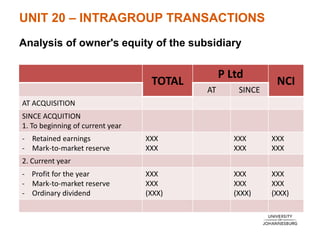
Analysis of owner's equity of the subsidiary
TOTAL
P Ltd
NCI
AT SINCE
AT ACQUISITION
SINCE ACQUITION
1. To beginning of current year
- Retained earnings
- Mark-to-market reserve
XXX
XXX
XXX
XXX
XXX
XXX
2. Current year
- Profit for the year
- Mark-to-market reserve
- Ordinary dividend
XXX
XXX
(XXX)
XXX
XXX
(XXX)
XXX
XXX
(XXX)
UNIT 20 – INTRAGROUP TRANSACTIONS
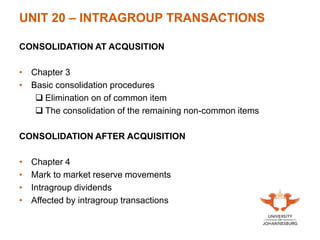
CONSOLIDATION AT ACQUSITION
• Chapter 3
• Basic consolidation procedures
 Elimination on of common item
 The consolidation of the remaining non-common items
CONSOLIDATION AFTER ACQUISITION
• Chapter 4
• Mark to market reserve movements
• Intragroup dividends
• Affected by intragroup transactions
DISCUSSION
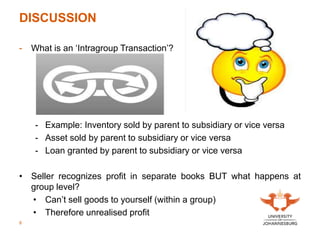
- What is an ‘Intragroup Transaction’?
- Example: Inventory sold by parent to subsidiary or vice versa
- Asset sold by parent to subsidiary or vice versa
- Loan granted by parent to subsidiary or vice versa
• Seller recognizes profit in separate books BUT what happens at
group level?
• Can’t sell goods to yourself (within a group)
• Therefore unrealised profit
8
Discussion
9
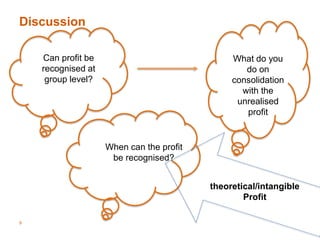
Can profit be
recognised at
group level?
What do you
do on
consolidation
with the
unrealised
profit
When can the profit
be recognised?
theoretical/intangible
Profit
EXAMPLE
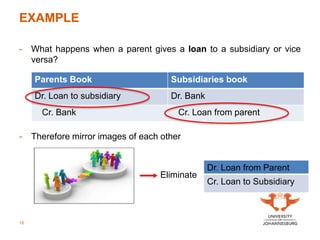
- What happens when a parent gives a loan to a subsidiary or vice
versa?
- Therefore mirror images of each other
Eliminate
10
Parents Book Subsidiaries book
Dr. Loan to subsidiary Dr. Bank
Cr. Bank Cr. Loan from parent
Dr. Loan from Parent
Cr. Loan to Subsidiary
Discussion
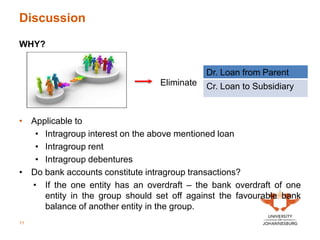
WHY?
Eliminate
• Applicable to
• Intragroup interest on the above mentioned loan
• Intragroup rent
• Intragroup debentures
• Do bank accounts constitute intragroup transactions?
• If the one entity has an overdraft – the bank overdraft of one
entity in the group should set off against the favourable bank
balance of another entity in the group.
11
Dr. Loan from Parent
Cr. Loan to Subsidiary
Discussion
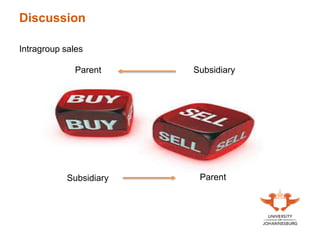
Intragroup sales
Parent Subsidiary
ParentSubsidiary
Discussion
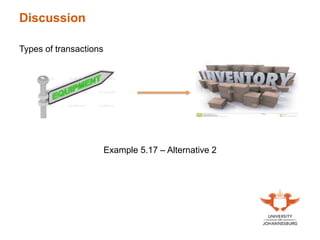
Types of transactions
Example 5.17 – Alternative 1
Discussion
Types of transactions
Example 5.17 – Alternative 2
Discussion
Types of transactions
Example 5.17 – Alternative 3
Discussion
Types of transactions
Example 5.17 – Alternative 4
Class Examples
17
All examples in Chapter 5 are important – Class Example focus
Example 5.17 (p. 261 – 297)
Comprehensive example in respect of the elimination of unrealised
gain and the relevant tax implication

Unit 20 intra-group transactions slides

  • 2.
    CONSULTATION TIMES MONDAY 13:00 –17:00 TUESDAY 08:00 – 10:00 WEDNESDAY 12:30 – 14:30
  • 3.
    UNIT 20 –INTRAGROUP TRANSACTIONS • Prior Knowledge • Assumed knowledge • Outcomes Important part of study guide
  • 4.
    LITERATURE • Group Statements- Sixteenth edition – 2015 Binnekade CS, Koppeschaar ZR, Stegmann N, Rossouw J & Wright W • LexisNexis Butterworths Chapter 5 (par 5.1 – 5.19)
  • 5.
    UNIT 20 –INTRAGROUP TRANSACTIONS After studying this unit you should be able to: • record the necessary consolidation journal entries in respect of intragroup transactions with the purpose of eliminating unrealised intragroup profits (or losses) relating to trade inventories and property, plant and equipment • take into account intragroup transactions in the analysis of the owners’ equity, where necessary (2B) • prepare a consolidated statement of comprehensive income, statement of financial position and statement of changes in equity, taking into account intragroup transactions, from the analysis of the owners’ equity and the given statements of comprehensive income, statements of financial position and statements of changes in equity • recognise income tax allocations on intragroup transactions relating to: - inventory sales and - depreciable property, plant and equipment (including the selling of manufactured property, plant and equipment).
  • 6.
    UNIT 20 –INTRAGROUP TRANSACTIONS Analysis of owner's equity of the subsidiary TOTAL P Ltd NCI AT SINCE AT ACQUISITION SINCE ACQUITION 1. To beginning of current year - Retained earnings - Mark-to-market reserve XXX XXX XXX XXX XXX XXX 2. Current year - Profit for the year - Mark-to-market reserve - Ordinary dividend XXX XXX (XXX) XXX XXX (XXX) XXX XXX (XXX)
  • 7.
    UNIT 20 –INTRAGROUP TRANSACTIONS CONSOLIDATION AT ACQUSITION • Chapter 3 • Basic consolidation procedures  Elimination on of common item  The consolidation of the remaining non-common items CONSOLIDATION AFTER ACQUISITION • Chapter 4 • Mark to market reserve movements • Intragroup dividends • Affected by intragroup transactions
  • 8.
    DISCUSSION - What isan ‘Intragroup Transaction’? - Example: Inventory sold by parent to subsidiary or vice versa - Asset sold by parent to subsidiary or vice versa - Loan granted by parent to subsidiary or vice versa • Seller recognizes profit in separate books BUT what happens at group level? • Can’t sell goods to yourself (within a group) • Therefore unrealised profit 8
  • 9.
    Discussion 9 Can profit be recognisedat group level? What do you do on consolidation with the unrealised profit When can the profit be recognised? theoretical/intangible Profit
  • 10.
    EXAMPLE - What happenswhen a parent gives a loan to a subsidiary or vice versa? - Therefore mirror images of each other Eliminate 10 Parents Book Subsidiaries book Dr. Loan to subsidiary Dr. Bank Cr. Bank Cr. Loan from parent Dr. Loan from Parent Cr. Loan to Subsidiary
  • 11.
    Discussion WHY? Eliminate • Applicable to •Intragroup interest on the above mentioned loan • Intragroup rent • Intragroup debentures • Do bank accounts constitute intragroup transactions? • If the one entity has an overdraft – the bank overdraft of one entity in the group should set off against the favourable bank balance of another entity in the group. 11 Dr. Loan from Parent Cr. Loan to Subsidiary
  • 12.
  • 13.
  • 14.
  • 15.
  • 16.
  • 17.
    Class Examples 17 All examplesin Chapter 5 are important – Class Example focus Example 5.17 (p. 261 – 297) Comprehensive example in respect of the elimination of unrealised gain and the relevant tax implication

Editor's Notes

  • #9 Intragroup Transaction – A transaction that takes place between related parties within the group Parent sells to subsidiary or subsidiary sells to parent Examples Sale of inventory or sale of assets Unrealised profit – You do not yet physically have that profit in your back pocket.
  • #10 Can profit be recognised at group level? No – sale seen as sale to yourself. Cant make a profit from yourself. When can the profit be recognised Sold to third parties Only then does the profit realise from the groups perspective (That’s when the group makes a profit) Unrealised profit – You do not yet physically have that profit in your back pocket. It is a ‘theoretical/intangible Profit’.
  • #12 WHY ----- > Assets and liabilities are not overstated on consolidation Do bank accounts constitute intragroup transactions? No ----Bank Accounts ----- > cant offset unless both entities have bank accounts at the same financial institution; the bank itself would set off the two accounts against each other in terms of an agreement between the two entities concerned and the bank; and the group has the intention to settle the amounts on a net basis.