© 2009 The McGraw-Hill Companies, Inc. All rights reserved.
McGraw-Hill/Irwin
The Reporting
Entity and
Consolidated
Financial
Statements
3
3-2
Consolidated Financial Statements
• Consolidated financial statements present
the financial position and results of
operations for a parent (controlling entity)
and one or more subsidiaries (controlled
entities) as if the individual entities actually
were a single company or entity.
3-3
Consolidated Financial Statements
• Consolidation is required when a corporation owns a
majority of another corporation’s outstanding common
stock and occasionally under other circumstances.
• Two companies are considered to be related when one
controls the other or both are under the common control
of another entity.
• The same accounting principles should be applied in
preparing consolidated financial statements as in
preparing separate-company financial statements.
• More useful than the separate financial statements of the
individual companies when the companies are related.
3-4
Benefits of Consolidated Financial
Statements
• Presented primarily for those parties having a long-
run interest in the parent company, including its
management, shareholders, long-term creditors or
other resource providers.
• Often provide the only means of obtaining a clear
picture of the total resources of the combined entity
that are under the parent's control.
3-5
Limitations of Consolidated Financial
Statements
• Results of individual companies included in
the consolidation are not disclosed, thereby
hiding poor performance.
• Not all the consolidated retained earnings
balance is necessarily available for
dividends of the parent.
• Financial ratios are not necessarily
representative of any single company in the
consolidation.
3-6
Limitations of Consolidated Financial
Statements
• Similar accounts of different companies that
are combined in the consolidation may not
be entirely comparable.
• Additional information about companies
may be needed for a fair presentation, thus
requiring voluminous footnotes.
• Information is lost any time data sets are
aggregated.
3-7
Subsidiary Financial Statements
• Creditors, preferred stockholders, and
noncontrolling common stockholders of
subsidiaries are most interested in the separate
financial statements of the subsidiaries in which
they have an interest.
• Because subsidiaries are legally separate from
their parents, the creditors and stockholders of
a subsidiary generally have no claim on the
parent, and the stockholders of the subsidiary do
not share in the profits of the parent.
3-8
Concepts and Standards
• Professional guidance is provided in ARB 51,
FASB 94, and FASB 160.
• Traditional view of control
– ARB 51 indicates that consolidated financial
statements normally are appropriate for a group of
companies when one company “has a controlling
financial interest in the other companies.”
– FASB 94 requires consolidation of all majority-owned
subsidiaries unless the parent is unable to exercise
control.
3-9
Concepts and Standards
• Less Than Majority Ownership
– A company may be able to direct the operating and
financing policies of another with less than majority
ownership.
– FASB 94 does not preclude consolidation with less
than majority ownership, but such consolidations have
seldom been found in practice.
– FASB 141R indicates that control can be obtained
without majority ownership of a company’s common
stock.
3-10
Concepts and Standards
• Traditional view of control includes:
– Direct control that occurs when one
company owns a majority of another
company’s common stock.
– Indirect control or pyramiding that occurs
when a company’s common stock is owned
by one or more other companies that are all
under common control.
3-11
Concepts and Standards
• Ability to Exercise Control
– Sometimes, majority stockholders may not be
able to exercise control even though they hold
more than 50 percent of outstanding voting stock.
• Subsidiary is in legal reorganization or bankruptcy
• Foreign country restricts remittance of subsidiary
profits to domestic parent company
– The unconsolidated subsidiary is reported as an
intercorporate investment.
3-12
Concepts and Standards
• Differences in Fiscal Periods
– Difference in the fiscal periods of a parent and
subsidiary should not preclude consolidation.
– Often the fiscal period of the subsidiary is
changed to coincide with that of the parent.
– Another alternative is to adjust the financial
statement data of the subsidiary each period
to place the data on a basis consistent with
the fiscal period of the parent.
3-13
Concepts and Standards
• Changing Concept of the Reporting Entity
– FASB 94, requiring consolidation of all majority-
owned subsidiaries, was issued to eliminate the
inconsistencies found in practice until a more
comprehensive standard could be issued.
– Completion of the FASB’s consolidation project
has been hampered by, among other things,
issues related to:
• Control
• Reporting entity
3-14
Concepts and Standards
• FASB has been attempting to move toward a
consolidation requirement for entities under
effective control.
– Ability to direct the policies of another entity even
though majority ownership is lacking.
– Even though FASB 141R indicates that control can
be achieved without majority ownership, a
comprehensive consolidation policy has yet to be
achieved.
3-15
Concepts and Standards
• Defining the accounting entity would help
resolve the issue of when to prepare
consolidated financial statements and what
entities should be included.
• FASB 160 deals only with selected issues
related to consolidated financial statements,
leaving a comprehensive consolidation policy
until a later time.
3-16
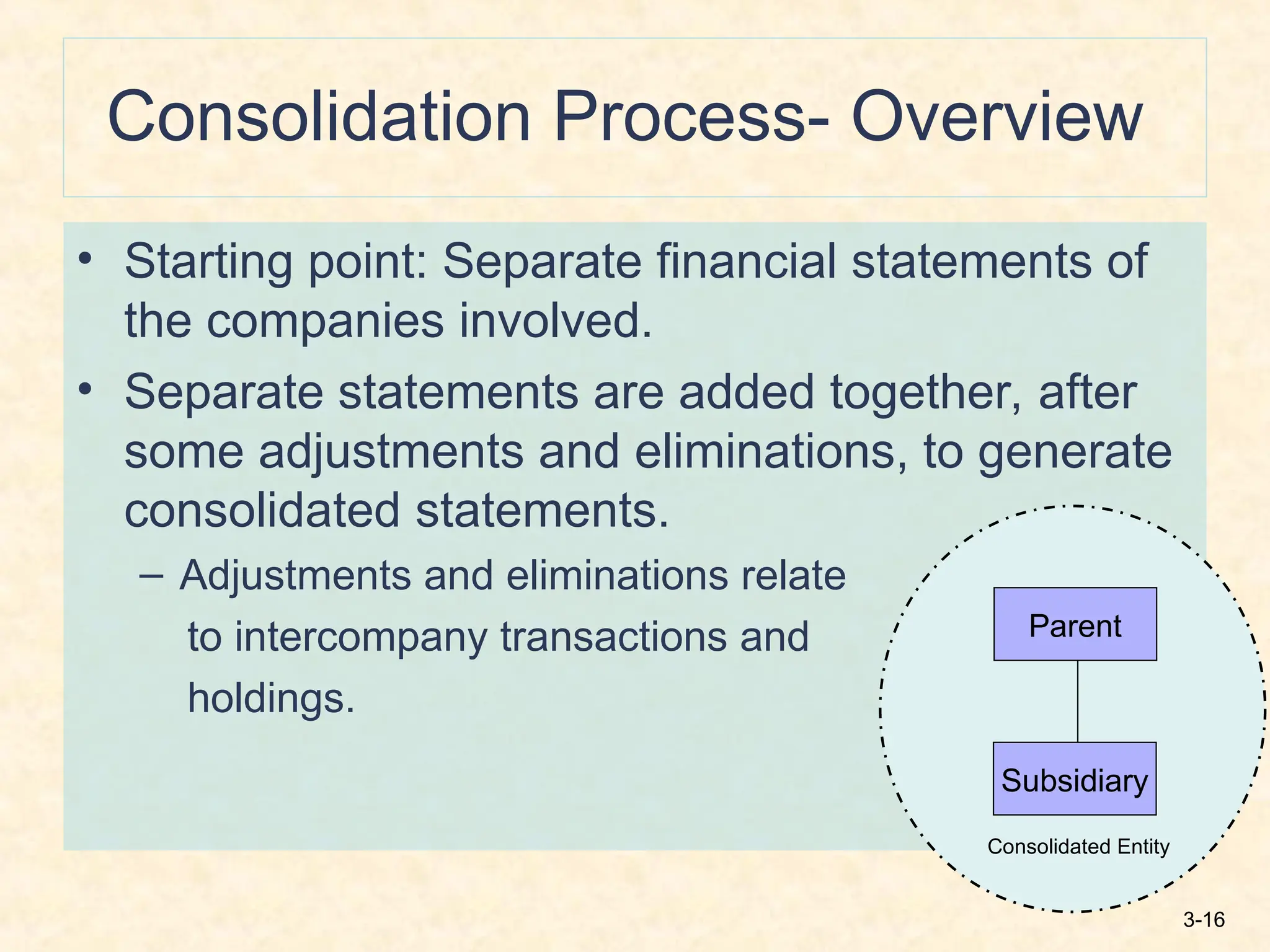
Consolidation Process- Overview
• Starting point: Separate financial statements of
the companies involved.
• Separate statements are added together, after
some adjustments and eliminations, to generate
consolidated statements.
– Adjustments and eliminations relate
to intercompany transactions and
holdings.
Parent
Subsidiary
Consolidated Entity
3-17
Consolidation Process
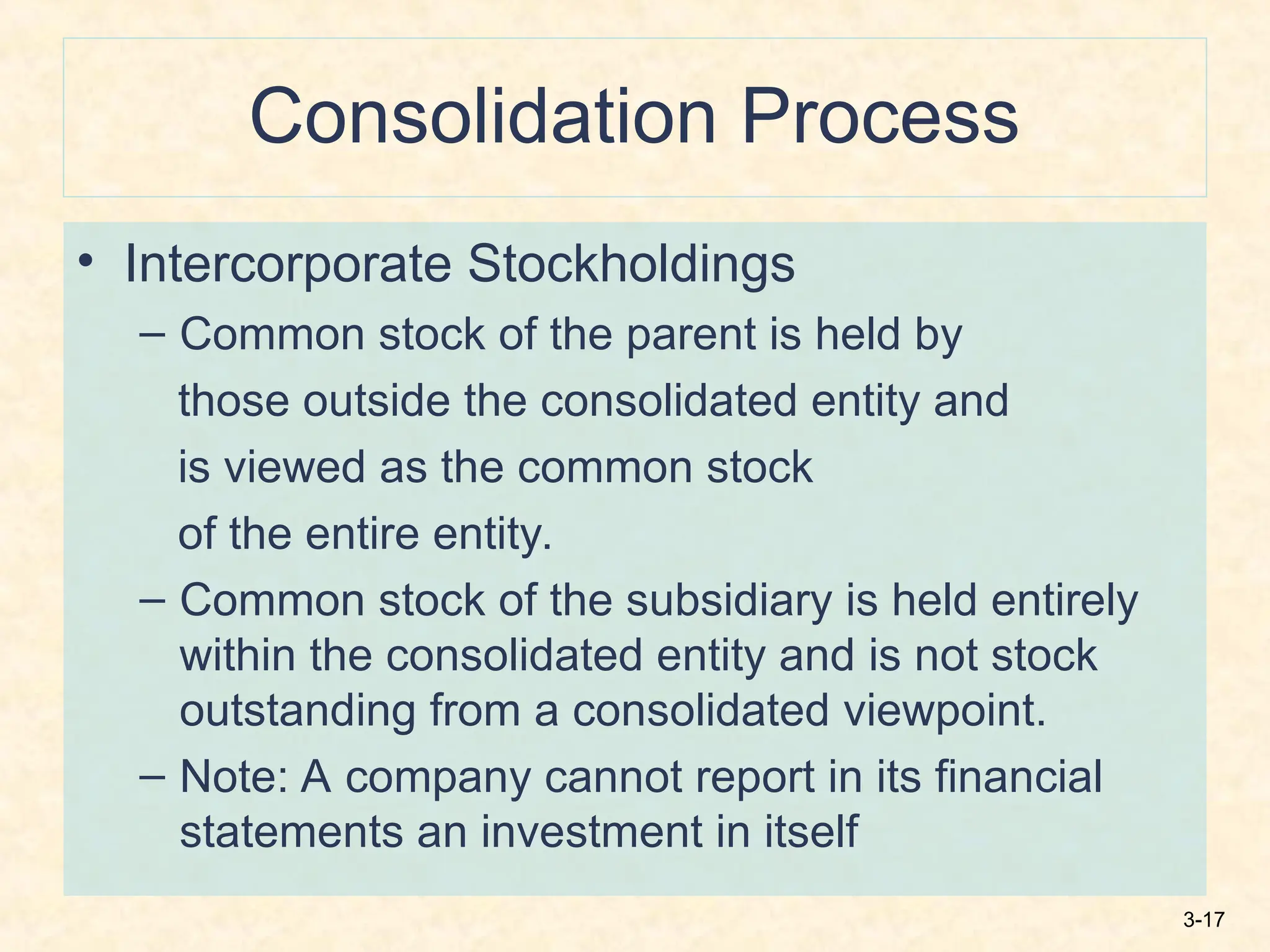
• Intercorporate Stockholdings
– Common stock of the parent is held by
those outside the consolidated entity and
is viewed as the common stock
of the entire entity.
– Common stock of the subsidiary is held entirely
within the consolidated entity and is not stock
outstanding from a consolidated viewpoint.
– Note: A company cannot report in its financial
statements an investment in itself
3-18
Consolidation Process
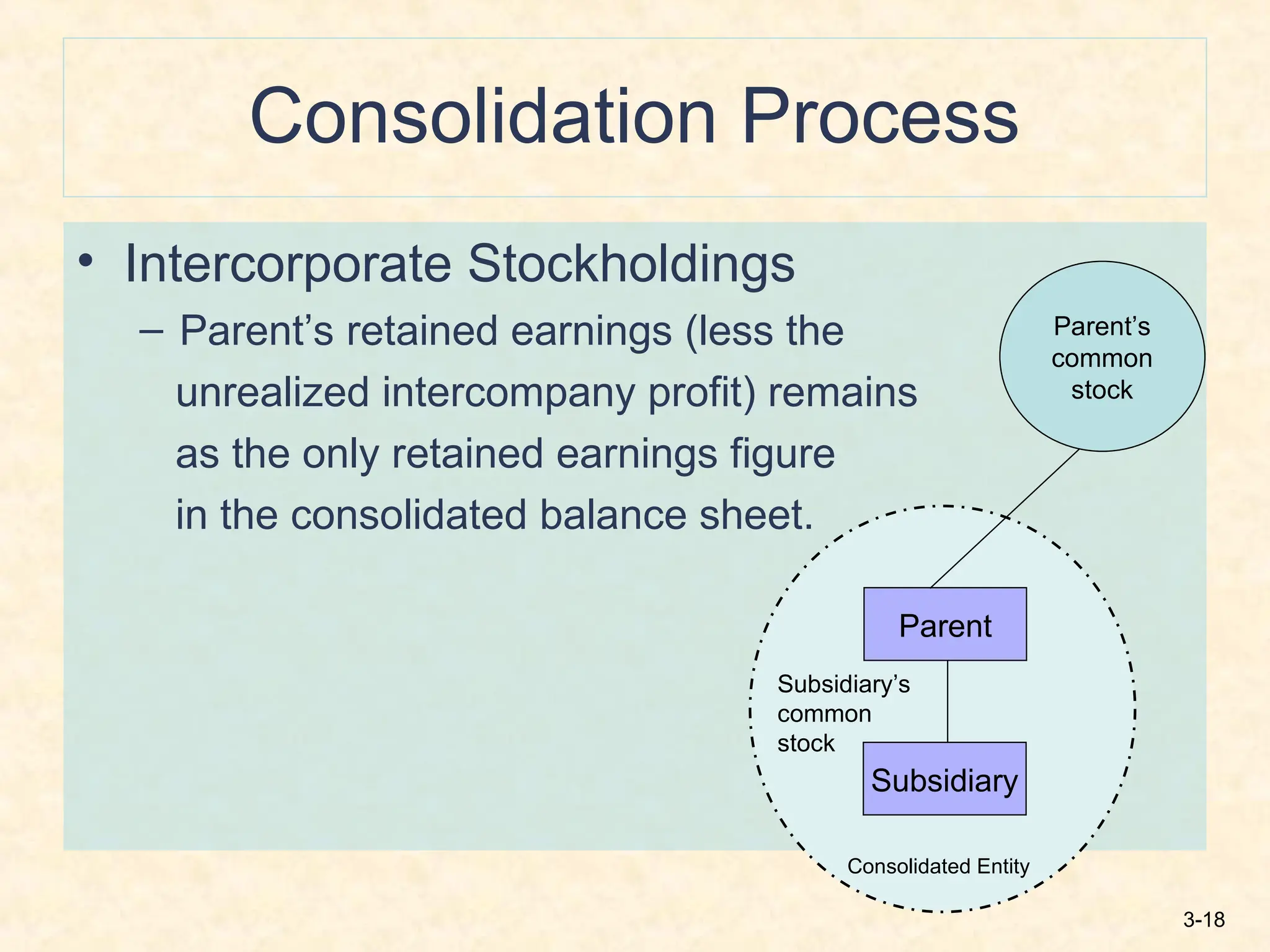
• Intercorporate Stockholdings
– Parent’s retained earnings (less the
unrealized intercompany profit) remains
as the only retained earnings figure
in the consolidated balance sheet.
Parent
Subsidiary
Subsidiary’s
common
stock
Parent’s
common
stock
Consolidated Entity
3-19
Consolidation Process
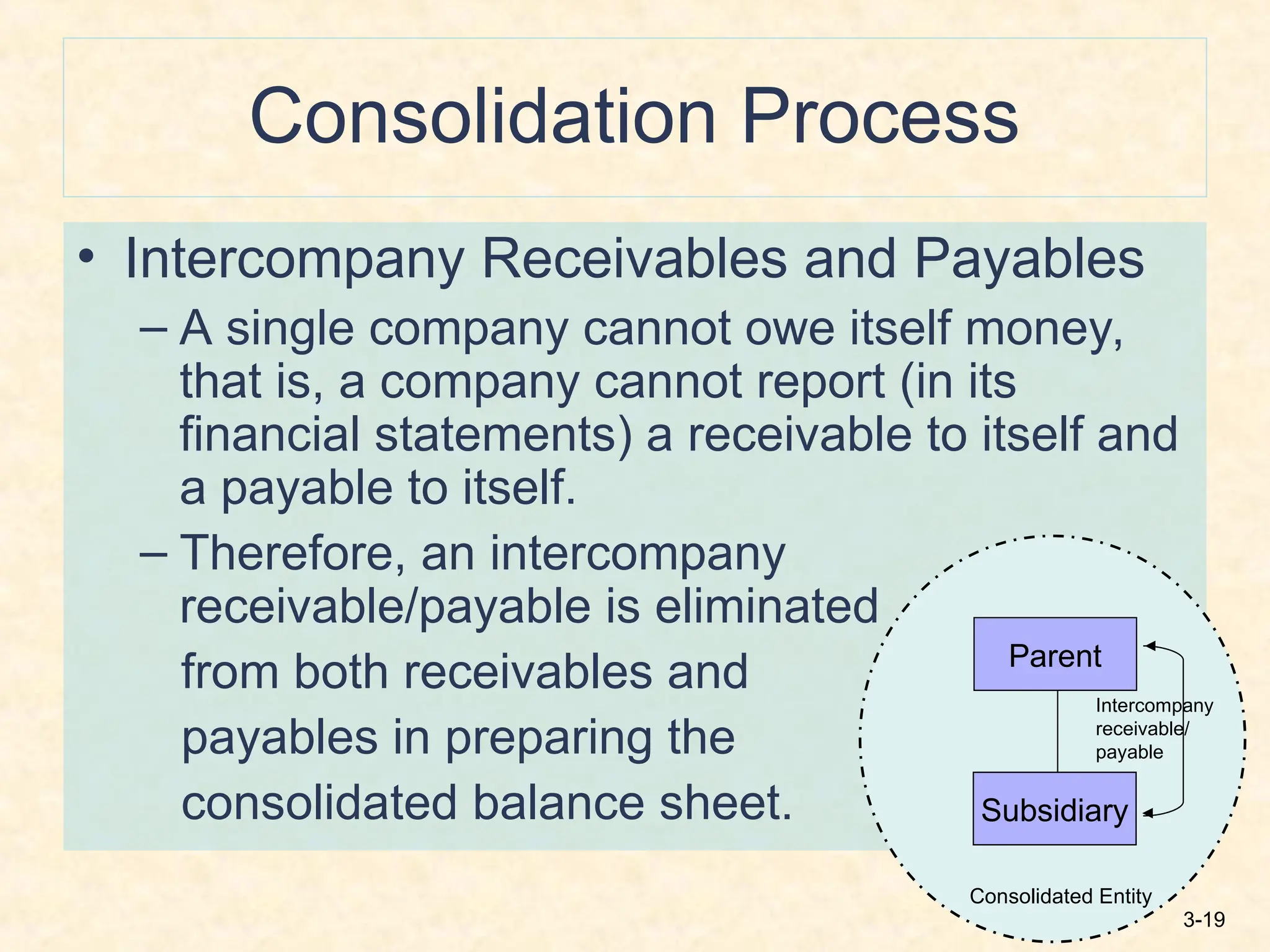
• Intercompany Receivables and Payables
– A single company cannot owe itself money,
that is, a company cannot report (in its
financial statements) a receivable to itself and
a payable to itself.
– Therefore, an intercompany
receivable/payable is eliminated
from both receivables and
payables in preparing the
consolidated balance sheet.
Parent
Subsidiary
Intercompany
receivable/
payable
Consolidated Entity
3-20
Consolidation Process
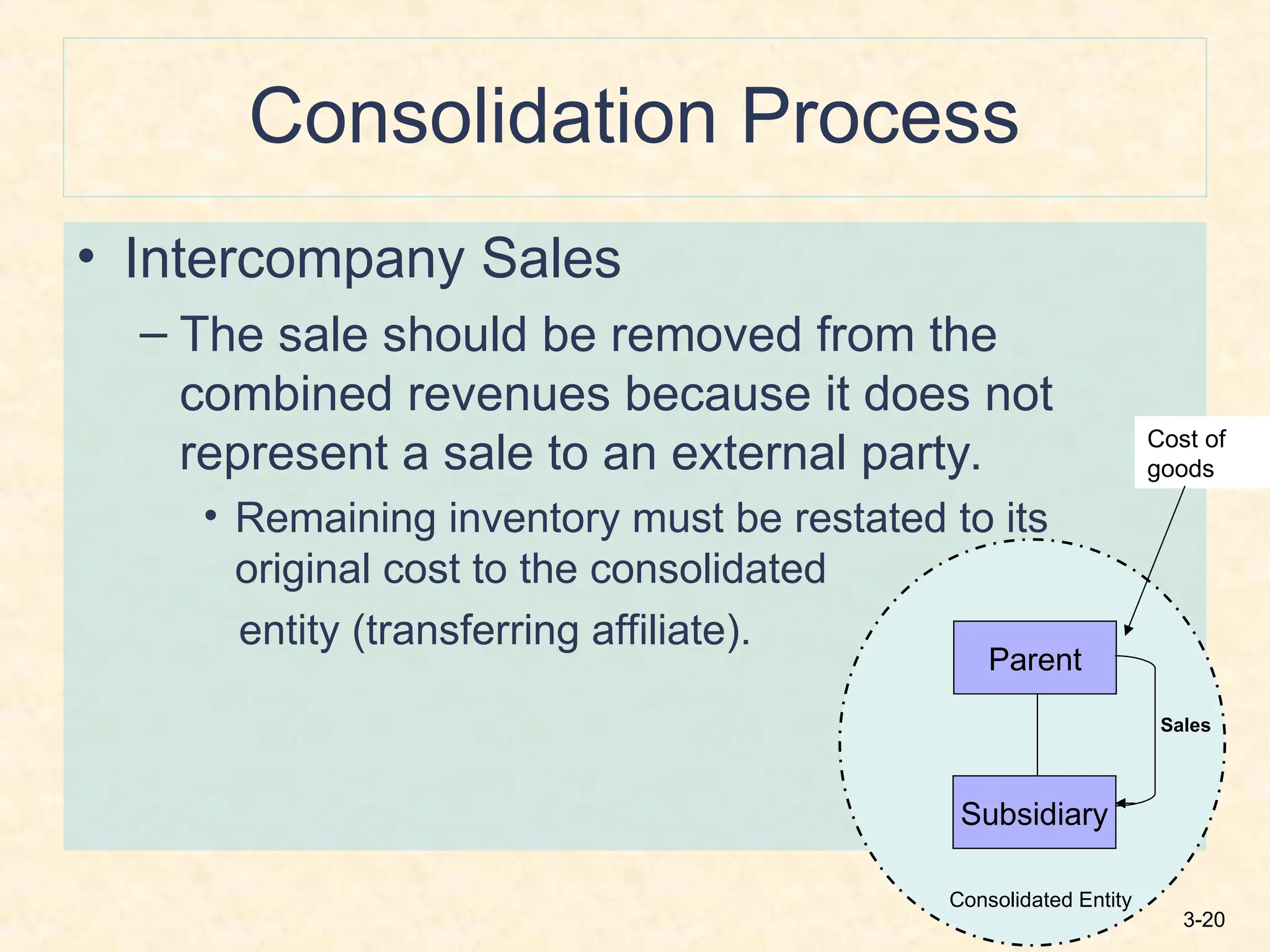
• Intercompany Sales
– The sale should be removed from the
combined revenues because it does not
represent a sale to an external party.
• Remaining inventory must be restated to its
original cost to the consolidated
entity (transferring affiliate).
Parent
Subsidiary
Cost of
goods
Consolidated Entity
Sales
3-21
Consolidation Process
• Difference between Fair Value and Book Value
– Fair value of the consideration given usually
reflects the fair value of the acquired company
and differs from its book value.
– An acquiree’s assets and liabilities must be
valued based on their acquisition-date fair values,
and any excess of the consideration given over
the fair values of the net assets is considered
goodwill.
3-22
Consolidation Process
• Single-Entity Viewpoint
– To understand the adjustments needed, one
should focus on:
1. identifying the treatment accorded a particular
item by each of the separate companies and
2. identifying the amount that would appear in the
financial statements with respect to that item if
the consolidated entity were actually a single
company.
3-23
Mechanics of the Consolidation
Process
• A worksheet is used to facilitate the process of
combining and adjusting the account balances
involved in a consolidation.
• While the parent company and the subsidiary
each maintain their own books, there are no
books for the consolidated entity.
• The balances of the accounts are taken at the
end of each period from the books of the parent
and the subsidiary and entered in the
consolidation workpaper.
3-24
Mechanics of the Consolidation
Process
• Where the simple adding of the amounts from
the two companies leads to a consolidated
figure different from the amount that would
appear if the two companies were actually one,
the combined amount must be adjusted to the
desired figure.
• This is done through the preparation of
eliminating entries.
3-25
Noncontrolling Interest
• For the parent to consolidate the subsidiary,
only a controlling interest is needed—not 100%
interest.
• Those shareholders of the subsidiary other than
the parent are referred to as “noncontrolling” or
“minority” shareholders.
• Noncontrolling interest or minority interest refers
to the claim of these shareholders on the income
and net assets of the subsidiary.
3-26
Noncontrolling Interest
• Computation of income to the noncontrolling
interest: In uncomplicated situations, it is a
simple proportionate share of the subsidiary’s
net income.
• Presentation: FASB 160 requires that the term
“consolidated net income” be applied to the
income available to all stockholders, with the
allocation of that income between the controlling
and noncontrolling stockholders shown.
3-27
Noncontrolling Interest
• The noncontrolling interest’s claim on the net
assets of the subsidiary was previously shown
between liabilities and stockholders’ equity in the
consolidated balance sheet.
– Some firms reported minority interest as a liability,
although it did not meet the definition of a liability.
• FASB 160 makes clear that the noncontrolling
interest’s claim on net assets is an element of
equity, not a liability.
3-28
Combined Financial Statements
• Financial statements are also prepared for a
group of companies when no one company in
the group owns a majority of the common
stock of any other company in the group.
• Combined financial statements are those that
include a group of related companies without
including the parent company or other owner.
– Procedures are essentially the same as those used in
preparing consolidated financial statements.
3-29
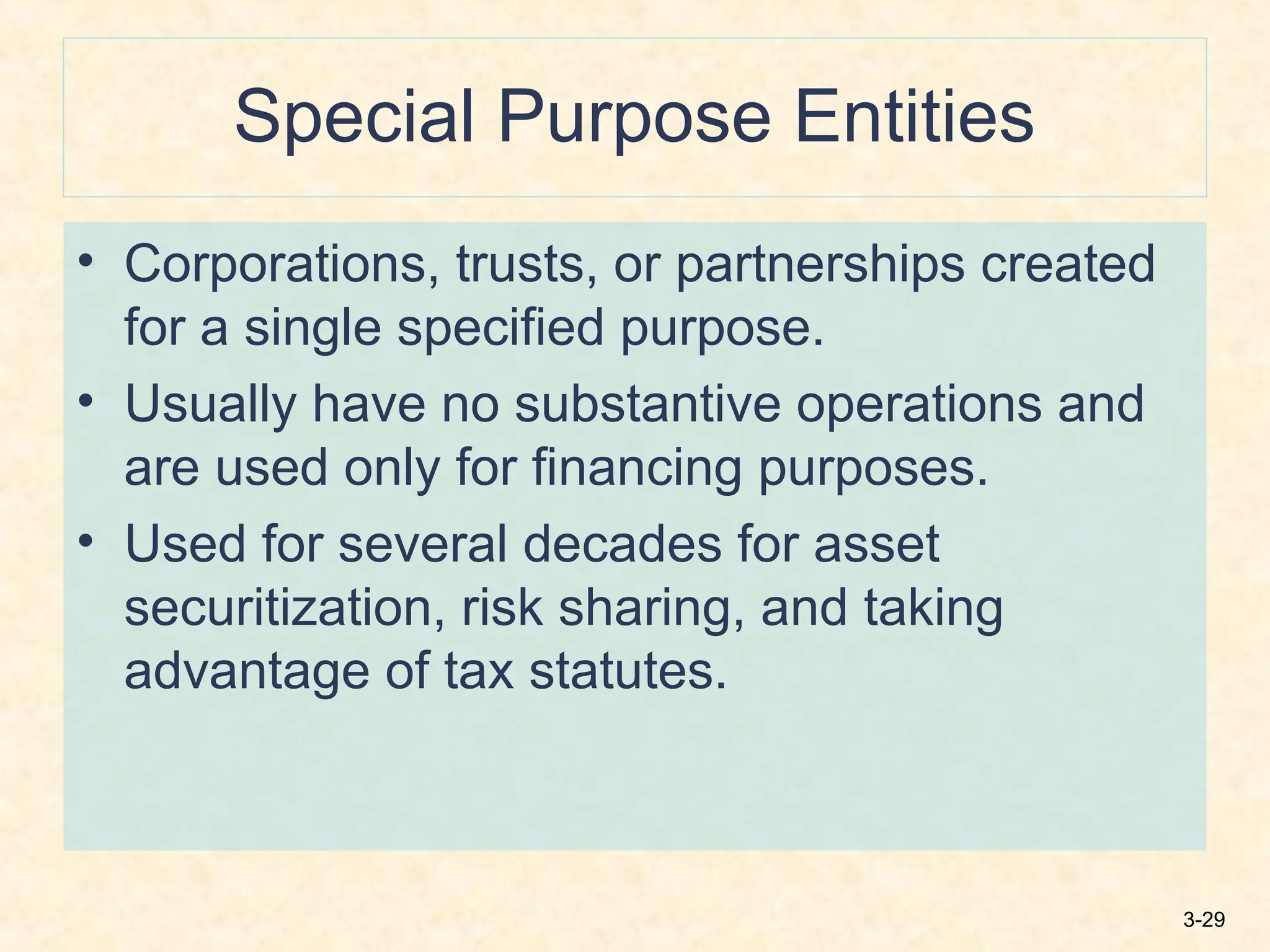
Special Purpose Entities
• Corporations, trusts, or partnerships created
for a single specified purpose.
• Usually have no substantive operations and
are used only for financing purposes.
• Used for several decades for asset
securitization, risk sharing, and taking
advantage of tax statutes.
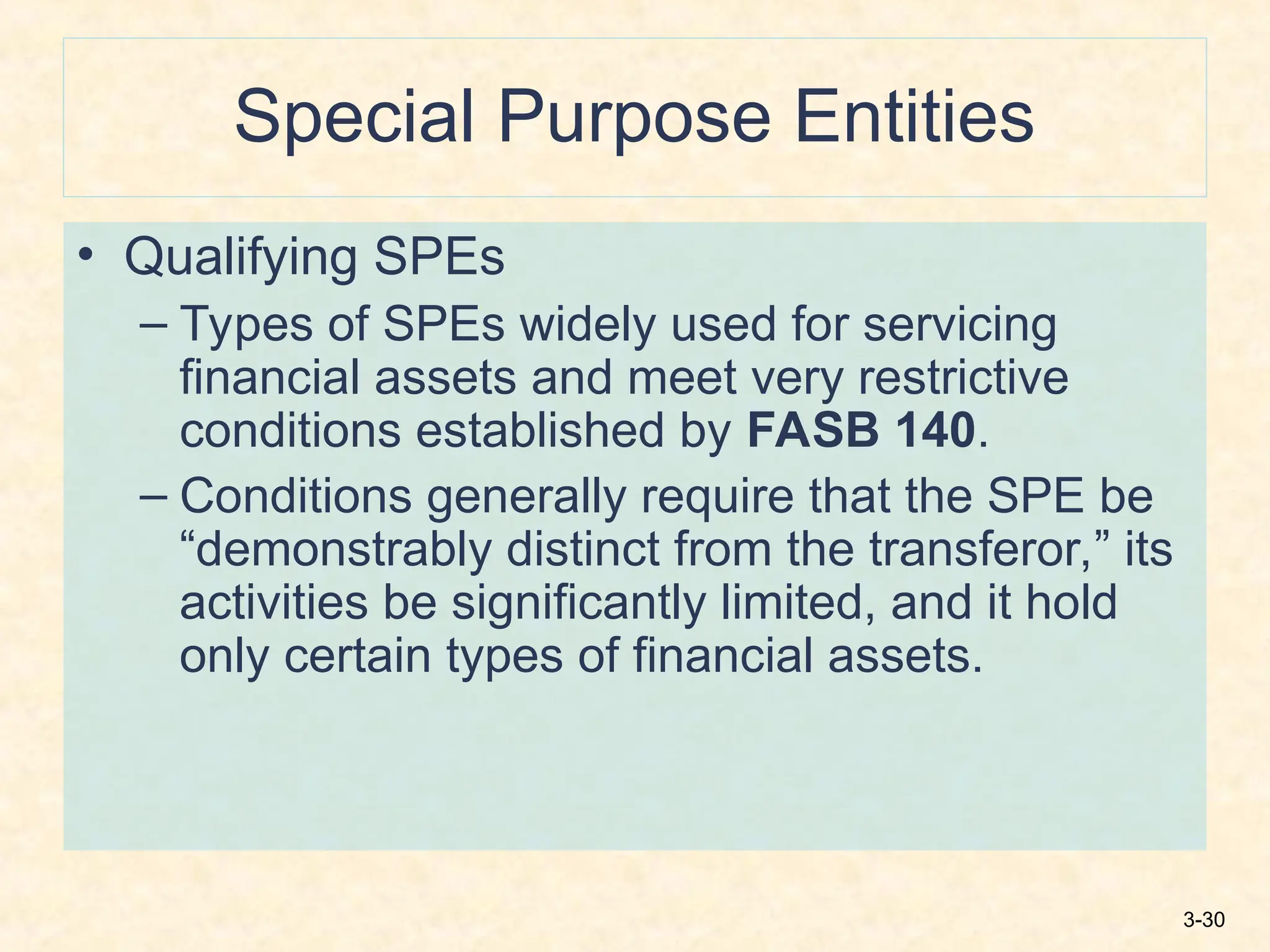
3-30
Special Purpose Entities
• Qualifying SPEs
– Types of SPEs widely used for servicing
financial assets and meet very restrictive
conditions established by FASB 140.
– Conditions generally require that the SPE be
“demonstrably distinct from the transferor,” its
activities be significantly limited, and it hold
only certain types of financial assets.
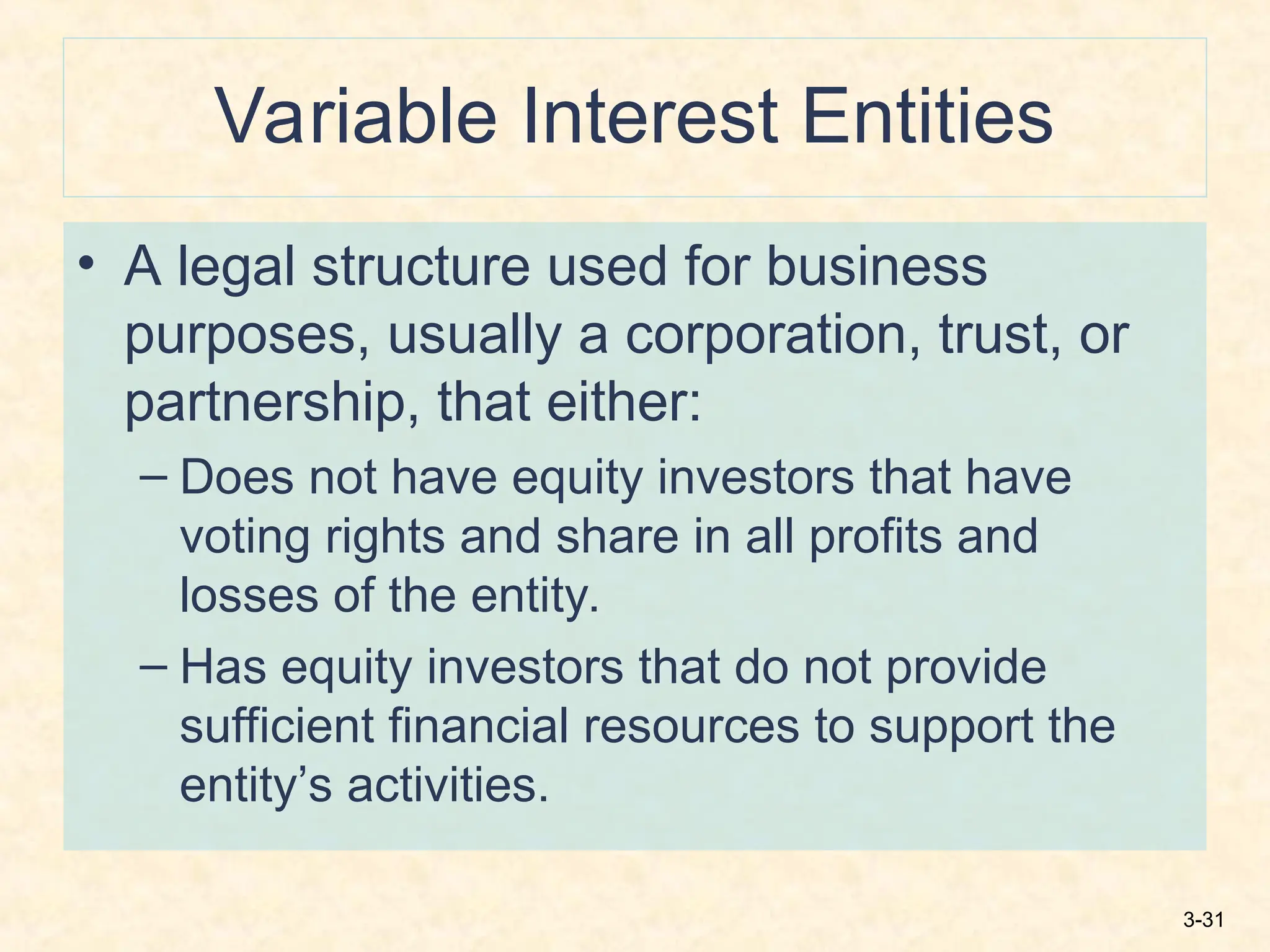
3-31
Variable Interest Entities
• A legal structure used for business
purposes, usually a corporation, trust, or
partnership, that either:
– Does not have equity investors that have
voting rights and share in all profits and
losses of the entity.
– Has equity investors that do not provide
sufficient financial resources to support the
entity’s activities.
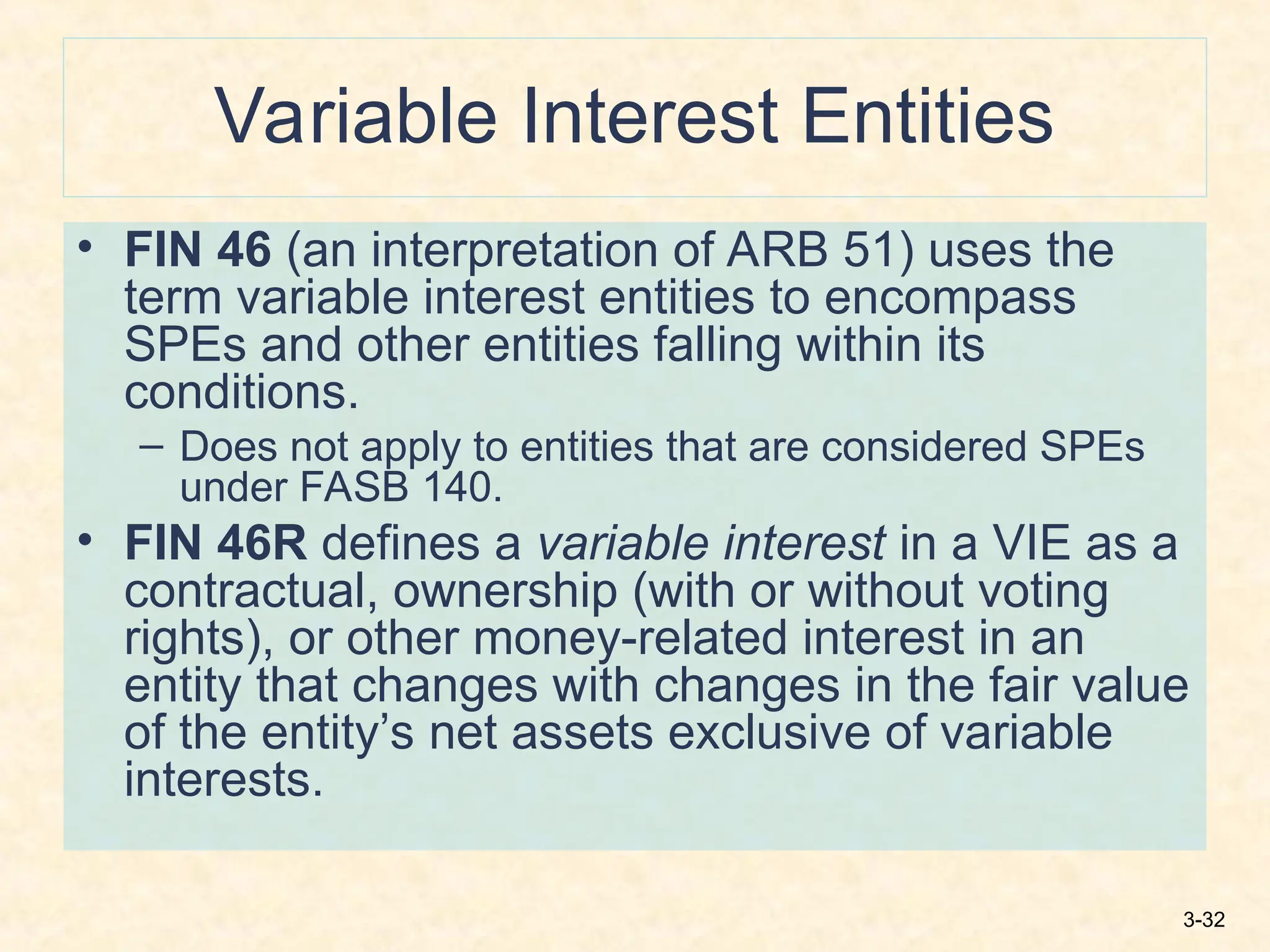
3-32
Variable Interest Entities
• FIN 46 (an interpretation of ARB 51) uses the
term variable interest entities to encompass
SPEs and other entities falling within its
conditions.
– Does not apply to entities that are considered SPEs
under FASB 140.
• FIN 46R defines a variable interest in a VIE as a
contractual, ownership (with or without voting
rights), or other money-related interest in an
entity that changes with changes in the fair value
of the entity’s net assets exclusive of variable
interests.
3-33
Different Approaches to
Consolidation
• Theories that might serve as a basis for
preparing consolidated financial statements:
– Proprietary theory
– Parent company theory
– Entity theory
• With the issuance of FASB 141R, the
FASB’s approach to consolidation has moved
very much toward the entity theory.
3-34
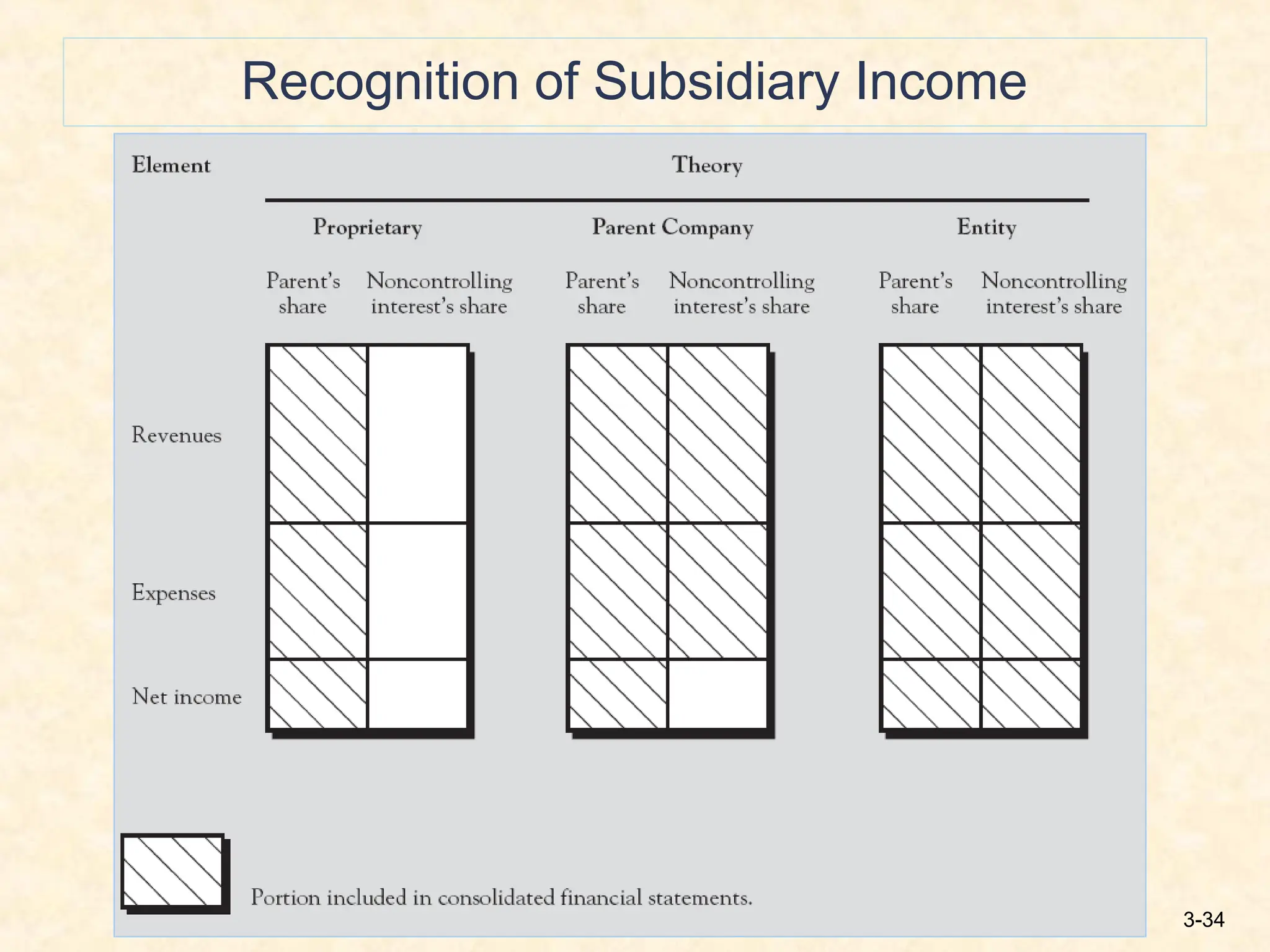
Recognition of Subsidiary Income
3-35
Proprietary Theory
• Views the firm as an extension of its owners.
• Assets and liabilities of the firm are
considered to be those of the owners.
• Results in a pro rata consolidation where the
parent consolidates only its proportionate
share of a less-than-wholly owned
subsidiary’s assets, liabilities, revenues and
expenses.
3-36
Parent Company Theory
• Recognizes that though the parent does not
have direct ownership or responsibility, it has
the ability to exercise effective control over all
of the subsidiary’s assets and liabilities, not
simply a proportionate share.
• Separate recognition is given, in the
consolidated financial statements, to the
noncontrolling interest’s claim on the net
assets and earnings of the subsidiary.
3-37
Entity Theory
• Focuses on the firm as a separate
economic entity, rather than on the
ownership rights of the shareholders.
• Emphasis is on the consolidated entity
itself, with the controlling and
noncontrolling shareholders viewed as two
separate groups, each having an equity in
the consolidated entity.
3-38
Entity Theory
• All of the assets, liabilities, revenues, and
expenses of a less-than-wholly owned
subsidiary are included in the consolidated
financial statements, with no special
treatment accorded either the controlling
or noncontrolling interest.
3-39
Current Practice
• FASB 141R has significantly changed the
preparation of consolidated financial
statements subsequent to the acquisition
of less-than-wholly owned subsidiaries.
– Under FASB 141R consolidation follows
largely an entity-theory approach.
– Accordingly, the full entity fair value increment
and the full amount of goodwill are
recognized.
3-40
Current Practice
• Current approach clearly follows the entity
theory with minor modifications aimed at
the practical reality that consolidated
financial statements are used primarily by
those having a long-run interest in the
parent company.

The reporting entity and financial statements

  • 1.
    © 2009 TheMcGraw-Hill Companies, Inc. All rights reserved. McGraw-Hill/Irwin The Reporting Entity and Consolidated Financial Statements 3
  • 2.
    3-2 Consolidated Financial Statements •Consolidated financial statements present the financial position and results of operations for a parent (controlling entity) and one or more subsidiaries (controlled entities) as if the individual entities actually were a single company or entity.
  • 3.
    3-3 Consolidated Financial Statements •Consolidation is required when a corporation owns a majority of another corporation’s outstanding common stock and occasionally under other circumstances. • Two companies are considered to be related when one controls the other or both are under the common control of another entity. • The same accounting principles should be applied in preparing consolidated financial statements as in preparing separate-company financial statements. • More useful than the separate financial statements of the individual companies when the companies are related.
  • 4.
    3-4 Benefits of ConsolidatedFinancial Statements • Presented primarily for those parties having a long- run interest in the parent company, including its management, shareholders, long-term creditors or other resource providers. • Often provide the only means of obtaining a clear picture of the total resources of the combined entity that are under the parent's control.
  • 5.
    3-5 Limitations of ConsolidatedFinancial Statements • Results of individual companies included in the consolidation are not disclosed, thereby hiding poor performance. • Not all the consolidated retained earnings balance is necessarily available for dividends of the parent. • Financial ratios are not necessarily representative of any single company in the consolidation.
  • 6.
    3-6 Limitations of ConsolidatedFinancial Statements • Similar accounts of different companies that are combined in the consolidation may not be entirely comparable. • Additional information about companies may be needed for a fair presentation, thus requiring voluminous footnotes. • Information is lost any time data sets are aggregated.
  • 7.
    3-7 Subsidiary Financial Statements •Creditors, preferred stockholders, and noncontrolling common stockholders of subsidiaries are most interested in the separate financial statements of the subsidiaries in which they have an interest. • Because subsidiaries are legally separate from their parents, the creditors and stockholders of a subsidiary generally have no claim on the parent, and the stockholders of the subsidiary do not share in the profits of the parent.
  • 8.
    3-8 Concepts and Standards •Professional guidance is provided in ARB 51, FASB 94, and FASB 160. • Traditional view of control – ARB 51 indicates that consolidated financial statements normally are appropriate for a group of companies when one company “has a controlling financial interest in the other companies.” – FASB 94 requires consolidation of all majority-owned subsidiaries unless the parent is unable to exercise control.
  • 9.
    3-9 Concepts and Standards •Less Than Majority Ownership – A company may be able to direct the operating and financing policies of another with less than majority ownership. – FASB 94 does not preclude consolidation with less than majority ownership, but such consolidations have seldom been found in practice. – FASB 141R indicates that control can be obtained without majority ownership of a company’s common stock.
  • 10.
    3-10 Concepts and Standards •Traditional view of control includes: – Direct control that occurs when one company owns a majority of another company’s common stock. – Indirect control or pyramiding that occurs when a company’s common stock is owned by one or more other companies that are all under common control.
  • 11.
    3-11 Concepts and Standards •Ability to Exercise Control – Sometimes, majority stockholders may not be able to exercise control even though they hold more than 50 percent of outstanding voting stock. • Subsidiary is in legal reorganization or bankruptcy • Foreign country restricts remittance of subsidiary profits to domestic parent company – The unconsolidated subsidiary is reported as an intercorporate investment.
  • 12.
    3-12 Concepts and Standards •Differences in Fiscal Periods – Difference in the fiscal periods of a parent and subsidiary should not preclude consolidation. – Often the fiscal period of the subsidiary is changed to coincide with that of the parent. – Another alternative is to adjust the financial statement data of the subsidiary each period to place the data on a basis consistent with the fiscal period of the parent.
  • 13.
    3-13 Concepts and Standards •Changing Concept of the Reporting Entity – FASB 94, requiring consolidation of all majority- owned subsidiaries, was issued to eliminate the inconsistencies found in practice until a more comprehensive standard could be issued. – Completion of the FASB’s consolidation project has been hampered by, among other things, issues related to: • Control • Reporting entity
  • 14.
    3-14 Concepts and Standards •FASB has been attempting to move toward a consolidation requirement for entities under effective control. – Ability to direct the policies of another entity even though majority ownership is lacking. – Even though FASB 141R indicates that control can be achieved without majority ownership, a comprehensive consolidation policy has yet to be achieved.
  • 15.
    3-15 Concepts and Standards •Defining the accounting entity would help resolve the issue of when to prepare consolidated financial statements and what entities should be included. • FASB 160 deals only with selected issues related to consolidated financial statements, leaving a comprehensive consolidation policy until a later time.
  • 16.
    3-16 Consolidation Process- Overview •Starting point: Separate financial statements of the companies involved. • Separate statements are added together, after some adjustments and eliminations, to generate consolidated statements. – Adjustments and eliminations relate to intercompany transactions and holdings. Parent Subsidiary Consolidated Entity
  • 17.
    3-17 Consolidation Process • IntercorporateStockholdings – Common stock of the parent is held by those outside the consolidated entity and is viewed as the common stock of the entire entity. – Common stock of the subsidiary is held entirely within the consolidated entity and is not stock outstanding from a consolidated viewpoint. – Note: A company cannot report in its financial statements an investment in itself
  • 18.
    3-18 Consolidation Process • IntercorporateStockholdings – Parent’s retained earnings (less the unrealized intercompany profit) remains as the only retained earnings figure in the consolidated balance sheet. Parent Subsidiary Subsidiary’s common stock Parent’s common stock Consolidated Entity
  • 19.
    3-19 Consolidation Process • IntercompanyReceivables and Payables – A single company cannot owe itself money, that is, a company cannot report (in its financial statements) a receivable to itself and a payable to itself. – Therefore, an intercompany receivable/payable is eliminated from both receivables and payables in preparing the consolidated balance sheet. Parent Subsidiary Intercompany receivable/ payable Consolidated Entity
  • 20.
    3-20 Consolidation Process • IntercompanySales – The sale should be removed from the combined revenues because it does not represent a sale to an external party. • Remaining inventory must be restated to its original cost to the consolidated entity (transferring affiliate). Parent Subsidiary Cost of goods Consolidated Entity Sales
  • 21.
    3-21 Consolidation Process • Differencebetween Fair Value and Book Value – Fair value of the consideration given usually reflects the fair value of the acquired company and differs from its book value. – An acquiree’s assets and liabilities must be valued based on their acquisition-date fair values, and any excess of the consideration given over the fair values of the net assets is considered goodwill.
  • 22.
    3-22 Consolidation Process • Single-EntityViewpoint – To understand the adjustments needed, one should focus on: 1. identifying the treatment accorded a particular item by each of the separate companies and 2. identifying the amount that would appear in the financial statements with respect to that item if the consolidated entity were actually a single company.
  • 23.
    3-23 Mechanics of theConsolidation Process • A worksheet is used to facilitate the process of combining and adjusting the account balances involved in a consolidation. • While the parent company and the subsidiary each maintain their own books, there are no books for the consolidated entity. • The balances of the accounts are taken at the end of each period from the books of the parent and the subsidiary and entered in the consolidation workpaper.
  • 24.
    3-24 Mechanics of theConsolidation Process • Where the simple adding of the amounts from the two companies leads to a consolidated figure different from the amount that would appear if the two companies were actually one, the combined amount must be adjusted to the desired figure. • This is done through the preparation of eliminating entries.
  • 25.
    3-25 Noncontrolling Interest • Forthe parent to consolidate the subsidiary, only a controlling interest is needed—not 100% interest. • Those shareholders of the subsidiary other than the parent are referred to as “noncontrolling” or “minority” shareholders. • Noncontrolling interest or minority interest refers to the claim of these shareholders on the income and net assets of the subsidiary.
  • 26.
    3-26 Noncontrolling Interest • Computationof income to the noncontrolling interest: In uncomplicated situations, it is a simple proportionate share of the subsidiary’s net income. • Presentation: FASB 160 requires that the term “consolidated net income” be applied to the income available to all stockholders, with the allocation of that income between the controlling and noncontrolling stockholders shown.
  • 27.
    3-27 Noncontrolling Interest • Thenoncontrolling interest’s claim on the net assets of the subsidiary was previously shown between liabilities and stockholders’ equity in the consolidated balance sheet. – Some firms reported minority interest as a liability, although it did not meet the definition of a liability. • FASB 160 makes clear that the noncontrolling interest’s claim on net assets is an element of equity, not a liability.
  • 28.
    3-28 Combined Financial Statements •Financial statements are also prepared for a group of companies when no one company in the group owns a majority of the common stock of any other company in the group. • Combined financial statements are those that include a group of related companies without including the parent company or other owner. – Procedures are essentially the same as those used in preparing consolidated financial statements.
  • 29.
    3-29 Special Purpose Entities •Corporations, trusts, or partnerships created for a single specified purpose. • Usually have no substantive operations and are used only for financing purposes. • Used for several decades for asset securitization, risk sharing, and taking advantage of tax statutes.
  • 30.
    3-30 Special Purpose Entities •Qualifying SPEs – Types of SPEs widely used for servicing financial assets and meet very restrictive conditions established by FASB 140. – Conditions generally require that the SPE be “demonstrably distinct from the transferor,” its activities be significantly limited, and it hold only certain types of financial assets.
  • 31.
    3-31 Variable Interest Entities •A legal structure used for business purposes, usually a corporation, trust, or partnership, that either: – Does not have equity investors that have voting rights and share in all profits and losses of the entity. – Has equity investors that do not provide sufficient financial resources to support the entity’s activities.
  • 32.
    3-32 Variable Interest Entities •FIN 46 (an interpretation of ARB 51) uses the term variable interest entities to encompass SPEs and other entities falling within its conditions. – Does not apply to entities that are considered SPEs under FASB 140. • FIN 46R defines a variable interest in a VIE as a contractual, ownership (with or without voting rights), or other money-related interest in an entity that changes with changes in the fair value of the entity’s net assets exclusive of variable interests.
  • 33.
    3-33 Different Approaches to Consolidation •Theories that might serve as a basis for preparing consolidated financial statements: – Proprietary theory – Parent company theory – Entity theory • With the issuance of FASB 141R, the FASB’s approach to consolidation has moved very much toward the entity theory.
  • 34.
  • 35.
    3-35 Proprietary Theory • Viewsthe firm as an extension of its owners. • Assets and liabilities of the firm are considered to be those of the owners. • Results in a pro rata consolidation where the parent consolidates only its proportionate share of a less-than-wholly owned subsidiary’s assets, liabilities, revenues and expenses.
  • 36.
    3-36 Parent Company Theory •Recognizes that though the parent does not have direct ownership or responsibility, it has the ability to exercise effective control over all of the subsidiary’s assets and liabilities, not simply a proportionate share. • Separate recognition is given, in the consolidated financial statements, to the noncontrolling interest’s claim on the net assets and earnings of the subsidiary.
  • 37.
    3-37 Entity Theory • Focuseson the firm as a separate economic entity, rather than on the ownership rights of the shareholders. • Emphasis is on the consolidated entity itself, with the controlling and noncontrolling shareholders viewed as two separate groups, each having an equity in the consolidated entity.
  • 38.
    3-38 Entity Theory • Allof the assets, liabilities, revenues, and expenses of a less-than-wholly owned subsidiary are included in the consolidated financial statements, with no special treatment accorded either the controlling or noncontrolling interest.
  • 39.
    3-39 Current Practice • FASB141R has significantly changed the preparation of consolidated financial statements subsequent to the acquisition of less-than-wholly owned subsidiaries. – Under FASB 141R consolidation follows largely an entity-theory approach. – Accordingly, the full entity fair value increment and the full amount of goodwill are recognized.
  • 40.
    3-40 Current Practice • Currentapproach clearly follows the entity theory with minor modifications aimed at the practical reality that consolidated financial statements are used primarily by those having a long-run interest in the parent company.