data - science - life
Considerations & Challenges in
Building an End-to-End
Microbiome Workflow
data - science - life
Craig earned his Ph.D. in Microbology at the University of Warwick, he then
completed his Postdoctoral research at the John Innes Centre before joining EBI
and developing their bioinformatics capability. Dr McAnulla has extensive
experience in developing large scale pipelines for analyzing microbiome
datasets. His skills cover both software and biology and he often provides deep
insights to industry experts on these topics.
Presenters
Raminderpal earned his PhD in the semiconductor industry where he spent a
decade building advanced technologies for semiconductor modelling and
data mining. In 2012, Dr Singh took the helm as the Business Development
Executive for IBM Research’s genomics program, where he developed and led
the execution of the go-to-market and business plan for the IBM Watson
Genomics program. In addition to many published papers, Dr Singh has two
books and twelve patents.
Dr Craig McAnulla
Senior Consultant Bioinformatics at Eagle Genomics
Dr Raminderpal Singh
Vice President Business Development at Eagle Genomics
Please Tweet your questions
@eaglegen or enter them
into GoTo Webinar
Agenda
1. Considerations
2. Challenges
3. Industrialized Microbiome Workflow & Collaboration
Environment
4. Deployment of a Collaboration System
data - science - life
Considerations for successful microbiome data management and analysis:
1. Intrinsic factors
2. The relatively early maturity of the field
3. Calculation of business value
1. Considerations
data - science - life
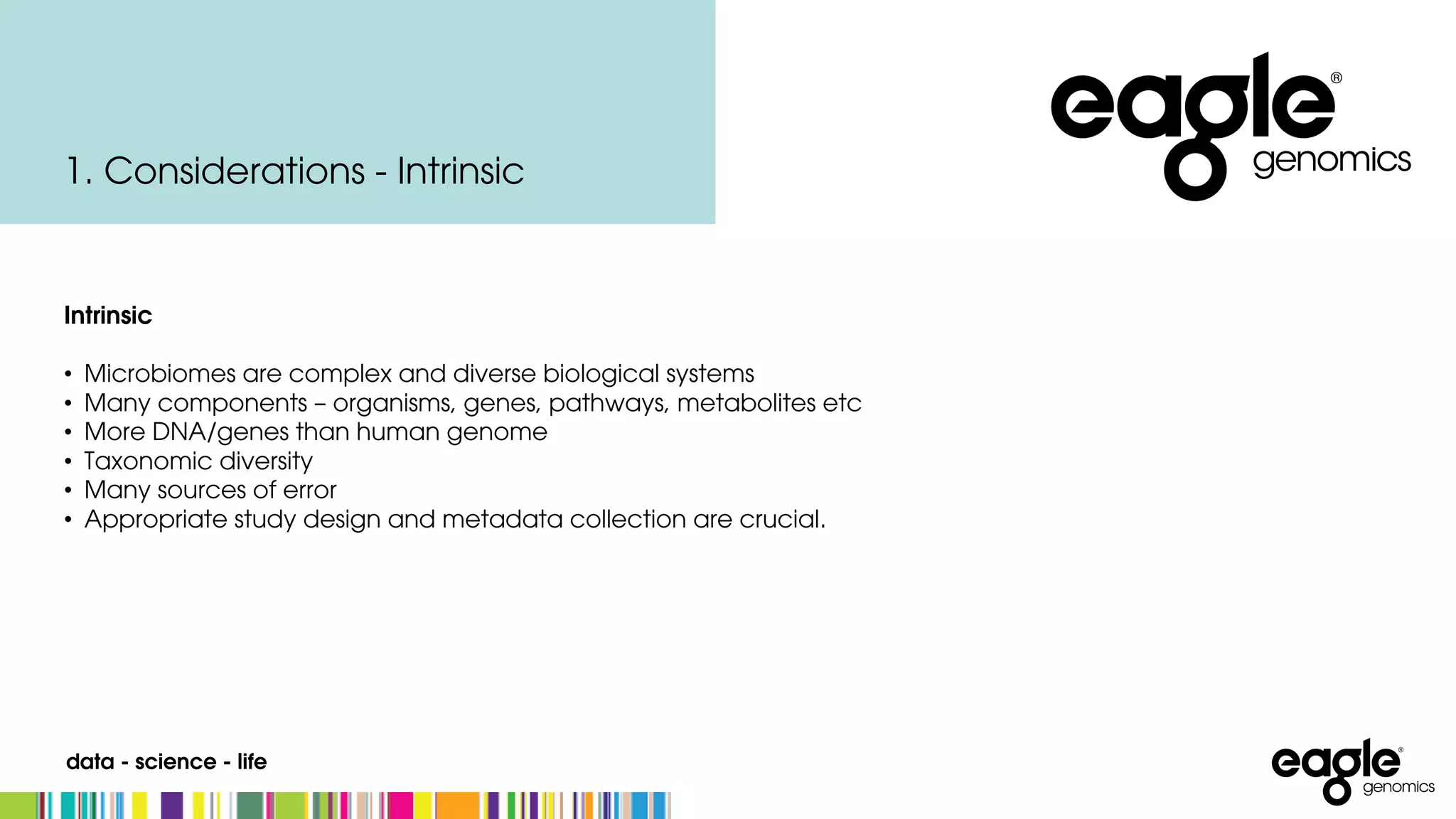
Intrinsic
• Microbiomes are complex and diverse biological systems
• Many components – organisms, genes, pathways, metabolites etc
• More DNA/genes than human genome
• Taxonomic diversity
• Many sources of error
• Appropriate study design and metadata collection are crucial.
1. Considerations - Intrinsic
data - science - life
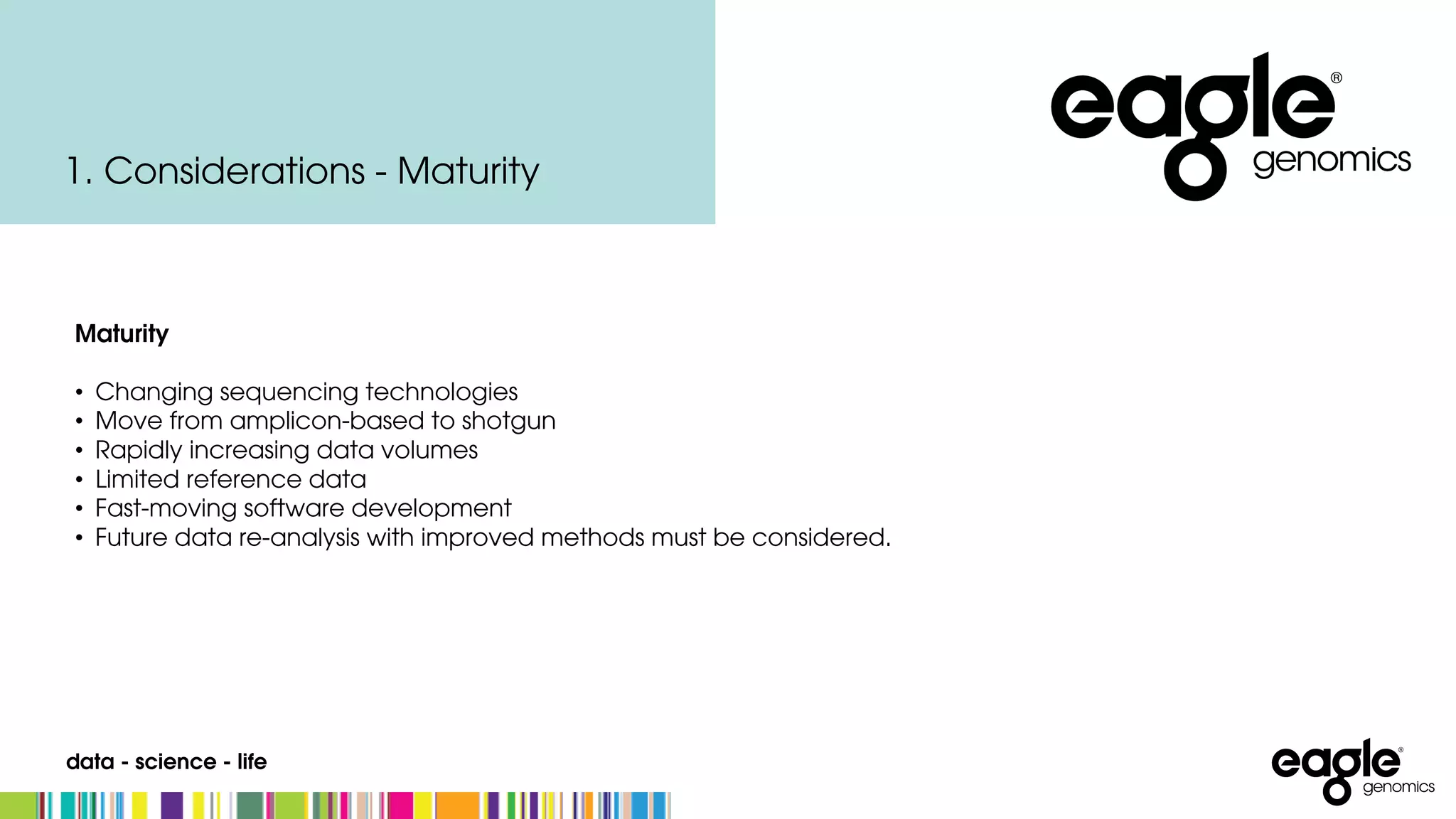
Maturity
• Changing sequencing technologies
• Move from amplicon-based to shotgun
• Rapidly increasing data volumes
• Limited reference data
• Fast-moving software development
• Future data re-analysis with improved methods must be considered.
1. Considerations - Maturity
data - science - life
1. Considerations – Business value
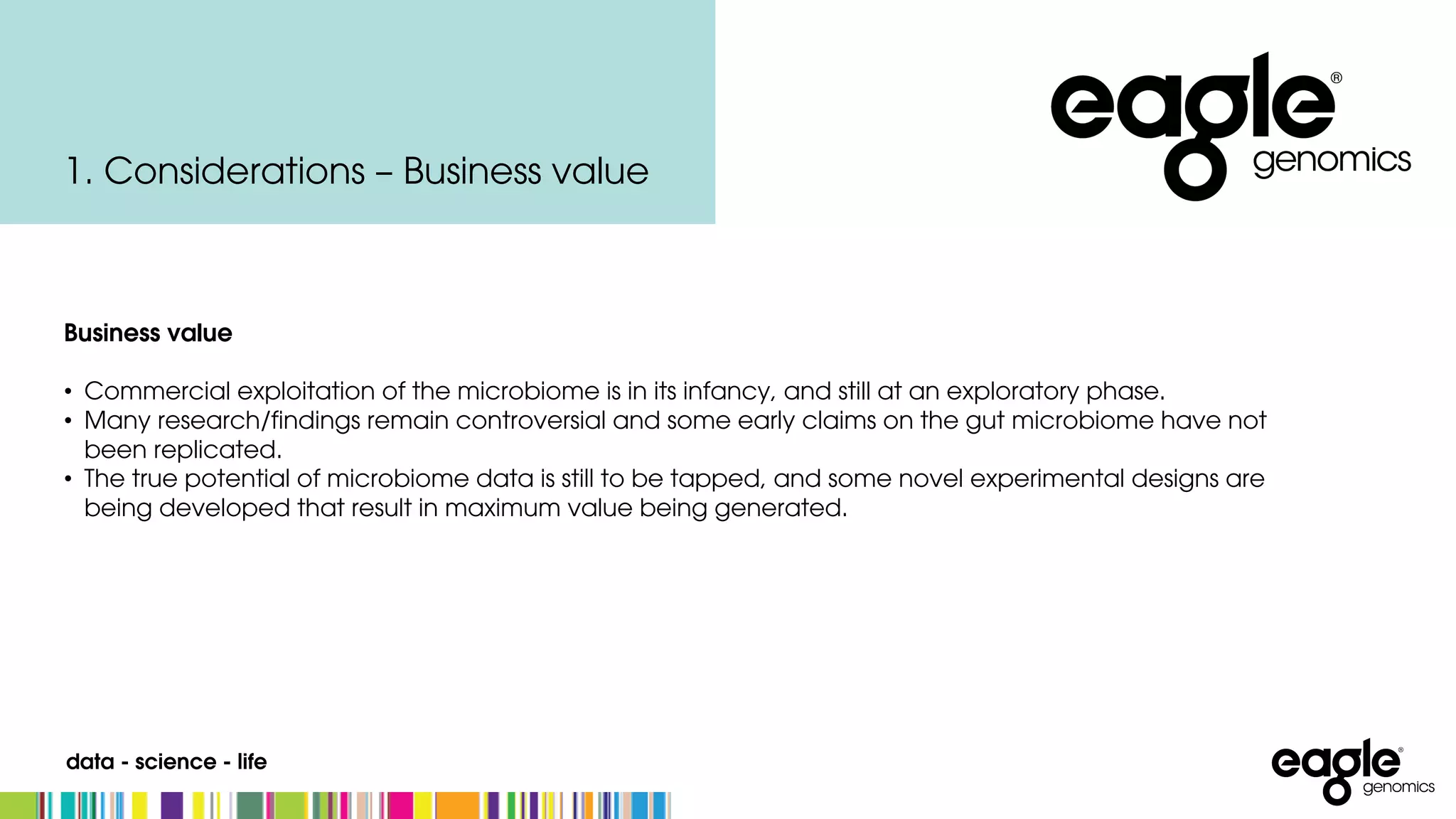
Business value
• Commercial exploitation of the microbiome is in its infancy, and still at an exploratory phase.
• Many research/findings remain controversial and some early claims on the gut microbiome have not
been replicated.
• The true potential of microbiome data is still to be tapped, and some novel experimental designs are
being developed that result in maximum value being generated.
data - science - life
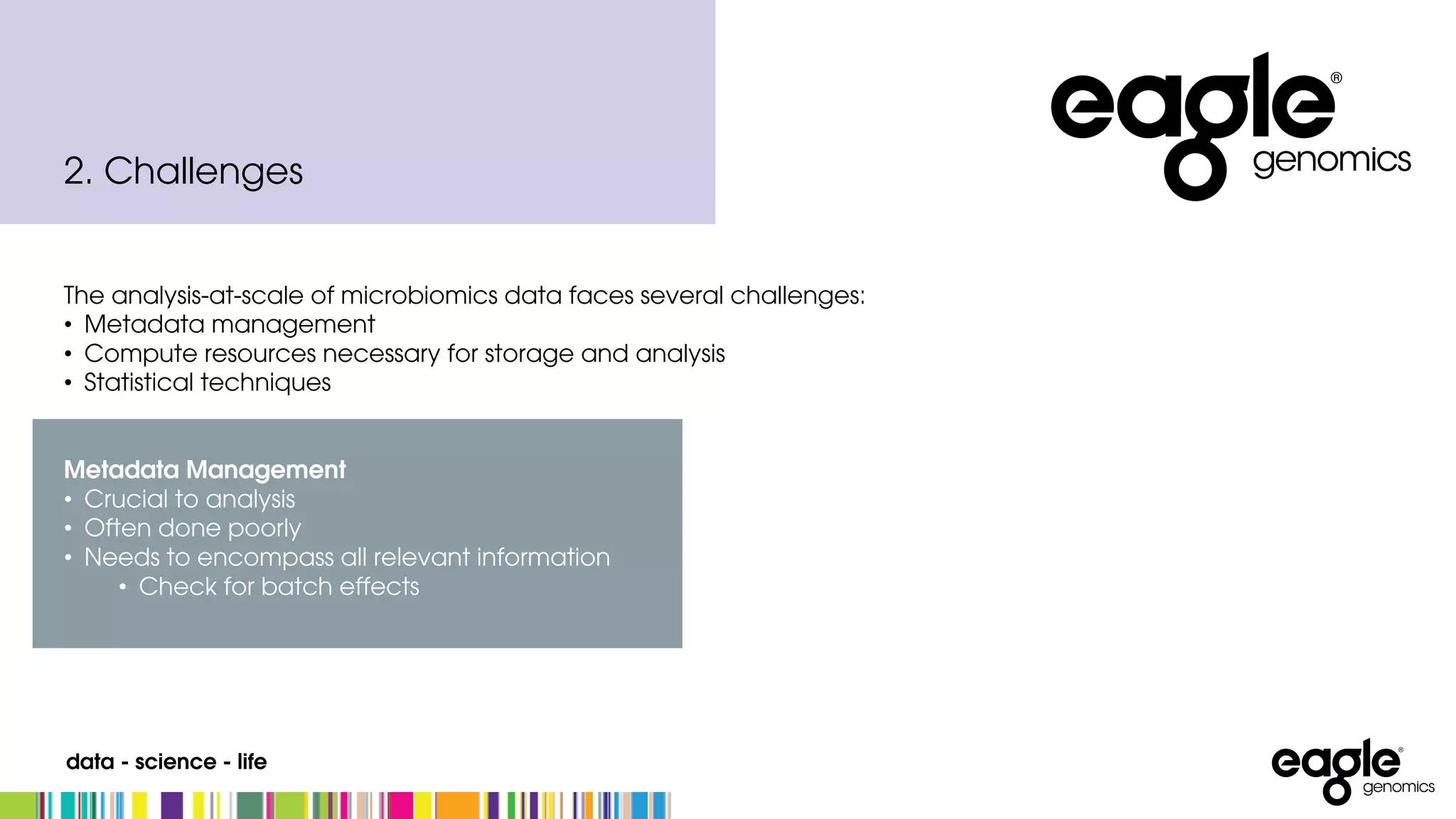
The analysis-at-scale of microbiomics data faces several challenges:
• Metadata management
• Compute resources necessary for storage and analysis
• Statistical techniques
Metadata Management
• Crucial to analysis
• Often done poorly
• Needs to encompass all relevant information
• Check for batch effects
2. Challenges
data - science - life
2. Challenges
Data Storage and Compute Resources
• Shotgun metagenomics example study - 1.7 billion paired-end Illumina reads, 266.5 Gb.
• Bigger data volume than the human genome at 30x coverage.
• Study size is increasing
How to store this?
• Analysis selection critical
• Analyses MUST work with these data volumes
• eg Kraken, Humann2
• Compute resources
• Eg Kraken, multicore machine > 100Gigs
• Solution – the cloud
• AWS, Azure
data - science - life
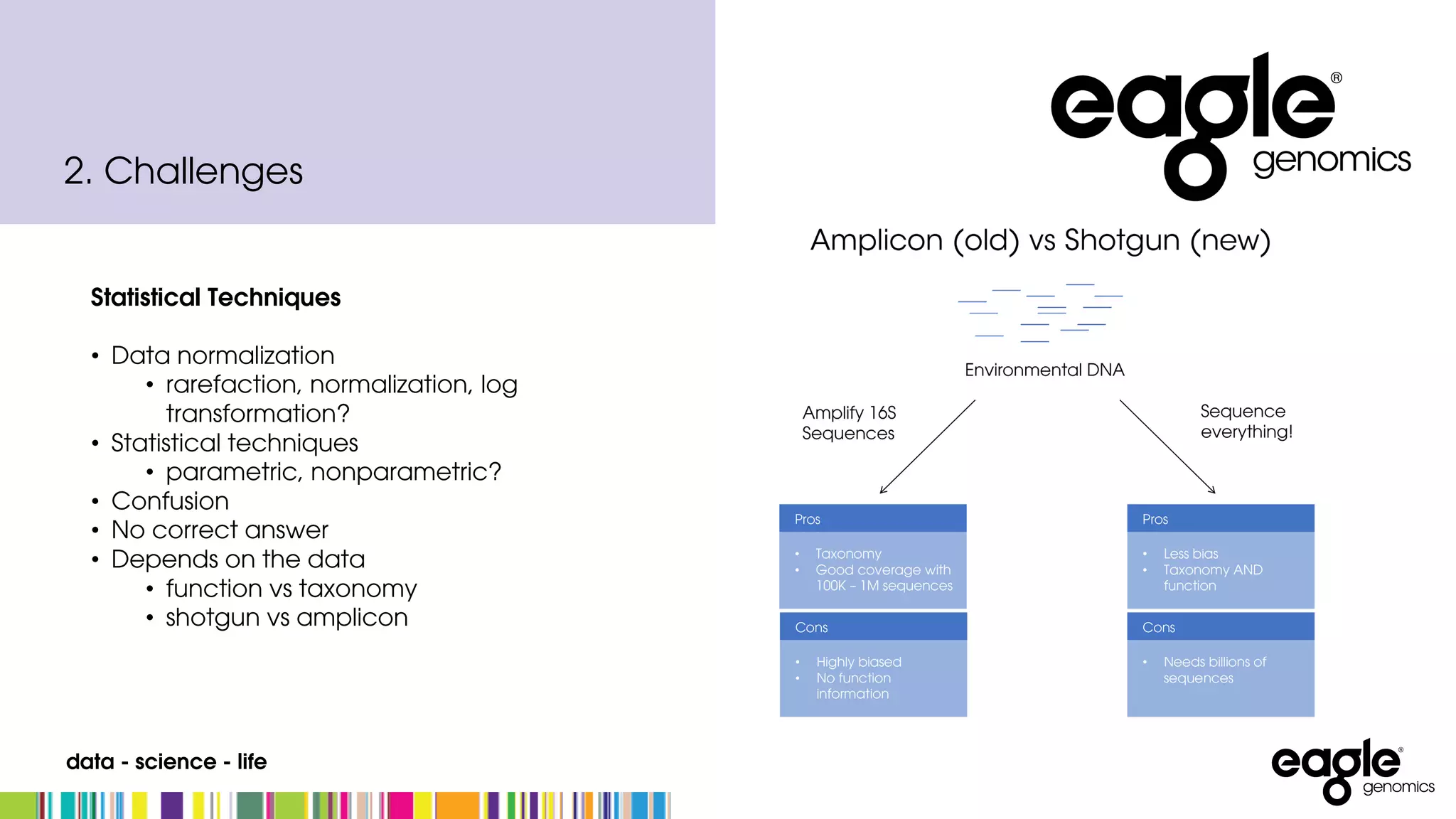
Statistical Techniques
• Data normalization
• rarefaction, normalization, log
transformation?
• Statistical techniques
• parametric, nonparametric?
• Confusion
• No correct answer
• Depends on the data
• function vs taxonomy
• shotgun vs amplicon
2. Challenges
data - science - life
• Eagle Genomics leads the industry in
configuring and deploying best-in-class
microbiome workflow solutions.
• These run large-scale parallelized
pipelines cost-efficiently, with seamless
connectivity between the source data
and the scientists.
3. Industrialized Microbiome
Workflow & Collaboration
Environment
www.eaglegenomics.com
“Unilever’s digital data program now
processes genetic sequences twenty
times faster - without incurring higher
compute costs. In addition, its robust
architecture supports ten times as many
scientists, all working simultaneously.”
Pete Keeley, eScience Technical Lead - R&D IT
at Unilever
data - science - life
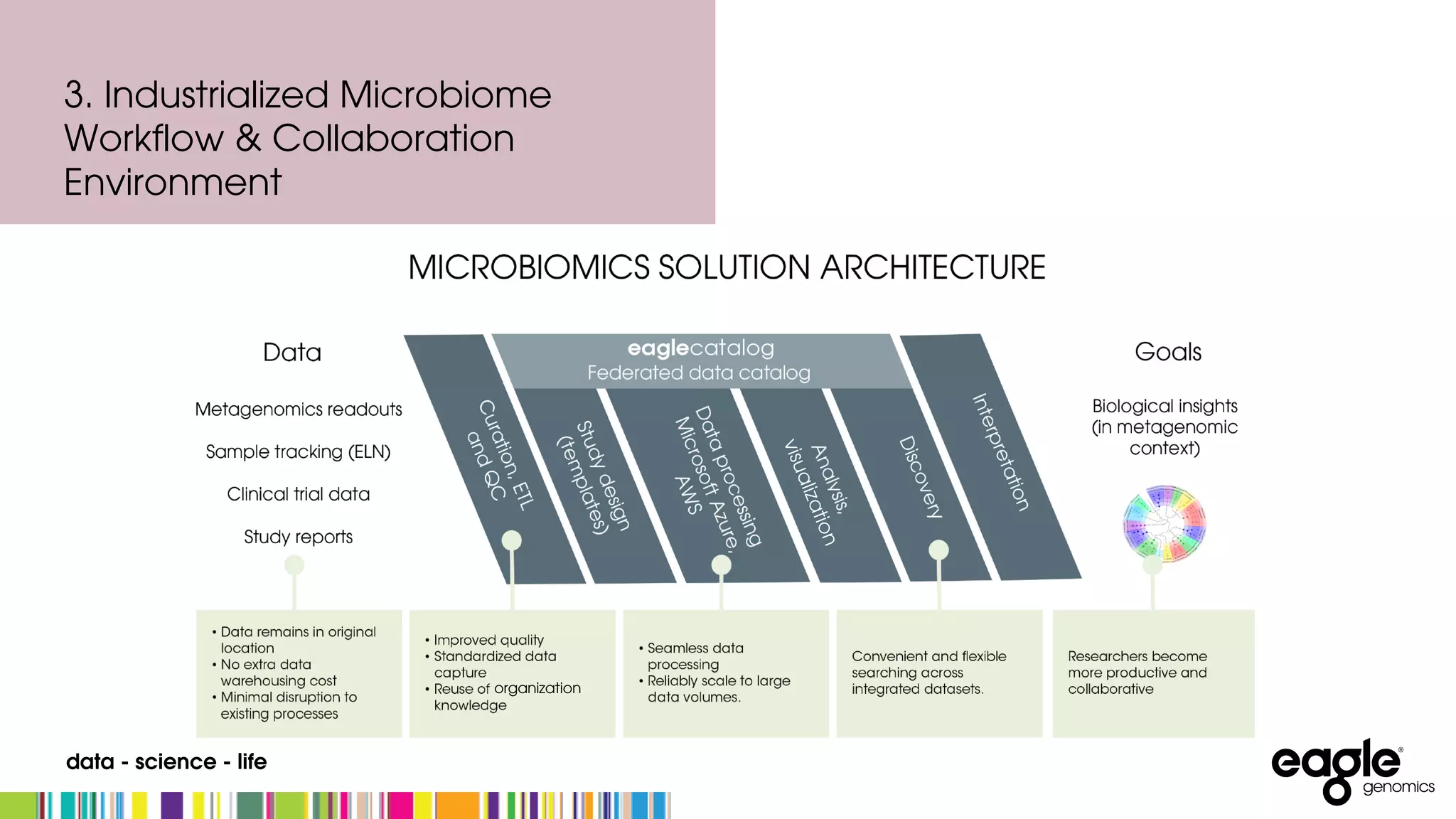
organization
3. Industrialized Microbiome
Workflow & Collaboration
Environment
data - science - life
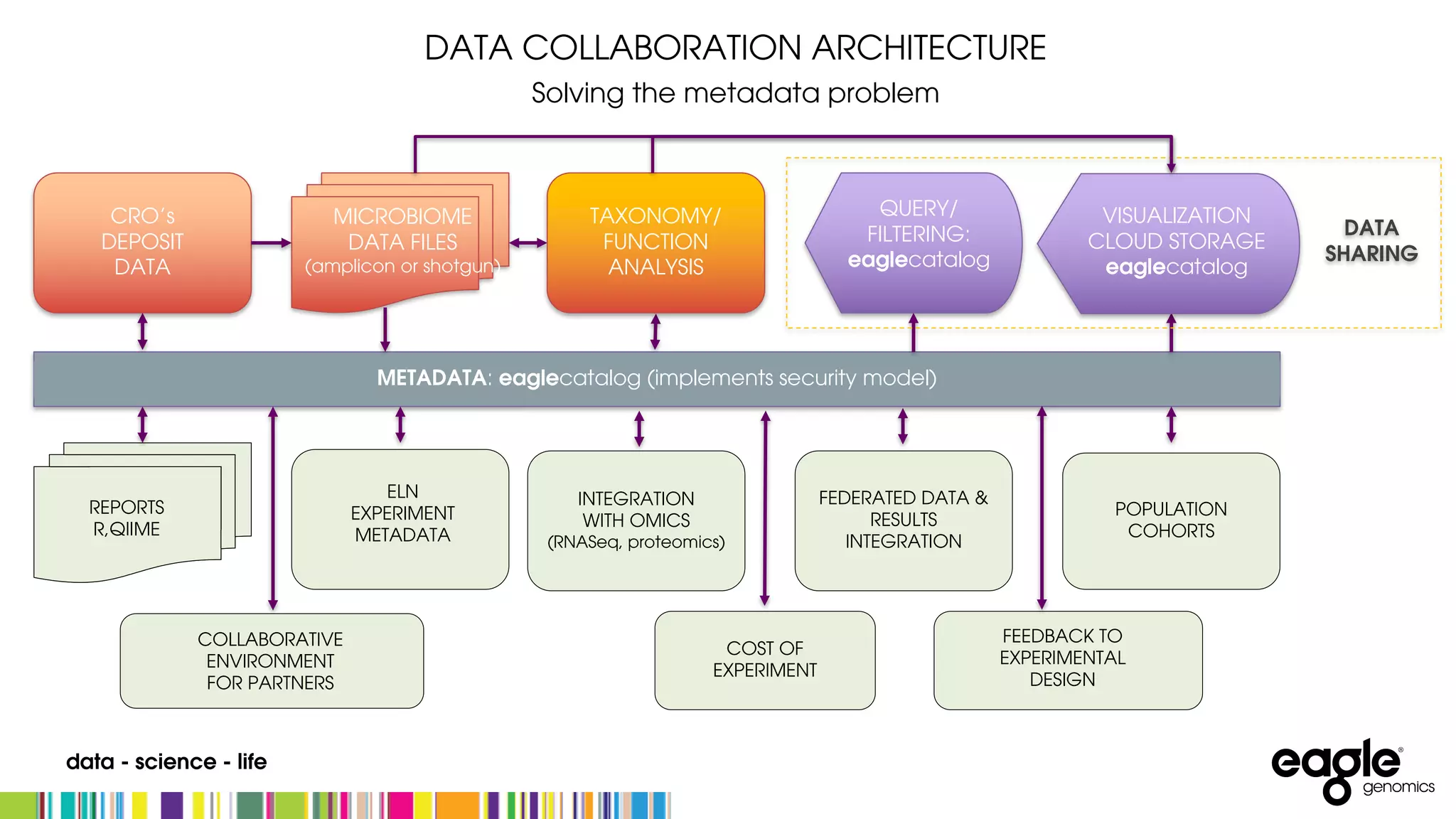
MICROBIOME
DATA FILES
(amplicon or shotgun)
METADATA: eaglecatalog (implements security model)
QUERY/
FILTERING:
eaglecatalog
DATA
SHARING
CRO’s
DEPOSIT
DATA
ELN
EXPERIMENT
METADATA
INTEGRATION
WITH OMICS
(RNASeq, proteomics)
FEDERATED DATA &
RESULTS
INTEGRATION
TAXONOMY/
FUNCTION
ANALYSIS
REPORTS
R,QIIME
POPULATION
COHORTS
VISUALIZATION
CLOUD STORAGE
eaglecatalog
COLLABORATIVE
ENVIRONMENT
FOR PARTNERS
FEEDBACK TO
EXPERIMENTAL
DESIGN
COST OF
EXPERIMENT
DATA COLLABORATION ARCHITECTURE
Solving the metadata problem
data - science - life
4. Deployment of a Collaboration
System
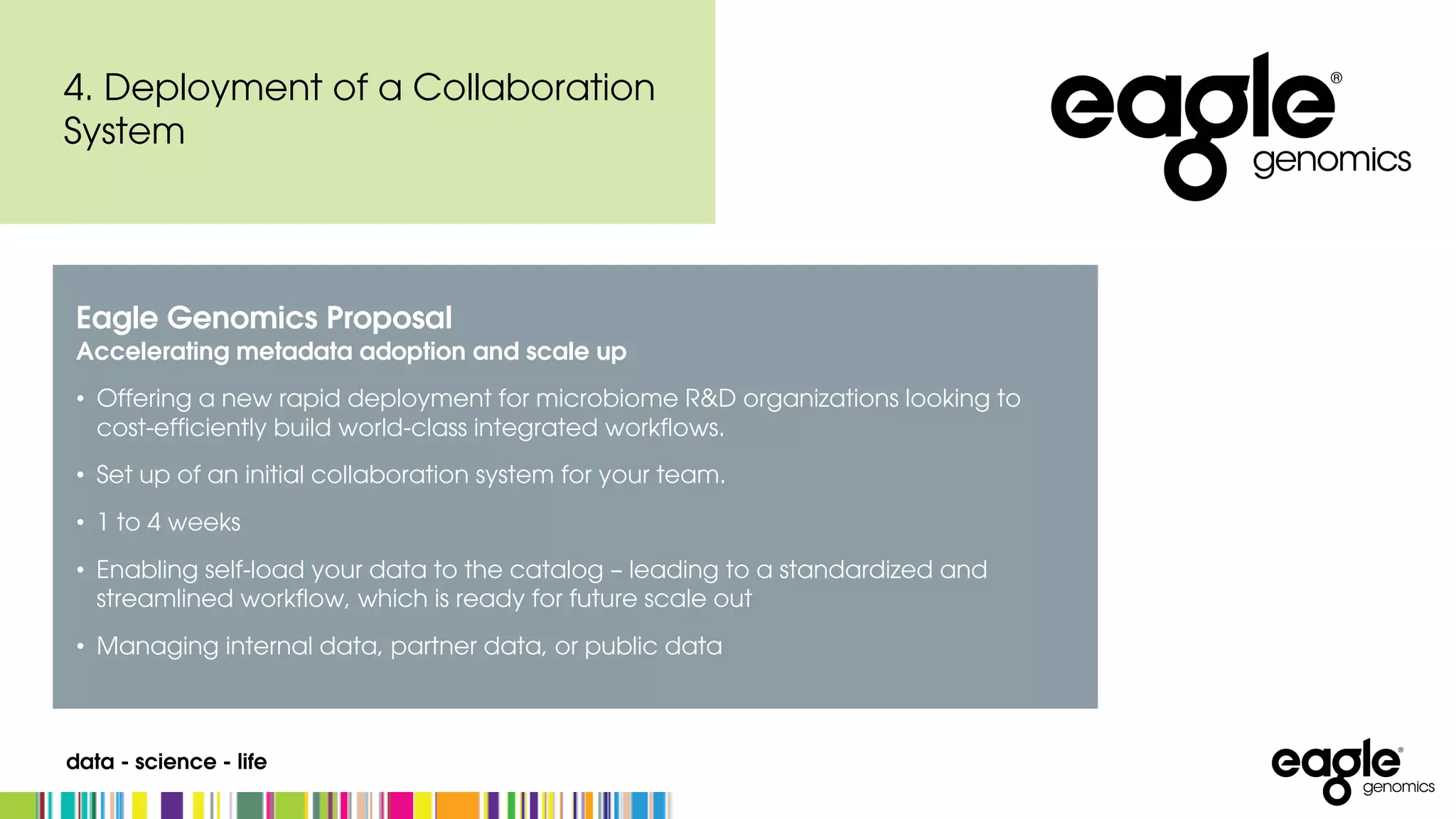
Eagle Genomics Proposal
Accelerating metadata adoption and scale up
• Offering a new rapid deployment for microbiome R&D organizations looking to
cost-efficiently build world-class integrated workflows.
• Set up of an initial collaboration system for your team.
• 1 to 4 weeks
• Enabling self-load your data to the catalog – leading to a standardized and
streamlined workflow, which is ready for future scale out
• Managing internal data, partner data, or public data
data - science - life
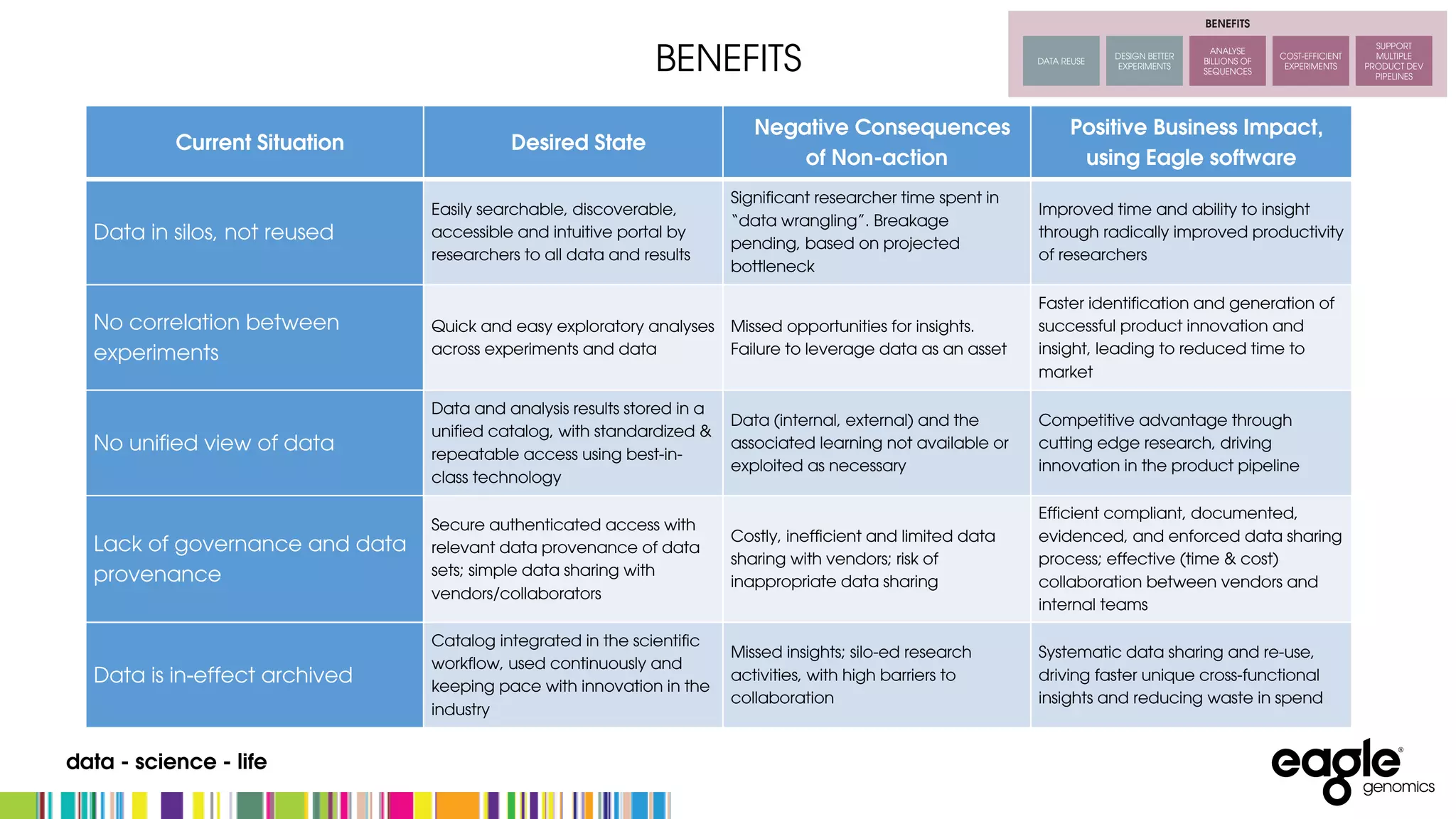
Current Situation Desired State
Negative Consequences
of Non-action
Positive Business Impact,
using Eagle software
Data in silos, not reused
Easily searchable, discoverable,
accessible and intuitive portal by
researchers to all data and results
Significant researcher time spent in
“data wrangling”. Breakage
pending, based on projected
bottleneck
Improved time and ability to insight
through radically improved productivity
of researchers
No correlation between
experiments
Quick and easy exploratory analyses
across experiments and data
Missed opportunities for insights.
Failure to leverage data as an asset
Faster identification and generation of
successful product innovation and
insight, leading to reduced time to
market
No unified view of data
Data and analysis results stored in a
unified catalog, with standardized &
repeatable access using best-in-
class technology
Data (internal, external) and the
associated learning not available or
exploited as necessary
Competitive advantage through
cutting edge research, driving
innovation in the product pipeline
Lack of governance and data
provenance
Secure authenticated access with
relevant data provenance of data
sets; simple data sharing with
vendors/collaborators
Costly, inefficient and limited data
sharing with vendors; risk of
inappropriate data sharing
Efficient compliant, documented,
evidenced, and enforced data sharing
process; effective (time & cost)
collaboration between vendors and
internal teams
Data is in-effect archived
Catalog integrated in the scientific
workflow, used continuously and
keeping pace with innovation in the
industry
Missed insights; silo-ed research
activities, with high barriers to
collaboration
Systematic data sharing and re-use,
driving faster unique cross-functional
insights and reducing waste in spend
BENEFITS
For	more	info,	contact:
Raminderpal Singh
raminderpal.singh@eaglegenomics.com
In Summary,
Considerations & Challenges in
Building an End-to-End Microbiome
Workflow
data - science - life

Considerations and challenges in building an end to-end microbiome workflow

  • 1.
    data - science- life Considerations & Challenges in Building an End-to-End Microbiome Workflow
  • 2.
    data - science- life Craig earned his Ph.D. in Microbology at the University of Warwick, he then completed his Postdoctoral research at the John Innes Centre before joining EBI and developing their bioinformatics capability. Dr McAnulla has extensive experience in developing large scale pipelines for analyzing microbiome datasets. His skills cover both software and biology and he often provides deep insights to industry experts on these topics. Presenters Raminderpal earned his PhD in the semiconductor industry where he spent a decade building advanced technologies for semiconductor modelling and data mining. In 2012, Dr Singh took the helm as the Business Development Executive for IBM Research’s genomics program, where he developed and led the execution of the go-to-market and business plan for the IBM Watson Genomics program. In addition to many published papers, Dr Singh has two books and twelve patents. Dr Craig McAnulla Senior Consultant Bioinformatics at Eagle Genomics Dr Raminderpal Singh Vice President Business Development at Eagle Genomics Please Tweet your questions @eaglegen or enter them into GoTo Webinar
  • 3.
    Agenda 1. Considerations 2. Challenges 3.Industrialized Microbiome Workflow & Collaboration Environment 4. Deployment of a Collaboration System data - science - life
  • 4.
    data - science- life Considerations for successful microbiome data management and analysis: 1. Intrinsic factors 2. The relatively early maturity of the field 3. Calculation of business value 1. Considerations
  • 5.
    data - science- life Intrinsic • Microbiomes are complex and diverse biological systems • Many components – organisms, genes, pathways, metabolites etc • More DNA/genes than human genome • Taxonomic diversity • Many sources of error • Appropriate study design and metadata collection are crucial. 1. Considerations - Intrinsic
  • 6.
    data - science- life Maturity • Changing sequencing technologies • Move from amplicon-based to shotgun • Rapidly increasing data volumes • Limited reference data • Fast-moving software development • Future data re-analysis with improved methods must be considered. 1. Considerations - Maturity
  • 7.
    data - science- life 1. Considerations – Business value Business value • Commercial exploitation of the microbiome is in its infancy, and still at an exploratory phase. • Many research/findings remain controversial and some early claims on the gut microbiome have not been replicated. • The true potential of microbiome data is still to be tapped, and some novel experimental designs are being developed that result in maximum value being generated.
  • 8.
    data - science- life The analysis-at-scale of microbiomics data faces several challenges: • Metadata management • Compute resources necessary for storage and analysis • Statistical techniques Metadata Management • Crucial to analysis • Often done poorly • Needs to encompass all relevant information • Check for batch effects 2. Challenges
  • 9.
    data - science- life 2. Challenges Data Storage and Compute Resources • Shotgun metagenomics example study - 1.7 billion paired-end Illumina reads, 266.5 Gb. • Bigger data volume than the human genome at 30x coverage. • Study size is increasing How to store this? • Analysis selection critical • Analyses MUST work with these data volumes • eg Kraken, Humann2 • Compute resources • Eg Kraken, multicore machine > 100Gigs • Solution – the cloud • AWS, Azure
  • 10.
    data - science- life Statistical Techniques • Data normalization • rarefaction, normalization, log transformation? • Statistical techniques • parametric, nonparametric? • Confusion • No correct answer • Depends on the data • function vs taxonomy • shotgun vs amplicon 2. Challenges
  • 11.
    data - science- life • Eagle Genomics leads the industry in configuring and deploying best-in-class microbiome workflow solutions. • These run large-scale parallelized pipelines cost-efficiently, with seamless connectivity between the source data and the scientists. 3. Industrialized Microbiome Workflow & Collaboration Environment www.eaglegenomics.com “Unilever’s digital data program now processes genetic sequences twenty times faster - without incurring higher compute costs. In addition, its robust architecture supports ten times as many scientists, all working simultaneously.” Pete Keeley, eScience Technical Lead - R&D IT at Unilever
  • 12.
    data - science- life organization 3. Industrialized Microbiome Workflow & Collaboration Environment
  • 13.
    data - science- life MICROBIOME DATA FILES (amplicon or shotgun) METADATA: eaglecatalog (implements security model) QUERY/ FILTERING: eaglecatalog DATA SHARING CRO’s DEPOSIT DATA ELN EXPERIMENT METADATA INTEGRATION WITH OMICS (RNASeq, proteomics) FEDERATED DATA & RESULTS INTEGRATION TAXONOMY/ FUNCTION ANALYSIS REPORTS R,QIIME POPULATION COHORTS VISUALIZATION CLOUD STORAGE eaglecatalog COLLABORATIVE ENVIRONMENT FOR PARTNERS FEEDBACK TO EXPERIMENTAL DESIGN COST OF EXPERIMENT DATA COLLABORATION ARCHITECTURE Solving the metadata problem
  • 14.
    data - science- life 4. Deployment of a Collaboration System Eagle Genomics Proposal Accelerating metadata adoption and scale up • Offering a new rapid deployment for microbiome R&D organizations looking to cost-efficiently build world-class integrated workflows. • Set up of an initial collaboration system for your team. • 1 to 4 weeks • Enabling self-load your data to the catalog – leading to a standardized and streamlined workflow, which is ready for future scale out • Managing internal data, partner data, or public data
  • 15.
    data - science- life Current Situation Desired State Negative Consequences of Non-action Positive Business Impact, using Eagle software Data in silos, not reused Easily searchable, discoverable, accessible and intuitive portal by researchers to all data and results Significant researcher time spent in “data wrangling”. Breakage pending, based on projected bottleneck Improved time and ability to insight through radically improved productivity of researchers No correlation between experiments Quick and easy exploratory analyses across experiments and data Missed opportunities for insights. Failure to leverage data as an asset Faster identification and generation of successful product innovation and insight, leading to reduced time to market No unified view of data Data and analysis results stored in a unified catalog, with standardized & repeatable access using best-in- class technology Data (internal, external) and the associated learning not available or exploited as necessary Competitive advantage through cutting edge research, driving innovation in the product pipeline Lack of governance and data provenance Secure authenticated access with relevant data provenance of data sets; simple data sharing with vendors/collaborators Costly, inefficient and limited data sharing with vendors; risk of inappropriate data sharing Efficient compliant, documented, evidenced, and enforced data sharing process; effective (time & cost) collaboration between vendors and internal teams Data is in-effect archived Catalog integrated in the scientific workflow, used continuously and keeping pace with innovation in the industry Missed insights; silo-ed research activities, with high barriers to collaboration Systematic data sharing and re-use, driving faster unique cross-functional insights and reducing waste in spend BENEFITS
  • 16.
    For more info, contact: Raminderpal Singh raminderpal.singh@eaglegenomics.com In Summary, Considerations& Challenges in Building an End-to-End Microbiome Workflow data - science - life