How Logilab ELN helps Organizations in Research Data
Management
What is Research Data Management (RDM)?
Research Data Management (RDM) refers to the methods of recording, organizing, storing,
processing, and caring for information that is produced from a research project or used during a
research project. It is an iterative and continuous process. The decisions that are taken in the early
stages will substantially affect what will be carried out in the later ones. It is the most efficient way to
properly manage the data, rather than trying to reconstruct everything after anything occurs. The
term is often mentioned nowadays in relation to open science — the general movement in the world
of research to make scientific data open, accessible, and reusable.
Importance of Research Data Management
There has been a growth in research-related data for several reasons. But the advancement and
use of sophisticated research technology combined with the advent of immediate and low-cost
communications and collaboration technology are enabling the creation of massive amounts of
research data. These data must be managed properly with Electronic Lab Notebook in order to
facilitate quality research.
Research today not only has to be rigorous, innovative, and insightful - it also has to be organized! As
improved technology creates more capacity to create and store data, it increases the challenge of
making data FAIR: Findable, Accessible, Interoperable, and Reusable (The FAIR Guiding Principles for
scientific data management and stewardship).
To address these challenges, funding agencies require a data management or data sharing plan to
be submitted with grant applications. Additionally, many academic journals require the submission
of relevant data with manuscripts to promote open access and reproducibility of research.
Early and attentive management at each step of the data lifecycle will ensure the discoverability
and longevity of your research.
Data Management Plans have been a requirement of various funding agencies for most of the past
decade. Governmental agencies have been issuing policies on data and management for much
longer. The basics are the same across all of the plans: preserve data & provide access. There are
other components to be considered, however the basic premise is to make the data available for
future research and evaluation for the purposes of reproducibility, research integrity, further
research, or challenge.
The U.S. Health & Human Services Office of Research Integrity web page sums up the reasons which
are as follows:
● To establish good work practices.
● To teach people in your lab.
● To meet contractual requirements.
● To avoid fraud.
● To defend patents.
● To allow work to be reproduced by others.
● To facilitate preparation of formal reports, presentations and papers.
● To validate your research.
● To serve as a source for assigning credit to lab members.
Of all the above reasons, the most basic part of science is the reproducibility of research. Without
strong data management policies, documentation, and data management, reproducibility is at risk.
Research labs of all disciplines have varying types of equipment, but there is at least one standard
among them: Research is to be documented in accordance with the scientific method. Good data is
data that is documented, stored, and accessible.
Challenges in Research Data Management
Laboratory data, i.e., the data produced in the practice of the scientific method, is not consistently
managed within academic labs or even to the level of many academic research institutions. As data
on which research is based becomes more openly available, Data Management Plans will more
often be enforced. Thus, Data integrity, Data lifecycle, Data Security, Perpetual Revision History,
Permanence, and unchangeable date & time stamps, will be concerns that will evolve into the
management of laboratory research data. Proof of research and discovery is a major concern
among researchers and there are more instances of research fraud, unintended or intentional, than
most people realize.
Research funding agencies make statements regarding data management and publishers provide
for the submission of supplemental data. Yet there are research retractions for faulty and falsified
data every now and then. Good data management tools and processes can help to limit “bad”
research.
ROLE OF ELN IN RESEARCH DATA MANAGEMENT
ELN in General
There are tools in the marketplace that can help researchers maintain their independence, provide
researchers and their administrators with the ability to protect their work product and enable
scientific reproducibility. They are Electronic Lab Notebooks (ELN). It has been originally designed to
replace the analog paper notebook with a much-improved digital version.
Any ELN must have the basic capabilities namely
● Data integrity - single source of truth
● Easy but secure readability
● Revision history (perpetual)
● Time stamps
● Electronic signature
● Ability to comply with regulations related to data accessibility and the security of data and
research
● User access rights management.
When data is entered into an ELN or made to capture automatically – and data means research
data, notes, observations, formulas, equations, sketches, data sets, image or any other type of data –
the product must have the ability provide the ability to support several interested parties:
● a funding agency’s requirement for a Data Management Plan;
● the researcher’s need to document their research;
● the administration’s need to be able to protect and prove discovery; and
● the publisher’s need to review and publish data supporting the research.
The data upon which research is published needs to be kept in a secure environment, but that
environment must also provide for research collaboration. Some cloud-based ELNs provide such a
capability, some even to the point of enabling thousands of researchers to collaborate on a single
platform for the purposes of data gathering. But, security must be contemplated. The ELN should
enable different levels of access, comply with industry standard security protocols and, when used in
conjunction with institutional policies, protect personally-identifiable information.
Finally, an ELN must have the ability to scale to support thousands of users combined with the ability
to be completely configurable and should be agnostic to scientific discipline.
About Logilab ELN
Logilab ELN is an Electronic Lab Notebook agnostic to scientific discipline where it is put to use and
will enable the users to document protocols & procedures, enter lab results, scientific and research
observations, notes and other data & perform calculations in paperless electronic format.
Logilab ELN is a proven and dependable system that provides a fully configurable templates with
test/task-based workflow design to meet the needs of both regulated QA/QC and non-regulated
R&D operations for industries including pharmaceutical, life sciences, biopharmaceutical, chemical,
petrochemical, environmental, manufacturing, food, feed and dairy.
Logilab ELN is designed to capture data in a spreadsheet-like template called a Labsheet or lab
notebook. Labsheet templates can be designed by scientists by dragging and dropping generic
fields into the Labsheet and creating a form like input template depending on the type of test,
experiment or research task. This makes the ELN usable for any digital
data capture application for lab personnel, research scientists, process and process research
personnel.
Labsheets can be designed with data fields like text, numeric, drop-down list, date, time, formula,
image, hyperlinks etc.,
Logilab ELN also provides a protocol-based approach for recording of experiments. Protocols are
laboratory procedures and instructions which can be executed in a step-by-step manner and
corresponding result outcomes can be recorded. It has a wide variety of rich features, namely text
data input, research conditions, tables, images, charts, preparation, drawing of chemical structures,
equations, tagging of fields, etc.
It ensures easy adaptability, time-savings due to faster configuration and operations and Reduced
complexity to use resulting in better customer experience.
Logilab ELN’s Role in Research Data Management
1. Logilab ELN can help to store the Data Management Plan (DMP) in a central repository that can
be shared among the group of users in a collaborative manner. This forms the basis of the best
practice for managing the research data.
2. Logilab ELN helps the research organizations to set up independent data security policy, data
sharing policy and data retention policy.
3. Logilab ELN has a very important feature namely project management. Using this feature,
project id or grand id can be configured which will help the users to manage the research
projects. Project teams with authorized users (role-based) can be configured in the Logilab ELN.
4. Logilab ELN allows a wide variety of data and data types to be collected. It may be raw data,
documents, protocols, observations, notes and other data directly from instruments and mobile
devices.
5. Logilab ELN allows the data to be enriched with metadata. It is also possible to index and search
the data using metadata.
6. The data, records and files can be version-controlled easily.
7. Logilab ELN supports attaching or recording of different image format files.
8. Logilab ELN supports multiple security requirements namely authentication of users (using
unique username and password combination), role-based user access permissions, password
policy setup and able to work only in authorized networks.
9. The data collected and stored can be made to go through a review/approval process by using
the workflow feature of Logilab ELN.
10. Logilab ELN has the audit-trail functionality by which the actions performed on the data is
stored with date and time more accurately.
11. Logilab ELN is more secure in use and complies with data integrity principles, Copyright and
Intellectual property rights can be ensured for research data as they are stored in a unique and
original way in a secured central database.
12. Logilab ELN ensures faster and accurate data accessibility in a user-readable format using an
easy-to-use flexible search engine (data can be searched with a wide variety of criteria).
Exporting using pdf and spreadsheet makes accessibility and readability very easy.
13. Logilab ELN ensures that data is well-documented, properly organized and stored, licensed,
easily identifiable, can be archived for a specific period and can be easily shared. This makes
the task of reproducibility much simpler and accurate.
Following are few advantages that Research users may obtain:
Prevention of data loss and human error
This is achieved by using protected databases and storing information in an organized manner
significantly reduces the risk for loss, and tracking experiments, supply quantities and equipment
usage prevents unnecessary repetitions and mistakes.
Improvement in research processes
This is achieved by adopting best practices in research activities.
Ensuring continuity
This is achieved by having all information in an easily accessible and searchable format enables
different teams to collaborate along the process of research or production, and enables laboratories
to continue research done by former lab members.
Fulfilling the requirements for publication
There are many journals that require raw data to be submitted along with the manuscript. Using
Logilab ELN data can be presented in a user-readable format (PDF, excel, etc), gathering relevant
data is much easier when the data is properly structured and organized.
Meeting requirements for funds
Now-a-days, many grant institutions require researchers to provide an RDM plan detailing their
methods of research data management. RDM plans can be prepared, approved and stored in the
system by using Logilab ELN.
Meeting regulatory requirements
Identifying, formatting, protecting, and structuring research data leads to better protection against
compliance infractions and improves organization’s ability to comply with regulations.
FEATURES IN LOGILAB ELN TO CONTRIBUTE TO FAIR PRINCIPLES
Global Search
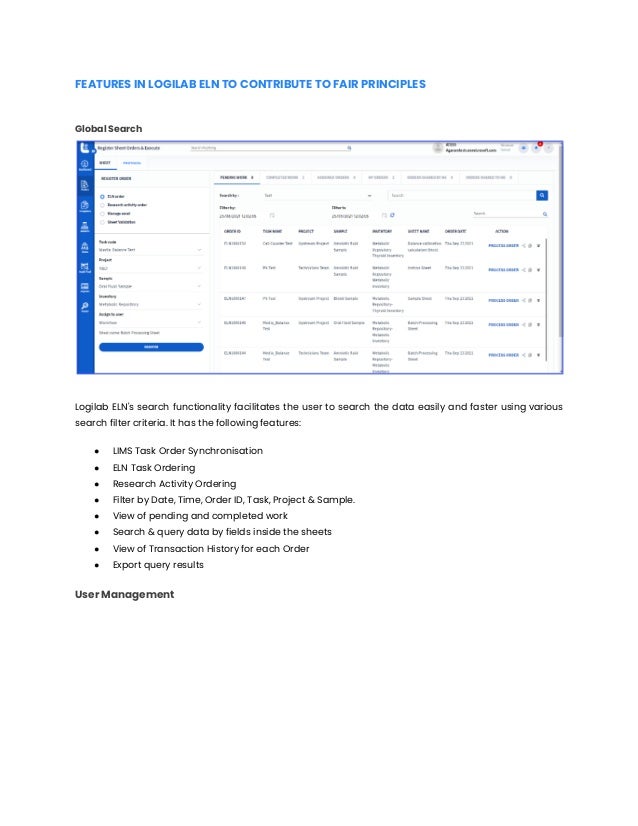
Logilab ELN's search functionality facilitates the user to search the data easily and faster using various
search filter criteria. It has the following features:
● LIMS Task Order Synchronisation
● ELN Task Ordering
● Research Activity Ordering
● Filter by Date, Time, Order ID, Task, Project & Sample.
● View of pending and completed work
● Search & query data by fields inside the sheets
● View of Transaction History for each Order
● Export query results
User Management
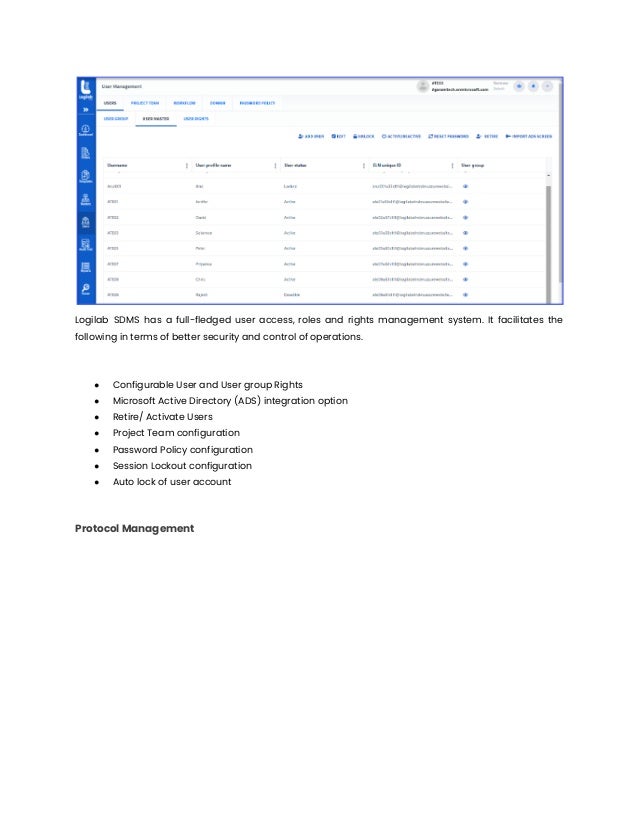
Logilab SDMS has a full-fledged user access, roles and rights management system. It facilitates the
following in terms of better security and control of operations.
● Configurable User and User group Rights
● Microsoft Active Directory (ADS) integration option
● Retire/ Activate Users
● Project Team configuration
● Password Policy configuration
● Session Lockout configuration
● Auto lock of user account
Protocol Management
Logilab ELN supports protocol template-based experiments and can be reviewed / approved and
shared across authorized team members.
A powerful rich-text editor is available with the following features:
● Text Entry and formatting like MS-Word
● Insert: Tables, special characters, symbols, mathematical formulae, chemical diagrams and
equations, hyperlink, video link, page-break, etc
● Collaborative editing – users can edit and share with other authorised users
● Image import, copy/paste, positioning
● Import word and excel documents
● Lock and unlock text editing in specific area
● Checklist features with text, numeric, radio-button, check-box and drop-down options
● Features to attach multiple file types
● Facility to add inventory resources
Workflow
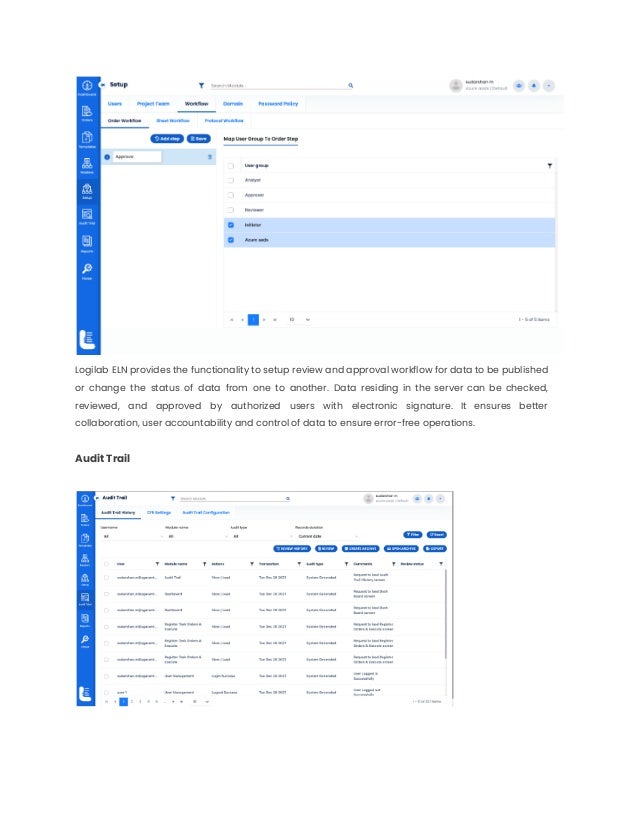
Logilab ELN provides the functionality to setup review and approval workflow for data to be published
or change the status of data from one to another. Data residing in the server can be checked,
reviewed, and approved by authorized users with electronic signature. It ensures better
collaboration, user accountability and control of data to ensure error-free operations.
Audit Trail
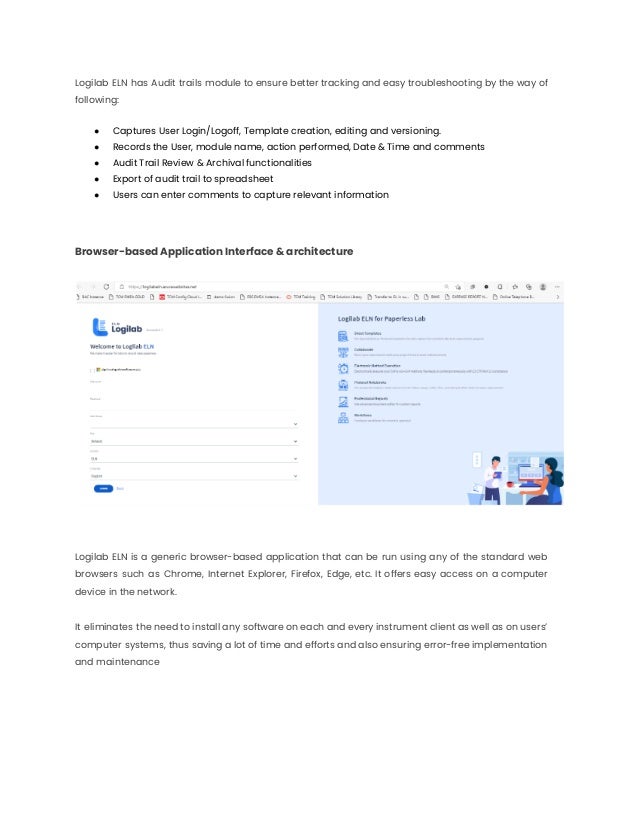
Logilab ELN has Audit trails module to ensure better tracking and easy troubleshooting by the way of
following:
● Captures User Login/Logoff, Template creation, editing and versioning.
● Records the User, module name, action performed, Date & Time and comments
● Audit Trail Review & Archival functionalities
● Export of audit trail to spreadsheet
● Users can enter comments to capture relevant information
Browser-based Application Interface & architecture
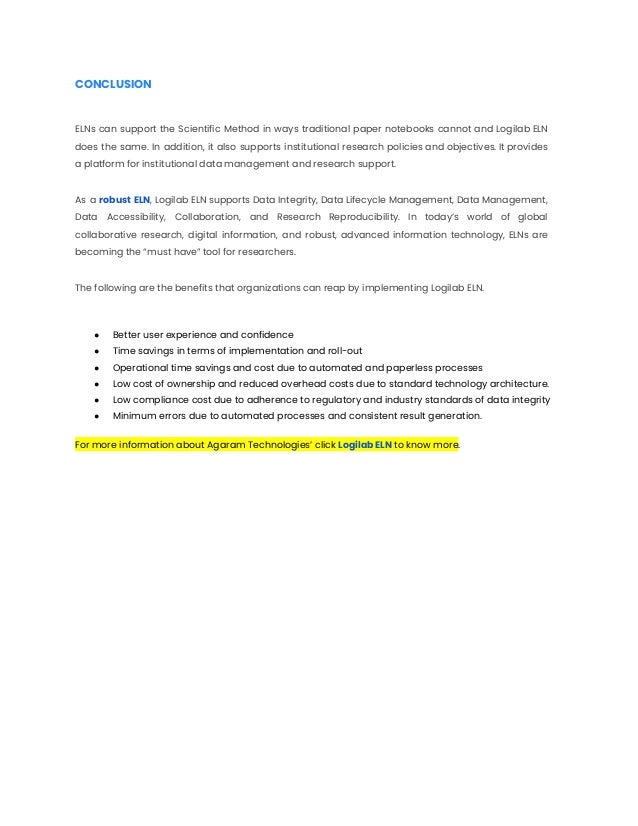
Logilab ELN is a generic browser-based application that can be run using any of the standard web
browsers such as Chrome, Internet Explorer, Firefox, Edge, etc. It offers easy access on a computer
device in the network.
It eliminates the need to install any software on each and every instrument client as well as on users’
computer systems, thus saving a lot of time and efforts and also ensuring error-free implementation
and maintenance
CONCLUSION
ELNs can support the Scientific Method in ways traditional paper notebooks cannot and Logilab ELN
does the same. In addition, it also supports institutional research policies and objectives. It provides
a platform for institutional data management and research support.
As a robust ELN, Logilab ELN supports Data Integrity, Data Lifecycle Management, Data Management,
Data Accessibility, Collaboration, and Research Reproducibility. In today’s world of global
collaborative research, digital information, and robust, advanced information technology, ELNs are
becoming the “must have” tool for researchers.
The following are the benefits that organizations can reap by implementing Logilab ELN.
● Better user experience and confidence
● Time savings in terms of implementation and roll-out
● Operational time savings and cost due to automated and paperless processes
● Low cost of ownership and reduced overhead costs due to standard technology architecture.
● Low compliance cost due to adherence to regulatory and industry standards of data integrity
● Minimum errors due to automated processes and consistent result generation.
For more information about Agaram Technologies’ click Logilab ELN to know more.

How Logilab ELN helps Organizations in Research Data Management

  • 1.
    How Logilab ELNhelps Organizations in Research Data Management What is Research Data Management (RDM)? Research Data Management (RDM) refers to the methods of recording, organizing, storing, processing, and caring for information that is produced from a research project or used during a research project. It is an iterative and continuous process. The decisions that are taken in the early stages will substantially affect what will be carried out in the later ones. It is the most efficient way to properly manage the data, rather than trying to reconstruct everything after anything occurs. The term is often mentioned nowadays in relation to open science — the general movement in the world of research to make scientific data open, accessible, and reusable. Importance of Research Data Management There has been a growth in research-related data for several reasons. But the advancement and use of sophisticated research technology combined with the advent of immediate and low-cost communications and collaboration technology are enabling the creation of massive amounts of
  • 2.
    research data. Thesedata must be managed properly with Electronic Lab Notebook in order to facilitate quality research. Research today not only has to be rigorous, innovative, and insightful - it also has to be organized! As improved technology creates more capacity to create and store data, it increases the challenge of making data FAIR: Findable, Accessible, Interoperable, and Reusable (The FAIR Guiding Principles for scientific data management and stewardship). To address these challenges, funding agencies require a data management or data sharing plan to be submitted with grant applications. Additionally, many academic journals require the submission of relevant data with manuscripts to promote open access and reproducibility of research. Early and attentive management at each step of the data lifecycle will ensure the discoverability and longevity of your research. Data Management Plans have been a requirement of various funding agencies for most of the past decade. Governmental agencies have been issuing policies on data and management for much longer. The basics are the same across all of the plans: preserve data & provide access. There are other components to be considered, however the basic premise is to make the data available for future research and evaluation for the purposes of reproducibility, research integrity, further research, or challenge. The U.S. Health & Human Services Office of Research Integrity web page sums up the reasons which are as follows: ● To establish good work practices. ● To teach people in your lab. ● To meet contractual requirements. ● To avoid fraud. ● To defend patents. ● To allow work to be reproduced by others. ● To facilitate preparation of formal reports, presentations and papers. ● To validate your research. ● To serve as a source for assigning credit to lab members. Of all the above reasons, the most basic part of science is the reproducibility of research. Without strong data management policies, documentation, and data management, reproducibility is at risk. Research labs of all disciplines have varying types of equipment, but there is at least one standard
  • 3.
    among them: Researchis to be documented in accordance with the scientific method. Good data is data that is documented, stored, and accessible. Challenges in Research Data Management Laboratory data, i.e., the data produced in the practice of the scientific method, is not consistently managed within academic labs or even to the level of many academic research institutions. As data on which research is based becomes more openly available, Data Management Plans will more often be enforced. Thus, Data integrity, Data lifecycle, Data Security, Perpetual Revision History, Permanence, and unchangeable date & time stamps, will be concerns that will evolve into the management of laboratory research data. Proof of research and discovery is a major concern among researchers and there are more instances of research fraud, unintended or intentional, than most people realize. Research funding agencies make statements regarding data management and publishers provide for the submission of supplemental data. Yet there are research retractions for faulty and falsified data every now and then. Good data management tools and processes can help to limit “bad” research. ROLE OF ELN IN RESEARCH DATA MANAGEMENT ELN in General There are tools in the marketplace that can help researchers maintain their independence, provide researchers and their administrators with the ability to protect their work product and enable scientific reproducibility. They are Electronic Lab Notebooks (ELN). It has been originally designed to replace the analog paper notebook with a much-improved digital version. Any ELN must have the basic capabilities namely ● Data integrity - single source of truth ● Easy but secure readability ● Revision history (perpetual) ● Time stamps ● Electronic signature ● Ability to comply with regulations related to data accessibility and the security of data and research
  • 4.
    ● User accessrights management. When data is entered into an ELN or made to capture automatically – and data means research data, notes, observations, formulas, equations, sketches, data sets, image or any other type of data – the product must have the ability provide the ability to support several interested parties: ● a funding agency’s requirement for a Data Management Plan; ● the researcher’s need to document their research; ● the administration’s need to be able to protect and prove discovery; and ● the publisher’s need to review and publish data supporting the research. The data upon which research is published needs to be kept in a secure environment, but that environment must also provide for research collaboration. Some cloud-based ELNs provide such a capability, some even to the point of enabling thousands of researchers to collaborate on a single platform for the purposes of data gathering. But, security must be contemplated. The ELN should enable different levels of access, comply with industry standard security protocols and, when used in conjunction with institutional policies, protect personally-identifiable information. Finally, an ELN must have the ability to scale to support thousands of users combined with the ability to be completely configurable and should be agnostic to scientific discipline. About Logilab ELN Logilab ELN is an Electronic Lab Notebook agnostic to scientific discipline where it is put to use and will enable the users to document protocols & procedures, enter lab results, scientific and research observations, notes and other data & perform calculations in paperless electronic format. Logilab ELN is a proven and dependable system that provides a fully configurable templates with test/task-based workflow design to meet the needs of both regulated QA/QC and non-regulated R&D operations for industries including pharmaceutical, life sciences, biopharmaceutical, chemical, petrochemical, environmental, manufacturing, food, feed and dairy. Logilab ELN is designed to capture data in a spreadsheet-like template called a Labsheet or lab notebook. Labsheet templates can be designed by scientists by dragging and dropping generic fields into the Labsheet and creating a form like input template depending on the type of test, experiment or research task. This makes the ELN usable for any digital data capture application for lab personnel, research scientists, process and process research personnel.
  • 5.
    Labsheets can bedesigned with data fields like text, numeric, drop-down list, date, time, formula, image, hyperlinks etc., Logilab ELN also provides a protocol-based approach for recording of experiments. Protocols are laboratory procedures and instructions which can be executed in a step-by-step manner and corresponding result outcomes can be recorded. It has a wide variety of rich features, namely text data input, research conditions, tables, images, charts, preparation, drawing of chemical structures, equations, tagging of fields, etc. It ensures easy adaptability, time-savings due to faster configuration and operations and Reduced complexity to use resulting in better customer experience. Logilab ELN’s Role in Research Data Management 1. Logilab ELN can help to store the Data Management Plan (DMP) in a central repository that can be shared among the group of users in a collaborative manner. This forms the basis of the best practice for managing the research data. 2. Logilab ELN helps the research organizations to set up independent data security policy, data sharing policy and data retention policy. 3. Logilab ELN has a very important feature namely project management. Using this feature, project id or grand id can be configured which will help the users to manage the research projects. Project teams with authorized users (role-based) can be configured in the Logilab ELN. 4. Logilab ELN allows a wide variety of data and data types to be collected. It may be raw data, documents, protocols, observations, notes and other data directly from instruments and mobile devices. 5. Logilab ELN allows the data to be enriched with metadata. It is also possible to index and search the data using metadata. 6. The data, records and files can be version-controlled easily.
  • 6.
    7. Logilab ELNsupports attaching or recording of different image format files. 8. Logilab ELN supports multiple security requirements namely authentication of users (using unique username and password combination), role-based user access permissions, password policy setup and able to work only in authorized networks. 9. The data collected and stored can be made to go through a review/approval process by using the workflow feature of Logilab ELN. 10. Logilab ELN has the audit-trail functionality by which the actions performed on the data is stored with date and time more accurately. 11. Logilab ELN is more secure in use and complies with data integrity principles, Copyright and Intellectual property rights can be ensured for research data as they are stored in a unique and original way in a secured central database. 12. Logilab ELN ensures faster and accurate data accessibility in a user-readable format using an easy-to-use flexible search engine (data can be searched with a wide variety of criteria). Exporting using pdf and spreadsheet makes accessibility and readability very easy. 13. Logilab ELN ensures that data is well-documented, properly organized and stored, licensed, easily identifiable, can be archived for a specific period and can be easily shared. This makes the task of reproducibility much simpler and accurate. Following are few advantages that Research users may obtain: Prevention of data loss and human error
  • 7.
    This is achievedby using protected databases and storing information in an organized manner significantly reduces the risk for loss, and tracking experiments, supply quantities and equipment usage prevents unnecessary repetitions and mistakes. Improvement in research processes This is achieved by adopting best practices in research activities. Ensuring continuity This is achieved by having all information in an easily accessible and searchable format enables different teams to collaborate along the process of research or production, and enables laboratories to continue research done by former lab members. Fulfilling the requirements for publication There are many journals that require raw data to be submitted along with the manuscript. Using Logilab ELN data can be presented in a user-readable format (PDF, excel, etc), gathering relevant data is much easier when the data is properly structured and organized. Meeting requirements for funds Now-a-days, many grant institutions require researchers to provide an RDM plan detailing their methods of research data management. RDM plans can be prepared, approved and stored in the system by using Logilab ELN. Meeting regulatory requirements Identifying, formatting, protecting, and structuring research data leads to better protection against compliance infractions and improves organization’s ability to comply with regulations.
  • 8.
    FEATURES IN LOGILABELN TO CONTRIBUTE TO FAIR PRINCIPLES Global Search Logilab ELN's search functionality facilitates the user to search the data easily and faster using various search filter criteria. It has the following features: ● LIMS Task Order Synchronisation ● ELN Task Ordering ● Research Activity Ordering ● Filter by Date, Time, Order ID, Task, Project & Sample. ● View of pending and completed work ● Search & query data by fields inside the sheets ● View of Transaction History for each Order ● Export query results User Management
  • 9.
    Logilab SDMS hasa full-fledged user access, roles and rights management system. It facilitates the following in terms of better security and control of operations. ● Configurable User and User group Rights ● Microsoft Active Directory (ADS) integration option ● Retire/ Activate Users ● Project Team configuration ● Password Policy configuration ● Session Lockout configuration ● Auto lock of user account Protocol Management
  • 10.
    Logilab ELN supportsprotocol template-based experiments and can be reviewed / approved and shared across authorized team members. A powerful rich-text editor is available with the following features: ● Text Entry and formatting like MS-Word ● Insert: Tables, special characters, symbols, mathematical formulae, chemical diagrams and equations, hyperlink, video link, page-break, etc ● Collaborative editing – users can edit and share with other authorised users ● Image import, copy/paste, positioning ● Import word and excel documents ● Lock and unlock text editing in specific area ● Checklist features with text, numeric, radio-button, check-box and drop-down options ● Features to attach multiple file types ● Facility to add inventory resources Workflow
  • 11.
    Logilab ELN providesthe functionality to setup review and approval workflow for data to be published or change the status of data from one to another. Data residing in the server can be checked, reviewed, and approved by authorized users with electronic signature. It ensures better collaboration, user accountability and control of data to ensure error-free operations. Audit Trail
  • 12.
    Logilab ELN hasAudit trails module to ensure better tracking and easy troubleshooting by the way of following: ● Captures User Login/Logoff, Template creation, editing and versioning. ● Records the User, module name, action performed, Date & Time and comments ● Audit Trail Review & Archival functionalities ● Export of audit trail to spreadsheet ● Users can enter comments to capture relevant information Browser-based Application Interface & architecture Logilab ELN is a generic browser-based application that can be run using any of the standard web browsers such as Chrome, Internet Explorer, Firefox, Edge, etc. It offers easy access on a computer device in the network. It eliminates the need to install any software on each and every instrument client as well as on users’ computer systems, thus saving a lot of time and efforts and also ensuring error-free implementation and maintenance
  • 13.
    CONCLUSION ELNs can supportthe Scientific Method in ways traditional paper notebooks cannot and Logilab ELN does the same. In addition, it also supports institutional research policies and objectives. It provides a platform for institutional data management and research support. As a robust ELN, Logilab ELN supports Data Integrity, Data Lifecycle Management, Data Management, Data Accessibility, Collaboration, and Research Reproducibility. In today’s world of global collaborative research, digital information, and robust, advanced information technology, ELNs are becoming the “must have” tool for researchers. The following are the benefits that organizations can reap by implementing Logilab ELN. ● Better user experience and confidence ● Time savings in terms of implementation and roll-out ● Operational time savings and cost due to automated and paperless processes ● Low cost of ownership and reduced overhead costs due to standard technology architecture. ● Low compliance cost due to adherence to regulatory and industry standards of data integrity ● Minimum errors due to automated processes and consistent result generation. For more information about Agaram Technologies’ click Logilab ELN to know more.