PRINCIPLES OF ABSOLUTE LIABILITY
.
It is the fundamental principle of law that “Sic utere tuo ut
alienum non laedas”(means : Enjoy your own property in a
such a manner as not to injure another persons )
But there are certain occasions and activities, by which there
are chances of causing harm or injury to the useful peoples
For example Factories.
• Types of liabilities are :-
Absolute Liability
Strict Liability
Vicarious Liability
STRICT LIABILITY
 Strict liability means
 liability without fault
i.e., without intention or negligence.
(the defendant is held liable without fault.)
Also known as “NO fault labiality” which was evolved in
Rylands vs. Fletcher case.
It is the application of Strict Liability but without the
exceptions
Absolute liability is a standard of legal liability found
in tort and criminal law of various legal jurisdictions
Evolved in the famous case
“M.C. Metha vs. Union of India” in 1987
ABSOLUTE LIABILITY
STRICT LIABILITY
Rule in Ryland v. Fletcher
• “The person who, for his own purpose, brings on
his land and collects and keeps there anything
likely to do mischief if it escapes, must keep it in
at his peril; and if he does not do so is prima facie
answerable for all the damage which is the
natural consequence of its escape.”
• The liability under this rule is strict and it is no
defense that the thing escape without that
persons willful act, default or negligence or that
he had no knowledge of its existence.
Case facts:
• The defendant was a mill owner, and he employed some
independent contractors who were apparently competent, to
construct a reservoir on his land to provide water for his
mill. In the course of work the contractors came upon some
old shafts and passages on the defendant’s land. They
communicated with the mines of the plaintiff, a neighbour
of the defendant, although no one suspected this, for the
shafts appeared to be filled with earth. The contractors did
not block them up, and when the reservoir was filled the
water from it burst through the old shafts and flooded the
plaintiff’s mines. It was found as a fact that the defendant
had not been negligent, although the contractors had been.
But the House of Lords held the defendant liable.
• On the basis of liability in this case rule propounded by the
house of lord Mrs. Blackburn, J
For the application of the rule therefore the following three essentials
should be there:
(1) Some dangerous thing must have been brought by a person on his
land.
(2) The thing thus brought or kept by a person on his land must
escape.
(3) It must be non-natural use of land.
• EXCEPTIONS TO THE RULE
The following exceptions to the rule have been recognized by
Rylands v Fletcher and some later cases:-
I. Default of the claimant
II. Act of God
III. Statutory Authority
IV. Consent of the claimant
V. Act of third party.
ABSOLUTE LIABILITY
Rule laid down by Supreme Court of India in the
Oleum Gas Leak Case
• Where an enterprise is engaged in a hazardous or
inherently dangerous activity, the enterprise is
strictly and absolutely liable to compensate all
those who are affected by the accident and such
liability is not subject to any exceptions.
• The enterprise cannot escape liability by showing
it had taken all reasonable care and there was no
negligence on its part.
• This principle, however, has been rarely applied
since it was formulated.
Case facts:
• Shriram Food and Fertilizers Industry a subsidiary of Delhi Cloth Mills
Limited was producing caustic and chlorine. On December 4th and 6th
1985, a major leakage of oleum gas took place from one of the units of
Shriram Food and Fertilizers Limited in the heart of the capital city of
Delhi which resulted in the death of several persons that one advocate
practicing in the Tis Hazari Courts died.
• The leakage was caused by a series of mechanical and human errors.
This leakage resulted from the bursting of the tank containing oleum gas
as a result of the collapse of the structure on which it was mounted and
it created a scare amongst the people residing in that area. Hardly had
the people got out of the shock of this disaster when, within two days,
another leakage, though this time a minor one took place as a result of escape
of oleum gas from the joints of a pipe.
• On 6th December, 1985 by the District Magistrate, Delhi under Section
133(1) of Cr.P.C, directed Shriram that within two days Shriram should
cease carrying on the occupation of manufacturing and processing
hazardous and lethal chemicals and gases including chlorine, oleum,
super-chlorine, phosphate, etc at their establishment in Delhi and within
7 days to remove such chemicals and gases from Delhi. At this juncture
M.C.Mehta moved to the Supreme Court to claim compensation by filing
a PIL for the losses caused and pleaded that the closed establishment
should not be allowed to restart.
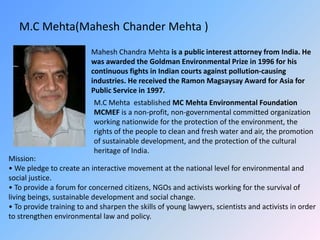
M.C Mehta(Mahesh Chander Mehta )
Mahesh Chandra Mehta is a public interest attorney from India. He
was awarded the Goldman Environmental Prize in 1996 for his
continuous fights in Indian courts against pollution-causing
industries. He received the Ramon Magsaysay Award for Asia for
Public Service in 1997.
M.C Mehta established MC Mehta Environmental Foundation
MCMEF is a non-profit, non-governmental committed organization
working nationwide for the protection of the environment, the
rights of the people to clean and fresh water and air, the promotion
of sustainable development, and the protection of the cultural
heritage of India.
Mission:
• We pledge to create an interactive movement at the national level for environmental and
social justice.
• To provide a forum for concerned citizens, NGOs and activists working for the survival of
living beings, sustainable development and social change.
• To provide training to and sharpen the skills of young lawyers, scientists and activists in order
to strengthen environmental law and policy.
REMEDIES:-
• Action for Damages
• Injunction
• Specific restitution of a property (in an action for
detention of property)
• Recovery of land (in cases of wrongful dispossession)
• Other legal remedies.
Water Pollution
• Water Pollution refers to the contamination of water bodies and resources.
making water unsuitable for both humans and other living things. Humans
can be affected by water pollution as water pollution make water unsuitable
for drinking, cooking, washing, bathing and also recreational activities
(domestic use)Marine Animals living in these water bodies will also be
affected as they will be poisoned when consuming the water, or when they
consume the pollutants in the water which are normally very poisonous.
• Pollution in the Ganges River
The settlements built along the river, as well as the dumping of waste
water have resulted in the serious pollution in the Ganges.
Some people even cremate and dump the bodies of the deceased into the
river during holy rituals.
Water Pollution & Some Important Case Laws:
• The M.C. Mehta v. Union of India [AIR 1988 SC 1037] also
known as the Kanpur Tanneries or Ganga Pollution case is
among the most significant water pollution case. Detailed
scientific investigations and the reports were produced before
the Court as evidence.
• In Vineet Kumar Mathur v. Union of India [(1996) 1 SCC
119], the Court took note of the continued violation of the
State.
• In Ambuja Petrochemicals v. A.P. Pollution Control Board
[AIR 1997 AP 41], oneof the industries covered by the
Patencheru belt of treatment plants was served with a notice
for violating the Water (Prevention and Control of Pollution)
Act. The industry replied to the notice. The Board however,
not satisfied with the reply of the industry, directed its closure.
Corporate Manslaughter and Corporate
Homicide Act 2007, United Kingdom
• Companies and organisations can be found guilty of corporate
manslaughter as a result of serious management failures
resulting in a gross breach of a duty of care.
Liability for organisations
Corporate Manslaughter and Corporate Homicide Act 2007
Health and Safety at Work Act 1974
Case review on under the Corporate Manslaughter and
Corporate Homicide Act 2007
• Cotswold Geotechnical Holdings Ltd., a geological survey company, in
February’2011 was fined with £385,000 over the death of geologist
Alexander Wright under the Corporate Manslaughter and Corporate
Homicide Act 2007
The Facts
The prosecution of Cotswold arose out of the death of an employee, Alex
Wright, in September 2008. Alex Wright, who was a geologist, died whilst
taking soil samples from a 3.5 metre deep trial pit on a building site.
• Tragically, the walls of the trial pit were not properly supported and
collapsed, burying Alex Wright.
• The prosecution asserted that Cotswold had failed to take all reasonably
practicable steps to prevent Alex Wright working in a dangerous way.
• The jury heard that Cotswold had failed to update and comply with its
own risk assessments and had not complied with industry guidance and
fined with £385,000 .
Thank you
by
Raghuram Netha

Absolute liability

  • 1.
    PRINCIPLES OF ABSOLUTELIABILITY . It is the fundamental principle of law that “Sic utere tuo ut alienum non laedas”(means : Enjoy your own property in a such a manner as not to injure another persons ) But there are certain occasions and activities, by which there are chances of causing harm or injury to the useful peoples For example Factories.
  • 2.
    • Types ofliabilities are :- Absolute Liability Strict Liability Vicarious Liability
  • 3.
    STRICT LIABILITY  Strictliability means  liability without fault i.e., without intention or negligence. (the defendant is held liable without fault.) Also known as “NO fault labiality” which was evolved in Rylands vs. Fletcher case. It is the application of Strict Liability but without the exceptions Absolute liability is a standard of legal liability found in tort and criminal law of various legal jurisdictions Evolved in the famous case “M.C. Metha vs. Union of India” in 1987 ABSOLUTE LIABILITY
  • 4.
    STRICT LIABILITY Rule inRyland v. Fletcher • “The person who, for his own purpose, brings on his land and collects and keeps there anything likely to do mischief if it escapes, must keep it in at his peril; and if he does not do so is prima facie answerable for all the damage which is the natural consequence of its escape.” • The liability under this rule is strict and it is no defense that the thing escape without that persons willful act, default or negligence or that he had no knowledge of its existence.
  • 5.
    Case facts: • Thedefendant was a mill owner, and he employed some independent contractors who were apparently competent, to construct a reservoir on his land to provide water for his mill. In the course of work the contractors came upon some old shafts and passages on the defendant’s land. They communicated with the mines of the plaintiff, a neighbour of the defendant, although no one suspected this, for the shafts appeared to be filled with earth. The contractors did not block them up, and when the reservoir was filled the water from it burst through the old shafts and flooded the plaintiff’s mines. It was found as a fact that the defendant had not been negligent, although the contractors had been. But the House of Lords held the defendant liable. • On the basis of liability in this case rule propounded by the house of lord Mrs. Blackburn, J
  • 6.
    For the applicationof the rule therefore the following three essentials should be there: (1) Some dangerous thing must have been brought by a person on his land. (2) The thing thus brought or kept by a person on his land must escape. (3) It must be non-natural use of land. • EXCEPTIONS TO THE RULE The following exceptions to the rule have been recognized by Rylands v Fletcher and some later cases:- I. Default of the claimant II. Act of God III. Statutory Authority IV. Consent of the claimant V. Act of third party.
  • 7.
    ABSOLUTE LIABILITY Rule laiddown by Supreme Court of India in the Oleum Gas Leak Case • Where an enterprise is engaged in a hazardous or inherently dangerous activity, the enterprise is strictly and absolutely liable to compensate all those who are affected by the accident and such liability is not subject to any exceptions. • The enterprise cannot escape liability by showing it had taken all reasonable care and there was no negligence on its part. • This principle, however, has been rarely applied since it was formulated.
  • 8.
    Case facts: • ShriramFood and Fertilizers Industry a subsidiary of Delhi Cloth Mills Limited was producing caustic and chlorine. On December 4th and 6th 1985, a major leakage of oleum gas took place from one of the units of Shriram Food and Fertilizers Limited in the heart of the capital city of Delhi which resulted in the death of several persons that one advocate practicing in the Tis Hazari Courts died. • The leakage was caused by a series of mechanical and human errors. This leakage resulted from the bursting of the tank containing oleum gas as a result of the collapse of the structure on which it was mounted and it created a scare amongst the people residing in that area. Hardly had the people got out of the shock of this disaster when, within two days, another leakage, though this time a minor one took place as a result of escape of oleum gas from the joints of a pipe. • On 6th December, 1985 by the District Magistrate, Delhi under Section 133(1) of Cr.P.C, directed Shriram that within two days Shriram should cease carrying on the occupation of manufacturing and processing hazardous and lethal chemicals and gases including chlorine, oleum, super-chlorine, phosphate, etc at their establishment in Delhi and within 7 days to remove such chemicals and gases from Delhi. At this juncture M.C.Mehta moved to the Supreme Court to claim compensation by filing a PIL for the losses caused and pleaded that the closed establishment should not be allowed to restart.
  • 9.
    M.C Mehta(Mahesh ChanderMehta ) Mahesh Chandra Mehta is a public interest attorney from India. He was awarded the Goldman Environmental Prize in 1996 for his continuous fights in Indian courts against pollution-causing industries. He received the Ramon Magsaysay Award for Asia for Public Service in 1997. M.C Mehta established MC Mehta Environmental Foundation MCMEF is a non-profit, non-governmental committed organization working nationwide for the protection of the environment, the rights of the people to clean and fresh water and air, the promotion of sustainable development, and the protection of the cultural heritage of India. Mission: • We pledge to create an interactive movement at the national level for environmental and social justice. • To provide a forum for concerned citizens, NGOs and activists working for the survival of living beings, sustainable development and social change. • To provide training to and sharpen the skills of young lawyers, scientists and activists in order to strengthen environmental law and policy.
  • 10.
    REMEDIES:- • Action forDamages • Injunction • Specific restitution of a property (in an action for detention of property) • Recovery of land (in cases of wrongful dispossession) • Other legal remedies.
  • 11.
    Water Pollution • WaterPollution refers to the contamination of water bodies and resources. making water unsuitable for both humans and other living things. Humans can be affected by water pollution as water pollution make water unsuitable for drinking, cooking, washing, bathing and also recreational activities (domestic use)Marine Animals living in these water bodies will also be affected as they will be poisoned when consuming the water, or when they consume the pollutants in the water which are normally very poisonous. • Pollution in the Ganges River The settlements built along the river, as well as the dumping of waste water have resulted in the serious pollution in the Ganges. Some people even cremate and dump the bodies of the deceased into the river during holy rituals.
  • 12.
    Water Pollution &Some Important Case Laws: • The M.C. Mehta v. Union of India [AIR 1988 SC 1037] also known as the Kanpur Tanneries or Ganga Pollution case is among the most significant water pollution case. Detailed scientific investigations and the reports were produced before the Court as evidence. • In Vineet Kumar Mathur v. Union of India [(1996) 1 SCC 119], the Court took note of the continued violation of the State. • In Ambuja Petrochemicals v. A.P. Pollution Control Board [AIR 1997 AP 41], oneof the industries covered by the Patencheru belt of treatment plants was served with a notice for violating the Water (Prevention and Control of Pollution) Act. The industry replied to the notice. The Board however, not satisfied with the reply of the industry, directed its closure.
  • 13.
    Corporate Manslaughter andCorporate Homicide Act 2007, United Kingdom • Companies and organisations can be found guilty of corporate manslaughter as a result of serious management failures resulting in a gross breach of a duty of care. Liability for organisations Corporate Manslaughter and Corporate Homicide Act 2007 Health and Safety at Work Act 1974
  • 14.
    Case review onunder the Corporate Manslaughter and Corporate Homicide Act 2007 • Cotswold Geotechnical Holdings Ltd., a geological survey company, in February’2011 was fined with £385,000 over the death of geologist Alexander Wright under the Corporate Manslaughter and Corporate Homicide Act 2007 The Facts The prosecution of Cotswold arose out of the death of an employee, Alex Wright, in September 2008. Alex Wright, who was a geologist, died whilst taking soil samples from a 3.5 metre deep trial pit on a building site. • Tragically, the walls of the trial pit were not properly supported and collapsed, burying Alex Wright. • The prosecution asserted that Cotswold had failed to take all reasonably practicable steps to prevent Alex Wright working in a dangerous way. • The jury heard that Cotswold had failed to update and comply with its own risk assessments and had not complied with industry guidance and fined with £385,000 .
  • 15.