Prof. Madhura Tilak


Prof. Madhura Tilak
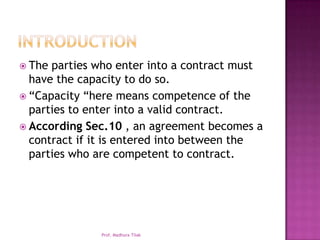
 The parties who enter into a contract must
  have the capacity to do so.
 “Capacity “here means competence of the
  parties to enter into a valid contract.
 According Sec.10 , an agreement becomes a
  contract if it is entered into between the
  parties who are competent to contract.


              Prof. Madhura Tilak
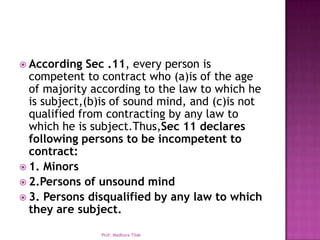
 According   Sec .11, every person is
  competent to contract who (a)is of the age
  of majority according to the law to which he
  is subject,(b)is of sound mind, and (c)is not
  qualified from contracting by any law to
  which he is subject.Thus,Sec 11 declares
  following persons to be incompetent to
  contract:
 1. Minors
 2.Persons of unsound mind
 3. Persons disqualified by any law to which
  they are subject.

               Prof. Madhura Tilak
 According  to Sec 3 of the Indian Majority
  Act, 1875, a minor is a person who has not
  completed eighteen years of age.
 In following cases he attains majority after
  21 years of age:
 1.where a guardian of minor person or
  property has been appointed under guardians
  and wards act,1890 or,
 2.where the superintendence of minor’s
  property is assumed by a court of wards.

               Prof. Madhura Tilak
 The  position of minor as regards his
  agreements may be summed up as under:
 1. An agreement with or by a minor is void
  and inoperative ab initio.(mihiribibi v
  Dharmodas Ghose(1903)
 2.He can be a promisee or beneficiary.
 3.His agreement cannot be ratified by him on
  attaing the age of majority.
 4.If he has received any benefit under a void
  agreement, he cannot be asked to
  compensate or pay for it.
               Prof. Madhura Tilak
 One  of the essential conditions of
  competency of parties to a contract is that
  they should be of sound mind.
 Sec 12 lays down the soundness of mind:
 “A person is said to be of sound mind for the
  purpose of making the contract if,at the time
  when he makes it, he is capable of
  understanding it and of forming a rational
  judgement as to its effect upon his
  interests.


               Prof. Madhura Tilak
A  person ,who is usually of unsound mind but
  occasionally of sound mind, may make a
  contract when he is of sound mind.
 A person ,who is usually of sound mind but
  occasionally of unsound mind, may not make
  a contract when he is of unsound mind.
 Eg:A person is a lunatic ,who is at intervals of
  sound mind, may contract during those
  intervals.


                Prof. Madhura Tilak
 Soundness    of minds depends on two facts:
 i)his capacity to understand the contents of
  the business concerned,
 ii) his ability to form a rational judgement as
  to its effect on his interests.
 If a person is incapable of both, he suffers
  from unsoundness of mind.


                Prof. Madhura Tilak
 Lunatics:  A lunatic is a person who is
  mentally deranged due to some mental strain
  or personal experience. He suffers from
  intermittent intervals of sanity and insanity.
  He can enter contracts during the period
  when he is of sound mind.
 Idiots: An Idiot is a person who has
  completely lost his mental powers. He does
  not exhibit understanding of even ordinary
  matters. Idiocy is permanent lunacy denotes
  periodical insanity with lucid intervals. An
  agreeement of an idiot , like that of minor is
  void.
                Prof. Madhura Tilak
 Drunken  or intoxicated persons: A drunken
 or intoxicated person suffers from temporary
 incapacity to contract ie. at the time when
 he is so drunk or intoxicated that he is
 incapable of forming a rational judgment.
 The position of a drunken or intoxicated
 person is similar to that of a lunatic.


              Prof. Madhura Tilak
 1.Alien Enemies: An Alien (the subject of
  foreign state)is a person who is not subject
  of the Republic of India. He may be Alien
  friend of Alien enemy.
 2.Foreign sovereigns, their diplomatic staff
  and accredited representatives of foreign
  states:They have some special privileges and
  generally cannot be sued unless of their own
  submit to the jurisdiction of our law
  courts.But an indian citizen has to obtain a
  prior sanction of central govt. in order to sue
  them in our law courts.

                Prof. Madhura Tilak
3.Corporations: A Corporation is an artificial
   person created by law, having a legal existence
   apart from its members.
It may come in to existence by a special Act of
   legislature or by registration under the
   companies’ Act, 1956.
4.Insolvents: When a debtor is adjudged insolvent,
   his property vests in the official receiver or
   official assignee.
As such insolvent is deprived of his power to deal
   in that property.
 5.Convicts: A convict when undergoing
   imprisonment is incapable of entering into
   contract.

                Prof. Madhura Tilak

Capacity to contract

  • 1.
  • 2.
     The partieswho enter into a contract must have the capacity to do so.  “Capacity “here means competence of the parties to enter into a valid contract.  According Sec.10 , an agreement becomes a contract if it is entered into between the parties who are competent to contract. Prof. Madhura Tilak
  • 3.
     According Sec .11, every person is competent to contract who (a)is of the age of majority according to the law to which he is subject,(b)is of sound mind, and (c)is not qualified from contracting by any law to which he is subject.Thus,Sec 11 declares following persons to be incompetent to contract:  1. Minors  2.Persons of unsound mind  3. Persons disqualified by any law to which they are subject. Prof. Madhura Tilak
  • 4.
     According to Sec 3 of the Indian Majority Act, 1875, a minor is a person who has not completed eighteen years of age.  In following cases he attains majority after 21 years of age:  1.where a guardian of minor person or property has been appointed under guardians and wards act,1890 or,  2.where the superintendence of minor’s property is assumed by a court of wards. Prof. Madhura Tilak
  • 5.
     The position of minor as regards his agreements may be summed up as under:  1. An agreement with or by a minor is void and inoperative ab initio.(mihiribibi v Dharmodas Ghose(1903)  2.He can be a promisee or beneficiary.  3.His agreement cannot be ratified by him on attaing the age of majority.  4.If he has received any benefit under a void agreement, he cannot be asked to compensate or pay for it. Prof. Madhura Tilak
  • 6.
     One of the essential conditions of competency of parties to a contract is that they should be of sound mind.  Sec 12 lays down the soundness of mind:  “A person is said to be of sound mind for the purpose of making the contract if,at the time when he makes it, he is capable of understanding it and of forming a rational judgement as to its effect upon his interests. Prof. Madhura Tilak
  • 7.
    A person,who is usually of unsound mind but occasionally of sound mind, may make a contract when he is of sound mind.  A person ,who is usually of sound mind but occasionally of unsound mind, may not make a contract when he is of unsound mind.  Eg:A person is a lunatic ,who is at intervals of sound mind, may contract during those intervals. Prof. Madhura Tilak
  • 8.
     Soundness of minds depends on two facts:  i)his capacity to understand the contents of the business concerned,  ii) his ability to form a rational judgement as to its effect on his interests.  If a person is incapable of both, he suffers from unsoundness of mind. Prof. Madhura Tilak
  • 9.
     Lunatics: A lunatic is a person who is mentally deranged due to some mental strain or personal experience. He suffers from intermittent intervals of sanity and insanity. He can enter contracts during the period when he is of sound mind.  Idiots: An Idiot is a person who has completely lost his mental powers. He does not exhibit understanding of even ordinary matters. Idiocy is permanent lunacy denotes periodical insanity with lucid intervals. An agreeement of an idiot , like that of minor is void. Prof. Madhura Tilak
  • 10.
     Drunken or intoxicated persons: A drunken or intoxicated person suffers from temporary incapacity to contract ie. at the time when he is so drunk or intoxicated that he is incapable of forming a rational judgment. The position of a drunken or intoxicated person is similar to that of a lunatic. Prof. Madhura Tilak
  • 11.
     1.Alien Enemies:An Alien (the subject of foreign state)is a person who is not subject of the Republic of India. He may be Alien friend of Alien enemy.  2.Foreign sovereigns, their diplomatic staff and accredited representatives of foreign states:They have some special privileges and generally cannot be sued unless of their own submit to the jurisdiction of our law courts.But an indian citizen has to obtain a prior sanction of central govt. in order to sue them in our law courts. Prof. Madhura Tilak
  • 12.
    3.Corporations: A Corporationis an artificial person created by law, having a legal existence apart from its members. It may come in to existence by a special Act of legislature or by registration under the companies’ Act, 1956. 4.Insolvents: When a debtor is adjudged insolvent, his property vests in the official receiver or official assignee. As such insolvent is deprived of his power to deal in that property.  5.Convicts: A convict when undergoing imprisonment is incapable of entering into contract. Prof. Madhura Tilak