Course Title:
Course Title:
The Teacher and the
The Teacher and the
Community, School
Community, School
Culture and
Culture and
Organizational Leadership
Course Code: ED103
Course Code: ED103
Vicrosechister L. Jayson
BSED 1Fil
BSED 1Fil
Prof. Maningas
Prof. Maningas
Course Title:
Course Title: The Teacher and the Community, School Culture
The Teacher and the Community, School Culture
and Organizational Leadership
Course
Course Code:
Code: ED103
ED103
Course
Course Description:
Description: This course
This course focuses on
focuses on society a
society as a
s a context
context
upon which the schools have been
established. Educational philosophies that
are related to the society as a foundation of
schools and schooling shall be emphasized.
Further, principles and theories on school
culture, and organizational leadership shall
be included to prepare prospective
teachers to become school leaders and
managers.
managers.
Course Objectives:
Course Objectives:
Course
Course Credits:
Credits: 3
3 units
units
Contact
Contact Hours:
Hours: 3
3 hours/week
hours/week
Pre-requisite:
Pre-requisite: ED 102
ED 102 The Teaching
The Teaching Profession
Profession
Point for Reflection:
1.
1. A
A teacher
teacher cannot
cannot separate
separate himself/her
himself/herself
self from
from the
the
community of
community of which s/he
which s/he is a
is a part.
part. S/he together with
S/he together with
his/her teaching profession has a social dimension.
2.
2. Education has meaning and function to the extent that it is
Education has meaning and function to the extent that it is
relevant to the society within which it exists.
3.
3. Theteachingprofessionhasfunctiononlyto
Theteachingprofessionhasfunctiononlyto theextentthat
theextentthat
it is able to
it is able to fulfill the needs of the
fulfill the needs of the society and contribute to
society and contribute to
the development of people in the society.
The Social Science Theories of Education
Education and Society
Education and schooling are found within the context of
society.
society. Schools exist within soci
Schools exist within social context and any change
al context and any change
within schools in terms of educational aims, goals, and objectives
including its contents are always in relation to societal changes.
Society and schools are interdependent and provide bi-
directional influence to ea
directional influence to each other.
ch other. Sociology as a
Sociology as a science
science
provides theories, concepts and principles that help us better
understand theories and principles that help shape and guide
education.
education. Education on the other hand
Education on the other hand through its curriculum
through its curriculum
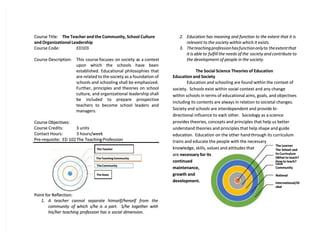
trains and educate the people with the necessary
knowledge, skills, values and attitudes that
are
are necessary for its
necessary for its
continued
continued
maintenance,
maintenance,
growth and
growth and
development.
development.
The Teacher
The Teacher
TheTeachingCommunity
TheCommunity
TheCommunity
The State
The State
The Learner
The Learner
The School and
The School and
itsCurriculum
itsCurriculum
(What to teach?
(What to teach?
How to teach?
How to teach?
Local
Local
Community
Community
National
National
International/Gl
International/Gl
obal
obal
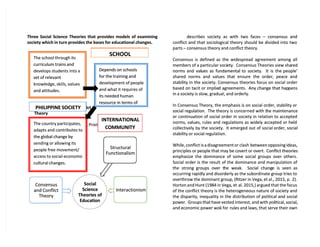
Three Social Science Theories that provides models of examining
society which in turn provides the bases for educational changes.
Consensus and Conflict
Theory
Theory
Dahrendorf (in Vega, Prieto, &
Dahrendorf (in Vega, Prieto, & Carreon, 2015,p.2)
Carreon, 2015,p.2)
describes society as with two faces
describes society as with two faces –
– consensus and
consensus and
conflict and that sociological theory should be divided into two
parts
parts –
– consensus theory and conflict theory.
consensus theory and conflict theory.
Consensus is defined as the widespread agreement among all
members of a particular soci
members of a particular society.
ety. Consensus Theories view sha
Consensus Theories view shared
red
norms and val
norms and values as fundamental
ues as fundamental to society.
to society. It is the
It is the people’
people’
shared norms and values that ensure the order, peace and
stability in the society. Consensus theories focus on social order
based on tacit or implie
based on tacit or implied agreements.
d agreements. Any change that hap
Any change that happens
pens
in a society is slow, gradual, and orderly.
In Consensus Theory, the emphasis is on social order, stability or
social regulation.
social regulation. The theory is concerned with t
The theory is concerned with the maintenance
he maintenance
or continuation of social order in society in relation to accepted
norms, values, rules and regulations as widely accepted or held
collectively by the society.
collectively by the society. It emerged out of social
It emerged out of social order, social
order, social
stability or social regulation.
While, conflict is a disagreement or clash
While, conflict is a disagreement or clash between opposing ideas,
between opposing ideas,
principles or people that may be covert or overt.
principles or people that may be covert or overt. Conflict theories
Conflict theories
emphasize the dominance of some social groups over others.
Social order is the result of the dominance and manipulation of
the strong
the strong groups over t
groups over the weak.
he weak. Social chang
Social change is seen
e is seen as
as
occurring rapidly and disorderly as the subordinate group tries to
overthrow the dominant group, (Ritzer in Vega, et al., 2015, p.
overthrow the dominant group, (Ritzer in Vega, et al., 2015, p. 2).
2).
Horton and Hunt (1984 in Vega, et
Horton and Hunt (1984 in Vega, et al. 2015,) argued that the focus
al. 2015,) argued that the focus
of the conflict theory is the heterogeneous nature of society and
the disparity, inequality in the distribution of political and social
power.
power. Groups that have vested interest, and with pol
Groups that have vested interest, and with political, social,
itical, social,
and economic power wok for
and economic power wok for rules and laws, that serve their own
rules and laws, that serve their own
Social
Social
Science
Science
Theories of
Theories of
Education
Education
Consensus
Consensus
and Conflict
and Conflict
Theory
Theory
Structural
Structural
Functionalism
Functionalism
Interactionism
Interactionism
The school through its
curriculum trains and
develops students into a
set of relevant
set of relevant
knowledge, skills, values
and attitudes.
and attitudes.
Depends on schools
Depends on schools
for the training and
development of people
and what it requires of
its needed human
its needed human
resource in terms of
The country participates,
adapts and contributes to
the global change by
sending or allowing its
people free movement/
access to social-economic
cultural changes.
cultural changes.
SCHOOL
SCHOOL
PHILIPPINE SOCIETY
PHILIPPINE SOCIETY
INTERNATIONAL
INTERNATIONAL
COMMUNITY
COMMUNITY
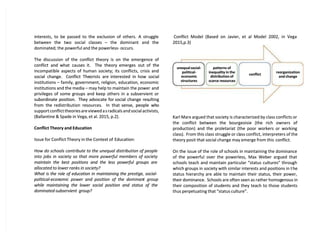
interests, to be passed to the exclusion of others. A struggle
between the two social classes
between the two social classes –
– the dominant and the
the dominant and the
dominated; the powerful and the powerless- occurs.
The discussion of the conflict theory is on the emergence of
conflict and
conflict and what causes
what causes it.
it. The theory
The theory emerges out
emerges out of the
of the
incompatible aspects of human society; its conflicts, crisis and
social change.
social change. Conflict The
Conflict Theorists are
orists are interested in
interested in how social
how social
institutions
institutions –
– family, government, religion, education, economic
family, government, religion, education, economic
institutions and the media
institutions and the media –
– may help to maintain the power
may help to maintain the power and
and
privileges of some groups and keep others in a subservient or
subordinate position.
subordinate position. They advocate for
They advocate for social change res
social change resulting
ulting
from the
from the redistribution resources.
redistribution resources. In that
In that sense, people wh
sense, people who
o
support conflict theories are viewed a
support conflict theories are viewed as radicals and social activists,
s radicals and social activists,
(Ballantine & Spade in Vega, et al. 2015, p.2).
Conflict Theory and Education
Issue for Conflict Theory in the Context of
Issue for Conflict Theory in the Context of Education:
Education:
How do schools contribute to the unequal distribution of people
into jobs in society so that more powerful members of society
maintain the best positions and the less powerful groups are
allocated to lower ranks in society?
What is the role of education in maintaining the prestige, social-
political-econ
political-economic
omic power
power and
and position
position of
of the
the dominan
dominant
t group
group
while maintaining the lower social position and status of the
dominated-subservient group?
Conflict Model (Based on Javier, et al Model 2002, in Vega
2015,p.3)
2015,p.3)
Karl Marx argued that society is characterized by class conflicts or
the conflict between the bourgeoisie (the rich owners of
production) and the proletariat (the poor workers or working
class).
class). From this class struggle or cl
From this class struggle or class conflict, interpreters of the
ass conflict, interpreters of the
theory posit that social change may emerge from this
theory posit that social change may emerge from this conflict.
conflict.
On the issue of the role of schools in maintaining the dominance
of the powerful over the powerless, Max Weber argued that
schools teach and maintain particular “status cultures” through
which groups in society with similar interests and positions in t
which groups in society with similar interests and positions in the
he
status hierarchy are able to maintain their status, their power,
their dominance.
their dominance. Schools are often seen as rather homog
Schools are often seen as rather homogenous in
enous in
their composition of students and they teach to those students
thus perpetuating that “status culture”.
unequal social-
unequal social-
political-
political-
economic
economic
structures
structures
patterns of
patterns of
inequality in the
inequality in the
distribution of
distribution of
scarce resources
scarce resources
conflict
conflict
reorganization
reorganization
and change
and change
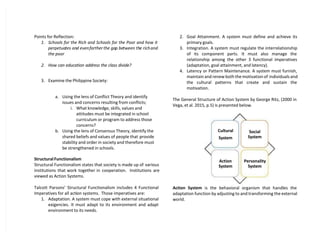
Points for Reflection:
1. Schools for the Rich and Schools for the Poor and how it
perpetuates and evenfarther the gap between the richand
the poor
2. How can education address the class divide?
3. Examine the Philippine Society:
a. Using the lens of Conflict Theory and identify
issues and concerns resulting from conflicts;
i. What knowledge, skills, values and
attitudes must be integrated in school
curriculum or program to address those
concerns?
b. Using the lens of Consensus Theory, identify the
shared beliefs and values of people that provide
stability and order in society and therefore must
be strengthened in schools.
Structural Functionalism
Structural Functionalism states that society is made up of various
institutions that work together in cooperation. Institutions are
viewed as Action Systems.
Talcott Parsons’ Structural Functionalism includes 4 Functional
Imperatives for all action systems. Those imperatives are:
1. Adaptation. A system must cope with external situational
exigencies. It must adapt to its environment and adapt
environment to its needs.
2. Goal Attainment. A system must define and achieve its
primary goals.
3. Integration. A system must regulate the interrelationship
of its component parts. It must also manage the
relationship among the other 3 functional imperatives
(adaptation, goal attainment, and latency).
4. Latency or Pattern Maintenance. A system must furnish,
maintain and renew both the motivation of individuals and
the cultural patterns that create and sustain the
motivation.
The General Structure of Action System by George Ritz, (2000 in
Vega, et al. 2015, p.5) is presented below.
Action System is the behavioral organism that handles the
adaptation function by adjusting to and transforming the external
world.
Cultural
System
Social
System
Action
System
Personality
System
Personality System performs the goal-attainment function by
defining system goals and mobilizing resources to attain them.
Social System copes with the integration function by controlling
its component parts.
Cultural System performs the latency function by providing actors
with the norms and values that motivate them for action.
Assumptions of Structural Functionalism
1. Systems have the property of order and interdependence
of parts.
2. Systems tend toward self-maintaining order, or
equilibrium.
3. The system may be static or involved in an ordered process
of change.
4. The nature of one part of the system has an impact on the
form that the other parts can take.
5. Systems maintain boundaries with their environments.
6. Allocation and integration are two fundamental processes
necessary for a given state of equilibrium of a system.
7. Systems tend toward self-maintenance involving the
maintenance of the relationships of parts to the whole,
control of environmental variations, and control of
tendencies to change the system from within.
Parson’s conception of the social system begins at the micro-level
with the interaction between the ego and alter ego which he
identified as the most elementary form of the social system. A
social system consists of the following:
1. Individual actors
2. Interaction
3. Physical or environmental aspect
4. Motivation towards the optimization of
gratification
5. Relation to situation and each other is defined and
mediated by a system of culturally-structured and
shared symbols.
Parson was not only interested in the structural components of
the social system, but he was also interested in examining the
function of social systems. It is believed that systems exist because
they are able to meet the needs of society in its particular
situations. Parsons listed the Functional Requisites of a Social
System:
1. Social system must be structured so that they operate
compatibly with other systems.
2. To survive, the social system must have the requisites from
other systems.
3. The system must meet a significant proportion of the needs
of its actors.
4. The system must elicit adequate participation from its
members.
5. It must have at least a minimum of control over potentially
disruptive behavior.
6. If conflict becomes sufficiently disruptive, it must be
controlled.
7. A social system requires a language in order to survive.
Functionalist explains that a society assumes a particular form
because that form works well for the society and develops certain
characteristics because those characteristics meets the needs of
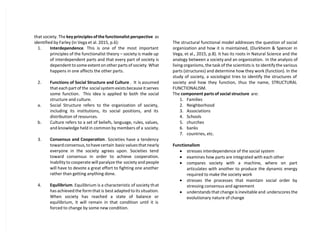
that society. The key principles of the functionalist perspective as
identified by Farley (in Vega et al. 2015, p.6):
1. Interdependence. This is one of the most important
principles of the functionalist theory – society is made up
of interdependent parts and that every part of society is
dependent to some extent on other parts of society. What
happens in one affects the other parts.
2. Functions of Social Structure and Culture . It is assumed
that each part of the social system exists because it serves
some function. This idea is applied to both the social
structure and culture.
a. Social Structure refers to the organization of society,
including its institutions, its social positions, and its
distribution of resources.
b. Culture refers to a set of beliefs, language, rules, values,
and knowledge held in common by members of a society.
3. Consensus and Cooperation. Societies have a tendency
toward consensus, to have certain basic values that nearly
everyone in the society agrees upon. Societies tend
toward consensus in order to achieve cooperation.
Inability to cooperate will paralyze the society and people
will have to devote a great effort to fighting one another
rather than getting anything done.
4. Equilibrium. Equilibrium is a characteristic of society that
has achieved the form that is best adapted to its situation.
When society has reached a state of balance or
equilibrium, it will remain in that condition until it is
forced to change by some new condition.
The structural functional model addresses the question of social
organization and how it is maintained, (Durkheim & Spencer in
Vega, et al., 2015, p.8). It has its roots in Natural Science and the
analogy between a society and an organization. In the analysis of
living organisms, the task of the scientists is to identify the various
parts (structures) and determine how they work (function). In the
study of society, a sociologist tries to identify the structures of
society and how they function, thus the name, STRUCTURAL
FUNCTIONALISM.
The component parts of social structure are:
1. Families
2. Neighborhood
3. Associations
4. Schools
5. churches
6. banks
7. countries, etc.
Functionalism
 stresses interdependence of the social system
 examines how parts are integrated with each other
 compares society with a machine, where on part
articulates with another to produce the dynamic energy
required to make the society work
 stresses the processes that maintain social order by
stressing consensus and agreement
 understands that change is inevitable and underscores the
evolutionary nature of change
 acknowledges that conflict between groups exists,
functionalism believe that without a common bond to
unite groups, society will integrate
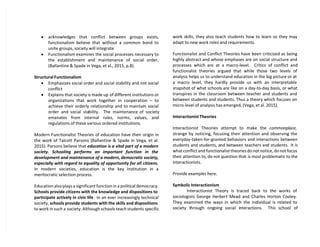
 Functionalism examines the social processes necessary to
the establishment and maintenance of social order,
(Ballantine & Spade in Vega, et al., 2015, p.8).
Structural Functionalism
 Emphasizes social order and social stability and not social
conflict
 Explains that society is made up of different institutions or
organizations that work together in cooperation – to
achieve their orderly relationship and to maintain social
order and social stability. The maintenance of society
emanates from internal rules, norms, values, and
regulations of these various ordered institutions.
Modern Functionalist Theories of education have their origin in
the work of Talcott Parsons (Ballantine & Spade in Vega, et al.
2015). Parsons believe that education is a vital part of a modern
society. Schooling performs an important function in the
development and maintenance of a modern, democratic society,
especially with regard to equality of opportunity for all citizens.
In modern societies, education is the key institution in a
meritocratic selection process.
Education also plays a significant function in a political democracy.
Schools provide citizens with the knowledge and dispositions to
participate actively in civic life . In an ever increasingly technical
society, schools provide students with the skills and dispositions
to work in such a society. Although schools teach students specific
work skills, they also teach students how to learn so they may
adapt to new work roles and requirements.
Functionalist and Conflict Theories have been criticized as being
highly abstract and whose emphases are on social structure and
processes which are at a macro-level. Critics of conflict and
functionalist theories argued that while those two levels of
analysis helps us to understand education in the big picture or at
a macro level, they hardly provide us with an interpretable
snapshot of what schools are like on a day-to-day basis, or what
transpires in the classroom between teacher and students and
between students and students. Thus a theory which focuses on
micro-level of analysis has emerged, (Vega, et al. 2015).
Interactionist Theories
Interactionist Theories attempt to make the commonplace,
strange by noticing, focusing their attention and observing the
everyday-taken-for-granted behaviors and interactions between
students and students, and between teachers and students. It is
what conflict and functionalist theories do not notice, do not focus
their attention to, do not question that is most problematic to the
interactionists.
Provide examples here.
Symbolic Interactionism
Interactionist Theory is traced back to the works of
sociologists George Herbert Mead and Charles Horton Cooley.
They examined the ways in which the individual is related to
society through ongoing social interactions. This school of
thought, known as Social Interactionism, views the self as socially
constructed in relation to social forces and structures and the
product of ongoing negotiations of meanings . Thus, the social self
is an active product of human agency rather than a deterministic
product of social structure. The social self is a result of social
interaction mediated by symbols, in particular, language. The
distinctive attributes of human behavior is viewed as the result of
individuals’ participation in varying types of social structures
which in turn is dependent on the existence of language behavior.
Symbolic Interactionism is not only interested in socialization but
also in interaction. Interaction is significant in terms of (a)
development of one’s ability to think, and (b) development of
one’s ability to express what s/he thinks. All types of interaction,
not just interaction during socialization, refine our ability to think
which in turn shapes the interaction process.
However, not all forms of social interactions require mental
processing or will involve our ability to think. They are Non-
Symbolic Interaction or in the term used by George Herbert Mead,
the conversation of gestures which does not involve thinking.
Blumer made the differentiation between those two basic forms
of social interaction, namely (1) non-symbolic interaction which
does not involve thinking, and (2) symbolic interaction which
require mental processing, (Vega, et al. 2015, p.11).
Principles of Symbolic Interactionism
1. Human beings, unlike lower animals, are endowed with a
capacity for thought.
2. The capacity for thought is shaped by social interaction.
3. In social interaction, people learn the meanings and
symbols that allow them to exercise their distinct capacity
for human thought.
4. Meanings and symbols allow people to carry on
distinctively human action and interaction.
5. People are able to modify or alter the meanings and
symbols they use in action and interaction on the basis of
their interpretation of the situation.
6. People are able to make these modifications and
alterations, because, in part, of their ability to interact with
themselves, which allows them to examine possible
courses of action, assess their relative advantages and
disadvantages, and then choose one.
7. The intertwined patterns of actions and interactions make
up groups and societies.
Symbolic Interactionism is based on the following premises by
Mead:
1. People act toward the things they encounter on the basis
of what those things mean to them. The word things refer
not only to objects but to people, activities, and situations
as well.
2. We learn what things are by observing how other people
respond to them through social interaction.
3. As a result of ongoing interaction, the sounds (or words),
gestures, facial expressions, and body postures we use in
dealing with others acquire symbolic meanings that are
shared by people who belong to the same culture.
Example: The handshake, a symbolic gesture which is not
simply a mutual grasping of hands, palms, fingers but
conveys the symbolic gesture of greetings among Filipinos.
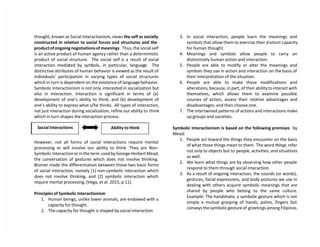
Social Interactions Ability to think
The importance of thinking to symbolic interactionists is reflected
in their views on objects. According to Blumer, there are three
types of objects:
1. Physical objects – chair, tree, Vans shoes
2. Social objects – student, mother, boyfriend,
girlfriend
3. Abstract objects – such as ideas or moral principles
(All human beings are created by God and
therefore everybody must be given equal rights
and must be treated with respect and dignity.)
Objects are seen simply as out there in the real word. What is
important is the way they are defined or interpreted by the
individuals experiencing those objects. Such interpretations lead
to a relativistic view that objects may have different meanings for
different individuals. Example: a shoe for a shoemaker may be his
source of livelihood or an expression of his artistic talent; a shoe
for a poor kid may be a source of frustration for not owning a pair;
a shoe for a teenager may be a source of pride, a status symbol.
Related to the idea of the self as a social construct is the concept
of the looking glass self put forward by early symbolic
interactionist theorist, Charles Horton Cooley. The concept of the
looking glass self suggests that we come to develop an
understanding of who we are and who we are not, a self-
definition, on the basis of the words or actions of others towards
us. The looking glass self forwards the idea We see ourselves as
others see us. A student may acquire the idea that s/he is smart
or dumb, likeable or unlikeable, pretty or ugly from what others
tell him/her; or how others make him/her feel about
himself/herself. Cooley explained that we use other people as a
mirror into which we look to see what we are like, (Farley in Vega,
et al., 2015, p.12).
Questions for Reflection:
1. Who are you in the eyes and words of other people?
a. Do you accept your own self-image as presented to
you by others without question?
b. Do you like what you see in the mirror?
2. What is your interpretation of the following and reflect on
the effects of your interpretation on your behavior?
a. A kind-hearted teacher
b. A teacher known for failing students; or a teacher
known for passing all students despite absences
and failing quizzes and exams
c. A classmate who is very active in class
d. A classmate who smokes and into
fraternity/sorority
From: Vega, V.A., Prieto, N.G. & Carreon, M.L. (2015). Social
Dimensions of Education. Q.C.: Lorimar Publishing,
Inc.
Socio-Cultural Phenomenon Influencing Education
Multiculturalism
Multiculturalism is the phenomenon of multiple groups of cultures
existing within one society largely due to the arrival of immigrants.
The term is often used to describe societies, especially nations,
which have many distinct cultural groups resulting from
immigration. The presence of many cultural groups in a society
can lead to anxiety about the stability of national identity, but it
can also lead to cultural exchanges that can bring benefits to the
cultural groups. When different cultural groups collaborate with
each other, they can accomplish many great works in literature,
arts, philosophy, technology, fashion and all other human
endeavors that celebrate the richness of the talents and
intelligence of humanity.
Multiculturalism is also defined as a policy that emphasizes the
unique characteristics of different cultures, especially as they
relate to one another in receiving nations. Multiculturalism is a
systematic and comprehensive response to cultural and ethnic
diversity, with educational, linguistic, economic and social
components, and specific institutional mechanisms.
Multiculturalism is viewed as a model of democratic-policy-
response to culture and ethnic diversity because it corresponds to
the ideal of culture of peace based on respect of diversity, as well
as universally shared values and norms.
3 Interrelated Referents of Multiculturalism
1. Demographic-Descriptive when the word multicultural
refers to the existence of linguistically, culturally, and
ethnically diverse segments in the population of a society
or state.
2. Ideological-Normative when the word refers to the
management and organization of governmental responses
to ethnic diversity (assimilationism, differentialism and its
extreme forms of exclusion, apartheid, ethnic cleansing,
and genocide).
3. Programmatic-Political when the word refers to the
specific policies developed to respond to and manage
ethnic diversity.
Multiculturalism and Multicultural Education
Multiculturalism refers to the evolution of cultural diversity within
a jurisdiction introduced by its selection policies and
institutionalized by its settlement policies. With the evolving and
growing presence of diverse cultural groups in a society, there
arise the need for Multicultural Education which is an emerging
discipline whose aim is to create equal educational opportunities
from diverse racial, ethnic, social class and cultural groups. It
supports the idea that students and their cultural backgrounds
and experiences should be the center of their education and that
learning should occur in a familiar contact that attends to multiple
ways of thinking.
Multicultural education is a tool for establishing pride and
confidence among students in their unique and special
backgrounds. This theory concentrates on the need of including
notions of race, class and diversity while teaching. According to
James Banks (in Vega, et al. 2015), the goal of multicultural
education is to transform the school so that male and female
students, exceptional students, and students from diverse
cultural, social class, racial and ethnic groups experience an equal
opportunity to learn. A key assumption of multicultural education
is that students are more likely to achieve when the total
classroom climate is more consistent with their diverse cultures
and learning styles.
Other goals of Multicultural Education:
 To help all students acquire knowledge, attitudes, and
skills needed to function effectively in pluralistic
democratic society and to interact, negotiate, and
communicate with peoples from diverse groups in order to
create a civic and moral community that works for the
common good.
 To help students acquire the knowledge and commitments
needed to make reflective decisions and to take personal,
social, civic action to promote democracy and democratic
living.
 Related goal, is to help all students develop more positive
attitudes towards different racial, ethnic, cultural, and
religious groups.
4 Approaches to accomplish the goals of Multicultural Education
1. Contributions Approach. Ethnic heroes and holidays are
included in the curriculum. Heroes, holidays, and food
become a special focus on a particular day; recognizing the
contributions of various groups.
2. Additive Approach. A unit or course in incorporated (a unit
on women in history), but no substantial change is made
to the curriculum as a whole. Special units and topics about
various groups are added to, but do not fundamentally
alter the curriculum.
3. Transformation Approach. Students are taught to view
events and issues from diverse ethnic and cultural
perspectives. Curriculum is changed, so that students see
the world from the different perspective of various groups.
4. Social Action Approach. Going beyond transformation
approach, students not only learn to view issues from
multiple perspectives but also become directly involved in
solving related problems; promotes decision-making and
social action in order to achieve multicultural goals and a
more vibrant democracy, (Sadker & Sadker in Vega, et al.
2015).
 Multicultural education is grounded on the ideals of social
justice, education equity, and a dedication to facilitating
educational experiences in which all students reach their
full potential as learners and as socially aware and active
beings, locally, nationally, and globally.
 Multicultural education acknowledges that schools are
essential to laying the foundation for the transformation
of society and the elimination of oppression and injustice.
 Multicultural education is a progressive approach for
transforming education that holistically critiques and
addresses current shortcomings, failings and
discriminatory practices in education.
 Interdisciplinary approach
Ideals Underpinning Multicultural Education
 Every student must have an equal opportunity to achieve
his/her full potential.
 Every student must be prepared to competently
participate in an increasingly intercultural society.
 Teachers must be prepared to effectively facilitate learning
for every individual student, no matter how culturally
similar or different form themselves.
 Schools must be active participants in ending oppression
of all types, first, by ending oppression within their own
walls, then, by producing socially and critically active and
aware students.
 Education must become fully student-centered and
inclusive of the voices and experiences of the students.
 Educators, activists and others must take a more active
role in reexamining all educational practices and how they
affect the learning of all students; testing methods,
teaching approaches, evaluation and assessment, school
psychology, and counseling.
Dimensions of Multicultural Education , (Banks, 1997 in Vega, et
al. 2015)
1. Content Integration – deals with the extent to which
teachers sue examples and content from a variety of
culture and groups to illustrate key concepts,
generalizations, and issues within their subject area or
disciplines.
2. Knowledge Construction Process – describes how
teachers help students understand, investigate and
determine how the biases, frames of reference, and
perspectives within a discipline influence the ways in
which knowledge is constructed within it. Students also
learn how to build knowledge themselves in this
dimension.
3. Prejudice Reduction. It describes lessons and activities
used by teachers to help students develop positive
attitudes toward different racial, ethnic, and cultural
groups. Lessons, units and teaching materials that include
content about different racial and ethnic groups can help
students develop more positive intergroup attitudes if
certain conditions exist in the teaching situation. These
conditions include positive images of the ethnic groups in
the materials and the use of the multiethnic materials in a
consistent and sequential way.
4. Equity Pedagogy exists when teachers modify their
teaching in ways that will facilitate the academic
achievement of students from diverse racial, cultural, and
social class groups.
5. Empowering School Culture and Social Structure. This is
created when the culture and organization of the school
are transformed in ways that enable students from diverse
racial, ethnic, and gender groups to experience equality
and equal status.
Culturally-ResponsiveTeaching acknowledges cultural diversity in
classrooms and accommodates this diversity in instruction by: (1)
recognizing and accepting student diversity, it communicates that
all students are welcome and valued as human beings; (2) building
on students’ cultural backgrounds, culturally-responsive teaching
communicatespositiveimagesaboutthe students’ home cultures;
and (3) being responsive to different learning styles, culturally-
responsive teaching, builds on students’ strengths and uses these
to help students learn.
Culturally-responsive instruction covers areas related to:
1. Inclusive content in the curriculum that reflects the
diversity of society. Students from diverse backgrounds
see themselves and their experiences in the curriculum.
2. Students’ prior knowledge, including their culture and
language.
3. The idea that culture is central to student learning because
there is no strong evidence that culture practices affect the
thinking process.
Culturally-responsive teaching encompasses the following
elements:
1. Communication of high expectations
2. Active teaching methods that promote student
engagement
3. Teacher as facilitator
4. Positive perspectives on parents and families of culturally
and linguistically diverse students
5. Cultural sensitivity
6. Reshaping the curriculum so that it is culturally responsive
to the background of students
7. Culturally mediated instruction that is characterized by the
use of culturally mediated cognition, culturally appropriate
social situations for learning, and culturally valued
knowledge in curriculum content
8. Small group instruction and academically-related
discourse
Globalization
Globalization refers to the increasing interconnectedness and
convergence of activities and forms of life among diverse cultures
throughout the world. It is fundamentally the closer integration of
countries and peoples of the world which has been brought about
by the enormous reduction of costs of transportation and
communication and the breaking down of artificial barriers to the
flows of goods, services, capital knowledge, and (to a lesser
extent) people across countries, (Stiglitz in Vega, et al, 2015).
International forces are fuelling globalization and driving
tremendous developments in the world. It crystallizes (1) the
hopes of that we will finally achieve a global society, and (2) the
fears of others that their lives and jobs are threatened by forces
beyond their control, (Chronicle of Higher Education in Vega et al,
2015, p.117).
Globalization as a theory seeks to explain the integration of
economies and societies around the world as they are knit
together by travel, language, values and ideas, trade, labor and
financial flows, communication and technology. It also addresses
the political interconnectedness of nations via global governance
arrangements and expanding cultural exchange via the internet,
mass media, travel, etc. As a process, globalization affects all
countries, some more favorably than others in terms of economic
growth, national sovereignty, and cultural identity.
Education Systems: Core of the Globalization Process
With the ever-increasing globalization, interconnected of peoples
of the world, education finds itself at the very center of it. Global
development as the direction of globalization, education has
become an inseparable tool. Rinne (in Vega, et al., 2015)
emphasizes that educational policy has become an ever more
important part of economic, trade, labor, and social policy in
western countries. One concrete global development is the
development of mega-universities, university networks and virtual
universities that can offer competitive training programs for
students recruited from all over the world.
Globalization of higher education is becoming increasingly
realized in the present times as credentials and proof of
competency are being based more on global standards. Countries
embrace globalization as a movement and prompted them to get
organized to facilitate the flow of economic, political, as well as
socio-cultural activities among them.
Global Education and Globalization
Globalization demands an education that develops higher-order
cognitive and interpersonal skills required for problem-finding,
problem-solving, articulating arguments, and deploying verifiable
facts or artifacts. Motivated by economic forces and driven by
digital technologies and communications, globalization links
individuals and institutions across the world with interconnection.
This resulted to democratization, intensification of
interdependence, and creates new forms of local reaction and
self-definition. However, some see globalization as resulting to a
universal economy and culture that is rooted in North American
and Western ideals and interests. (Conflict Theories will interpret
it as domination of the Americans and Westerners over others; or
a tool to subjugate weak economies by strong economies that will
further widen the gap between the rich and the poor).
Global Education aims to extend students’ awareness of the world
in which they live by opening to the diverse heritage of human
thoughts and action, and creativity. It emphasizes the changes in
communication and relationships among people throughout the
world by highlighting issues like human conflict, economic
systems, human rights, and social justice, human commonality
and diversity, literatures and cultures, and the impact of
technological revolution. In analyzing and finding solutions to
global-human problems, global education employs
interdisciplinary and multi-disciplinary approach.
Objectives of global education are to develop learners’:
 Ability to think critically and ethically
 Ability to effectively access, interpret, evaluate and apply
information
o essential for facing a constantly changing work
environment
o for continuing self-education
o for participation as an ethical and responsible
member of a global society.
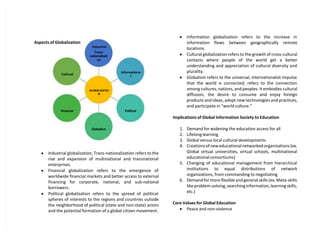
Aspects of Globalization
 Industrial globalization, Trans-nationalization refers to the
rise and expansion of multinational and transnational
enterprises.
 Financial globalization refers to the emergence of
worldwide financial markets and better access to external
financing for corporate, national, and sub-national
borrowers.
 Political globalization refers to the spread of political
spheres of interests to the regions and countries outside
the neighborhood of political (state and non-state) actors
and the potential formation of a global citizen movement.
 Information globalization refers to the increase in
information flows between geographically remote
locations.
 Cultural globalization refers to the growth of cross-cultural
contacts where people of the world get a better
understanding and appreciation of cultural diversity and
plurality.
 Globalism refers to the universal, internationalist impulse
that the world is connected; refers to the connection
among cultures, nations, and peoples. It embodies cultural
diffusion, the desire to consume and enjoy foreign
products and ideas, adopt new technologies and practices,
and participate in “world culture.”
Implications of Global Information Society to Education
1. Demand for widening the education access for all
2. Lifelong learning
3. Global versus local cultural developments
4. Creations of new educational networked organizations (ex.
Global virtual universities, virtual schools, multinational
educational consortiums)
5. Changing of educational management from hierarchical
institutions to equal distributions of network
organizations, from commanding to negotiating
6. Demand for more flexible and general skills (ex. Meta-skills
like problem-solving, searching information, learning skills,
etc.)
Core Values for Global Education
 Peace and non-violence
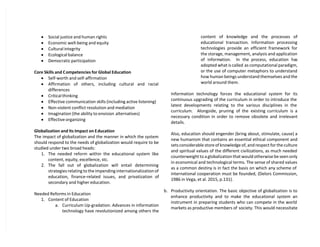
GLOBALIZATIO
N
Industrial
Trans-
nationalizati
on
Informationa
l
Political
Globalism
Financial
Cultural
 Social justice and human rights
 Economic well-being and equity
 Cultural integrity
 Ecological balance
 Democratic participation
Core Skills and Competencies for Global Education
 Self-worth and self-affirmation
 Affirmation of others, including cultural and racial
differences
 Critical thinking
 Effective communication skills (including active listening)
 Non-violent conflict resolution and mediation
 Imagination (the ability to envision alternatives)
 Effective organizing
Globalization and Its Impact on Education
The impact of globalization and the manner in which the system
should respond to the needs of globalization would require to be
studied under two broad heads:
1. The needed reform within the educational system like
content, equity, excellence, stc.
2. The fall out of globalization will entail determining
strategies relating to the impending internationalization of
education, finance-related issues, and privatization of
secondary and higher education.
Needed Reforms in Education
1. Content of Education
a. Curriculum Up-gradation. Advances in information
technology have revolutionized among others the
content of knowledge and the processes of
educational transaction. Information processing
technologies provide an efficient framework for
the storage, management, analysis and application
of information. In the process, education has
adopted what is called as computational paradigm,
or the use of computer metaphors to understand
how human beings understand themselves and the
world around them.
Information technology forces the educational system for its
continuous upgrading of the curriculum in order to introduce the
latest developments relating to the various disciplines in the
curriculum. Alongside, pruning of the existing curriculum is a
necessary condition in order to remove obsolete and irrelevant
details.
Also, education should engender (bring about, stimulate, cause) a
new humanism that contains an essential ethical component and
sets considerable store of knowledge of, and respect for the culture
and spiritual values of the different civilizations, as much needed
counterweight to a globalization that would otherwise be seen only
in economical and technological terms. The sense of shared values
as a common destiny is in fact the basis on which any scheme of
international cooperation must be founded, (Delors Commission,
1986 in Vega, et al. 2015, p.131).
b. Productivity orientation. The basic objective of globalization is to
enhance productivity and to make the educational system an
instrument in preparing students who can compete in the world
markets as productive members of society. This would necessitate
making skill training as an integral part of the curriculum besides
making attitudinal changes so that students do not consider
working with their hands as an unattractive option.
An important feature of globalization in relation to education is the
need for producing higher quality manpower that can successfully
face competition in the world markets. This implies selecting the
best human material and giving them education of highest quality.
2. The Fall Out of Globalization
a. Internationalization of Education. Implicit in the system of
globalization is the inevitability of internationalization of
the educational system, particularly at the higher
education stage. It is assumed that education will improve
it is internationalized and healthy competition will take
place. It will provide global opportunities, promote good
will, and will encourage exchange of scholars.
b. Finance-related issues. In order to be part of global
configuration, the requirement of funds for social services
including education will increase manifold. For this
purpose, it is necessary to augment government funding
for education.
c. Privatization of secondary and higher education. As a
corollary to the suggestions about reducing public
investment in secondary and higher education, plea has
been made to hand over these sectors to private
institutions. It has also been suggested that institutions
beyond primary basic education should increasingly
depend upon tuition fees, the philanthropy of the general
public, and the industrial and commercial organizations,
which should be allowed to set up, manage and finance
institutions of post elementary education.
Education as a service industry is part of globalization
process under the umbrella of the General Agreement on
Trade and Services (GATS). There is however a distinct
possibility that thus might force countries with quite
different academic needs and resources to conform to
structures inevitably designed to service the interest of the
most powerful academic systems and corporate
educational providers breeding inequality and
dependence, (Altbach in Vega, et al 2015). World Bank
Task Force Report expressed the fear that Globalization
can lead to unregulated and poor quality higher education
with the worldwide marketing of fraudulent degrees or
other so-called higher education credentials.
ASEAN INTEGRATION
The Association of Southeast Asian Nations (ASEAN)
The Member Countries
1. Brunei Darussalam,
2. the Kingdom of Cambodia,
3. the Republic of Indonesia,
4. the Lao People’s Democratic Republic,
5. Malaysia,
6. the Union of Myanmar,
7. the Republic of the Philippines,
8. the Republic of Singapore
9. the Kingdom of Thailand
10. the Socialist Republic of Vietnam
ASEAN was created as an organization in 1967 with the aim of
helping to bring about a Southeast Asian region of peace,
freedom, and prosperity for their peoples.
Aims and Purposes:
1. To accelerate the economic growth, social progress, and
cultural development in the region through joint
endeavors in the spirit of equality and partnership in order
to strengthen the foundation for a prosperous and
peaceful community of Southeast Asian Nations;
2. To promote regional peace and stability through abiding
respect for justice and the rule of law in the relationship
among countries of the region and adherence to the
principles of the United Nations Charter;
3. To promote active collaboration and mutual assistance on
matters of common interest in the economic, social,
cultural, technical, scientific and administrative fields;
4. To provide assistance to each other in the form of training
and research facilities in the educational, professional,
technical, and administrative spheres;
5. To collaborate more effectively for the greater utilization
of their agriculture and industries, the expansion of their
trade, including the study of the problems of international
commodity trade, the improvement of their
transportation and communication facilities and the
raising of the living standards of their peoples;
6. To promote Southeast Asian Studies, and
7. To maintain close and beneficial cooperation with existing
international and regional organizations with similar aims
and purposes, and explore all avenues for even closer
cooperation among themselves.
ASEAN Fundamental Principles (Contained in the 1976 Treaty of
Amity and Cooperation)
1. Mutual respect for the independence, sovereignty,
equality, territorial integrity, and national identity of all
nations;
2. The right of every State to lead its national existence free
from external interference, subversion, and coercion;
3. Non-interference in the internal affairs of one another;
4. Settlement of differences by peaceful manner;
5. Renunciation of the threat or use of force; and
6. Effective cooperation among themselves.
7. ASEAN Historical Events
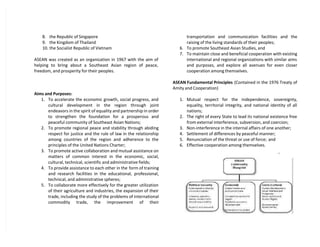
The Pillars of ASEAN Community
The ASEAN Heads of States indicate that the member states
acknowledge that an integrated , stable, knowledgeable and
caring community will help ASEAN nations to strengthen their
economic competitiveness and attractiveness to investors, in
particular, during economic downturn.
The integration is a tripartite course of action highlighting
economic progress, political security, and socio-cultural
community. This is known as the three pillars of the ASEAN
Community, namely:
1. ASEAN Economic Community (AEC)
2. ASEAN Political-Security Community (APSC)
3. ASEAN Socio-Cultural Community (ASCC)
The First Pillar: ASEAN Economic Community (AEC)
ASEAN Economic Community (AEC) is a blueprint, a vision towards
integrating the ASEAN resource markets. This AEC primarily
targets the creation of a single market and production base, which
allows the free flow of goods, services, investments, and skilled
labor, and the freer movement of capital across the region. This
means less restrictions and qualifications on imports and skilled
workers.
This global movement of capital and employment is expected to
intensify competition in both labor and product markets. Since
workers all over South East Asia can now be employed within the
region having less rules and regulations to comply with, our local
labor force ought to have more job opportunities but may likewise
face a much sterner competition.
For Reflection:
Implications for Education in the Philippines. . .
The Second Pillar: ASEAN Political-Security Community (APSC)
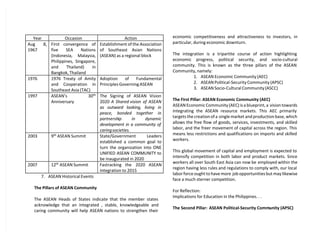
Year Occasion Action
Aug 8,
1967
First convergence of
five SEA Nations
(Indonesia, Malaysia,
Philippines, Singapore,
and Thailand) in
Bangkok, Thailand
Establishment of the Association
of Southeast Asian Nations
(ASEAN) as a regional block
1976 1976 Treaty of Amity
and Cooperation in
Southeast Asia (TAC)
Adoption of Fundamental
Principles Governing ASEAN
1997 ASEAN’s 30th
Anniversary
The Signing of ASEAN Vision
2020 A Shared vision of ASEAN
as outward looking, living in
peace, bonded together in
partnership in dynamic
development in a community of
caringsocieties.
2003 9th
ASEAN Summit State/Government Leaders
established a common goal to
turn the organization into ONE
UNIFIED ASEAN COMMUNITY to
be inaugurated in 2020
2007 12th
ASEAN Summit Fastracking the 2020 ASEAN
Integration to 2015
The ASEAN Political-Security Community (APSC) oversees that the
ASEAN community continues to live in peace, stability, resilience,
and in concord. Through the APSC, the member countries have
established a rule-based community of mutually shared norms
and values.
With APSC, all ASEAN member countries agree to rely exclusively
on scholarly and peaceful processes of settling intra-regional
conflicts about matters of security and cultural differences. APSC
has the following components:
1. Political development
2. Shaping and sharing of norms
3. Conflict prevention
4. Conflict resolution
5. Post-conflict peace building
6. Implementing mechanisms
The Third Pillar: ASEAN Socio-Cultural Community (ASCC)
The ASEAN Socio-Cultural Community (ASCC) aims to promote a
caring and sharing society which stems from the fact that all
actions undertaken by the ASEAN are to uplift the lives of its
people and make living in the region a more fulfilling experience.
ASCC seeks to provide fair access to opportunities without
prejudice to religion, race, gender, and cultural background. By
doing this, human potential can be maximized and nurtured to the
fullest through allowing all individuals to take part in a competitive
world that respects human welfare and dignity.
The ASCC is also concerned with virtues of social justice which is
upheld by addressing issues of poverty and equity while
simultaneously providing better opportunities to the vulnerable
groups including children and the elderly who are the most prone
to be victims of abuse and discrimination. They are to be provided
with special care and privileges.
Finally, the environment must be protected to ensure that our
natural resources are well managed to sustain development and
also to serve as our legacy for the future generations.
Information and Communication Technology
Information and Communication Technologies (ICT) in education
consists of the hardware, software, network media for the
collection, storage, processing, transmission, and presentation of
information (via text and images) as well as related services,
(World Bank).
ICT has become a personalized commodity, and the environment
we are operating is becoming more and more based on
information and communication technology. The
commercialization of the Internet through the World Wide Web
(www) service has the advantages of bringing ICT to the ordinary
people and to education. This affordability and availability has
triggered the new generation’s techno-economic innovations in
our society, (Castells, 1996).
ICT is a driving force in globalization. While ICT enables the
interconnectedness of peoples and societies and levels the playing
fields in access to information, it also highlights the division in the
world between haves and the have-nots,between the information
rich and the information poor. The digital divide is not only
dividing the people in terms of the availability of ICT but also in
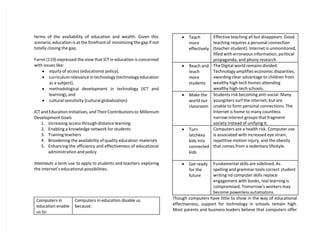
terms of the availability of education and wealth. Given this
scenario, education is at the forefront of minimizing the gap if not
totally closing the gap.
Farrel (119) expressed the view that ICT in education is concerned
with issues like:
 equity of access (educational policy),
 curriculum relevance in technology (technology education
as a subject),
 methodological development in technology (ICT and
learning), and
 cultural sensitivity (cultural globalization)
ICT and Education Initiatives, and Their Contributions to Millenium
Development Goals
1. increasing access through distance learning
2. Enabling a knowledge network for students
3. Training teachers
4. Broadening the availability of quality education materials
5. Enhancing the efficiency and effectiveness of educational
administration and policy
Internauts a term use to apply to students and teachers exploring
the internet’s educational possibilities.
Computers in
education enable
us to:
Computers in education disable us
because:
 Teach
more
effectively
Effective teaching all but disappears. Good
teaching requires a personal connection
(teacher-student). Internet is unmonitored,
filled with erroneous information, political
propaganda, and phony research
 Reach and
teach
more
students
The Digital world remains divided.
Technology amplifies economic disparities,
awarding clear advantage to children from
wealthy high tech homes attending
wealthy high-tech schools.
 Make the
world our
classroom
Students risk becoming anti-social. Many
youngsters surf the internet, but are
unable to form personal connections. The
Internet is home to many countless
narrow-interest groups that fragment
society instead of unifying it.
 Turn
latchkey
kids into
connected
kids
Computers are a health risk. Computer use
is associated with increased eye strain,
repetitive motion injury, and the obesity
that comes from a sedentary lifestyle.
 Get ready
for the
future
Fundamental skills are sidelined. As
spelling and grammar tools correct student
writing nd computer skills replace
engagement with books, real learning is
compromised. Tomorrow’s workers may
become powerless automatons.
Though computers have little to show in the way of educational
effectiveness, support for technology in schools remain high.
Most parents and business leaders believe that computers offer
essential workplace skills – an important, if not academic goal.
The public also believes that computers and Internet provide a
window on the latest information, and that somehow computers
make education more efficient and more enjoyable.
Lewis Perelman (in Vega, et al. 2015): There is a strong case of
education transformation. Knowledge acquisition is no longer
something that happens only in school. Now it occurs everywhere
and is lifelong. With the growth of hypermedia and networking,
learning can happen anytime, anywhere. Schools are no longer
needed and they are getting in the way of the truly necessary
changes.
We see a future where teachers and learners continue to embrace
and integrate educational technology and use it to improve
teaching and learning. The following are some of the possible
outcomes of the process of change:
 Multimedia learning resources available via information
networks will proliferate and become an essential feature
of education.
 Learners and teachers alike will have access to powerful
portable computing devices that will be wirelessly
connected to network resources.
 Learning will increasingly take place in authentic contexts
and focus on authentic tasks. Students will work on real
problems, finding their own answers. Technology will be
on tool in that process.
 Students will become active learners, collaborating with
one another and with more experienced members of
society, to seek out information and gain knowledge.
 Teachers’ roles will tend to shift from the sage on the stage
to the guide on the side. Instead of conveying information,
they will help learners make use of new information tools
to find, analyze, and synthesize information to solve
problems, to think creatively, and to construct their own
understanding.
 Education will become a lifelong process, important and
accessible to all, and schools will become centers of
learning – not just for children, but for all members of the
community.
 The artificial divisions of grade levels will disappear.
Education will increasingly focus on authentic
performance-based forms of assessment. Student will be
judged by their ability to find out and use information to
solve genuine problems,
 The boundaries separating schools from each other and
the community will blur or disappear. Using distance
learning technologies, including the Internet, students will
learn from teachers at other locations and collaborate with
students at other locations. Teachers will learn alongside
students. Students will learn from other students or from
other members of the community. Communities will
change as technology enables collaboration over
distances.
Gender and Development
Gender is one of the universal dimensions on which status
difference are based. The term gender is often mistakenly
interchanged with the term sex. Sex is a biological concept, while
gender is a social construct specifying the socially-culturally-
prescribed roles that men and women are to follow.
Gender shapes the lives of all people in all societies. It influences
all aspects of our lives, the schooling we receive, the social roles
we play, and the power and authority we command. Population
processes – where women and men live, how they bear and rear
children, and how they die – are shaped by gender as well, (Riley
in Vega, et al. 2015).
Theories of Gender Development
Social Learning Theory believes that parents, as distributors of
reinforcement, reinforce appropriate gender role behaviors. By
their choice of toys, by urging “boy” or “girl” behavior, and by
reinforcing such behavior, parents encourage their children to
engage in gender-appropriate behavior. If the parents have good
relationships with their children, they become models for their
children to imitate, encouraging them to acquire gender-related
behavior. Thus, children are reinforced or punished for different
kinds of behavior. They also learn appropriate gender behavior
from other male or female models.
Cognitive-Developmental Theory explains gender development
in conjunction with the cognitive development of children as
speculated by Lawrence Kohlberg based on the original theory of
Jean Piaget about how children develop their ability to think and
reason. Piaget theorized that from about two-seven years old
(corresponding to preschool years), children’s intelligence is
intuitive in nature. This is the Pre-OperationalStage. At this stage,
children can make mental representations and is able to pretend,
imagine, and ever closer to the use of symbols (language). A sub-
stage is called Symbolic Sub-stage where children show progress
in their cognitive abilities by being able to draw objects that are
not present because of the dramatic increase in their language
and make-believe play. This is also termed as symbolic function of
the child’s ability to represent objects and events through
symbols. Kohlberg used this description of children during this
stage as a background for the speculation on how gender or
understanding of his/her role in a social context is developed. For
Kohlberg, this is the beginning of the process of acquiring gender-
appropriate behavior.
Gender Schema Theory explains gender development based on a
schema. A schema, in general, is a mental blueprint for organizing
information. A gender schema is a blueprint for organizing
information about the different social roles men and women play,
and information about what society expects of men and women.
Such a schema helps a child to develop gender identity and
formulate an appropriate gender role. Consequently, children
develop an integrated schema or picture of what gender is and
should be, (Elliott et al., 1996 in Vega et al. 2015).
Gender Stereotyping
Gender roles are primarily socialized in the family and reinforced
by other social institutions. Gender stereotyping is defined as the
beliefs humans hold about the characteristics associated with
males and females. From an early age, people form ideas about
what and how males and females are or should be. Based on their
formed ideas about males and females, they assign labels, develop
attitudes, and expectations that could either be favorable or
unfavorable; facilitates or hinders the development of full human
potentials of any of the two categories. Problems occur when
beliefs, attitudes, and expectations associated with a particular
gender has a negative image; when an individual (based on
gender) is assumed to have all the characteristics associated with
his/her gender. For example: Girls are good in English. Boys are
good in Math. Girls are emotional and indecisive . Boys don’t cry,
they are brave, strong, and can be depended on. Schools may also
be responsible in promoting gender stereotyping when they treat
boys and girls differently.
Attitude towards men’s and women’s role is referred to as gender
ideologies.
3 gender ideologies
1. A traditional gender ideology maintains that men’s sphere
is work and women’s sphere is the home. The implicit
assumption is that men have greater power then women.
2. Egalitarian gender ideology maintains that power is
distributed equally between men and women and that
each group identifies equally with the same spheres.
3. Transitional gender ideology believes that it is acceptable
for women to devote energy both to work and family
domains, but they should hold proportionally more
responsibility for the home and men should focus their
energy more proportionally on work.
Gender and Equality
Gender equality gives women and men the same entitlements to
all aspects of human development – economic, social, cultural,
civil and political rights. It also gives the same level of respect, the
same opportunities to make choices and the same level of power
to shape the outcomes of their choices.
Research from around the world has shown that gender inequality
tends to slow down economic growth and make the rise from
poverty more difficult. To understand the link between gender
inequality and difficulty to rise from poverty, we have the
following:
 Half of the world’s population is female
 Research show that women and girls tend to work
harder than men
 Women are more likely to invest their earnings in
their children
 Women are major consumers as well as consumers
 Women shoulder critical, life-sustaining
responsibilities without which men and boys could
not survive, much less enjoy high levels of
productivity
Given the data, women empowerment is particularly important
for determining a country’s demographic trends which affect its
economic success and environmental sustainability,
(worldbank.org/gender).
Throughout the world, women play a critical role in the national
economic growth and development. Their contributions have a
lasting impact on households and communities, and it is the
women who most directly influence family nutrition and the
health and education of their children. Giving women equal rights
and opportunities can only serve to enhance this contribution and
bring us closer to the goal of eliminating poverty, hunger, and
disease.
Reducing gender inequality in the labor market will increase
women’s economic security and contribute to economic growth
and development. Ensuring women’s equal right to property and
access to resources is fundamental to the fight against poverty.
The full participation of women at all levels of decision-making is
a basic human right, one that is critical to peace and development.
Points for Reflection:
1. Gender is the costume, a mask, a straitjacket in
which men and women dance their unequal dance,
(Lerner, G. in the Creation of Patriarchy).
2. Of all the ways that one group has systematically
mistreated one another, none is more deeply
rooted than the way men have subordinated
women. All other subordination pale by contrast,
(Wolfe A. in The Gender Question).
3. What are the implications of gender inequality?
4. The role of schools in promoting gender equality.
For Research:
1. Peace Education: A Transformative Response to Major
Societal Changes
2. The Need for Education for Sustainable Development
The Teacher in the 21st
Century Society
The buzzword in education is lifelong learning. The term evolved
from a human society that is becoming even more complex
characterized by technological innovations, free movement of
people, goods, and services, and an information-driven-society. It
assumes that with the right knowledge, skills and attitudes, one
will successfully adapt to such an environment without being
dependent on formal schools and teachers. Lifelong learning is a
continuous process by which one equips oneself to seize learning
opportunities throughout life, and through which s/he broadens
his/her knowledge, skills and attitudes, and enables him/her
adapt to a changing, complex, interdependent world, (Learning
the Treasure Within, International Commission on Education.
UNESCO, 1996 in Vega, et al., 2015).
The International Commission on Education envisions education
in the 21st
Century as anchored on the Four Pillars:
1. Learning to Know
2. Learning to Do
3. Learning to Live Together
4. Learning to Be
Learning to know implies learning how to learn by developing
one’s concentration, memory skills and ability to think. It includes
the development of the faculties of
1. Memory
2. Imagination
3. Reasoning
4. Problem solving
5. Ability to think in a coherent and critical
way.
When individuals know how to learn on their own, it is assumed
that they will develop knowledge and skills needed to function
productively in the 21st
Century. Learning how to learn
presupposes the following learn-to-learn skills:
1. Learning to read with comprehension
2. Listening
3. Observing
4. Asking questions
5. Data gathering
6. Note-taking
7. Accessing, processing, and selecting
information
The focus on students’ ability to learn how to learn has shifted the
role of teachers from provider of knowledge and information to
being a facilitator by which students are able to learn on their own
because the teacher has successfully empowered students with
the necessary skills. We may use here the analogy of a beggar
asking for food. If you give the beggar a fish, you only feed
him/her for a day. But if you teach him/her how to fish, you feed
him/her for a lifetime. That is exactly the role of a teacher in the
21st
century – teaching students how to learn. If teachers are able
to do that, then they are able to teach them for a lifetime. To be
able to do that, teachers must facilitate the development of:
1. Values and skills for searching for
knowledge and wisdom
2. Learn how to learn
3. A taste for learning throughout life
4. Critical thinking
5. Tools and processes for understanding
6. Intellectual curiosity
With those acquired skills, learners are expected to be
transformed which means that they become more enlightened,
more empowered, and more enriched. They in turn will be able
to transform their own family and the society in general.
Learning is not simply the acquisition of things learners need to
know but more importantly is that they are able to do something
useful with what they know. Here comes the second pillar of
education which is Learning to Do. It implies the application of
what learners have learned or known into practice. This is closely
related to technical-vocational education and work skills training.
It emphasizes how one’s knowledge acquired in school can be
applied and practiced in the world of work. Zhou (2006 in Vega,
et al. 2015) points out that learning to do involve the acquisition
of skills that enables individuals to effectively participate in the
global economy and society.
This pillar also includes the development of competence, life skills,
personal qualities, aptitudes and attitudes. Learning to do can no
longer have the simple meaning of preparing someone for a
clearly defined task and can no longer be regarded as simple
transmission of a more or less routine practice. The pillar brings
to the fore the need for personal competence which employers
seek in their applicants. Personal competence may mean a mix of
skills in an individual, a social behavior which enables an individual
to work together in teams, ability to collaborate and readiness to
take risks.
Focus of Education in relation to Learning to Do is the launching of
learners into a lifelong continuum of knowledge, values, attitudes,
competencies and skills; and the development of new knowledge
and skills that are required by the changing work environment.
The need for the development of new knowledge and skills is an
offshoot of the increasing globalization and free trade which
resulted to new economic pressures for business organizations
and individuals to upgrade their knowledge and skills to maintain
their competitive edge or at least be at par with their competitors.
Given the nature of a competitive world, individuals need to
remain competitive in terms of their knowledge and skills. This
raises the obvious concern of equitable access to learning
opportunities and meaningful work for all to maintain and
advance human dignity and worth. Technical-vocational
education must not only focus on the development of new
knowledge and skills but also on the need for values in education
and training associated with life skills; the development of one’s
ability to manage his/her life and time effectively; capacity for
teamwork; responsible corporate and global citizenship and
democracy.
In summary, learning to do involves putting innovatively what one
knows into practice through:
1. Skills development
2. Practical know-how
3. Development of competence
4. Life skills
5. Personal qualities
6. Aptitudes
7. Attitudes
It is only within the context of peace that one will be able to put
into practice what one is able to know. It is only within the context
of a peaceful society that one will become productive in all
spheres of his/her life. Thus the pillar of Learning to Live Together
is the next anchor or education in the 21st
Century. Learning to
live together involves the development of social skills and values,
such as respect and concern for others, social and interpersonal
skills and the appreciation of diversity among people.
It is a dynamic, holistic and lifelong process through which mutual
respect, understanding, caring and sharing, compassion, social
responsibility, solidarity, acceptance and tolerance of diversity
among individuals and groups (ethnic, social, cultural, religious,
national and regional groups) are internalized and practiced
together to solve problems and to work towards a just and free
peaceful and democratic society.
It involves developing, broadening or changing perceptions and
attitudes toward ourselves and others, and consequently the way
we behave in our daily encounters and interactions with others.
Connected with the Learning to Do, it demonstrates that in order
to learn to live and work together productively and harmoniously,
we must first find peace within ourselves, expand our acceptance
and understanding of others, and continually strives towards living
the values which enables us to contribute more fully to the
development of a peaceful and just society.
The Role of the Teacher in relation to Learning to Live Together
1. Helps the students to develop an understanding of other people
and appreciation of interdependence;
2. Helps students realize the value of being able to live together
with others;
3. Provides a safe and accepting learning environment;
4. Helps students develop life and career skills, social and cross-
cultural skills, flexibility, and adaptability;
5. Helps students develop self-awareness, self-esteem, empathy,
respect for others, active citizenship, local and global identity,
and appreciation of diversity.
The fourth pillar of education is geared towards the
development of the whole person, an integrated, holistic
individual, the Learning to Be. That is the dominant theme of
Edgar Faure’s Report: Learning to Be: The World of Education
Today and Tomorrow published by UNESCO. The pillar aims to the
development of all the dimensions of the complete person or the
integration of the physical, intellectual, emotional, and ethical
dimensions into a complete human being. This is one of the
fundamental principles of the International Commission on
Education for the 21st
Century which states that:
Education must contribute to the all-
around development of each individual –
mind and body, intelligence, sensitivity,
aesthetic sense, personal responsibility,
and spiritual values. It describes Learning
to Be as the complete fulfillment of
man/woman in all the richness of his/her
personality, the complexity of his/her
forms of expression and his/her various
commitment – as individual member of a
family and of a community, citizen and
producer, inventor of techniques and
creative dreamer, (in Vega et al. p. 21).
The Commission further defines Learning to Be as a dialectical
process, which starts with knowing oneself and then opens
relationships with others. In that sense, education is above all an
inner journey whose stages correspond to those of the continuous
maturing personality. It is thus a very individualized process and
a process of constructing social interaction. That definition is
anchored on a Humanistic Philosophy of Education whose aim is
the overall development of the human person as an individual and
as a member of society. It takes into account all the powers,
faculties and innate potentials within the human person,
respecting the dignity and worth of each individual. It underscores
the humanistic dimensions in education, highlighting the role of
values and attitudes towards a holistic and integrated approach to
education.
Faure’s Report refers to the individual as unfinished, divided, and
incomplete. Education must therefore be directed towards the
development of the complete man. The physical, intellectual,
emotional, and ethical integration of the individual into a
complete man is a broad definition of the fundamental aim of
education. The humanistic aim of education towards the
development of the complete man is reflected in Paulo Freire’s
view that man’s ultimate vocation and destiny is man’s
humanization which can be accomplished through
conscientization. Conscientization is the process of becoming
aware of the contradictions existing within oneself and in society
and of gradually being able to bring about personal and social
transformation. The process of conscientization begins when the
individual becomes fully conscious of his own creative potential
and aims at becoming fully human.
Universal Aim of Education (Faure Report)
1. Towards a scientific humanism based on scientific and
technological training. Command of specific thought and
language has become indispensable in today’s world.
Objective knowledge must be directed towards action and
primarily in the service of humankind. Science becomes a
science with a conscience, and science at the service of
development. Citizens of the new millennium must learn to
become scientific humanists.
2. Creativity means preserving each individual’s originality and
creative ingenuity along with realism. Creativity means
transmitting culture without stifling the individual. It is about
encouraging the use of one’s gifts, aptitude and personal
forms of expression without cultivating egoism and paying
attention to individual’s specific traits without overlooking
collective activity and welfare. This is possible when there is
respect for the creativity of others and other cultures or
creative diversity.
3. SocialCommitment consists of preparing the individual for life
in society, moving him/her into a coherent moral, intellectual
and affective universe composed of sets of values,
interpretations of the past and conceptions of the future. An
individual comes into full realization of his/her own social
dimension through active participation in the functioning of
social structures and a personal commitment to reform when
necessary. In essence, that is the practice in a democratic
society.
4. CompeleteMan respects the many sidedness of personality as
essential in education if the individual is to develop for
himself/herself as well as for others. It calls for balance
among the physical, intellectual, ethical, emotional and
spiritual components of personality.
Learning to Be operates on the fundamental principle that
education must contribute to the total development of the whole
person – body and soul, mind and spirit, intelligence and emotion,
creativity and sensitivity, personal autonomy and responsibility,
social conscience and commitment, human, ethical, cultural and
spiritual values. A definition and explanation of these
fundamental and dominant values serve as basic guidelines for a
holistic approach to learning, utilizing a valuing process which
takes into consideration the cognitive, affective and behavioral
powers of the learner.
Related Social-Philosophical Views
Pragmatism is a world philosophy which is based on change,
process, and relativity. It conceived of knowledge as a process in
which reality is constantly changing. It assumes that learning
occurs as the person engages in problem-solving which is
transferable to a wide variety of subjects and situations. Both the
learners and the environment are constantly changing.
Pragmatists reject the idea of unchanging universal truths. Truth
is relative and knowledge must be the result of testing and
verification. To them, teaching should focus on critical thinking,
teaching is exploratory rather than explanatory and method is
more important than subject matter
.
Progressivism is an educational philosophy whose main
philosophical base is found in Pragmatism. For Progressivism, the
aim of education is to promote democratic social living. It believes
that knowledge must lead to growth and development; it is a
living-learning process. Knowledge must focus on active and
relevant learning. The role of the teacher is guide for problem-
solving and scientific inquiry. Its curriculum is based on students’
interests; addresses human problems and affairs; interdisciplinary
subject matter; and on activities and projects.
John Dewey, the great educational pragmatist and a major
proponent of progressivism, viewed education as a process for
improving human condition. He saw schools as specialized
environments within the larger social environment. Curriculum is
based on a child’s experiences and interests and prepared the
child for life’s affairs. Subject matter was inter-disciplinary.
Dewey emphasized problem-solving and scientific method.
Social Reconstructionism’s aim is to improve and reconstruct
society. Education is for change and social reforms. Knowledge
focus on skills and subjects needed to identify and ameliorate
society’s problems. It requires active learning that is concerned
with contemporary and future society. The role of the teacher is
to serve as an agent of change and reform. Teachers help students
become aware of problems confronting humankind. The
curriculum is focused on social sciences and social research
methods, the examination of social-economic and political
problems.
Paolo Freire’s Philosophy. The Pedagogy of the Oppressed.
Believed that education should enlighten the masses about their
oppression, prompt them to feel dissatisfied with their condition
and give them the competencies necessary for correcting the
identified inequities. For Freire (in Maningas, 2016), education is
a tool by which people could learn more about their capacity as
human beings – to enhance the knowledge that they already have,
(p.218).
Jurgen Habermas’ Philosophy. Emphasizes that education’s goal is
emancipation of the awareness, competencies, and attitudes that
people need to take control of their lives. In this view educated
people do not follow social conventions without reflection.
Theodore Brameld argued that social reconstructionists were
committed to facilitating the emergence of a new culture;
believed that schools should help students develop into social
beings dedicated to the common good.
George Counts believed that society must be totally reorganized
to promote the common good.
Harold Rugg believed that schools should engage children in
critical analysis of society in order to improve it.
Alvin Toffler (1970, in Llagas, Corpuz, & Bilbao, 2016, p.1)
predicted in his book Future Shock that the prime objective of
education must be to increase the individuals’ cope-ability – the
speed and economy with which individuals can adapt to continual
change. In 1980, he surmised in the Third Wave that the electronic
cottage will become the norm of the future…there will be a
transformation of our technological system and our energy base
into a new techno sphere.
In the 21st
Century, the most basic of all raw materials will be
knowledge and that education will require a proliferation of new
channels and an emerging connection between education and
global competitiveness. There will be a universalization of access
to computer, information technology, and advanced media,
(Toffler, in Llagas, et.al., 2016, p.1).
John Naisbitt
The trends shaping the 80’s are shifts from industrial to
information society, from national economy to world economy,
from hierarchies to networking, and from centralization to
decentralization. In Megatrends 2000, Naisbitt described the year
as “…operating like a powerful magnet on humanity, reaching
down into the 1990’s and intensifying the decade. It is simplifying
emotions, accelerating change, heightening awareness and
compelling us to reexamine ourselves, our values, and our
institutions.
Llagas, A., Corpuz, B. & Bilbao, P. (2016). Becoming 21st
Century Educational
Leader. Q.C.: Lorimar Publishing, Inc.
Seifert, E.H. and Vornberg, J.A. (2002). The new school leader for the 21st
century: The principal.
Lanham: The Scrarecrow Press, Inc.
CHAPTER II
School as a Social Institution and as an Organization
School as a Social Institution
The basic purpose of education is the transmission of knowledge.
While before, education was a family responsibility, along with the
community and the church, industrialization changed it
dramatically. Schools became necessary when cultural complexity
created a need for specialized knowledge and skills which could
not be easily acquired in the family, community and church. The
complexity of the modern life has not diminished the function of
the family, but it has added the need for many types of instruction
which require specialized educational agencies like the school,
college or university.
Functions of Schools
Schools is first and foremost a social institution, an established
organization having an identifiable structure and a set of functions
meant to preserve and extend social order, (McNergney & Hebert
In Vega, et al. 2015, p.87). Its primary function is to move young
people in the mainstream of society. The curricula, teaching
process of evaluation and relationships among people reinforce a
public image to which young people are expected to aspire. It is
concerned with preserving our heritage, adapting to social change
and making change happen where it is needed.
The school is a place for contemplation of reality, and out task as
teachers is to show this reality to students. At home, the family
teaches children this reality in personal, informal, and
unstructured way. In school, we teach reality in professional,
formal and structured way. Hence in school there is a set of
curriculum which includes knowledge subjects, skills subjects, and
enabling subjects. There are also teachers who facilitate learning,
who teach children and youth certain types of acceptable
behavior, and see to it that children develop in all aspects –
physically, emotionally, socially, and academically.
The Intellectual Purposes of Schooling:
 To teach basic cognitive skills such as reading, writing, and
mathematics
 To transmit specific knowledge (in literature, history and
the sciences)
 To help students acquire higher order thinking skills such
as analysis, evaluation, and synthesis
The Political Purposes of Schooling:
 To inculcate allegiance to the existing political order
(patriotism)
 To prepare citizens who will participate in the political
order
 To help assimilate diverse cultural groups into a common
political order
 To teach children the basic laws of society
The Social Purposes of Schooling:
 To socialize children into various roles, behaviors, and
values of society (socialization); a key ingredient in the
stability of society; enables members to help solve social
problems
o By participating in the socialization of children,
schools work along with other social institutions
such as the family and the church to ensure social
cohesion
The Economic Purposes of Schooling:
 To prepare students for their later occupational roles
 To select, train and allocate individuals into the division of
labor
The Multiple School Functions (Yin Cheong Cheng In Vega, et al.
2015, p.88)
1. Technical/Economic
2. Human/Social
3. Political
4. Cultural
5. Educational
Technical/EconomicFunctions. They refer to the contributions of
schools to the technical or economic development and needs of
individuals, the institution, the local community, the society and
the international community.
 At the individual level, schools can help students acquire
knowledge and skills necessary to survival and to compete
in a modern society or a competitive economy and provide
job training and opportunity.
 At the institutional level, schools are service organizations
providing quality service. They serve as life place or work
place of society for clients, employers, and all those
concerned.
 At the community and society levels, schools serve the
economic or instrumental needs of the local community,
supply quality labor forces to the economic system, modify
or shape economic behaviors of students (future
customers and citizens), contribute to the development
and stability of the manpower structure of the economy.
 At the international level, school education supplies the
high quality forces necessary in international
competitions, economic cooperation, earth protection,
and technology and information exchange.
Human/Social Functions. They refer to the contributions of
schools to human development and social relationships at
different levels of society.
 At the individual level, schools help individuals develop
themselves, psychologically, socially, and physically, and
help them develop their potential as fully as possible.
 At the institutional level, a school is a social entity or social
system composed of different social relationships. The
quality of social climate and relationships in it often
determines the quality of work life and learning life for
teachers and students. Therefore, one of the important
functions is to provide environment of quality.
 At the community and society levels. According to
Functionalism, schools serve the social needs or functions
of the local community, support social integration of
multiple and diverse constituencies of society, facilitate
the social mobility within the existing social class structure,
reinforce social equality for all people of different
backgrounds, select and allocate competent people to
appropriate roles and positions, and contribute to social
change and development in the long run.
o From the Conflict perspective, it is possible that
schools reproduce the existing social class
structure and perpetuate social inequality
o Due to growing global consciousness, schools are
expected to play an important role in preparing
students for international harmony, social
cooperation, global human relationship, and
elimination of national, regional, racial, and gender
biases at the international level.
PoliticalFunctions. They refer to the contribution of schools to the
political development at different levels of society.
 At the individual level, schools help students to develop
positive civic attitudes and skills to exercise the rights and
responsibilities of citizenship.
 At the community and society levels, schools serve the
political needs of the local community, maintain the
stability of the political structure, promote awareness and
movement of democracy, and facilitate the planned
political development and changes.
 At the international level, schools act as a place for
systematically socializing students into a set of political
norms, values, and beliefs, or for critically discussing and
reflecting on the existing political events. Schools often
become a political coalition of teachers, parents, and
students that can contribute to the stability of the political
power structure.
o The growing awareness of international
dependence reinforces the needs for the
contribution of school education to international
understanding, global common interest,
international coalitions, peace movements against
war, and eliminations of conflicts between regions
and nations.
Cultural Functions. They refer to the contributions of schools to
the cultural transmission and development at different levels of
society.
 At the individual level, schools help students to develop
their creativity and aesthetic awareness and to be
socialized with the successful norms, values, and beliefs of
society.
 At the institutional level, schools act as a place for
systematic cultural transmission to and reproduction of
the next generation, cultural integration among the
multiple and diverse constituencies, and cultural
revitalization of the outdated poor traditions.
 At the community and society levels, schools serve as a
cultural unit carrying the explicit norms and expectations
of the local community, transmit all the important values
and artifacts of society to students, integrate the diverse
subcultures from different backgrounds, and revitalize the
strengths of the existing culture such that the society can
reduce internal conflicts and wastage, an build up a
unifying force for the nation.
 At the international level, schools can encourage
appreciation of cultural diversity, and acceptance of
different norms, traditions, values, and beliefs in different
countries and regions, and finally contribute to the
development of global culture through integration of
different cultures.
Education functions. They refer to the contributions of schools to
the development and maintenance of education at different levels
of society.
 At the individual level, it is important for schools to help
students to learn how to learn and help teacher to learn
how to teach. Facilitating teachers’ professional
development is one of the key functions of education at
this level.
 At the institutional level, schools serve as a systematic
place for systematic learning, teaching and disseminating
knowledge, and as a center for systematically
experimenting and implementing educational changes and
development.
 At the community and society levels, schools provide
service for different educational needs of the local
community, facilitate development of education
professions and education structures, disseminate
knowledge and information to the next generation, and
contribute to the formation of a learning society.
 At the international level, schools help promote mutual
understanding among nations and build up a global family
for the younger generation. Schools can contribute to the
development of global education and international
education exchange and cooperation.
The Manifest and Latent Functions of Education
Manifest functions of education are the open and intended goals
or consequences of activities within an organization or institution.
The latent functions are the hidden, unstated, and sometimes
unintended consequences of activities within schools.
The Manifest Functions:
1. Social Control. Schools are responsible for teaching values
such as discipline, respect, obedience, punctuality, and
perseverance. Schools teach conformity by encouraging
young people to be good students, conscientious future
workers and law-abiding citizens.
2. Socialization. From kindergarten through college, schools
teach students their various roles in their family, school,
and society in general. Students are also taught specific
subject matters.
3. Social Placement. Schools are responsible for identifying
the most qualified people to fill available positions in
society.
4. Transmitting Culture. As a social institution, schools
perform a conservative function of transmitting the
dominant culture. Young people are exposed to the
existing beliefs, norms and values of the society.
5. Promoting Social and Political Integration.
6. Agent of Change
The Latent Functions:
1. Restricting some activities
2. Matchmaking and production of social networks
3. Creation of generation gap
Functions of Schools by Calderon (1998 in Vega, et al. 2015)
1. Conservation Function. The school conserves and
preserves through its libraries and other devices recorded
experiences of the past generations such as knowledge,
inventions, mathematics-scientific-historical facts, skills,
customs, traditions, language, literature, music, writings
and the arts. All these are preserved for future
generations.
2. Instructional Functions. The main concern of the school is
to pass on the accumulated experiences of the past
generations to the incoming generations. This is
performed by teachers, mentors, instructors, or
professors. Some call such instruction as enculturation,
when things of the local culture are taught to the students.
In the performance of this function, school is expected to
produce leaders in all fields of endeavor- politics,
education, trade, science, medicine, etc.
3. Research Function. The school conducts research to
improve the old ways of doing things or to discover
unknown facts or systems that will improve the quality of
human life.
4. Social Service Function. One justification for the existence
of schools is for them to perform social service in the
locality where they are located. This can be done through
various forms of community service depending on the
need of the community and the available expertise of the
school.
School as an Organization
Organization is a collection of people who work together to attain
specified objectives. There are two types:
1. Formal organization. It is formal when two or more
persons come together to accomplish a common
objective, and they follow a formal relationship. They are
governed by established rules and policies for compliance
and there exists a system of authority. The formation of
such an organization is deliberate by the top level
management. The basic objective of the establishment of
an organization is the attainment of the organization’s
goal. For this purpose, work is assigned, and authorities are
delegated to each member. The concept of division of
labor and specialization of workers are applied. The work
is assigned on the basis of their capabilities. The job of each
member is fixed. Roles, responsibilities, authority and
accountability associated with the job are clearly defined.
The hierarchical structure determines the logical authority
relationship and follows a chain of command. The
communication between two members is only through
planned channels.
2. Informal organization. It is formed within the formal
organization and is a system of interpersonal relationship
between individuals. It is created spontaneously out of
socio-psychological needs and urge of people to talk.
Informal organization is characterized by mutual aid and
cooperation, and companionship between and among
members. Informal organization may also be formed
outside the formal organization through social media
networks like Facebook, Viber, WhatsApp and others.
In an informal organization, there are no defined channels of
communication and so members can interact with other
members freely. They work together in their individual
capacities and in their formal or professional capacities. There
are no defined set of rules and regulations that govern the
relationship of members. Instead, it is a set of social norms,
connections, and interactions.
Forces affecting the nature of organization
1. People
 People make up the internal social system of the organization.
The system consists of individuals and groups (large groups,
small groups, formal, informal). Groups are dynamic, they
form, change and disband.
2. Structure
 Defines the formal relationship and use of people in
organizations creating complex problems of cooperation,
negotiation, and decision-making.
3. Technology
 Provides the resources with which people work and affect the
tasks they perform.
4. Environment
 All organizations operate within an internal and external
environment. An organization does not exist alone. It is part of
a larger system that contains many other elements or social
institutions.
Characteristics of People that can affect how people behave at
work:
1. Individual Difference or the belief that each person is
different from all others. The headings under which
personal characteristics can vary have been classified as
follows:
a. Competencies or abilities and skills
b. Constructs or the conceptual framework which
governs how people perceive their environment
c. Expectations or what people have learned to
expect about their own and others’ behavior
d. Values or what people believe to be important
e. Self-Regulatory Plans or the goals people set for
themselves and the plans they make to achieve
those goals.
Individual differences interact with Environmental or
situational variables include the type of work individuals carry out,
the culture, climate and management style in the organization,
the social group within which individuals work, and the reference
groups that individuals use for comparative purposes.
Ability is the quality that makes an action possible. Overriding all
abilities is the general intelligence factor which accounts for most
variations in performance.
Intelligence or the capacity to solve problems, apply principles,
make inferences and perceive relationships.
 The capacity for abstract thinking and reasoning
with a range of different contents and media
 The capacity to process information
 Related to specific aspects of reasoning, inference,
cognition (knowing, conceiving) and perception
(understanding, recognition)
Personality is the relatively stable and enduring aspects of
individuals that distinguish them from other people. It is all-
embracing in terms of the individual’s behavior and the way it is
organized and coordinated when s/he interacts with the
environment.
Influence of Background. Individual differences may be a function
of people’s background which will include the environment and
culture in which they have been brought up and now exist.
Levinson (1978) suggested that “individual life structure” is
shaped by 3 types of external events:
1. Socio-cultural environment
2. Roles that they play and the relationships they have
3. Opportunities and constraints that enable or inhibit them
to express and develop their personality
Attitude is a settled mode of thinking. It is evaluative in nature for
it contains an assessment of whether the object to which it refers
is liked or disliked. Within organizations, attitudes are affected by:
 cultural factors like values and norms
 the behavior of management (management style)
 policies such as those concerned with pay, recognition,
promotion, and the quality of working life and the
influence of reference group (group with whom people
identify)
Behavior at work is dependent on both the personal
characteristics of individuals (personality and attitudes) and the
situation in which they are working. These factors interact.
Behavior will be influenced by the perceptions of individuals about
the situation they are in. The psychological climate or individuals’
perception of the situation gives it psychological significance and
meaning. The key environmental variables are:
 role characteristics such as role ambiguity and conflict
 job characteristics such as autonomy and challenge
 leader behaviors including goal emphasis and work
facilitation
 work group characteristics including cooperation and
friendliness
 organizational policies that directly affect individuals such
as reward system
A general understanding about the nature of people or the 6
basic concepts with which we need to view people:
1. Individual differences
2. Perception. People look at the world and see things
differently. It is the unique way in which each person sees,
organizes and interprets things based on their
personalities, needs, demographic factors, and past
experiences. People tend to act on the basis of their
perception. They may have selective perception causing
misunderstanding, problems, and conflicts in
organizations.
3. A Whole Person. Organizations employ not just the brain of
the person or his skills but the whole person. Skills do not
exist apart from background and knowledge, homelife is
not totally separable from worklife, emotional conditions
are not separate from physical conditions.
4. Motivated Behavior. Human behavior is always driven,
triggered, or energized by their needs, desires, or wants
whether or not they are conscious or unconscious of them.
5. Desire for Involvement. People are actively seeking
opportunities at work to become involved in relevant
decisions, contributing to the organization’s success, thus
the need to involve them, to empower them.
6. Value of the Person. Employees’ value and dignity as
human beings dictate that they be treated differently from
other factors (within the context of schools, teachers and
students must be treated differently from factors like
technology, financial resources, school building, class
schedule, academic and teaching tasks)
The Nature of Organizations
Organizations are social systems whose behaviors are governed
by social laws and psychological laws. People in the organizations
have psychological needs that need to be fulfilled, and they also
have social roles that they need to fulfill as well as status that they
need to maintain or improve. As social system, organizations are
dynamic.
Organizations and individuals have mutual interests ,
organizations need people and people need organizations.
Organization are formed and maintained based on mutuality of
interest which provides super-ordinate goals that can only be
attained through the integrated efforts of individuals.
In order to attract and retain valuable employees, ethical
treatment is necessary. When the organization’s goals and
actions are ethical, mutuality creates a triple reward system –
individual objectives, organizational objectives, and social
objectives).
How Organizations Function?
The two factors that determine how an organization functions in
relation to its internal and external environment are its structure
and processes that operate within it. Organizations are also
affected by the culture they develop, the values and norms that
affect behavior.
Organization Structure
Organization structure consists of all the tangible and regularly
occurring features which help to shape its members’ behavior.
Structures incorporate a network of roles and relationships and
are there to help in the process of ensuring that collective effort is
explicitly organized to achieve specified ends.
The organization structure identifies and ensures the division of
the overall management task into a variety of activities. It
allocates these activities to the different parts of the organization
and establishes means of controlling, coordinating, and
integrating them. The structure consists of units, divisions, and
departments. It indicates who is responsible for what at each level
of the organization. Organization structure is usually described in
the form of Organization Chart.
Organizational Processes
The structure of the organization as described in an organizational
chart does not give any real indication of how it functions. To
understand this, it is necessary to consider the various processes
that take place within the structural framework, namely:
1. Group behavior
2. Teamwork
3. Leadership
4. Power
5. Politics
6. Conflict
7. Interaction and networking
8. Communication
Group Behavior. Organizations consist of groups of people
working together. Interactions take place within and between
groups and the degree to which these processes are formalized
variy according to the organizational context.
 Formal groups
 Informal groups
 Channels of communication
o Wheel Network. This is the most centralized form of
communication network wherein all the information
flows from one central person, typically the leader. The
other members have little or no communication link
with each other. The leader deliberately controls the
line of communications and make sure that the
information reaches all in the group.
o Chain Network. Under the chain pattern, the
information flows either up or down the line. Each
person gets the information from his immediate
superior and then passes it to their immediate
subordinates. Likewise, the chain gets created, and all
members get connected to a single person, typically
the leader. This network is suitable when the
information to be passed is legally correct.
o Circle Network. The network is one of the
decentralized forms of communication network
wherein the information is shared equally among all
members. Each person gives and receives information
from two or more persons in the network. Under this
pattern, each member has the equal chance to
participate.
o Free Flow Network. Under this pattern, everyone is
connected to each other, and the information can flow
freely from anywhere in the organization. It is the most
decentralized form of formal communication. The
distinct feature of this communication pattern is that
all persons in the group are linked to each other and
can freely communicate with anyone they want.
o Inverted ‘V’ Communication. In this network the
subordinate is allowed to communicate with his/her
immediate superior as well as with the superior’s
superior. However, the communication between the
subordinate and the superior’s superior is limited.
Task and Maintenance Functions. The following
functions need to be carried out in groups:
o Task – initiating, information-seeking, diagnosing,
opinion-seeking, evaluating, decision-making
o Maintenance – encouraging, compromising, peace-
keeping, clarifying, summarizing, standard-setting
It is the job of the group leader to ensure that these functions
operate effectively. Leaderless groups can work, but only in
special circumstances. A leader is essential. The style adopted by
the leader affects the way the group operates. If the leader is
respected, this will increase group cohesiveness and its ability to
get things done. An inappropriately authoritarian style creates
tension and resentment. An over-permissive style means that
respect for the leader diminishes and the group does not function
so effectively.
 Group Ideology. In the course of interacting and carrying out
task and maintenance functions, the group develops an ideology
which affects the attitudes and actions of its members and the
degree of satisfaction which they feel.
 Group Cohesion. If the group ideology is strong and individual
members identify closely with the group, it will become
increasingly cohesive. Group norms or implicit rules will evolve
which define what is acceptable behavior and which is not.
o Cohesive group of individuals, sharing common fate, exerts a
strong pressure towards conformity. It may lead to group think
which describes the exaggeration of irrational tendencies that
appears to occur in groups and that a group setting can
magnify the weakness of judgment.
 Reference Group. It consists of the group of people with
whom the individual identifies. This means that the group’s norms
are accepted and if in doubt about what to say or do, references
are made to these norms or to other group members before action
is taken. Most people in organization belong to a reference group
and this can significantly affect the ways in which they behave.
The reference group will also affect individual behavior. This may
be through overt pressure to conform or by more subtle processes.
Acceptance of group norms commonly goes through 2 stages: (1)
compliance, and (2) internalization. Pressure on members to
conform can cause problems when,
 There is incompatibility between a member’s
personal goal and those of the group
 There is no sense of pride from being a member of
the group
 The member is not fully integrated with the group
 The price of conformity is too high
Group Development. 4 stages of group development
I. Forming. Starts when there is anxiety, dependence on the
leader and feeling to find out the nature of the situation
and the task, and what is acceptable behavior.
II. Storming, where there is conflict, emotional resistance to
the demands of the task, resistance to control and even
rebellion against the leader.
III. Norming, when group cohesion is developed, norms
emerge, views are exchanged openly, mutual support and
cooperation increase and the group acquires a sense of
identity.
IV. Performing, when interpersonal problems are resolved,
roles are flexible and functional, there are constructive
attempts to complete tasks and energy is available for
effective work.
Identification. Individuals will identify with their groups if they
like other members, approve of the purpose and work of the
group and wish to be associated with the standing of the group
in the organization. Identification will be more complex if the
standing of the group is good.
Teamwork
Team
A team is a small number of people with complementary skills who
are committed to a common purpose, performance goals, and
approach for which they hold themselves mutually accountable.
Characteristics of effective teams:
1. Teams are the basic units of performance for the
organizations. They join together the skills, experiences,
and insights of several people.
2. Teamwork applies to the whole organization as well as
specific teams. It represents a set of values that encourage
behaviors such as listening and responding cooperatively
to points of views expressed by others, giving others the
benefit of the doubt, providing support to those who need
it and recognizing the interest and achievement of others.
3. Teams are created and energized by significant
performance challenges.
4. Teams outperform individuals acting alone in large
organizational groupings especially when performance
requires multiple skills, judgments and experiences.
5. Teams are flexible and responsive to changing events and
demands. They can adjust their approach to new
information and challenges with greater speed, accuracy
and effectiveness.
6. High performances teams invest much time and effort
exploring, shaping and agreeing on purpose that belongs
to them, both collectively and individually. They are
characterized by a deep sense of commitment to their
growth and success.
Dysfunctional Teams
1. The atmosphere can be strained and formalized.
2. Either there is too much discussion that gets nowhere or
discussion is inhibited by dominant members of the team.
3. Team members do not really understand what they are
there to do and the objectives or standards they are
expected to achieve.
4. People don’t listen to one another.
5. Disagreements are frequent and often relate to
personalities and differences of opinion rather than a
reasoned discussion of alternative points of view.
6. Decisions are not made jointly by team members.
7. There is evidence of open personal attacks or hidden
personal animosities.
8. People do not feel free to express their opinions.
9. Individual team members opt out or are allowed to opt
out, leaving the others to do the work.
10. There is little flexibility in the way in which team members
operate – people tend to use a limited range of skills or
specific tasks, and there is little evidence of multi-tasking.
11. The team leader dominates the team; more attention is
given to who takes control rather than to getting the work
done.
12. The team determines its own standards and norms which
may not be in accord with the standards and norms of the
organization.
Leadership, Power, Politics, and Conflicts
Leadership is the ability to persuade others willingly to behave
differently. The function of the team leaders is to achieve the task
set for them with the help of the group. Leaders have 2 main
roles: (1) they must achieve the task, and (2) they have to maintain
effective relationships between themselves and the group and the
individuals in it. In fulfilling their roles, leaders have to satisfy the
following:
1. Task needs. The group exists to achieve a common purpose
or task. The leader’s role is to ensure that this purpose is
fulfilled. If it is not, they will lose the confidence of the
group and the result will be frustration, disenchantment,
criticism, and possible the ultimate disintegration of the
group.
2. Group maintenance needs. To achieve its objectives, the
group needs to be held together. The leader’s job is to
build up and maintain team spirit and morale.
3. Individual needs. Individuals have their own needs which
they expect to be satisfied at work. The leader’s task is to
aware of these needs so that where necessary, they can
take steps to harmonize them with the needs of the task
and the group.
Power
Organizations exist to get things done and in the process, people
or groups exercise power. Power is the capacity to secure the
dominance of one’s goals or values over others. There are four
different types:
1. Reward power. It is derived from the belief of individuals
that compliance brings rewards. The ability to distribute
rewards contributes considerably to the executive power.
2. Coercive power. This power makes it plain that non-
compliance will bring punishment.
3. Expert power. It is exercised by people who are popular
and admired and with whom the less popular can identify.
It can also be a power emanating from one’s expertise or
superior knowledge.
4. Legitimized power. It is a power conferred by the position
in an organization held by an executive.
Politics
Power and politics are inextricably mixed and in many
organizations there will inevitably people who want to achieve
their satisfaction by acquiring power, legitimately or illegitimately.
Politics is a process of influencing individuals and groups of people
to your point of view where you cannot rely on authority.
Effective management is the process of harmonizing individual
endeavor and ambition to the common good.
Conflict
Conflict is inevitable in organizations because they function by
means of adjustments and compromises among competitive
elements in their structure and membership. Conflict also arises
when there is change because it may be seen as a threat to be
challenged or resisted or when there is frustration, this may
produce aggressive reaction, fight rather than flight.
Interaction and Networking
Interactions between people criss-cross the organization creating
networks for getting things done and exchanging information
which is not catered for in the formal structure. Networking is an
increasingly important process in flexible and delayered
organization where more fluid interaction across the structure are
required between individuals and teams. Individuals can often get
much more done by networking than by going through the formal
channels. People also get things done In organizations by creating
alliances – getting agreement on a course of action with other
people and joining forces to get things done.
Communication
The communication processes used in organizations have marked
effect on how they function especially if they take place though
networks which can turn into the ‘grapevine.’ E-mails in intranets
encourage the instant flow of information(and sometimes
produce information overload) but may inhibit face-to-face
interactions which are often the best way of getting things done.
Formal communication (Refer to p.________)
Informal Communication
The communication which does not follow any pre-defined
channel for the transmission of information. There are 4 general
types: (1) grapevine, (2) rumor, (3) small talk, and (4) gossip.
 Grapevine is an informal, unofficial and personal
communication channel or system that takes place within
the organization as a result of rumor and gossip. It is a
complex web of oral information flow linking all members
of the organization.
 Rumor is a statement or claim of questionable accuracy,
from no known reliable source, usually spread by word of
mouth.
 Small talk is an informal type of discourse that does not
cover any functional topics of conversation or any
transactions that need to be addressed. Small talk is
conversation for its own sake.
 Gossip is revealing personal information about others. A
friend who passes on the secret of other friends, but asks
you not to tell is an example of gossip. Gossip is defined as
the private information about others shared in
conversation or print.
Characteristics of informal Communication
 Formation through social relations
 Uncertain path
 Possibility of rumor and distortion
 Quick relay
Advantages of Informal Communication
 Fast and effective
 Free environment
 Better human relations
 Easy solution of the difficult problems
 Satisfying the social needs of the workers
Limitations
 Unsystematic
 Unreliable
Most Common Barriers to Effective Communication
1. Physical barriers have to do with poor or out-dated
equipment used during communications, background
noise, poor lighting, temperatures that are too hot or too
cold.
2. Attitudes also known as emotional noise. Emotions like
sadness or anger can taint objectivity. Also being
extremely nervous, having a personal agenda, or “needing
to be right no matter what” can make communications less
than effective.
3. Language. Even people speaking the same language can
have difficulty understanding each other if they are from
different generations or different regions of the same
country.
4. Physiological barriers. Poor health condition, poor eyesight
or hearing difficulties, physical pain
5. Cultural noise. People sometimes make stereotypical
assumptions about others based on their cultural
background.
6. Problems with Structure Design. Companies or institutions
can have organization structures that are not clear, which
can make communications difficult. Also to blame for
faulty communication are bad information systems and
lack of supervision or training of the people involved.
7. Lack of Common Experience pertains to that of the sender
and receiver of information. Sharing a story on the part of
the speaker to make a point may not be successfully
received and understood by the audience if they do not
have the same experience.
8. Ambiguity and Abstractions Overuse. Leaving things half-
said, using too many generalizations, proverbs or sayings
can all lead to communications that are not clear and that
can lead themselves to misinterpretations.
9. Information Overload. It takes time to process a lot of
information and too many details can overwhelm and
distract the audience from the important topics. Keep It
Simple.
10. Assumptions and Jumping to Conclusions. This can make
someone reach a decision about something before
listening to all the facts.
ORGANIZATIONAL CULTURE
Organizational culture refers to pattern of values, norms, beliefs,
attitudes and assumptions that may not have been articulated but
shape the ways in which people behave and things get done.
 Values refer to what is believed to be important
about how people and organizations behave
 Norms are the unwritten rules of behavior
The culture of an organization refers to the unique configuration
of norms, values, beliefs and ways of behaving that characterize
the manner in which groups and individuals combine to get things
done. Culture is a system of informal rules that spells out how
people are to behave most of the time. Culture is the commonly
held beliefs, attitudes, and values that exist in an organization.
Organizational Climate refers to those aspects of the environment
that are consciously perceived by organizational members. A
climate is a perception and is descriptive.
The Significance of Culture
Culture represents the social glue and generates a we feeling thus
counteracting processes offers a shared system of meanings
which is the basis for communication and mutual understanding.
If these functions are not fulfilled in a satisfactory way, culture
may significantly reduce the efficiency of an organization.
How Organizational Culture Develops. The values and norms are
the basis of culture and are formed in four ways:
1. Culture is formed by the leaders in the organization,
especially those who have shaped it in the past.
2. Culture is formed around critical incidents – important
events from which lessons are learned about desirable or
undesirable behavior.
3. Culture develops from the need to maintain effective
working relationships among organization members and
this establishes values and expectations.
4. Culture is influenced by the organization’s environment.
Culture is learned over a period of time. There are 2 ways in which
learning takes place:
1. The Trauma Model in which members of the organization
learn to cope with some threat by employing defense
mechanism.
2. The Positive Reinforcement Model where values, beliefs,
and norms of the organization are learned by the use of
reward system. Over the years, things that seem to work
become embedded ad entrenched.
Where culture has developed over long periods of time and has
become firmly embedded, it may be difficult to change quickly, if
at all, unless a traumatic even occurs.
Components of Culture:
1. Values
2. Norms
3. Artefacts
4. Leadership or Management Style
Values help to determine what we think is right or wrong, what is
important and what is desirable. Values are belief in what is best
or good for the organization and what should or ought to happen.
Some of the areas in which values can be expressed implicitly or
explicitly are:
 Performance
 Competence
 Competitiveness
 Innovation
 Quality
 Customer service (service to student)
 Teamwork
 Care and consideration for people (community and
country)
Values are translated into reality (enacted) through norms and
artefacts. They may also be expressed through the media of
language (organizational jargon), rituals, stories and myths.
Norms are the unwritten rules of behavior. They are the rules of
the game that provide informal guidelines on how to behave.
Norms tell people what they are supposed to be doing, believing,
even wearing. They are not expressed in writing – if they were,
they would be policies or procedures. They are passed on by word
of mouth or behavior and can be enforced by reactions of people
if they are violated. They can exert very powerful pressure on
behavior because of these reactions. We control others by the way
we react to them.
Within the context of schools, norms may refer to such aspects of
behavior as:
 How principals treat their teachers and how teachers
relate to them
 The prevailing work ethic in school (work hard, play hard;
come in early, stay late, if you cannot finish your work
during business hours, you are inefficient, look busy at all
times or look relaxed at all times)
 Status, how much import is attached to it; the existence of
lack of obvious status symbols
 Ambition, naked ambition is expected and approved of; or
a more subtle approach is the norm
 Performance, exacting performance standards are
general; the highest praise that can be given in an
organization is to be referred to as very professional
 Power recognized as a way of life, executed by political
means, dependent on expertise and ability rather than
position, concentrated at the top, shared at different levels
in different parts of the organization
 Politics rampant throughout the organization and treated
as normal behavior; not accepted as overt behavior
 Loyalty expected, a cradle to grave approach to careers,
discounted, the emphasis is on results and contribution in
the short term
 Anger openly expressed, hidden but expressed through
other means possibly political means
 Approachability, managers (principals, department heads)
are expected to be approachable and visible, or everything
happens behind closed doors
 Formality, a cool formal approach is the norm, or given
name, surname nickname are allowed or not allowed at all
levels, there are unwritten but clearly understood rules
about dress
Artefacts
They are the visible and tangible aspects of the organization that
people hear, see, touch, feel. They include such things as working
environment, the tone and language used in letters or
memoranda; the manner in which people address each other at
meetings, over the telephone, the welcome or lack of it given to
visitors, etc.
Leadership (Leading and Influencing Others)
This part from definition of Leadership to The Leaders’ Role in Encouraging
Others is from Dubrin, A.J. (1994). Applying Psychology, Individual and
Organizational Effectiveness. 4th
Ed. New Jersey: Prentice Hall, Inc.
Effective leadership has been evaluated as the most important
factor in moving organizations forward in a complex and
competitive world. To achieve such ends, effective leadership is
needed at all levels from supervisors to top executive.
The reason leadership is so important can be found in its
definition. Leadership is a process of influencing others to achieve
certain objectives. Leadership involves influencing the activities of
an individual or group in efforts toward reaching a goal in a given
situation. However, unduly coercive tactics are not part of
leadership. If influence is not exerted, then leadership is not
exerted. An employee who performs satisfactorily with almost no
boss contact is not being led.
Leadership, Management Supervision. Leadership is one
component of management, working with and through individuals
and groups to accomplish organizational goals. Management
includes the major activities of planning, organizing, controlling,
and leading. The non-leadership aspects of a manager’s job are
sometimes referred to as administrative work, while the
interpersonal aspects involve leadership. Leadership is regarded
as a force that inspires and energizes people and brings about
change. The other aspects of management deal more with status
quo. Among the leadership aspects of a manager’s job described
in this context are motivation, communication and conflict
resolution. Both good management and effective leadership are
important for an organization to run well. Supervision is first-level
management or overseeing of workers . Supervisors plan,
organize, control, and lead as do other managers. However,
supervisors spend more time in direct leadership activities than do
higher-level managers.
How Leaders Use Power to Achieve Goals
Leaders influence others to achieve goals through the use of
power – the ability to control resources, to influence important
decisions, and to get other people to do things. When power
stems from the formal position you occupy, it is referred to as
position power. When it stems from your personal characteristics
and skills, it is referred to as personal power. If you want to be an
effective leader, you must be able to use power in an intelligent
and sensitive manner.
Position power can be divided into three sub-types:
1. Legitimate power is the ability to influence others that
directly stems from the leader’ position. It is the easiest
type of power to understand and accept. People at higher
levels in an organization have more power than the people
below them. However, the culture of an organization helps
decide the limits to anybody’s power. Although employees
generally accept their boss’ right to make requests, they
do not like to be given orders in a way that implies they are
not as good as the leader. Effective leaders therefore
exercise authority by making polite requests, rather than
arrogant demands.
2. Reward power refers to the leader’s control over rewards
valued by the subordinates. For example, if a principal or a
department head can directly reward teachers with cash
bonuses for good performance, then that principal or
department head has the power to exert control over the
teachers who value cash or financial rewards. Effective
leaders do not use rewards as bribes for getting employees
to do what they want. Instead, rewards are used to
reinforce desirable behavior after it has already taken
place.
3. Coercive power refers to the leader’s control over
punishments. It is based on fear and thus may create
anxiety and defensiveness. Effective leaders generally
avoid the use of coercive power except when absolutely
necessary because coercion is likely to create resentment
and undermine their personal power. Yet, if skillfully used,
coercion can get some people to comply with rules,
regulations, and orders.
Personal power has two sub-types
1. Expert power is the ability to control others through
knowledge relevant to the job as perceived by
subordinates. You can also exercise expert power when
you do not have a formal leadership position (but
perceived as having specialized knowledge or skill). To
accumulate expert power, a leader should cultivate an
image of experience and competence. Credibility must be
preserved by avoiding careless statements and rash
decisions. It is also important to remain cool. A leader who
appears confused, vacillates, or obviously panicked will
quickly lose expert power.
2. Referentpower is the ability to control based on loyalty to
the leader and subordinates’ desire to please that person.
The charisma (personal charm and magnetism) of the
person is the basis of referent power. Some of the loyalty
to the leader is based on identification with the leader’s
personality traits and personal characteristics and
charisma, and therefore referent power, are both based on
the subjective perception of the leader’s traits and
characteristics. Although both position and personal
power are important, effective leaders rely heavily on
personal power to get work done.
Influence Tactics Used by Leaders
1. Leading by example is simple but effective way of
influencing members. The ideal approach to leading by
example is to be “Do as I Say and Do manager. This type of
manager shows consistency between actions and words.
Also actions and words confirm, support, and often clarify
each other. For example, if the firm has a dress code and
the supervisor explains the code and dresses accordingly,
a role model has been provided that is consistent in words
and actions. The action of following the dress code
provides an example that supports and clarifies the words
used to describe the dress code.
2. Assertiveness refers to being forthright with your
demands, expressing both the specifics of what you want
done and the feelings surrounding the demands. An
assertive leader might say, “I’m worried about the backlog
of paper works, and late submission of Report of Grades, I
want all paper works done and on my desk by Thursday at
4:00 in the afternoon. A leader might also be assertive by
checking frequently on subordinates.
3. Ingratiation refers to getting somebody else to like you,
often using political behaviors. Two specific ingratiating
behaviors: Acted in a friendly manner prior to asking for
what I wanted” and ”Praised the subordinate just before
asking for what I wanted.” Strong leaders tend not to rely
heavily on ingratiating tactics.
4. Rationality is appealing to reason and logic. It is an
influence tactic used frequently by effective leaders.
Pointing out the facts of a situation to a group member in
order to prompt that person to act is an example of
rationality.
5. Exchange is the use of reciprocal favors in order to
influence others. Leaders with limited personal and
position power tend to emphasize exchanging favors with
group members.
6. Upward Appeal means asking for help from a higher
authority. The leader exerts influence by getting a more
powerful person to carry out the influence act. More than
occasional use of upward appeal weakens the manager’s
stature in the eyes of subordinates and superiors and
erodes effectiveness as a leader.
7. Blocking refers to work slowdowns or the threat thereof,
thus being used primarily to exert upward rather than
downward influence. However, a leader sometimes use
blocking in ways such as: “ I ignored him until he came
around to my way of thinking” or “I stopped being friendly
until she started listening to me.”
8. Joking and Kidding can be used to influence others. Good-
natured ribbing is especially effective when a
straightforward statement might be interpreted as harsh
criticism.
9. Charm and appearance. Being charming and creating a
positive appearance can influence others to accomplish a
task.
Traits, Motives, and Characteristics of Effective Leaders
Past studies on leadership focused on the traits, motives and
characteristics of leaders. Trait approach to understanding
leadership has been downplayed because the emerging belief
now is that leadership can be best understood when the leader,
the group members, and the situation in which they are placed.
Effective leadership is not solely and exclusively attributable to the
personal traits and characteristics of the leader. A realistic view is
that certain traits and behaviors contribute to effective leadership
in a wide variety of situations.
The following is a sampling of key leadership traits, motives, and
characteristics. However, those are not sufficient to lead
effectively. The leader also has to possess key skills and take
certain actions. Traits and motives presented below illustrate in
which leaders differ from non-leaders. Note that these are only
some of the many traits, motives, and characteristics.
Power Motive. Effective leaders have a strong need to control
resources. Leaders with high power drives have 3 dominant
characteristics:
1. They act with vigor and determination to exert their power
2. They invest much time in thinking about ways to alter the
behavior and thinking of others, and
3. They care about their personal standing with those around
them
The strong need for power is important because it means that the
leader is influencing others. The power needed to satisfy the
power motive can be obtained through acquiring the right
position or through developing personal power.
Drive and Achievement Motive. Leaders are noted for high level
of effort in achieving work goals. Drive refers to such aspects of
behavior as ambition, energy, tenacity, initiative, and above all
achievement motivation. The achievement motive is reflected in
finding joy in accomplishment for its own sake. High achievers find
satisfaction in completing challenging tasks, attaining high
standards, and developing better ways of doing things.
Cognitive Ability. Effective leaders have good problem-solving
ability. Cognitive Resource Theory posits that “intelligent and
competent leaders make more effective plans, decisions and
action strategies than do leaders with less intelligence or
competence.” However, an advanced cognitive ability can also be
disadvantageous. John D. Greary ( in Dubrin, A., 2004) comments:
Sometimes a less than top IQ is an
advantage because that person does
not see all the problems. S/he sees the
big problem and gets on and gets it
solved. But the extremely bright
person can see so many problems that
he or she never gets around to solving
any of them.
Self-confidence. In every setting, it is important for the leader to
be self-confident. A leader who is self-assured without being
overbearing instills confidence in subordinates. Aside from being
a psychological trait, self-confidence or self-assurance refers to
the behavior exhibited by the person in a number of situations. It
is like being cool under pressure.
Courage. Study of 200 US and Japanese managers indicate that
courage is an important leadership attribute in revitalizing an
organization. Managerial courage involves a manager giving voice
to ideas that deviate from current thinking because the manager
believes they will produce improved benefits for the organization.
Sometimes, the ideas recommend change, at other times the
ideas advocate maintaining the status quo.
Internal Locus of Control. Effective leaders believe they are the
primary causes of events happening to them. A study has shown
that supervisory leaders with an internal locus of control are
favored by group members. Part of the reason is that an internal
person is perceived as more powerful than an external because
that person takes responsibility for things happening.
Behaviors and Skills of Effective Leaders
Technical Competence refers to the knowledge of the business.
An effective leader has to be technically competent in some
discipline, particularly when leading a group of specialists. It is
difficult to establish rapport with group members when the leader
does not understand their work. Group members also have to
respect the leader’s technical skill. At a minimum, the manager of
specialists has to be snowproof (not readily bluffed about
technical matters by group members).
Credibility and Integrity. Studies show that honesty is the most
sought after leadership traits. Group members however measure
honesty by the deeds (behavior) of leaders. Leaders are
considered honest when they follow through on promises. In a
related study, it was found that of all the behaviors describing
leadership the most essential was the leader’s display of trust of
others.
Insight into People and Situation . Insight is a depth of
understanding that requires intuition and common sense. It is a
skill associated with cognitive ability and could be classified as a
trait or behavior. A leader with good insight is able to make better
work assignments, do a better job of training members, and be
sensitive to people’s feelings. The reason is that such a leader
makes a careful assessment of the strengths and weaknesses of
group members. Another advantage of being insightful is that the
leader can size up the situation and adapt his or her leadership
approach accordingly.
Maintaining High Standards. Effective leaders consistently hold
group members to high standards of performance which raises
productivity. Setting high expectations for others becomes self-
fulfilling prophecy. Workers tend to live up to the expectations set
for them by supervisors (the Pygmalion Effect). Setting high
expectations might take the form of encouraging team members
to establish difficult goals.
Stability Under Pressure. Effective leaders are steady performers
even under heavy workloads and uncertain conditions. Remaining
steady under uncertain conditions contributes to effectiveness
because it helps subordinates cope with the situation. When the
leader remains calm, group members are reassured that things
will work out satisfactorily.
Recovery Quickly from Setbacks. Effective leaders are resilient,
they bounce back quickly from setbacks. They do not even think
about failure and they don’t even use the word. Instead, they use
the word, glitch, mistake, bugle, and setback. In practice, this
means that the leader sets an example for subordinates by not
crumbling when something goes wrong. Instead the leader tries to
conduct business as usual.
Supportiveness. Supportive behavior towards the subordinates is
frequently associated with leadership effectiveness. A supportive
leader is one who gives praise and encouragement to
subordinates
subordinates increasing
increasing morale a
morale and producti
nd productivity.
vity. Supportive
Supportive
leadership also contributes to preventing burnout among group
members.
members.
Power Sharing
Power Sharing. A dominant trend in workplace is for managers to
. A dominant trend in workplace is for managers to
share authority and power with team members. power sharing is
the basis of empowerment, a manager sharing power with team
members to help them achieve greater confidence in their
abilities.
abilities.
3 Key Leadership Styles
A
A leadership style
leadership style is a leader’s characteristic way of behaving in
is a leader’s characteristic way of behaving in
most situations. The leadership continuum, or classical approach
to understanding leaders, classifies leaders according to how
much authority they retain for themselves versus how much is
turned over to the group. Three points on the continuum are
autocratic, participative, ad free-rein leaders.
Autocratic Participative
Free-rein
Free-rein
Consultative
Consultative Consensus
Consensus Democratic
Democratic
Autocratic Leader
Autocratic Leader attempts to retain most of the authority
attempts to retain most of the authority
granted to the group. Autocratic leaders make all the major
decisions and assume subordinates will comply without question.
Leaders who use this style give minimum consideration to what
group members are likely to think about an order or decision. An
autocrat is sometimes se
autocrat is sometimes seen as rigid and demandin
en as rigid and demanding by
g by have to be
have to be
made rapidly or when group members.
Although authoritarian (a synonym for autocratic) style of
leadership is not in vogue, many successful leaders are autocratic.
This style of leadership works best in situations where decisions or
when group opinion is not needed.
A
A participative leader
participative leader is one who shares decision-making
is one who shares decision-making
authority with the group. Although the participative styleis usually
associated with a strong people orientation, one observes that t
associated with a strong people orientation, one observes that the
he
participative leader can be tough-minded. This type of leadership
has 3 sub-
has 3 sub-types”
types”
1.
1. Consultative leaders
Consultative leaders. A consultative leader solicits
. A consultative leader solicits
opinion from the group before making a decision
yet does not feel obliged to accept the group
thinking. Leaders of this type make it clear they
alone have the authority to make the final
decisions. A standard way to practice consultative
leadership would be to call a group meeting and
discuss an issue before making a decision.
2.
2. Consensual Leaders
Consensual Leaders. A consensual leader
. A consensual leader
encourages group discussion about an issue then
makes a decision that reflects the consensus of
group members. Consensus leaders thus turn
group members. Consensus leaders thus turn over
over
more authority to the group than do consultative
leaders. The consensus style results in long delays
in decision-making because every party involved
has to agree.
has to agree.
3.
3. Democratic Leaders
Democratic Leaders. A democratic leader confers
. A democratic leader confers
final authority on the group. He or she functions as
a collector of opinion and takes a vote before
making a decision. Democratic leaders turn over so
much authority to the group that they are
sometimes
sometimes called
called free-rein l
free-rein leaders.
eaders. The
The group
group
usually achieves its goals when working under a
democratic
democratic leader.
leader. Democratic
Democratic leadership
leadership has
has
more relevance for community activities than for
most work settings.
most work settings.
Free-rein Leadership
Free-rein Leadership (The Subordinate-Centered Styles)
(The Subordinate-Centered Styles)
A free-rein leader is one who turns over virtually all authority to
the group. The free-rein style leadership style is also referred to as
laizzes-faire (allow them to do). They issue general goals and
guidelines to the group and then d
guidelines to the group and then do not get involved again unless
o not get involved again unless
requested.
requested. The only li
The only limits directly
mits directly imposed on
imposed on the group ar
the group are
e
those specified by the leader’s boss. Such extreme degree of
group freedom is rarely encountered in a work
group freedom is rarely encountered in a work organization.
organization.
A real problem with free-rein leadership in practice is that it
frustrates many subordinates. Most people feel a leader is paid t
frustrates many subordinates. Most people feel a leader is paid to
o
give direction and advice. People often characterize a free-rein
leader as weak and ineffective.
Transformational and Charismatic Leadership
An important development in understanding leaders and
leadership is the emphasis on the type of leader who, through
charm and talent, captivates the imagination of others. The
transformational leader is one who helps organization and people
make positive changes. Transformational leadership is a
combination of charisma, inspirational leadership, and
combination of charisma, inspirational leadership, and intellectual
intellectual
stimulation. The transformational leader exerts more influence on
people than a transactional leader, who mainly conducts
transactions with group members. (Transactional leaders trade
money, jobs, and security for compliance.)
The transformational leader is adept at turning around failing
situations, but can also move an organization to performing
adequately to a much higher levels of achievement.
How Transformations Take Place
Transformation takes place in one or three ways:
1.
1. Transformational leader raises people’s awareness of the
Transformational leader raises people’s awareness of the
importance and value of certain rewards and how to
achieve them.
achieve them. The leader
The leader might poi
might point out
nt out the pride
the pride
workers would experience if the firm became number one
in its field and the financial rewards associated with such
success.
success.
2.
2. The transformational leader gets people to look beyond
The transformational leader gets people to look beyond
their self-interests for the sake of the group and the
organization.
organization.
3.
3. The transformational leader helps people to go beyond a
The transformational leader helps people to go beyond a
focus on minor satisfaction as a quest for self-fulfillment.
In this way, people are urged to
In this way, people are urged to move to a higher point on
move to a higher point on
the need hierarchy.
the need hierarchy.
The Link between Charisma and Transformational Leadership
Transformational leaders have charisma, the ability to lead
others based on personal charm, magnetism, inspiration, and
emotion.
emotion. Charisma is the basis of referent power. To label a leader
Charisma is the basis of referent power. To label a leader
as charismatic does not mean that everybody grants him or her
referent power. The best a charismatic leader can hope for is th
referent power. The best a charismatic leader can hope for is that
at
the majority of people in the
the majority of people in the organization grant him/her referent
organization grant him/her referent
power.
power. The following are some significa
The following are some significant qualities and actions of
nt qualities and actions of
charismatic leaders:
1.
1. Charismatic leaders have vision. A major requirement of a
Charismatic leaders have vision. A major requirement of a
charismatic leader is that the person offers the
organization an exciting image of where the organization
is headed and how to get there. A vision is more than a
forecast. It describes an ideal version of the future
organization or an organizational unit. A sense of vision
inspires an organization to perform well.
2.
2. Charismatic leaders are masterful communicators. To
Charismatic leaders are masterful communicators. To
inspire people, the charismatic leaders use colorful
language and exciting metaphors and analogies.
3.
3. Charismatic leaders inspire trust. People believe so
Charismatic leaders inspire trust. People believe so
strongly in the integrity of the charismatic leaders that
they will risk their careers to pursue the
they will risk their careers to pursue the chief’s vision.
chief’s vision.
4.
4. Charismatic leaders help group members feel capable. The
Charismatic leaders help group members feel capable. The
charismatic leader recognizes the importance of effort
charismatic leader recognizes the importance of effort-to-
-to-
performance expectancies. One technique used to help
people feel more competent is
people feel more competent is to let them achieve success
to let them achieve success
on relatively easy projects.
5.
5. Charismatic leaders have energy and an action-oriented
Charismatic leaders have energy and an action-oriented
leadership style. Most charismatic leaders are energetic
and serve as a model for getting things done on
and serve as a model for getting things done on time.
time.
Qualities and Practices of Ethical Versus Unethical Charismatic
Leaders
Leaders
Superleadership: Leading Others to Lead Themselves
An important goal for leaders is to
An important goal for leaders is to become Superleader, one who
become Superleader, one who
leads others to lead themselves. When people are self-directing,
they require a minimum of external control. A superleader leads
others to lead themselves by acting as a teacher and a coach and
not as a director.
not as a director.
The key aspect of Superleadership deals with learning the right
thought patterns. The Superleadership Theory contends that the
leader must teach team members how to develop productive
thinking. The purpose of productive or constructive thinking is to
enable workers to gain control over their own behavior. A central
part of Superleadership is the leader serving as a model of
constructive thought patterns.
Unethical
Unethical Charismatic
Charismatic Leader
Leader Ethical
Ethical Charismatic
Charismatic Leader
Leader

 Uses personal power only
Uses personal power only
for personal gain or impact

 Uses power
Uses power

 Promotes own personal
Promotes own personal
vision
vision

 Aligns vision with followers’
Aligns vision with followers’
needs and aspirations

 Censures critical or
Censures critical or
opposing views
opposing views

 Considers and learns from
Considers and learns from
criticisms
criticisms

 Demands own decisions be
Demands own decisions be
accepted without question

 Stimulates followers to think
Stimulates followers to think
independently and to
question th
question the leader’s view
e leader’s view

 One-way communication
One-way communication 
 Open, two-way
Open, two-way
communication
communication

 Insensitive to followers’
Insensitive to followers’
needs
needs

 Coaches, develops, and
Coaches, develops, and
supports followers; shares
recognition with others

 Relies on convenient
Relies on convenient
external moral standards
to satisfy self-interests

 Relies on internal moral
Relies on internal moral
standards to satisfy
organizational and societal
interests
interests
French, W. &
French, W. & Bell, Jr., C
Bell, Jr., C.H.
.H. (1995). Organi
(1995). Organization Development,
zation Development,
Behavioral Science Interventions for Organization
Development, 5
Development, 5th
th
ed. N.J.: Prentice Hall, Inc.
School Culture
School Culture
School culture has been and can be defined in many ways and in
some cases it is described as school climate, ethos or
some cases it is described as school climate, ethos or saga, (Seifert
saga, (Seifert
& Vornberg, 2002).
& Vornberg, 2002). In this discussion, school c
In this discussion, school culture is defined as
ulture is defined as
that which refers to the interaction among the following factors:
1.
1. Attitudes and beliefs held by stakeholders
Attitudes and beliefs held by stakeholders
inside and outside the organization
2.
2. Cultural norms of the school
Cultural norms of the school
3.
3. Relationships among individuals in the
Relationships among individuals in the
school
school
School culture is composed of traditions, values, and beliefs that
are held in common by the students, teachers, and principals.
Schools are direct reflection of the society from which the
students come.
students come. As teachers and principals, are f
As teachers and principals, are fully aware, many
ully aware, many
of the conflicts, problems, and concerns that find their way into
the schools are deeply rooted in the community. Students bring to
school the conflicts that are occurring where they reside, whether
that be with parents, siblings, or another student. Many times,
these conflicts are manifested outside the school doors on
these conflicts are manifested outside the school doors only to be
ly to be
brought inside the school in terms of arguments, fights,
harassment, and violence.
School Culture
School Culture (from www.educationreform, Last Updated, 11-
(from www.educationreform, Last Updated, 11-
25-13)
25-13)
The term school culture generally refers to the beliefs,
perceptions, relationships, attitudes, and written and unwritten
rules that shape and influence every aspect of how a school
functions.
functions. The term also encompasses more conc
The term also encompasses more concrete issues such
rete issues such
as the physical and emotional safety of students, the orderliness
of the classrooms and public spaces, or he degree to which the
school embraces and celebrates, racial, ethnic, linguistic, or
cultural diversity.
cultural diversity.
Like the larger social culture, a school culture results from both
conscious and unconscious perspectives, values, interactions, and
practices and it is heavily shaped by a school’s particular
institutional history. Students, parents, teachers, administrators,
and other staff members all contribute to
and other staff members all contribute to their school’s culture as
their school’s culture as
do other influences such as the community in which the school is
located, the policies that govern how it operates, or
located, the policies that govern how it operates, or the principles
the principles
upon which the school was founded.
Generally, school culture is divided into two basic forms:
1.
1. Positive cultures
Positive cultures
2.
2. Negative cultures
Negative cultures
Positive school cultures are conducive
Positive school cultures are conducive to professional satisfaction,
to professional satisfaction,
morale, and effectiveness, as well as to student learning,
fulfillment, and well-being. Below is a representative list of the
characteristics commonly associated with positive school culture:
1.
1. The individual successes of teachers and students are
The individual successes of teachers and students are
recognized and celebrated;
2.
2. Relationships and interactions are characterized by
Relationships and interactions are characterized by
openness, trust, respect, and appreciation;
3. Staff relationships are collegial, collaborative and
productive and all staff members are held to high
professional standards;
4. Students and staff members feel emotionally and physically
safe, and the school’s policies and facilities promote
students’ safety;
5. School leaders, teachers and staff members model positive,
healthy behaviors for students;
6. Mistakes not punished as failures, but they are seen as
opportunities to learn and grow for both students and
educators;
7. Students are held consistently to high academic
expectations and a majority of students meet or exceed
those expectations;
8. Important leadership decisions are made collaboratively
with input from staff members, students and parents;
9. Criticisms, when voice, is constructive and well-intentioned,
not antagonistic or self-serving;
10. Educational resources and learning opportunities are
equitably distributed to all students including minorities
and students with disabilities;
11. All students have access to the academic support and
services they may need to succeed.
School Reforms
School culture has become a central concept in many
efforts to change how schools operate and improve educational
results. While a school culture is heavily influenced by its
institutional history, culture also shapes social patterns, habits,
and dynamics that influence future behaviors which could become
an obstacle to reform and improvement. For example, if a faculty
culture is generally dysfunctional (if interpersonal tensions and
distrust are common, problems are rarely addressed or resolved,
or staff members tend to argue more than they collaborate or
engage in productive professional discussion), it is likely that these
cultural factors will significantly complicate or hinder any attempt
to change how the school operates. The simple example illustrates
why school culture has become the object of so many research
studies and reform efforts. Without a school culture that is
conducive to improvement, reform becomes exponentially more
difficult.
The following describe a few representative examples of common
ways that schools may attempt to improve their culture:
1. Establishing Professional Learning Communities that
encourages teachers to communicate, share expertise, and
work together more collegially and productively;
2. Providing presentations, seminars and learning experiences
designed to educate staff and students about bullying and
reduce instances of bullying;
3. Creating events and educational experiences that honor and
celebrate the racial, ethnic, and linguistic diversity of the
student body, such as hosting cultural events and festivals,
exhibiting culturally relevant materials throughout the school,
inviting local cultural leaders to present to students, or making
explicit connections between the diverse cultural backgrounds
of students and what is being taught in History, Social Studies,
and Literature courses;
4. Establishing an advisory or assigning an adult advisor to
strengthen adult-student relationships and ensure that
students are well-known and supported by at least one
adult in the school;
5. Surveying students, parents, and teachers about their
experiences in the school, and hosting community forums
that invite participants to share their opinions about and
recommendations for the school and its programs;
6. Creating a leadership team comprising a representative
cross-section of school administrators, teachers, students,
parents and community members that oversees and leads
school improvement initiatives.
Debate
Since most members of a school community will benefit
from a more positive culture, and cultural factors tend to
contribute significantly to emotional states such as happiness and
unhappiness or fulfillment and dissatisfaction, the concept of a
more positive culture, is rarely in itself controversial. For this
reason, debates tend to arise (if they arise at all) in response to
specific reform proposals rather than to the general goal of
improving a school culture.
Given that organizational dysfunction is, by nature, an entrenched
pattern of often unconscious behaviors, attitudes, and beliefs that
tend to obstruct organizational change and improvement – and
because human beings can become deeply attached to emotions
and behaviors that may make them less happy, fulfilled,
productive or successful – attempts to reform school cultures are
likely to encounter resistance, criticisms, or controversy in schools
that are most in need of cultural reforms.
In recent years, problems related to school culture are being cited
as reasons for why schools should be closed or why a significant
percentage of the teaching faculty should be fired. In these cases,
school culture may become a flashpoint in larger debates about
specific school-reform policies and strategies. Because all school
cultures are unique, it is important to investigate and develop an
understanding of the underlying causes of ay debates, including
the preexisting cultural conditions that may be contributing to the
debates.
From the Glossary of Education Reform by Great School
Partnership, licensed under a Creative Commons Attribution-
NonCommercial-ShareAlike 4.0 International License.
What Makes a Good School Culture (Leah Shafer, 23 July 2018,
www.gse.harvard.edu.)
“A good school cultures starts with connections- strong and
overlapping interactions among all members of the school
community.”
Most principals have an instinctive awareness that organizational
culture is a key element of school success. They might say that
their school has a “good culture” when teachers express a shared
vision and students are succeeding – or that they need to work on
school culture when several teachers resign or student discipline
rates rise.
But like many organizational leaders, principals may get stymied
(blocked, thwarted, hindered) when they actually try to describe
the elements that create a positive culture. It is tricky to define,
and identifying its components can be challenging. Amid the midst
for tangible outcomes like higher test scores and graduation rates,
it can be tempting to think that school culture is just too vague or
soft to prioritize. That would be a mistake according to Ebony
Bridwell-Mitchell, an expert in educational leadership and
management. Bridwell-Mitchell explained that those who studied
culture have tracked and demonstrated a strong and significant
correlation between organizational culture and an organization’s
performance. Once principals understand what constitutes
culture – once they learn to see it not as a hazy mass of intangibles,
but as something that can be pinpointed ad designed – they can
start to execute a cultural vision.
Bridwell-Mitchell identified the building blocks of an
organization’s character and fundamentally how it feels to work
there.
Culture Is Connections
A culture will be strong or weak depending on the
interactions between people in the organization. In a strong
culture, there are many, overlapping, and cohesive interactions,
so that knowledge about the organization’s distinctive character –
and what it takes to thrive in it – is widely spread. In a weak
culture, sparse interactions make it difficult for people to learn the
organization’s culture, so its character is barely noticeable and the
commitment is scarce or sporadic.
Beliefs, values, and actions will spread the farthest and be tightly
reinforced when everyone is communicating with everyone else.
In a strong school culture, leaders communicate directly with
teachers, administrators, counselors, and families, who also
communicate directly with each other. A culture is weaker when
communications are limited and there are fewer connections. For
example, if certain teachers never hear directly from their
principal, an administrator is continually excluded from
communications, or any groups of staff members are operating in
isolation from others, it will be difficult for messages about shared
beliefs and commitments to spread.
Within that weak or strong structure, what exactly people believe
and how they act depends on the messages – both direct and
indirect – that the leaders and others in the organization send. A
good culture arises
from messages that
promote traits like
collaboration,
honesty and hard
work.
Culture is shaped by
five interwoven
elements, each of
which principals
have the power to
influence.
1. Fundamental
beliefs and assumptions, or the things that people at your
school consider as true. For example, “All students have
the potential to succeed.” Or “Teaching is a team sport.”
2. Shared values, or the judgments people at your school
make about those beliefs and assumptions – whether they
are right or wrong, good or bad, just or unjust. For
example, “It is wrong that some of our students may not
Shared values
norms
Patterns and
behaviors
Tangible
evidence
Fundamental
beliefs and
assumptions
have the same opportunity to graduate from college.” Or
“It is not just for teachers not to teach well for they deprive
students the opportunity to learn and improve their lives.”
3. Norms or how members believe they should act and
behave, or what they think is expected of them. For
example, “We should talk often and early to parents of our
students about what it will take for their children to
graduate from college.”
4. Patterns and behaviors or the way people actually act and
behave in your school.
5. Tangible evidence, or the physical, visual, auditory or other
sensory signs that demonstrate the behaviors of the
people in your school. For example, prominentlydisplayed
posters showcasing the school’s enrollment or a full
parking lot an hour before school or class sessions start.
Each of these components influences and drives the others,
forming a circle of reinforcing beliefs and actions. Bridwell-
Mitchell says, strong connections among every member of the
school community reinforce the circle at every point.
School Culture and the Changing Nature of School and Society
In order to create a school culture that is conducive to student
learning, instruction, and discipline, principals (and teachers) need
to have an understanding of the social and economic context of
where the school is located. Some issues surrounding the context
are:
 Poverty
 Changing family patterns
 School safety
Poverty. Most schools (particularly, public schools here in the
Philippines) have children that live in economic poverty. Most
children in the public school systems come from economically
disadvantaged families. Reeves (1998 in Seifert & Vornberg, 2002,
p.87) claimed that the more poverty-level students a school has,
the more likely a child is to fail because poverty level appears to
be the best predictor of student achievement. Teacher
expectations for students living in poverty may play a role in how
the student feels about his/her academic well-being. It is inherent
that students, regardless of their financial circumstances, expect
the highest quality instruction from all teachers.
Changing Family Patterns
One of the most dramatic changes in society that has impacted
the school is changing family patterns. What used to be
considered as the atypical family, a single parent family has over
the years become the norm in the US. The traditional family with
a father, mother, and children has continued to decline and single-
mother families continue to rise. (In the Philippines, the trend of
single-parent family is increasing.)
According to the 1998 Survey conducted by the US Census Bureau
(in Seinfert & Vornberg, 2002):
 There were 2.1 Million father-child households
 There were 9.8 Million mother-child households
o 42.2% of those women had never been married
 25% of married couples with children were 18 years of age
or under
o A factor that affects school and has direct
implication to the schooling of children
o Teenage parents tend to be less interested in their
children because they have yet to fulfill their
personal needs, socially, academically, or in their
work life.
Based on the study:
 Single-parent families have greater tendencies to live in
poverty and the children are less successful in school;
 Children living in single-parent families are more likely to
be unsuccessful in school and are more likely to be living in
poverty;
Seinfert & Vornberg (2002) expressed the view that the traditional
families continue to disintegrate. The family structureis in flux and
the future families are uncertain, but the tragedy in society is
compounded on the children. The question for schools, teachers
and principals:
What can we do as a school to ameliorate the impact of single
parents (or disintegrated families) on the child’s educational
experience?
The answer to this question is one of conscience and effort, not
one of citing the cause and continuing to do the same things,
(Seinfert & Vornberg, 2002, p.89).
Points for Reflection:
1. What constitutes effort to address the needs of your
students coming from poor families, single-parent families,
teen-aged parents?
2. When can a teacher say that s/he has done everything she
could, and that his/her conscience is clear?
3. What are the same things that teachers and principals
must stop doing; and new things that teachers and
principals must start doing?
The Issue on Safety and Security of Students, Teachers,
Administrators
!997 Survey by the National Center for Educational Statistics.
(Note: this may be a US experience but may also be reflective of
Filipino learners’ experience)
 47% of survey-respondents had experienced some type of
child-directed violence in their school; types of student-on-
student violence:
o Intimidation
o Verbal and written threats
o Theft
o Vandalism
o Fights
o Assaults with weapon
 10% of the principals reported assaults against persons in
the form of:
o Rape
o Robbery
o Attacks involving weapons
 Student suicide, while not considered an act of violence
against another person, is a concern for mental health
workers and need school attention.
Questions:
1. Why have these tragedies occurred? What can schools do
to stop violence? What can schools do to create a safe and
secured schools and society?
2. Is the school setting the best place to solve issues such as
poverty, single-parent families, violence and diversity?
3. Do teachers and principals have the education and training
to help children solve those societal issues?
The School Leader in the Community
The technological and cultural changes in society affect schools
tremendously and its role within it. As more technological and
industrial development materialized and the society’s populations
become increasingly diversified in ethnic, religious, and cultural
backgrounds, the work of the school as the foundation to the
community has become increasingly complex and highlighted.
Societal changes have become even more difficult because of the
liberalization of beliefs and actions from outside the institution
such as family values and tremendous impact on students of mass
media’s messages in the form of entertainment, they also include
the changes that are brought into the school by the participants –
teachers, students, parents, and the principal.
To understand the role of a school leader in the community, one
must understand the concept that school is a part of a large social
system and the school is also a system within itself. Social-Cultural
changes happening outside and the changes brought-in by the
school participants impact the school. The school is a community
of learners and it is a community for learners . Everyone is a
learner in the
community and
no one is immune
from learning.
The more one
learns, the more
each member is
able to contribute
to the
development of
the school – the
better the
community
becomes.
School Culture
Discussion of leadership starts with considering the culture where
the leadership activity takes place. Organization’s culture or
school’sculture is made up of the beliefs and values which school
participants hold to be meaningful in the actual operation of the
system. These values are manifested in things such as rituals,
roles, mores, traditions, and significant artifacts that represent
these values. School culture plays a major influence in the
School leader,
teachers,
students, parents
community
largersociety
leadership that is provided by the principal because the beliefs
that are present in the school’s culture, actions, of the principal,
teachers, students are somewhat circumscribed by expectations
for the goals of the school.
The Principal as a Steward
The principal, as the formal leader, becomes a steward of
the system and the mission of the school as well as those
individuals who are part of the school, (Senge in Seifert &
Vornberg, 2002, p.20). S/he protects the system from being
undermined by outside forces that will injure the community and
its purpose. The school leader is also expected to examine the
beliefs and values of the system, weighing them carefully for their
impact on the purpose of the school, and then determining those
that need to be changed to best meet the challenges of the larger
community in which the school participates.
The school contributes to the development of society by
extending the education of its participants. But the school is very
much an institution that is itself a participant in a larger
environment – that of social institutions. As such, the school is
influenced and changed by all of the other social institutions that
participate in this society – family, religion, economy,
politics/government, mass media.
Expectation for the leadership of the
principal
School
family
religion
politics/
government
economy
mass media
OLD MODEL
 Director of other
teachers
 Coordinator of
educational
resources
 Leadership using
somewhat
authoritarian style
and often done in
charismatic
manner by
directing all players
TODAY’S EXPECTATIONS OF
LEADERS
 To meet all challenges in
everyday operations
 To move the entire school
toward accomplishment
of the established mission
 Leadership though
collaborative efforts of all
stakeholders
 To encourage and
empower all participants
to analyze their situation
and improve their actions
to meet the goals
established by the
stakeholders as a rou .
While model of leadership has changed from being authoritarian
to being collaborative, principals must also step into a more
directive role when the situation calls for immediate action and
ensure that measures are accomplished to protect the
educational participants and the overall mission of the school. The
charismatic leader generally appears at times of stress and the
state of mind of followers is a powerful ingredient in explaining.
The risk of a school following the charismatic leader is to depend
on one individual to have all of the ideas and to deal with all
threats.
In the 21st
Century-environment, leaders are no longer viewed as
individuals who think the organization’s way through the
problems and assign tasks to those on the front lines in the
classrooms. Senge, (in Seifert & Vornberg, 2002, p.21) refers to the
new model as learning organizations – that which incorporates
integrating thinking and acting at all levels. This requires not only
adaptivelearning in schools to cope with new challenges, but also
focus on generative learning, or creating new strategies for
unknown contingencies and ensuring that processes exist that
continually improve those strategies. Leaders in learning
organizations influence their colleagues to focus not on events
that occurred (reactive), but to the systemic structure of what is
occurring (generative).
Real question to ask by learning communities and educational
leaders: (Barth, in Seifert * Vornberg, 2002, p. 22). Under what
conditions, will principal, teachers, and students become
serious, committed, sustained, lifelong, cooperative learners?
Barth’s Assumption about School Change:
1. Schools have the capacity to improve themselves, if the
conditions are right. A major responsibility of those outside the
school is to help provide and support these conditions for those
inside.
2. When the need the and purpose is there and when the
conditions are right, adults and students alike learn while
energizing and contributing to the learning of each other.
3. What needs to be improved about schools is their culture, the
quality of interpersonal relationships, and the nature and quality
of learning experiences.
4. School improvement is an effort to determine and provide, from
actions inside and outside the school, conditions under which
the adults and youngsters who inhabit school will promote and
sustain learning among participants.
School Culture and the Hidden Curriculum
Hidden curriculum is a type of curriculum that is not
deliberately planned but has a great impact on the behavior of
learners. Peer influence, school environment, media, parental
pressure or total absence of it, societal changes, cultural practices
that students experience, see, and interpret may influence
students’ behavior, academic motivation, values, beliefs,
attitudes, and many others.
The following is an excerpt from the dissertation of Maningas, G.
(2016). It is a reflection on an issue echoed by the participants in
his study.
Creeping Hidden Curriculum. . . A Threat to Students’ Academic
and Personal Development
Papasa ako kahit hindi ako magaral masyado. Wala naming
bumabagsak. Sabi nila mahihina kami pero ipinapasa naman
nila kami.
That is the voice of one of the participants that compels us to
look into. Over the years of their schooling, there are negative
beliefs and values that students developed. They may be
considered as unintended outcomes of the curriculum.
Through the lack of professional and ethical competence of
some teachers, some students have acquired undesirable
thoughts, feelings, and actions that threaten their academic
development and the formation of the character of the learners
as envisioned by education. McLaren (2003) defines hidden
curriculum as unintended outcomes of the schooling process.
Critical educators recognize that schools shape students both
through standardized learning situations and through other
agendas, including rules of conduct, classroom organization,
and the informal pedagogical procedures used by the teacher.
Coming to the fore through the participants’ narrative is the
sneaky influence of hidden curriculum in the behavior of
students. The participants’ belief that they are going to pass
even if they do not study because no one fails anyway, or
teachers simply guess the grades of their students are
transmitted to students by the total physical and instructional
environment, governance structures, teacher expectations, and
grading procedures.
Through the tacit ways by which hidden curriculum facilitates
the construction of knowledge and behavior, negative beliefs,
attitudes, and behaviors are strengthened or the positive
beliefs, attitudes and behaviors are modified in the process.
Such is the power of hidden curriculum that when left
undetected threatens the intent of the written, official and
intended curriculum. The hidden curriculum finds a powerful
medium in the teachers and classmates in the classroom.
Through their verbal and non-verbal communications transmit
the message consciously orunconsciously. However, not all by-
products of the hidden curriculum are bad or negative because
we have also seen in the narratives of the participants, that
through the verbal and non-verbal communications of their
teachers, they have acquired a sense of hope and belief in the
potential to succeed in life. Through their teachers’
encouraging and supporting words and gestures, they found the
motivation and inspiration to strive harder. And we need to find
more of them in our classrooms so that the true nature of
education will be materialized in the lives of our students. As
Freire (2005) said: “Education is a tool by which people could
learn more about their capacity as human beings – to enhance
the knowledge that they already have.”
For students to succeed through education, it must be based ad
weaved around the Ethics of Justice and Ethics of Care and
implemented within the context of the Ethical Classroom.
Justice is about fairness which implies that we give our students
what is due them and that is nothing but the best education we
can offer them. Care is about concern and sensitivity to their
needs and feelings. They become particularly important for
students from the economically-disadvantaged families who
see education as their only means by which they can liberate
themselves from the complex web of their poverty. Anything
less than that is an injustice committed against them.
The de-motivating elements due to lack or absence of personal
and professional traits among some teachers, when viewed in
relation to the personal goals of students to help their family is
elevated to ethical and moral discussion. The lives of the
students and their poor families are intertwined with
curriculum, instruction, teachers, school administrators, peers,
classmates and all available resources in the society. Denying
poor students to improve their human condition in life through
the lack f competence and dedication to their learning and
development can be viewed as a violation of the ethics of justice
and ethics of care, setting the condition for structural violence
in the classrooms. Thus there is a need to establish a Culture of
Justice, a Culture of Care, and a Culture of Ethics in our schools,
in our classrooms.
The Culture of Petiks, Hayahay, and Chill-chiil lang in the
Classroom
Kasi po nakikita ko sa mga kamag-aaral ko noong high school
na sapat lang ang kanilang ginagawa at hindi sila masyadong
nahihirapan. Kaya ayun, naging kapareho na din nila ako na
petiks lang. Nakita ko sa mga classmates ko na petiks lang sila.
The existing problem in the classroom is one of being petiks.
Other participants use the term hayahay, chill-chill lang, all
describing a general condition of complacency. Participants
enter into a context of learners who are lacking in academic
motivation. They observe their classmates’ behavior, they see
and observe its consequences and in seeing them, they decide
whether it is worth imitating or not. In their observed
consequence, they see that it is favorable to them – hindi
nahihirapan. For students who are lacking in academic interest
and motivation, petiks behavior is an attractive possibility for
them, thus they imitate. This situation also poses dangers for
those who are with high academic motivation. In the long run,
they will imitate the behavior of being petiks or hayahay.
Continuing with their high academic motivation in a class of
petiks and hayahay is like going against the tide, paddling
against the current of the river. It is just a matter of time before
they become hayahay too.
Over the years of exposure to the culture of petiks and hayahay
in the classroom, mediocrity becomes the norm thus a culture
of petiks, hayahay, chill-chill lang. As Bandura (1991) argued,
our behavior is purposive and regulated by forethought. We
form beliefs from what we think as desirable or not on the basis
of what we see. From our observation on the actions of others
and its ensuing consequences, we see possible behaviors. The
culture of petiks and hayahay may also be seen as a micro
representation of what James Fallow (in Teodoro, 2009) see as
damaged culture or Jocanos’ (in De Leon, 2011) view as
reflection of pwede na yan mentality.
The emerging tendencies of participants to be mediocre (sakto
lang, petiks, hayahay, chill-chill lang), tendencies to avoid being
at the bottom of the class but not wanting to go above the
average level of academic performance is in stark contrast with
Singaporean students who are among the top performing
students in the world along with students from Canada, Finland,
Japan, and South Korea in the Program for International Student
on Assessment (Mehta, 2014). In explaining how Singaporean
students pursue learning, Tan and Yates (2007) asserted that
the influence of Confucian Culture pervade the beliefs and
values of Singaporeans. The Confucian culture encourages hard
work and effort in the pursuit of learning so much so that
students work by the motto: No pain, No gain. The importance
of education and diligence is stressed by the parents and
children. Therefore the willingness to work hard especially in
academics is extremely important to students, (Tan & Yates,
2007, p.471).
Maningas, G.M. (2016). The phenomenon of sakto lang academic
performance: a grounded theory of incongruent low academic
outcome and high academic self-concept. Doctoral Dissertation.
Philippine Normal University.
School Culture
 Successful schools emerge from the direction of the
principals who see the school organization from a holistic
point of view. Seeing the big picture is what principals do
when they understand and are able to communicate and
shape the values, beliefs and attitudes of faculty and
students. This allows them to give guidance to the future
of the organization.
 Culture can affect what teachers discuss in their classroom,
in the faculty room, etc.
 Cultural beliefs and attitudes impact school improvement
to the point that teachers and students internalize those
beliefs and make them personal values.
 People new to the school must learn the culture or face
sanctions employed by the school.
 Students and teachers must not become totally socialized
to the culture or else the organization will run the risk of
stagnation.
 A deterrent to a positive school culture is teacher and
principal mobility. The loss of key members of any
organization always impacts on the improvement of the
organization.
 It is the principal’s responsibility to provide direction so
that the school culture becomes a positive force in
allowing the school to become the best it can be.
o Principals interested in modifying or changing their
school culture must identify and understand the
current culture. Cultural change must be done
carefully and with some hesitation.
o Principals must understand that actions support
deeply held beliefs. It is important that they
address the beliefs of all the stakeholders is school
improvement is to occur.
o Principals must be open to constructive criticisms
and the willingness to confront their own beliefs.
 Changing the school culture for school improvement must
be the target, not change for change’s sake.
 At any point in time, the image of the future will evolve and
the principal that can adapt to internal and/or external
threats is the person capable of creating a dynamic school
culture, (Senge, in Seinfert & Vornberg, 2002, p.95).

Bosworth’s Strategies for Changing School Culture (For the
School Leaders)
1. Establish a program of rewards for positive behavior
2. Communicate core values by modeling appropriate
behavior
3. Celebrate staff, student, and community accomplishments
4. Use staff development for teachers and students that
allows for giving and receiving praise
5. Assure that teachers and students learn to optimize the
opportunities to demonstrate respectful behavior
6. Communicate expectations in clear and concise manner
7. Provide development in conflict and negotiation skills.
The School Improvement Model of School Culture (Cavanaugh &
Dellar, 1997)
 The nucleus of the model is composed of the values and
norms held by individual teachers. These values and norms
form the elements of the school culture as they are
exchanged among all the faculty members. Should this fail
to occur, there will be an absence of school culture.
Teachers working in isolation have no way of solving
school-related problems.
 The factors that cause schools to improve academically
and culturally:
1. Teacher efficacy. It is about the value teachers place on
schooling and the level to which they will work to
accomplish the goals of the organization. The teachers’
values are given credence by their participation in the
school community.
2. Collegiality. It is concerned with and among teachers’
interpersonal relationships and their need for
empowerment. With collegiality comes support from
principals and other teachers which in turn provide
educational confidence in the teaching and learning
process. With this confidence, teachers become willing
participants in classroom research and innovation. Most of
all, they trust each other and the principal to help with
problems and listen when mistakes occur.
3. Collaboration. Focuses on teacher-to-teacher discourse in
the formal setting of the school organization. This aspect of
school culture provides the consistency in instruction that
students must have to be successful. Moving from class-to-
class and teacher-to-teacher, students’ learning
experiences are enhanced by a unified curriculum and a
variety of instructional strategies.
4. Shared planning. Assumes that teachers know and
understand the school vision and their willingness to
participate and implement the school’s targets. This type of
planning provides a unity of purpose for all stakeholders.
Teacher participation in decision-making mandates that
teachers know and understand school policies, procedures,
and most of all the school’s future direction. Being equal
partners in decision making provides the motivation for
teachers to pull their share of the load.
5. Transformational leadership. Focuses on the principal’s
willingness and capacity to support teachers and programs.
Principals must be willing to divest themselves of some
leadership responsibilities to focus on the school and
community. This does not mean an abdication of
responsibility by the principal, but it does mean a sharing of
that responsibility with the entire school community.
Sharing of responsibility should cause individuals in the
school to develop leadership skills by capturing the energy
and expertise of the professionals in the organization.
6. Emphasis on learning
CHAPTER III
EDUCATIONAL LEADERSHIP
This Chapter is taken from Llagas A.T., Corpuz, B.B. and Bilbao, P.P.
(2016). Becoming a 21st
Century Educational Leader. Q.C.: Lorimar
Publishing, Inc.
From Administration and Supervision to Instructional Leadership
Studies on the quality of education here in the country and abroad
brought to the fore renewed interest in supervision coupled with
quality monitoring. Goddard and Richards (in Llagas, Corpuz, &
Bilbao, 2016, p.28) describes the renewed interest.
Supervision has been a neglected area of
education management for a long time.
During the 1970’s, the word inspector or
even supervisor had a negative
connotation and even became a taboo
term in some countries. Inspection was
seen as an old-fashioned, non-democratic
institution as a few countries got rid not
only of the terminology but also the
supervision service itself. Since the
beginning of the 1990’s, there have been
renewed interest in issues of quality and
therefore in quality monitoring and
supervision.
Weber (in Llagas, et al., 2016) pointed out that instructional
leadership includes both management and supervision. He
underscored that “beyond the direct contact with teachers
(supervision) and the control of support services for instruction
(management) leadership duties include some overarching
concerns such as defining school goals, setting standards, and
influencing learning climate. It includes both the tone and the
substance of a leader’s relationship with faculty, students, and
community.
Leadership is authority invested in a trusted person and thus
qualifies as a kind of moral and transformational power over the
organization, (Weber, in Llagas, et al. 2016). The leadership
process is interpersonal and dynamic with the following functions:
1. Setting school academic goals
2. Maximizing effects of instructional organization
3. Hiring, supervising, evaluating teachers
4. Protecting instructional time and programs
5. Setting standards for achievement/setting tone for
learning climate
6. Monitoring achievement levels/evaluating programs
Mm
The instructional leader is expected to be familiar with all levels of
instruction in the school. S/he is likened to a conductor who knows
the qualities of each instrument in the orchestra. The instructional
leader relies on collaborative planning with teachers, parents,
internal and external stakeholders. S/he is focused on two
domains: (1) curriculum management and (2) staff development.
Hiring, supervising, and evaluating are interactive functions and
concerns of instructional leadership. Hence, the instructional
leader is expected to possess competence to observe teachers, to
offer advice as needed, listen to the problems encountered, and
make formative as well as summative evaluation of teacher
performance.
Monitoring achievement levels and evaluating program is a
challenge to instructional leaders. Setting high expectations for
students is a challenge to teachers and instructional leaders. The
instructional leader is a ‘physician’ of the instructional program,
keeping a finger on the pulse of the process, by knowing the
program objectives, looking for symptoms of health or problems,
and prescribing remedies for weak or troubled areas.
Re-conceptualization of Supervision to Instructional Leadership
Supervision was re-conceptualized to instructional leadership in
the late 90’s. Supervision services became part of quality
monitoring in the educational system.
Monitoring can be defined as an internal management process of
continuous control of inputs, processes, and outputs in order to
identify strengths and weaknesses, formulate practical proposals
for action to be taken and take the necessary steps to reach the
expected results. Monitoring system is classified into:
1. Compliance monitoring
2. Diagnostic monitoring
3. Performance monitoring
Typology of monitoring systems by focus
Characteristic
Type
Compliance Diagnostic Performance
Theoretical
Reference
Bureaucratic
Organization
Theory
Pedagogical
Theory
Market
Competition
Theory
Goal Ensure
standardized
formal quality
Ensure
efficient
learning
Promote
academic
achievement
Focus Inputs Teaching-
learning
process
Academic
achievement
Key
Monitoring
Device
Inspectorate
and self-
reporting
Advisory
services and
self-
assessment
Standardized
testing and
league tables
Behaviors of a good supervisor according to a focus group
discussion in Chile:
 Helps assists and indicates possible errors without waiting
for them to occur in order to be able to sanction them
 Does not impose, but who respects the specificity of the
school and is willing to listen
 Knows how to guide, with human relations and empathy
 Concentrates on the daily school processes in a systematic
and integrated way
 Develops support networks
 Takes into account the know-how of the teacher and
stimulates his/her professional development
A new paradigm shift of instructional leadership has emerged in
the early 90’s. Administrative structures tend to decentralize
gradually moving from bureaucratic to hierarchical structure. The
educational administrator/supervisor is now an instructional
leader. S/he is an active listener, a creative problem-solver, a
resource provider, a team player, has trust, encourages and
supports the people in the organization. S/he keeps the
communication channels in a two-way direction.
Davis (in Llagas, et al., 2016) defines leadership as the ability to
persuade others to seek defined objectives enthusiastically. It is
the human factor that binds a group together and motivates it
toward goals. The instructional leader is a key element in helping
new teachers develop their potentials and motivate experience
teachers to be teacher-leaders, mentors and coaches and
becoming instructional leaders in the future.
3 dimensions of the principal as a leader (Referee Report for
Accredited Membership of the Australian Principal Centre (APC):
1. Educational Leadership. The ability to lead in crafting a
shared school vision including the development of
curriculum policies and practices;
2. People Leadership. The ability to work with various
stakeholders. Misfire the respect and cooperation of
people and promote the development and effectiveness of
people within the organization.
3. Strategic Leadership. The ability to explore complex issues
from global perspective, to manage and educational
enterprise, to focus resources and motivate people in the
realization of the shared school vision.
Reinventing the Principalship
This is a review of the functions and competencies of school
leaders in basic education: the principal/school head, head
teachers/department heads, and teachers-in-charge.
Under the umbrella of educational leadership, the school
head/principal is on the frontline. S/he is a leader in a learning
organization as designer, steward and teacher. As a designer, the
principal encourages building a shared vision/mission on how to
deal with critical issues. As a steward, the principal is committed
to and responsible for the vision, manages it over self -interest. As
a teacher, the principal fosters learning for everyone in the
organization. As a leader, the principal is a team player, fosters
team learning and collaborative problem-solving as the school
culture develops trust, supports innovation and creativity, (Senge,
P. in Llagas, et al. 2016).
Functions, Responsibility and Accountability of School Heads (RA
9155 of 2001, Governing Act of Basic Education):
1. Setting the mission, vision, goals and objectives of the
school;
2. Creating an environment within the school that is
conducive to teaching and learning;
3. Implementing the school curriculum and being
accountable for higher learning outcomes;
4. Developing the school education program and school
improvement plan;
5. Offering educational programs, projects, and services
which provide equitable opportunities for all learners in
the community;
6. Introducing new and innovative modes of instruction to
achieve higher learning outcomes;
7. Administering and managing all personnel, physical and
fiscal resources of the school;
8. Recommending the staffing complement of the school
based on its needs;
9. Encouraging staff development;
10. Establishing school and community network and
encouraging the active participation of teachers’
organizations, non-academic personnel of public schools,
and parents-teachers-community associations;
11. Accepting donations, gifts, bequest and grants for the
purpose of upgrading teachers/learning facilitators’
competencies, improving and expanding school facilities
and providing instructional materials and equipment. Such
donations or grants must be reported to the appropriate
district supervisors and division superintendent; and
12. Performing such other functions as may be assigned by
proper authorities.
Promulgated at the start of the 21st
century, policy makers believe
that the enumerated functions and responsibilities need to be
reviewed. New perspectives of transformative leadership are
emerging aimed to reinvent/reshape school leadership.
Sergiovanni (in Llagas, et al. 2016) proposes a reflective practice
perspective initiating that administering which includes the
principalship is a moral craft with three dimensions: (1) heart, (2)
head, and (3) hand.
The Heart, Head, and Hand of Leadership
The heart of leadership has to do with what a person believes,
values, dreams about, and is committed to or that person’s
personal vision. The headofleadership has to do with the theories
of practice each of us has developed over time and our ability to
reflect on the situations we face in light of these theories. The
process of reflection combined with our personal vision becomes
the basis for our strategies and actions. The hand of leadership has
to do with the actions we take, the decisions we make, the
leadership and management behaviors we use as our strategies
become institutionalized in the form of school programs, policies,
and procedures.
Blumberg (in Llagas, et al. 2016) emphasized that bringing
together head, heart and hand in practice would result to
transforming the school from being an organization into an
institutional culture. Institutionalization happens in an
organization over time, reflecting the organization’s distinctive
history, the people who create and embody interest in developing
its own culture.
Selznick (in Llagas, et al. 2016, p.43) explains organization turning
into institution as:
Organizations become institutions as they
are infused with value, that is, prized not
as tools alone but as sources of direct
personal gratification and vehicles of
group integrity. This infusion produces a
distinct identity for the organization.
Where institutionalization is well-
advanced, distinctive outlooks, habits and
other commitments are unified, coloring
all aspects of organizational life and
lending it social integration that goes well
beyond formal coordination and
command.
Institutional Culture
Selznick’s conception of institution is similar to the more familiar
conception of school as learning community. To become wither,
the school must move beyond concerns for goals and roles to the
task of building purposes into its structure and embodying these
purposes in everything that it does with the effect of transforming
school members from neutral participants to committed
followers. The embodiment of purpose and the development of
followership are inescapably moral.
Reinventing principalship accepts the assumption that leadership
is not a right but a responsibility. The test of moral leadership is
when the followers and other stakeholders believe in the
competence, and well-being of the leader who encourages and
support empowerment of the followers for the benefit of the
school.
Sergiovanni (in Llagas, et al. 2016) differentiates a follower from a
subordinate. Subordinates respond to bureaucratic authority and
sometimes to personal authority. Followers by contrast, respond
to ideas. You can’t be a follower unless you have something to
follow. Zalenick suggests that subordinate may cooperate with the
management system but are rarely committed to it. By contrast,
one of the hallmarks of being a follower is commitment. Kelly
suggests that followers are committed to the organization, to a
purpose or principle. They build their competence and focus their
efforts for maximum impact. Subordinates do what they are
supposed to do, and they do not tend to do more.
What may a principal do to develop and help emerge
followership? To do these, principals may have to draw from the
4 sources of authority as described by Sergiovanni.
1. Bureaucratic Authority. When principals use bureaucratic
authority, they rely on rules, mandates, and regulations in
efforts to direct thought and action.
2. Personal Authority. When principals use personal
authority, they rely on their own interpersonal style,
cleverness, guile, political know-how and other forms of
managerial and psychological skills in order to direct
thought and action.
3. Professional Authority. When principals rely on
professional authority, they appeal to expertise, expecting
everyone to be subordinates to a form of technical
rationality that is presumably validated by craft notions of
what constitutes best educational practice or scientific
findings from educational research.
4. Moral Authority. When principals rely on moral authority,
they bring to the forefront a form of normative rationality
as discussed above that places every subordinate to a set
of ideas, ideals, and shared values and asks them to
respond morally by doing their duty, meeting their
obligations, and accepting their responsibilities.
All are important, but the art of leadership is balancing the four
competing sources of authority in such a way that moral and
professional authority flourish without neglecting bureaucratic
and personal authority.
In the principalship, the challenge of leadership is anchored on
competing imperatives, the management and the moral
imperative. If schools are to survive, they have to be managed
effectively and efficiently. Policies are implemented, resources
should be available, the school should be child-friendly. More than
these imperatives, the school must transform into an institution,
a learning community. Institutionalization is the moral imprerative
principals face. Leadership values are internalized such as
empowerment, balance of professional and moral sources of
authority making the professional manager conception of the
principalship.
The challenge of leadership would lead to institutionalizing a
school culture. Culture influences what is thought of and done in
the school by the principal possessing cultural leadership. The
challenge of cultural with moral leadership in schools is for the
principals to engage in the process of decision-making without
thought to self-interest.
The principal leads in developing a school culture that:
 Affects how individuals treat and relate to one another
 Develops slowly and is remarkably resistant to change
 Is shaped by the behavior of everyone in the organization
– administration, learners, faculty, staff and parents
 Shapes teachers’ feeling optimistic and positive about
their work and not frustrated that their expertise and
efforts are not being used to best advantage
 Shapes the tone of the organization; a positive culture
inspires optimism and hope; a negative culture promotes
cynicism and defeatism
 Enhances respect toward learners which does not happen
by itself; it must be cultivated
 Promotes interpersonal relationship with respect, both
personal and professional
 Promotes student culture of hard work, responsibility and
success
 Enhances ongoing learning and professional inquiry which
are regarded as hallmarks of a profession
 Ensures the quality of the initiatives undertaken by the
administration, faculty, staff, students, parents and
community (LGUs and NGOs)
 Culminates Total Quality Management (TQM) and Total
Quality Education (TQE)
The Principal and the Servant Leadership
Principals are responsible for ministering to the needs of the
schools they serve. The needs are defined by the shared values
and purposes of the school’s covenant. They minister by
furnishing help and being of service to parents, teachers, and
students. They minister by providing leadership in a way that
encourages others to be leaders in their own right. They minister
by highlighting and protecting the values of the school. The
principal as minister is one who is devoted to a cause, mission or
set of ideas and accepts the duty and obligation to serve this
cause. Ultimately, his/her success is known by the quality of the
followership that emerges. Quality of followership is a barometer
that indicates the extent to which moral authority has replaced
bureaucratic and psychological authority. When moral authority
drives leadership practice, the principal is at the same time a
leader of leaders, follower of ideas, minister of values, and servant
to the followership.
The Principal and Accountability to the State, Community and
Stakeholders
School Heads or Principals are responsible for transforming
schools to nurseries of the citizens of the state, (Article II, Section
1, Code of Ethics). They are accountable to deliver quality
education and report such educational outcomes, not just outputs
of the teaching-learning process periodically. This is their personal
accountability to the state, the community and stakeholders. As
they perform their role, functions and responsibilities, they are
guided by the Ethical Standards in the Code of Ethic of Professional
Teachers and the provisions of RA 6713 Establishing a Code of
Conduct ad Ethical Standards for Public Officials and Employees to
uphold the time-honored principle of “public office being a public
trust.
As an instructional/curriculum leader, the school head has the
overall responsibility in setting up an efficient and effective
instructional system at the classroom level. Instructional
leadership will enhance the creation of a school environment
conducive to learning and develop a synergy in the school
community. With the responsibility as an instructional leader goes
the accountability of the school head to the school community and
other stakeholders, (SBM-TEEP, 2000 in Llagas, et al, 2016).
Instructional Leadership and Supervision Models
Model 1. Supervision as Inspection (Pre-1900)
 Supervision of teachers was duly the function of
administrators as managerial routines.
 The supervisor’s function is to instruct poorly prepared
teachers to conform to standard practice in the
organizational administration.
 The focus of supervision through the school masters who
have unlimited powers to establish criteria for effective
instruction.
Model 2. Democracy in Supervision (1900-1960)
 This model used scientific means of supervision.
 Supervisors were specialists and must have the ability to
analyze teaching situations.
 The use of data-gathering devices and tools was
introduced.
 Teachers must possess certain skills to develop new
methods and materials for instruction.
 The influence of John Dewey was very prominent during
this period.
Model 3. Supervision as Leadership (1960 to early 1990)
 Leadership was guiding organization.
 Supervision to lead mutually accepted goals, extending
democratic methods, improving classroom instruction,
promoting research and professional leadership.
 Use of clinical supervision was premised on the principle
that teaching could be improved by a prescribed formal
process of collaboration between teacher and
instructional leader.
 Incorporated the cycle of supervision which consisted of as
pre-conference, observation and post-conference.
 Supervision embraced the concepts of being
developmental (professional growth plans), teacher
empowerment, peer supervision, transformational
instructional leadership.
Model 4. Standard-Based Supervision (2000 - )
 Emergence of standard-based reforms to raise academic
achievement, new curriculum standards, teacher
standards, school heads standards and high stake tests.
 Supervision focused on teaching-learning standards for
improvement of teaching-learning outcomes.
 Changed the view of supervision from inspection to
participation, from bureaucratic to democratic and from
evaluation to support.
With the standard-based supervision, the main goal is to improve
both teaching and learner performance. School heads act as
collaborative, supportive instructional leaders that continue to
evaluate teacher performance and mentor teachers to reflect and
improve instruction. Thus, the ultimate goal of supervision is the
improvement of teaching-learning, thus, school teachers also
become teacher leaders.
Instructional leadership is a joint responsibility of both the school
heads and the school teachers. While the school head is
responsible of this role over the school teachers and staff, the
teachers assume this role among their peers and students. To
address these responsibilities, the Department of Education
(DepEd) developed the National Competency-Based Standards for
School Heads (NCBS-SH) and the National Competency-Based
Standards for Teachers (NCBTS). These two documents are the
foundations upon which the instructional supervision roles of the
school heads and classroom teachers are anchored.
Perspectives for School Heads as Instructional Leaders
Instructional leadership embraces actions that the principal or
school head makes or delegates to others to promote growth in
students’ learning which include (a) the clear statement of
school’s vision, mission, and goals, (b) support for learning
resources, (c) support for professional development of teachers,
and (d) creation of a Professional Learning Community (PLC). As
instructional or curriculum leaders, their major tasks include:
1. Ensuring curriculum quality and applicability
2. Integrating and aligning the curriculum
3. Implementing the curriculum efficiently and effectively
4. Regularly evaluating, enriching and updating the
curriculum
6 Fundamental standards that define what principals should do ,
(United States of America National Association of Elementary
School Principals, 2001):
1. Lead schools to place student learning at the center.
2. Set high expectations and standards for the academic
performance of learners and adults.
3. Demand content and instruction that ensure student
achievement on agreed upon academic achievement.
4. Create a culture of continuous learning for adults
connected to student learning.
5. Use multiple sources of data as diagnostic tool to assess,
identify, and apply instructional improvement.
6. Actively engage the community to create shared
responsibilities for student and school success.
Instructional Leadership is driven by the National Competency-
Based Standards for School Heads (NCBS-SH). DepEd in 2012
through the Basic Education Sector Reform Agenda (BESRA)
developed the NCBS-SH as the common standards for all school
heads. The development was guided by the following basic
principles.
1. Function-based. The competencies are based on school
head functions as stated in RA 9155 or An Act Instituting
a Framework of Governance for Basic Education,
Establishing Authority and Accountability, Renaming the
Department of Education, Culture and Sports (DECS) as
the Department of Education (DepEd), related laws and
DepEd policies.
2. Responsive. Competencies are applicable in any range of
context: big or small school, city or rural school, culturally
divergent groups.
The Core Principle
School heads are competent, committed and accountable in
providing access to quality and relevant education for all through
transformationalleadership
3. Impartial. These are applicable to any school head,
regardless of position item, gender, age, experience and
other personal circumstances.
4. Coherent. These are clear and logical.
5. Valid. All performance indicators are research-and-
experience-based.
The National Competency-Based Standards for School Heads
(NCBS-SH) Domains and Descriptions
National Competency-Based Standards for School Heads(NCBS-
SH)
Domain 1 School Leadership
Domain 2 Instructional Leadership
Domain 3 Creating Student-Centered Learning Climate
Domain 4 HR Management and Professional
Development
Domain 5 Parent Involvement and Community
Partnership
Domain 6 School Management and Operations
Domain 7 Personal and Professional Attributes and
Interpersonal Effectiveness
Competencies and Behavioral Indicators under Domain 2:
Instructional Leadership
Competencies Indicators
Assessment for
Learning
-manages the processes and procedures
in monitoring student achievement
-ensures utilization of a range of
assessment processes to assess student
performance
-assesses the effectiveness of
curricular/co-curricularprogramsand/or
instructional strategies
-utilizes assessment results to improve
learning
-creates and manages a school process
to ensure students’ progress is conveyed
to students/parents/guardians regularly
Developing and
using
programs/adopting
existing programs
-develops/adopts research-based school
programs
-assists in implementing an existing
coherent and responsive school-wide
curriculum
-addresses deficiencies ad sustains
successes of current programs in
collaboration with teachers and learners
Develops a culture of functional literacy
Implementing
programs for
instructional
improvement
-manages the introduction of curriculum
initiatives in line with DepEd policies
-works with teachers in curriculum
review
-enriches curricular offerings based on
local needs
Manages curriculum innovations and
enrichment with the use of technology
-organizes teams to champion
instructional innovation programs
towards curricular responsiveness
Instructional
supervision
-prepares and implements an
instructional supervisory plan
-conducts instructional supervision using
appropriate strategy
-Evaluates lesson plans as well as
classroom learning management
-provides in a collegial manner timely,
accurate and specific feedback to
teachers regarding their performance
-provides expert technical assistance and
instructional support to teachers
Perspectives for Classroom Teachers as Instructional Leaders
The new view of instructional leadership is no longer limited to the
function of school heads. Those who remain to be in the classroom
as classroom teachers or master teachers are also considered as
instructional leaders. Sometimes they are also referred to as
teacher leaders and more specifically, instructional leaders.
Teacher teaching behavior and student learning outcomes are the
two main foci of school heads’ instructional leadership. Ideal
teaching is defined by a set of standards contained in the National
Competency-Based Teacher Standards (NCBTS).
National Competency-Based Teacher Standards (NCBTS)
Domain 1 Social Regard for Learning
Domain 2 The Learning Environment
Domain 3 The Diversity of Learners
Domain 4 Curriculum
Domain 5 Planning, Assessing and Reporting
Domain 6 Community Linkages
Domain 7 Personal Growth and Professional
Development
Teacher Leaders perform the following roles:
1. Instructional Leader. As an instructional specialist, teacher
and master teachers help colleague use effective teaching
strategies. They assist their peers in various aspects of
teaching like assessment in learning, development of
instructional materials or doing action research. They
become mentors to novice teachers.
2. Curriculum Leader. As a curriculum specialist, teacher
leaders understand
3. Classroom Leader
4. Learning Leader
5. Peer Leader
6. School Leader
The Teacher as Leader
The Principal as Leader of Leaders
The Principal and Instructional Leadership
 Instructional Leadership Defined
 Instructional Delivery Systems
o Inquiry Instructional System
o Cooperative Instructional System
o Problem-Based Instructional System
o Concept Attainment Instructional System
o Classroom Discussion Instructional System
 Instructional Collaboration
 Evaluation of Instruction
o Two-Hat Theory of Instructional Evaluation
o Results-Based Supervision as a Model for
Instructional Evaluation
o Democratic Supervision as a Model for
Instructional Evaluation
Integrity and Ethics for School Leadership
 Ethical Conduct
 Core Values and Ethical Decision Making
 Ethical Leadership
====================== God Bless! =====================

THE TEACHER IN THE COMMUNITY

  • 1.
    Course Title: Course Title: TheTeacher and the The Teacher and the Community, School Community, School Culture and Culture and Organizational Leadership Organizational Leadership Course Code: ED103 Course Code: ED103 Vicrosechister L. Jayson Vicrosechister L. Jayson BSED 1Fil BSED 1Fil Prof. Maningas Prof. Maningas
  • 2.
    Course Title: Course Title:The Teacher and the Community, School Culture The Teacher and the Community, School Culture and Organizational Leadership and Organizational Leadership Course Course Code: Code: ED103 ED103 Course Course Description: Description: This course This course focuses on focuses on society a society as a s a context context upon which the schools have been upon which the schools have been established. Educational philosophies that established. Educational philosophies that are related to the society as a foundation of are related to the society as a foundation of schools and schooling shall be emphasized. schools and schooling shall be emphasized. Further, principles and theories on school Further, principles and theories on school culture, and organizational leadership shall culture, and organizational leadership shall be included to prepare prospective be included to prepare prospective teachers to become school leaders and teachers to become school leaders and managers. managers. Course Objectives: Course Objectives: Course Course Credits: Credits: 3 3 units units Contact Contact Hours: Hours: 3 3 hours/week hours/week Pre-requisite: Pre-requisite: ED 102 ED 102 The Teaching The Teaching Profession Profession Point for Reflection: Point for Reflection: 1. 1. A A teacher teacher cannot cannot separate separate himself/her himself/herself self from from the the community of community of which s/he which s/he is a is a part. part. S/he together with S/he together with his/her teaching profession has a social dimension. his/her teaching profession has a social dimension. 2. 2. Education has meaning and function to the extent that it is Education has meaning and function to the extent that it is relevant to the society within which it exists. relevant to the society within which it exists. 3. 3. Theteachingprofessionhasfunctiononlyto Theteachingprofessionhasfunctiononlyto theextentthat theextentthat it is able to it is able to fulfill the needs of the fulfill the needs of the society and contribute to society and contribute to the development of people in the society. the development of people in the society. The Social Science Theories of Education The Social Science Theories of Education Education and Society Education and Society Education and schooling are found within the context of Education and schooling are found within the context of society. society. Schools exist within soci Schools exist within social context and any change al context and any change within schools in terms of educational aims, goals, and objectives within schools in terms of educational aims, goals, and objectives including its contents are always in relation to societal changes. including its contents are always in relation to societal changes. Society and schools are interdependent and provide bi- Society and schools are interdependent and provide bi- directional influence to ea directional influence to each other. ch other. Sociology as a Sociology as a science science provides theories, concepts and principles that help us better provides theories, concepts and principles that help us better understand theories and principles that help shape and guide understand theories and principles that help shape and guide education. education. Education on the other hand Education on the other hand through its curriculum through its curriculum trains and educate the people with the necessary trains and educate the people with the necessary knowledge, skills, values and attitudes that knowledge, skills, values and attitudes that are are necessary for its necessary for its continued continued maintenance, maintenance, growth and growth and development. development. The Teacher The Teacher TheTeachingCommunity TheTeachingCommunity TheCommunity TheCommunity The State The State The Learner The Learner The School and The School and itsCurriculum itsCurriculum (What to teach? (What to teach? How to teach? How to teach? Local Local Community Community National National International/Gl International/Gl obal obal
  • 3.
    Three Social ScienceTheories that provides models of examining Three Social Science Theories that provides models of examining society which in turn provides the bases for educational changes. society which in turn provides the bases for educational changes. Consensus and Conflict Consensus and Conflict Theory Theory Dahrendorf (in Vega, Prieto, & Dahrendorf (in Vega, Prieto, & Carreon, 2015,p.2) Carreon, 2015,p.2) describes society as with two faces describes society as with two faces – – consensus and consensus and conflict and that sociological theory should be divided into two conflict and that sociological theory should be divided into two parts parts – – consensus theory and conflict theory. consensus theory and conflict theory. Consensus is defined as the widespread agreement among all Consensus is defined as the widespread agreement among all members of a particular soci members of a particular society. ety. Consensus Theories view sha Consensus Theories view shared red norms and val norms and values as fundamental ues as fundamental to society. to society. It is the It is the people’ people’ shared norms and values that ensure the order, peace and shared norms and values that ensure the order, peace and stability in the society. Consensus theories focus on social order stability in the society. Consensus theories focus on social order based on tacit or implie based on tacit or implied agreements. d agreements. Any change that hap Any change that happens pens in a society is slow, gradual, and orderly. in a society is slow, gradual, and orderly. In Consensus Theory, the emphasis is on social order, stability or In Consensus Theory, the emphasis is on social order, stability or social regulation. social regulation. The theory is concerned with t The theory is concerned with the maintenance he maintenance or continuation of social order in society in relation to accepted or continuation of social order in society in relation to accepted norms, values, rules and regulations as widely accepted or held norms, values, rules and regulations as widely accepted or held collectively by the society. collectively by the society. It emerged out of social It emerged out of social order, social order, social stability or social regulation. stability or social regulation. While, conflict is a disagreement or clash While, conflict is a disagreement or clash between opposing ideas, between opposing ideas, principles or people that may be covert or overt. principles or people that may be covert or overt. Conflict theories Conflict theories emphasize the dominance of some social groups over others. emphasize the dominance of some social groups over others. Social order is the result of the dominance and manipulation of Social order is the result of the dominance and manipulation of the strong the strong groups over t groups over the weak. he weak. Social chang Social change is seen e is seen as as occurring rapidly and disorderly as the subordinate group tries to occurring rapidly and disorderly as the subordinate group tries to overthrow the dominant group, (Ritzer in Vega, et al., 2015, p. overthrow the dominant group, (Ritzer in Vega, et al., 2015, p. 2). 2). Horton and Hunt (1984 in Vega, et Horton and Hunt (1984 in Vega, et al. 2015,) argued that the focus al. 2015,) argued that the focus of the conflict theory is the heterogeneous nature of society and of the conflict theory is the heterogeneous nature of society and the disparity, inequality in the distribution of political and social the disparity, inequality in the distribution of political and social power. power. Groups that have vested interest, and with pol Groups that have vested interest, and with political, social, itical, social, and economic power wok for and economic power wok for rules and laws, that serve their own rules and laws, that serve their own Social Social Science Science Theories of Theories of Education Education Consensus Consensus and Conflict and Conflict Theory Theory Structural Structural Functionalism Functionalism Interactionism Interactionism The school through its The school through its curriculum trains and curriculum trains and develops students into a develops students into a set of relevant set of relevant knowledge, skills, values knowledge, skills, values and attitudes. and attitudes. Depends on schools Depends on schools for the training and for the training and development of people development of people and what it requires of and what it requires of its needed human its needed human resource in terms of resource in terms of The country participates, The country participates, adapts and contributes to adapts and contributes to the global change by the global change by sending or allowing its sending or allowing its people free movement/ people free movement/ access to social-economic access to social-economic cultural changes. cultural changes. SCHOOL SCHOOL PHILIPPINE SOCIETY PHILIPPINE SOCIETY INTERNATIONAL INTERNATIONAL COMMUNITY COMMUNITY
  • 4.
    interests, to bepassed to the exclusion of others. A struggle interests, to be passed to the exclusion of others. A struggle between the two social classes between the two social classes – – the dominant and the the dominant and the dominated; the powerful and the powerless- occurs. dominated; the powerful and the powerless- occurs. The discussion of the conflict theory is on the emergence of The discussion of the conflict theory is on the emergence of conflict and conflict and what causes what causes it. it. The theory The theory emerges out emerges out of the of the incompatible aspects of human society; its conflicts, crisis and incompatible aspects of human society; its conflicts, crisis and social change. social change. Conflict The Conflict Theorists are orists are interested in interested in how social how social institutions institutions – – family, government, religion, education, economic family, government, religion, education, economic institutions and the media institutions and the media – – may help to maintain the power may help to maintain the power and and privileges of some groups and keep others in a subservient or privileges of some groups and keep others in a subservient or subordinate position. subordinate position. They advocate for They advocate for social change res social change resulting ulting from the from the redistribution resources. redistribution resources. In that In that sense, people wh sense, people who o support conflict theories are viewed a support conflict theories are viewed as radicals and social activists, s radicals and social activists, (Ballantine & Spade in Vega, et al. 2015, p.2). (Ballantine & Spade in Vega, et al. 2015, p.2). Conflict Theory and Education Conflict Theory and Education Issue for Conflict Theory in the Context of Issue for Conflict Theory in the Context of Education: Education: How do schools contribute to the unequal distribution of people How do schools contribute to the unequal distribution of people into jobs in society so that more powerful members of society into jobs in society so that more powerful members of society maintain the best positions and the less powerful groups are maintain the best positions and the less powerful groups are allocated to lower ranks in society? allocated to lower ranks in society? What is the role of education in maintaining the prestige, social- What is the role of education in maintaining the prestige, social- political-econ political-economic omic power power and and position position of of the the dominan dominant t group group while maintaining the lower social position and status of the while maintaining the lower social position and status of the dominated-subservient group? dominated-subservient group? Conflict Model (Based on Javier, et al Model 2002, in Vega Conflict Model (Based on Javier, et al Model 2002, in Vega 2015,p.3) 2015,p.3) Karl Marx argued that society is characterized by class conflicts or Karl Marx argued that society is characterized by class conflicts or the conflict between the bourgeoisie (the rich owners of the conflict between the bourgeoisie (the rich owners of production) and the proletariat (the poor workers or working production) and the proletariat (the poor workers or working class). class). From this class struggle or cl From this class struggle or class conflict, interpreters of the ass conflict, interpreters of the theory posit that social change may emerge from this theory posit that social change may emerge from this conflict. conflict. On the issue of the role of schools in maintaining the dominance On the issue of the role of schools in maintaining the dominance of the powerful over the powerless, Max Weber argued that of the powerful over the powerless, Max Weber argued that schools teach and maintain particular “status cultures” through schools teach and maintain particular “status cultures” through which groups in society with similar interests and positions in t which groups in society with similar interests and positions in the he status hierarchy are able to maintain their status, their power, status hierarchy are able to maintain their status, their power, their dominance. their dominance. Schools are often seen as rather homog Schools are often seen as rather homogenous in enous in their composition of students and they teach to those students their composition of students and they teach to those students thus perpetuating that “status culture”. thus perpetuating that “status culture”. unequal social- unequal social- political- political- economic economic structures structures patterns of patterns of inequality in the inequality in the distribution of distribution of scarce resources scarce resources conflict conflict reorganization reorganization and change and change
  • 5.
    Points for Reflection: 1.Schools for the Rich and Schools for the Poor and how it perpetuates and evenfarther the gap between the richand the poor 2. How can education address the class divide? 3. Examine the Philippine Society: a. Using the lens of Conflict Theory and identify issues and concerns resulting from conflicts; i. What knowledge, skills, values and attitudes must be integrated in school curriculum or program to address those concerns? b. Using the lens of Consensus Theory, identify the shared beliefs and values of people that provide stability and order in society and therefore must be strengthened in schools. Structural Functionalism Structural Functionalism states that society is made up of various institutions that work together in cooperation. Institutions are viewed as Action Systems. Talcott Parsons’ Structural Functionalism includes 4 Functional Imperatives for all action systems. Those imperatives are: 1. Adaptation. A system must cope with external situational exigencies. It must adapt to its environment and adapt environment to its needs. 2. Goal Attainment. A system must define and achieve its primary goals. 3. Integration. A system must regulate the interrelationship of its component parts. It must also manage the relationship among the other 3 functional imperatives (adaptation, goal attainment, and latency). 4. Latency or Pattern Maintenance. A system must furnish, maintain and renew both the motivation of individuals and the cultural patterns that create and sustain the motivation. The General Structure of Action System by George Ritz, (2000 in Vega, et al. 2015, p.5) is presented below. Action System is the behavioral organism that handles the adaptation function by adjusting to and transforming the external world. Cultural System Social System Action System Personality System
  • 6.
    Personality System performsthe goal-attainment function by defining system goals and mobilizing resources to attain them. Social System copes with the integration function by controlling its component parts. Cultural System performs the latency function by providing actors with the norms and values that motivate them for action. Assumptions of Structural Functionalism 1. Systems have the property of order and interdependence of parts. 2. Systems tend toward self-maintaining order, or equilibrium. 3. The system may be static or involved in an ordered process of change. 4. The nature of one part of the system has an impact on the form that the other parts can take. 5. Systems maintain boundaries with their environments. 6. Allocation and integration are two fundamental processes necessary for a given state of equilibrium of a system. 7. Systems tend toward self-maintenance involving the maintenance of the relationships of parts to the whole, control of environmental variations, and control of tendencies to change the system from within. Parson’s conception of the social system begins at the micro-level with the interaction between the ego and alter ego which he identified as the most elementary form of the social system. A social system consists of the following: 1. Individual actors 2. Interaction 3. Physical or environmental aspect 4. Motivation towards the optimization of gratification 5. Relation to situation and each other is defined and mediated by a system of culturally-structured and shared symbols. Parson was not only interested in the structural components of the social system, but he was also interested in examining the function of social systems. It is believed that systems exist because they are able to meet the needs of society in its particular situations. Parsons listed the Functional Requisites of a Social System: 1. Social system must be structured so that they operate compatibly with other systems. 2. To survive, the social system must have the requisites from other systems. 3. The system must meet a significant proportion of the needs of its actors. 4. The system must elicit adequate participation from its members. 5. It must have at least a minimum of control over potentially disruptive behavior. 6. If conflict becomes sufficiently disruptive, it must be controlled. 7. A social system requires a language in order to survive. Functionalist explains that a society assumes a particular form because that form works well for the society and develops certain characteristics because those characteristics meets the needs of
  • 7.
    that society. Thekey principles of the functionalist perspective as identified by Farley (in Vega et al. 2015, p.6): 1. Interdependence. This is one of the most important principles of the functionalist theory – society is made up of interdependent parts and that every part of society is dependent to some extent on other parts of society. What happens in one affects the other parts. 2. Functions of Social Structure and Culture . It is assumed that each part of the social system exists because it serves some function. This idea is applied to both the social structure and culture. a. Social Structure refers to the organization of society, including its institutions, its social positions, and its distribution of resources. b. Culture refers to a set of beliefs, language, rules, values, and knowledge held in common by members of a society. 3. Consensus and Cooperation. Societies have a tendency toward consensus, to have certain basic values that nearly everyone in the society agrees upon. Societies tend toward consensus in order to achieve cooperation. Inability to cooperate will paralyze the society and people will have to devote a great effort to fighting one another rather than getting anything done. 4. Equilibrium. Equilibrium is a characteristic of society that has achieved the form that is best adapted to its situation. When society has reached a state of balance or equilibrium, it will remain in that condition until it is forced to change by some new condition. The structural functional model addresses the question of social organization and how it is maintained, (Durkheim & Spencer in Vega, et al., 2015, p.8). It has its roots in Natural Science and the analogy between a society and an organization. In the analysis of living organisms, the task of the scientists is to identify the various parts (structures) and determine how they work (function). In the study of society, a sociologist tries to identify the structures of society and how they function, thus the name, STRUCTURAL FUNCTIONALISM. The component parts of social structure are: 1. Families 2. Neighborhood 3. Associations 4. Schools 5. churches 6. banks 7. countries, etc. Functionalism  stresses interdependence of the social system  examines how parts are integrated with each other  compares society with a machine, where on part articulates with another to produce the dynamic energy required to make the society work  stresses the processes that maintain social order by stressing consensus and agreement  understands that change is inevitable and underscores the evolutionary nature of change
  • 8.
     acknowledges thatconflict between groups exists, functionalism believe that without a common bond to unite groups, society will integrate  Functionalism examines the social processes necessary to the establishment and maintenance of social order, (Ballantine & Spade in Vega, et al., 2015, p.8). Structural Functionalism  Emphasizes social order and social stability and not social conflict  Explains that society is made up of different institutions or organizations that work together in cooperation – to achieve their orderly relationship and to maintain social order and social stability. The maintenance of society emanates from internal rules, norms, values, and regulations of these various ordered institutions. Modern Functionalist Theories of education have their origin in the work of Talcott Parsons (Ballantine & Spade in Vega, et al. 2015). Parsons believe that education is a vital part of a modern society. Schooling performs an important function in the development and maintenance of a modern, democratic society, especially with regard to equality of opportunity for all citizens. In modern societies, education is the key institution in a meritocratic selection process. Education also plays a significant function in a political democracy. Schools provide citizens with the knowledge and dispositions to participate actively in civic life . In an ever increasingly technical society, schools provide students with the skills and dispositions to work in such a society. Although schools teach students specific work skills, they also teach students how to learn so they may adapt to new work roles and requirements. Functionalist and Conflict Theories have been criticized as being highly abstract and whose emphases are on social structure and processes which are at a macro-level. Critics of conflict and functionalist theories argued that while those two levels of analysis helps us to understand education in the big picture or at a macro level, they hardly provide us with an interpretable snapshot of what schools are like on a day-to-day basis, or what transpires in the classroom between teacher and students and between students and students. Thus a theory which focuses on micro-level of analysis has emerged, (Vega, et al. 2015). Interactionist Theories Interactionist Theories attempt to make the commonplace, strange by noticing, focusing their attention and observing the everyday-taken-for-granted behaviors and interactions between students and students, and between teachers and students. It is what conflict and functionalist theories do not notice, do not focus their attention to, do not question that is most problematic to the interactionists. Provide examples here. Symbolic Interactionism Interactionist Theory is traced back to the works of sociologists George Herbert Mead and Charles Horton Cooley. They examined the ways in which the individual is related to society through ongoing social interactions. This school of
  • 9.
    thought, known asSocial Interactionism, views the self as socially constructed in relation to social forces and structures and the product of ongoing negotiations of meanings . Thus, the social self is an active product of human agency rather than a deterministic product of social structure. The social self is a result of social interaction mediated by symbols, in particular, language. The distinctive attributes of human behavior is viewed as the result of individuals’ participation in varying types of social structures which in turn is dependent on the existence of language behavior. Symbolic Interactionism is not only interested in socialization but also in interaction. Interaction is significant in terms of (a) development of one’s ability to think, and (b) development of one’s ability to express what s/he thinks. All types of interaction, not just interaction during socialization, refine our ability to think which in turn shapes the interaction process. However, not all forms of social interactions require mental processing or will involve our ability to think. They are Non- Symbolic Interaction or in the term used by George Herbert Mead, the conversation of gestures which does not involve thinking. Blumer made the differentiation between those two basic forms of social interaction, namely (1) non-symbolic interaction which does not involve thinking, and (2) symbolic interaction which require mental processing, (Vega, et al. 2015, p.11). Principles of Symbolic Interactionism 1. Human beings, unlike lower animals, are endowed with a capacity for thought. 2. The capacity for thought is shaped by social interaction. 3. In social interaction, people learn the meanings and symbols that allow them to exercise their distinct capacity for human thought. 4. Meanings and symbols allow people to carry on distinctively human action and interaction. 5. People are able to modify or alter the meanings and symbols they use in action and interaction on the basis of their interpretation of the situation. 6. People are able to make these modifications and alterations, because, in part, of their ability to interact with themselves, which allows them to examine possible courses of action, assess their relative advantages and disadvantages, and then choose one. 7. The intertwined patterns of actions and interactions make up groups and societies. Symbolic Interactionism is based on the following premises by Mead: 1. People act toward the things they encounter on the basis of what those things mean to them. The word things refer not only to objects but to people, activities, and situations as well. 2. We learn what things are by observing how other people respond to them through social interaction. 3. As a result of ongoing interaction, the sounds (or words), gestures, facial expressions, and body postures we use in dealing with others acquire symbolic meanings that are shared by people who belong to the same culture. Example: The handshake, a symbolic gesture which is not simply a mutual grasping of hands, palms, fingers but conveys the symbolic gesture of greetings among Filipinos. Social Interactions Ability to think
  • 10.
    The importance ofthinking to symbolic interactionists is reflected in their views on objects. According to Blumer, there are three types of objects: 1. Physical objects – chair, tree, Vans shoes 2. Social objects – student, mother, boyfriend, girlfriend 3. Abstract objects – such as ideas or moral principles (All human beings are created by God and therefore everybody must be given equal rights and must be treated with respect and dignity.) Objects are seen simply as out there in the real word. What is important is the way they are defined or interpreted by the individuals experiencing those objects. Such interpretations lead to a relativistic view that objects may have different meanings for different individuals. Example: a shoe for a shoemaker may be his source of livelihood or an expression of his artistic talent; a shoe for a poor kid may be a source of frustration for not owning a pair; a shoe for a teenager may be a source of pride, a status symbol. Related to the idea of the self as a social construct is the concept of the looking glass self put forward by early symbolic interactionist theorist, Charles Horton Cooley. The concept of the looking glass self suggests that we come to develop an understanding of who we are and who we are not, a self- definition, on the basis of the words or actions of others towards us. The looking glass self forwards the idea We see ourselves as others see us. A student may acquire the idea that s/he is smart or dumb, likeable or unlikeable, pretty or ugly from what others tell him/her; or how others make him/her feel about himself/herself. Cooley explained that we use other people as a mirror into which we look to see what we are like, (Farley in Vega, et al., 2015, p.12). Questions for Reflection: 1. Who are you in the eyes and words of other people? a. Do you accept your own self-image as presented to you by others without question? b. Do you like what you see in the mirror? 2. What is your interpretation of the following and reflect on the effects of your interpretation on your behavior? a. A kind-hearted teacher b. A teacher known for failing students; or a teacher known for passing all students despite absences and failing quizzes and exams c. A classmate who is very active in class d. A classmate who smokes and into fraternity/sorority From: Vega, V.A., Prieto, N.G. & Carreon, M.L. (2015). Social Dimensions of Education. Q.C.: Lorimar Publishing, Inc. Socio-Cultural Phenomenon Influencing Education Multiculturalism Multiculturalism is the phenomenon of multiple groups of cultures existing within one society largely due to the arrival of immigrants. The term is often used to describe societies, especially nations, which have many distinct cultural groups resulting from
  • 11.
    immigration. The presenceof many cultural groups in a society can lead to anxiety about the stability of national identity, but it can also lead to cultural exchanges that can bring benefits to the cultural groups. When different cultural groups collaborate with each other, they can accomplish many great works in literature, arts, philosophy, technology, fashion and all other human endeavors that celebrate the richness of the talents and intelligence of humanity. Multiculturalism is also defined as a policy that emphasizes the unique characteristics of different cultures, especially as they relate to one another in receiving nations. Multiculturalism is a systematic and comprehensive response to cultural and ethnic diversity, with educational, linguistic, economic and social components, and specific institutional mechanisms. Multiculturalism is viewed as a model of democratic-policy- response to culture and ethnic diversity because it corresponds to the ideal of culture of peace based on respect of diversity, as well as universally shared values and norms. 3 Interrelated Referents of Multiculturalism 1. Demographic-Descriptive when the word multicultural refers to the existence of linguistically, culturally, and ethnically diverse segments in the population of a society or state. 2. Ideological-Normative when the word refers to the management and organization of governmental responses to ethnic diversity (assimilationism, differentialism and its extreme forms of exclusion, apartheid, ethnic cleansing, and genocide). 3. Programmatic-Political when the word refers to the specific policies developed to respond to and manage ethnic diversity. Multiculturalism and Multicultural Education Multiculturalism refers to the evolution of cultural diversity within a jurisdiction introduced by its selection policies and institutionalized by its settlement policies. With the evolving and growing presence of diverse cultural groups in a society, there arise the need for Multicultural Education which is an emerging discipline whose aim is to create equal educational opportunities from diverse racial, ethnic, social class and cultural groups. It supports the idea that students and their cultural backgrounds and experiences should be the center of their education and that learning should occur in a familiar contact that attends to multiple ways of thinking. Multicultural education is a tool for establishing pride and confidence among students in their unique and special backgrounds. This theory concentrates on the need of including notions of race, class and diversity while teaching. According to James Banks (in Vega, et al. 2015), the goal of multicultural education is to transform the school so that male and female students, exceptional students, and students from diverse cultural, social class, racial and ethnic groups experience an equal opportunity to learn. A key assumption of multicultural education is that students are more likely to achieve when the total classroom climate is more consistent with their diverse cultures and learning styles. Other goals of Multicultural Education:
  • 12.
     To helpall students acquire knowledge, attitudes, and skills needed to function effectively in pluralistic democratic society and to interact, negotiate, and communicate with peoples from diverse groups in order to create a civic and moral community that works for the common good.  To help students acquire the knowledge and commitments needed to make reflective decisions and to take personal, social, civic action to promote democracy and democratic living.  Related goal, is to help all students develop more positive attitudes towards different racial, ethnic, cultural, and religious groups. 4 Approaches to accomplish the goals of Multicultural Education 1. Contributions Approach. Ethnic heroes and holidays are included in the curriculum. Heroes, holidays, and food become a special focus on a particular day; recognizing the contributions of various groups. 2. Additive Approach. A unit or course in incorporated (a unit on women in history), but no substantial change is made to the curriculum as a whole. Special units and topics about various groups are added to, but do not fundamentally alter the curriculum. 3. Transformation Approach. Students are taught to view events and issues from diverse ethnic and cultural perspectives. Curriculum is changed, so that students see the world from the different perspective of various groups. 4. Social Action Approach. Going beyond transformation approach, students not only learn to view issues from multiple perspectives but also become directly involved in solving related problems; promotes decision-making and social action in order to achieve multicultural goals and a more vibrant democracy, (Sadker & Sadker in Vega, et al. 2015).  Multicultural education is grounded on the ideals of social justice, education equity, and a dedication to facilitating educational experiences in which all students reach their full potential as learners and as socially aware and active beings, locally, nationally, and globally.  Multicultural education acknowledges that schools are essential to laying the foundation for the transformation of society and the elimination of oppression and injustice.  Multicultural education is a progressive approach for transforming education that holistically critiques and addresses current shortcomings, failings and discriminatory practices in education.  Interdisciplinary approach Ideals Underpinning Multicultural Education  Every student must have an equal opportunity to achieve his/her full potential.  Every student must be prepared to competently participate in an increasingly intercultural society.  Teachers must be prepared to effectively facilitate learning for every individual student, no matter how culturally similar or different form themselves.  Schools must be active participants in ending oppression of all types, first, by ending oppression within their own
  • 13.
    walls, then, byproducing socially and critically active and aware students.  Education must become fully student-centered and inclusive of the voices and experiences of the students.  Educators, activists and others must take a more active role in reexamining all educational practices and how they affect the learning of all students; testing methods, teaching approaches, evaluation and assessment, school psychology, and counseling. Dimensions of Multicultural Education , (Banks, 1997 in Vega, et al. 2015) 1. Content Integration – deals with the extent to which teachers sue examples and content from a variety of culture and groups to illustrate key concepts, generalizations, and issues within their subject area or disciplines. 2. Knowledge Construction Process – describes how teachers help students understand, investigate and determine how the biases, frames of reference, and perspectives within a discipline influence the ways in which knowledge is constructed within it. Students also learn how to build knowledge themselves in this dimension. 3. Prejudice Reduction. It describes lessons and activities used by teachers to help students develop positive attitudes toward different racial, ethnic, and cultural groups. Lessons, units and teaching materials that include content about different racial and ethnic groups can help students develop more positive intergroup attitudes if certain conditions exist in the teaching situation. These conditions include positive images of the ethnic groups in the materials and the use of the multiethnic materials in a consistent and sequential way. 4. Equity Pedagogy exists when teachers modify their teaching in ways that will facilitate the academic achievement of students from diverse racial, cultural, and social class groups. 5. Empowering School Culture and Social Structure. This is created when the culture and organization of the school are transformed in ways that enable students from diverse racial, ethnic, and gender groups to experience equality and equal status. Culturally-ResponsiveTeaching acknowledges cultural diversity in classrooms and accommodates this diversity in instruction by: (1) recognizing and accepting student diversity, it communicates that all students are welcome and valued as human beings; (2) building on students’ cultural backgrounds, culturally-responsive teaching communicatespositiveimagesaboutthe students’ home cultures; and (3) being responsive to different learning styles, culturally- responsive teaching, builds on students’ strengths and uses these to help students learn. Culturally-responsive instruction covers areas related to: 1. Inclusive content in the curriculum that reflects the diversity of society. Students from diverse backgrounds see themselves and their experiences in the curriculum.
  • 14.
    2. Students’ priorknowledge, including their culture and language. 3. The idea that culture is central to student learning because there is no strong evidence that culture practices affect the thinking process. Culturally-responsive teaching encompasses the following elements: 1. Communication of high expectations 2. Active teaching methods that promote student engagement 3. Teacher as facilitator 4. Positive perspectives on parents and families of culturally and linguistically diverse students 5. Cultural sensitivity 6. Reshaping the curriculum so that it is culturally responsive to the background of students 7. Culturally mediated instruction that is characterized by the use of culturally mediated cognition, culturally appropriate social situations for learning, and culturally valued knowledge in curriculum content 8. Small group instruction and academically-related discourse Globalization Globalization refers to the increasing interconnectedness and convergence of activities and forms of life among diverse cultures throughout the world. It is fundamentally the closer integration of countries and peoples of the world which has been brought about by the enormous reduction of costs of transportation and communication and the breaking down of artificial barriers to the flows of goods, services, capital knowledge, and (to a lesser extent) people across countries, (Stiglitz in Vega, et al, 2015). International forces are fuelling globalization and driving tremendous developments in the world. It crystallizes (1) the hopes of that we will finally achieve a global society, and (2) the fears of others that their lives and jobs are threatened by forces beyond their control, (Chronicle of Higher Education in Vega et al, 2015, p.117). Globalization as a theory seeks to explain the integration of economies and societies around the world as they are knit together by travel, language, values and ideas, trade, labor and financial flows, communication and technology. It also addresses the political interconnectedness of nations via global governance arrangements and expanding cultural exchange via the internet, mass media, travel, etc. As a process, globalization affects all countries, some more favorably than others in terms of economic growth, national sovereignty, and cultural identity. Education Systems: Core of the Globalization Process With the ever-increasing globalization, interconnected of peoples of the world, education finds itself at the very center of it. Global development as the direction of globalization, education has become an inseparable tool. Rinne (in Vega, et al., 2015) emphasizes that educational policy has become an ever more important part of economic, trade, labor, and social policy in western countries. One concrete global development is the
  • 15.
    development of mega-universities,university networks and virtual universities that can offer competitive training programs for students recruited from all over the world. Globalization of higher education is becoming increasingly realized in the present times as credentials and proof of competency are being based more on global standards. Countries embrace globalization as a movement and prompted them to get organized to facilitate the flow of economic, political, as well as socio-cultural activities among them. Global Education and Globalization Globalization demands an education that develops higher-order cognitive and interpersonal skills required for problem-finding, problem-solving, articulating arguments, and deploying verifiable facts or artifacts. Motivated by economic forces and driven by digital technologies and communications, globalization links individuals and institutions across the world with interconnection. This resulted to democratization, intensification of interdependence, and creates new forms of local reaction and self-definition. However, some see globalization as resulting to a universal economy and culture that is rooted in North American and Western ideals and interests. (Conflict Theories will interpret it as domination of the Americans and Westerners over others; or a tool to subjugate weak economies by strong economies that will further widen the gap between the rich and the poor). Global Education aims to extend students’ awareness of the world in which they live by opening to the diverse heritage of human thoughts and action, and creativity. It emphasizes the changes in communication and relationships among people throughout the world by highlighting issues like human conflict, economic systems, human rights, and social justice, human commonality and diversity, literatures and cultures, and the impact of technological revolution. In analyzing and finding solutions to global-human problems, global education employs interdisciplinary and multi-disciplinary approach. Objectives of global education are to develop learners’:  Ability to think critically and ethically  Ability to effectively access, interpret, evaluate and apply information o essential for facing a constantly changing work environment o for continuing self-education o for participation as an ethical and responsible member of a global society.
  • 16.
    Aspects of Globalization Industrial globalization, Trans-nationalization refers to the rise and expansion of multinational and transnational enterprises.  Financial globalization refers to the emergence of worldwide financial markets and better access to external financing for corporate, national, and sub-national borrowers.  Political globalization refers to the spread of political spheres of interests to the regions and countries outside the neighborhood of political (state and non-state) actors and the potential formation of a global citizen movement.  Information globalization refers to the increase in information flows between geographically remote locations.  Cultural globalization refers to the growth of cross-cultural contacts where people of the world get a better understanding and appreciation of cultural diversity and plurality.  Globalism refers to the universal, internationalist impulse that the world is connected; refers to the connection among cultures, nations, and peoples. It embodies cultural diffusion, the desire to consume and enjoy foreign products and ideas, adopt new technologies and practices, and participate in “world culture.” Implications of Global Information Society to Education 1. Demand for widening the education access for all 2. Lifelong learning 3. Global versus local cultural developments 4. Creations of new educational networked organizations (ex. Global virtual universities, virtual schools, multinational educational consortiums) 5. Changing of educational management from hierarchical institutions to equal distributions of network organizations, from commanding to negotiating 6. Demand for more flexible and general skills (ex. Meta-skills like problem-solving, searching information, learning skills, etc.) Core Values for Global Education  Peace and non-violence GLOBALIZATIO N Industrial Trans- nationalizati on Informationa l Political Globalism Financial Cultural
  • 17.
     Social justiceand human rights  Economic well-being and equity  Cultural integrity  Ecological balance  Democratic participation Core Skills and Competencies for Global Education  Self-worth and self-affirmation  Affirmation of others, including cultural and racial differences  Critical thinking  Effective communication skills (including active listening)  Non-violent conflict resolution and mediation  Imagination (the ability to envision alternatives)  Effective organizing Globalization and Its Impact on Education The impact of globalization and the manner in which the system should respond to the needs of globalization would require to be studied under two broad heads: 1. The needed reform within the educational system like content, equity, excellence, stc. 2. The fall out of globalization will entail determining strategies relating to the impending internationalization of education, finance-related issues, and privatization of secondary and higher education. Needed Reforms in Education 1. Content of Education a. Curriculum Up-gradation. Advances in information technology have revolutionized among others the content of knowledge and the processes of educational transaction. Information processing technologies provide an efficient framework for the storage, management, analysis and application of information. In the process, education has adopted what is called as computational paradigm, or the use of computer metaphors to understand how human beings understand themselves and the world around them. Information technology forces the educational system for its continuous upgrading of the curriculum in order to introduce the latest developments relating to the various disciplines in the curriculum. Alongside, pruning of the existing curriculum is a necessary condition in order to remove obsolete and irrelevant details. Also, education should engender (bring about, stimulate, cause) a new humanism that contains an essential ethical component and sets considerable store of knowledge of, and respect for the culture and spiritual values of the different civilizations, as much needed counterweight to a globalization that would otherwise be seen only in economical and technological terms. The sense of shared values as a common destiny is in fact the basis on which any scheme of international cooperation must be founded, (Delors Commission, 1986 in Vega, et al. 2015, p.131). b. Productivity orientation. The basic objective of globalization is to enhance productivity and to make the educational system an instrument in preparing students who can compete in the world markets as productive members of society. This would necessitate
  • 18.
    making skill trainingas an integral part of the curriculum besides making attitudinal changes so that students do not consider working with their hands as an unattractive option. An important feature of globalization in relation to education is the need for producing higher quality manpower that can successfully face competition in the world markets. This implies selecting the best human material and giving them education of highest quality. 2. The Fall Out of Globalization a. Internationalization of Education. Implicit in the system of globalization is the inevitability of internationalization of the educational system, particularly at the higher education stage. It is assumed that education will improve it is internationalized and healthy competition will take place. It will provide global opportunities, promote good will, and will encourage exchange of scholars. b. Finance-related issues. In order to be part of global configuration, the requirement of funds for social services including education will increase manifold. For this purpose, it is necessary to augment government funding for education. c. Privatization of secondary and higher education. As a corollary to the suggestions about reducing public investment in secondary and higher education, plea has been made to hand over these sectors to private institutions. It has also been suggested that institutions beyond primary basic education should increasingly depend upon tuition fees, the philanthropy of the general public, and the industrial and commercial organizations, which should be allowed to set up, manage and finance institutions of post elementary education. Education as a service industry is part of globalization process under the umbrella of the General Agreement on Trade and Services (GATS). There is however a distinct possibility that thus might force countries with quite different academic needs and resources to conform to structures inevitably designed to service the interest of the most powerful academic systems and corporate educational providers breeding inequality and dependence, (Altbach in Vega, et al 2015). World Bank Task Force Report expressed the fear that Globalization can lead to unregulated and poor quality higher education with the worldwide marketing of fraudulent degrees or other so-called higher education credentials. ASEAN INTEGRATION The Association of Southeast Asian Nations (ASEAN) The Member Countries 1. Brunei Darussalam, 2. the Kingdom of Cambodia, 3. the Republic of Indonesia, 4. the Lao People’s Democratic Republic, 5. Malaysia, 6. the Union of Myanmar, 7. the Republic of the Philippines,
  • 19.
    8. the Republicof Singapore 9. the Kingdom of Thailand 10. the Socialist Republic of Vietnam ASEAN was created as an organization in 1967 with the aim of helping to bring about a Southeast Asian region of peace, freedom, and prosperity for their peoples. Aims and Purposes: 1. To accelerate the economic growth, social progress, and cultural development in the region through joint endeavors in the spirit of equality and partnership in order to strengthen the foundation for a prosperous and peaceful community of Southeast Asian Nations; 2. To promote regional peace and stability through abiding respect for justice and the rule of law in the relationship among countries of the region and adherence to the principles of the United Nations Charter; 3. To promote active collaboration and mutual assistance on matters of common interest in the economic, social, cultural, technical, scientific and administrative fields; 4. To provide assistance to each other in the form of training and research facilities in the educational, professional, technical, and administrative spheres; 5. To collaborate more effectively for the greater utilization of their agriculture and industries, the expansion of their trade, including the study of the problems of international commodity trade, the improvement of their transportation and communication facilities and the raising of the living standards of their peoples; 6. To promote Southeast Asian Studies, and 7. To maintain close and beneficial cooperation with existing international and regional organizations with similar aims and purposes, and explore all avenues for even closer cooperation among themselves. ASEAN Fundamental Principles (Contained in the 1976 Treaty of Amity and Cooperation) 1. Mutual respect for the independence, sovereignty, equality, territorial integrity, and national identity of all nations; 2. The right of every State to lead its national existence free from external interference, subversion, and coercion; 3. Non-interference in the internal affairs of one another; 4. Settlement of differences by peaceful manner; 5. Renunciation of the threat or use of force; and 6. Effective cooperation among themselves.
  • 20.
    7. ASEAN HistoricalEvents The Pillars of ASEAN Community The ASEAN Heads of States indicate that the member states acknowledge that an integrated , stable, knowledgeable and caring community will help ASEAN nations to strengthen their economic competitiveness and attractiveness to investors, in particular, during economic downturn. The integration is a tripartite course of action highlighting economic progress, political security, and socio-cultural community. This is known as the three pillars of the ASEAN Community, namely: 1. ASEAN Economic Community (AEC) 2. ASEAN Political-Security Community (APSC) 3. ASEAN Socio-Cultural Community (ASCC) The First Pillar: ASEAN Economic Community (AEC) ASEAN Economic Community (AEC) is a blueprint, a vision towards integrating the ASEAN resource markets. This AEC primarily targets the creation of a single market and production base, which allows the free flow of goods, services, investments, and skilled labor, and the freer movement of capital across the region. This means less restrictions and qualifications on imports and skilled workers. This global movement of capital and employment is expected to intensify competition in both labor and product markets. Since workers all over South East Asia can now be employed within the region having less rules and regulations to comply with, our local labor force ought to have more job opportunities but may likewise face a much sterner competition. For Reflection: Implications for Education in the Philippines. . . The Second Pillar: ASEAN Political-Security Community (APSC) Year Occasion Action Aug 8, 1967 First convergence of five SEA Nations (Indonesia, Malaysia, Philippines, Singapore, and Thailand) in Bangkok, Thailand Establishment of the Association of Southeast Asian Nations (ASEAN) as a regional block 1976 1976 Treaty of Amity and Cooperation in Southeast Asia (TAC) Adoption of Fundamental Principles Governing ASEAN 1997 ASEAN’s 30th Anniversary The Signing of ASEAN Vision 2020 A Shared vision of ASEAN as outward looking, living in peace, bonded together in partnership in dynamic development in a community of caringsocieties. 2003 9th ASEAN Summit State/Government Leaders established a common goal to turn the organization into ONE UNIFIED ASEAN COMMUNITY to be inaugurated in 2020 2007 12th ASEAN Summit Fastracking the 2020 ASEAN Integration to 2015
  • 21.
    The ASEAN Political-SecurityCommunity (APSC) oversees that the ASEAN community continues to live in peace, stability, resilience, and in concord. Through the APSC, the member countries have established a rule-based community of mutually shared norms and values. With APSC, all ASEAN member countries agree to rely exclusively on scholarly and peaceful processes of settling intra-regional conflicts about matters of security and cultural differences. APSC has the following components: 1. Political development 2. Shaping and sharing of norms 3. Conflict prevention 4. Conflict resolution 5. Post-conflict peace building 6. Implementing mechanisms The Third Pillar: ASEAN Socio-Cultural Community (ASCC) The ASEAN Socio-Cultural Community (ASCC) aims to promote a caring and sharing society which stems from the fact that all actions undertaken by the ASEAN are to uplift the lives of its people and make living in the region a more fulfilling experience. ASCC seeks to provide fair access to opportunities without prejudice to religion, race, gender, and cultural background. By doing this, human potential can be maximized and nurtured to the fullest through allowing all individuals to take part in a competitive world that respects human welfare and dignity. The ASCC is also concerned with virtues of social justice which is upheld by addressing issues of poverty and equity while simultaneously providing better opportunities to the vulnerable groups including children and the elderly who are the most prone to be victims of abuse and discrimination. They are to be provided with special care and privileges. Finally, the environment must be protected to ensure that our natural resources are well managed to sustain development and also to serve as our legacy for the future generations. Information and Communication Technology Information and Communication Technologies (ICT) in education consists of the hardware, software, network media for the collection, storage, processing, transmission, and presentation of information (via text and images) as well as related services, (World Bank). ICT has become a personalized commodity, and the environment we are operating is becoming more and more based on information and communication technology. The commercialization of the Internet through the World Wide Web (www) service has the advantages of bringing ICT to the ordinary people and to education. This affordability and availability has triggered the new generation’s techno-economic innovations in our society, (Castells, 1996). ICT is a driving force in globalization. While ICT enables the interconnectedness of peoples and societies and levels the playing fields in access to information, it also highlights the division in the world between haves and the have-nots,between the information rich and the information poor. The digital divide is not only dividing the people in terms of the availability of ICT but also in
  • 22.
    terms of theavailability of education and wealth. Given this scenario, education is at the forefront of minimizing the gap if not totally closing the gap. Farrel (119) expressed the view that ICT in education is concerned with issues like:  equity of access (educational policy),  curriculum relevance in technology (technology education as a subject),  methodological development in technology (ICT and learning), and  cultural sensitivity (cultural globalization) ICT and Education Initiatives, and Their Contributions to Millenium Development Goals 1. increasing access through distance learning 2. Enabling a knowledge network for students 3. Training teachers 4. Broadening the availability of quality education materials 5. Enhancing the efficiency and effectiveness of educational administration and policy Internauts a term use to apply to students and teachers exploring the internet’s educational possibilities. Computers in education enable us to: Computers in education disable us because:  Teach more effectively Effective teaching all but disappears. Good teaching requires a personal connection (teacher-student). Internet is unmonitored, filled with erroneous information, political propaganda, and phony research  Reach and teach more students The Digital world remains divided. Technology amplifies economic disparities, awarding clear advantage to children from wealthy high tech homes attending wealthy high-tech schools.  Make the world our classroom Students risk becoming anti-social. Many youngsters surf the internet, but are unable to form personal connections. The Internet is home to many countless narrow-interest groups that fragment society instead of unifying it.  Turn latchkey kids into connected kids Computers are a health risk. Computer use is associated with increased eye strain, repetitive motion injury, and the obesity that comes from a sedentary lifestyle.  Get ready for the future Fundamental skills are sidelined. As spelling and grammar tools correct student writing nd computer skills replace engagement with books, real learning is compromised. Tomorrow’s workers may become powerless automatons. Though computers have little to show in the way of educational effectiveness, support for technology in schools remain high. Most parents and business leaders believe that computers offer
  • 23.
    essential workplace skills– an important, if not academic goal. The public also believes that computers and Internet provide a window on the latest information, and that somehow computers make education more efficient and more enjoyable. Lewis Perelman (in Vega, et al. 2015): There is a strong case of education transformation. Knowledge acquisition is no longer something that happens only in school. Now it occurs everywhere and is lifelong. With the growth of hypermedia and networking, learning can happen anytime, anywhere. Schools are no longer needed and they are getting in the way of the truly necessary changes. We see a future where teachers and learners continue to embrace and integrate educational technology and use it to improve teaching and learning. The following are some of the possible outcomes of the process of change:  Multimedia learning resources available via information networks will proliferate and become an essential feature of education.  Learners and teachers alike will have access to powerful portable computing devices that will be wirelessly connected to network resources.  Learning will increasingly take place in authentic contexts and focus on authentic tasks. Students will work on real problems, finding their own answers. Technology will be on tool in that process.  Students will become active learners, collaborating with one another and with more experienced members of society, to seek out information and gain knowledge.  Teachers’ roles will tend to shift from the sage on the stage to the guide on the side. Instead of conveying information, they will help learners make use of new information tools to find, analyze, and synthesize information to solve problems, to think creatively, and to construct their own understanding.  Education will become a lifelong process, important and accessible to all, and schools will become centers of learning – not just for children, but for all members of the community.  The artificial divisions of grade levels will disappear. Education will increasingly focus on authentic performance-based forms of assessment. Student will be judged by their ability to find out and use information to solve genuine problems,  The boundaries separating schools from each other and the community will blur or disappear. Using distance learning technologies, including the Internet, students will learn from teachers at other locations and collaborate with students at other locations. Teachers will learn alongside students. Students will learn from other students or from other members of the community. Communities will change as technology enables collaboration over distances. Gender and Development Gender is one of the universal dimensions on which status difference are based. The term gender is often mistakenly interchanged with the term sex. Sex is a biological concept, while
  • 24.
    gender is asocial construct specifying the socially-culturally- prescribed roles that men and women are to follow. Gender shapes the lives of all people in all societies. It influences all aspects of our lives, the schooling we receive, the social roles we play, and the power and authority we command. Population processes – where women and men live, how they bear and rear children, and how they die – are shaped by gender as well, (Riley in Vega, et al. 2015). Theories of Gender Development Social Learning Theory believes that parents, as distributors of reinforcement, reinforce appropriate gender role behaviors. By their choice of toys, by urging “boy” or “girl” behavior, and by reinforcing such behavior, parents encourage their children to engage in gender-appropriate behavior. If the parents have good relationships with their children, they become models for their children to imitate, encouraging them to acquire gender-related behavior. Thus, children are reinforced or punished for different kinds of behavior. They also learn appropriate gender behavior from other male or female models. Cognitive-Developmental Theory explains gender development in conjunction with the cognitive development of children as speculated by Lawrence Kohlberg based on the original theory of Jean Piaget about how children develop their ability to think and reason. Piaget theorized that from about two-seven years old (corresponding to preschool years), children’s intelligence is intuitive in nature. This is the Pre-OperationalStage. At this stage, children can make mental representations and is able to pretend, imagine, and ever closer to the use of symbols (language). A sub- stage is called Symbolic Sub-stage where children show progress in their cognitive abilities by being able to draw objects that are not present because of the dramatic increase in their language and make-believe play. This is also termed as symbolic function of the child’s ability to represent objects and events through symbols. Kohlberg used this description of children during this stage as a background for the speculation on how gender or understanding of his/her role in a social context is developed. For Kohlberg, this is the beginning of the process of acquiring gender- appropriate behavior. Gender Schema Theory explains gender development based on a schema. A schema, in general, is a mental blueprint for organizing information. A gender schema is a blueprint for organizing information about the different social roles men and women play, and information about what society expects of men and women. Such a schema helps a child to develop gender identity and formulate an appropriate gender role. Consequently, children develop an integrated schema or picture of what gender is and should be, (Elliott et al., 1996 in Vega et al. 2015). Gender Stereotyping Gender roles are primarily socialized in the family and reinforced by other social institutions. Gender stereotyping is defined as the beliefs humans hold about the characteristics associated with males and females. From an early age, people form ideas about what and how males and females are or should be. Based on their formed ideas about males and females, they assign labels, develop
  • 25.
    attitudes, and expectationsthat could either be favorable or unfavorable; facilitates or hinders the development of full human potentials of any of the two categories. Problems occur when beliefs, attitudes, and expectations associated with a particular gender has a negative image; when an individual (based on gender) is assumed to have all the characteristics associated with his/her gender. For example: Girls are good in English. Boys are good in Math. Girls are emotional and indecisive . Boys don’t cry, they are brave, strong, and can be depended on. Schools may also be responsible in promoting gender stereotyping when they treat boys and girls differently. Attitude towards men’s and women’s role is referred to as gender ideologies. 3 gender ideologies 1. A traditional gender ideology maintains that men’s sphere is work and women’s sphere is the home. The implicit assumption is that men have greater power then women. 2. Egalitarian gender ideology maintains that power is distributed equally between men and women and that each group identifies equally with the same spheres. 3. Transitional gender ideology believes that it is acceptable for women to devote energy both to work and family domains, but they should hold proportionally more responsibility for the home and men should focus their energy more proportionally on work. Gender and Equality Gender equality gives women and men the same entitlements to all aspects of human development – economic, social, cultural, civil and political rights. It also gives the same level of respect, the same opportunities to make choices and the same level of power to shape the outcomes of their choices. Research from around the world has shown that gender inequality tends to slow down economic growth and make the rise from poverty more difficult. To understand the link between gender inequality and difficulty to rise from poverty, we have the following:  Half of the world’s population is female  Research show that women and girls tend to work harder than men  Women are more likely to invest their earnings in their children  Women are major consumers as well as consumers  Women shoulder critical, life-sustaining responsibilities without which men and boys could not survive, much less enjoy high levels of productivity Given the data, women empowerment is particularly important for determining a country’s demographic trends which affect its economic success and environmental sustainability, (worldbank.org/gender). Throughout the world, women play a critical role in the national economic growth and development. Their contributions have a
  • 26.
    lasting impact onhouseholds and communities, and it is the women who most directly influence family nutrition and the health and education of their children. Giving women equal rights and opportunities can only serve to enhance this contribution and bring us closer to the goal of eliminating poverty, hunger, and disease. Reducing gender inequality in the labor market will increase women’s economic security and contribute to economic growth and development. Ensuring women’s equal right to property and access to resources is fundamental to the fight against poverty. The full participation of women at all levels of decision-making is a basic human right, one that is critical to peace and development. Points for Reflection: 1. Gender is the costume, a mask, a straitjacket in which men and women dance their unequal dance, (Lerner, G. in the Creation of Patriarchy). 2. Of all the ways that one group has systematically mistreated one another, none is more deeply rooted than the way men have subordinated women. All other subordination pale by contrast, (Wolfe A. in The Gender Question). 3. What are the implications of gender inequality? 4. The role of schools in promoting gender equality. For Research: 1. Peace Education: A Transformative Response to Major Societal Changes 2. The Need for Education for Sustainable Development The Teacher in the 21st Century Society The buzzword in education is lifelong learning. The term evolved from a human society that is becoming even more complex characterized by technological innovations, free movement of people, goods, and services, and an information-driven-society. It assumes that with the right knowledge, skills and attitudes, one will successfully adapt to such an environment without being dependent on formal schools and teachers. Lifelong learning is a continuous process by which one equips oneself to seize learning opportunities throughout life, and through which s/he broadens his/her knowledge, skills and attitudes, and enables him/her adapt to a changing, complex, interdependent world, (Learning the Treasure Within, International Commission on Education. UNESCO, 1996 in Vega, et al., 2015). The International Commission on Education envisions education in the 21st Century as anchored on the Four Pillars: 1. Learning to Know 2. Learning to Do 3. Learning to Live Together 4. Learning to Be Learning to know implies learning how to learn by developing one’s concentration, memory skills and ability to think. It includes the development of the faculties of 1. Memory 2. Imagination 3. Reasoning
  • 27.
    4. Problem solving 5.Ability to think in a coherent and critical way. When individuals know how to learn on their own, it is assumed that they will develop knowledge and skills needed to function productively in the 21st Century. Learning how to learn presupposes the following learn-to-learn skills: 1. Learning to read with comprehension 2. Listening 3. Observing 4. Asking questions 5. Data gathering 6. Note-taking 7. Accessing, processing, and selecting information The focus on students’ ability to learn how to learn has shifted the role of teachers from provider of knowledge and information to being a facilitator by which students are able to learn on their own because the teacher has successfully empowered students with the necessary skills. We may use here the analogy of a beggar asking for food. If you give the beggar a fish, you only feed him/her for a day. But if you teach him/her how to fish, you feed him/her for a lifetime. That is exactly the role of a teacher in the 21st century – teaching students how to learn. If teachers are able to do that, then they are able to teach them for a lifetime. To be able to do that, teachers must facilitate the development of: 1. Values and skills for searching for knowledge and wisdom 2. Learn how to learn 3. A taste for learning throughout life 4. Critical thinking 5. Tools and processes for understanding 6. Intellectual curiosity With those acquired skills, learners are expected to be transformed which means that they become more enlightened, more empowered, and more enriched. They in turn will be able to transform their own family and the society in general. Learning is not simply the acquisition of things learners need to know but more importantly is that they are able to do something useful with what they know. Here comes the second pillar of education which is Learning to Do. It implies the application of what learners have learned or known into practice. This is closely related to technical-vocational education and work skills training. It emphasizes how one’s knowledge acquired in school can be applied and practiced in the world of work. Zhou (2006 in Vega, et al. 2015) points out that learning to do involve the acquisition of skills that enables individuals to effectively participate in the global economy and society. This pillar also includes the development of competence, life skills, personal qualities, aptitudes and attitudes. Learning to do can no longer have the simple meaning of preparing someone for a clearly defined task and can no longer be regarded as simple transmission of a more or less routine practice. The pillar brings to the fore the need for personal competence which employers seek in their applicants. Personal competence may mean a mix of skills in an individual, a social behavior which enables an individual to work together in teams, ability to collaborate and readiness to take risks.
  • 28.
    Focus of Educationin relation to Learning to Do is the launching of learners into a lifelong continuum of knowledge, values, attitudes, competencies and skills; and the development of new knowledge and skills that are required by the changing work environment. The need for the development of new knowledge and skills is an offshoot of the increasing globalization and free trade which resulted to new economic pressures for business organizations and individuals to upgrade their knowledge and skills to maintain their competitive edge or at least be at par with their competitors. Given the nature of a competitive world, individuals need to remain competitive in terms of their knowledge and skills. This raises the obvious concern of equitable access to learning opportunities and meaningful work for all to maintain and advance human dignity and worth. Technical-vocational education must not only focus on the development of new knowledge and skills but also on the need for values in education and training associated with life skills; the development of one’s ability to manage his/her life and time effectively; capacity for teamwork; responsible corporate and global citizenship and democracy. In summary, learning to do involves putting innovatively what one knows into practice through: 1. Skills development 2. Practical know-how 3. Development of competence 4. Life skills 5. Personal qualities 6. Aptitudes 7. Attitudes It is only within the context of peace that one will be able to put into practice what one is able to know. It is only within the context of a peaceful society that one will become productive in all spheres of his/her life. Thus the pillar of Learning to Live Together is the next anchor or education in the 21st Century. Learning to live together involves the development of social skills and values, such as respect and concern for others, social and interpersonal skills and the appreciation of diversity among people. It is a dynamic, holistic and lifelong process through which mutual respect, understanding, caring and sharing, compassion, social responsibility, solidarity, acceptance and tolerance of diversity among individuals and groups (ethnic, social, cultural, religious, national and regional groups) are internalized and practiced together to solve problems and to work towards a just and free peaceful and democratic society. It involves developing, broadening or changing perceptions and attitudes toward ourselves and others, and consequently the way we behave in our daily encounters and interactions with others. Connected with the Learning to Do, it demonstrates that in order to learn to live and work together productively and harmoniously, we must first find peace within ourselves, expand our acceptance and understanding of others, and continually strives towards living the values which enables us to contribute more fully to the development of a peaceful and just society. The Role of the Teacher in relation to Learning to Live Together
  • 29.
    1. Helps thestudents to develop an understanding of other people and appreciation of interdependence; 2. Helps students realize the value of being able to live together with others; 3. Provides a safe and accepting learning environment; 4. Helps students develop life and career skills, social and cross- cultural skills, flexibility, and adaptability; 5. Helps students develop self-awareness, self-esteem, empathy, respect for others, active citizenship, local and global identity, and appreciation of diversity. The fourth pillar of education is geared towards the development of the whole person, an integrated, holistic individual, the Learning to Be. That is the dominant theme of Edgar Faure’s Report: Learning to Be: The World of Education Today and Tomorrow published by UNESCO. The pillar aims to the development of all the dimensions of the complete person or the integration of the physical, intellectual, emotional, and ethical dimensions into a complete human being. This is one of the fundamental principles of the International Commission on Education for the 21st Century which states that: Education must contribute to the all- around development of each individual – mind and body, intelligence, sensitivity, aesthetic sense, personal responsibility, and spiritual values. It describes Learning to Be as the complete fulfillment of man/woman in all the richness of his/her personality, the complexity of his/her forms of expression and his/her various commitment – as individual member of a family and of a community, citizen and producer, inventor of techniques and creative dreamer, (in Vega et al. p. 21). The Commission further defines Learning to Be as a dialectical process, which starts with knowing oneself and then opens relationships with others. In that sense, education is above all an inner journey whose stages correspond to those of the continuous maturing personality. It is thus a very individualized process and a process of constructing social interaction. That definition is anchored on a Humanistic Philosophy of Education whose aim is the overall development of the human person as an individual and as a member of society. It takes into account all the powers, faculties and innate potentials within the human person, respecting the dignity and worth of each individual. It underscores the humanistic dimensions in education, highlighting the role of values and attitudes towards a holistic and integrated approach to education. Faure’s Report refers to the individual as unfinished, divided, and incomplete. Education must therefore be directed towards the development of the complete man. The physical, intellectual, emotional, and ethical integration of the individual into a complete man is a broad definition of the fundamental aim of education. The humanistic aim of education towards the development of the complete man is reflected in Paulo Freire’s view that man’s ultimate vocation and destiny is man’s humanization which can be accomplished through conscientization. Conscientization is the process of becoming aware of the contradictions existing within oneself and in society and of gradually being able to bring about personal and social transformation. The process of conscientization begins when the individual becomes fully conscious of his own creative potential and aims at becoming fully human.
  • 30.
    Universal Aim ofEducation (Faure Report) 1. Towards a scientific humanism based on scientific and technological training. Command of specific thought and language has become indispensable in today’s world. Objective knowledge must be directed towards action and primarily in the service of humankind. Science becomes a science with a conscience, and science at the service of development. Citizens of the new millennium must learn to become scientific humanists. 2. Creativity means preserving each individual’s originality and creative ingenuity along with realism. Creativity means transmitting culture without stifling the individual. It is about encouraging the use of one’s gifts, aptitude and personal forms of expression without cultivating egoism and paying attention to individual’s specific traits without overlooking collective activity and welfare. This is possible when there is respect for the creativity of others and other cultures or creative diversity. 3. SocialCommitment consists of preparing the individual for life in society, moving him/her into a coherent moral, intellectual and affective universe composed of sets of values, interpretations of the past and conceptions of the future. An individual comes into full realization of his/her own social dimension through active participation in the functioning of social structures and a personal commitment to reform when necessary. In essence, that is the practice in a democratic society. 4. CompeleteMan respects the many sidedness of personality as essential in education if the individual is to develop for himself/herself as well as for others. It calls for balance among the physical, intellectual, ethical, emotional and spiritual components of personality. Learning to Be operates on the fundamental principle that education must contribute to the total development of the whole person – body and soul, mind and spirit, intelligence and emotion, creativity and sensitivity, personal autonomy and responsibility, social conscience and commitment, human, ethical, cultural and spiritual values. A definition and explanation of these fundamental and dominant values serve as basic guidelines for a holistic approach to learning, utilizing a valuing process which takes into consideration the cognitive, affective and behavioral powers of the learner. Related Social-Philosophical Views Pragmatism is a world philosophy which is based on change, process, and relativity. It conceived of knowledge as a process in which reality is constantly changing. It assumes that learning occurs as the person engages in problem-solving which is transferable to a wide variety of subjects and situations. Both the learners and the environment are constantly changing. Pragmatists reject the idea of unchanging universal truths. Truth is relative and knowledge must be the result of testing and verification. To them, teaching should focus on critical thinking, teaching is exploratory rather than explanatory and method is more important than subject matter . Progressivism is an educational philosophy whose main philosophical base is found in Pragmatism. For Progressivism, the
  • 31.
    aim of educationis to promote democratic social living. It believes that knowledge must lead to growth and development; it is a living-learning process. Knowledge must focus on active and relevant learning. The role of the teacher is guide for problem- solving and scientific inquiry. Its curriculum is based on students’ interests; addresses human problems and affairs; interdisciplinary subject matter; and on activities and projects. John Dewey, the great educational pragmatist and a major proponent of progressivism, viewed education as a process for improving human condition. He saw schools as specialized environments within the larger social environment. Curriculum is based on a child’s experiences and interests and prepared the child for life’s affairs. Subject matter was inter-disciplinary. Dewey emphasized problem-solving and scientific method. Social Reconstructionism’s aim is to improve and reconstruct society. Education is for change and social reforms. Knowledge focus on skills and subjects needed to identify and ameliorate society’s problems. It requires active learning that is concerned with contemporary and future society. The role of the teacher is to serve as an agent of change and reform. Teachers help students become aware of problems confronting humankind. The curriculum is focused on social sciences and social research methods, the examination of social-economic and political problems. Paolo Freire’s Philosophy. The Pedagogy of the Oppressed. Believed that education should enlighten the masses about their oppression, prompt them to feel dissatisfied with their condition and give them the competencies necessary for correcting the identified inequities. For Freire (in Maningas, 2016), education is a tool by which people could learn more about their capacity as human beings – to enhance the knowledge that they already have, (p.218). Jurgen Habermas’ Philosophy. Emphasizes that education’s goal is emancipation of the awareness, competencies, and attitudes that people need to take control of their lives. In this view educated people do not follow social conventions without reflection. Theodore Brameld argued that social reconstructionists were committed to facilitating the emergence of a new culture; believed that schools should help students develop into social beings dedicated to the common good. George Counts believed that society must be totally reorganized to promote the common good. Harold Rugg believed that schools should engage children in critical analysis of society in order to improve it. Alvin Toffler (1970, in Llagas, Corpuz, & Bilbao, 2016, p.1) predicted in his book Future Shock that the prime objective of education must be to increase the individuals’ cope-ability – the speed and economy with which individuals can adapt to continual change. In 1980, he surmised in the Third Wave that the electronic cottage will become the norm of the future…there will be a transformation of our technological system and our energy base into a new techno sphere. In the 21st Century, the most basic of all raw materials will be knowledge and that education will require a proliferation of new
  • 32.
    channels and anemerging connection between education and global competitiveness. There will be a universalization of access to computer, information technology, and advanced media, (Toffler, in Llagas, et.al., 2016, p.1). John Naisbitt The trends shaping the 80’s are shifts from industrial to information society, from national economy to world economy, from hierarchies to networking, and from centralization to decentralization. In Megatrends 2000, Naisbitt described the year as “…operating like a powerful magnet on humanity, reaching down into the 1990’s and intensifying the decade. It is simplifying emotions, accelerating change, heightening awareness and compelling us to reexamine ourselves, our values, and our institutions. Llagas, A., Corpuz, B. & Bilbao, P. (2016). Becoming 21st Century Educational Leader. Q.C.: Lorimar Publishing, Inc. Seifert, E.H. and Vornberg, J.A. (2002). The new school leader for the 21st century: The principal. Lanham: The Scrarecrow Press, Inc. CHAPTER II School as a Social Institution and as an Organization School as a Social Institution The basic purpose of education is the transmission of knowledge. While before, education was a family responsibility, along with the community and the church, industrialization changed it dramatically. Schools became necessary when cultural complexity created a need for specialized knowledge and skills which could not be easily acquired in the family, community and church. The complexity of the modern life has not diminished the function of the family, but it has added the need for many types of instruction which require specialized educational agencies like the school, college or university. Functions of Schools Schools is first and foremost a social institution, an established organization having an identifiable structure and a set of functions meant to preserve and extend social order, (McNergney & Hebert In Vega, et al. 2015, p.87). Its primary function is to move young people in the mainstream of society. The curricula, teaching process of evaluation and relationships among people reinforce a public image to which young people are expected to aspire. It is concerned with preserving our heritage, adapting to social change and making change happen where it is needed. The school is a place for contemplation of reality, and out task as teachers is to show this reality to students. At home, the family teaches children this reality in personal, informal, and unstructured way. In school, we teach reality in professional,
  • 33.
    formal and structuredway. Hence in school there is a set of curriculum which includes knowledge subjects, skills subjects, and enabling subjects. There are also teachers who facilitate learning, who teach children and youth certain types of acceptable behavior, and see to it that children develop in all aspects – physically, emotionally, socially, and academically. The Intellectual Purposes of Schooling:  To teach basic cognitive skills such as reading, writing, and mathematics  To transmit specific knowledge (in literature, history and the sciences)  To help students acquire higher order thinking skills such as analysis, evaluation, and synthesis The Political Purposes of Schooling:  To inculcate allegiance to the existing political order (patriotism)  To prepare citizens who will participate in the political order  To help assimilate diverse cultural groups into a common political order  To teach children the basic laws of society The Social Purposes of Schooling:  To socialize children into various roles, behaviors, and values of society (socialization); a key ingredient in the stability of society; enables members to help solve social problems o By participating in the socialization of children, schools work along with other social institutions such as the family and the church to ensure social cohesion The Economic Purposes of Schooling:  To prepare students for their later occupational roles  To select, train and allocate individuals into the division of labor The Multiple School Functions (Yin Cheong Cheng In Vega, et al. 2015, p.88) 1. Technical/Economic 2. Human/Social 3. Political 4. Cultural 5. Educational Technical/EconomicFunctions. They refer to the contributions of schools to the technical or economic development and needs of individuals, the institution, the local community, the society and the international community.  At the individual level, schools can help students acquire knowledge and skills necessary to survival and to compete in a modern society or a competitive economy and provide job training and opportunity.  At the institutional level, schools are service organizations providing quality service. They serve as life place or work place of society for clients, employers, and all those concerned.  At the community and society levels, schools serve the economic or instrumental needs of the local community, supply quality labor forces to the economic system, modify or shape economic behaviors of students (future customers and citizens), contribute to the development and stability of the manpower structure of the economy.
  • 34.
     At theinternational level, school education supplies the high quality forces necessary in international competitions, economic cooperation, earth protection, and technology and information exchange. Human/Social Functions. They refer to the contributions of schools to human development and social relationships at different levels of society.  At the individual level, schools help individuals develop themselves, psychologically, socially, and physically, and help them develop their potential as fully as possible.  At the institutional level, a school is a social entity or social system composed of different social relationships. The quality of social climate and relationships in it often determines the quality of work life and learning life for teachers and students. Therefore, one of the important functions is to provide environment of quality.  At the community and society levels. According to Functionalism, schools serve the social needs or functions of the local community, support social integration of multiple and diverse constituencies of society, facilitate the social mobility within the existing social class structure, reinforce social equality for all people of different backgrounds, select and allocate competent people to appropriate roles and positions, and contribute to social change and development in the long run. o From the Conflict perspective, it is possible that schools reproduce the existing social class structure and perpetuate social inequality o Due to growing global consciousness, schools are expected to play an important role in preparing students for international harmony, social cooperation, global human relationship, and elimination of national, regional, racial, and gender biases at the international level. PoliticalFunctions. They refer to the contribution of schools to the political development at different levels of society.  At the individual level, schools help students to develop positive civic attitudes and skills to exercise the rights and responsibilities of citizenship.  At the community and society levels, schools serve the political needs of the local community, maintain the stability of the political structure, promote awareness and movement of democracy, and facilitate the planned political development and changes.  At the international level, schools act as a place for systematically socializing students into a set of political norms, values, and beliefs, or for critically discussing and reflecting on the existing political events. Schools often become a political coalition of teachers, parents, and students that can contribute to the stability of the political power structure. o The growing awareness of international dependence reinforces the needs for the contribution of school education to international understanding, global common interest, international coalitions, peace movements against war, and eliminations of conflicts between regions and nations.
  • 35.
    Cultural Functions. Theyrefer to the contributions of schools to the cultural transmission and development at different levels of society.  At the individual level, schools help students to develop their creativity and aesthetic awareness and to be socialized with the successful norms, values, and beliefs of society.  At the institutional level, schools act as a place for systematic cultural transmission to and reproduction of the next generation, cultural integration among the multiple and diverse constituencies, and cultural revitalization of the outdated poor traditions.  At the community and society levels, schools serve as a cultural unit carrying the explicit norms and expectations of the local community, transmit all the important values and artifacts of society to students, integrate the diverse subcultures from different backgrounds, and revitalize the strengths of the existing culture such that the society can reduce internal conflicts and wastage, an build up a unifying force for the nation.  At the international level, schools can encourage appreciation of cultural diversity, and acceptance of different norms, traditions, values, and beliefs in different countries and regions, and finally contribute to the development of global culture through integration of different cultures. Education functions. They refer to the contributions of schools to the development and maintenance of education at different levels of society.  At the individual level, it is important for schools to help students to learn how to learn and help teacher to learn how to teach. Facilitating teachers’ professional development is one of the key functions of education at this level.  At the institutional level, schools serve as a systematic place for systematic learning, teaching and disseminating knowledge, and as a center for systematically experimenting and implementing educational changes and development.  At the community and society levels, schools provide service for different educational needs of the local community, facilitate development of education professions and education structures, disseminate knowledge and information to the next generation, and contribute to the formation of a learning society.  At the international level, schools help promote mutual understanding among nations and build up a global family for the younger generation. Schools can contribute to the development of global education and international education exchange and cooperation. The Manifest and Latent Functions of Education Manifest functions of education are the open and intended goals or consequences of activities within an organization or institution. The latent functions are the hidden, unstated, and sometimes unintended consequences of activities within schools. The Manifest Functions: 1. Social Control. Schools are responsible for teaching values such as discipline, respect, obedience, punctuality, and
  • 36.
    perseverance. Schools teachconformity by encouraging young people to be good students, conscientious future workers and law-abiding citizens. 2. Socialization. From kindergarten through college, schools teach students their various roles in their family, school, and society in general. Students are also taught specific subject matters. 3. Social Placement. Schools are responsible for identifying the most qualified people to fill available positions in society. 4. Transmitting Culture. As a social institution, schools perform a conservative function of transmitting the dominant culture. Young people are exposed to the existing beliefs, norms and values of the society. 5. Promoting Social and Political Integration. 6. Agent of Change The Latent Functions: 1. Restricting some activities 2. Matchmaking and production of social networks 3. Creation of generation gap Functions of Schools by Calderon (1998 in Vega, et al. 2015) 1. Conservation Function. The school conserves and preserves through its libraries and other devices recorded experiences of the past generations such as knowledge, inventions, mathematics-scientific-historical facts, skills, customs, traditions, language, literature, music, writings and the arts. All these are preserved for future generations. 2. Instructional Functions. The main concern of the school is to pass on the accumulated experiences of the past generations to the incoming generations. This is performed by teachers, mentors, instructors, or professors. Some call such instruction as enculturation, when things of the local culture are taught to the students. In the performance of this function, school is expected to produce leaders in all fields of endeavor- politics, education, trade, science, medicine, etc. 3. Research Function. The school conducts research to improve the old ways of doing things or to discover unknown facts or systems that will improve the quality of human life. 4. Social Service Function. One justification for the existence of schools is for them to perform social service in the locality where they are located. This can be done through various forms of community service depending on the need of the community and the available expertise of the school. School as an Organization Organization is a collection of people who work together to attain specified objectives. There are two types: 1. Formal organization. It is formal when two or more persons come together to accomplish a common objective, and they follow a formal relationship. They are governed by established rules and policies for compliance
  • 37.
    and there existsa system of authority. The formation of such an organization is deliberate by the top level management. The basic objective of the establishment of an organization is the attainment of the organization’s goal. For this purpose, work is assigned, and authorities are delegated to each member. The concept of division of labor and specialization of workers are applied. The work is assigned on the basis of their capabilities. The job of each member is fixed. Roles, responsibilities, authority and accountability associated with the job are clearly defined. The hierarchical structure determines the logical authority relationship and follows a chain of command. The communication between two members is only through planned channels. 2. Informal organization. It is formed within the formal organization and is a system of interpersonal relationship between individuals. It is created spontaneously out of socio-psychological needs and urge of people to talk. Informal organization is characterized by mutual aid and cooperation, and companionship between and among members. Informal organization may also be formed outside the formal organization through social media networks like Facebook, Viber, WhatsApp and others. In an informal organization, there are no defined channels of communication and so members can interact with other members freely. They work together in their individual capacities and in their formal or professional capacities. There are no defined set of rules and regulations that govern the relationship of members. Instead, it is a set of social norms, connections, and interactions. Forces affecting the nature of organization 1. People  People make up the internal social system of the organization. The system consists of individuals and groups (large groups, small groups, formal, informal). Groups are dynamic, they form, change and disband. 2. Structure  Defines the formal relationship and use of people in organizations creating complex problems of cooperation, negotiation, and decision-making. 3. Technology  Provides the resources with which people work and affect the tasks they perform. 4. Environment  All organizations operate within an internal and external environment. An organization does not exist alone. It is part of a larger system that contains many other elements or social institutions. Characteristics of People that can affect how people behave at work: 1. Individual Difference or the belief that each person is different from all others. The headings under which personal characteristics can vary have been classified as follows: a. Competencies or abilities and skills b. Constructs or the conceptual framework which governs how people perceive their environment
  • 38.
    c. Expectations orwhat people have learned to expect about their own and others’ behavior d. Values or what people believe to be important e. Self-Regulatory Plans or the goals people set for themselves and the plans they make to achieve those goals. Individual differences interact with Environmental or situational variables include the type of work individuals carry out, the culture, climate and management style in the organization, the social group within which individuals work, and the reference groups that individuals use for comparative purposes. Ability is the quality that makes an action possible. Overriding all abilities is the general intelligence factor which accounts for most variations in performance. Intelligence or the capacity to solve problems, apply principles, make inferences and perceive relationships.  The capacity for abstract thinking and reasoning with a range of different contents and media  The capacity to process information  Related to specific aspects of reasoning, inference, cognition (knowing, conceiving) and perception (understanding, recognition) Personality is the relatively stable and enduring aspects of individuals that distinguish them from other people. It is all- embracing in terms of the individual’s behavior and the way it is organized and coordinated when s/he interacts with the environment. Influence of Background. Individual differences may be a function of people’s background which will include the environment and culture in which they have been brought up and now exist. Levinson (1978) suggested that “individual life structure” is shaped by 3 types of external events: 1. Socio-cultural environment 2. Roles that they play and the relationships they have 3. Opportunities and constraints that enable or inhibit them to express and develop their personality Attitude is a settled mode of thinking. It is evaluative in nature for it contains an assessment of whether the object to which it refers is liked or disliked. Within organizations, attitudes are affected by:  cultural factors like values and norms  the behavior of management (management style)  policies such as those concerned with pay, recognition, promotion, and the quality of working life and the influence of reference group (group with whom people identify) Behavior at work is dependent on both the personal characteristics of individuals (personality and attitudes) and the situation in which they are working. These factors interact. Behavior will be influenced by the perceptions of individuals about the situation they are in. The psychological climate or individuals’ perception of the situation gives it psychological significance and meaning. The key environmental variables are:  role characteristics such as role ambiguity and conflict  job characteristics such as autonomy and challenge
  • 39.
     leader behaviorsincluding goal emphasis and work facilitation  work group characteristics including cooperation and friendliness  organizational policies that directly affect individuals such as reward system A general understanding about the nature of people or the 6 basic concepts with which we need to view people: 1. Individual differences 2. Perception. People look at the world and see things differently. It is the unique way in which each person sees, organizes and interprets things based on their personalities, needs, demographic factors, and past experiences. People tend to act on the basis of their perception. They may have selective perception causing misunderstanding, problems, and conflicts in organizations. 3. A Whole Person. Organizations employ not just the brain of the person or his skills but the whole person. Skills do not exist apart from background and knowledge, homelife is not totally separable from worklife, emotional conditions are not separate from physical conditions. 4. Motivated Behavior. Human behavior is always driven, triggered, or energized by their needs, desires, or wants whether or not they are conscious or unconscious of them. 5. Desire for Involvement. People are actively seeking opportunities at work to become involved in relevant decisions, contributing to the organization’s success, thus the need to involve them, to empower them. 6. Value of the Person. Employees’ value and dignity as human beings dictate that they be treated differently from other factors (within the context of schools, teachers and students must be treated differently from factors like technology, financial resources, school building, class schedule, academic and teaching tasks) The Nature of Organizations Organizations are social systems whose behaviors are governed by social laws and psychological laws. People in the organizations have psychological needs that need to be fulfilled, and they also have social roles that they need to fulfill as well as status that they need to maintain or improve. As social system, organizations are dynamic. Organizations and individuals have mutual interests , organizations need people and people need organizations. Organization are formed and maintained based on mutuality of interest which provides super-ordinate goals that can only be attained through the integrated efforts of individuals. In order to attract and retain valuable employees, ethical treatment is necessary. When the organization’s goals and actions are ethical, mutuality creates a triple reward system – individual objectives, organizational objectives, and social objectives). How Organizations Function? The two factors that determine how an organization functions in relation to its internal and external environment are its structure and processes that operate within it. Organizations are also
  • 40.
    affected by theculture they develop, the values and norms that affect behavior. Organization Structure Organization structure consists of all the tangible and regularly occurring features which help to shape its members’ behavior. Structures incorporate a network of roles and relationships and are there to help in the process of ensuring that collective effort is explicitly organized to achieve specified ends. The organization structure identifies and ensures the division of the overall management task into a variety of activities. It allocates these activities to the different parts of the organization and establishes means of controlling, coordinating, and integrating them. The structure consists of units, divisions, and departments. It indicates who is responsible for what at each level of the organization. Organization structure is usually described in the form of Organization Chart. Organizational Processes The structure of the organization as described in an organizational chart does not give any real indication of how it functions. To understand this, it is necessary to consider the various processes that take place within the structural framework, namely: 1. Group behavior 2. Teamwork 3. Leadership 4. Power 5. Politics 6. Conflict 7. Interaction and networking 8. Communication Group Behavior. Organizations consist of groups of people working together. Interactions take place within and between groups and the degree to which these processes are formalized variy according to the organizational context.  Formal groups  Informal groups  Channels of communication o Wheel Network. This is the most centralized form of communication network wherein all the information flows from one central person, typically the leader. The other members have little or no communication link with each other. The leader deliberately controls the line of communications and make sure that the information reaches all in the group. o Chain Network. Under the chain pattern, the information flows either up or down the line. Each person gets the information from his immediate superior and then passes it to their immediate subordinates. Likewise, the chain gets created, and all members get connected to a single person, typically the leader. This network is suitable when the information to be passed is legally correct. o Circle Network. The network is one of the decentralized forms of communication network wherein the information is shared equally among all members. Each person gives and receives information from two or more persons in the network. Under this
  • 41.
    pattern, each memberhas the equal chance to participate. o Free Flow Network. Under this pattern, everyone is connected to each other, and the information can flow freely from anywhere in the organization. It is the most decentralized form of formal communication. The distinct feature of this communication pattern is that all persons in the group are linked to each other and can freely communicate with anyone they want. o Inverted ‘V’ Communication. In this network the subordinate is allowed to communicate with his/her immediate superior as well as with the superior’s superior. However, the communication between the subordinate and the superior’s superior is limited. Task and Maintenance Functions. The following functions need to be carried out in groups: o Task – initiating, information-seeking, diagnosing, opinion-seeking, evaluating, decision-making o Maintenance – encouraging, compromising, peace- keeping, clarifying, summarizing, standard-setting It is the job of the group leader to ensure that these functions operate effectively. Leaderless groups can work, but only in special circumstances. A leader is essential. The style adopted by the leader affects the way the group operates. If the leader is respected, this will increase group cohesiveness and its ability to get things done. An inappropriately authoritarian style creates tension and resentment. An over-permissive style means that respect for the leader diminishes and the group does not function so effectively.  Group Ideology. In the course of interacting and carrying out task and maintenance functions, the group develops an ideology which affects the attitudes and actions of its members and the degree of satisfaction which they feel.  Group Cohesion. If the group ideology is strong and individual members identify closely with the group, it will become increasingly cohesive. Group norms or implicit rules will evolve which define what is acceptable behavior and which is not. o Cohesive group of individuals, sharing common fate, exerts a strong pressure towards conformity. It may lead to group think which describes the exaggeration of irrational tendencies that appears to occur in groups and that a group setting can magnify the weakness of judgment.  Reference Group. It consists of the group of people with whom the individual identifies. This means that the group’s norms are accepted and if in doubt about what to say or do, references are made to these norms or to other group members before action is taken. Most people in organization belong to a reference group and this can significantly affect the ways in which they behave. The reference group will also affect individual behavior. This may be through overt pressure to conform or by more subtle processes. Acceptance of group norms commonly goes through 2 stages: (1)
  • 42.
    compliance, and (2)internalization. Pressure on members to conform can cause problems when,  There is incompatibility between a member’s personal goal and those of the group  There is no sense of pride from being a member of the group  The member is not fully integrated with the group  The price of conformity is too high Group Development. 4 stages of group development I. Forming. Starts when there is anxiety, dependence on the leader and feeling to find out the nature of the situation and the task, and what is acceptable behavior. II. Storming, where there is conflict, emotional resistance to the demands of the task, resistance to control and even rebellion against the leader. III. Norming, when group cohesion is developed, norms emerge, views are exchanged openly, mutual support and cooperation increase and the group acquires a sense of identity. IV. Performing, when interpersonal problems are resolved, roles are flexible and functional, there are constructive attempts to complete tasks and energy is available for effective work. Identification. Individuals will identify with their groups if they like other members, approve of the purpose and work of the group and wish to be associated with the standing of the group in the organization. Identification will be more complex if the standing of the group is good. Teamwork Team A team is a small number of people with complementary skills who are committed to a common purpose, performance goals, and approach for which they hold themselves mutually accountable. Characteristics of effective teams: 1. Teams are the basic units of performance for the organizations. They join together the skills, experiences, and insights of several people. 2. Teamwork applies to the whole organization as well as specific teams. It represents a set of values that encourage behaviors such as listening and responding cooperatively to points of views expressed by others, giving others the benefit of the doubt, providing support to those who need it and recognizing the interest and achievement of others. 3. Teams are created and energized by significant performance challenges. 4. Teams outperform individuals acting alone in large organizational groupings especially when performance requires multiple skills, judgments and experiences. 5. Teams are flexible and responsive to changing events and demands. They can adjust their approach to new information and challenges with greater speed, accuracy and effectiveness. 6. High performances teams invest much time and effort exploring, shaping and agreeing on purpose that belongs to them, both collectively and individually. They are characterized by a deep sense of commitment to their growth and success.
  • 43.
    Dysfunctional Teams 1. Theatmosphere can be strained and formalized. 2. Either there is too much discussion that gets nowhere or discussion is inhibited by dominant members of the team. 3. Team members do not really understand what they are there to do and the objectives or standards they are expected to achieve. 4. People don’t listen to one another. 5. Disagreements are frequent and often relate to personalities and differences of opinion rather than a reasoned discussion of alternative points of view. 6. Decisions are not made jointly by team members. 7. There is evidence of open personal attacks or hidden personal animosities. 8. People do not feel free to express their opinions. 9. Individual team members opt out or are allowed to opt out, leaving the others to do the work. 10. There is little flexibility in the way in which team members operate – people tend to use a limited range of skills or specific tasks, and there is little evidence of multi-tasking. 11. The team leader dominates the team; more attention is given to who takes control rather than to getting the work done. 12. The team determines its own standards and norms which may not be in accord with the standards and norms of the organization. Leadership, Power, Politics, and Conflicts Leadership is the ability to persuade others willingly to behave differently. The function of the team leaders is to achieve the task set for them with the help of the group. Leaders have 2 main roles: (1) they must achieve the task, and (2) they have to maintain effective relationships between themselves and the group and the individuals in it. In fulfilling their roles, leaders have to satisfy the following: 1. Task needs. The group exists to achieve a common purpose or task. The leader’s role is to ensure that this purpose is fulfilled. If it is not, they will lose the confidence of the group and the result will be frustration, disenchantment, criticism, and possible the ultimate disintegration of the group. 2. Group maintenance needs. To achieve its objectives, the group needs to be held together. The leader’s job is to build up and maintain team spirit and morale. 3. Individual needs. Individuals have their own needs which they expect to be satisfied at work. The leader’s task is to aware of these needs so that where necessary, they can take steps to harmonize them with the needs of the task and the group. Power Organizations exist to get things done and in the process, people or groups exercise power. Power is the capacity to secure the dominance of one’s goals or values over others. There are four different types:
  • 44.
    1. Reward power.It is derived from the belief of individuals that compliance brings rewards. The ability to distribute rewards contributes considerably to the executive power. 2. Coercive power. This power makes it plain that non- compliance will bring punishment. 3. Expert power. It is exercised by people who are popular and admired and with whom the less popular can identify. It can also be a power emanating from one’s expertise or superior knowledge. 4. Legitimized power. It is a power conferred by the position in an organization held by an executive. Politics Power and politics are inextricably mixed and in many organizations there will inevitably people who want to achieve their satisfaction by acquiring power, legitimately or illegitimately. Politics is a process of influencing individuals and groups of people to your point of view where you cannot rely on authority. Effective management is the process of harmonizing individual endeavor and ambition to the common good. Conflict Conflict is inevitable in organizations because they function by means of adjustments and compromises among competitive elements in their structure and membership. Conflict also arises when there is change because it may be seen as a threat to be challenged or resisted or when there is frustration, this may produce aggressive reaction, fight rather than flight. Interaction and Networking Interactions between people criss-cross the organization creating networks for getting things done and exchanging information which is not catered for in the formal structure. Networking is an increasingly important process in flexible and delayered organization where more fluid interaction across the structure are required between individuals and teams. Individuals can often get much more done by networking than by going through the formal channels. People also get things done In organizations by creating alliances – getting agreement on a course of action with other people and joining forces to get things done. Communication The communication processes used in organizations have marked effect on how they function especially if they take place though networks which can turn into the ‘grapevine.’ E-mails in intranets encourage the instant flow of information(and sometimes produce information overload) but may inhibit face-to-face interactions which are often the best way of getting things done. Formal communication (Refer to p.________) Informal Communication The communication which does not follow any pre-defined channel for the transmission of information. There are 4 general types: (1) grapevine, (2) rumor, (3) small talk, and (4) gossip.  Grapevine is an informal, unofficial and personal communication channel or system that takes place within the organization as a result of rumor and gossip. It is a complex web of oral information flow linking all members of the organization.
  • 45.
     Rumor isa statement or claim of questionable accuracy, from no known reliable source, usually spread by word of mouth.  Small talk is an informal type of discourse that does not cover any functional topics of conversation or any transactions that need to be addressed. Small talk is conversation for its own sake.  Gossip is revealing personal information about others. A friend who passes on the secret of other friends, but asks you not to tell is an example of gossip. Gossip is defined as the private information about others shared in conversation or print. Characteristics of informal Communication  Formation through social relations  Uncertain path  Possibility of rumor and distortion  Quick relay Advantages of Informal Communication  Fast and effective  Free environment  Better human relations  Easy solution of the difficult problems  Satisfying the social needs of the workers Limitations  Unsystematic  Unreliable Most Common Barriers to Effective Communication 1. Physical barriers have to do with poor or out-dated equipment used during communications, background noise, poor lighting, temperatures that are too hot or too cold. 2. Attitudes also known as emotional noise. Emotions like sadness or anger can taint objectivity. Also being extremely nervous, having a personal agenda, or “needing to be right no matter what” can make communications less than effective. 3. Language. Even people speaking the same language can have difficulty understanding each other if they are from different generations or different regions of the same country. 4. Physiological barriers. Poor health condition, poor eyesight or hearing difficulties, physical pain 5. Cultural noise. People sometimes make stereotypical assumptions about others based on their cultural background. 6. Problems with Structure Design. Companies or institutions can have organization structures that are not clear, which can make communications difficult. Also to blame for faulty communication are bad information systems and lack of supervision or training of the people involved. 7. Lack of Common Experience pertains to that of the sender and receiver of information. Sharing a story on the part of the speaker to make a point may not be successfully received and understood by the audience if they do not have the same experience. 8. Ambiguity and Abstractions Overuse. Leaving things half- said, using too many generalizations, proverbs or sayings
  • 46.
    can all leadto communications that are not clear and that can lead themselves to misinterpretations. 9. Information Overload. It takes time to process a lot of information and too many details can overwhelm and distract the audience from the important topics. Keep It Simple. 10. Assumptions and Jumping to Conclusions. This can make someone reach a decision about something before listening to all the facts. ORGANIZATIONAL CULTURE Organizational culture refers to pattern of values, norms, beliefs, attitudes and assumptions that may not have been articulated but shape the ways in which people behave and things get done.  Values refer to what is believed to be important about how people and organizations behave  Norms are the unwritten rules of behavior The culture of an organization refers to the unique configuration of norms, values, beliefs and ways of behaving that characterize the manner in which groups and individuals combine to get things done. Culture is a system of informal rules that spells out how people are to behave most of the time. Culture is the commonly held beliefs, attitudes, and values that exist in an organization. Organizational Climate refers to those aspects of the environment that are consciously perceived by organizational members. A climate is a perception and is descriptive. The Significance of Culture Culture represents the social glue and generates a we feeling thus counteracting processes offers a shared system of meanings which is the basis for communication and mutual understanding. If these functions are not fulfilled in a satisfactory way, culture may significantly reduce the efficiency of an organization. How Organizational Culture Develops. The values and norms are the basis of culture and are formed in four ways: 1. Culture is formed by the leaders in the organization, especially those who have shaped it in the past. 2. Culture is formed around critical incidents – important events from which lessons are learned about desirable or undesirable behavior. 3. Culture develops from the need to maintain effective working relationships among organization members and this establishes values and expectations. 4. Culture is influenced by the organization’s environment. Culture is learned over a period of time. There are 2 ways in which learning takes place: 1. The Trauma Model in which members of the organization learn to cope with some threat by employing defense mechanism. 2. The Positive Reinforcement Model where values, beliefs, and norms of the organization are learned by the use of reward system. Over the years, things that seem to work become embedded ad entrenched. Where culture has developed over long periods of time and has become firmly embedded, it may be difficult to change quickly, if at all, unless a traumatic even occurs.
  • 47.
    Components of Culture: 1.Values 2. Norms 3. Artefacts 4. Leadership or Management Style Values help to determine what we think is right or wrong, what is important and what is desirable. Values are belief in what is best or good for the organization and what should or ought to happen. Some of the areas in which values can be expressed implicitly or explicitly are:  Performance  Competence  Competitiveness  Innovation  Quality  Customer service (service to student)  Teamwork  Care and consideration for people (community and country) Values are translated into reality (enacted) through norms and artefacts. They may also be expressed through the media of language (organizational jargon), rituals, stories and myths. Norms are the unwritten rules of behavior. They are the rules of the game that provide informal guidelines on how to behave. Norms tell people what they are supposed to be doing, believing, even wearing. They are not expressed in writing – if they were, they would be policies or procedures. They are passed on by word of mouth or behavior and can be enforced by reactions of people if they are violated. They can exert very powerful pressure on behavior because of these reactions. We control others by the way we react to them. Within the context of schools, norms may refer to such aspects of behavior as:  How principals treat their teachers and how teachers relate to them  The prevailing work ethic in school (work hard, play hard; come in early, stay late, if you cannot finish your work during business hours, you are inefficient, look busy at all times or look relaxed at all times)  Status, how much import is attached to it; the existence of lack of obvious status symbols  Ambition, naked ambition is expected and approved of; or a more subtle approach is the norm  Performance, exacting performance standards are general; the highest praise that can be given in an organization is to be referred to as very professional  Power recognized as a way of life, executed by political means, dependent on expertise and ability rather than position, concentrated at the top, shared at different levels in different parts of the organization  Politics rampant throughout the organization and treated as normal behavior; not accepted as overt behavior  Loyalty expected, a cradle to grave approach to careers, discounted, the emphasis is on results and contribution in the short term  Anger openly expressed, hidden but expressed through other means possibly political means
  • 48.
     Approachability, managers(principals, department heads) are expected to be approachable and visible, or everything happens behind closed doors  Formality, a cool formal approach is the norm, or given name, surname nickname are allowed or not allowed at all levels, there are unwritten but clearly understood rules about dress Artefacts They are the visible and tangible aspects of the organization that people hear, see, touch, feel. They include such things as working environment, the tone and language used in letters or memoranda; the manner in which people address each other at meetings, over the telephone, the welcome or lack of it given to visitors, etc. Leadership (Leading and Influencing Others) This part from definition of Leadership to The Leaders’ Role in Encouraging Others is from Dubrin, A.J. (1994). Applying Psychology, Individual and Organizational Effectiveness. 4th Ed. New Jersey: Prentice Hall, Inc. Effective leadership has been evaluated as the most important factor in moving organizations forward in a complex and competitive world. To achieve such ends, effective leadership is needed at all levels from supervisors to top executive. The reason leadership is so important can be found in its definition. Leadership is a process of influencing others to achieve certain objectives. Leadership involves influencing the activities of an individual or group in efforts toward reaching a goal in a given situation. However, unduly coercive tactics are not part of leadership. If influence is not exerted, then leadership is not exerted. An employee who performs satisfactorily with almost no boss contact is not being led. Leadership, Management Supervision. Leadership is one component of management, working with and through individuals and groups to accomplish organizational goals. Management includes the major activities of planning, organizing, controlling, and leading. The non-leadership aspects of a manager’s job are sometimes referred to as administrative work, while the interpersonal aspects involve leadership. Leadership is regarded as a force that inspires and energizes people and brings about change. The other aspects of management deal more with status quo. Among the leadership aspects of a manager’s job described in this context are motivation, communication and conflict resolution. Both good management and effective leadership are important for an organization to run well. Supervision is first-level management or overseeing of workers . Supervisors plan, organize, control, and lead as do other managers. However, supervisors spend more time in direct leadership activities than do higher-level managers. How Leaders Use Power to Achieve Goals Leaders influence others to achieve goals through the use of power – the ability to control resources, to influence important decisions, and to get other people to do things. When power stems from the formal position you occupy, it is referred to as position power. When it stems from your personal characteristics and skills, it is referred to as personal power. If you want to be an
  • 49.
    effective leader, youmust be able to use power in an intelligent and sensitive manner. Position power can be divided into three sub-types: 1. Legitimate power is the ability to influence others that directly stems from the leader’ position. It is the easiest type of power to understand and accept. People at higher levels in an organization have more power than the people below them. However, the culture of an organization helps decide the limits to anybody’s power. Although employees generally accept their boss’ right to make requests, they do not like to be given orders in a way that implies they are not as good as the leader. Effective leaders therefore exercise authority by making polite requests, rather than arrogant demands. 2. Reward power refers to the leader’s control over rewards valued by the subordinates. For example, if a principal or a department head can directly reward teachers with cash bonuses for good performance, then that principal or department head has the power to exert control over the teachers who value cash or financial rewards. Effective leaders do not use rewards as bribes for getting employees to do what they want. Instead, rewards are used to reinforce desirable behavior after it has already taken place. 3. Coercive power refers to the leader’s control over punishments. It is based on fear and thus may create anxiety and defensiveness. Effective leaders generally avoid the use of coercive power except when absolutely necessary because coercion is likely to create resentment and undermine their personal power. Yet, if skillfully used, coercion can get some people to comply with rules, regulations, and orders. Personal power has two sub-types 1. Expert power is the ability to control others through knowledge relevant to the job as perceived by subordinates. You can also exercise expert power when you do not have a formal leadership position (but perceived as having specialized knowledge or skill). To accumulate expert power, a leader should cultivate an image of experience and competence. Credibility must be preserved by avoiding careless statements and rash decisions. It is also important to remain cool. A leader who appears confused, vacillates, or obviously panicked will quickly lose expert power. 2. Referentpower is the ability to control based on loyalty to the leader and subordinates’ desire to please that person. The charisma (personal charm and magnetism) of the person is the basis of referent power. Some of the loyalty to the leader is based on identification with the leader’s personality traits and personal characteristics and charisma, and therefore referent power, are both based on the subjective perception of the leader’s traits and characteristics. Although both position and personal power are important, effective leaders rely heavily on personal power to get work done.
  • 50.
    Influence Tactics Usedby Leaders 1. Leading by example is simple but effective way of influencing members. The ideal approach to leading by example is to be “Do as I Say and Do manager. This type of manager shows consistency between actions and words. Also actions and words confirm, support, and often clarify each other. For example, if the firm has a dress code and the supervisor explains the code and dresses accordingly, a role model has been provided that is consistent in words and actions. The action of following the dress code provides an example that supports and clarifies the words used to describe the dress code. 2. Assertiveness refers to being forthright with your demands, expressing both the specifics of what you want done and the feelings surrounding the demands. An assertive leader might say, “I’m worried about the backlog of paper works, and late submission of Report of Grades, I want all paper works done and on my desk by Thursday at 4:00 in the afternoon. A leader might also be assertive by checking frequently on subordinates. 3. Ingratiation refers to getting somebody else to like you, often using political behaviors. Two specific ingratiating behaviors: Acted in a friendly manner prior to asking for what I wanted” and ”Praised the subordinate just before asking for what I wanted.” Strong leaders tend not to rely heavily on ingratiating tactics. 4. Rationality is appealing to reason and logic. It is an influence tactic used frequently by effective leaders. Pointing out the facts of a situation to a group member in order to prompt that person to act is an example of rationality. 5. Exchange is the use of reciprocal favors in order to influence others. Leaders with limited personal and position power tend to emphasize exchanging favors with group members. 6. Upward Appeal means asking for help from a higher authority. The leader exerts influence by getting a more powerful person to carry out the influence act. More than occasional use of upward appeal weakens the manager’s stature in the eyes of subordinates and superiors and erodes effectiveness as a leader. 7. Blocking refers to work slowdowns or the threat thereof, thus being used primarily to exert upward rather than downward influence. However, a leader sometimes use blocking in ways such as: “ I ignored him until he came around to my way of thinking” or “I stopped being friendly until she started listening to me.” 8. Joking and Kidding can be used to influence others. Good- natured ribbing is especially effective when a straightforward statement might be interpreted as harsh criticism. 9. Charm and appearance. Being charming and creating a positive appearance can influence others to accomplish a task. Traits, Motives, and Characteristics of Effective Leaders Past studies on leadership focused on the traits, motives and characteristics of leaders. Trait approach to understanding leadership has been downplayed because the emerging belief now is that leadership can be best understood when the leader, the group members, and the situation in which they are placed. Effective leadership is not solely and exclusively attributable to the
  • 51.
    personal traits andcharacteristics of the leader. A realistic view is that certain traits and behaviors contribute to effective leadership in a wide variety of situations. The following is a sampling of key leadership traits, motives, and characteristics. However, those are not sufficient to lead effectively. The leader also has to possess key skills and take certain actions. Traits and motives presented below illustrate in which leaders differ from non-leaders. Note that these are only some of the many traits, motives, and characteristics. Power Motive. Effective leaders have a strong need to control resources. Leaders with high power drives have 3 dominant characteristics: 1. They act with vigor and determination to exert their power 2. They invest much time in thinking about ways to alter the behavior and thinking of others, and 3. They care about their personal standing with those around them The strong need for power is important because it means that the leader is influencing others. The power needed to satisfy the power motive can be obtained through acquiring the right position or through developing personal power. Drive and Achievement Motive. Leaders are noted for high level of effort in achieving work goals. Drive refers to such aspects of behavior as ambition, energy, tenacity, initiative, and above all achievement motivation. The achievement motive is reflected in finding joy in accomplishment for its own sake. High achievers find satisfaction in completing challenging tasks, attaining high standards, and developing better ways of doing things. Cognitive Ability. Effective leaders have good problem-solving ability. Cognitive Resource Theory posits that “intelligent and competent leaders make more effective plans, decisions and action strategies than do leaders with less intelligence or competence.” However, an advanced cognitive ability can also be disadvantageous. John D. Greary ( in Dubrin, A., 2004) comments: Sometimes a less than top IQ is an advantage because that person does not see all the problems. S/he sees the big problem and gets on and gets it solved. But the extremely bright person can see so many problems that he or she never gets around to solving any of them. Self-confidence. In every setting, it is important for the leader to be self-confident. A leader who is self-assured without being overbearing instills confidence in subordinates. Aside from being a psychological trait, self-confidence or self-assurance refers to the behavior exhibited by the person in a number of situations. It is like being cool under pressure. Courage. Study of 200 US and Japanese managers indicate that courage is an important leadership attribute in revitalizing an organization. Managerial courage involves a manager giving voice to ideas that deviate from current thinking because the manager believes they will produce improved benefits for the organization. Sometimes, the ideas recommend change, at other times the ideas advocate maintaining the status quo.
  • 52.
    Internal Locus ofControl. Effective leaders believe they are the primary causes of events happening to them. A study has shown that supervisory leaders with an internal locus of control are favored by group members. Part of the reason is that an internal person is perceived as more powerful than an external because that person takes responsibility for things happening. Behaviors and Skills of Effective Leaders Technical Competence refers to the knowledge of the business. An effective leader has to be technically competent in some discipline, particularly when leading a group of specialists. It is difficult to establish rapport with group members when the leader does not understand their work. Group members also have to respect the leader’s technical skill. At a minimum, the manager of specialists has to be snowproof (not readily bluffed about technical matters by group members). Credibility and Integrity. Studies show that honesty is the most sought after leadership traits. Group members however measure honesty by the deeds (behavior) of leaders. Leaders are considered honest when they follow through on promises. In a related study, it was found that of all the behaviors describing leadership the most essential was the leader’s display of trust of others. Insight into People and Situation . Insight is a depth of understanding that requires intuition and common sense. It is a skill associated with cognitive ability and could be classified as a trait or behavior. A leader with good insight is able to make better work assignments, do a better job of training members, and be sensitive to people’s feelings. The reason is that such a leader makes a careful assessment of the strengths and weaknesses of group members. Another advantage of being insightful is that the leader can size up the situation and adapt his or her leadership approach accordingly. Maintaining High Standards. Effective leaders consistently hold group members to high standards of performance which raises productivity. Setting high expectations for others becomes self- fulfilling prophecy. Workers tend to live up to the expectations set for them by supervisors (the Pygmalion Effect). Setting high expectations might take the form of encouraging team members to establish difficult goals. Stability Under Pressure. Effective leaders are steady performers even under heavy workloads and uncertain conditions. Remaining steady under uncertain conditions contributes to effectiveness because it helps subordinates cope with the situation. When the leader remains calm, group members are reassured that things will work out satisfactorily. Recovery Quickly from Setbacks. Effective leaders are resilient, they bounce back quickly from setbacks. They do not even think about failure and they don’t even use the word. Instead, they use the word, glitch, mistake, bugle, and setback. In practice, this means that the leader sets an example for subordinates by not crumbling when something goes wrong. Instead the leader tries to conduct business as usual. Supportiveness. Supportive behavior towards the subordinates is frequently associated with leadership effectiveness. A supportive
  • 53.
    leader is onewho gives praise and encouragement to leader is one who gives praise and encouragement to subordinates subordinates increasing increasing morale a morale and producti nd productivity. vity. Supportive Supportive leadership also contributes to preventing burnout among group leadership also contributes to preventing burnout among group members. members. Power Sharing Power Sharing. A dominant trend in workplace is for managers to . A dominant trend in workplace is for managers to share authority and power with team members. power sharing is share authority and power with team members. power sharing is the basis of empowerment, a manager sharing power with team the basis of empowerment, a manager sharing power with team members to help them achieve greater confidence in their members to help them achieve greater confidence in their abilities. abilities. 3 Key Leadership Styles 3 Key Leadership Styles A A leadership style leadership style is a leader’s characteristic way of behaving in is a leader’s characteristic way of behaving in most situations. The leadership continuum, or classical approach most situations. The leadership continuum, or classical approach to understanding leaders, classifies leaders according to how to understanding leaders, classifies leaders according to how much authority they retain for themselves versus how much is much authority they retain for themselves versus how much is turned over to the group. Three points on the continuum are turned over to the group. Three points on the continuum are autocratic, participative, ad free-rein leaders. autocratic, participative, ad free-rein leaders. Autocratic Participative Autocratic Participative Free-rein Free-rein Consultative Consultative Consensus Consensus Democratic Democratic Autocratic Leader Autocratic Leader attempts to retain most of the authority attempts to retain most of the authority granted to the group. Autocratic leaders make all the major granted to the group. Autocratic leaders make all the major decisions and assume subordinates will comply without question. decisions and assume subordinates will comply without question. Leaders who use this style give minimum consideration to what Leaders who use this style give minimum consideration to what group members are likely to think about an order or decision. An group members are likely to think about an order or decision. An autocrat is sometimes se autocrat is sometimes seen as rigid and demandin en as rigid and demanding by g by have to be have to be made rapidly or when group members. made rapidly or when group members. Although authoritarian (a synonym for autocratic) style of Although authoritarian (a synonym for autocratic) style of leadership is not in vogue, many successful leaders are autocratic. leadership is not in vogue, many successful leaders are autocratic. This style of leadership works best in situations where decisions or This style of leadership works best in situations where decisions or when group opinion is not needed. when group opinion is not needed. A A participative leader participative leader is one who shares decision-making is one who shares decision-making authority with the group. Although the participative styleis usually authority with the group. Although the participative styleis usually associated with a strong people orientation, one observes that t associated with a strong people orientation, one observes that the he participative leader can be tough-minded. This type of leadership participative leader can be tough-minded. This type of leadership has 3 sub- has 3 sub-types” types” 1. 1. Consultative leaders Consultative leaders. A consultative leader solicits . A consultative leader solicits opinion from the group before making a decision opinion from the group before making a decision yet does not feel obliged to accept the group yet does not feel obliged to accept the group thinking. Leaders of this type make it clear they thinking. Leaders of this type make it clear they alone have the authority to make the final alone have the authority to make the final decisions. A standard way to practice consultative decisions. A standard way to practice consultative leadership would be to call a group meeting and leadership would be to call a group meeting and discuss an issue before making a decision. discuss an issue before making a decision. 2. 2. Consensual Leaders Consensual Leaders. A consensual leader . A consensual leader encourages group discussion about an issue then encourages group discussion about an issue then makes a decision that reflects the consensus of makes a decision that reflects the consensus of group members. Consensus leaders thus turn group members. Consensus leaders thus turn over over more authority to the group than do consultative more authority to the group than do consultative leaders. The consensus style results in long delays leaders. The consensus style results in long delays in decision-making because every party involved in decision-making because every party involved has to agree. has to agree. 3. 3. Democratic Leaders Democratic Leaders. A democratic leader confers . A democratic leader confers final authority on the group. He or she functions as final authority on the group. He or she functions as a collector of opinion and takes a vote before a collector of opinion and takes a vote before making a decision. Democratic leaders turn over so making a decision. Democratic leaders turn over so
  • 54.
    much authority tothe group that they are much authority to the group that they are sometimes sometimes called called free-rein l free-rein leaders. eaders. The The group group usually achieves its goals when working under a usually achieves its goals when working under a democratic democratic leader. leader. Democratic Democratic leadership leadership has has more relevance for community activities than for more relevance for community activities than for most work settings. most work settings. Free-rein Leadership Free-rein Leadership (The Subordinate-Centered Styles) (The Subordinate-Centered Styles) A free-rein leader is one who turns over virtually all authority to A free-rein leader is one who turns over virtually all authority to the group. The free-rein style leadership style is also referred to as the group. The free-rein style leadership style is also referred to as laizzes-faire (allow them to do). They issue general goals and laizzes-faire (allow them to do). They issue general goals and guidelines to the group and then d guidelines to the group and then do not get involved again unless o not get involved again unless requested. requested. The only li The only limits directly mits directly imposed on imposed on the group ar the group are e those specified by the leader’s boss. Such extreme degree of those specified by the leader’s boss. Such extreme degree of group freedom is rarely encountered in a work group freedom is rarely encountered in a work organization. organization. A real problem with free-rein leadership in practice is that it A real problem with free-rein leadership in practice is that it frustrates many subordinates. Most people feel a leader is paid t frustrates many subordinates. Most people feel a leader is paid to o give direction and advice. People often characterize a free-rein give direction and advice. People often characterize a free-rein leader as weak and ineffective. leader as weak and ineffective. Transformational and Charismatic Leadership Transformational and Charismatic Leadership An important development in understanding leaders and An important development in understanding leaders and leadership is the emphasis on the type of leader who, through leadership is the emphasis on the type of leader who, through charm and talent, captivates the imagination of others. The charm and talent, captivates the imagination of others. The transformational leader is one who helps organization and people transformational leader is one who helps organization and people make positive changes. Transformational leadership is a make positive changes. Transformational leadership is a combination of charisma, inspirational leadership, and combination of charisma, inspirational leadership, and intellectual intellectual stimulation. The transformational leader exerts more influence on stimulation. The transformational leader exerts more influence on people than a transactional leader, who mainly conducts people than a transactional leader, who mainly conducts transactions with group members. (Transactional leaders trade transactions with group members. (Transactional leaders trade money, jobs, and security for compliance.) money, jobs, and security for compliance.) The transformational leader is adept at turning around failing The transformational leader is adept at turning around failing situations, but can also move an organization to performing situations, but can also move an organization to performing adequately to a much higher levels of achievement. adequately to a much higher levels of achievement. How Transformations Take Place How Transformations Take Place Transformation takes place in one or three ways: Transformation takes place in one or three ways: 1. 1. Transformational leader raises people’s awareness of the Transformational leader raises people’s awareness of the importance and value of certain rewards and how to importance and value of certain rewards and how to achieve them. achieve them. The leader The leader might poi might point out nt out the pride the pride workers would experience if the firm became number one workers would experience if the firm became number one in its field and the financial rewards associated with such in its field and the financial rewards associated with such success. success. 2. 2. The transformational leader gets people to look beyond The transformational leader gets people to look beyond their self-interests for the sake of the group and the their self-interests for the sake of the group and the organization. organization. 3. 3. The transformational leader helps people to go beyond a The transformational leader helps people to go beyond a focus on minor satisfaction as a quest for self-fulfillment. focus on minor satisfaction as a quest for self-fulfillment. In this way, people are urged to In this way, people are urged to move to a higher point on move to a higher point on the need hierarchy. the need hierarchy. The Link between Charisma and Transformational Leadership The Link between Charisma and Transformational Leadership Transformational leaders have charisma, the ability to lead Transformational leaders have charisma, the ability to lead others based on personal charm, magnetism, inspiration, and others based on personal charm, magnetism, inspiration, and emotion. emotion. Charisma is the basis of referent power. To label a leader Charisma is the basis of referent power. To label a leader as charismatic does not mean that everybody grants him or her as charismatic does not mean that everybody grants him or her referent power. The best a charismatic leader can hope for is th referent power. The best a charismatic leader can hope for is that at the majority of people in the the majority of people in the organization grant him/her referent organization grant him/her referent
  • 55.
    power. power. The followingare some significa The following are some significant qualities and actions of nt qualities and actions of charismatic leaders: charismatic leaders: 1. 1. Charismatic leaders have vision. A major requirement of a Charismatic leaders have vision. A major requirement of a charismatic leader is that the person offers the charismatic leader is that the person offers the organization an exciting image of where the organization organization an exciting image of where the organization is headed and how to get there. A vision is more than a is headed and how to get there. A vision is more than a forecast. It describes an ideal version of the future forecast. It describes an ideal version of the future organization or an organizational unit. A sense of vision organization or an organizational unit. A sense of vision inspires an organization to perform well. inspires an organization to perform well. 2. 2. Charismatic leaders are masterful communicators. To Charismatic leaders are masterful communicators. To inspire people, the charismatic leaders use colorful inspire people, the charismatic leaders use colorful language and exciting metaphors and analogies. language and exciting metaphors and analogies. 3. 3. Charismatic leaders inspire trust. People believe so Charismatic leaders inspire trust. People believe so strongly in the integrity of the charismatic leaders that strongly in the integrity of the charismatic leaders that they will risk their careers to pursue the they will risk their careers to pursue the chief’s vision. chief’s vision. 4. 4. Charismatic leaders help group members feel capable. The Charismatic leaders help group members feel capable. The charismatic leader recognizes the importance of effort charismatic leader recognizes the importance of effort-to- -to- performance expectancies. One technique used to help performance expectancies. One technique used to help people feel more competent is people feel more competent is to let them achieve success to let them achieve success on relatively easy projects. on relatively easy projects. 5. 5. Charismatic leaders have energy and an action-oriented Charismatic leaders have energy and an action-oriented leadership style. Most charismatic leaders are energetic leadership style. Most charismatic leaders are energetic and serve as a model for getting things done on and serve as a model for getting things done on time. time. Qualities and Practices of Ethical Versus Unethical Charismatic Qualities and Practices of Ethical Versus Unethical Charismatic Leaders Leaders Superleadership: Leading Others to Lead Themselves Superleadership: Leading Others to Lead Themselves An important goal for leaders is to An important goal for leaders is to become Superleader, one who become Superleader, one who leads others to lead themselves. When people are self-directing, leads others to lead themselves. When people are self-directing, they require a minimum of external control. A superleader leads they require a minimum of external control. A superleader leads others to lead themselves by acting as a teacher and a coach and others to lead themselves by acting as a teacher and a coach and not as a director. not as a director. The key aspect of Superleadership deals with learning the right The key aspect of Superleadership deals with learning the right thought patterns. The Superleadership Theory contends that the thought patterns. The Superleadership Theory contends that the leader must teach team members how to develop productive leader must teach team members how to develop productive thinking. The purpose of productive or constructive thinking is to thinking. The purpose of productive or constructive thinking is to enable workers to gain control over their own behavior. A central enable workers to gain control over their own behavior. A central part of Superleadership is the leader serving as a model of part of Superleadership is the leader serving as a model of constructive thought patterns. constructive thought patterns. Unethical Unethical Charismatic Charismatic Leader Leader Ethical Ethical Charismatic Charismatic Leader Leader   Uses personal power only Uses personal power only for personal gain or impact for personal gain or impact   Uses power Uses power   Promotes own personal Promotes own personal vision vision   Aligns vision with followers’ Aligns vision with followers’ needs and aspirations needs and aspirations   Censures critical or Censures critical or opposing views opposing views   Considers and learns from Considers and learns from criticisms criticisms   Demands own decisions be Demands own decisions be accepted without question accepted without question   Stimulates followers to think Stimulates followers to think independently and to independently and to question th question the leader’s view e leader’s view   One-way communication One-way communication   Open, two-way Open, two-way communication communication   Insensitive to followers’ Insensitive to followers’ needs needs   Coaches, develops, and Coaches, develops, and supports followers; shares supports followers; shares recognition with others recognition with others   Relies on convenient Relies on convenient external moral standards external moral standards to satisfy self-interests to satisfy self-interests   Relies on internal moral Relies on internal moral standards to satisfy standards to satisfy organizational and societal organizational and societal interests interests
  • 56.
    French, W. & French,W. & Bell, Jr., C Bell, Jr., C.H. .H. (1995). Organi (1995). Organization Development, zation Development, Behavioral Science Interventions for Organization Behavioral Science Interventions for Organization Development, 5 Development, 5th th ed. N.J.: Prentice Hall, Inc. ed. N.J.: Prentice Hall, Inc. School Culture School Culture School culture has been and can be defined in many ways and in School culture has been and can be defined in many ways and in some cases it is described as school climate, ethos or some cases it is described as school climate, ethos or saga, (Seifert saga, (Seifert & Vornberg, 2002). & Vornberg, 2002). In this discussion, school c In this discussion, school culture is defined as ulture is defined as that which refers to the interaction among the following factors: that which refers to the interaction among the following factors: 1. 1. Attitudes and beliefs held by stakeholders Attitudes and beliefs held by stakeholders inside and outside the organization inside and outside the organization 2. 2. Cultural norms of the school Cultural norms of the school 3. 3. Relationships among individuals in the Relationships among individuals in the school school School culture is composed of traditions, values, and beliefs that School culture is composed of traditions, values, and beliefs that are held in common by the students, teachers, and principals. are held in common by the students, teachers, and principals. Schools are direct reflection of the society from which the Schools are direct reflection of the society from which the students come. students come. As teachers and principals, are f As teachers and principals, are fully aware, many ully aware, many of the conflicts, problems, and concerns that find their way into of the conflicts, problems, and concerns that find their way into the schools are deeply rooted in the community. Students bring to the schools are deeply rooted in the community. Students bring to school the conflicts that are occurring where they reside, whether school the conflicts that are occurring where they reside, whether that be with parents, siblings, or another student. Many times, that be with parents, siblings, or another student. Many times, these conflicts are manifested outside the school doors on these conflicts are manifested outside the school doors only to be ly to be brought inside the school in terms of arguments, fights, brought inside the school in terms of arguments, fights, harassment, and violence. harassment, and violence. School Culture School Culture (from www.educationreform, Last Updated, 11- (from www.educationreform, Last Updated, 11- 25-13) 25-13) The term school culture generally refers to the beliefs, The term school culture generally refers to the beliefs, perceptions, relationships, attitudes, and written and unwritten perceptions, relationships, attitudes, and written and unwritten rules that shape and influence every aspect of how a school rules that shape and influence every aspect of how a school functions. functions. The term also encompasses more conc The term also encompasses more concrete issues such rete issues such as the physical and emotional safety of students, the orderliness as the physical and emotional safety of students, the orderliness of the classrooms and public spaces, or he degree to which the of the classrooms and public spaces, or he degree to which the school embraces and celebrates, racial, ethnic, linguistic, or school embraces and celebrates, racial, ethnic, linguistic, or cultural diversity. cultural diversity. Like the larger social culture, a school culture results from both Like the larger social culture, a school culture results from both conscious and unconscious perspectives, values, interactions, and conscious and unconscious perspectives, values, interactions, and practices and it is heavily shaped by a school’s particular practices and it is heavily shaped by a school’s particular institutional history. Students, parents, teachers, administrators, institutional history. Students, parents, teachers, administrators, and other staff members all contribute to and other staff members all contribute to their school’s culture as their school’s culture as do other influences such as the community in which the school is do other influences such as the community in which the school is located, the policies that govern how it operates, or located, the policies that govern how it operates, or the principles the principles upon which the school was founded. upon which the school was founded. Generally, school culture is divided into two basic forms: Generally, school culture is divided into two basic forms: 1. 1. Positive cultures Positive cultures 2. 2. Negative cultures Negative cultures Positive school cultures are conducive Positive school cultures are conducive to professional satisfaction, to professional satisfaction, morale, and effectiveness, as well as to student learning, morale, and effectiveness, as well as to student learning, fulfillment, and well-being. Below is a representative list of the fulfillment, and well-being. Below is a representative list of the characteristics commonly associated with positive school culture: characteristics commonly associated with positive school culture: 1. 1. The individual successes of teachers and students are The individual successes of teachers and students are recognized and celebrated; recognized and celebrated; 2. 2. Relationships and interactions are characterized by Relationships and interactions are characterized by openness, trust, respect, and appreciation; openness, trust, respect, and appreciation;
  • 57.
    3. Staff relationshipsare collegial, collaborative and productive and all staff members are held to high professional standards; 4. Students and staff members feel emotionally and physically safe, and the school’s policies and facilities promote students’ safety; 5. School leaders, teachers and staff members model positive, healthy behaviors for students; 6. Mistakes not punished as failures, but they are seen as opportunities to learn and grow for both students and educators; 7. Students are held consistently to high academic expectations and a majority of students meet or exceed those expectations; 8. Important leadership decisions are made collaboratively with input from staff members, students and parents; 9. Criticisms, when voice, is constructive and well-intentioned, not antagonistic or self-serving; 10. Educational resources and learning opportunities are equitably distributed to all students including minorities and students with disabilities; 11. All students have access to the academic support and services they may need to succeed. School Reforms School culture has become a central concept in many efforts to change how schools operate and improve educational results. While a school culture is heavily influenced by its institutional history, culture also shapes social patterns, habits, and dynamics that influence future behaviors which could become an obstacle to reform and improvement. For example, if a faculty culture is generally dysfunctional (if interpersonal tensions and distrust are common, problems are rarely addressed or resolved, or staff members tend to argue more than they collaborate or engage in productive professional discussion), it is likely that these cultural factors will significantly complicate or hinder any attempt to change how the school operates. The simple example illustrates why school culture has become the object of so many research studies and reform efforts. Without a school culture that is conducive to improvement, reform becomes exponentially more difficult. The following describe a few representative examples of common ways that schools may attempt to improve their culture: 1. Establishing Professional Learning Communities that encourages teachers to communicate, share expertise, and work together more collegially and productively; 2. Providing presentations, seminars and learning experiences designed to educate staff and students about bullying and reduce instances of bullying; 3. Creating events and educational experiences that honor and celebrate the racial, ethnic, and linguistic diversity of the student body, such as hosting cultural events and festivals, exhibiting culturally relevant materials throughout the school, inviting local cultural leaders to present to students, or making explicit connections between the diverse cultural backgrounds of students and what is being taught in History, Social Studies, and Literature courses; 4. Establishing an advisory or assigning an adult advisor to strengthen adult-student relationships and ensure that students are well-known and supported by at least one adult in the school;
  • 58.
    5. Surveying students,parents, and teachers about their experiences in the school, and hosting community forums that invite participants to share their opinions about and recommendations for the school and its programs; 6. Creating a leadership team comprising a representative cross-section of school administrators, teachers, students, parents and community members that oversees and leads school improvement initiatives. Debate Since most members of a school community will benefit from a more positive culture, and cultural factors tend to contribute significantly to emotional states such as happiness and unhappiness or fulfillment and dissatisfaction, the concept of a more positive culture, is rarely in itself controversial. For this reason, debates tend to arise (if they arise at all) in response to specific reform proposals rather than to the general goal of improving a school culture. Given that organizational dysfunction is, by nature, an entrenched pattern of often unconscious behaviors, attitudes, and beliefs that tend to obstruct organizational change and improvement – and because human beings can become deeply attached to emotions and behaviors that may make them less happy, fulfilled, productive or successful – attempts to reform school cultures are likely to encounter resistance, criticisms, or controversy in schools that are most in need of cultural reforms. In recent years, problems related to school culture are being cited as reasons for why schools should be closed or why a significant percentage of the teaching faculty should be fired. In these cases, school culture may become a flashpoint in larger debates about specific school-reform policies and strategies. Because all school cultures are unique, it is important to investigate and develop an understanding of the underlying causes of ay debates, including the preexisting cultural conditions that may be contributing to the debates. From the Glossary of Education Reform by Great School Partnership, licensed under a Creative Commons Attribution- NonCommercial-ShareAlike 4.0 International License. What Makes a Good School Culture (Leah Shafer, 23 July 2018, www.gse.harvard.edu.) “A good school cultures starts with connections- strong and overlapping interactions among all members of the school community.” Most principals have an instinctive awareness that organizational culture is a key element of school success. They might say that their school has a “good culture” when teachers express a shared vision and students are succeeding – or that they need to work on school culture when several teachers resign or student discipline rates rise. But like many organizational leaders, principals may get stymied (blocked, thwarted, hindered) when they actually try to describe the elements that create a positive culture. It is tricky to define, and identifying its components can be challenging. Amid the midst for tangible outcomes like higher test scores and graduation rates,
  • 59.
    it can betempting to think that school culture is just too vague or soft to prioritize. That would be a mistake according to Ebony Bridwell-Mitchell, an expert in educational leadership and management. Bridwell-Mitchell explained that those who studied culture have tracked and demonstrated a strong and significant correlation between organizational culture and an organization’s performance. Once principals understand what constitutes culture – once they learn to see it not as a hazy mass of intangibles, but as something that can be pinpointed ad designed – they can start to execute a cultural vision. Bridwell-Mitchell identified the building blocks of an organization’s character and fundamentally how it feels to work there. Culture Is Connections A culture will be strong or weak depending on the interactions between people in the organization. In a strong culture, there are many, overlapping, and cohesive interactions, so that knowledge about the organization’s distinctive character – and what it takes to thrive in it – is widely spread. In a weak culture, sparse interactions make it difficult for people to learn the organization’s culture, so its character is barely noticeable and the commitment is scarce or sporadic. Beliefs, values, and actions will spread the farthest and be tightly reinforced when everyone is communicating with everyone else. In a strong school culture, leaders communicate directly with teachers, administrators, counselors, and families, who also communicate directly with each other. A culture is weaker when communications are limited and there are fewer connections. For example, if certain teachers never hear directly from their principal, an administrator is continually excluded from communications, or any groups of staff members are operating in isolation from others, it will be difficult for messages about shared beliefs and commitments to spread. Within that weak or strong structure, what exactly people believe and how they act depends on the messages – both direct and indirect – that the leaders and others in the organization send. A good culture arises from messages that promote traits like collaboration, honesty and hard work. Culture is shaped by five interwoven elements, each of which principals have the power to influence. 1. Fundamental beliefs and assumptions, or the things that people at your school consider as true. For example, “All students have the potential to succeed.” Or “Teaching is a team sport.” 2. Shared values, or the judgments people at your school make about those beliefs and assumptions – whether they are right or wrong, good or bad, just or unjust. For example, “It is wrong that some of our students may not Shared values norms Patterns and behaviors Tangible evidence Fundamental beliefs and assumptions
  • 60.
    have the sameopportunity to graduate from college.” Or “It is not just for teachers not to teach well for they deprive students the opportunity to learn and improve their lives.” 3. Norms or how members believe they should act and behave, or what they think is expected of them. For example, “We should talk often and early to parents of our students about what it will take for their children to graduate from college.” 4. Patterns and behaviors or the way people actually act and behave in your school. 5. Tangible evidence, or the physical, visual, auditory or other sensory signs that demonstrate the behaviors of the people in your school. For example, prominentlydisplayed posters showcasing the school’s enrollment or a full parking lot an hour before school or class sessions start. Each of these components influences and drives the others, forming a circle of reinforcing beliefs and actions. Bridwell- Mitchell says, strong connections among every member of the school community reinforce the circle at every point. School Culture and the Changing Nature of School and Society In order to create a school culture that is conducive to student learning, instruction, and discipline, principals (and teachers) need to have an understanding of the social and economic context of where the school is located. Some issues surrounding the context are:  Poverty  Changing family patterns  School safety Poverty. Most schools (particularly, public schools here in the Philippines) have children that live in economic poverty. Most children in the public school systems come from economically disadvantaged families. Reeves (1998 in Seifert & Vornberg, 2002, p.87) claimed that the more poverty-level students a school has, the more likely a child is to fail because poverty level appears to be the best predictor of student achievement. Teacher expectations for students living in poverty may play a role in how the student feels about his/her academic well-being. It is inherent that students, regardless of their financial circumstances, expect the highest quality instruction from all teachers. Changing Family Patterns One of the most dramatic changes in society that has impacted the school is changing family patterns. What used to be considered as the atypical family, a single parent family has over the years become the norm in the US. The traditional family with a father, mother, and children has continued to decline and single- mother families continue to rise. (In the Philippines, the trend of single-parent family is increasing.) According to the 1998 Survey conducted by the US Census Bureau (in Seinfert & Vornberg, 2002):  There were 2.1 Million father-child households  There were 9.8 Million mother-child households o 42.2% of those women had never been married  25% of married couples with children were 18 years of age or under o A factor that affects school and has direct implication to the schooling of children
  • 61.
    o Teenage parentstend to be less interested in their children because they have yet to fulfill their personal needs, socially, academically, or in their work life. Based on the study:  Single-parent families have greater tendencies to live in poverty and the children are less successful in school;  Children living in single-parent families are more likely to be unsuccessful in school and are more likely to be living in poverty; Seinfert & Vornberg (2002) expressed the view that the traditional families continue to disintegrate. The family structureis in flux and the future families are uncertain, but the tragedy in society is compounded on the children. The question for schools, teachers and principals: What can we do as a school to ameliorate the impact of single parents (or disintegrated families) on the child’s educational experience? The answer to this question is one of conscience and effort, not one of citing the cause and continuing to do the same things, (Seinfert & Vornberg, 2002, p.89). Points for Reflection: 1. What constitutes effort to address the needs of your students coming from poor families, single-parent families, teen-aged parents? 2. When can a teacher say that s/he has done everything she could, and that his/her conscience is clear? 3. What are the same things that teachers and principals must stop doing; and new things that teachers and principals must start doing? The Issue on Safety and Security of Students, Teachers, Administrators !997 Survey by the National Center for Educational Statistics. (Note: this may be a US experience but may also be reflective of Filipino learners’ experience)  47% of survey-respondents had experienced some type of child-directed violence in their school; types of student-on- student violence: o Intimidation o Verbal and written threats o Theft o Vandalism o Fights o Assaults with weapon  10% of the principals reported assaults against persons in the form of: o Rape o Robbery o Attacks involving weapons  Student suicide, while not considered an act of violence against another person, is a concern for mental health workers and need school attention.
  • 62.
    Questions: 1. Why havethese tragedies occurred? What can schools do to stop violence? What can schools do to create a safe and secured schools and society? 2. Is the school setting the best place to solve issues such as poverty, single-parent families, violence and diversity? 3. Do teachers and principals have the education and training to help children solve those societal issues? The School Leader in the Community The technological and cultural changes in society affect schools tremendously and its role within it. As more technological and industrial development materialized and the society’s populations become increasingly diversified in ethnic, religious, and cultural backgrounds, the work of the school as the foundation to the community has become increasingly complex and highlighted. Societal changes have become even more difficult because of the liberalization of beliefs and actions from outside the institution such as family values and tremendous impact on students of mass media’s messages in the form of entertainment, they also include the changes that are brought into the school by the participants – teachers, students, parents, and the principal. To understand the role of a school leader in the community, one must understand the concept that school is a part of a large social system and the school is also a system within itself. Social-Cultural changes happening outside and the changes brought-in by the school participants impact the school. The school is a community of learners and it is a community for learners . Everyone is a learner in the community and no one is immune from learning. The more one learns, the more each member is able to contribute to the development of the school – the better the community becomes. School Culture Discussion of leadership starts with considering the culture where the leadership activity takes place. Organization’s culture or school’sculture is made up of the beliefs and values which school participants hold to be meaningful in the actual operation of the system. These values are manifested in things such as rituals, roles, mores, traditions, and significant artifacts that represent these values. School culture plays a major influence in the School leader, teachers, students, parents community largersociety
  • 63.
    leadership that isprovided by the principal because the beliefs that are present in the school’s culture, actions, of the principal, teachers, students are somewhat circumscribed by expectations for the goals of the school. The Principal as a Steward The principal, as the formal leader, becomes a steward of the system and the mission of the school as well as those individuals who are part of the school, (Senge in Seifert & Vornberg, 2002, p.20). S/he protects the system from being undermined by outside forces that will injure the community and its purpose. The school leader is also expected to examine the beliefs and values of the system, weighing them carefully for their impact on the purpose of the school, and then determining those that need to be changed to best meet the challenges of the larger community in which the school participates. The school contributes to the development of society by extending the education of its participants. But the school is very much an institution that is itself a participant in a larger environment – that of social institutions. As such, the school is influenced and changed by all of the other social institutions that participate in this society – family, religion, economy, politics/government, mass media. Expectation for the leadership of the principal School family religion politics/ government economy mass media OLD MODEL  Director of other teachers  Coordinator of educational resources  Leadership using somewhat authoritarian style and often done in charismatic manner by directing all players TODAY’S EXPECTATIONS OF LEADERS  To meet all challenges in everyday operations  To move the entire school toward accomplishment of the established mission  Leadership though collaborative efforts of all stakeholders  To encourage and empower all participants to analyze their situation and improve their actions to meet the goals established by the stakeholders as a rou .
  • 64.
    While model ofleadership has changed from being authoritarian to being collaborative, principals must also step into a more directive role when the situation calls for immediate action and ensure that measures are accomplished to protect the educational participants and the overall mission of the school. The charismatic leader generally appears at times of stress and the state of mind of followers is a powerful ingredient in explaining. The risk of a school following the charismatic leader is to depend on one individual to have all of the ideas and to deal with all threats. In the 21st Century-environment, leaders are no longer viewed as individuals who think the organization’s way through the problems and assign tasks to those on the front lines in the classrooms. Senge, (in Seifert & Vornberg, 2002, p.21) refers to the new model as learning organizations – that which incorporates integrating thinking and acting at all levels. This requires not only adaptivelearning in schools to cope with new challenges, but also focus on generative learning, or creating new strategies for unknown contingencies and ensuring that processes exist that continually improve those strategies. Leaders in learning organizations influence their colleagues to focus not on events that occurred (reactive), but to the systemic structure of what is occurring (generative). Real question to ask by learning communities and educational leaders: (Barth, in Seifert * Vornberg, 2002, p. 22). Under what conditions, will principal, teachers, and students become serious, committed, sustained, lifelong, cooperative learners? Barth’s Assumption about School Change: 1. Schools have the capacity to improve themselves, if the conditions are right. A major responsibility of those outside the school is to help provide and support these conditions for those inside. 2. When the need the and purpose is there and when the conditions are right, adults and students alike learn while energizing and contributing to the learning of each other. 3. What needs to be improved about schools is their culture, the quality of interpersonal relationships, and the nature and quality of learning experiences. 4. School improvement is an effort to determine and provide, from actions inside and outside the school, conditions under which the adults and youngsters who inhabit school will promote and sustain learning among participants. School Culture and the Hidden Curriculum Hidden curriculum is a type of curriculum that is not deliberately planned but has a great impact on the behavior of learners. Peer influence, school environment, media, parental pressure or total absence of it, societal changes, cultural practices that students experience, see, and interpret may influence students’ behavior, academic motivation, values, beliefs, attitudes, and many others. The following is an excerpt from the dissertation of Maningas, G. (2016). It is a reflection on an issue echoed by the participants in his study.
  • 65.
    Creeping Hidden Curriculum.. . A Threat to Students’ Academic and Personal Development Papasa ako kahit hindi ako magaral masyado. Wala naming bumabagsak. Sabi nila mahihina kami pero ipinapasa naman nila kami. That is the voice of one of the participants that compels us to look into. Over the years of their schooling, there are negative beliefs and values that students developed. They may be considered as unintended outcomes of the curriculum. Through the lack of professional and ethical competence of some teachers, some students have acquired undesirable thoughts, feelings, and actions that threaten their academic development and the formation of the character of the learners as envisioned by education. McLaren (2003) defines hidden curriculum as unintended outcomes of the schooling process. Critical educators recognize that schools shape students both through standardized learning situations and through other agendas, including rules of conduct, classroom organization, and the informal pedagogical procedures used by the teacher. Coming to the fore through the participants’ narrative is the sneaky influence of hidden curriculum in the behavior of students. The participants’ belief that they are going to pass even if they do not study because no one fails anyway, or teachers simply guess the grades of their students are transmitted to students by the total physical and instructional environment, governance structures, teacher expectations, and grading procedures. Through the tacit ways by which hidden curriculum facilitates the construction of knowledge and behavior, negative beliefs, attitudes, and behaviors are strengthened or the positive beliefs, attitudes and behaviors are modified in the process. Such is the power of hidden curriculum that when left undetected threatens the intent of the written, official and intended curriculum. The hidden curriculum finds a powerful medium in the teachers and classmates in the classroom. Through their verbal and non-verbal communications transmit the message consciously orunconsciously. However, not all by- products of the hidden curriculum are bad or negative because we have also seen in the narratives of the participants, that through the verbal and non-verbal communications of their teachers, they have acquired a sense of hope and belief in the potential to succeed in life. Through their teachers’ encouraging and supporting words and gestures, they found the motivation and inspiration to strive harder. And we need to find more of them in our classrooms so that the true nature of education will be materialized in the lives of our students. As Freire (2005) said: “Education is a tool by which people could learn more about their capacity as human beings – to enhance the knowledge that they already have.” For students to succeed through education, it must be based ad weaved around the Ethics of Justice and Ethics of Care and implemented within the context of the Ethical Classroom. Justice is about fairness which implies that we give our students what is due them and that is nothing but the best education we can offer them. Care is about concern and sensitivity to their needs and feelings. They become particularly important for
  • 66.
    students from theeconomically-disadvantaged families who see education as their only means by which they can liberate themselves from the complex web of their poverty. Anything less than that is an injustice committed against them. The de-motivating elements due to lack or absence of personal and professional traits among some teachers, when viewed in relation to the personal goals of students to help their family is elevated to ethical and moral discussion. The lives of the students and their poor families are intertwined with curriculum, instruction, teachers, school administrators, peers, classmates and all available resources in the society. Denying poor students to improve their human condition in life through the lack f competence and dedication to their learning and development can be viewed as a violation of the ethics of justice and ethics of care, setting the condition for structural violence in the classrooms. Thus there is a need to establish a Culture of Justice, a Culture of Care, and a Culture of Ethics in our schools, in our classrooms. The Culture of Petiks, Hayahay, and Chill-chiil lang in the Classroom Kasi po nakikita ko sa mga kamag-aaral ko noong high school na sapat lang ang kanilang ginagawa at hindi sila masyadong nahihirapan. Kaya ayun, naging kapareho na din nila ako na petiks lang. Nakita ko sa mga classmates ko na petiks lang sila. The existing problem in the classroom is one of being petiks. Other participants use the term hayahay, chill-chill lang, all describing a general condition of complacency. Participants enter into a context of learners who are lacking in academic motivation. They observe their classmates’ behavior, they see and observe its consequences and in seeing them, they decide whether it is worth imitating or not. In their observed consequence, they see that it is favorable to them – hindi nahihirapan. For students who are lacking in academic interest and motivation, petiks behavior is an attractive possibility for them, thus they imitate. This situation also poses dangers for those who are with high academic motivation. In the long run, they will imitate the behavior of being petiks or hayahay. Continuing with their high academic motivation in a class of petiks and hayahay is like going against the tide, paddling against the current of the river. It is just a matter of time before they become hayahay too. Over the years of exposure to the culture of petiks and hayahay in the classroom, mediocrity becomes the norm thus a culture of petiks, hayahay, chill-chill lang. As Bandura (1991) argued, our behavior is purposive and regulated by forethought. We form beliefs from what we think as desirable or not on the basis of what we see. From our observation on the actions of others and its ensuing consequences, we see possible behaviors. The culture of petiks and hayahay may also be seen as a micro representation of what James Fallow (in Teodoro, 2009) see as damaged culture or Jocanos’ (in De Leon, 2011) view as reflection of pwede na yan mentality.
  • 67.
    The emerging tendenciesof participants to be mediocre (sakto lang, petiks, hayahay, chill-chill lang), tendencies to avoid being at the bottom of the class but not wanting to go above the average level of academic performance is in stark contrast with Singaporean students who are among the top performing students in the world along with students from Canada, Finland, Japan, and South Korea in the Program for International Student on Assessment (Mehta, 2014). In explaining how Singaporean students pursue learning, Tan and Yates (2007) asserted that the influence of Confucian Culture pervade the beliefs and values of Singaporeans. The Confucian culture encourages hard work and effort in the pursuit of learning so much so that students work by the motto: No pain, No gain. The importance of education and diligence is stressed by the parents and children. Therefore the willingness to work hard especially in academics is extremely important to students, (Tan & Yates, 2007, p.471). Maningas, G.M. (2016). The phenomenon of sakto lang academic performance: a grounded theory of incongruent low academic outcome and high academic self-concept. Doctoral Dissertation. Philippine Normal University. School Culture  Successful schools emerge from the direction of the principals who see the school organization from a holistic point of view. Seeing the big picture is what principals do when they understand and are able to communicate and shape the values, beliefs and attitudes of faculty and students. This allows them to give guidance to the future of the organization.  Culture can affect what teachers discuss in their classroom, in the faculty room, etc.  Cultural beliefs and attitudes impact school improvement to the point that teachers and students internalize those beliefs and make them personal values.  People new to the school must learn the culture or face sanctions employed by the school.  Students and teachers must not become totally socialized to the culture or else the organization will run the risk of stagnation.  A deterrent to a positive school culture is teacher and principal mobility. The loss of key members of any organization always impacts on the improvement of the organization.  It is the principal’s responsibility to provide direction so that the school culture becomes a positive force in allowing the school to become the best it can be. o Principals interested in modifying or changing their school culture must identify and understand the current culture. Cultural change must be done carefully and with some hesitation.
  • 68.
    o Principals mustunderstand that actions support deeply held beliefs. It is important that they address the beliefs of all the stakeholders is school improvement is to occur. o Principals must be open to constructive criticisms and the willingness to confront their own beliefs.  Changing the school culture for school improvement must be the target, not change for change’s sake.  At any point in time, the image of the future will evolve and the principal that can adapt to internal and/or external threats is the person capable of creating a dynamic school culture, (Senge, in Seinfert & Vornberg, 2002, p.95).  Bosworth’s Strategies for Changing School Culture (For the School Leaders) 1. Establish a program of rewards for positive behavior 2. Communicate core values by modeling appropriate behavior 3. Celebrate staff, student, and community accomplishments 4. Use staff development for teachers and students that allows for giving and receiving praise 5. Assure that teachers and students learn to optimize the opportunities to demonstrate respectful behavior 6. Communicate expectations in clear and concise manner 7. Provide development in conflict and negotiation skills. The School Improvement Model of School Culture (Cavanaugh & Dellar, 1997)  The nucleus of the model is composed of the values and norms held by individual teachers. These values and norms form the elements of the school culture as they are exchanged among all the faculty members. Should this fail to occur, there will be an absence of school culture. Teachers working in isolation have no way of solving school-related problems.  The factors that cause schools to improve academically and culturally: 1. Teacher efficacy. It is about the value teachers place on schooling and the level to which they will work to accomplish the goals of the organization. The teachers’ values are given credence by their participation in the school community. 2. Collegiality. It is concerned with and among teachers’ interpersonal relationships and their need for empowerment. With collegiality comes support from principals and other teachers which in turn provide educational confidence in the teaching and learning process. With this confidence, teachers become willing participants in classroom research and innovation. Most of all, they trust each other and the principal to help with problems and listen when mistakes occur. 3. Collaboration. Focuses on teacher-to-teacher discourse in the formal setting of the school organization. This aspect of school culture provides the consistency in instruction that students must have to be successful. Moving from class-to- class and teacher-to-teacher, students’ learning experiences are enhanced by a unified curriculum and a variety of instructional strategies. 4. Shared planning. Assumes that teachers know and understand the school vision and their willingness to participate and implement the school’s targets. This type of
  • 69.
    planning provides aunity of purpose for all stakeholders. Teacher participation in decision-making mandates that teachers know and understand school policies, procedures, and most of all the school’s future direction. Being equal partners in decision making provides the motivation for teachers to pull their share of the load. 5. Transformational leadership. Focuses on the principal’s willingness and capacity to support teachers and programs. Principals must be willing to divest themselves of some leadership responsibilities to focus on the school and community. This does not mean an abdication of responsibility by the principal, but it does mean a sharing of that responsibility with the entire school community. Sharing of responsibility should cause individuals in the school to develop leadership skills by capturing the energy and expertise of the professionals in the organization. 6. Emphasis on learning CHAPTER III EDUCATIONAL LEADERSHIP This Chapter is taken from Llagas A.T., Corpuz, B.B. and Bilbao, P.P. (2016). Becoming a 21st Century Educational Leader. Q.C.: Lorimar Publishing, Inc. From Administration and Supervision to Instructional Leadership Studies on the quality of education here in the country and abroad brought to the fore renewed interest in supervision coupled with quality monitoring. Goddard and Richards (in Llagas, Corpuz, & Bilbao, 2016, p.28) describes the renewed interest. Supervision has been a neglected area of education management for a long time. During the 1970’s, the word inspector or even supervisor had a negative connotation and even became a taboo term in some countries. Inspection was seen as an old-fashioned, non-democratic institution as a few countries got rid not only of the terminology but also the supervision service itself. Since the beginning of the 1990’s, there have been renewed interest in issues of quality and therefore in quality monitoring and supervision. Weber (in Llagas, et al., 2016) pointed out that instructional leadership includes both management and supervision. He underscored that “beyond the direct contact with teachers (supervision) and the control of support services for instruction (management) leadership duties include some overarching
  • 70.
    concerns such asdefining school goals, setting standards, and influencing learning climate. It includes both the tone and the substance of a leader’s relationship with faculty, students, and community. Leadership is authority invested in a trusted person and thus qualifies as a kind of moral and transformational power over the organization, (Weber, in Llagas, et al. 2016). The leadership process is interpersonal and dynamic with the following functions: 1. Setting school academic goals 2. Maximizing effects of instructional organization 3. Hiring, supervising, evaluating teachers 4. Protecting instructional time and programs 5. Setting standards for achievement/setting tone for learning climate 6. Monitoring achievement levels/evaluating programs Mm The instructional leader is expected to be familiar with all levels of instruction in the school. S/he is likened to a conductor who knows the qualities of each instrument in the orchestra. The instructional leader relies on collaborative planning with teachers, parents, internal and external stakeholders. S/he is focused on two domains: (1) curriculum management and (2) staff development. Hiring, supervising, and evaluating are interactive functions and concerns of instructional leadership. Hence, the instructional leader is expected to possess competence to observe teachers, to offer advice as needed, listen to the problems encountered, and make formative as well as summative evaluation of teacher performance. Monitoring achievement levels and evaluating program is a challenge to instructional leaders. Setting high expectations for students is a challenge to teachers and instructional leaders. The instructional leader is a ‘physician’ of the instructional program, keeping a finger on the pulse of the process, by knowing the program objectives, looking for symptoms of health or problems, and prescribing remedies for weak or troubled areas. Re-conceptualization of Supervision to Instructional Leadership Supervision was re-conceptualized to instructional leadership in the late 90’s. Supervision services became part of quality monitoring in the educational system. Monitoring can be defined as an internal management process of continuous control of inputs, processes, and outputs in order to identify strengths and weaknesses, formulate practical proposals
  • 71.
    for action tobe taken and take the necessary steps to reach the expected results. Monitoring system is classified into: 1. Compliance monitoring 2. Diagnostic monitoring 3. Performance monitoring Typology of monitoring systems by focus Characteristic Type Compliance Diagnostic Performance Theoretical Reference Bureaucratic Organization Theory Pedagogical Theory Market Competition Theory Goal Ensure standardized formal quality Ensure efficient learning Promote academic achievement Focus Inputs Teaching- learning process Academic achievement Key Monitoring Device Inspectorate and self- reporting Advisory services and self- assessment Standardized testing and league tables Behaviors of a good supervisor according to a focus group discussion in Chile:  Helps assists and indicates possible errors without waiting for them to occur in order to be able to sanction them  Does not impose, but who respects the specificity of the school and is willing to listen  Knows how to guide, with human relations and empathy  Concentrates on the daily school processes in a systematic and integrated way  Develops support networks  Takes into account the know-how of the teacher and stimulates his/her professional development A new paradigm shift of instructional leadership has emerged in the early 90’s. Administrative structures tend to decentralize gradually moving from bureaucratic to hierarchical structure. The educational administrator/supervisor is now an instructional leader. S/he is an active listener, a creative problem-solver, a resource provider, a team player, has trust, encourages and supports the people in the organization. S/he keeps the communication channels in a two-way direction. Davis (in Llagas, et al., 2016) defines leadership as the ability to persuade others to seek defined objectives enthusiastically. It is the human factor that binds a group together and motivates it toward goals. The instructional leader is a key element in helping new teachers develop their potentials and motivate experience teachers to be teacher-leaders, mentors and coaches and becoming instructional leaders in the future. 3 dimensions of the principal as a leader (Referee Report for Accredited Membership of the Australian Principal Centre (APC): 1. Educational Leadership. The ability to lead in crafting a shared school vision including the development of curriculum policies and practices;
  • 72.
    2. People Leadership.The ability to work with various stakeholders. Misfire the respect and cooperation of people and promote the development and effectiveness of people within the organization. 3. Strategic Leadership. The ability to explore complex issues from global perspective, to manage and educational enterprise, to focus resources and motivate people in the realization of the shared school vision. Reinventing the Principalship This is a review of the functions and competencies of school leaders in basic education: the principal/school head, head teachers/department heads, and teachers-in-charge. Under the umbrella of educational leadership, the school head/principal is on the frontline. S/he is a leader in a learning organization as designer, steward and teacher. As a designer, the principal encourages building a shared vision/mission on how to deal with critical issues. As a steward, the principal is committed to and responsible for the vision, manages it over self -interest. As a teacher, the principal fosters learning for everyone in the organization. As a leader, the principal is a team player, fosters team learning and collaborative problem-solving as the school culture develops trust, supports innovation and creativity, (Senge, P. in Llagas, et al. 2016). Functions, Responsibility and Accountability of School Heads (RA 9155 of 2001, Governing Act of Basic Education): 1. Setting the mission, vision, goals and objectives of the school; 2. Creating an environment within the school that is conducive to teaching and learning; 3. Implementing the school curriculum and being accountable for higher learning outcomes; 4. Developing the school education program and school improvement plan; 5. Offering educational programs, projects, and services which provide equitable opportunities for all learners in the community; 6. Introducing new and innovative modes of instruction to achieve higher learning outcomes; 7. Administering and managing all personnel, physical and fiscal resources of the school; 8. Recommending the staffing complement of the school based on its needs; 9. Encouraging staff development; 10. Establishing school and community network and encouraging the active participation of teachers’ organizations, non-academic personnel of public schools, and parents-teachers-community associations; 11. Accepting donations, gifts, bequest and grants for the purpose of upgrading teachers/learning facilitators’ competencies, improving and expanding school facilities and providing instructional materials and equipment. Such donations or grants must be reported to the appropriate district supervisors and division superintendent; and 12. Performing such other functions as may be assigned by proper authorities. Promulgated at the start of the 21st century, policy makers believe that the enumerated functions and responsibilities need to be
  • 73.
    reviewed. New perspectivesof transformative leadership are emerging aimed to reinvent/reshape school leadership. Sergiovanni (in Llagas, et al. 2016) proposes a reflective practice perspective initiating that administering which includes the principalship is a moral craft with three dimensions: (1) heart, (2) head, and (3) hand. The Heart, Head, and Hand of Leadership The heart of leadership has to do with what a person believes, values, dreams about, and is committed to or that person’s personal vision. The headofleadership has to do with the theories of practice each of us has developed over time and our ability to reflect on the situations we face in light of these theories. The process of reflection combined with our personal vision becomes the basis for our strategies and actions. The hand of leadership has to do with the actions we take, the decisions we make, the leadership and management behaviors we use as our strategies become institutionalized in the form of school programs, policies, and procedures. Blumberg (in Llagas, et al. 2016) emphasized that bringing together head, heart and hand in practice would result to transforming the school from being an organization into an institutional culture. Institutionalization happens in an organization over time, reflecting the organization’s distinctive history, the people who create and embody interest in developing its own culture. Selznick (in Llagas, et al. 2016, p.43) explains organization turning into institution as: Organizations become institutions as they are infused with value, that is, prized not as tools alone but as sources of direct personal gratification and vehicles of group integrity. This infusion produces a distinct identity for the organization. Where institutionalization is well- advanced, distinctive outlooks, habits and other commitments are unified, coloring all aspects of organizational life and lending it social integration that goes well beyond formal coordination and command. Institutional Culture Selznick’s conception of institution is similar to the more familiar conception of school as learning community. To become wither, the school must move beyond concerns for goals and roles to the task of building purposes into its structure and embodying these purposes in everything that it does with the effect of transforming school members from neutral participants to committed followers. The embodiment of purpose and the development of followership are inescapably moral. Reinventing principalship accepts the assumption that leadership is not a right but a responsibility. The test of moral leadership is when the followers and other stakeholders believe in the competence, and well-being of the leader who encourages and support empowerment of the followers for the benefit of the school.
  • 74.
    Sergiovanni (in Llagas,et al. 2016) differentiates a follower from a subordinate. Subordinates respond to bureaucratic authority and sometimes to personal authority. Followers by contrast, respond to ideas. You can’t be a follower unless you have something to follow. Zalenick suggests that subordinate may cooperate with the management system but are rarely committed to it. By contrast, one of the hallmarks of being a follower is commitment. Kelly suggests that followers are committed to the organization, to a purpose or principle. They build their competence and focus their efforts for maximum impact. Subordinates do what they are supposed to do, and they do not tend to do more. What may a principal do to develop and help emerge followership? To do these, principals may have to draw from the 4 sources of authority as described by Sergiovanni. 1. Bureaucratic Authority. When principals use bureaucratic authority, they rely on rules, mandates, and regulations in efforts to direct thought and action. 2. Personal Authority. When principals use personal authority, they rely on their own interpersonal style, cleverness, guile, political know-how and other forms of managerial and psychological skills in order to direct thought and action. 3. Professional Authority. When principals rely on professional authority, they appeal to expertise, expecting everyone to be subordinates to a form of technical rationality that is presumably validated by craft notions of what constitutes best educational practice or scientific findings from educational research. 4. Moral Authority. When principals rely on moral authority, they bring to the forefront a form of normative rationality as discussed above that places every subordinate to a set of ideas, ideals, and shared values and asks them to respond morally by doing their duty, meeting their obligations, and accepting their responsibilities. All are important, but the art of leadership is balancing the four competing sources of authority in such a way that moral and professional authority flourish without neglecting bureaucratic and personal authority. In the principalship, the challenge of leadership is anchored on competing imperatives, the management and the moral imperative. If schools are to survive, they have to be managed effectively and efficiently. Policies are implemented, resources should be available, the school should be child-friendly. More than these imperatives, the school must transform into an institution, a learning community. Institutionalization is the moral imprerative principals face. Leadership values are internalized such as empowerment, balance of professional and moral sources of authority making the professional manager conception of the principalship. The challenge of leadership would lead to institutionalizing a school culture. Culture influences what is thought of and done in the school by the principal possessing cultural leadership. The challenge of cultural with moral leadership in schools is for the principals to engage in the process of decision-making without thought to self-interest. The principal leads in developing a school culture that:  Affects how individuals treat and relate to one another
  • 75.
     Develops slowlyand is remarkably resistant to change  Is shaped by the behavior of everyone in the organization – administration, learners, faculty, staff and parents  Shapes teachers’ feeling optimistic and positive about their work and not frustrated that their expertise and efforts are not being used to best advantage  Shapes the tone of the organization; a positive culture inspires optimism and hope; a negative culture promotes cynicism and defeatism  Enhances respect toward learners which does not happen by itself; it must be cultivated  Promotes interpersonal relationship with respect, both personal and professional  Promotes student culture of hard work, responsibility and success  Enhances ongoing learning and professional inquiry which are regarded as hallmarks of a profession  Ensures the quality of the initiatives undertaken by the administration, faculty, staff, students, parents and community (LGUs and NGOs)  Culminates Total Quality Management (TQM) and Total Quality Education (TQE) The Principal and the Servant Leadership Principals are responsible for ministering to the needs of the schools they serve. The needs are defined by the shared values and purposes of the school’s covenant. They minister by furnishing help and being of service to parents, teachers, and students. They minister by providing leadership in a way that encourages others to be leaders in their own right. They minister by highlighting and protecting the values of the school. The principal as minister is one who is devoted to a cause, mission or set of ideas and accepts the duty and obligation to serve this cause. Ultimately, his/her success is known by the quality of the followership that emerges. Quality of followership is a barometer that indicates the extent to which moral authority has replaced bureaucratic and psychological authority. When moral authority drives leadership practice, the principal is at the same time a leader of leaders, follower of ideas, minister of values, and servant to the followership. The Principal and Accountability to the State, Community and Stakeholders School Heads or Principals are responsible for transforming schools to nurseries of the citizens of the state, (Article II, Section 1, Code of Ethics). They are accountable to deliver quality education and report such educational outcomes, not just outputs of the teaching-learning process periodically. This is their personal accountability to the state, the community and stakeholders. As they perform their role, functions and responsibilities, they are guided by the Ethical Standards in the Code of Ethic of Professional Teachers and the provisions of RA 6713 Establishing a Code of Conduct ad Ethical Standards for Public Officials and Employees to uphold the time-honored principle of “public office being a public trust. As an instructional/curriculum leader, the school head has the overall responsibility in setting up an efficient and effective instructional system at the classroom level. Instructional leadership will enhance the creation of a school environment conducive to learning and develop a synergy in the school
  • 76.
    community. With theresponsibility as an instructional leader goes the accountability of the school head to the school community and other stakeholders, (SBM-TEEP, 2000 in Llagas, et al, 2016). Instructional Leadership and Supervision Models Model 1. Supervision as Inspection (Pre-1900)  Supervision of teachers was duly the function of administrators as managerial routines.  The supervisor’s function is to instruct poorly prepared teachers to conform to standard practice in the organizational administration.  The focus of supervision through the school masters who have unlimited powers to establish criteria for effective instruction. Model 2. Democracy in Supervision (1900-1960)  This model used scientific means of supervision.  Supervisors were specialists and must have the ability to analyze teaching situations.  The use of data-gathering devices and tools was introduced.  Teachers must possess certain skills to develop new methods and materials for instruction.  The influence of John Dewey was very prominent during this period. Model 3. Supervision as Leadership (1960 to early 1990)  Leadership was guiding organization.  Supervision to lead mutually accepted goals, extending democratic methods, improving classroom instruction, promoting research and professional leadership.  Use of clinical supervision was premised on the principle that teaching could be improved by a prescribed formal process of collaboration between teacher and instructional leader.  Incorporated the cycle of supervision which consisted of as pre-conference, observation and post-conference.  Supervision embraced the concepts of being developmental (professional growth plans), teacher empowerment, peer supervision, transformational instructional leadership. Model 4. Standard-Based Supervision (2000 - )  Emergence of standard-based reforms to raise academic achievement, new curriculum standards, teacher standards, school heads standards and high stake tests.  Supervision focused on teaching-learning standards for improvement of teaching-learning outcomes.  Changed the view of supervision from inspection to participation, from bureaucratic to democratic and from evaluation to support. With the standard-based supervision, the main goal is to improve both teaching and learner performance. School heads act as collaborative, supportive instructional leaders that continue to evaluate teacher performance and mentor teachers to reflect and improve instruction. Thus, the ultimate goal of supervision is the improvement of teaching-learning, thus, school teachers also become teacher leaders. Instructional leadership is a joint responsibility of both the school heads and the school teachers. While the school head is
  • 77.
    responsible of thisrole over the school teachers and staff, the teachers assume this role among their peers and students. To address these responsibilities, the Department of Education (DepEd) developed the National Competency-Based Standards for School Heads (NCBS-SH) and the National Competency-Based Standards for Teachers (NCBTS). These two documents are the foundations upon which the instructional supervision roles of the school heads and classroom teachers are anchored. Perspectives for School Heads as Instructional Leaders Instructional leadership embraces actions that the principal or school head makes or delegates to others to promote growth in students’ learning which include (a) the clear statement of school’s vision, mission, and goals, (b) support for learning resources, (c) support for professional development of teachers, and (d) creation of a Professional Learning Community (PLC). As instructional or curriculum leaders, their major tasks include: 1. Ensuring curriculum quality and applicability 2. Integrating and aligning the curriculum 3. Implementing the curriculum efficiently and effectively 4. Regularly evaluating, enriching and updating the curriculum 6 Fundamental standards that define what principals should do , (United States of America National Association of Elementary School Principals, 2001): 1. Lead schools to place student learning at the center. 2. Set high expectations and standards for the academic performance of learners and adults. 3. Demand content and instruction that ensure student achievement on agreed upon academic achievement. 4. Create a culture of continuous learning for adults connected to student learning. 5. Use multiple sources of data as diagnostic tool to assess, identify, and apply instructional improvement. 6. Actively engage the community to create shared responsibilities for student and school success. Instructional Leadership is driven by the National Competency- Based Standards for School Heads (NCBS-SH). DepEd in 2012 through the Basic Education Sector Reform Agenda (BESRA) developed the NCBS-SH as the common standards for all school heads. The development was guided by the following basic principles. 1. Function-based. The competencies are based on school head functions as stated in RA 9155 or An Act Instituting a Framework of Governance for Basic Education, Establishing Authority and Accountability, Renaming the Department of Education, Culture and Sports (DECS) as the Department of Education (DepEd), related laws and DepEd policies. 2. Responsive. Competencies are applicable in any range of context: big or small school, city or rural school, culturally divergent groups. The Core Principle School heads are competent, committed and accountable in providing access to quality and relevant education for all through transformationalleadership
  • 78.
    3. Impartial. Theseare applicable to any school head, regardless of position item, gender, age, experience and other personal circumstances. 4. Coherent. These are clear and logical. 5. Valid. All performance indicators are research-and- experience-based. The National Competency-Based Standards for School Heads (NCBS-SH) Domains and Descriptions National Competency-Based Standards for School Heads(NCBS- SH) Domain 1 School Leadership Domain 2 Instructional Leadership Domain 3 Creating Student-Centered Learning Climate Domain 4 HR Management and Professional Development Domain 5 Parent Involvement and Community Partnership Domain 6 School Management and Operations Domain 7 Personal and Professional Attributes and Interpersonal Effectiveness Competencies and Behavioral Indicators under Domain 2: Instructional Leadership Competencies Indicators Assessment for Learning -manages the processes and procedures in monitoring student achievement -ensures utilization of a range of assessment processes to assess student performance -assesses the effectiveness of curricular/co-curricularprogramsand/or instructional strategies -utilizes assessment results to improve learning -creates and manages a school process to ensure students’ progress is conveyed to students/parents/guardians regularly Developing and using programs/adopting existing programs -develops/adopts research-based school programs -assists in implementing an existing coherent and responsive school-wide curriculum -addresses deficiencies ad sustains successes of current programs in collaboration with teachers and learners Develops a culture of functional literacy Implementing programs for instructional improvement -manages the introduction of curriculum initiatives in line with DepEd policies -works with teachers in curriculum review -enriches curricular offerings based on local needs
  • 79.
    Manages curriculum innovationsand enrichment with the use of technology -organizes teams to champion instructional innovation programs towards curricular responsiveness Instructional supervision -prepares and implements an instructional supervisory plan -conducts instructional supervision using appropriate strategy -Evaluates lesson plans as well as classroom learning management -provides in a collegial manner timely, accurate and specific feedback to teachers regarding their performance -provides expert technical assistance and instructional support to teachers Perspectives for Classroom Teachers as Instructional Leaders The new view of instructional leadership is no longer limited to the function of school heads. Those who remain to be in the classroom as classroom teachers or master teachers are also considered as instructional leaders. Sometimes they are also referred to as teacher leaders and more specifically, instructional leaders. Teacher teaching behavior and student learning outcomes are the two main foci of school heads’ instructional leadership. Ideal teaching is defined by a set of standards contained in the National Competency-Based Teacher Standards (NCBTS). National Competency-Based Teacher Standards (NCBTS) Domain 1 Social Regard for Learning Domain 2 The Learning Environment Domain 3 The Diversity of Learners Domain 4 Curriculum Domain 5 Planning, Assessing and Reporting Domain 6 Community Linkages Domain 7 Personal Growth and Professional Development Teacher Leaders perform the following roles: 1. Instructional Leader. As an instructional specialist, teacher and master teachers help colleague use effective teaching strategies. They assist their peers in various aspects of teaching like assessment in learning, development of instructional materials or doing action research. They become mentors to novice teachers. 2. Curriculum Leader. As a curriculum specialist, teacher leaders understand 3. Classroom Leader 4. Learning Leader 5. Peer Leader 6. School Leader
  • 80.
    The Teacher asLeader The Principal as Leader of Leaders The Principal and Instructional Leadership  Instructional Leadership Defined  Instructional Delivery Systems o Inquiry Instructional System o Cooperative Instructional System o Problem-Based Instructional System o Concept Attainment Instructional System o Classroom Discussion Instructional System  Instructional Collaboration  Evaluation of Instruction o Two-Hat Theory of Instructional Evaluation o Results-Based Supervision as a Model for Instructional Evaluation o Democratic Supervision as a Model for Instructional Evaluation Integrity and Ethics for School Leadership  Ethical Conduct  Core Values and Ethical Decision Making  Ethical Leadership ====================== God Bless! =====================