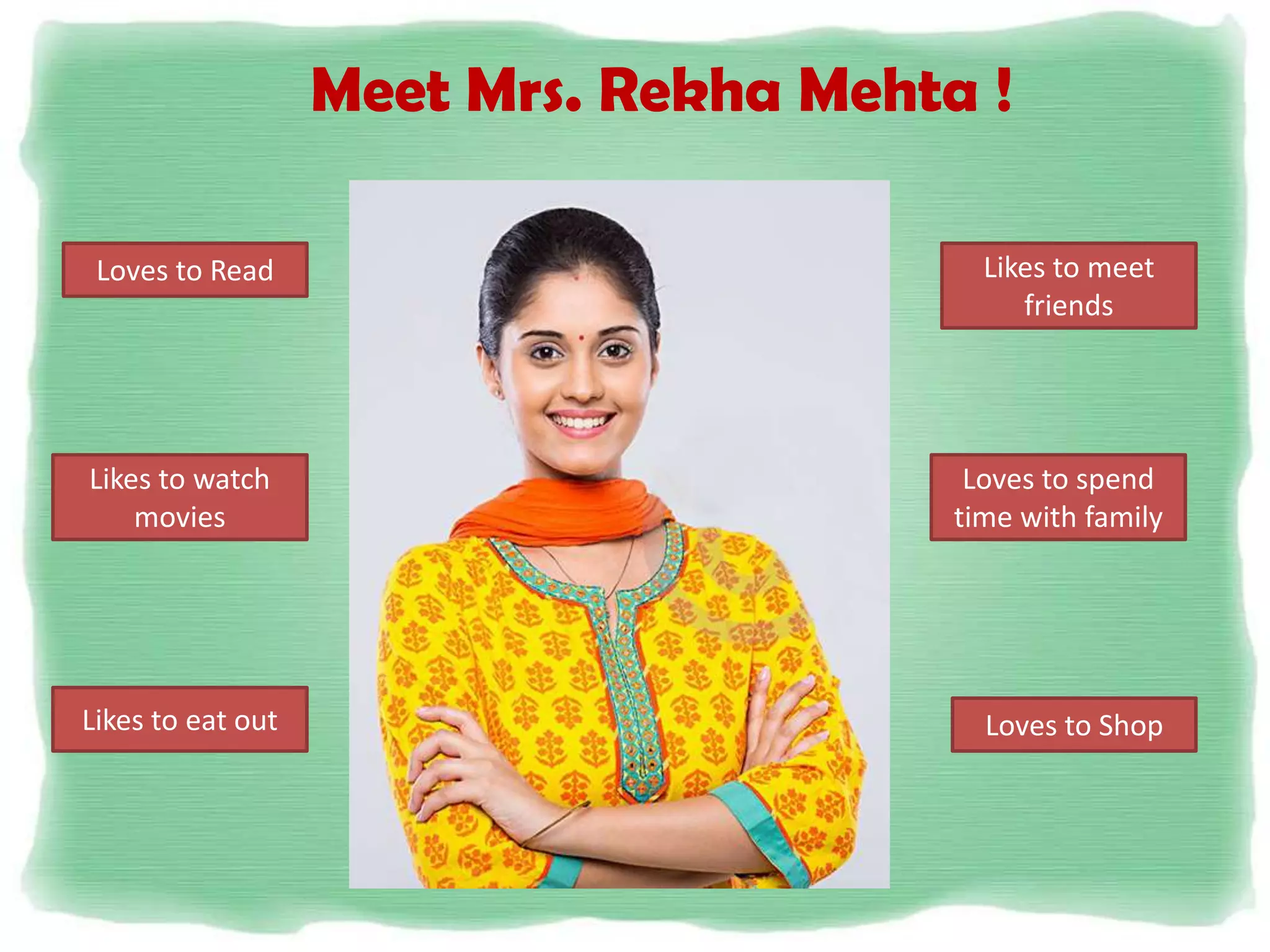
Meet Mrs. Rekha Mehta !
Loves to Read
Loves to Shop
Likes to watch
movies
Likes to eat out
Likes to meet
friends
Loves to spend
time with family
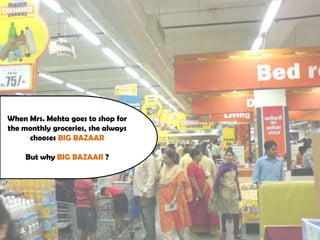
When Mrs. Mehta goes to shop for
the monthly groceries, she always
chooses BIG BAZAAR
But why BIG BAZAAR ?
About Big Bazaar
• Largest hypermarket chain in India.
• Brain-child of Kishore Biyani, first generation
entrepreneur.
• First store opened in Kolkata in October 2001.
• Two more stores opened in same month at
Hyderabad and Mumbai.
Research data
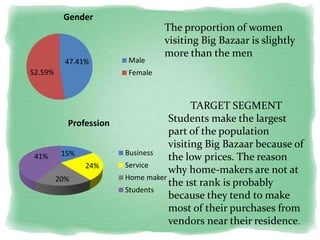
47.41%
52.59%
Gender
Male
Female
15%
24%
20%
41%
Profession
Business
Service
Home maker
Students
The proportion of women
visiting Big Bazaar is slightly
more than the men
TARGET SEGMENT
Students make the largest
part of the population
visiting Big Bazaar because of
the low prices. The reason
why home-makers are not at
the 1st rank is probably
because they tend to make
most of their purchases from
vendors near their residence.
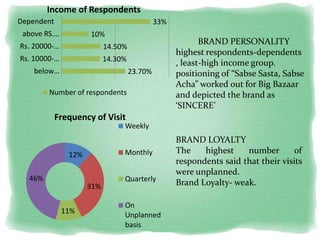
23.70%
14.30%
14.50%
10%
33%
below…
Rs. 10000-…
Rs. 20000-…
above RS.…
Dependent
Income of Respondents
Number of respondents
12%
31%
11%
46%
Frequency of Visit
Weekly
Monthly
Quarterly
On
Unplanned
basis
BRAND PERSONALITY
highest respondents-dependents
, least-high income group.
positioning of “Sabse Sasta, Sabse
Acha” worked out for Big Bazaar
and depicted the brand as
‘SINCERE’
BRAND LOYALTY
The highest number of
respondents said that their visits
were unplanned.
Brand Loyalty- weak.
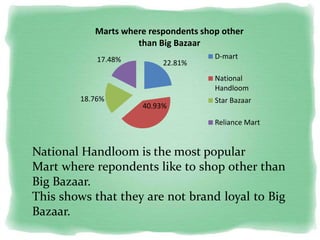
22.81%
40.93%
18.76%
17.48%
Marts where respondents shop other
than Big Bazaar
D-mart
National
Handloom
Star Bazaar
Reliance Mart
National Handloom is the most popular
Mart where repondents like to shop other than
Big Bazaar.
This shows that they are not brand loyal to Big
Bazaar.
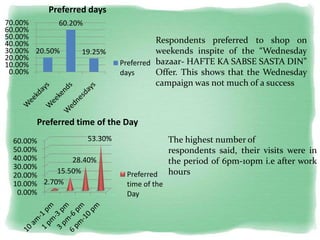
20.50%
60.20%
19.25%
0.00%
10.00%
20.00%
30.00%
40.00%
50.00%
60.00%
70.00%
Preferred days
Preferred
days
0.00%
10.00%
20.00%
30.00%
40.00%
50.00%
60.00%
2.70%
15.50%
28.40%
53.30%
Preferred time of the Day
Preferred
time of the
Day
Respondents preferred to shop on
weekends inspite of the “Wednesday
bazaar- HAFTE KA SABSE SASTA DIN”
Offer. This shows that the Wednesday
campaign was not much of a success
The highest number of
respondents said, their visits were in
the period of 6pm-10pm i.e after work
hours
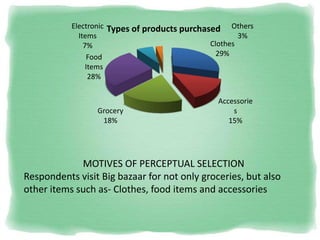
Clothes
29%
Accessorie
s
15%
Grocery
18%
Food
Items
28%
Electronic
Items
7%
Others
3%
Types of products purchased
MOTIVES OF PERCEPTUAL SELECTION
Respondents visit Big bazaar for not only groceries, but also
other items such as- Clothes, food items and accessories
0
100
200
300
400
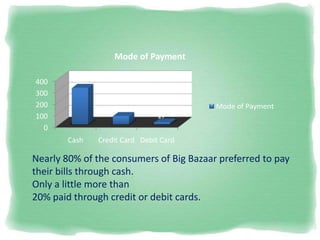
Cash Credit Card Debit Card
316
72
17
Mode of Payment
Mode of Payment
Nearly 80% of the consumers of Big Bazaar preferred to pay
their bills through cash.
Only a little more than
20% paid through credit or debit cards.
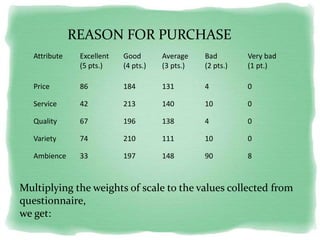
Attribute Excellent
(5 pts.)
Good
(4 pts.)
Average
(3 pts.)
Bad
(2 pts.)
Very bad
(1 pt.)
Price 86 184 131 4 0
Service 42 213 140 10 0
Quality 67 196 138 4 0
Variety 74 210 111 10 0
Ambience 33 197 148 90 8
REASON FOR PURCHASE
Multiplying the weights of scale to the values collected from
questionnaire,
we get:
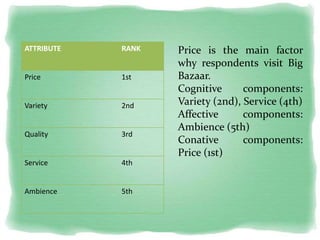
ATTRIBUTE RANK
Price 1st
Variety 2nd
Quality 3rd
Service 4th
Ambience 5th
Price is the main factor
why respondents visit Big
Bazaar.
Cognitive components:
Variety (2nd), Service (4th)
Affective components:
Ambience (5th)
Conative components:
Price (1st)
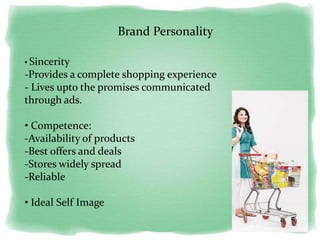
Brand Personality
• Sincerity
-Provides a complete shopping experience
- Lives upto the promises communicated
through ads.
• Competence:
-Availability of products
-Best offers and deals
-Stores widely spread
-Reliable
• Ideal Self Image
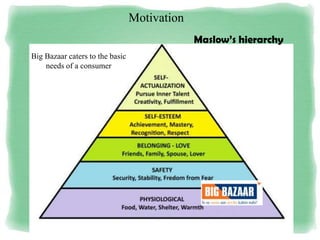
Motivation
Big Bazaar caters to the basic
needs of a consumer
Maslow’s hierarchy
0.00% 10.00% 20.00% 30.00% 40.00% 50.00%
< 30 mins
30mns-1 hr
1 hr-2 hrs
> 2 hrs
5.90%
31.80%
45%
17.30%
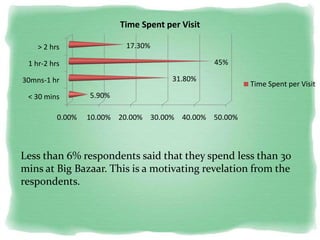
Time Spent per Visit
Less than 6% respondents said that they spend less than 30
mins at Big Bazaar. This is a motivating revelation from the
respondents.
40
138
154
73
Money Spent per visit
< 500
500-1000
1000-2000
> 2000
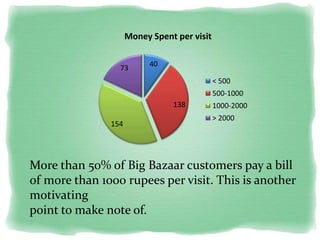
More than 50% of Big Bazaar customers pay a bill
of more than 1000 rupees per visit. This is another
motivating
point to make note of.
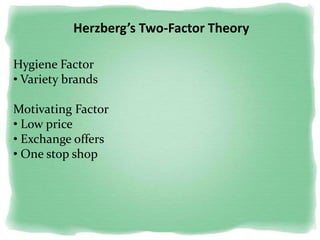
Herzberg’s Two-Factor Theory
Hygiene Factor
• Variety brands
Motivating Factor
• Low price
• Exchange offers
• One stop shop
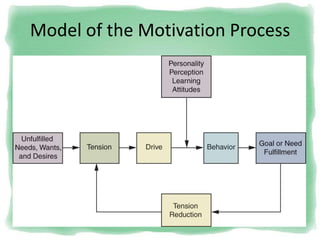
Model of the Motivation Process
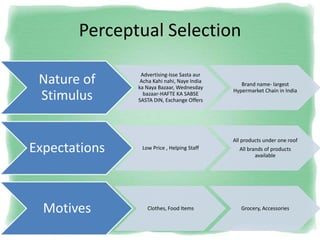
Perceptual Selection
Nature of
Stimulus
Advertising-Isse Sasta aur
Acha Kahi nahi, Naye India
ka Naya Bazaar, Wednesday
bazaar-HAFTE KA SABSE
SASTA DIN, Exchange Offers
Brand name- largest
Hypermarket Chain in India
Expectations Low Price , Helping Staff
All products under one roof
All brands of products
available
Motives Clothes, Food Items Grocery, Accessories
Absolute Threshold
Point at which an individual can differentiate
between something & nothing
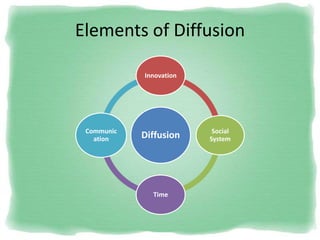
Elements of Diffusion
Diffusion
Innovation
Social
System
Time
Communic
ation
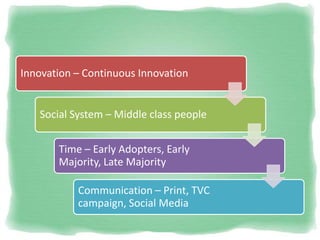
Innovation – Continuous Innovation
Social System – Middle class people
Time – Early Adopters, Early
Majority, Late Majority
Communication – Print, TVC
campaign, Social Media
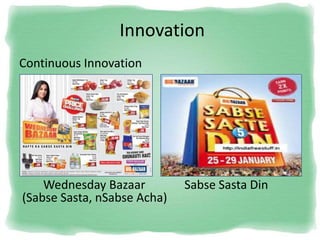
Innovation
Continuous Innovation
Wednesday Bazaar Sabse Sasta Din
(Sabse Sasta, nSabse Acha)
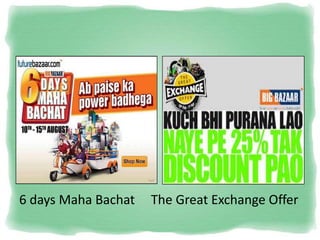
6 days Maha Bachat The Great Exchange Offer
Decision Making Process
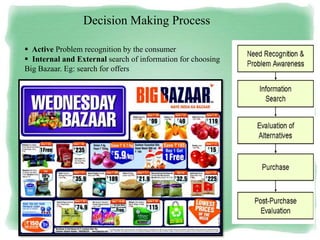
 Active Problem recognition by the consumer
 Internal and External search of information for choosing
Big Bazaar. Eg: search for offers
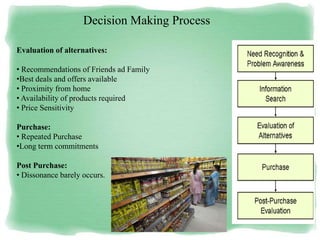
Evaluation of alternatives:
• Recommendations of Friends ad Family
•Best deals and offers available
• Proximity from home
• Availability of products required
• Price Sensitivity
Purchase:
• Repeated Purchase
•Long term commitments
Post Purchase:
• Dissonance barely occurs.
Decision Making Process
TVC Campaign
• Sabse sasta 3 din Campaign
• Swagatam khushiyon ka Campaign
• Public Holiday Sale Campaign
• Making India Beautiful Campaign
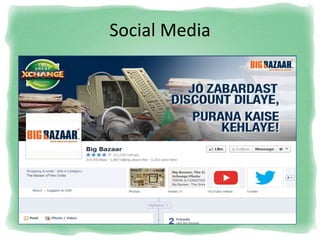
Social Media
Learning
• Motivation: The low prices and constant offers
• Cues: Advertisements, posters, in store promotions
• Response: People choosing Big Bazaar over other
departmental stores
• Reinforcement: The offers and deals lead to repeat
visits to the stores.

consumer behavior project on Big Bazaar

Editor's Notes

  • #19 This model highlights the motivation process. We can see that the “drive” toward behavior will often end in the fulfillment of the need. The processes and effects of previous learning tie strongly into choices made when the behavior is defined.