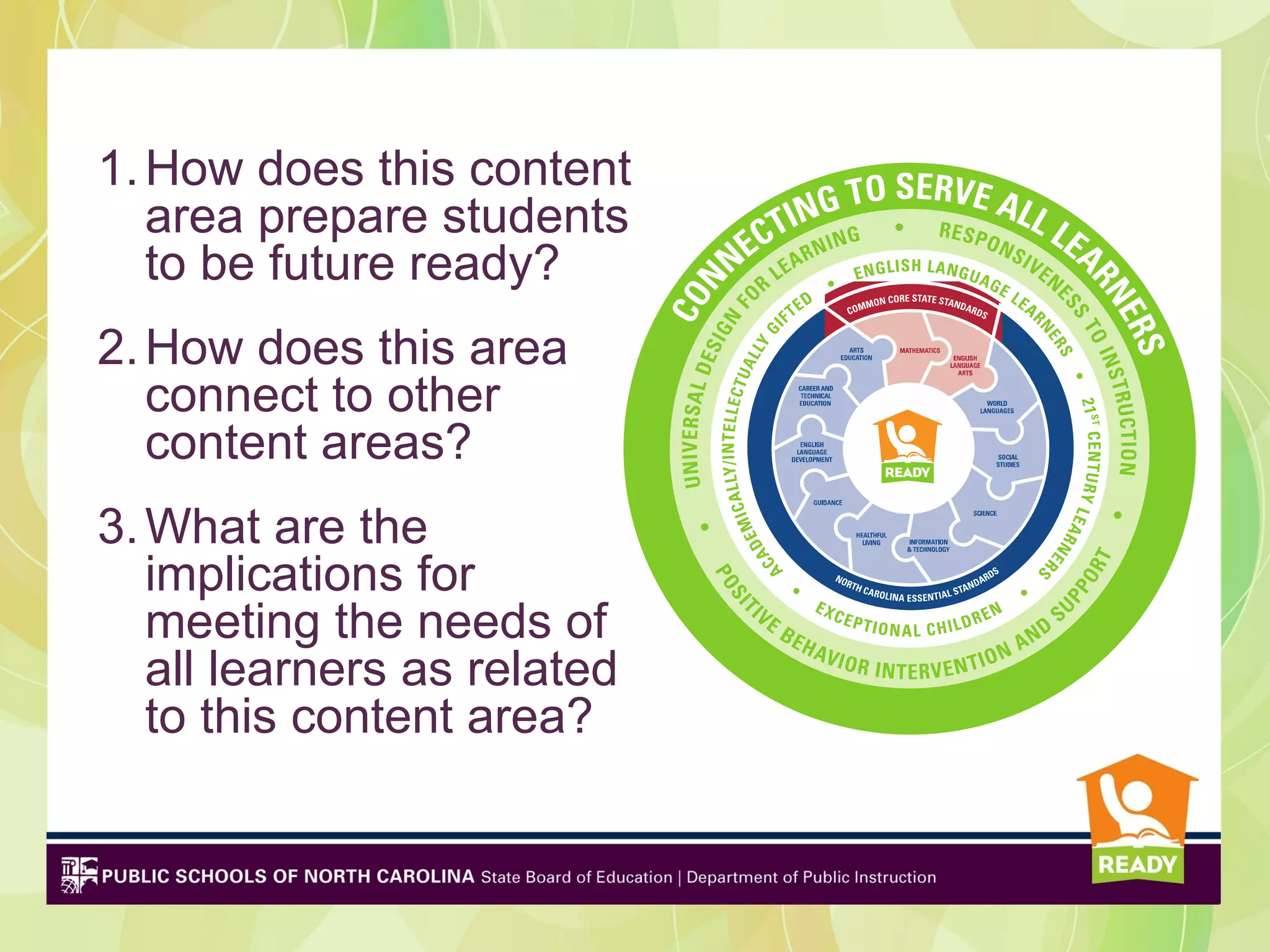
Connecting to Serve All

     Addressing Student Needs in an
      Era Of New Content Standards
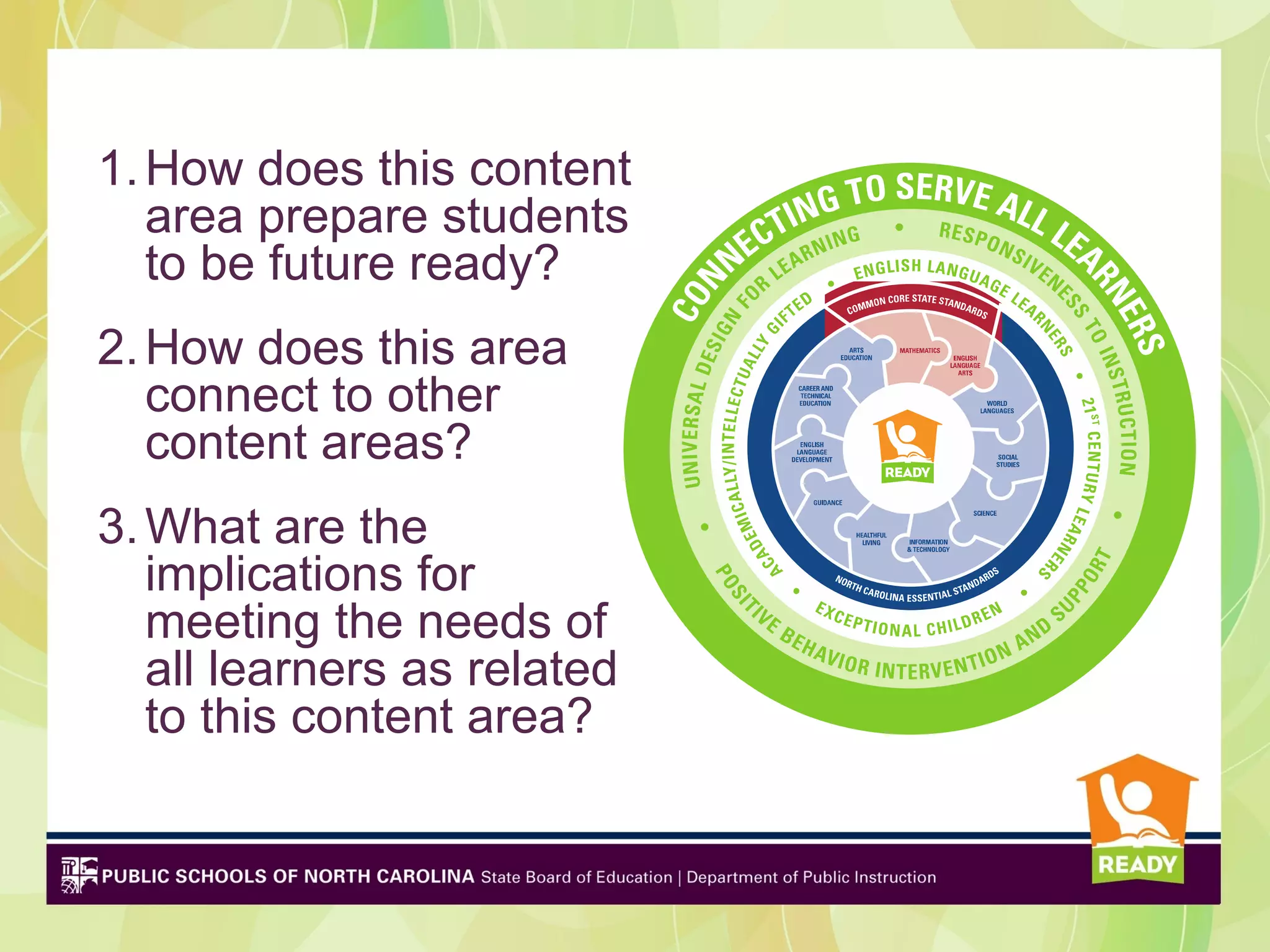
1. How does this content
   area prepare students
   to be future ready?
2. How does this area
   connect to other
   content areas?
3. What are the
   implications for
   meeting the needs of
   all learners as related
   to this content area?
By the time many
students hit middle
school,
disengagement has
become a learned
behavior.
~Keely Potter,
Reading Specialist
Four Critical Questions
• What do we want our students to learn?
• How do we know that they have learned it?
• What do we do if they have not learned it?
• What do we do when they already know it?
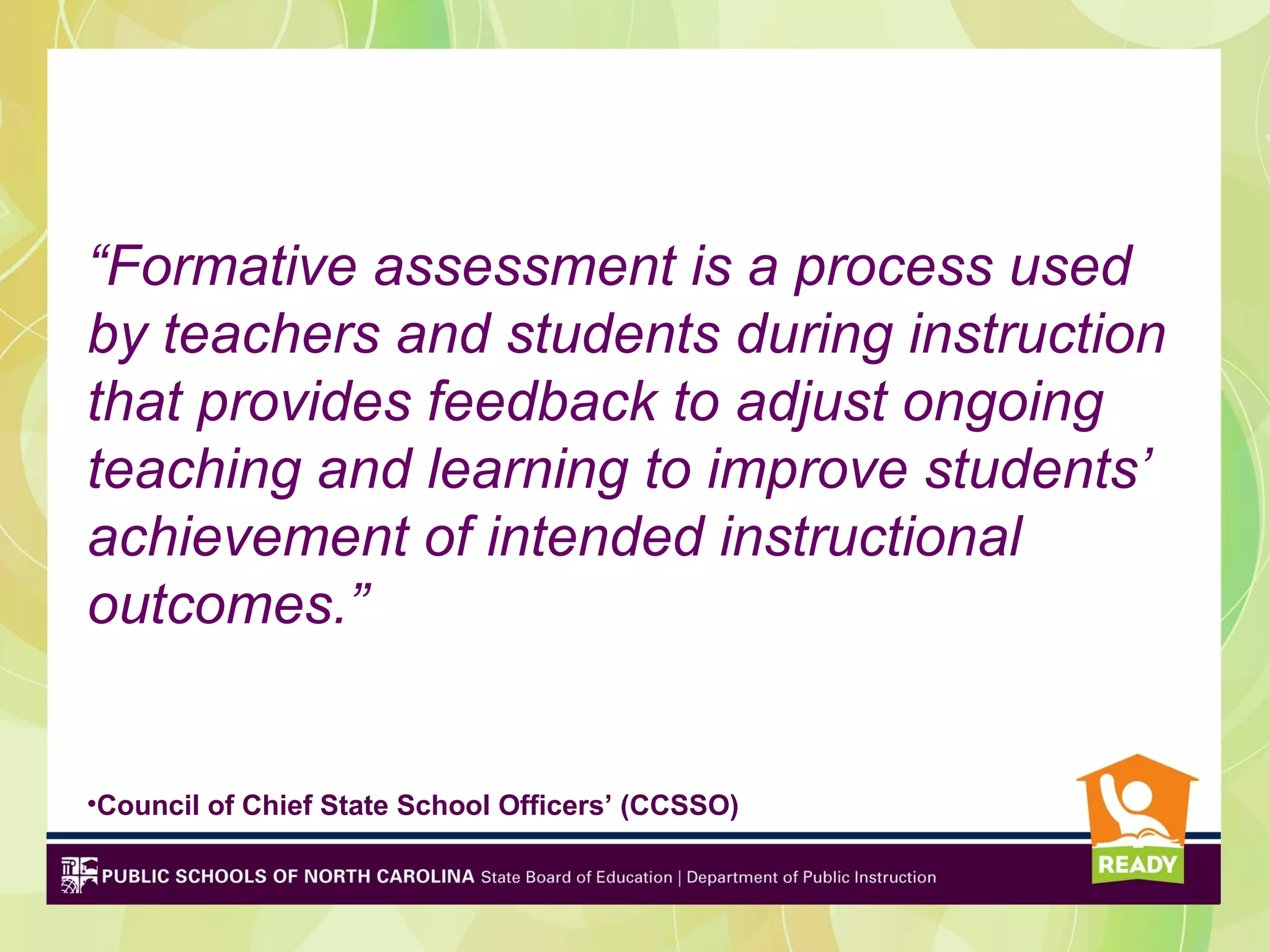
“Formative assessment is a process used
by teachers and students during instruction
that provides feedback to adjust ongoing
teaching and learning to improve students’
achievement of intended instructional
outcomes.”


•Council of Chief State School Officers’ (CCSSO)
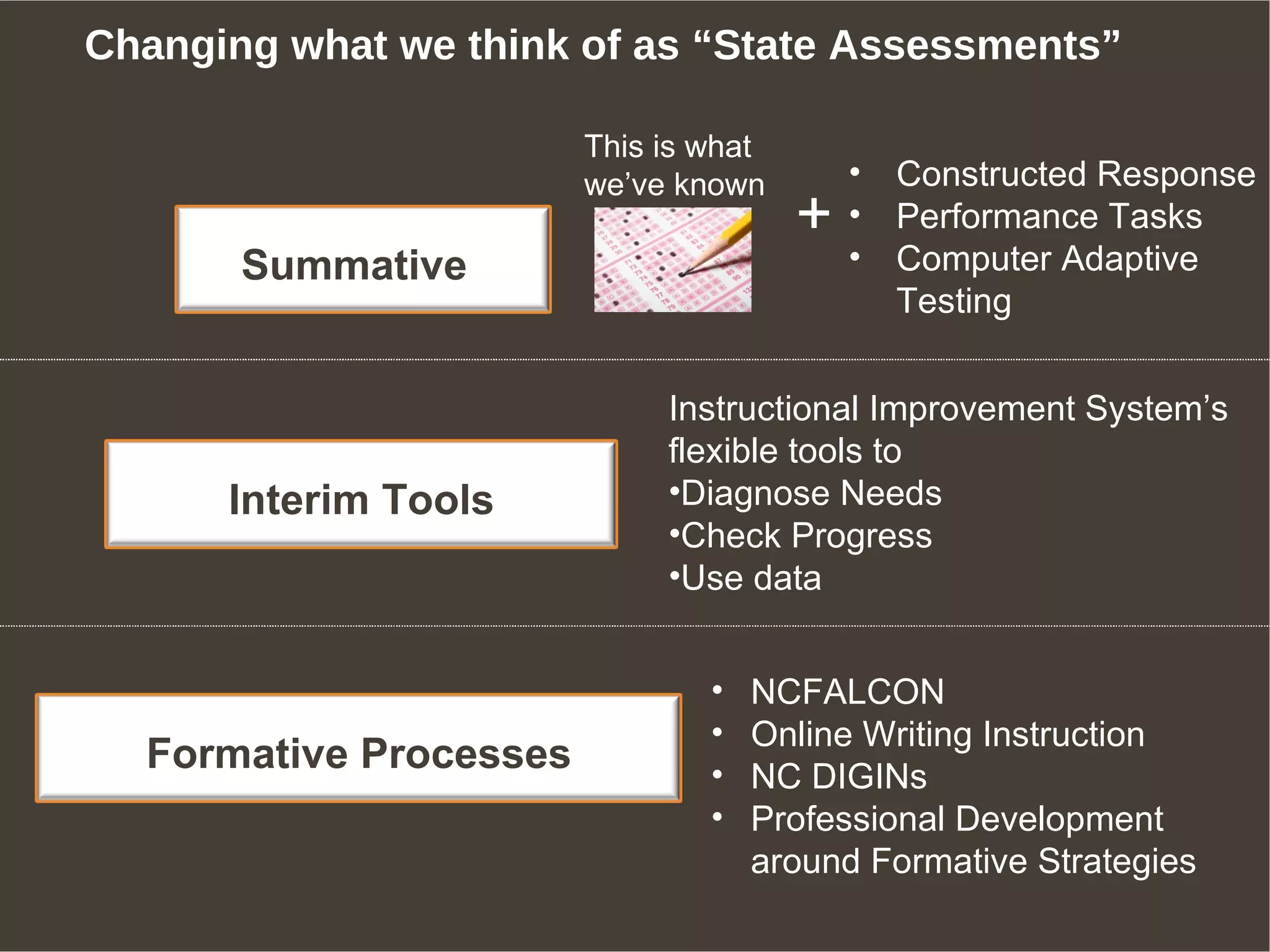
Changing what we think of as “State Assessments”

                        This is what
                        we’ve known        •   Constructed Response
                                       +   •   Performance Tasks
       Summative                           •   Computer Adaptive
                                               Testing


                             Instructional Improvement System’s
                             flexible tools to
      Interim Tools          •Diagnose Needs
                             •Check Progress
                             •Use data


                                •   NCFALCON
                                •   Online Writing Instruction
  Formative Processes           •   NC DIGINs
                                •   Professional Development
                                    around Formative Strategies
Universal Design
Universal Design
Universal Design
Universal Design for Learning (UDL)

   A set of principles for curriculum
 development that applies to the general
 education curriculum to promote learning
 environments that meet the needs of all
                learners.
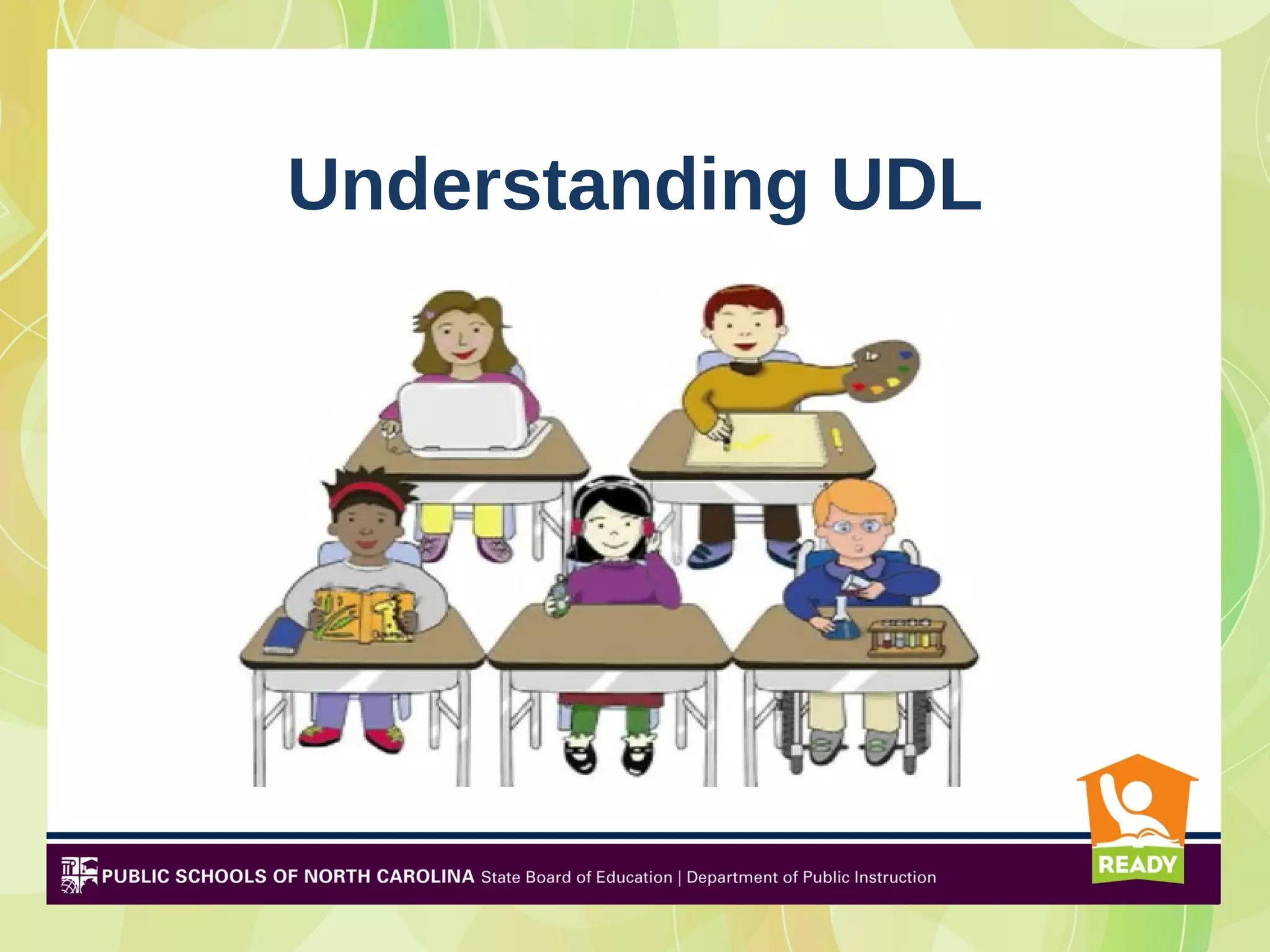
Understanding UDL
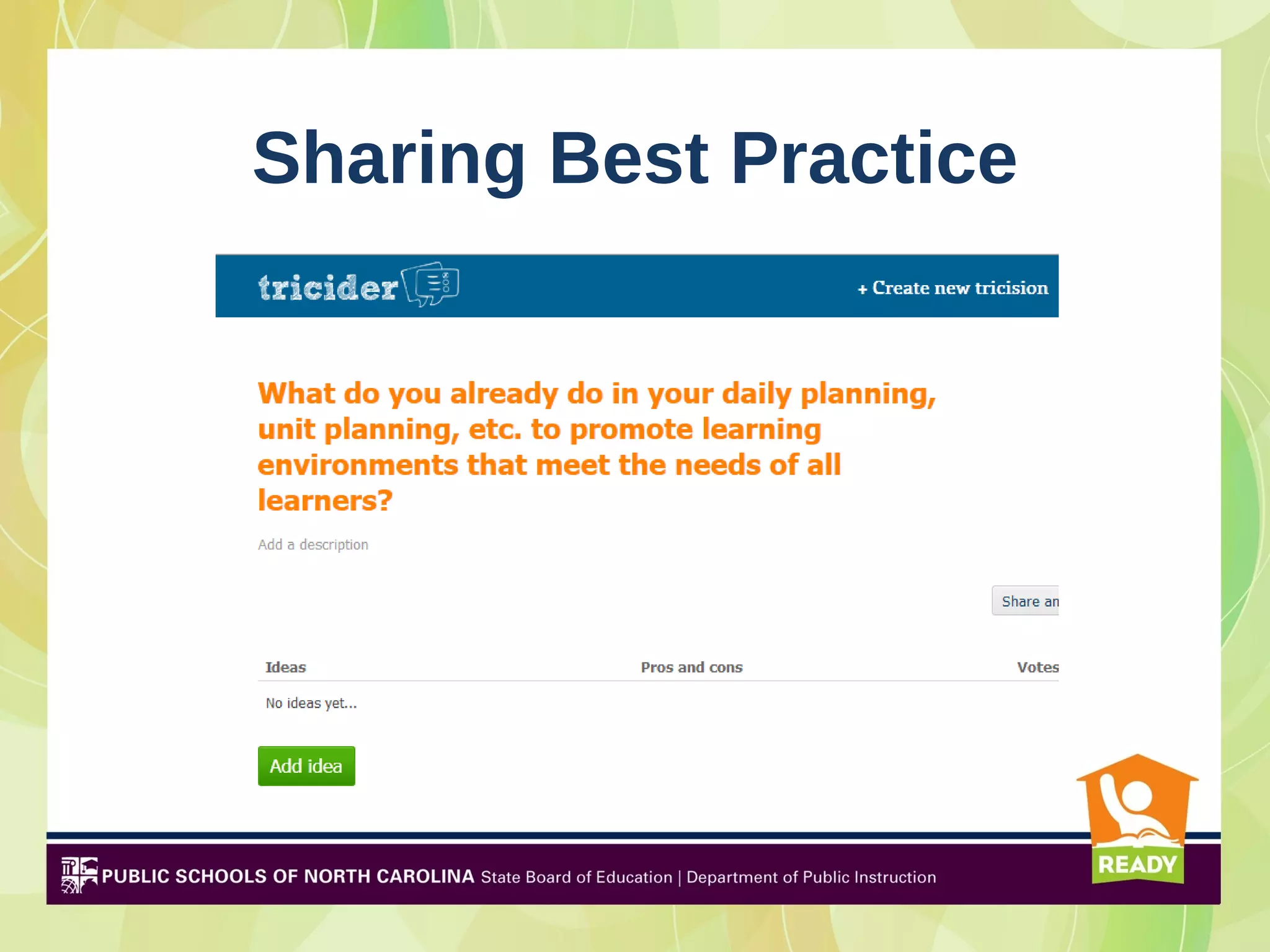
Sharing Best Practice
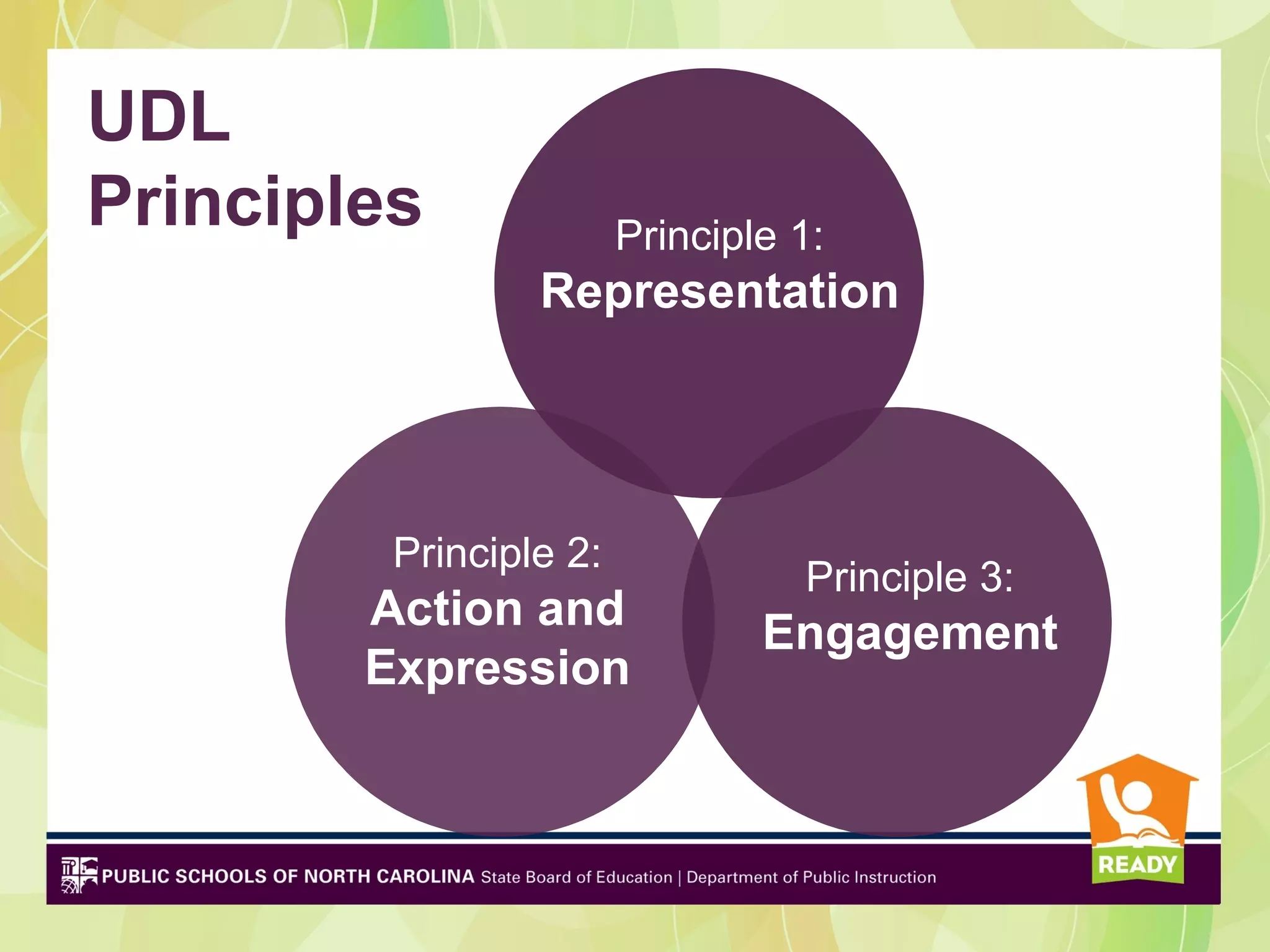
UDL
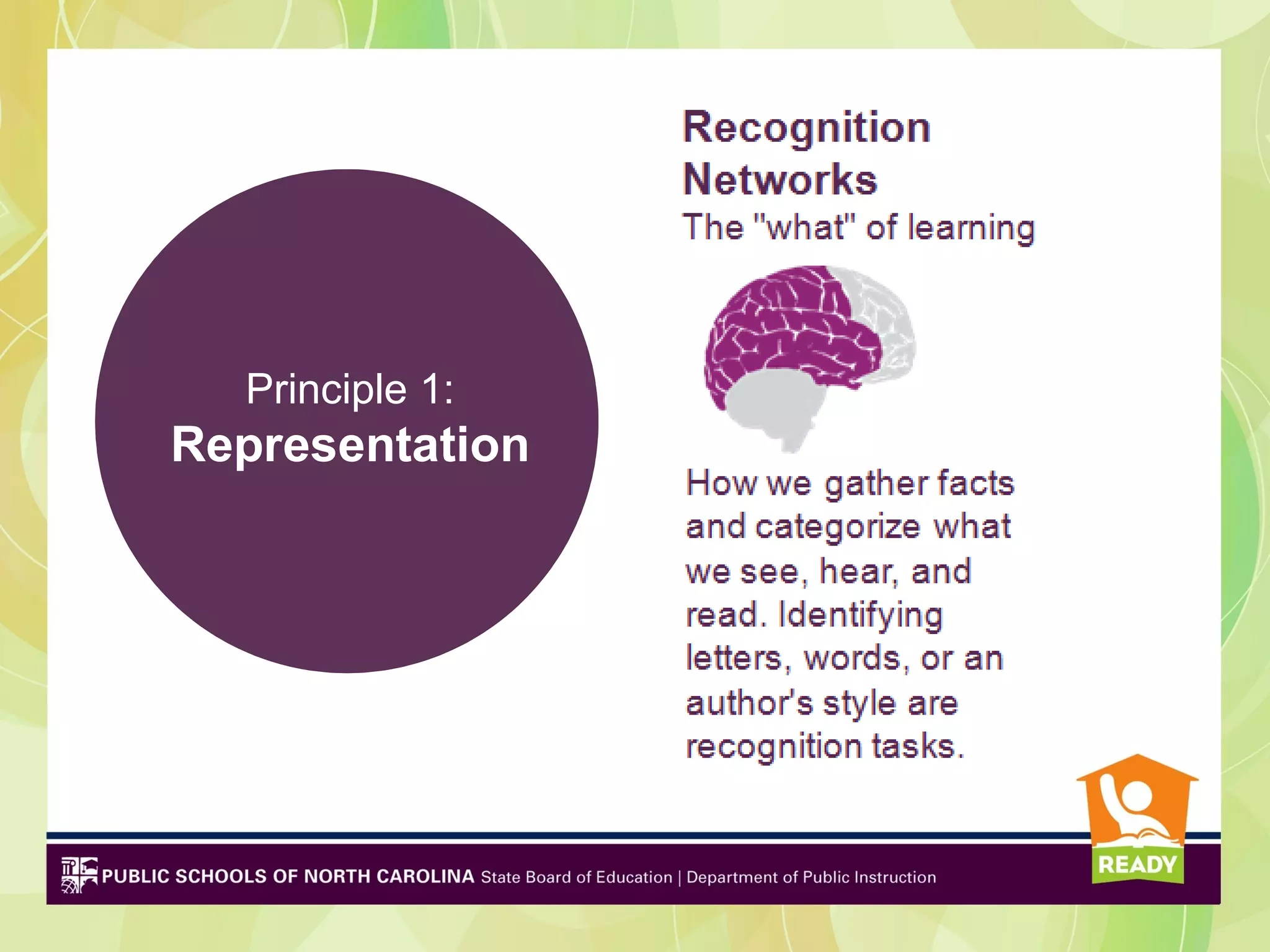
Principles              Principle 1:
                 Representation


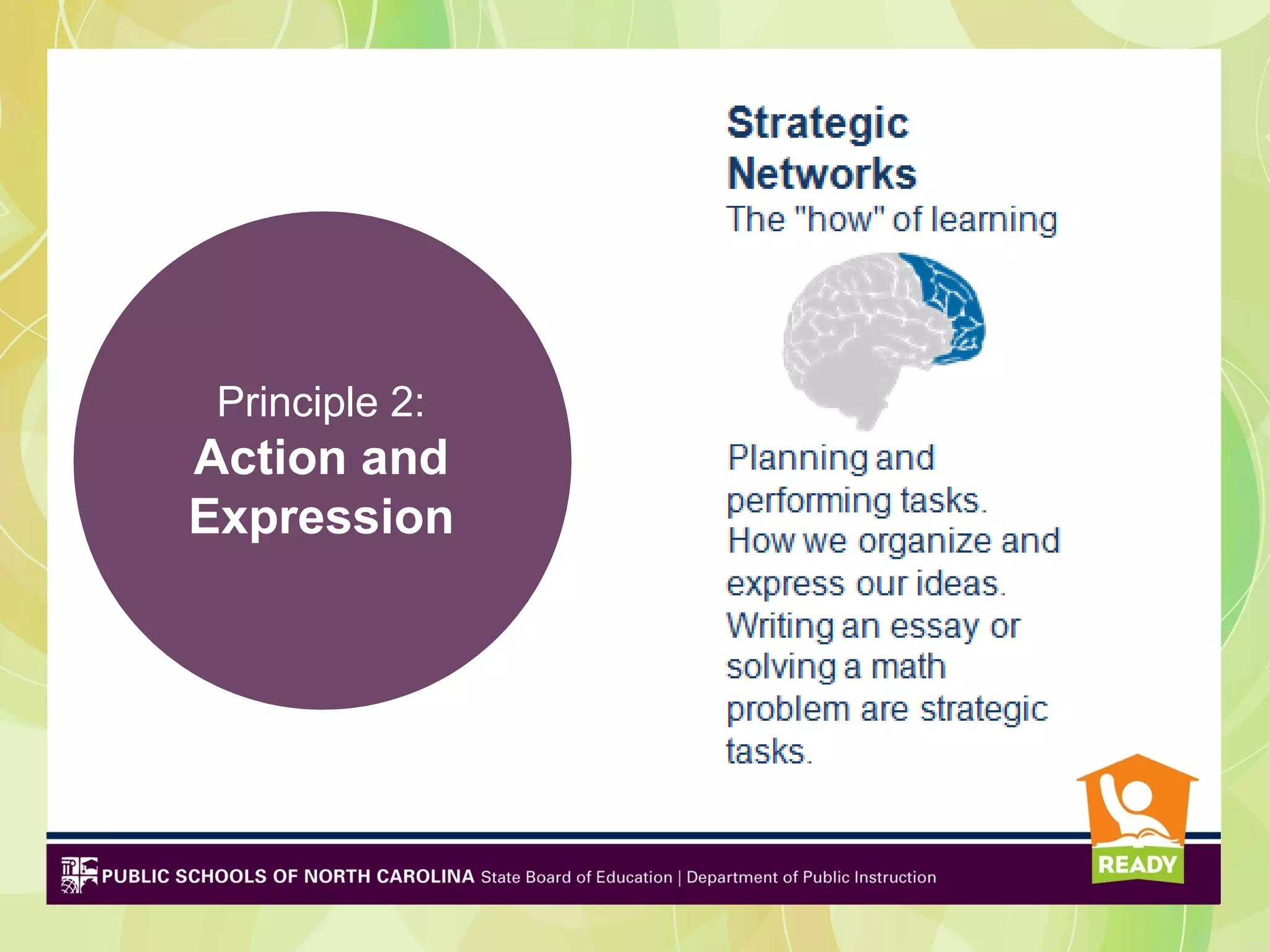
         Principle 2:
                                  Principle 3:
        Action and              Engagement
        Expression
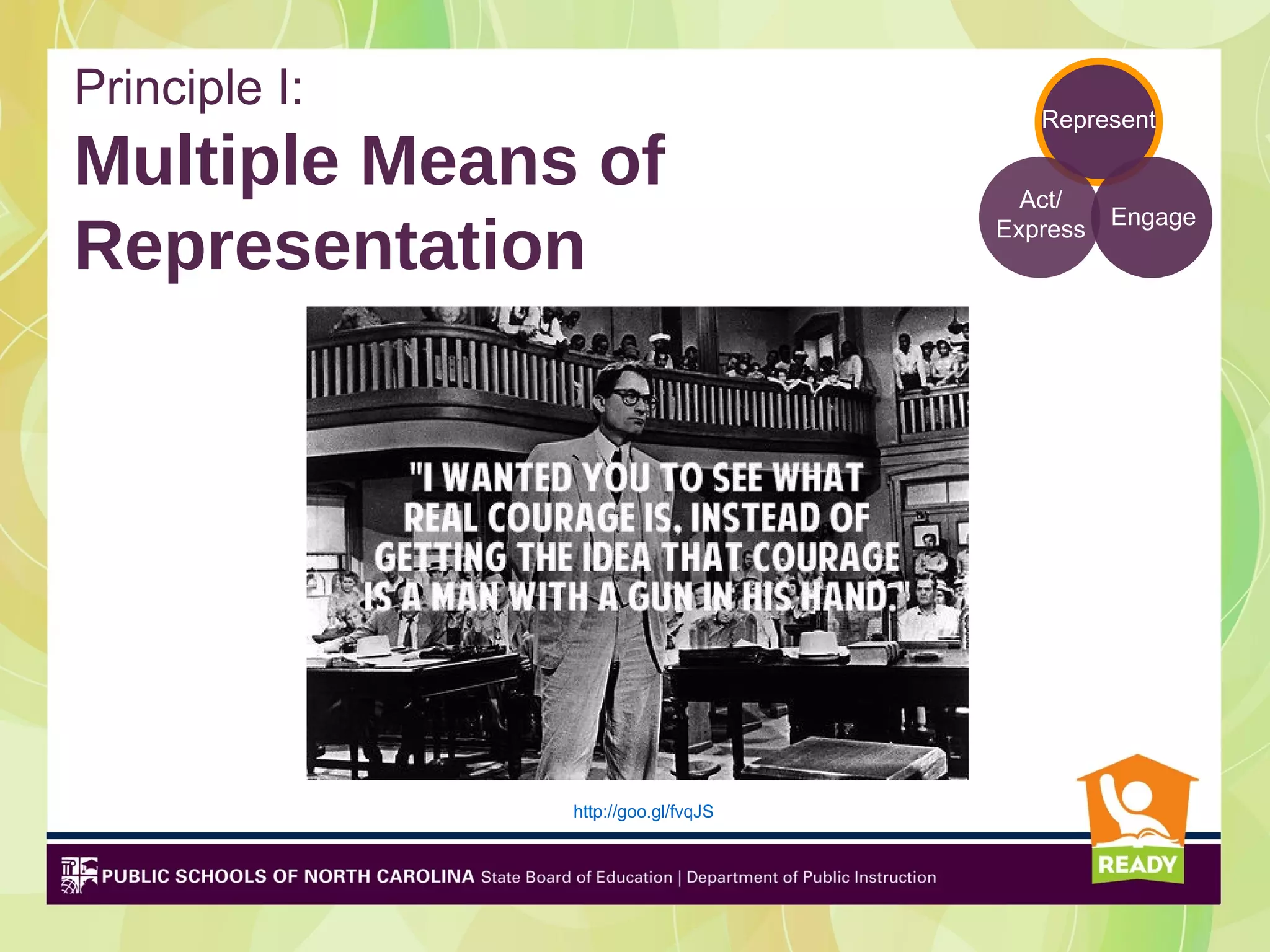
Principle I:                            Represent

Multiple Means of                      Act/
                                               Engage
Representation                       Express


               http://goo.gl/fvqJS
Principle 1:
Representation
UDL requires Multiple Means            Represent


of Representation.                   Act/
                                             Engage
                                   Express

  Multiple Means of Representation
 Examples:
  Manipulatives         Videos

  Visual Displays       Music

  Anticipatory Guides   Movement

  Graphic Organizers    Text Readers

  Artifacts
Multiple Means of                                 Represent

Representation for ELLs                          Act/
                                                         Engage
                                               Express
Non-verbal               Language Support
• Modeling               • Word banks
• Pictures               • Word walls
• Realia/Concrete objects • Labels
• Gestures               • Graphic organizers
• Manipulatives          • Sentence starters
• Demonstrations         • Sentence frames
• Hands-on
• Picture dictionaries
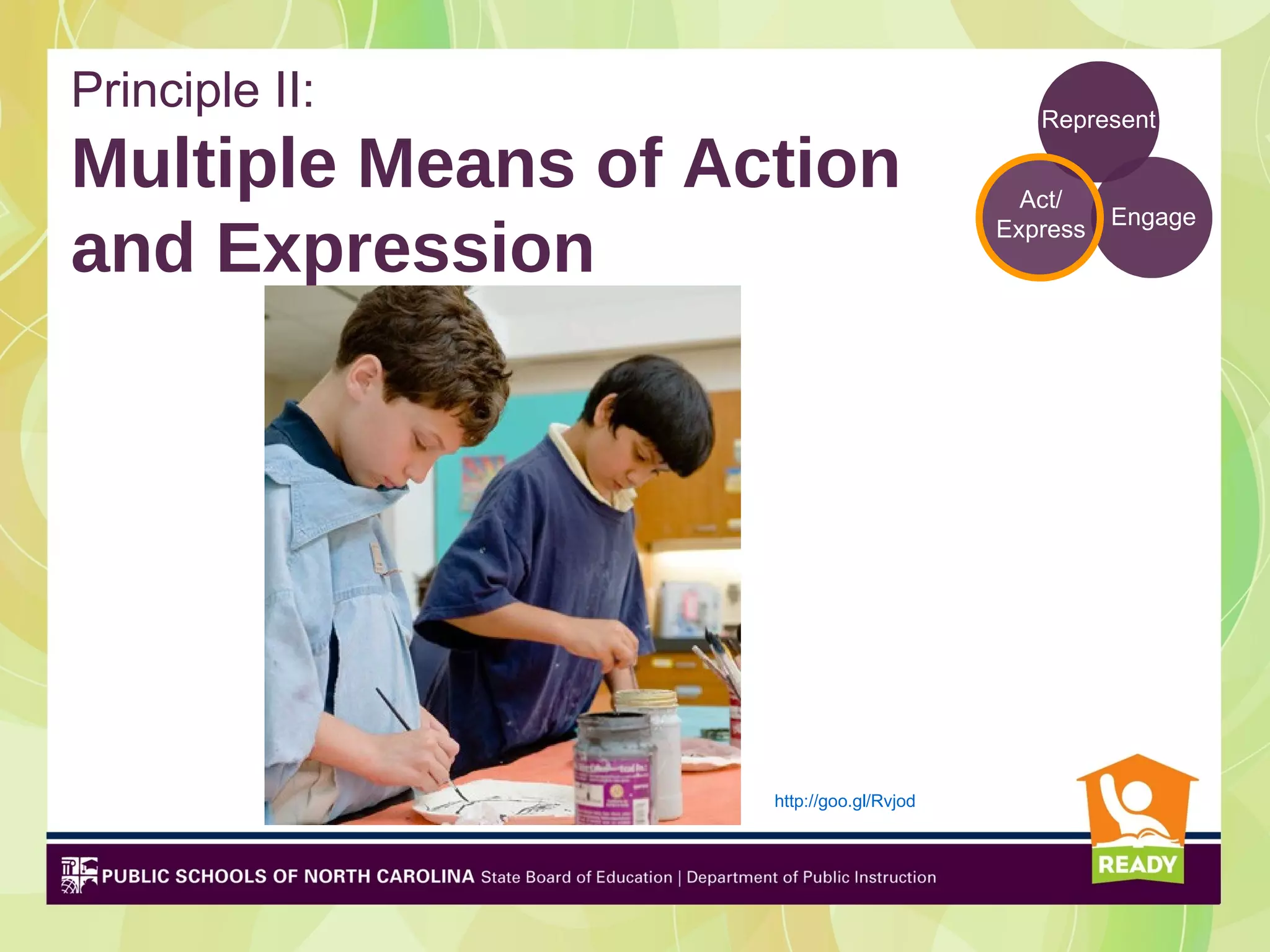
Principle II:                                Represent

Multiple Means of Action                    Act/
                                                    Engage
and Expression                            Express


                    http://goo.gl/Rvjod
Principle 2:
Action and
Expression
Action/Expression
     Quick Draw Directions
     • Use a sheet of paper to create an image/
       drawing that depicts a way that you
       provide students with opportunities to act
       or express themselves or their ideas.


                                                    http://goo.gl/dHJqh


22
Six-Step Partner
• Find a six-step
  partner and share
  ideas.
• Share an idea you
  like.
                      http://goo.gl/Vb2g8
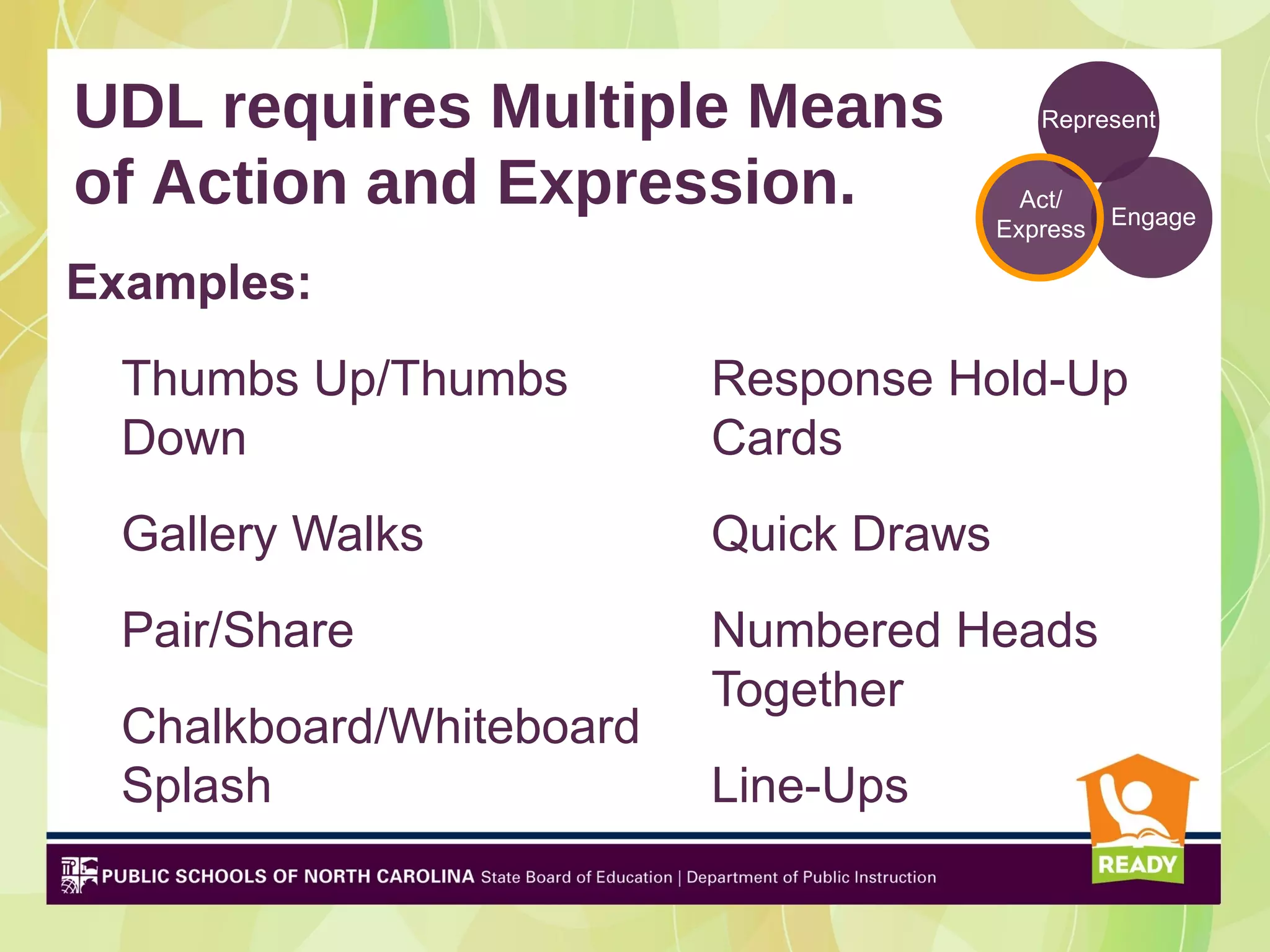
UDL requires Multiple Means                Represent


of Action and Expression.                 Act/
                                                  Engage
                                        Express

Examples:
  Thumbs Up/Thumbs        Response Hold-Up
  Down                    Cards
  Gallery Walks           Quick Draws
  Pair/Share              Numbered Heads
                          Together
  Chalkboard/Whiteboard
  Splash                  Line-Ups
Multiple Means of                          Represent

Expressing for ELLs                       Act/
                                                  Engage
                                        Express


  • Role-play
  • Illustrations/ Drawings / Visuals
  • Gestures
  • First language
Principle III:      Represent

Multiple Means     Act/
                           Engage
of Engagement    Express
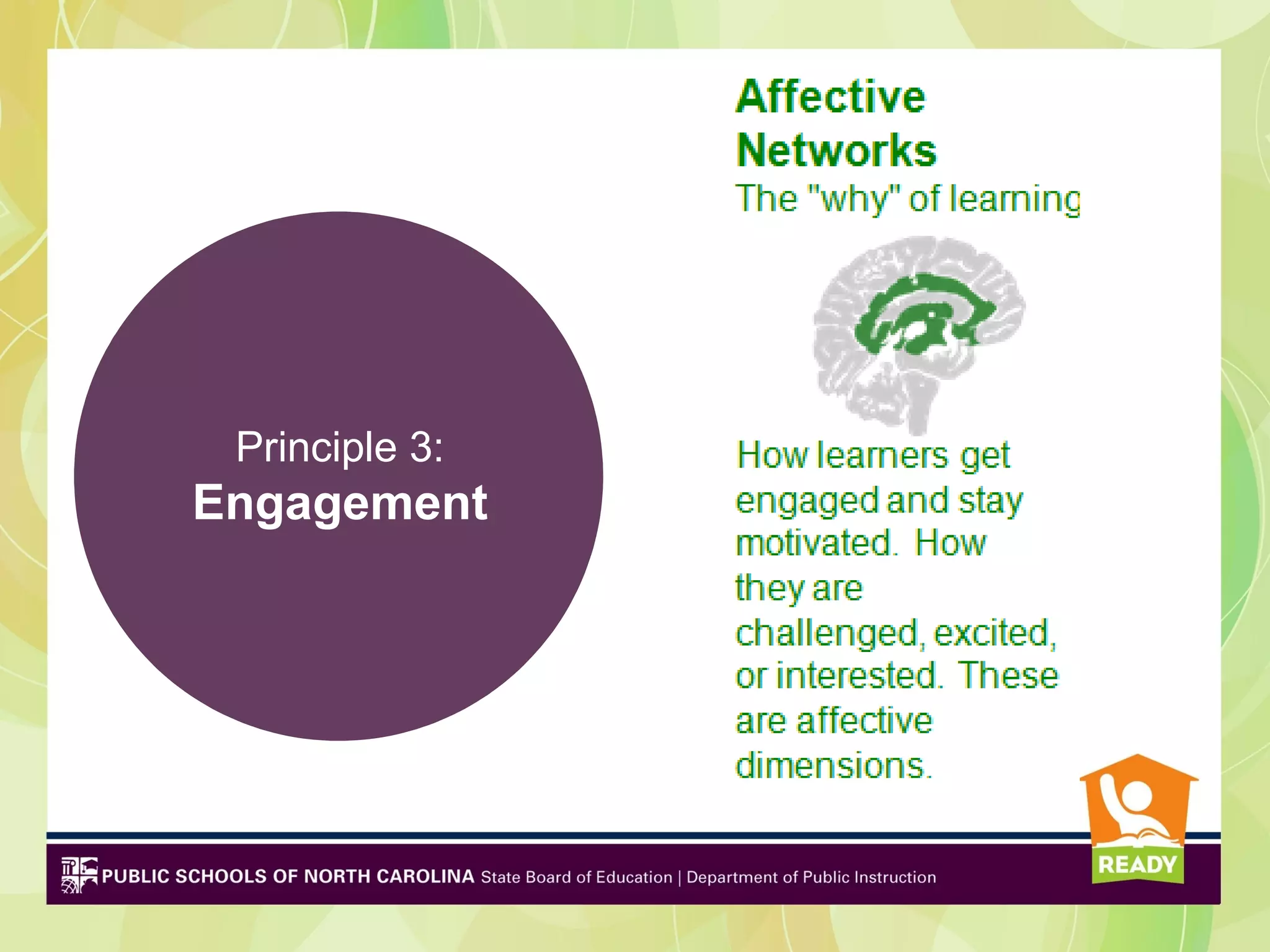
Principle 3:
Engagement
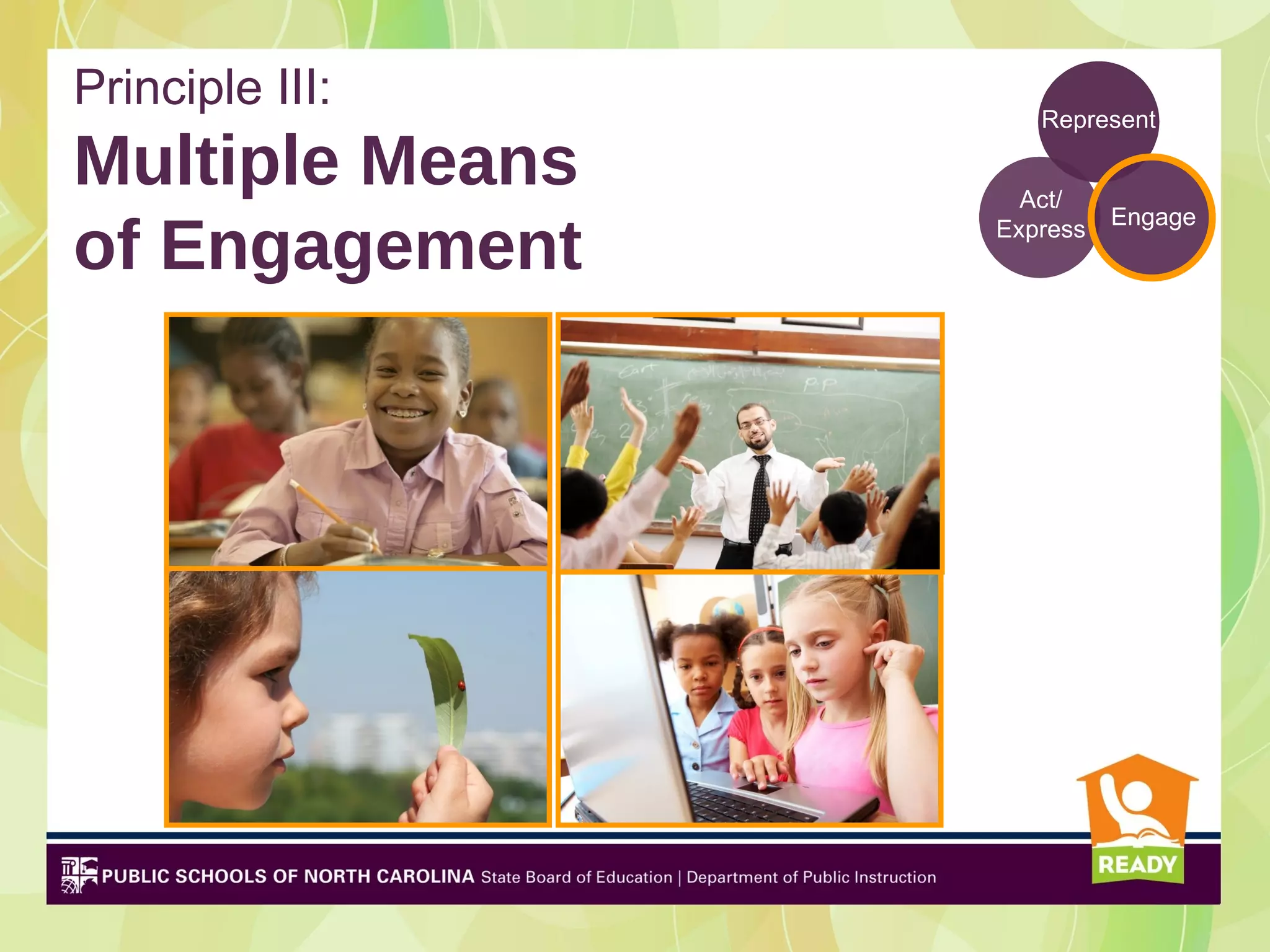
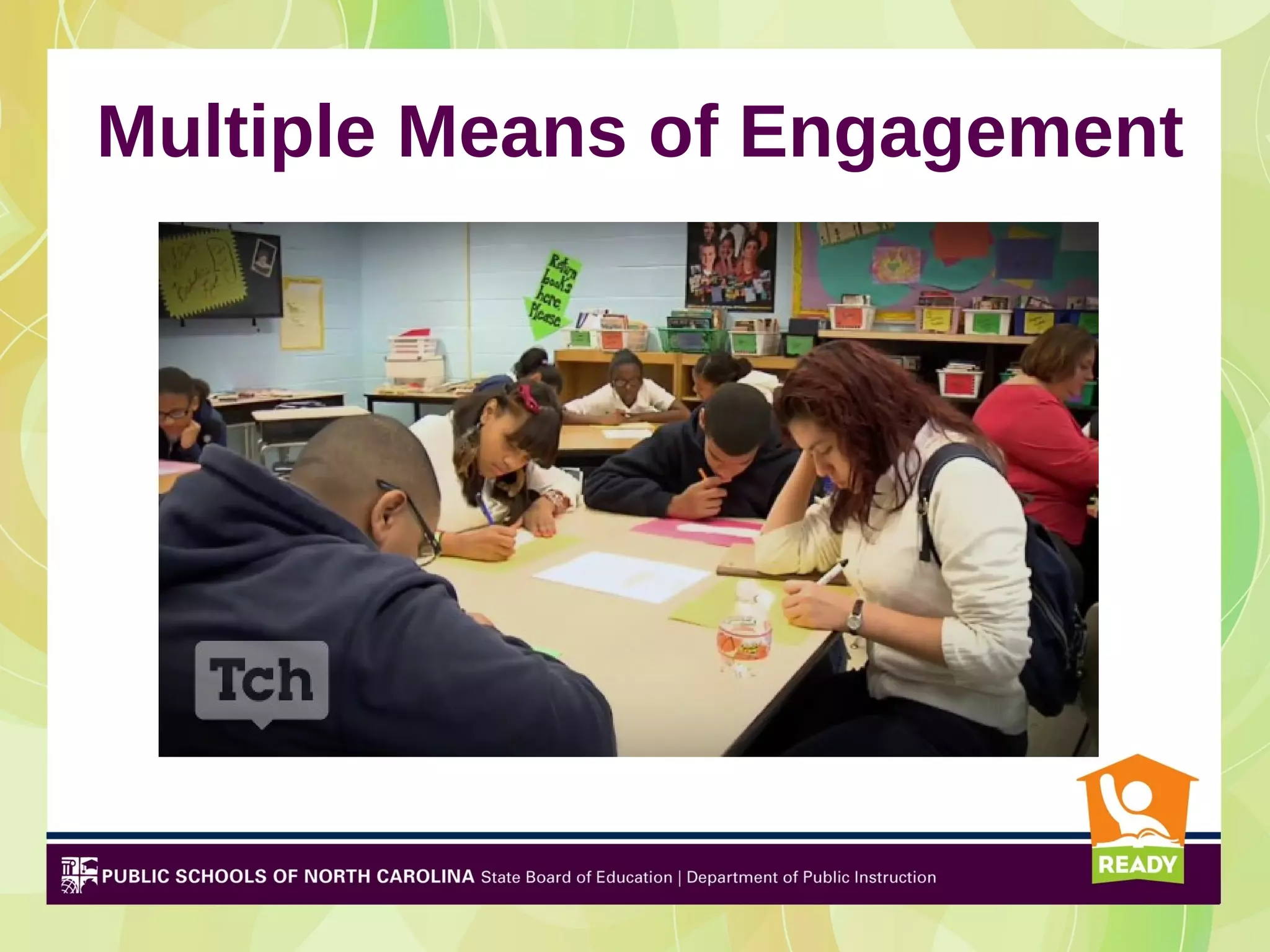
Multiple Means of Engagement
UDL requires Multiple Means       Represent


of Engagement.                   Act/
                                         Engage
                               Express


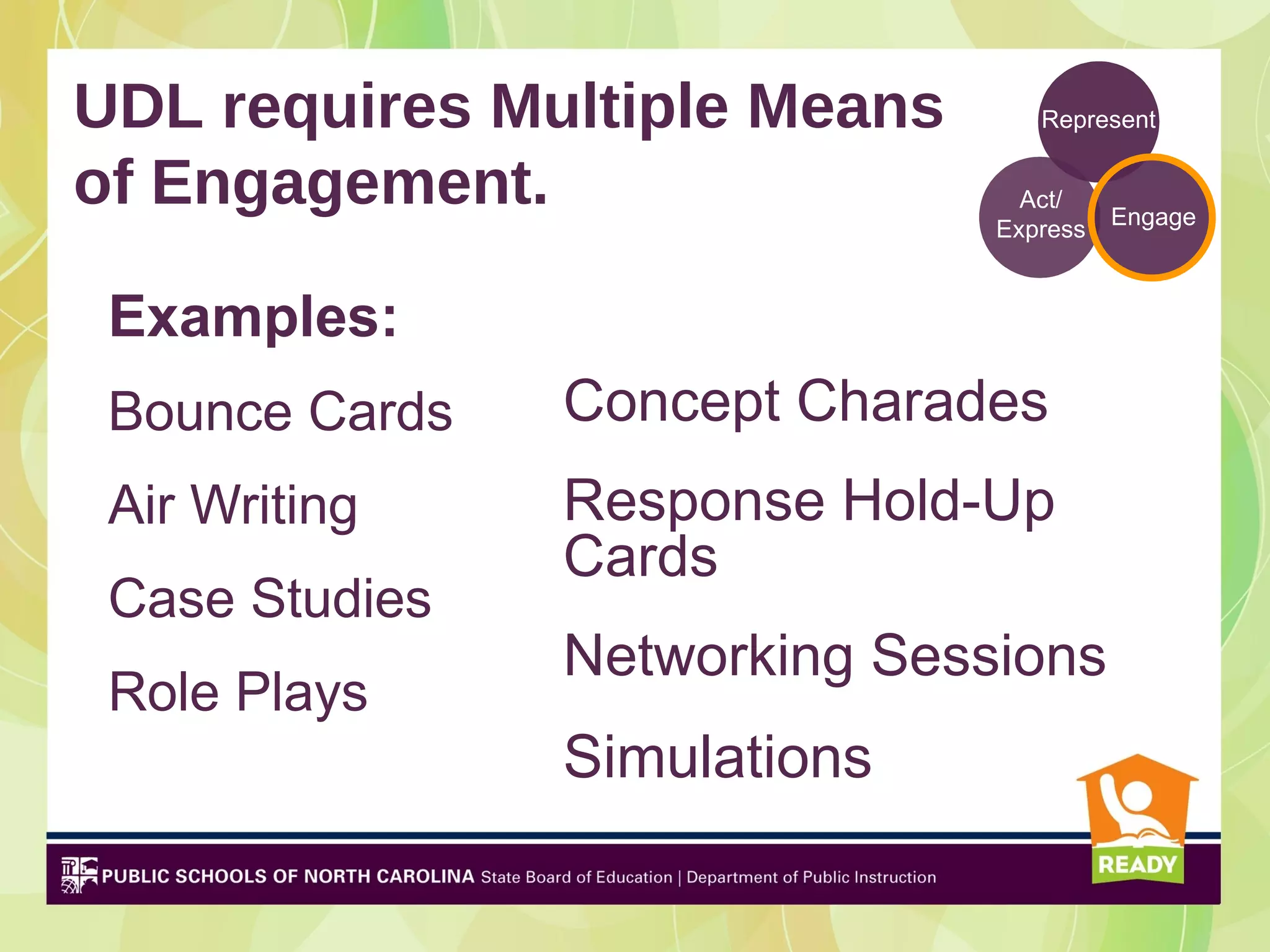
 Examples:
 Bounce Cards   Concept Charades
 Air Writing    Response Hold-Up
                Cards
 Case Studies
                Networking Sessions
 Role Plays
                Simulations
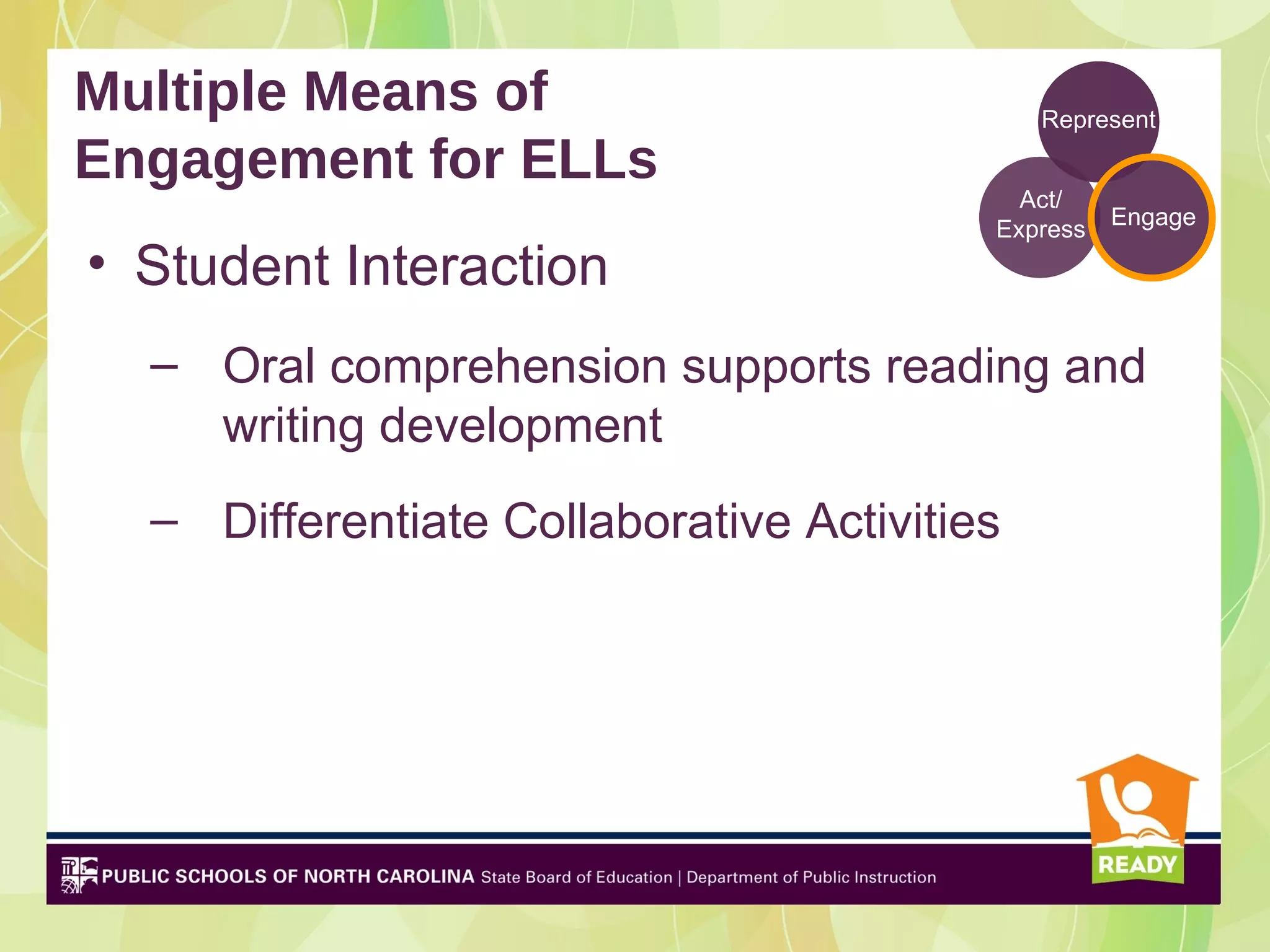
Multiple Means of                            Represent

Engagement for ELLs
                                           Act/
                                                   Engage
                                         Express
• Student Interaction
  – Oral comprehension supports reading and
    writing development
  – Differentiate Collaborative Activities
BR
  EA
     K
Universal Design
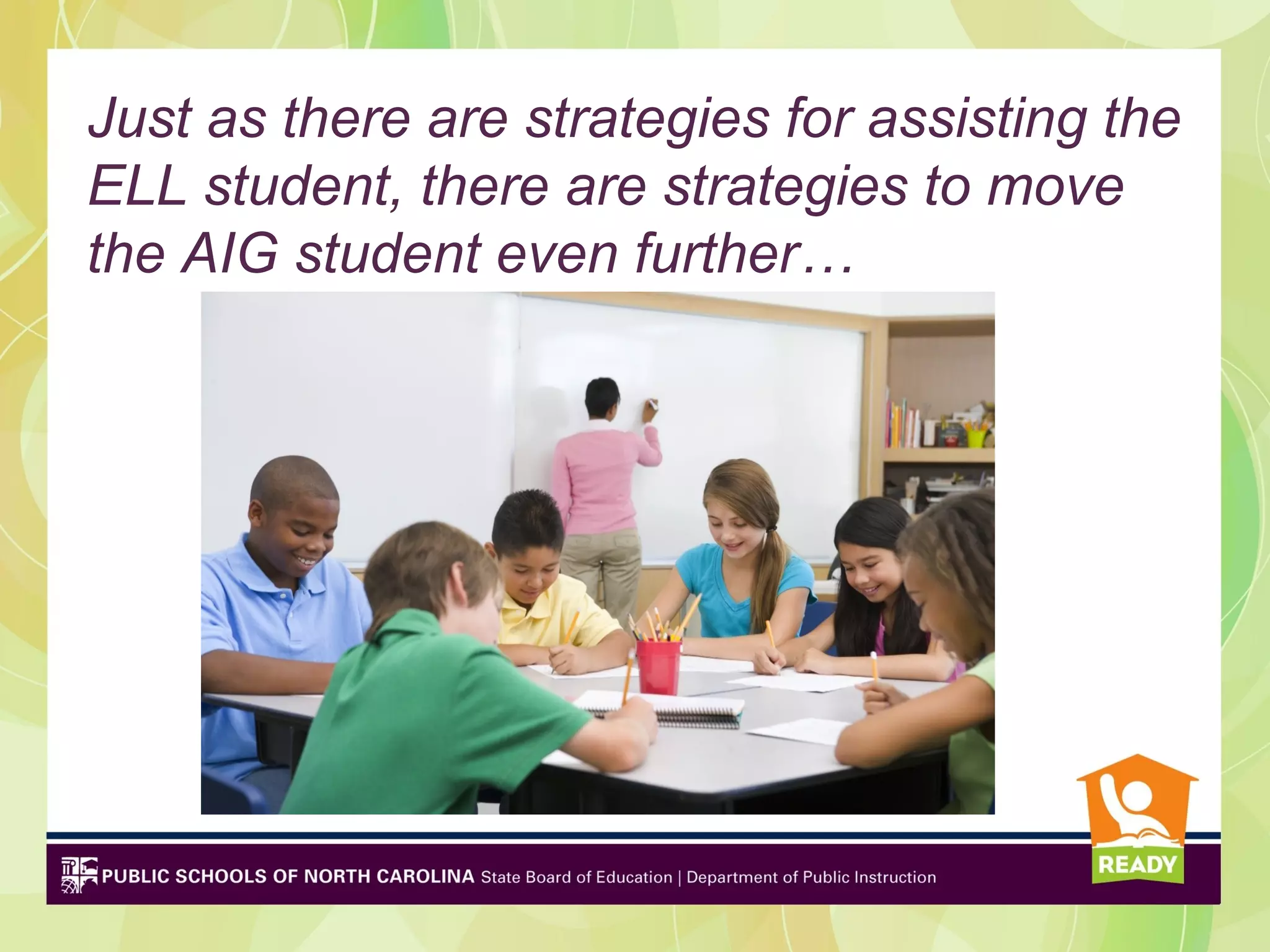
Just as there are strategies for assisting the
ELL student, there are strategies to move
the AIG student even further…
What do gifted learners
need in order to maximize
     their learning?
Table Talk
• How do the Common Core State
  Standards provide quality opportunities
  for high-end differentiation?


                                http://goo.gl/VPVY8
Gifted Education and new NCSCOS
• An opportunity for growth and collaboration with regular
  education and within the field of gifted.

• Students may access more rigorous standards
  throughout the day, which would impact direct gifted
  education services and ensure access to more advanced
  education throughout the day.
   – A rising tide raises all ships.

• Common Core State Standards align with and validate
  gifted education best practices, such as concept-based
  learning, integration of disciplines, and inquiry-based
  options.
Why Gifted Students Need
     Differentiated Learning
For most.…
•Faster pace of learning (2-3 repetitions)
•Ability to synthesize information within and
across disciplines (conceptual understanding)
•Intensity of learning in area of interest
•Precocity for information
•Asynchronous development: Vary in Needs and
Strengths
Learning Needs of Gifted:
                 Some, Not All:

•   Complexity: Abstract-thinking, Variety of
    concepts, subjects and strategies
•   Depth: Higher levels of thinking, concepts
•   Creativity: Open-endedness, choice
•   Acceleration: Rapid pacing, Focus on
    Growth
•   Relevance: Personal interest, Real-world
    problems and audiences, Connections
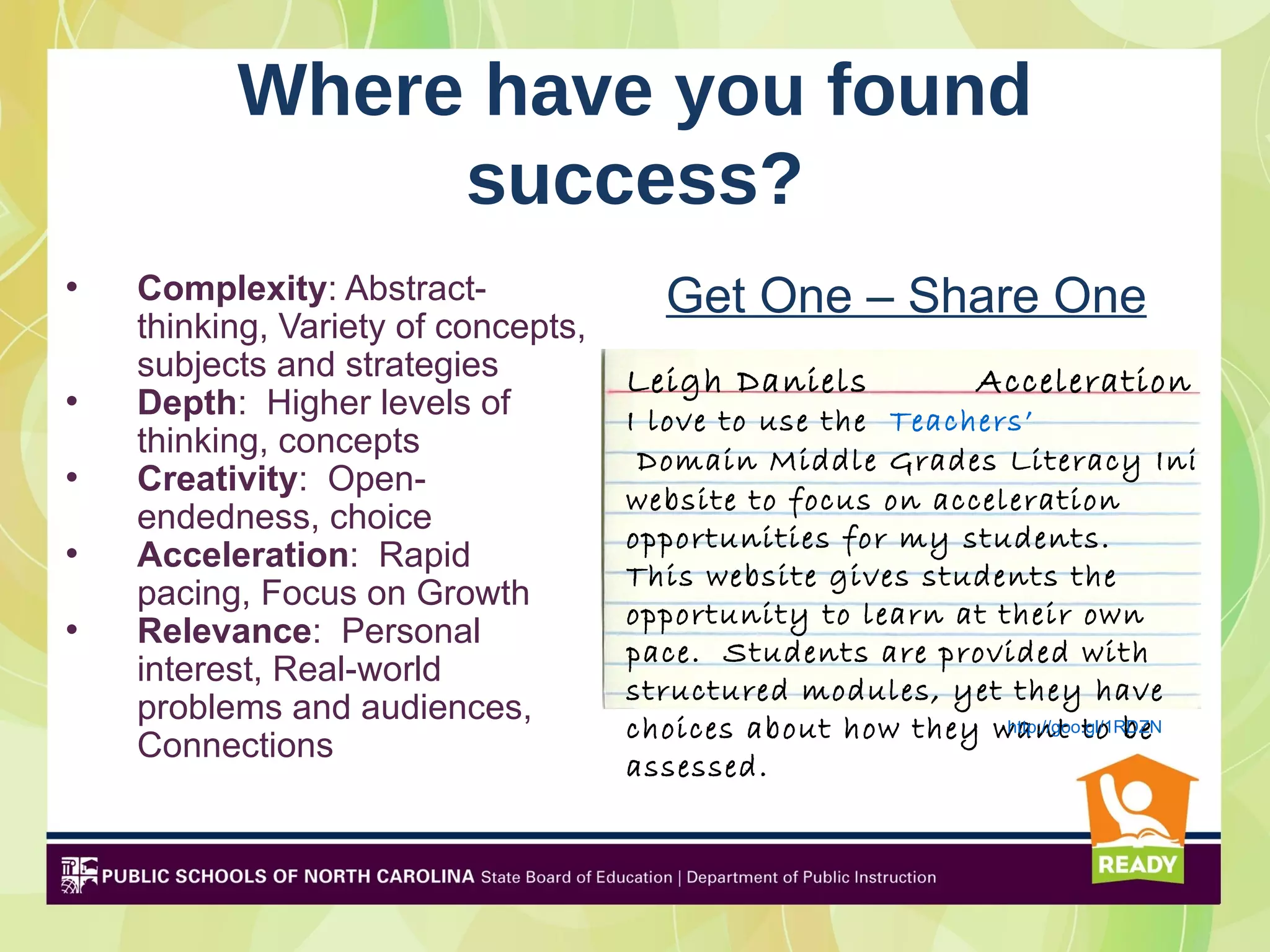
Where have you found
               success?
•   Complexity: Abstract-              Get One – Share One
    thinking, Variety of concepts,
    subjects and strategies          Leigh Daniels          Acceleration
•   Depth: Higher levels of          I love to use the Teachers’
    thinking, concepts                Domain Middle Grades Literacy Initiati
•   Creativity: Open-
                                     website to focus on acceleration
    endedness, choice
                                     opportunities for my students.
•   Acceleration: Rapid
                                     This website gives students the
    pacing, Focus on Growth
                                     opportunity to learn at their own
•   Relevance: Personal
                                     pace. Students are provided with
    interest, Real-world
                                     structured modules, yet they have
    problems and audiences,
                                     choices about how they want to be
                                                              http://goo.gl/1RDZN
    Connections
                                     assessed.
Universal Design
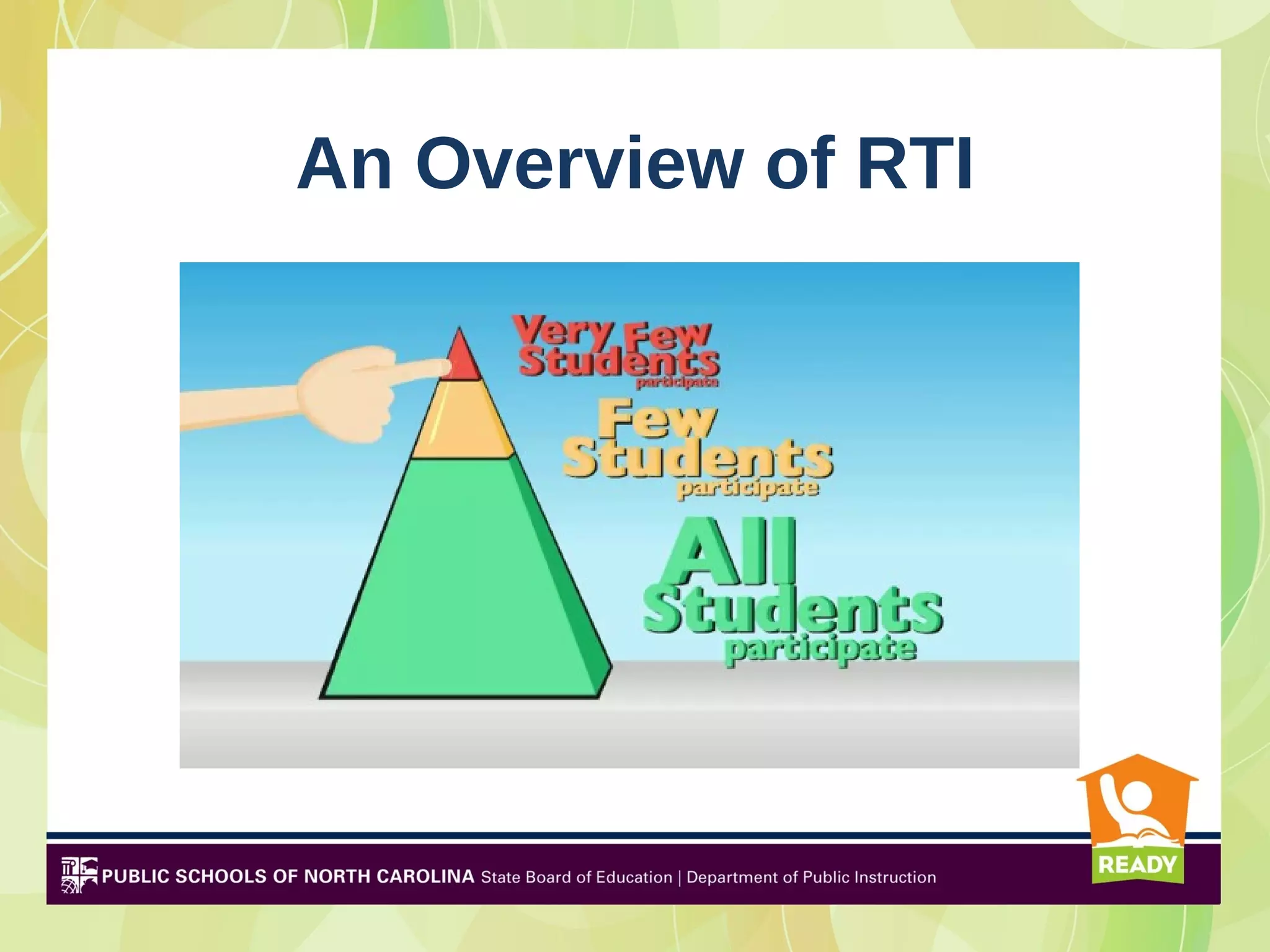
An Overview of RTI
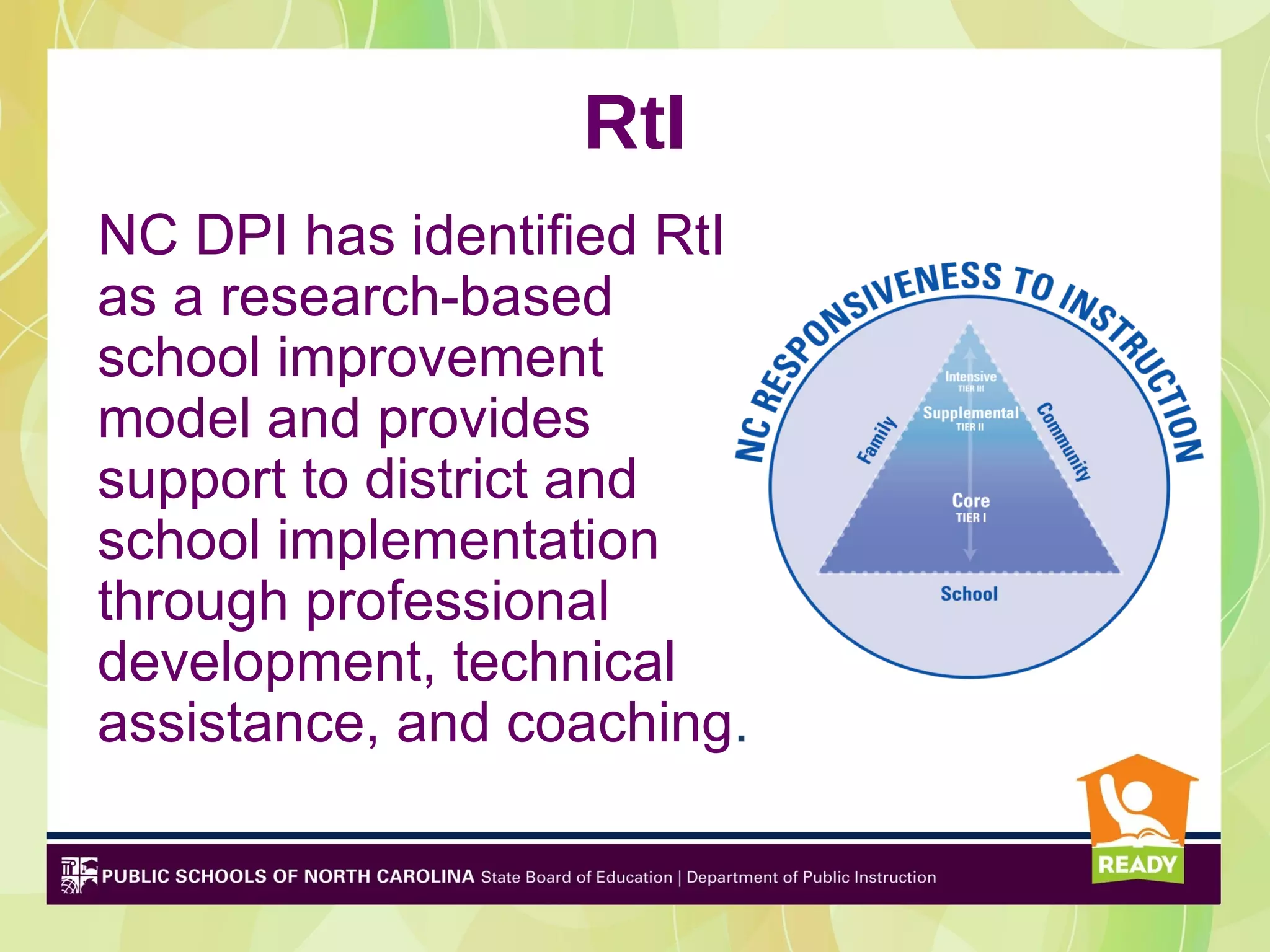
RtI
NC DPI has identified RtI
as a research-based
school improvement
model and provides
support to district and
school implementation
through professional
development, technical
assistance, and coaching.
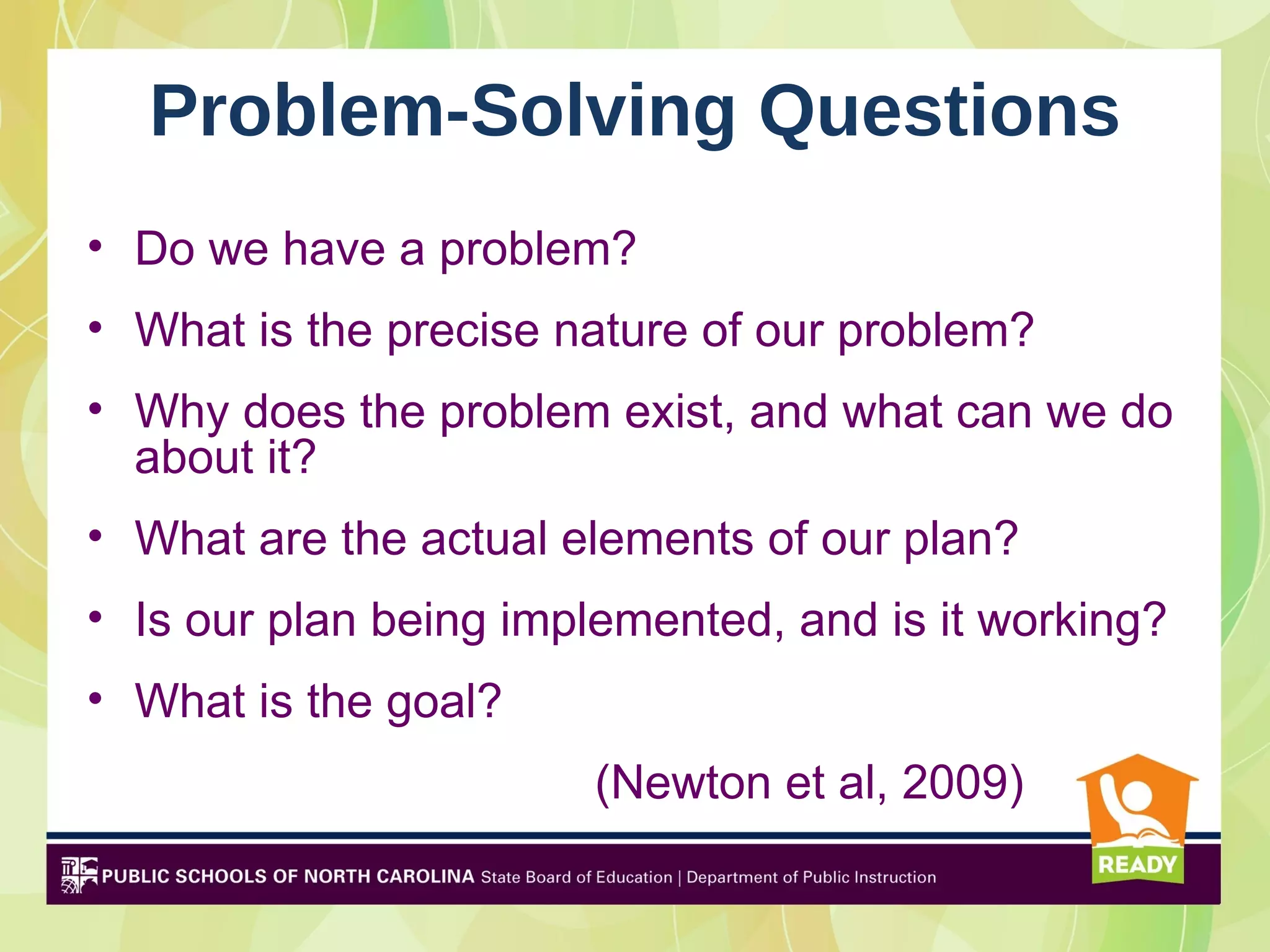
Problem-Solving Questions
• Do we have a problem?
• What is the precise nature of our problem?
• Why does the problem exist, and what can we do
  about it?
• What are the actual elements of our plan?
• Is our plan being implemented, and is it working?
• What is the goal?
                       (Newton et al, 2009)
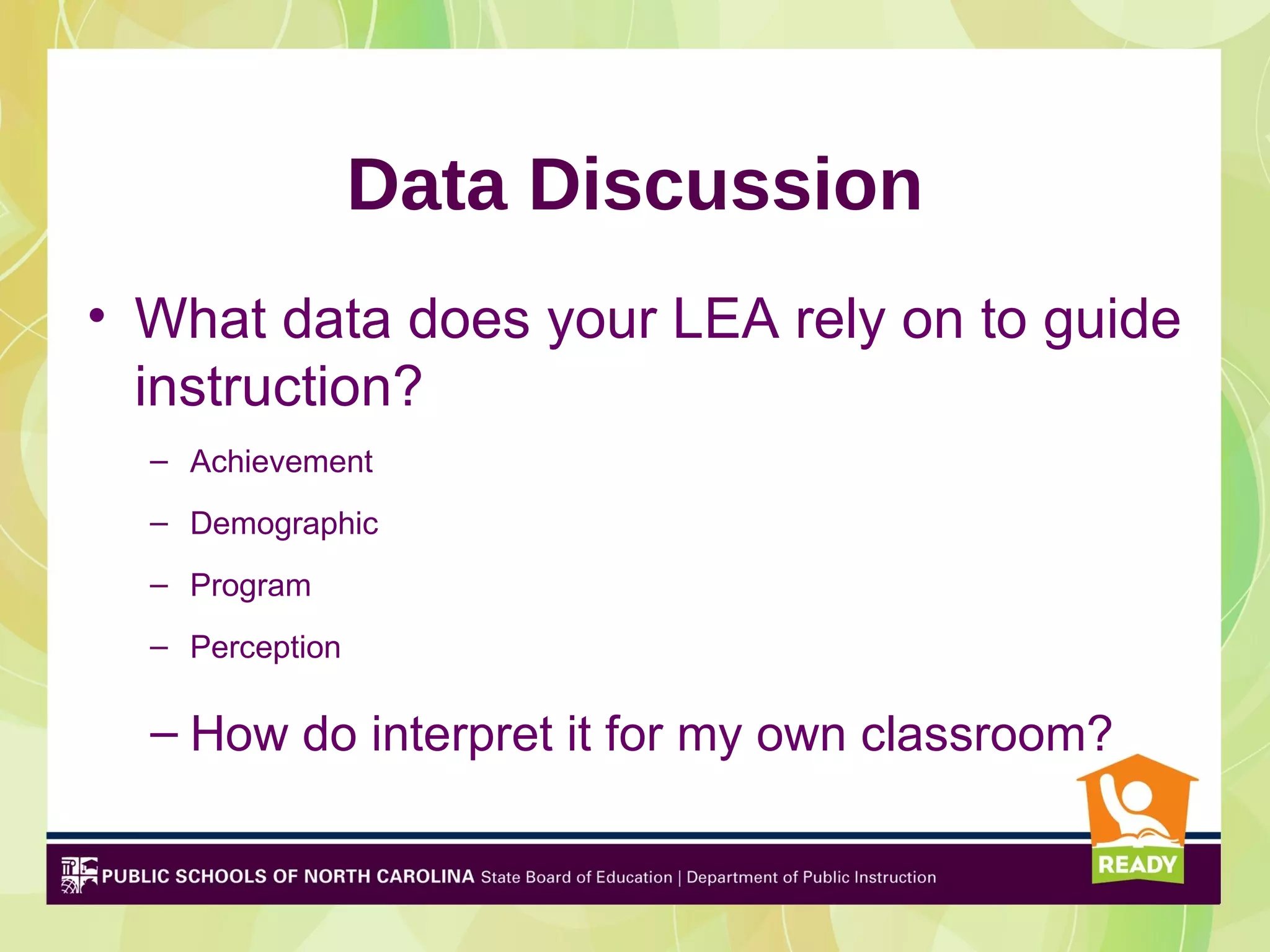
Data Discussion
• What data does your LEA rely on to guide
  instruction?
  – Achievement
  – Demographic
  – Program
  – Perception

  – How do interpret it for my own classroom?
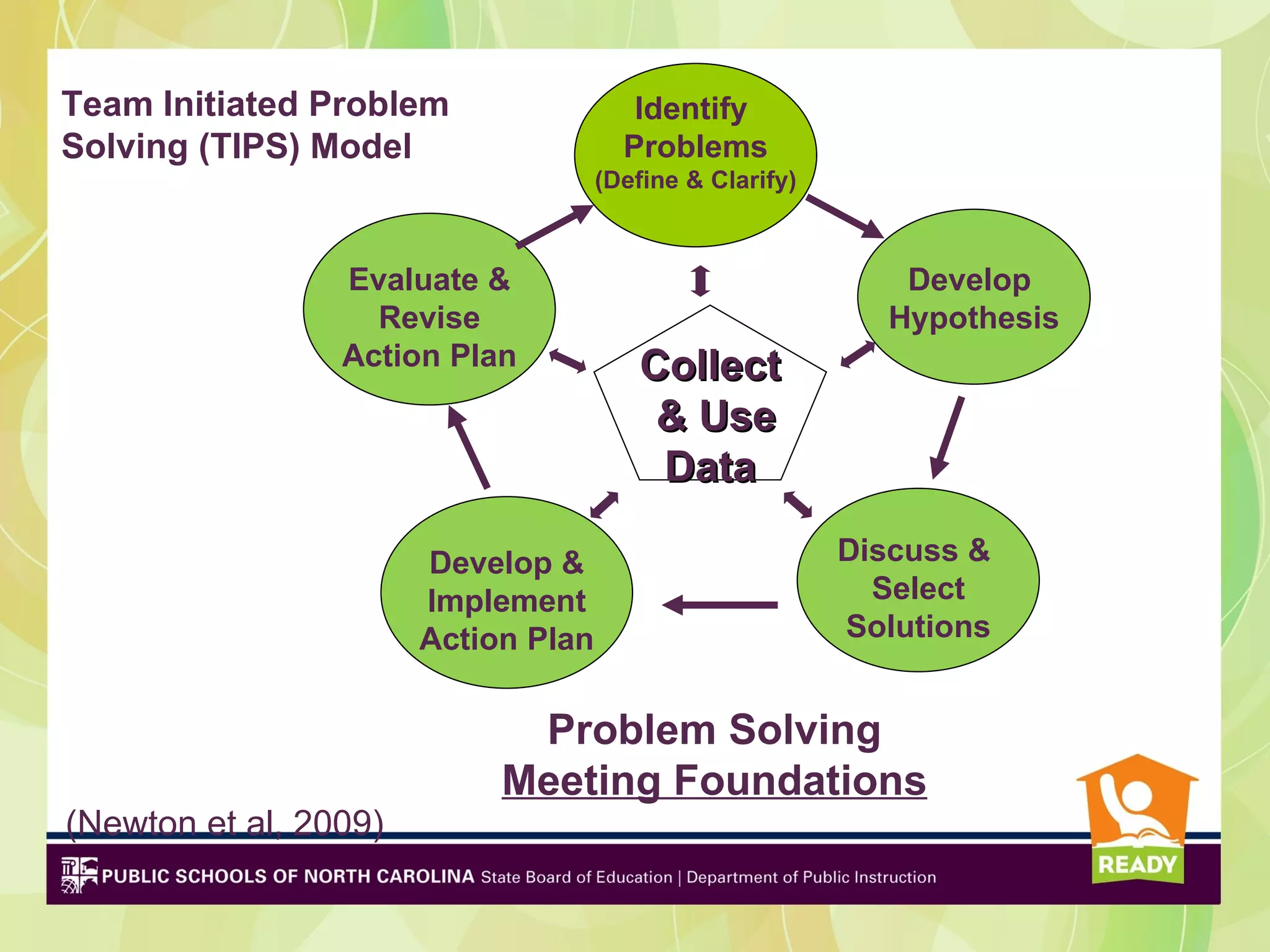
Team Initiated Problem                  Identify
Solving (TIPS) Model                   Problems
                                     (Define & Clarify)


                 Evaluate &                                  Develop
                   Revise                                   Hypothesis
                 Action Plan            Collect
                                         & Use
                                         Data

                       Develop &                          Discuss &
                       Implement                            Select
                       Action Plan                        Solutions


                             Problem Solving
                            Meeting Foundations
(Newton et al, 2009)
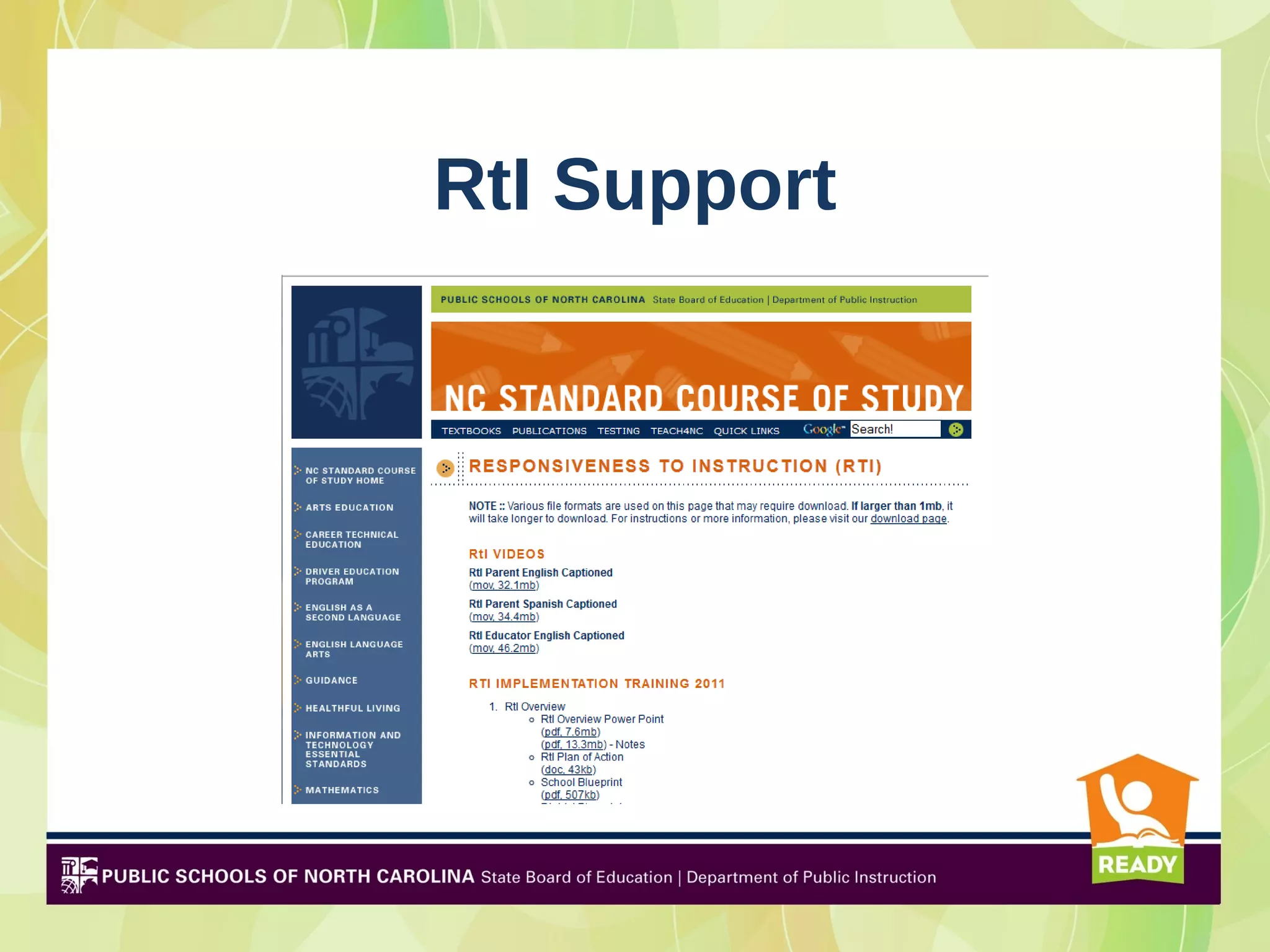
RtI Support
Universal Design
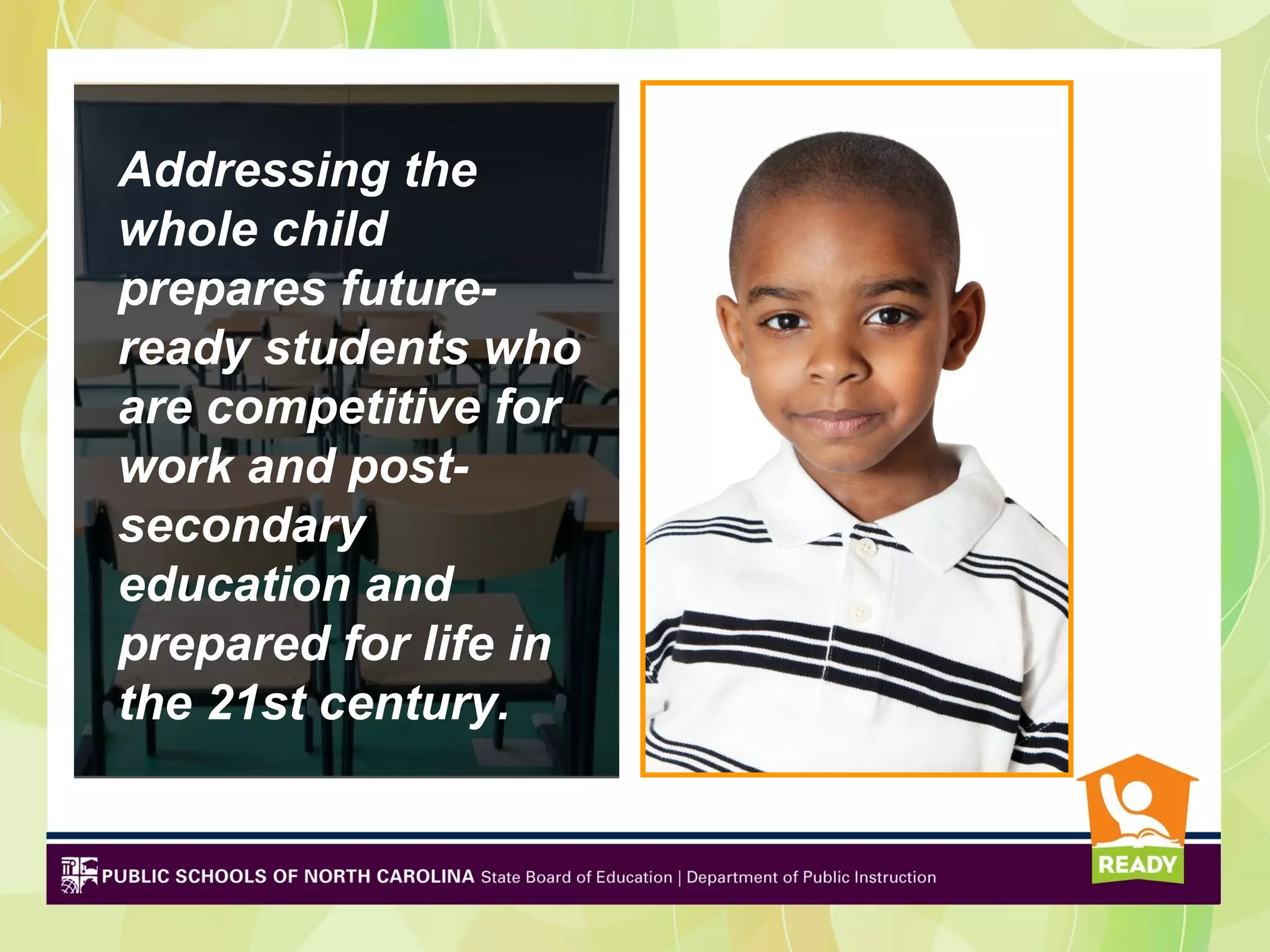
Addressing the
whole child
prepares future-
ready students who
are competitive for
work and post-
secondary
education and
prepared for life in
the 21st century.
1. How does this content
   area prepare students
   to be future ready?
2. How does this area
   connect to other
   content areas?
3. What are the
   implications for
   meeting the needs of
   all learners as related
   to this content area?

Connecting to Serve All

  • 1.
    Connecting to ServeAll Addressing Student Needs in an Era Of New Content Standards
  • 2.
    1. How doesthis content area prepare students to be future ready? 2. How does this area connect to other content areas? 3. What are the implications for meeting the needs of all learners as related to this content area?
  • 3.
    By the timemany students hit middle school, disengagement has become a learned behavior. ~Keely Potter, Reading Specialist
  • 4.
    Four Critical Questions •What do we want our students to learn? • How do we know that they have learned it? • What do we do if they have not learned it? • What do we do when they already know it?
  • 7.
    “Formative assessment isa process used by teachers and students during instruction that provides feedback to adjust ongoing teaching and learning to improve students’ achievement of intended instructional outcomes.” •Council of Chief State School Officers’ (CCSSO)
  • 8.
    Changing what wethink of as “State Assessments” This is what we’ve known • Constructed Response + • Performance Tasks Summative • Computer Adaptive Testing Instructional Improvement System’s flexible tools to Interim Tools •Diagnose Needs •Check Progress •Use data • NCFALCON • Online Writing Instruction Formative Processes • NC DIGINs • Professional Development around Formative Strategies
  • 9.
  • 10.
  • 11.
  • 12.
    Universal Design forLearning (UDL) A set of principles for curriculum development that applies to the general education curriculum to promote learning environments that meet the needs of all learners.
  • 13.
  • 14.
  • 15.
    UDL Principles Principle 1: Representation Principle 2: Principle 3: Action and Engagement Expression
  • 16.
    Principle I: Represent Multiple Means of Act/ Engage Representation Express http://goo.gl/fvqJS
  • 17.
  • 18.
    UDL requires MultipleMeans Represent of Representation. Act/ Engage Express Multiple Means of Representation Examples: Manipulatives Videos Visual Displays Music Anticipatory Guides Movement Graphic Organizers Text Readers Artifacts
  • 19.
    Multiple Means of Represent Representation for ELLs Act/ Engage Express Non-verbal Language Support • Modeling • Word banks • Pictures • Word walls • Realia/Concrete objects • Labels • Gestures • Graphic organizers • Manipulatives • Sentence starters • Demonstrations • Sentence frames • Hands-on • Picture dictionaries
  • 20.
    Principle II: Represent Multiple Means of Action Act/ Engage and Expression Express http://goo.gl/Rvjod
  • 21.
  • 22.
    Action/Expression Quick Draw Directions • Use a sheet of paper to create an image/ drawing that depicts a way that you provide students with opportunities to act or express themselves or their ideas. http://goo.gl/dHJqh 22
  • 23.
    Six-Step Partner • Finda six-step partner and share ideas. • Share an idea you like. http://goo.gl/Vb2g8
  • 24.
    UDL requires MultipleMeans Represent of Action and Expression. Act/ Engage Express Examples: Thumbs Up/Thumbs Response Hold-Up Down Cards Gallery Walks Quick Draws Pair/Share Numbered Heads Together Chalkboard/Whiteboard Splash Line-Ups
  • 25.
    Multiple Means of Represent Expressing for ELLs Act/ Engage Express • Role-play • Illustrations/ Drawings / Visuals • Gestures • First language
  • 26.
    Principle III: Represent Multiple Means Act/ Engage of Engagement Express
  • 27.
  • 28.
  • 29.
    UDL requires MultipleMeans Represent of Engagement. Act/ Engage Express Examples: Bounce Cards Concept Charades Air Writing Response Hold-Up Cards Case Studies Networking Sessions Role Plays Simulations
  • 30.
    Multiple Means of Represent Engagement for ELLs Act/ Engage Express • Student Interaction – Oral comprehension supports reading and writing development – Differentiate Collaborative Activities
  • 31.
  • 32.
  • 33.
    Just as thereare strategies for assisting the ELL student, there are strategies to move the AIG student even further…
  • 34.
    What do giftedlearners need in order to maximize their learning?
  • 35.
    Table Talk • Howdo the Common Core State Standards provide quality opportunities for high-end differentiation? http://goo.gl/VPVY8
  • 36.
    Gifted Education andnew NCSCOS • An opportunity for growth and collaboration with regular education and within the field of gifted. • Students may access more rigorous standards throughout the day, which would impact direct gifted education services and ensure access to more advanced education throughout the day. – A rising tide raises all ships. • Common Core State Standards align with and validate gifted education best practices, such as concept-based learning, integration of disciplines, and inquiry-based options.
  • 37.
    Why Gifted StudentsNeed Differentiated Learning For most.… •Faster pace of learning (2-3 repetitions) •Ability to synthesize information within and across disciplines (conceptual understanding) •Intensity of learning in area of interest •Precocity for information •Asynchronous development: Vary in Needs and Strengths
  • 38.
    Learning Needs ofGifted: Some, Not All: • Complexity: Abstract-thinking, Variety of concepts, subjects and strategies • Depth: Higher levels of thinking, concepts • Creativity: Open-endedness, choice • Acceleration: Rapid pacing, Focus on Growth • Relevance: Personal interest, Real-world problems and audiences, Connections
  • 39.
    Where have youfound success? • Complexity: Abstract- Get One – Share One thinking, Variety of concepts, subjects and strategies Leigh Daniels Acceleration • Depth: Higher levels of I love to use the Teachers’ thinking, concepts Domain Middle Grades Literacy Initiati • Creativity: Open- website to focus on acceleration endedness, choice opportunities for my students. • Acceleration: Rapid This website gives students the pacing, Focus on Growth opportunity to learn at their own • Relevance: Personal pace. Students are provided with interest, Real-world structured modules, yet they have problems and audiences, choices about how they want to be http://goo.gl/1RDZN Connections assessed.
  • 40.
  • 41.
  • 42.
    RtI NC DPI hasidentified RtI as a research-based school improvement model and provides support to district and school implementation through professional development, technical assistance, and coaching.
  • 44.
    Problem-Solving Questions • Dowe have a problem? • What is the precise nature of our problem? • Why does the problem exist, and what can we do about it? • What are the actual elements of our plan? • Is our plan being implemented, and is it working? • What is the goal? (Newton et al, 2009)
  • 45.
    Data Discussion • Whatdata does your LEA rely on to guide instruction? – Achievement – Demographic – Program – Perception – How do interpret it for my own classroom?
  • 46.
    Team Initiated Problem Identify Solving (TIPS) Model Problems (Define & Clarify) Evaluate & Develop Revise Hypothesis Action Plan Collect & Use Data Develop & Discuss & Implement Select Action Plan Solutions Problem Solving Meeting Foundations (Newton et al, 2009)
  • 47.
  • 48.
  • 49.
    Addressing the whole child preparesfuture- ready students who are competitive for work and post- secondary education and prepared for life in the 21st century.
  • 50.
    1. How doesthis content area prepare students to be future ready? 2. How does this area connect to other content areas? 3. What are the implications for meeting the needs of all learners as related to this content area?

Editor's Notes

  • #2 Introductory information (Overarching Philosophy for SI 2012): The theme for this Summer Institute is “Addressing Student Needs in an Era of New Content Standards.” Teaching the whole child allows us to address student needs in the context of new standards. By thinking about the purpose and role of each content area, how it connects to other areas of learning, and how students’ needs are met, we are able to ensure that students receive the appropriate instruction to allow them to be successful.
  • #3 As you participate in the workshop over these two days, please keep these questions in mind to help address the overall theme of the institute: “Addressing Student Needs in an Era of New Content Standards.” Discuss with your colleagues how your LEA or Charter School is making sure that students receive all areas of the Standard Course of Study. Where are the gaps? How are teachers integrating instruction across the curriculum to help students learn content and make connections? What support is needed? How are we differentiating to meet the needs of all learners? What strategies and infrastructure is in place to support meeting students ’ needs? NOTE: It is suggested that this slide be revisited during facilitated team time on Day 2 (to allow for cross-curricular discussions among teams) and/or at the end of the content session.
  • #4 Because connections are not being made…
  • #5 3 mins What links can we include here and or on a handout? Last year connections? Color code questions (Color code sections in PP) Make connection with last year’s work at Summer Institute… there is an organized way to move through these questions. Relate back to DuFour – foundation
  • #8 Evidence…. Throughout ELA standards, we talk about Evidence. Also bring up the RTI, UDL, and Differentiation…. That formative assessment is …. MORE IMPORTANT THAN EVER
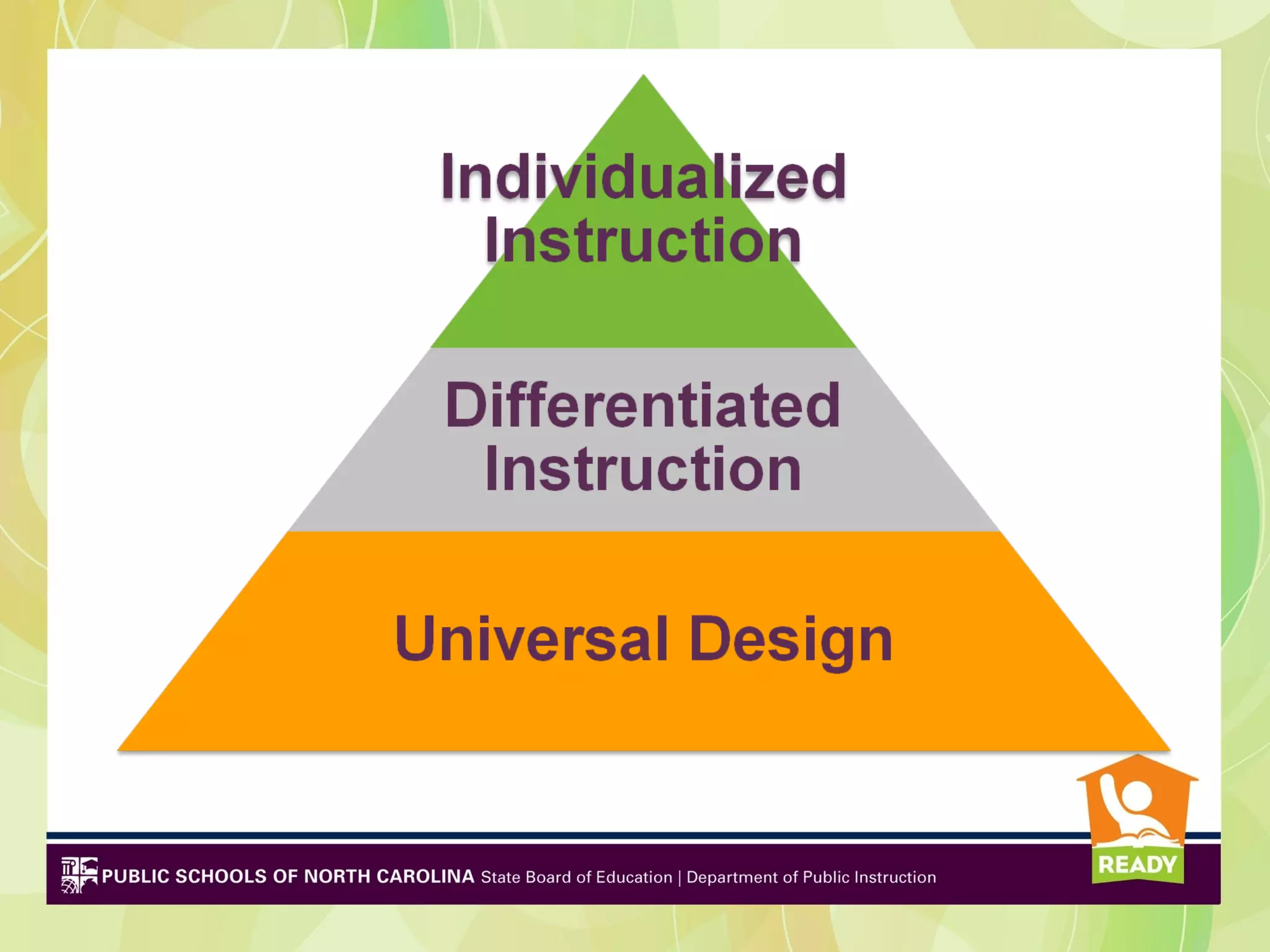
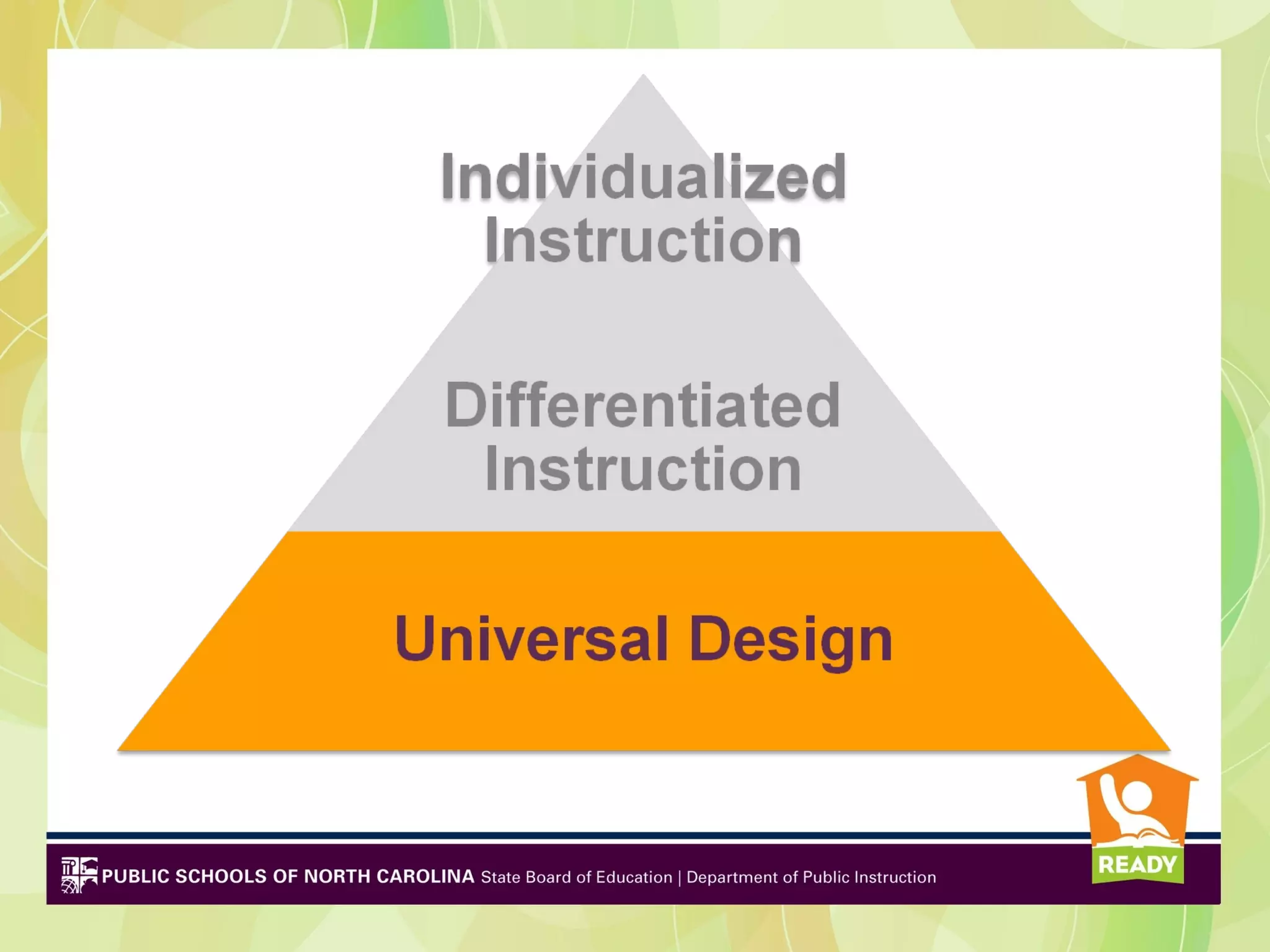
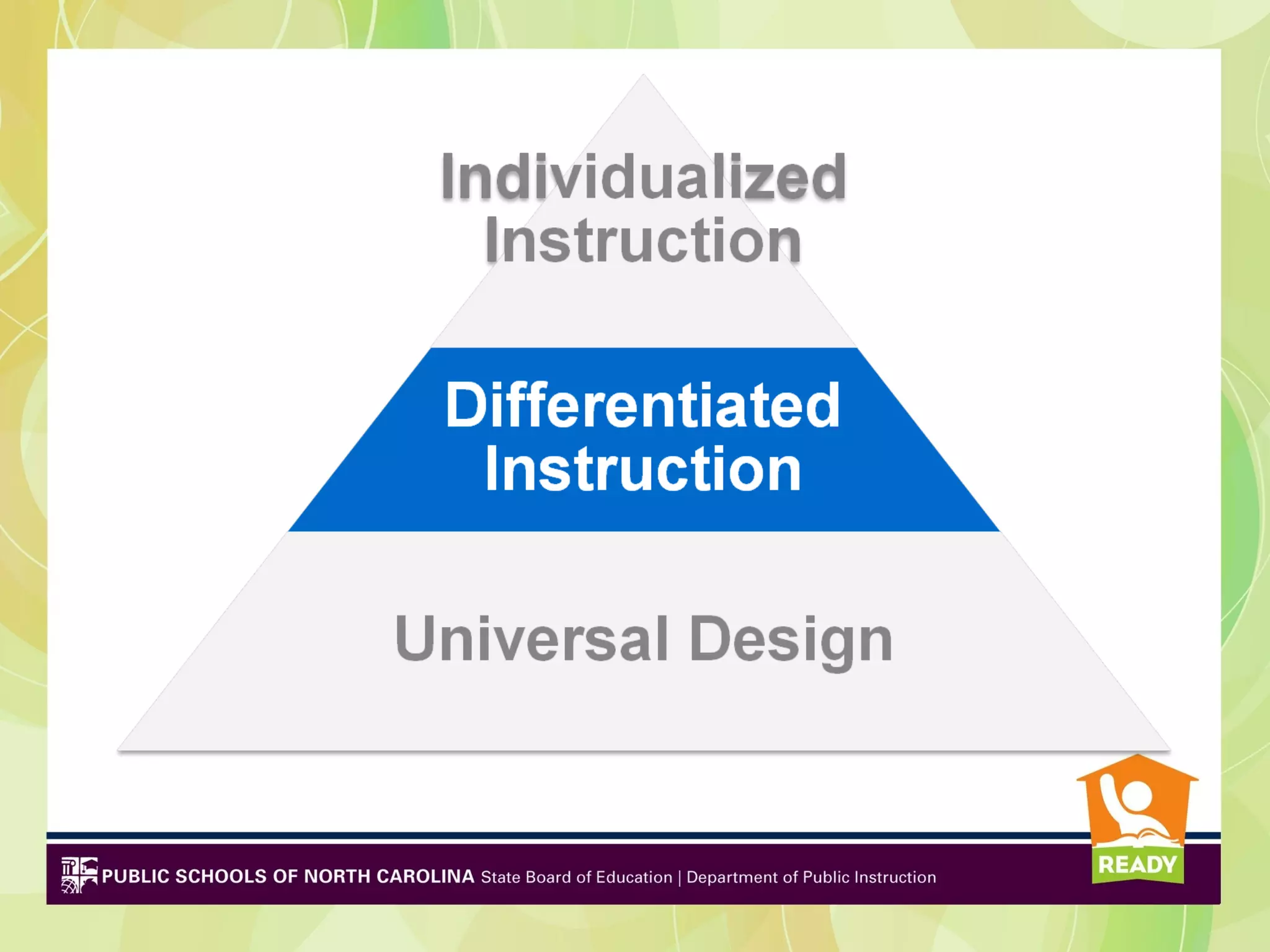
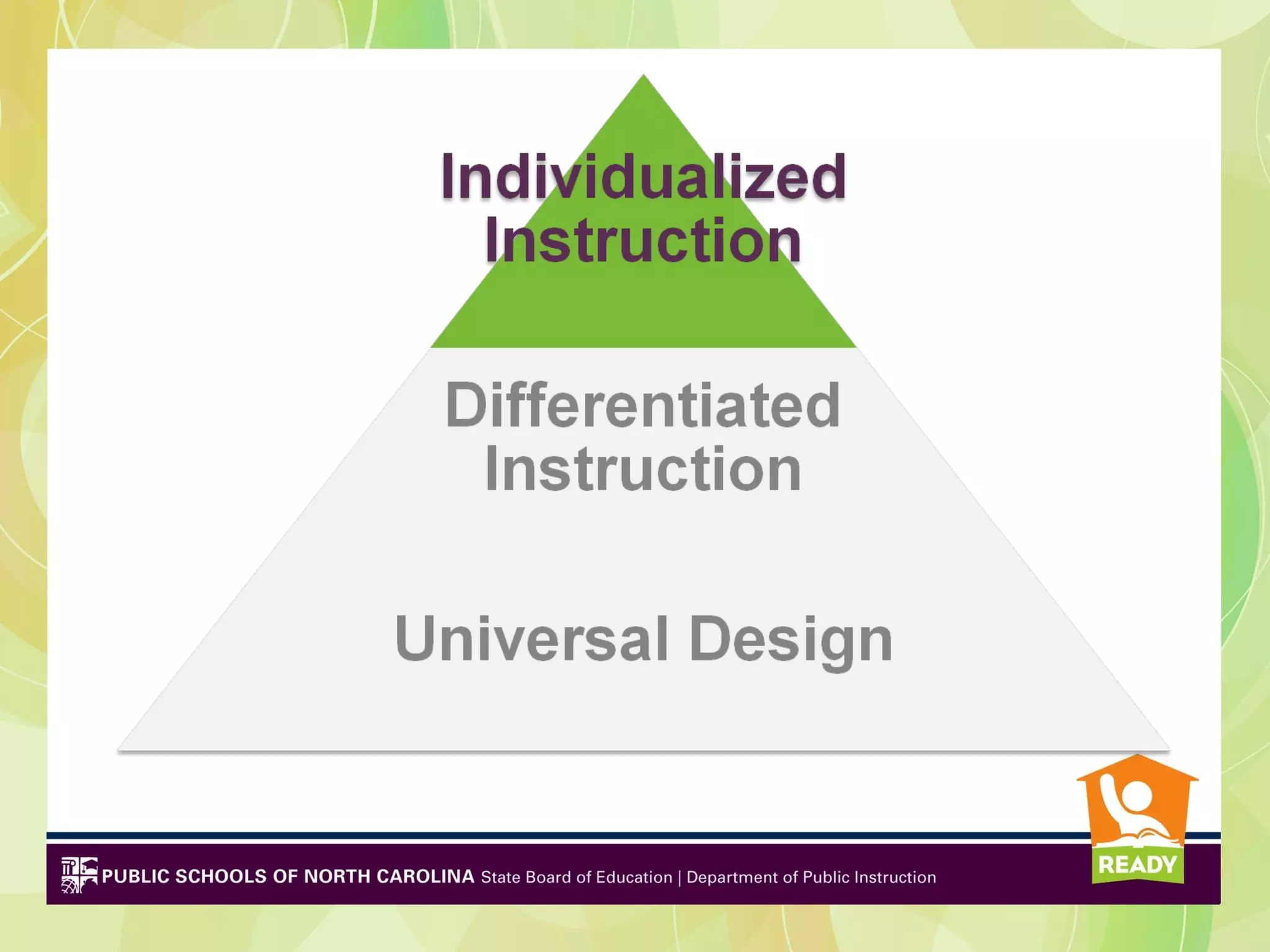
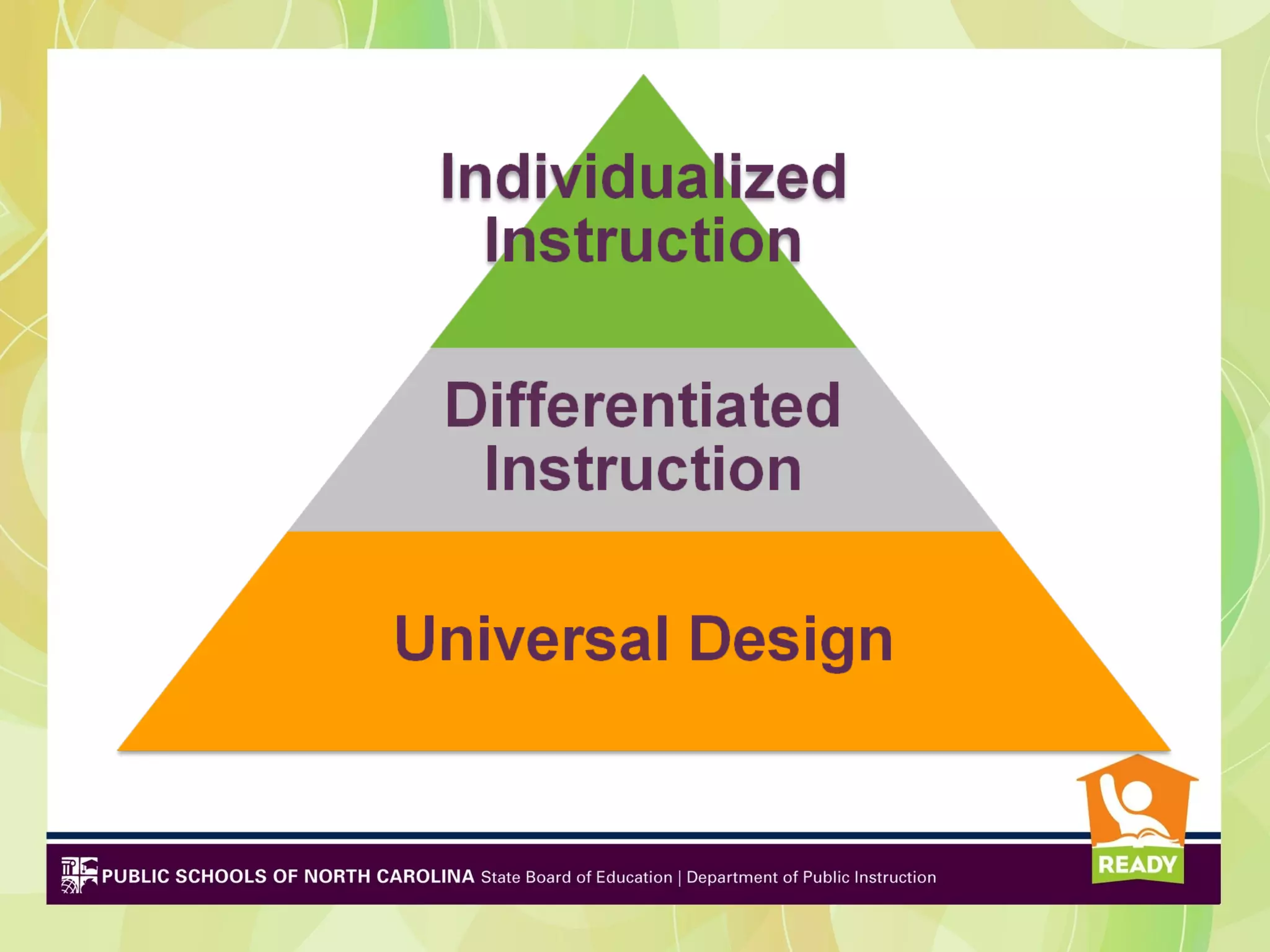
  • #10 When embraced or actualized with all students in mind, universal design would be the foundation of instructional practice. If students continue to struggle after instructed by a teacher utilizing universal design, the next course of action would be differentiated instruction, followed by individualized instruction. This is the framework for appropriate instruction or the best practice to use to meet the needs of all students.
  • #11 When embraced or actualized with all students in mind, universal design would be the foundation of instructional practice. If students continue to struggle after instructed by a teacher utilizing universal design, the next course of action would be differentiated instruction, followed by individualized instruction. This is the framework for appropriate instruction or the best practice to use to meet the needs of all students.
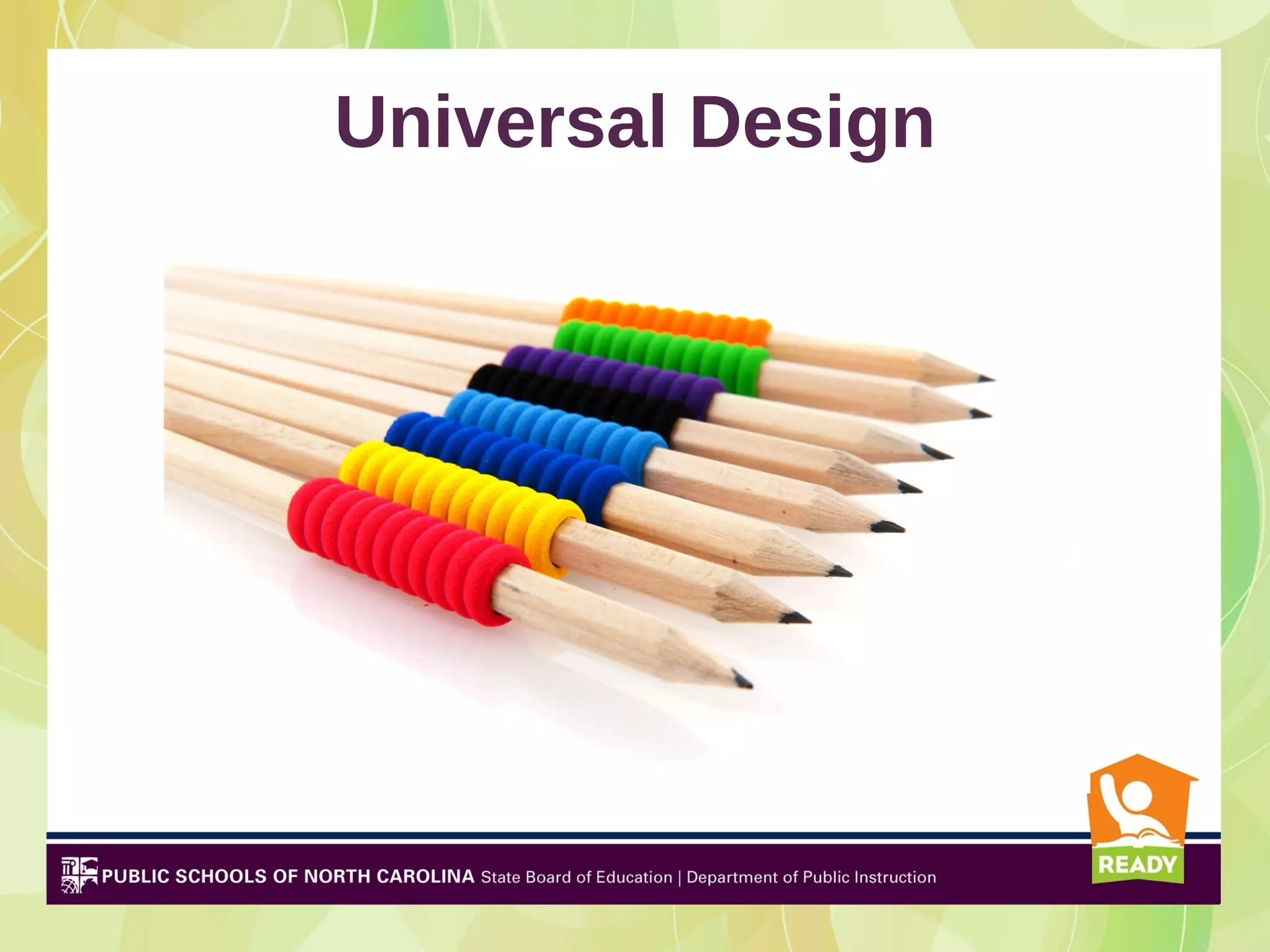
  • #12 Fist to Five – Understanding of Universal Design Create a multi-numbered group – If you have a 1, find a new group of a 2, 3, 4, and 5. No group can be more than five people. You can have a smaller group. However, the goal is to join a group in which there are varying levels of understanding. Once in your group, share ideas for two minutes about Universal Design. Share out one big idea per group. UDL can be as varied as the use of pencil grips, mind maps, or allowing students to use notes or a partner to complete an assignment. The important thing to remember is that the scaffolding of the lesson is built in ahead of time.
  • #13 With UDL, students are more… Engaged in their own learning Learning at greater breadth and depth Achieving at higher levels Motivated to continue learning
  • #14 Share this site: National Center on UDL http://www.udlcenter.org/ Video is linked.
  • #15 http://goo.gl/f9dwY Shared understanding What do you already do in your daily planning, unit planning, etc. to promote learning environments that meet the needs of all learners? Best ideas…
  • #16 Universal Design is the foundation of what we need to do for all students. After setting the goals and considering barriers. Eliminate the barriers by incorporating the 3 principles of UDL. Multiple means of Representation: Graphs, Charts, multimedia. Number two-Action & Expression- Give students multiple means of expressing . Number 3: Provide multiple means of engagement, what is motivating to one student will not be for another. Give students choices, help them feel safe taking risk and making mistakes. Remember the goal is to eliminate the barriers that are often present in curriculum.
  • #17 The what of learning To give diverse learners options for acquiring information and knowledge Present content in a variety of formats and modalities
  • #18 Discussion – partner talk. Share out big ideas.
  • #19 Provide information and content in different ways Perception – customizing the display of information or offering alternatives for visual or auditory information such as varying the size of text, the contrast of color in text or images, the volume or rate of speech, the layout of visual or other elements, the fonts, use of ASL, books on tape, providing physical objects to convey perspectives or interaction Language, expressions, and symbols – Clarifying vocabulary, syntax, and structure, promoting understanding across languages, illustrating through multiple media – preteach vocabulary, provide electronic translation tools or links to multilingual glossaries on the web, embed visual, non-linguistic supports for vocabulary clarification (pictures, videos, etc.) Comprehension – Activating or supplying background knowledge, highlighting patterns, critical features, big ideas, guiding information processing, maximizing transfer and generalization
  • #20 [UDL Principle I: Provide Multiple Means of Representation (the “what” of learning).] Non-verbal representation is important for English language learners as, by definition, their English language skills are weak. M ake use of the five senses: sight, touch, smell, hearing, and taste in representation. Model content and academic language so students can see and hear; bring in real objects (also referred to as concrete objects or realia) so students can see, touch, smell, and perhaps taste the object.; use math manipulatives so students can see and touch math concepts, etc. Representation that provides language support is critical. Word banks, work walls, labels provide vocabulary. Sentence starters and sentence frames which provide explicit language forms should be used to move students along the language continuum from the entering level to that of proficiency.
  • #21 (the “how” of learning). Learners differ in the ways that they can navigate a learning environment and express what they know. For example, individuals with significant movement impairments (e.g., cerebral palsy), those who struggle with strategic and organizational abilities (executive function disorders), those who have language barriers, and so forth approach learning tasks very differently. Some may be able to express themselves well in written text but not speech, and vice versa. It should also be recognized that action and expression require a great deal of strategy, practice, and organization, and this is another area in which learners can differ. In reality, there is not one means of action and expression that will be optimal for all learners; providing options for action and expression is essential.
  • #25 Differentiate the ways that students can express what they know. You may switch these examples for content specific examples. Quick Draws- Students quickly illustrate their understanding of a complicated or abstract idea through a drawing. Chalkbord or Whiteboard Splash- Students are asked one question and each student puts their response on a portion of the chalkboard/whiteboard for everyone to see. Line-Ups- Students take a position on a topic by lining up on different sides of the room. Numbered Heads- Each is student is accountable for information they have learned in their group. Students count off and then form groups based on their numbers. During debrief call out the number of the student who will be presenting for the group. Physical Action – Vary the methods for response and navigation; optimize access to tools and assistive technologies (use of the computer rather than written form, use of speech to text devices, touch screens, customized functions of keys on the keyboard, etc) Expression and communication – Use multiple media for communication; Use multiple tools for construction and composition; Build fluencies with graduated levels of support for practice and performance (use of drawing, film, music, dance/movement, social media, storyboards, spellcheckers, calculators, story webs, concept mapping, manipulatives, web applications like Wikis, Power Point, etc.) Executive Function – Provide models of process and product of goal setting, guides and checklists; post goals, objectives, and schedules in an obvious place, embed prompts to “show and explain your work”, provide graphic organizers, provide checklist and guides for note-taking, use assessment checklists, scoring rubrics, and multiple examples of annotated student work/performance examples)
  • #26 [UDL Principle II: (the “how” of learning).] Learners differ in the ways they navigate a learning environment and express what they know. There is not one means of action and expression that will be optimal for all learners; providing options for action and expression is essential for ELLs. English language learners have limited knowledge of social and academic English. They may understand a concept, but not be able to express comprehension in English. Differentiating instruction to include role-play, illustrations, gestures and focused use of their first language allows greater access to academic content. First language (L1) development is important in the acquisition of the second language. The stronger a student is in his first language, the easier it is to learn a second language. The L1 can be used to clarify concepts and/or directions for classroom activities/procedures. ELLs may use their first language to help each other, tutor, ask and answer questions, use a bilingual dictionary, or clarify information.  Teachers may use the student ’s first language to check comprehension, explain an activity, provide books in languages other than English, and build relationships with students and families.
  • #27 (the “why” of learning). Affect represents a crucial element to learning, and learners differ markedly in the ways in which they can be engaged or motivated to learn. There are a variety of sources that can influence individual variation in affect including neurology, culture, personal relevance, subjectivity, and background knowledge, along with a variety of other factors presented in these guidelines. Some learners are highly engaged by spontaneity and novelty while other are disengaged, even frightened, by those aspects, preferring strict routine. Some learners might like to work alone, while others prefer to work with their peers. In reality, there is not one means of engagement that will be optimal for all learners in all contexts; providing multiple options for engagement is essential.
  • #29 Photo is linked to the TCH website.
  • #30 Stimulate interest and motivation for learning Bounce Cards – Student takes what another student has said or shared and bounces an idea off of it. Recruiting interest – provide choice in how an objective can be reached and allow learners to participate in the design of classroom activities and academic tasks; ensure cultural and personal relevancy Sustaining effort and persistence – flexible grouping, implement a plan for positive behavior intervention and supports (PBIS), construct communities of student learners (CSLs), peer tutors Self regulation – support activities that encourage self-reflection and identification of personal goals; a key factor in learners losing motivation is their inability to recognize their own progress so it ’s important they have multiple models and scaffolds of different self assessment techniques so that they can identify and choose ones that are optimal for their unique needs.
  • #31 [UDL Principle III : How learners get engaged and stay motivated. How they are challenged, excited or interested. These are affective dimensions.] Interaction is extremely important for ELLs. They must use the English language to make it their own and to learn its nuances. Asking ELLs to perform an incomprehensible task is counter-productive. Providing structured collaborative activities is one way to facilitate meaningful practice of academic language in preparation for whole group presentations. Oral language development promotes proficiency in reading and writing in English. Collaborative activities increase opportunities for student interaction. ELLs may be able to accomplish a task that would be too difficult to carry out on their own under the guidance of another more proficient student. Activities should be structured to encourage less proficient ELLs to observe, listen, and gradually begin to collaborate in the activity, finally doing the task themselves. But ELLs should be grouped depending upon the particular activity and characteristics of the students. Because interaction with peers is a necessary step on the way to language acquisition, higher proficient ELLs may be expected to lend first language support to a lower proficient ELL in one activity but be allowed to interact with stronger students in another. Of course, English language proficiency is not the only criterion for grouping.
  • #32 Tell participants – 5 minutes in room.
  • #33 When embraced or actualized with all students in mind, universal design would be the foundation of instructional practice. If students continue to struggle after instructed by a teacher utilizing universal design, the next course of action would be differentiated instruction, followed by individualized instruction. This is the framework for appropriate instruction or the best practice to use to meet the needs of all students.
  • #34 Add audio here
  • #35 Table Talk Brainstorm
  • #36 Specific to ELA… complex texts, higher-order questioning, thinking critically about texts, evidence, going deeper with the standards for gifted… content, process, product, or learning environment, staircase of complexity – stretching students…. Point of frustration to support growth and grappling…no ceiling.
  • #39 Index Cards – Groups and share out. (Look for a new idea here.) Tomorrow, as you begin to create lessons, look for explicit opportunities to integrate some of these ideas.
  • #40 Direct them to trainer notes Directions for Share One – Get One On an index card, write
  • #41 When embraced or actualized with all students in mind, universal design would be the foundation of instructional practice. If students continue to struggle after instructed by a teacher utilizing universal design, the next course of action would be differentiated instruction, followed by individualized instruction. This is the framework for appropriate instruction or the best practice to use to meet the needs of all students.
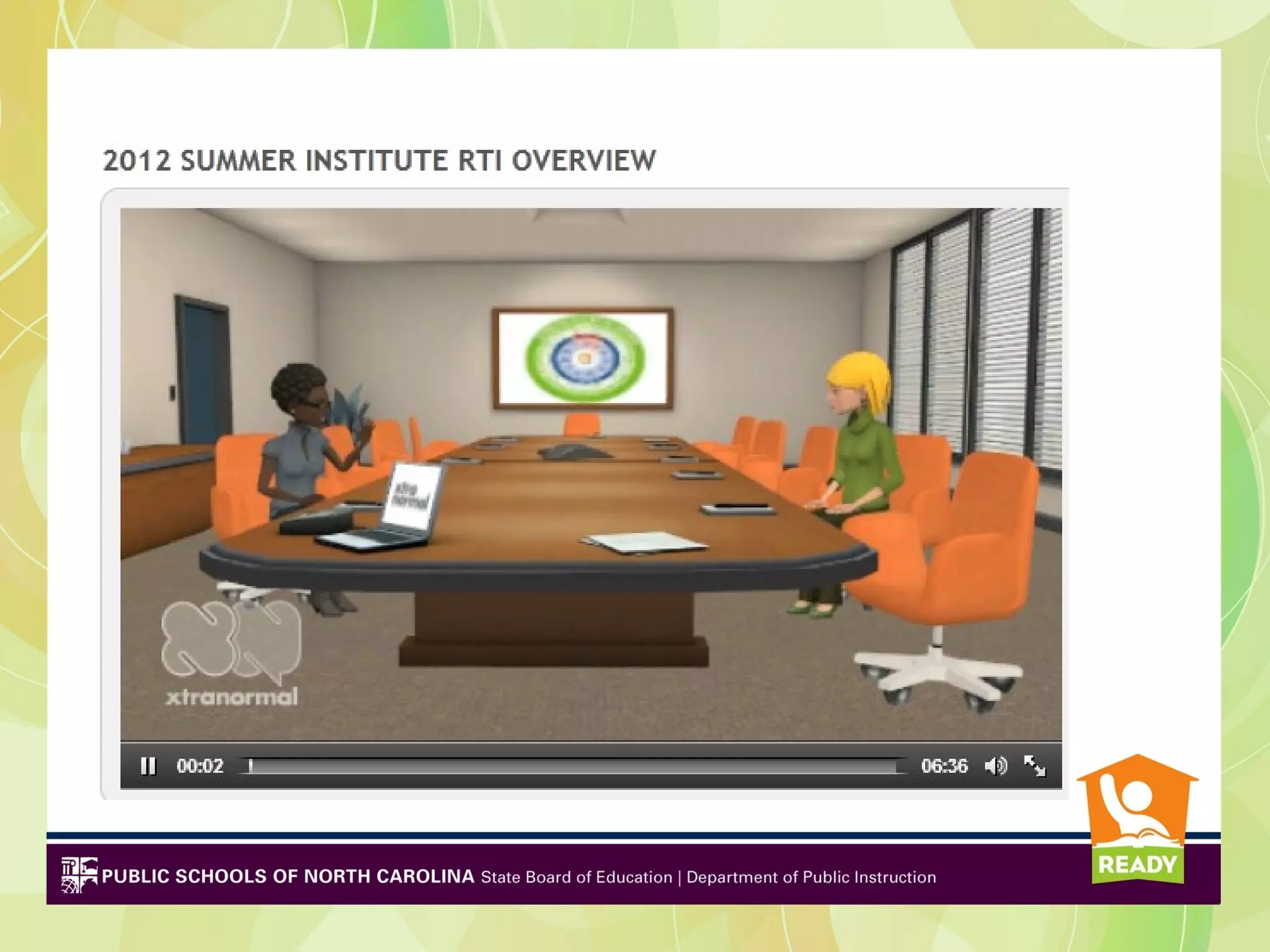
  • #42 http://www.youtube.com/watch?v=nkK1bT8ls0M
  • #43 Thumbs up and Thumbs down…. Avatars or video of presenters discussing RtI for this section. Voki Responsiveness to Instruction (RtI) is a multi-tiered framework which promotes school improvement through engaging, high quality instruction. Problem: Difference between expected/desired outcome and current outcome Problem identification: Finding a difference & determining if it is significant enough to require action now Problem solving: Figuring out how to eliminate or reduce difference (Newton et al, 2009)
  • #44 http://www.xtranormal.com/watch/13512359/2012-summer-institute-rti-overview-remix
  • #45 20 mins (Much of this will be absorbed into the voci) Do we have a problem? (identify) What is the precise nature of our problem? (define, clarify, confirm/disconfirm inferences) Why does the problem exist, & what can we do about it? (hypothesis & solution) What are the actual elements of our plan? (Action Plan) Is our plan being implemented, & is it working? (evaluate & revise plan) What is the goal ? (What will it look like when there is not a problem?) An instructional example: Identify Problem: A teacher identifies that some of her students did not perform well on a classroom reading formative assessment. Her first step would be to more clearly define the problem using the data from the assessment: how many students did not meet the performance goal? How far off the target were they? What, if any, are the commonalities between the questions the students missed? Develop Hypothesis: Once the problem is well defined, the teacher would begin to develop a hypothesis about the reason. Looking at the data (both from the current assessment and other data collected), what are the underlying skill or performance deficits creating the students ’ difficulties? Is the problem a lack of decoding skills, fluency, comprehension, etc? Do all of the students in the group have the same needs? Discuss & Select Solutions: Based on the data & hypothesis, the teacher would brainstorm possible solutions to address the needs of the students, then select a solution to try based on the intensity & frequency of the students ’ needs. Develop & Implement Action Plan: Once a solution is selected, the teacher would develop a plan to put the solution in place. When will the solution happen? Who will do it? What materials/tools will be needed? What data will be collected? How will you know if the solution worked? Evaluate & Revise Action Plan: Once the solution has been implemented, the data is examined to see if the problem is solved, or if plan needs to be revised an re-implemented.
  • #46 Types of Data   There are basically four types of data collected and used as indicators of school or district success and progress: achievement data, demographic data, program data and perception data. Achievement data is used to determine the level of student achievement in a particular content area (e.g., performance-based assessments, written exams, quizzes). Demographic Data are descriptive information about the school community such as enrollment, gender, ethnicity, economic status, student attendance, grade levels, school suspensions and behavioral problems. Program Data define the programs, instrucional strategies and classroom practices of the teachers. Program data collected may be useful in making informed decisions about future program and curriculum choices. Perception Data tells us what students, parents, staff and others think about the learning environment. They include questionnaires, interviews, surveys and observations. Collecting and evaluating perception data allows educations to pay attention to the opinions and ideas of the community. Tool to do: brainstorm data sources individually, categorize into 4 areas with buddy, share out as group
  • #47 Many LEAs use this model for School Improvement Plans. The TIPS Model includes multiple components. While the TIPS process was designed to improve team decision-making about school-wide problems, the steps of the process are just as effective when used informally by a teacher problem-solving in the classroom. The TIPS process is grounded by Meeting Foundations which include structures and processes to increase the effectiveness and efficiency of team operations. Data-based decision-making is integral to the TIPS process, and so is located in the center of the graphic. At each stage of the problem solving process, the team ’s use of data is critical to inform decision-making. The first step of the TIPS process is to identify and clearly define the problem . Teams are encouraged to identify as much information about the problem as possible (what, when, where, who, why) The next step is to use this information about the problem to develop a hypothesis , or why the team thinks the problem exists. The hypothesis is used to begin generating solutions . Teams should look for solutions that will reduce or eliminate the problem, while addressing the reason the problem exists. Once the team has selected the solutions they believe will be most effective, the team will develop an action plan to put those solutions in place, including details for how the solutions will be implemented. After the action plan has been implemented for several weeks, the team meets again to evaluate the action plan and revise as necessary, based on the data collected during the implementation of the plan. 06/19/12 Newton, J. S., Todd, A. W., Algozzine, K., Horner, R. H., & Algozzine, B. 2008
  • #48 Web page is linked:
  • #49 When embraced or actualized with all students in mind, universal design would be the foundation of instructional practice. If students continue to struggle after instructed by a teacher utilizing universal design, the next course of action would be differentiated instruction, followed by individualized instruction. This is the framework for appropriate instruction or the best practice to use to meet the needs of all students.
  • #50 It is our continued charge as a state and as a country to find ways to ensure that our students are future-ready. North Carolina high school graduates must be better prepared for college and possess the skills necessary for careers in today's and future economies. A whole child education, as delivered through all content areas defined in the Basic Education Program, ensures that students are healthy, safe, engaged, supported, and challenged. Teaching the whole child provides students with the knowledge, skills, and abilities to transfer and connect ideas and concepts across disciplines and prepares future-ready students who are competitive for work and post-secondary education and prepared for life in the 21 st century. NOTE: It is suggested that this slide be used as a closing at the very end of the Content Sessions
  • #51 NOTE: It is suggested that this slide be revisited during facilitated team time on Day 2 (to allow for cross-curricular discussions among teams) and/or at the end of the content session. Graffiti Write activity using sticky notes