Conjunctive Adverbs
and Transitions
6th
Grade English
What do we know about
conjunctions?
Conjunctions
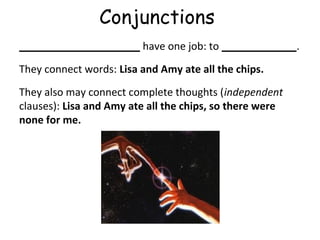
Conjunctions have one job: to connect.
They connect words: Lisa and Amy ate all the chips.
They also may connect complete thoughts (independent
clauses): Lisa and Amy ate all the chips, so there were
none for me.
Conjunctive Adverbs
Conjunctive adverbs are connectors too.
They join words, phrases, clauses or even whole
paragraphs to give writing “flow.”
Lisa and Amy ate all the chips, so there were none for me.
I decided not to share my popcorn with them.
A little choppy? This one is better:
Lisa and Amy ate all the chips, so there were none for me.
Therefore, I decided not to share my popcorn with them.
Even though they look like conjunctions, they
are adverbs because they modify a verb.
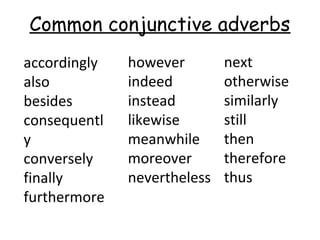
accordingly
also
besides
consequentl
y
conversely
finally
furthermore
Common conjunctive adverbs
however
indeed
instead
likewise
meanwhile
moreover
nevertheless
next
otherwise
similarly
still
then
therefore
thus
Add information
also
additionally
furthermore
besides
moreover
Result
consequently
therefore
thus
Functions of conjunctive adverbs
To sequence
or show time
finally
next
then
meanwhile
Comparison
likewise
similarly
also
Contrast
however
despite
although
instead
rather
conversely
otherwise
s
Summarize
indeed
for example
certainly
To reinforce
thus
finally
above all
all in all
in conclusion
1. The aquarium closed at 6; consequently, we didn't get to see the sharks. (result)
2. Your dog got into our yard; furthermore, he dug up all the flowers. (adding information)
3. Erin finished her social studies homework; meanwhile, Eric worked on his narrative. (time)
4. Halloween is for those who like thrills; likewise, romantics love Valentine's Day.
(comparison)
5. We wanted to bring our dog on vacation. However, the resort doesn’t allow pets. (contrast)
6. Alicia was the only student to solve the math problem; she is a clever girl indeed. (reinforce)
7. The platypus is a mammal that lays eggs, has a bill like a duck, and is poisonous. All in all, it's
a very odd creature! (summarize)
Try this...
Leon's apartment complex does not allow dogs
over thirty pounds.
He would have adopted the Great Dane from the
animal shelter.
Leon's apartment complex does not allow dogs
over thirty pounds; ______________, he would
have adopted the Great Dane from the animal
shelter.
Try this...
The dark skies made Clarice rethink her run.
She had 30 math problems to solve before class.
The dark skies made Clarice rethink her run;
________________, she had 30 math problems
to solve before class.
Punctuation & conjunctive adverbs
There are several ways to punctuate conjunctive
adverbs.
When a conjunctive adverb connects two
independent clauses (two complete
thoughts), it comes after a semicolon and
before a comma.
After mowing the yard in the hot sun, Pete
was too hungry to shower; however, he did
wash his dusty hands.
Punctuation & conjunctive adverbs
When you have an independent clause
(complete thought) and a dependent clause
(a fragment), you can use a comma on
either side of the conjunctive adverb.
Maria declined Jeff's third invitation to go
out. The young man is determined,
nevertheless, to take her to dinner soon.
Punctuation & conjunctive adverbs
Sometimes you can make two complete
sentences with a comma after the
conjunctive adverb.
At 10 a.m., Paul was supposed to be taking
his English test. Instead, he was in bed with
the flu.
Debrief
Watch the Schmoop video over conjunctive
adverbs.
youtube/watch?v=a5HZpmJpfSI
On your paper strip, write three
conjunctive adverbs you heard in the video.
BONUS: Tell the purpose of those
conjunctive adverbs. Be sure to write your
name on your paper!!!
Notes:
Conjunctive Adverbs
Print pages 14 to 17
Conjunctions
_____________________ have one job: to _____________.
They connect words: Lisa and Amy ate all the chips.
They also may connect complete thoughts (independent
clauses): Lisa and Amy ate all the chips, so there were
none for me.
______________ __________ are connectors too.
They join words, phrases, clauses or even whole
paragraphs to give writing “___________.”
Lisa and Amy ate all the chips, so there were none for me.
I decided not to share my popcorn with them.
A little choppy? This one is better:
Lisa and Amy ate all the chips, so there were none for me.
____________, I decided not to share my popcorn with them.
Even though they look like conjunctions, they are
____________ because they modify a _________.
Conjunctive Adverbs
Add information
also
additionally
furthermore
besides
moreover
Result
consequently
therefore
thus
Functions of conjunctive adverbs
Sequence or
to show time
finally
next
then
meanwhile
Comparison
likewise
similarly
also
Contrast
however
despite
although
instead
rather
conversely
otherwise
s
Summarize
indeed
for example
certainly
To reinforce
thus
finally
above all
all in all
in conclusion
The aquarium closed at 6; consequently, we didn't get to see the sharks. (result)
Your dog got into our yard; furthermore, he dug up all the flowers. (adding information)
Erin finished her social studies homework; meanwhile, Eric worked on his narrative. (time)
Halloween is for those who like thrills; likewise, romantics love Valentine's Day. (comparison)
We wanted to bring our puppy on vacation. However, the resort doesn’t allow pets. (contrast)
Alicia was the only student to solve the math problem; she is a clever girl indeed. (reinforce)
The platypus is a mammal that lays eggs, has a bill like a duck, and is poisonous. All in all, it's a
very odd creature! (summarize)
When a conjunctive adverb connects two independent clauses (two
______________ thoughts), it comes after a _______________ and before
a comma.
After mowing the yard in the hot sun, Pete was too hungry to shower;
however, he did wash his dusty hands.
When you have an independent clause (complete thought) and a
________________ clause (fragment), you can use a _________________
on either side of the conjunctive adverb.
Maria declined Jeff's third invitation to go out. The young man is determined,
nevertheless, to take her to dinner soon.
Sometimes you can just make ________________________, with a comma
right ___________ the conjunctive adverb.
At 10 a.m., Paul was supposed to be taking his English test. Instead, he was
home in bed with the flu.
Punctuation & conjunctive adverbs
Missing Homework
Write a paragraph explaining these questions:
Why is homework necessary to our learning?
Why is it important to bring all my materials to class and be
prepared for the day’s lesson?
If I don’t do my homework or remember to bring it on the day it
is due, what problems can come up?
What would be a fitting consequence for me if I don’t do my
homework or remember to bring it to class?

Conjunctive adverbs notes

  • 1.
  • 2.
    What do weknow about conjunctions?
  • 3.
    Conjunctions Conjunctions have onejob: to connect. They connect words: Lisa and Amy ate all the chips. They also may connect complete thoughts (independent clauses): Lisa and Amy ate all the chips, so there were none for me.
  • 4.
    Conjunctive Adverbs Conjunctive adverbsare connectors too. They join words, phrases, clauses or even whole paragraphs to give writing “flow.” Lisa and Amy ate all the chips, so there were none for me. I decided not to share my popcorn with them. A little choppy? This one is better: Lisa and Amy ate all the chips, so there were none for me. Therefore, I decided not to share my popcorn with them. Even though they look like conjunctions, they are adverbs because they modify a verb.
  • 5.
  • 6.
    Add information also additionally furthermore besides moreover Result consequently therefore thus Functions ofconjunctive adverbs To sequence or show time finally next then meanwhile Comparison likewise similarly also Contrast however despite although instead rather conversely otherwise s Summarize indeed for example certainly To reinforce thus finally above all all in all in conclusion 1. The aquarium closed at 6; consequently, we didn't get to see the sharks. (result) 2. Your dog got into our yard; furthermore, he dug up all the flowers. (adding information) 3. Erin finished her social studies homework; meanwhile, Eric worked on his narrative. (time) 4. Halloween is for those who like thrills; likewise, romantics love Valentine's Day. (comparison) 5. We wanted to bring our dog on vacation. However, the resort doesn’t allow pets. (contrast) 6. Alicia was the only student to solve the math problem; she is a clever girl indeed. (reinforce) 7. The platypus is a mammal that lays eggs, has a bill like a duck, and is poisonous. All in all, it's a very odd creature! (summarize)
  • 7.
    Try this... Leon's apartmentcomplex does not allow dogs over thirty pounds. He would have adopted the Great Dane from the animal shelter. Leon's apartment complex does not allow dogs over thirty pounds; ______________, he would have adopted the Great Dane from the animal shelter.
  • 8.
    Try this... The darkskies made Clarice rethink her run. She had 30 math problems to solve before class. The dark skies made Clarice rethink her run; ________________, she had 30 math problems to solve before class.
  • 9.
    Punctuation & conjunctiveadverbs There are several ways to punctuate conjunctive adverbs. When a conjunctive adverb connects two independent clauses (two complete thoughts), it comes after a semicolon and before a comma. After mowing the yard in the hot sun, Pete was too hungry to shower; however, he did wash his dusty hands.
  • 10.
    Punctuation & conjunctiveadverbs When you have an independent clause (complete thought) and a dependent clause (a fragment), you can use a comma on either side of the conjunctive adverb. Maria declined Jeff's third invitation to go out. The young man is determined, nevertheless, to take her to dinner soon.
  • 11.
    Punctuation & conjunctiveadverbs Sometimes you can make two complete sentences with a comma after the conjunctive adverb. At 10 a.m., Paul was supposed to be taking his English test. Instead, he was in bed with the flu.
  • 12.
    Debrief Watch the Schmoopvideo over conjunctive adverbs. youtube/watch?v=a5HZpmJpfSI On your paper strip, write three conjunctive adverbs you heard in the video. BONUS: Tell the purpose of those conjunctive adverbs. Be sure to write your name on your paper!!!
  • 13.
  • 14.
    Conjunctions _____________________ have onejob: to _____________. They connect words: Lisa and Amy ate all the chips. They also may connect complete thoughts (independent clauses): Lisa and Amy ate all the chips, so there were none for me.
  • 15.
    ______________ __________ areconnectors too. They join words, phrases, clauses or even whole paragraphs to give writing “___________.” Lisa and Amy ate all the chips, so there were none for me. I decided not to share my popcorn with them. A little choppy? This one is better: Lisa and Amy ate all the chips, so there were none for me. ____________, I decided not to share my popcorn with them. Even though they look like conjunctions, they are ____________ because they modify a _________. Conjunctive Adverbs
  • 16.
    Add information also additionally furthermore besides moreover Result consequently therefore thus Functions ofconjunctive adverbs Sequence or to show time finally next then meanwhile Comparison likewise similarly also Contrast however despite although instead rather conversely otherwise s Summarize indeed for example certainly To reinforce thus finally above all all in all in conclusion The aquarium closed at 6; consequently, we didn't get to see the sharks. (result) Your dog got into our yard; furthermore, he dug up all the flowers. (adding information) Erin finished her social studies homework; meanwhile, Eric worked on his narrative. (time) Halloween is for those who like thrills; likewise, romantics love Valentine's Day. (comparison) We wanted to bring our puppy on vacation. However, the resort doesn’t allow pets. (contrast) Alicia was the only student to solve the math problem; she is a clever girl indeed. (reinforce) The platypus is a mammal that lays eggs, has a bill like a duck, and is poisonous. All in all, it's a very odd creature! (summarize)
  • 17.
    When a conjunctiveadverb connects two independent clauses (two ______________ thoughts), it comes after a _______________ and before a comma. After mowing the yard in the hot sun, Pete was too hungry to shower; however, he did wash his dusty hands. When you have an independent clause (complete thought) and a ________________ clause (fragment), you can use a _________________ on either side of the conjunctive adverb. Maria declined Jeff's third invitation to go out. The young man is determined, nevertheless, to take her to dinner soon. Sometimes you can just make ________________________, with a comma right ___________ the conjunctive adverb. At 10 a.m., Paul was supposed to be taking his English test. Instead, he was home in bed with the flu. Punctuation & conjunctive adverbs
  • 18.
    Missing Homework Write aparagraph explaining these questions: Why is homework necessary to our learning? Why is it important to bring all my materials to class and be prepared for the day’s lesson? If I don’t do my homework or remember to bring it on the day it is due, what problems can come up? What would be a fitting consequence for me if I don’t do my homework or remember to bring it to class?