M
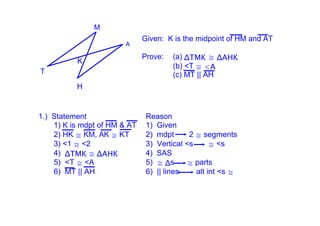
                               Given:  K is the midpoint of HM and AT
                        A

                               Prove:  (a) ΔTMK ≅ ΔAHK
           K
                                       (b) <T ≅ <A
T                                      (c) MT || AH
           H


1.)  Statement                  Reason
     1) K is mdpt of HM & AT    1)  Given  
     2) HK ≅ KM, AK ≅ KT        2)  mdpt       2 ≅ segments
     3) <1 ≅ <2                 3)  Vertical <s       ≅ <s
     4)  ΔTMK ≅ ΔAHK            4)  SAS
     5)  <T ≅ <A                5)  ≅ Δs      ≅ parts
     6)  MT || AH               6)  || lines        alt int <s ≅
B                          A
      2.)                                1

                                2
                    C                        D
      1)  AB ≅ CD                      1) Given
      2)  <1 ≅ <2                      2)  Given
      3)  AC ≅ AC                      3)  Reflexive
      4)  ΔCAB ≅ ΔACD                  4)  SAS
      5)  <DAC ≅ <ACB                  5)  ≅ Δs          ≅ parts
      6)  BC || DA                     6)  || lines      alt int <s ≅
                D
            C               E
3.)
        A               B

1) CA ≅ CB                          1)  Given
2)  <CAB ≅ <ECB                     2)  Given
3)  ΔACB isosceles                  3)  2 ≅ sides     isos Δ
4)  <CAB ≅ <CBA                     4)  isos Δ      ≅ base <s
5)  <ECB ≅ <CBA                     5)  Transitive
6)  CE || AB                        6)  || lines      alt int <s ≅
B
4.)  
             D       E

         A               C
        Statements           Reasons
        1)  BA ≅ BC          1)  Given
        2)  <BDE ≅ <BCA      2)  Given
        3)  ΔBAC isosceles   3) 2 ≅ sides isosceles
        4)  <BAC ≅ <BCA      4)  isosceles      ≅ base <s
        5)  <BDE ≅ <BAC      5)  transitive
        6)  DE || AC         6)  || lines     corr <s ≅
Warmup:

1.)   What are complementary angles?
      Draw an example of a pair of adjacent complementary angles.
      Draw an example of a pair of non­adjacent complmntry angles.

2.)   What are supplementary angles?
      Draw an example of a pair of adjacent supplementary angles.
      Draw an example of a pair of non­adjacent supplmntry angles.
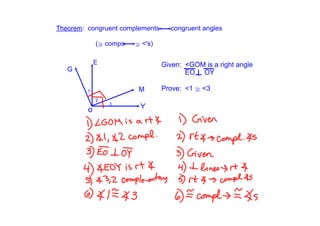
Theorem:  congruent complements      congruent angles

              (≅ comps       ≅ <'s)

              E                       Given:  <GOM is a right angle
   G                                           EO     OY

          1                   M       Prove:  <1 ≅ <3
              2
                   3
          o                    Y

       1.)   <GOM is a right angle           1.)  Given
       2.) <1, <2 are comp <s                2.)  Def of complementary     
       3.)   EO     OY                       3.)  Given
       4.)   <EOY is a rt <                  4.)         lines   rt <s
       5.)    <2, <3 are comp <s             5.)   Def of complementary
       6.) <1 ≅ <3                           6.)  ≅ comps        ≅ <'s
Complete in your notes:
                      R               Given:   RA    bisector of HE
T                                 W            <2 ≅ <3
                                               <H ≅ <E

              2       3               Prove:   ΔTHA ≅ ΔWEA
          1               4

H                 A               E
Theorem:  congruent supplements      congruent angles

                      (≅ sups    ≅ <'s)


E                                         Given:  Line BOY, <2 ≅ <3
                                                  
          1       2
B         4                       Y
              o   3                       Prove:  <1 ≅ <4

M

Congruent Complements and Supplements

  • 1.
    M Given:  K is the midpoint of HM and AT A Prove:  (a) ΔTMK ≅ ΔAHK K (b) <T ≅ <A T (c) MT || AH H 1.)  Statement Reason 1) K is mdpt of HM & AT 1)  Given   2) HK ≅ KM, AK ≅ KT 2)  mdpt       2 ≅ segments 3) <1 ≅ <2 3)  Vertical <s       ≅ <s 4)  ΔTMK ≅ ΔAHK 4)  SAS 5)  <T ≅ <A 5)  ≅ Δs      ≅ parts 6)  MT || AH 6)  || lines        alt int <s ≅
  • 2.
    B A 2.) 1 2 C D 1)  AB ≅ CD 1) Given 2)  <1 ≅ <2 2)  Given 3)  AC ≅ AC 3)  Reflexive 4)  ΔCAB ≅ ΔACD 4)  SAS 5)  <DAC ≅ <ACB 5)  ≅ Δs ≅ parts 6)  BC || DA 6)  || lines      alt int <s ≅ D C E 3.) A B 1) CA ≅ CB 1)  Given 2)  <CAB ≅ <ECB 2)  Given 3)  ΔACB isosceles 3)  2 ≅ sides     isos Δ 4)  <CAB ≅ <CBA 4)  isos Δ      ≅ base <s 5)  <ECB ≅ <CBA 5)  Transitive 6)  CE || AB 6)  || lines      alt int <s ≅
  • 3.
    B 4.)   D E A C Statements Reasons 1)  BA ≅ BC 1)  Given 2)  <BDE ≅ <BCA 2)  Given 3)  ΔBAC isosceles 3) 2 ≅ sides isosceles 4)  <BAC ≅ <BCA 4)  isosceles      ≅ base <s 5)  <BDE ≅ <BAC 5)  transitive 6)  DE || AC 6)  || lines     corr <s ≅
  • 4.
    Warmup: 1.)   What are complementary angles? Draw an example of a pair of adjacent complementary angles. Draw an example of a pair of non­adjacent complmntry angles. 2.)   What are supplementary angles? Draw an example of a pair of adjacent supplementary angles. Draw an example of a pair of non­adjacent supplmntry angles.
  • 5.
    Theorem:  congruent complements      congruent angles (≅ comps  ≅ <'s) E Given:  <GOM is a right angle G      EO     OY 1 M Prove:  <1 ≅ <3 2 3 o Y 1.)   <GOM is a right angle 1.)  Given 2.) <1, <2 are comp <s 2.)  Def of complementary      3.)   EO     OY 3.)  Given 4.)   <EOY is a rt < 4.)   lines  rt <s 5.)    <2, <3 are comp <s 5.)   Def of complementary 6.) <1 ≅ <3 6.)  ≅ comps  ≅ <'s
  • 6.
    Complete in your notes: R Given: RA    bisector of HE T W <2 ≅ <3 <H ≅ <E 2 3 Prove:   ΔTHA ≅ ΔWEA 1 4 H A     E
  • 7.
    Theorem:  congruent supplements      congruent angles (≅ sups  ≅ <'s) E Given:  Line BOY, <2 ≅ <3      1 2 B 4 Y o 3 Prove:  <1 ≅ <4 M