The People’s BranchThe People’s Branch
Wayne Phaneuf – Cuthbertson High School, Union County NCWayne Phaneuf – Cuthbertson High School, Union County NC
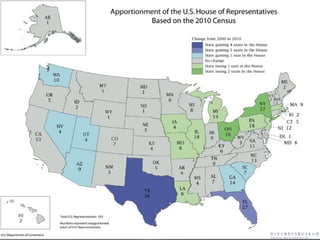
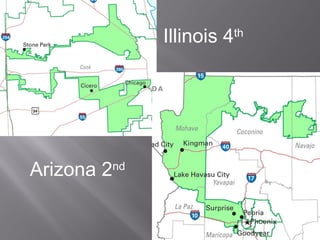
 If census shows a need to reapportion seats, state legislatures redraw district
lines [another example of federalism]
 District populations must be roughly equal [Baker v. Carr (1962)]
 Sometimes lines are drawn in odd fashion to favor one party
 Such districts are said to be gerrymandered
 They usually become “safe seats”
 NC 12th
was challenged in Shaw v. Reno (1992)
Richard Burr [R-NC]Richard Burr [R-NC]
Robert PettingerRobert Pettinger
[R-NC 9[R-NC 9thth
]]
U.S. Senators for North Carolina
Alma Adams [D-
NC 12th
]
Thom Tillis [R-NC]
Illinois 4th
Arizona 2nd
• Presiding Officer elected by majorityPresiding Officer elected by majority
party; #3 in presidential successionparty; #3 in presidential succession
• Has broad powers over bills andHas broad powers over bills and
committeescommittees
• floor leaders organizefloor leaders organize
party efforts +/- billsparty efforts +/- bills
• Whips assist floorWhips assist floor
leaders by keeping themleaders by keeping them
informed on membersinformed on members
and vote countand vote count
Nancy PelosiNancy Pelosi
[D-CA][D-CA]
Steny HoyerSteny Hoyer
[D-MD][D-MD]
Paul RyanPaul Ryan
[R-WI][R-WI]
KevinKevin
McCarthyMcCarthy
[R-CA][R-CA]
Steve ScaliseSteve Scalise
[R-LA][R-LA]
• The Constitution names theThe Constitution names the
VP as pres. of the SenateVP as pres. of the Senate
• Can only vote to break a tieCan only vote to break a tie
• usually not thereusually not there
• Real power is w/Maj.Real power is w/Maj.
Ldr. – throughLdr. – through
organization andorganization and
personalitypersonality
• coordinates w/Min.coordinates w/Min.
Ldr.Ldr.
• Power and resp.Power and resp.
of whips much likeof whips much like
in the Housein the House
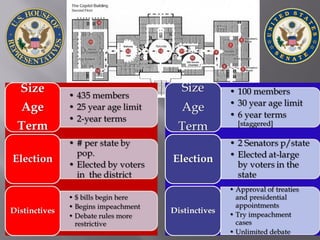
• Honorary position
• Presiding officer but little power
• #4 in line of presidential succession
Orrin Hatch [R-UT]Orrin Hatch [R-UT]
Mike Pence - VPMike Pence - VP
Mitch McConnellMitch McConnell
[R-KY][R-KY]
John CornynJohn Cornyn
[R-TX][R-TX]
CharlesCharles
SchumerSchumer
[D-NY][D-NY]
Dick DurbinDick Durbin
[D-IL][D-IL]
 Established in both houses to deal withEstablished in both houses to deal with
workloadworkload
 Standing committees
 Where most of Congress’s work is done
 Permanent, subject matter committees [e.g.
armed services, foreign relations, judiciary]
 Divided into more specific sub-committees
 Life and death power over bills [more later]
 Controlled by chairpersons
 Work of lobbyists – the good and the bad
 Select committees
 Formed for a specific purpose
 Last for a few to several congresses
 Joint committees – members from both houses
 Conference committee – special committee
dealing with bills that passed both houses
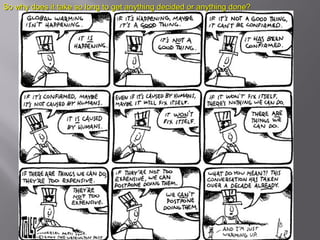
So why does it take so long to get anything decided or anything done?So why does it take so long to get anything decided or anything done?
 Legislative powers – making law
 Making law based on expressed powers [Art. I, sec. 8]
 use of implied power to apply expressed powers [e.g. commerce power
implies laws for airline regulation]
 Appropriation and allocating of money for specific purposes
 Regulation of business, military and foreign policy
 Non-legislative powers
 Proposal of amendments
 Impeachment – investigate, charge, try, remove or not
 Investigative power – looking into matters that fall within the scope of its
legislative powers
 Approval of presidential appointments and treaties [Senate’s authority to
“advise and consent”]
 Electoral power – 12th
amendment: if no presidential gets a clear electoral
majority, the House votes – one vote per state. Vote determined by
state’s House caucus [members]
 Limits on power: habeas corpus, bills of attainder, ex post facto laws
 Casework:
 Helping constituents with issues between them and
the federal government
 Connection with voters and power to do what they
cannot. A way to help and represent the people
 Bringing home jobs and grants [pork barrel projects]
 Oh, it also helps at reelection time
 Staffers do nearly all of this work
 Resources:
 Member and committee staff members: research,Member and committee staff members: research,
communications, campaigning, polling, policy, etc.communications, campaigning, polling, policy, etc.
 Congressional Budget Office [CBO] – informationCongressional Budget Office [CBO] – information
and analysis for budget decisions – usually moreand analysis for budget decisions – usually more
accurate projections than the OMBaccurate projections than the OMB
 General Accounting Office [GAO] – reviews andGeneral Accounting Office [GAO] – reviews and
makes recommendations on financial activities ofmakes recommendations on financial activities of
federal agenciesfederal agencies
 The Library of Congress – research source forThe Library of Congress – research source for
members of Congress and their staffsmembers of Congress and their staffs
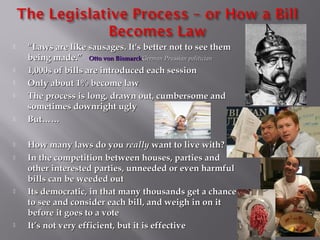
 ““Laws are like sausages. It's better not to see themLaws are like sausages. It's better not to see them
being made.”being made.” Otto von BismarckOtto von BismarckGerman Prussian politicianGerman Prussian politician
 1,000s of bills are introduced each session1,000s of bills are introduced each session
 Only about 1% become lawOnly about 1% become law
 The process is long, drawn out, cumbersome andThe process is long, drawn out, cumbersome and
sometimes downright uglysometimes downright ugly
 But……But……
 How many laws do youHow many laws do you reallyreally want to live with?want to live with?
 In the competition between houses, parties andIn the competition between houses, parties and
other interested parties, unneeded or even harmfulother interested parties, unneeded or even harmful
bills can be weeded outbills can be weeded out
 Its democratic, in that many thousands get a chanceIts democratic, in that many thousands get a chance
to see and consider each bill, and weigh in on itto see and consider each bill, and weigh in on it
before it goes to a votebefore it goes to a vote
 It’s not very efficient, but it is effectiveIt’s not very efficient, but it is effective
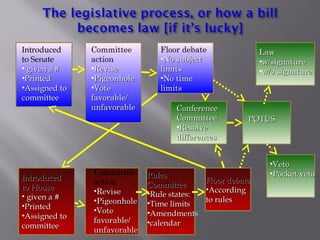
IntroducedIntroduced
to Senateto Senate
• given a #given a #
•PrintedPrinted
•Assigned toAssigned to
committeecommittee
Committee
action
•ReviseRevise
•PigeonholePigeonhole
•VoteVote
favorable/favorable/
unfavorableunfavorable
Floor debate
•No subjectNo subject
limitslimits
•No timeNo time
limitslimits
IntroducedIntroduced
to Houseto House
• given a #given a #
•PrintedPrinted
•Assigned toAssigned to
committeecommittee
Committee
action
•ReviseRevise
•PigeonholePigeonhole
•VoteVote
favorable/favorable/
unfavorableunfavorable
RulesRules
CommitteeCommittee
•Rule states:Rule states:
•Time limitsTime limits
•AmendmentsAmendments
•calendarcalendar
Floor debateFloor debate
•AccordingAccording
to rulesto rules
ConferenceConference
CommitteeCommittee
•ResolveResolve
differencesdifferences
POTUSPOTUS
LawLaw
•w/signaturew/signature
•w/o signaturew/o signature
•VetoVeto
•Pocket vetoPocket veto

Congress basics

  • 1.
    The People’s BranchThePeople’s Branch Wayne Phaneuf – Cuthbertson High School, Union County NCWayne Phaneuf – Cuthbertson High School, Union County NC
  • 5.
     If censusshows a need to reapportion seats, state legislatures redraw district lines [another example of federalism]  District populations must be roughly equal [Baker v. Carr (1962)]  Sometimes lines are drawn in odd fashion to favor one party  Such districts are said to be gerrymandered  They usually become “safe seats”  NC 12th was challenged in Shaw v. Reno (1992)
  • 6.
    Richard Burr [R-NC]RichardBurr [R-NC] Robert PettingerRobert Pettinger [R-NC 9[R-NC 9thth ]] U.S. Senators for North Carolina Alma Adams [D- NC 12th ] Thom Tillis [R-NC]
  • 7.
  • 8.
    • Presiding Officerelected by majorityPresiding Officer elected by majority party; #3 in presidential successionparty; #3 in presidential succession • Has broad powers over bills andHas broad powers over bills and committeescommittees • floor leaders organizefloor leaders organize party efforts +/- billsparty efforts +/- bills • Whips assist floorWhips assist floor leaders by keeping themleaders by keeping them informed on membersinformed on members and vote countand vote count Nancy PelosiNancy Pelosi [D-CA][D-CA] Steny HoyerSteny Hoyer [D-MD][D-MD] Paul RyanPaul Ryan [R-WI][R-WI] KevinKevin McCarthyMcCarthy [R-CA][R-CA] Steve ScaliseSteve Scalise [R-LA][R-LA]
  • 9.
    • The Constitutionnames theThe Constitution names the VP as pres. of the SenateVP as pres. of the Senate • Can only vote to break a tieCan only vote to break a tie • usually not thereusually not there • Real power is w/Maj.Real power is w/Maj. Ldr. – throughLdr. – through organization andorganization and personalitypersonality • coordinates w/Min.coordinates w/Min. Ldr.Ldr. • Power and resp.Power and resp. of whips much likeof whips much like in the Housein the House • Honorary position • Presiding officer but little power • #4 in line of presidential succession Orrin Hatch [R-UT]Orrin Hatch [R-UT] Mike Pence - VPMike Pence - VP Mitch McConnellMitch McConnell [R-KY][R-KY] John CornynJohn Cornyn [R-TX][R-TX] CharlesCharles SchumerSchumer [D-NY][D-NY] Dick DurbinDick Durbin [D-IL][D-IL]
  • 10.
     Established inboth houses to deal withEstablished in both houses to deal with workloadworkload  Standing committees  Where most of Congress’s work is done  Permanent, subject matter committees [e.g. armed services, foreign relations, judiciary]  Divided into more specific sub-committees  Life and death power over bills [more later]  Controlled by chairpersons  Work of lobbyists – the good and the bad  Select committees  Formed for a specific purpose  Last for a few to several congresses  Joint committees – members from both houses  Conference committee – special committee dealing with bills that passed both houses
  • 11.
    So why doesit take so long to get anything decided or anything done?So why does it take so long to get anything decided or anything done?
  • 12.
     Legislative powers– making law  Making law based on expressed powers [Art. I, sec. 8]  use of implied power to apply expressed powers [e.g. commerce power implies laws for airline regulation]  Appropriation and allocating of money for specific purposes  Regulation of business, military and foreign policy  Non-legislative powers  Proposal of amendments  Impeachment – investigate, charge, try, remove or not  Investigative power – looking into matters that fall within the scope of its legislative powers  Approval of presidential appointments and treaties [Senate’s authority to “advise and consent”]  Electoral power – 12th amendment: if no presidential gets a clear electoral majority, the House votes – one vote per state. Vote determined by state’s House caucus [members]  Limits on power: habeas corpus, bills of attainder, ex post facto laws
  • 13.
     Casework:  Helpingconstituents with issues between them and the federal government  Connection with voters and power to do what they cannot. A way to help and represent the people  Bringing home jobs and grants [pork barrel projects]  Oh, it also helps at reelection time  Staffers do nearly all of this work  Resources:  Member and committee staff members: research,Member and committee staff members: research, communications, campaigning, polling, policy, etc.communications, campaigning, polling, policy, etc.  Congressional Budget Office [CBO] – informationCongressional Budget Office [CBO] – information and analysis for budget decisions – usually moreand analysis for budget decisions – usually more accurate projections than the OMBaccurate projections than the OMB  General Accounting Office [GAO] – reviews andGeneral Accounting Office [GAO] – reviews and makes recommendations on financial activities ofmakes recommendations on financial activities of federal agenciesfederal agencies  The Library of Congress – research source forThe Library of Congress – research source for members of Congress and their staffsmembers of Congress and their staffs
  • 14.
     ““Laws arelike sausages. It's better not to see themLaws are like sausages. It's better not to see them being made.”being made.” Otto von BismarckOtto von BismarckGerman Prussian politicianGerman Prussian politician  1,000s of bills are introduced each session1,000s of bills are introduced each session  Only about 1% become lawOnly about 1% become law  The process is long, drawn out, cumbersome andThe process is long, drawn out, cumbersome and sometimes downright uglysometimes downright ugly  But……But……  How many laws do youHow many laws do you reallyreally want to live with?want to live with?  In the competition between houses, parties andIn the competition between houses, parties and other interested parties, unneeded or even harmfulother interested parties, unneeded or even harmful bills can be weeded outbills can be weeded out  Its democratic, in that many thousands get a chanceIts democratic, in that many thousands get a chance to see and consider each bill, and weigh in on itto see and consider each bill, and weigh in on it before it goes to a votebefore it goes to a vote  It’s not very efficient, but it is effectiveIt’s not very efficient, but it is effective
  • 15.
    IntroducedIntroduced to Senateto Senate •given a #given a # •PrintedPrinted •Assigned toAssigned to committeecommittee Committee action •ReviseRevise •PigeonholePigeonhole •VoteVote favorable/favorable/ unfavorableunfavorable Floor debate •No subjectNo subject limitslimits •No timeNo time limitslimits IntroducedIntroduced to Houseto House • given a #given a # •PrintedPrinted •Assigned toAssigned to committeecommittee Committee action •ReviseRevise •PigeonholePigeonhole •VoteVote favorable/favorable/ unfavorableunfavorable RulesRules CommitteeCommittee •Rule states:Rule states: •Time limitsTime limits •AmendmentsAmendments •calendarcalendar Floor debateFloor debate •AccordingAccording to rulesto rules ConferenceConference CommitteeCommittee •ResolveResolve differencesdifferences POTUSPOTUS LawLaw •w/signaturew/signature •w/o signaturew/o signature •VetoVeto •Pocket vetoPocket veto