5.Conflict
Management Styles
Conflict Management Styles
 Functional or effective management of
conflict involves matching styles with
situations. Matching can be effective when
the criteria for conflict management are
satisfied. The situation s in which each of
the styles is appropriate or inappropriate
are described.
Conflict Management Styles
 Integrating Style
 Obliging Style
 Dominating Style
 Avoiding Style
 Compromising Style
Integrating Styles
 This is useful for effectively dealing with complex
problems. When one party alone cannot solve
the problem this style is appropriate. It is also
useful in utilizing the skills, information other
resources possessed by different parties to
define or redefine a problem and to formulate
effective alternative solutions for it and/ or when
commitment is needed from parties for effective
implementation of a solution. This can be done
provided that there is enough time for problem
solving.
Integrating Styles…
 This style may not be effective in some
situations. It is inappropriate when the task or
problem is simple or trivial:
- when there is no time for problem solving
- when the other parties do not have adequate
training and experience for problem solving
- when they are unconcerned about outcomes.
Obliging Style
 This style is useful when a party is not familiar
with the issues involved in a conflict or the other
party is right and the issue is much more
important to the other party. This style may be
used as a strategy when a party is willing to give
up something with the hope of getting some
benefit from the other party when needed.
 This style may be appropriate when a party is
dealing from a position of weakness or believes
that preserving a relationship is important.
Obliging Style…
 This style is inappropriate if the issue
involved in a conflict is important to the
party, and the party believes that he or she
is right.
 It is also inappropriate when a party
believes that the other party is wrong or
unethical.
Dominating Style
 This style appropriate when the issues involved in a
conflict are important to the party, or an unfavourable
decision by the other party may be harmful to this party.
 This style may be used by a supervisor if the issues
involve routine matters or if a speedy decision is
required.
 A supervisor may have to use it to deal with
subordinates who are very assertive or who do not have
expertise to make technical decisions. This is also
effective in dealing with the implementation of unpopular
courses of action.
Dominating Style…
 This is also effective in dealing with the
implementation of unpopular courses of action.
 This style is inappropriate when the issues
involved in conflict are complex and there is
enough time to make a good decision. When
both the parties are equally powerful, using this
style by one or both parties may lead to
stalemate.
Avoiding Style
 This style may be used when the potential
dysfunctional effect of confronting the
other party outweighs the benefits of the
resolution of conflict. This may be used to
deal with some trivial or minor issues or
hen a cooling – off period is needed
before a complex problem can be
effectively deal with.
Avoiding Style…
 This style is inappropriate when the issues
are important to a party.
 This style is also inappropriate when it is
the responsibility of the party to make
decisions, when the parties are unwilling
to wait, or when prompt action is required.
Compromising Style
 This style is useful when the goals of the conflicting
parties are mutually exclusive or when both parties are
equally powerful and have reached an impasse in their
negotiation process. This can be used when consensus
cannot reached, the parties need a temporary solution to
a complex problem or other styles have been used and
found to be ineffective in dealing with the issues
effectively.
 This style may have to be used for avoiding protracted
conflict.
Compromising Style…
 This style may have to be used for avoiding
protracted conflict.
 This style is inappropriate for dealing with
complex problems needing a problem solving
approach .
 Unfortunately, very often management
practitioners use this style to deal with complex
problems and as a result, fail to formulate
effective, long term solutions.
Compromising Style…
 This style also may be inappropriate if a
party is more powerful than another and
believes that his or her position is right.
 This style also may not be appropriate
when it comes to dealing with conflict of
values.
Value of Conflict
 Constructive
Opens up issues of importance, resulting in
issue clarification
Helps build cohesiveness as people learn
more about each other
Causes reassessment by allowing for
examination of procedures or actions
Increases individual involvement
Value of Conflict
 Destructive
Diverts energy from more important issues
and tasks
Deepens difference in values
Polarizes groups so that cooperation is
reduced
Destroys the morale of people or reinforces
poor self-concepts
Conflict and the Work World
 85% of people experience conflict at work
 Conflict at work affects peoples health
1 in 4 people are unhappy at work
People become demoralized and depressed
 Conflict affects businesses bottom line
People and Conflict
 Most people do not like to be in conflict
 Conflict occurs when parties view the system as
not working
 People see only one solution
 People do not want to see common ground
 Each person is doing the best they can for
themselves
 People must be willing to move off of their
position to reach agreement
 People have to be heard
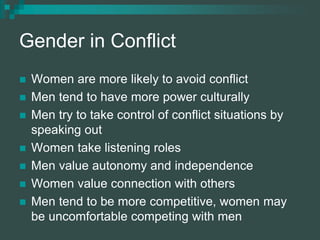
Gender in Conflict
 Women are more likely to avoid conflict
 Men tend to have more power culturally
 Men try to take control of conflict situations by
speaking out
 Women take listening roles
 Men value autonomy and independence
 Women value connection with others
 Men tend to be more competitive, women may
be uncomfortable competing with men
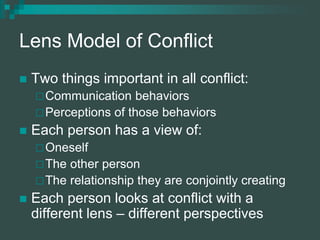
Lens Model of Conflict
 Two things important in all conflict:
Communication behaviors
Perceptions of those behaviors
 Each person has a view of:
Oneself
The other person
The relationship they are conjointly creating
 Each person looks at conflict with a
different lens – different perspectives
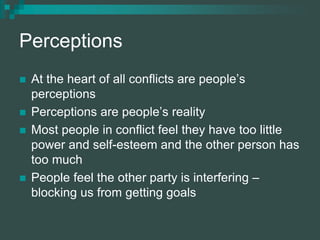
Perceptions
 At the heart of all conflicts are people’s
perceptions
 Perceptions are people’s reality
 Most people in conflict feel they have too little
power and self-esteem and the other person has
too much
 People feel the other party is interfering –
blocking us from getting goals
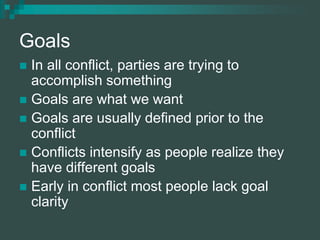
Goals
 In all conflict, parties are trying to
accomplish something
 Goals are what we want
 Goals are usually defined prior to the
conflict
 Conflicts intensify as people realize they
have different goals
 Early in conflict most people lack goal
clarity
THANK YOU.

Conflict Management Styles

  • 1.
  • 2.
    Conflict Management Styles Functional or effective management of conflict involves matching styles with situations. Matching can be effective when the criteria for conflict management are satisfied. The situation s in which each of the styles is appropriate or inappropriate are described.
  • 3.
    Conflict Management Styles Integrating Style  Obliging Style  Dominating Style  Avoiding Style  Compromising Style
  • 4.
    Integrating Styles  Thisis useful for effectively dealing with complex problems. When one party alone cannot solve the problem this style is appropriate. It is also useful in utilizing the skills, information other resources possessed by different parties to define or redefine a problem and to formulate effective alternative solutions for it and/ or when commitment is needed from parties for effective implementation of a solution. This can be done provided that there is enough time for problem solving.
  • 5.
    Integrating Styles…  Thisstyle may not be effective in some situations. It is inappropriate when the task or problem is simple or trivial: - when there is no time for problem solving - when the other parties do not have adequate training and experience for problem solving - when they are unconcerned about outcomes.
  • 6.
    Obliging Style  Thisstyle is useful when a party is not familiar with the issues involved in a conflict or the other party is right and the issue is much more important to the other party. This style may be used as a strategy when a party is willing to give up something with the hope of getting some benefit from the other party when needed.  This style may be appropriate when a party is dealing from a position of weakness or believes that preserving a relationship is important.
  • 7.
    Obliging Style…  Thisstyle is inappropriate if the issue involved in a conflict is important to the party, and the party believes that he or she is right.  It is also inappropriate when a party believes that the other party is wrong or unethical.
  • 8.
    Dominating Style  Thisstyle appropriate when the issues involved in a conflict are important to the party, or an unfavourable decision by the other party may be harmful to this party.  This style may be used by a supervisor if the issues involve routine matters or if a speedy decision is required.  A supervisor may have to use it to deal with subordinates who are very assertive or who do not have expertise to make technical decisions. This is also effective in dealing with the implementation of unpopular courses of action.
  • 9.
    Dominating Style…  Thisis also effective in dealing with the implementation of unpopular courses of action.  This style is inappropriate when the issues involved in conflict are complex and there is enough time to make a good decision. When both the parties are equally powerful, using this style by one or both parties may lead to stalemate.
  • 10.
    Avoiding Style  Thisstyle may be used when the potential dysfunctional effect of confronting the other party outweighs the benefits of the resolution of conflict. This may be used to deal with some trivial or minor issues or hen a cooling – off period is needed before a complex problem can be effectively deal with.
  • 11.
    Avoiding Style…  Thisstyle is inappropriate when the issues are important to a party.  This style is also inappropriate when it is the responsibility of the party to make decisions, when the parties are unwilling to wait, or when prompt action is required.
  • 12.
    Compromising Style  Thisstyle is useful when the goals of the conflicting parties are mutually exclusive or when both parties are equally powerful and have reached an impasse in their negotiation process. This can be used when consensus cannot reached, the parties need a temporary solution to a complex problem or other styles have been used and found to be ineffective in dealing with the issues effectively.  This style may have to be used for avoiding protracted conflict.
  • 13.
    Compromising Style…  Thisstyle may have to be used for avoiding protracted conflict.  This style is inappropriate for dealing with complex problems needing a problem solving approach .  Unfortunately, very often management practitioners use this style to deal with complex problems and as a result, fail to formulate effective, long term solutions.
  • 14.
    Compromising Style…  Thisstyle also may be inappropriate if a party is more powerful than another and believes that his or her position is right.  This style also may not be appropriate when it comes to dealing with conflict of values.
  • 15.
    Value of Conflict Constructive Opens up issues of importance, resulting in issue clarification Helps build cohesiveness as people learn more about each other Causes reassessment by allowing for examination of procedures or actions Increases individual involvement
  • 16.
    Value of Conflict Destructive Diverts energy from more important issues and tasks Deepens difference in values Polarizes groups so that cooperation is reduced Destroys the morale of people or reinforces poor self-concepts
  • 17.
    Conflict and theWork World  85% of people experience conflict at work  Conflict at work affects peoples health 1 in 4 people are unhappy at work People become demoralized and depressed  Conflict affects businesses bottom line
  • 18.
    People and Conflict Most people do not like to be in conflict  Conflict occurs when parties view the system as not working  People see only one solution  People do not want to see common ground  Each person is doing the best they can for themselves  People must be willing to move off of their position to reach agreement  People have to be heard
  • 19.
    Gender in Conflict Women are more likely to avoid conflict  Men tend to have more power culturally  Men try to take control of conflict situations by speaking out  Women take listening roles  Men value autonomy and independence  Women value connection with others  Men tend to be more competitive, women may be uncomfortable competing with men
  • 20.
    Lens Model ofConflict  Two things important in all conflict: Communication behaviors Perceptions of those behaviors  Each person has a view of: Oneself The other person The relationship they are conjointly creating  Each person looks at conflict with a different lens – different perspectives
  • 21.
    Perceptions  At theheart of all conflicts are people’s perceptions  Perceptions are people’s reality  Most people in conflict feel they have too little power and self-esteem and the other person has too much  People feel the other party is interfering – blocking us from getting goals
  • 22.
    Goals  In allconflict, parties are trying to accomplish something  Goals are what we want  Goals are usually defined prior to the conflict  Conflicts intensify as people realize they have different goals  Early in conflict most people lack goal clarity
  • 23.