Configuring and Visualizing The Data Resources
in a Cloud-based Data Collection Framework
Date: 29th of June, 2017
Contact Information
Tampere University of Technology
FAST Laboratory
P.O. Box 600,
FIN-33101 Tampere
Finland
Email: fast@tut.fi
www.tut.fi/fast
Conference: 23rd ICE/IEEE ITMC Conference
(ICE2017).
Madeira, Portugal – June 27-30, 2017
Title of the paper: Configuring and Visualizing The
Data Resources in a Cloud-based Data Collection
Framework
Authors: Wael M. Mohammed, David Aleixo, Borja
Ramis Ferrer, Carlos Agostinho, Jose L. Martinez
Lastra
if you would like to recieve a reprint of the
original paper, please contact us.
Configuring and Visualizing The
Data Resources in a Cloud-based
Data Collection Framework
23rd ICE/IEEE ITMC Conference (ICE2017).
Madeira, Portugal – June 27-30, 2017
Wael M. Mohammed1, David Aleixo2, Borja Ramis Ferrer1, Carlos Agostinho2, Jose L.
Martinez Lastra1
wael.mohammed@tut.fi, daa@uninova.pt, borja.ramisferrer@tut.fi, ca@uninova.pt,
jose.lastra@tut.fi
1 Tampere University of Technology, 33720 Tampere, Finland
2 Centre of Technology and Systems, CTS, UNINOVA, 2829-516 Caparica, Portugal
Outline
• Introduction
• Motivation
• The State of The Art
• Cloud-based data collection framework
• Implementation
• Conclusion and the future work
Configuring and Visualizing The Data Resources in a Cloud-
based Data Collection Framework
3
Introduction
Cloud Collaborative Manufacturing Networks (C2NET)
project is an EU Horizon 2020 R&D project within the
framework of the Factories of the Future (FoF) public-
private partnership. The goal of the project is the
development of Cloud-enabled tools for supporting SMEs
supply network optimization.
A data collection is required. Thus C2NET contains a Data
Collection Framework that capable of collecting data from
factory shopfloor using IoT device and ERP data using
Legacy Systems Hubs.
Configuring and Visualizing The Data Resources in a Cloud-
based Data Collection Framework
4
Motivation
• Providing the user with an easy and friendly
interface for the adding data resources.
• Provide a flexible solution that can be user for
different cases.
• Decrease the amount of interfaces and allow the
user to interact from minimal interfaces.
Configuring and Visualizing The Data Resources in a Cloud-
based Data Collection Framework
5
State of The Art
Hypermedia in Web Applications
The revolution of the web-based application that occur in
the beginning of this century opened several doors for new
standards to be created and developed such as HTML,
CSS, JQuery. These standards allow the front-end web
designers and developers to interfaces for the web-based
applications.
Configuring and Visualizing The Data Resources in a Cloud-
based Data Collection Framework
6
State of The Art
Data Collection Frameworks
In the definition of the Manufacturing Enterprise
Solutions Association (MESA) MES functions, the
data collection is considered as MES function that
is required for collecting the data form the
shopfloor or other resources.
Aspects:
1. Communication
2. Transformation
3. Data Storage
Configuring and Visualizing The Data Resources in a Cloud-
based Data Collection Framework
7
Cloud-based Data Collection
Framework
Company
• Three data source
types are defined;
XLS, SQL and REST
• The company end
user can interact with
the C2NET via web
browser
• The end user is able
to access the data on
the company side.
Configuring and Visualizing The Data Resources in a Cloud-
based Data Collection Framework
8
Cloud-based Data Collection
Framework
C2NET
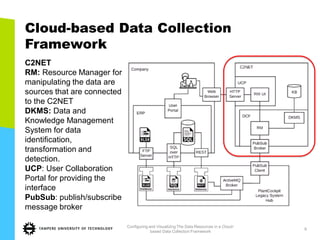
RM: Resource Manager for
manipulating the data are
sources that are connected
to the C2NET
DKMS: Data and
Knowledge Management
System for data
identification,
transformation and
detection.
UCP: User Collaboration
Portal for providing the
interface
PubSub: publish/subscribe
message broker
Configuring and Visualizing The Data Resources in a Cloud-
based Data Collection Framework
9
Cloud-based Data Collection
Framework
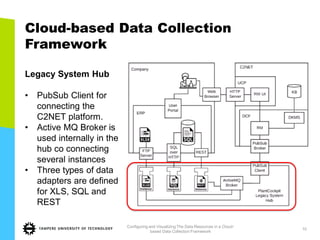
Legacy System Hub
• PubSub Client for
connecting the
C2NET platform.
• Active MQ Broker is
used internally in the
hub co connecting
several instances
• Three types of data
adapters are defined
for XLS, SQL and
REST
Configuring and Visualizing The Data Resources in a Cloud-
based Data Collection Framework
10
Cloud-based Data Collection
Framework
• The approach that has been adopted for configuring the data
resource in the C2NET tends to several data resources to
be connected.
• It is expected increase the privacy of the company data
• It contains four messages:
– Half configuration
– External property
– Full configuration
– Data
Configuring and Visualizing The Data Resources in a Cloud-
based Data Collection Framework
11
Cloud-based Data Collection
Framework
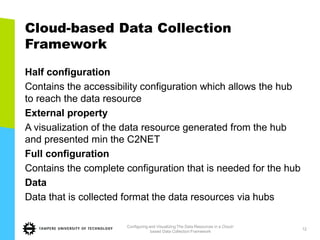
Half configuration
Contains the accessibility configuration which allows the hub
to reach the data resource
External property
A visualization of the data resource generated from the hub
and presented min the C2NET
Full configuration
Contains the complete configuration that is needed for the hub
Data
Data that is collected format the data resources via hubs
Configuring and Visualizing The Data Resources in a Cloud-
based Data Collection Framework
12
Cloud-based Data Collection
Framework
User and C2NET
interaction for adding and
configuring the data
resources.
Configuring and Visualizing The Data Resources in a Cloud-
based Data Collection Framework
13
Cloud-based Data Collection
Framework
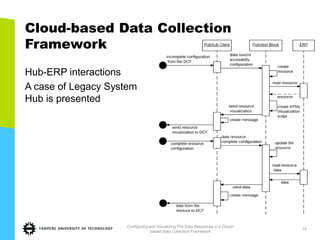
Hub-ERP interactions
A case of Legacy System
Hub is presented
Configuring and Visualizing The Data Resources in a Cloud-
based Data Collection Framework
14
Implementation
• Metal-working
example for
validating the
concept
• Data is
provided as
Excel files via
FTP server
Configuring and Visualizing The Data Resources in a Cloud-
based Data Collection Framework
15
Implementation
Configuration data resource in the RM contains
external property, outputConfigutration, private
dataset and source
Configuring and Visualizing The Data Resources in a Cloud-
based Data Collection Framework
16
Implementation
• Visualization
of the data
resources in
the DCF
Configuring and Visualizing The Data Resources in a Cloud-
based Data Collection Framework
17
Conclusion
• The approach provided a flexible and generic
way for configuring and visualizing the data
resources.
• The privacy of the ERP data is guaranteed since
the company can build its own hub and visualize
it in the DCF without using an external
applications
Configuring and Visualizing The Data Resources in a Cloud-
based Data Collection Framework
18
Acknowledgement
The research leading to these results has received funding from the European
Union’s Horizon 2020 research and innovation program under grant agreement
n° 636909, correspondent to the project shortly entitled C2NET, Cloud
Collaborative Manufacturing Networks .
Configuring and Visualizing The Data Resources in a Cloud-
based Data Collection Framework
19
THANK YOU!
Any questions?
http://www.youtube.com/user/fastlaboratory
https://www.facebook.com/fast.laboratory
http://www.slideshare.net/fastlaboratory
Configuring and Visualizing The Data Resources in a Cloud-
based Data Collection Framework
20

Configuring and Visualizing The Data Resources in a Cloud-based Data Collection Framework

  • 1.
    Configuring and VisualizingThe Data Resources in a Cloud-based Data Collection Framework Date: 29th of June, 2017 Contact Information Tampere University of Technology FAST Laboratory P.O. Box 600, FIN-33101 Tampere Finland Email: fast@tut.fi www.tut.fi/fast Conference: 23rd ICE/IEEE ITMC Conference (ICE2017). Madeira, Portugal – June 27-30, 2017 Title of the paper: Configuring and Visualizing The Data Resources in a Cloud-based Data Collection Framework Authors: Wael M. Mohammed, David Aleixo, Borja Ramis Ferrer, Carlos Agostinho, Jose L. Martinez Lastra if you would like to recieve a reprint of the original paper, please contact us.
  • 2.
    Configuring and VisualizingThe Data Resources in a Cloud-based Data Collection Framework 23rd ICE/IEEE ITMC Conference (ICE2017). Madeira, Portugal – June 27-30, 2017 Wael M. Mohammed1, David Aleixo2, Borja Ramis Ferrer1, Carlos Agostinho2, Jose L. Martinez Lastra1 wael.mohammed@tut.fi, daa@uninova.pt, borja.ramisferrer@tut.fi, ca@uninova.pt, jose.lastra@tut.fi 1 Tampere University of Technology, 33720 Tampere, Finland 2 Centre of Technology and Systems, CTS, UNINOVA, 2829-516 Caparica, Portugal
  • 3.
    Outline • Introduction • Motivation •The State of The Art • Cloud-based data collection framework • Implementation • Conclusion and the future work Configuring and Visualizing The Data Resources in a Cloud- based Data Collection Framework 3
  • 4.
    Introduction Cloud Collaborative ManufacturingNetworks (C2NET) project is an EU Horizon 2020 R&D project within the framework of the Factories of the Future (FoF) public- private partnership. The goal of the project is the development of Cloud-enabled tools for supporting SMEs supply network optimization. A data collection is required. Thus C2NET contains a Data Collection Framework that capable of collecting data from factory shopfloor using IoT device and ERP data using Legacy Systems Hubs. Configuring and Visualizing The Data Resources in a Cloud- based Data Collection Framework 4
  • 5.
    Motivation • Providing theuser with an easy and friendly interface for the adding data resources. • Provide a flexible solution that can be user for different cases. • Decrease the amount of interfaces and allow the user to interact from minimal interfaces. Configuring and Visualizing The Data Resources in a Cloud- based Data Collection Framework 5
  • 6.
    State of TheArt Hypermedia in Web Applications The revolution of the web-based application that occur in the beginning of this century opened several doors for new standards to be created and developed such as HTML, CSS, JQuery. These standards allow the front-end web designers and developers to interfaces for the web-based applications. Configuring and Visualizing The Data Resources in a Cloud- based Data Collection Framework 6
  • 7.
    State of TheArt Data Collection Frameworks In the definition of the Manufacturing Enterprise Solutions Association (MESA) MES functions, the data collection is considered as MES function that is required for collecting the data form the shopfloor or other resources. Aspects: 1. Communication 2. Transformation 3. Data Storage Configuring and Visualizing The Data Resources in a Cloud- based Data Collection Framework 7
  • 8.
    Cloud-based Data Collection Framework Company •Three data source types are defined; XLS, SQL and REST • The company end user can interact with the C2NET via web browser • The end user is able to access the data on the company side. Configuring and Visualizing The Data Resources in a Cloud- based Data Collection Framework 8
  • 9.
    Cloud-based Data Collection Framework C2NET RM:Resource Manager for manipulating the data are sources that are connected to the C2NET DKMS: Data and Knowledge Management System for data identification, transformation and detection. UCP: User Collaboration Portal for providing the interface PubSub: publish/subscribe message broker Configuring and Visualizing The Data Resources in a Cloud- based Data Collection Framework 9
  • 10.
    Cloud-based Data Collection Framework LegacySystem Hub • PubSub Client for connecting the C2NET platform. • Active MQ Broker is used internally in the hub co connecting several instances • Three types of data adapters are defined for XLS, SQL and REST Configuring and Visualizing The Data Resources in a Cloud- based Data Collection Framework 10
  • 11.
    Cloud-based Data Collection Framework •The approach that has been adopted for configuring the data resource in the C2NET tends to several data resources to be connected. • It is expected increase the privacy of the company data • It contains four messages: – Half configuration – External property – Full configuration – Data Configuring and Visualizing The Data Resources in a Cloud- based Data Collection Framework 11
  • 12.
    Cloud-based Data Collection Framework Halfconfiguration Contains the accessibility configuration which allows the hub to reach the data resource External property A visualization of the data resource generated from the hub and presented min the C2NET Full configuration Contains the complete configuration that is needed for the hub Data Data that is collected format the data resources via hubs Configuring and Visualizing The Data Resources in a Cloud- based Data Collection Framework 12
  • 13.
    Cloud-based Data Collection Framework Userand C2NET interaction for adding and configuring the data resources. Configuring and Visualizing The Data Resources in a Cloud- based Data Collection Framework 13
  • 14.
    Cloud-based Data Collection Framework Hub-ERPinteractions A case of Legacy System Hub is presented Configuring and Visualizing The Data Resources in a Cloud- based Data Collection Framework 14
  • 15.
    Implementation • Metal-working example for validatingthe concept • Data is provided as Excel files via FTP server Configuring and Visualizing The Data Resources in a Cloud- based Data Collection Framework 15
  • 16.
    Implementation Configuration data resourcein the RM contains external property, outputConfigutration, private dataset and source Configuring and Visualizing The Data Resources in a Cloud- based Data Collection Framework 16
  • 17.
    Implementation • Visualization of thedata resources in the DCF Configuring and Visualizing The Data Resources in a Cloud- based Data Collection Framework 17
  • 18.
    Conclusion • The approachprovided a flexible and generic way for configuring and visualizing the data resources. • The privacy of the ERP data is guaranteed since the company can build its own hub and visualize it in the DCF without using an external applications Configuring and Visualizing The Data Resources in a Cloud- based Data Collection Framework 18
  • 19.
    Acknowledgement The research leadingto these results has received funding from the European Union’s Horizon 2020 research and innovation program under grant agreement n° 636909, correspondent to the project shortly entitled C2NET, Cloud Collaborative Manufacturing Networks . Configuring and Visualizing The Data Resources in a Cloud- based Data Collection Framework 19
  • 20.