Download to read offline
![International Journal of Data Mining & Knowledge Management Process (IJDKP) Vol.5, No.5, September 2015
DOI : 10.5121/ijdkp.2015.5505 65
CONFIDENTIAL DATA IDENTIFICATION USING
DATA MINING TECHNIQUES IN DATA LEAKAGE
PREVENTION SYSTEM
Peneti Subhashini and B Padmaja Rani
Department of Computer Science Engineering,
Jawaharlal Nehru Technological University,
Hyderabad, Telangana, India-500085.
ABSTRACT
Data leakage means sending confidential data to an unauthorized person. Nowadays, identifying
confidential data is a big challenge for the organizations. We developed a system by using data mining
techniques, which identifies confidential data of an organization. First, we create clusters for the training
data set. Next, identify confidential terms and context terms for each cluster. Finally, based on the
confidential terms and context terms, the confidentiality level of the detected document calculated in terms
of score. If the score of the detected document beyond a predefined threshold, then the document is blocked
and marked as a confidential.
KEYWORDS
Data leakage, Data mining techniques, Confidential terms, Context terms, Threshold, Confidentiality level.
1. INTRODUCTION
Now day’s data leakage is the biggest challenge in all the types of public and private
organizations. For the protection of confidential data, data leakage prevention system (DLP) is
used by many organizations [1].Confidential information such as customer data, employee data
and business secrets which are the main assets of an organization. Confidential information is
crucial for the organization’s staff and partners to perform their business tasks [2]. Data leakage
prevention is the category of solution, which helps an organization to apply controls for
preventing the unwanted or malicious leakage of confidential information to unauthorized entities
in or outside the organization [3].
Data leakage prevention systems use confidential terms and data identification methods for
controlling data leakages in the organization. First, DLP system identifies which documents are
confidential documents and non-confidential documents. In this paper, the confidential data
identification method classifies the organization documents into confidential and non-
confidential. Any employee in the organization wants to send any document to an outside; first
the sending document is compared with existing confidential and non-confidential documents of](https://image.slidesharecdn.com/confidentialdataidentificationusing-151007094051-lva1-app6891/75/Confidential-data-identification-using-1-2048.jpg)
![International Journal of Data Mining & Knowledge Management Process (IJDKP) Vol.5, No.5, September 2015
66
an organization. If the sending document (whole document or some portions) is matched with any
one of the existing confidential documents that is blocked by the DLP.
2. RELATED WORK
In this section we provide review on different confidential data identification methods in Data
leakage prevention. Existing confidential data identification methods can be divided into two
categories: Content based and Behaviour based methods. The content based method includes
rule-based and classifier based approaches.
In content-based approach, directly focuses on data values. Data values contain the use of
confidential words, regular expression, text classification and information retrieval. In rule-based
approach a group of predefined polices is outlined with respect to words and terms that will seem
within the document. These rules determine the confidentiality level of the document. Rule-based
approaches suffer from a high rate of false-positives; according to [12].Organizations that uses
rule-based approaches usually defined a high threshold for confidential content in documents,
as a result of high false-positive rate, rule-based approaches are not used these days
[13,14,15,16].
In classifier based approach various classifications and machine learning techniques are used [17,
18], such as SVM (Support Vector Machine) and Naïve Bayes [19, 20, 21]. In this approach the
content of the document is represented as vectors [22]. Vectors are generated using terms and
their frequencies of the documents. These vectors classifies, whether the documents are
confidential or not. Small portions of confidential data are not identified by this approach.
The behaviour-based approach focus on identifying anomalies in behaviour [23]. These
anomalies can be tracked in the communication, in and out of the organization, or the analysis of
past and current communication.
In this paper, implemented a method in contrast to the above methods. Data mining approaches,
confidential word matching approaches are the confidential concepts of this method. In the first
step, we used clustering concept to group together a document of similar content. In a second
step, extract the confidential terms content of each cluster using language modelling technique.
Finally, determine whether a tested document is confidential or not.
3. CONFIDENTIAL DATA IDENTIFICATION METHOD
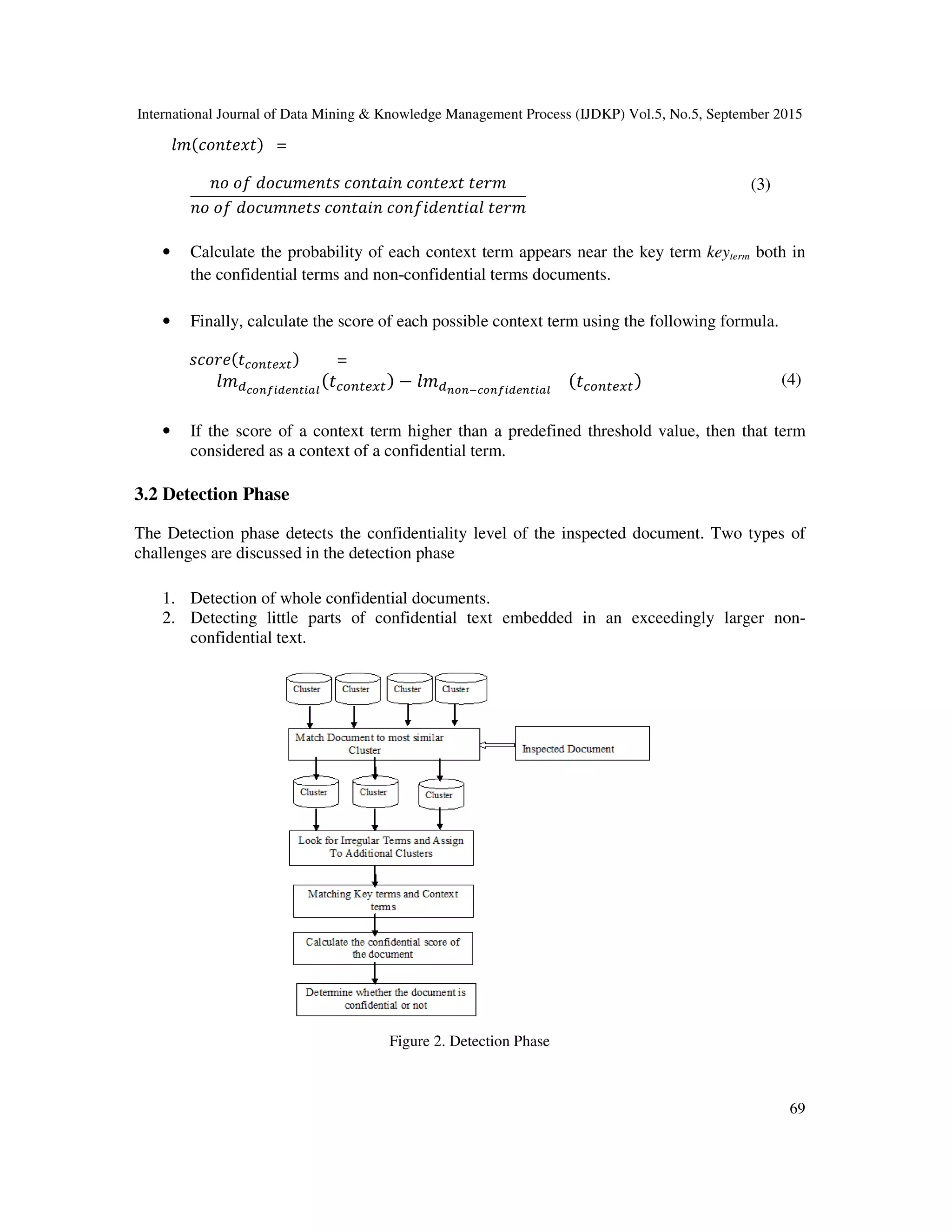
The projected method consists of two phases. Training phase and detection phase. During the
training phase, organization documents are grouped together with the help of clustering and
language modelling techniques. During the detection phase confidential score calculated for the
inspected document. If the score exceeds the predefined threshold value then that document
marked as a confidential. Section 3.1 and section 3.2 provides detailed description about training
phase and detection phase.
3.1 Training Phase
The objective of this phase is to representation of confidential content of a document. This
representation should include not only confidential words and terms, but also the context in](https://image.slidesharecdn.com/confidentialdataidentificationusing-151007094051-lva1-app6891/75/Confidential-data-identification-using-2-2048.jpg)
![International Journal of Data Mining & Knowledge Management Process (IJDKP) Vol.5, No.5, September 2015
67
which they appear [4].The training phase requires two sets of documents as an input. C is the one
input, which contains a set of confidential documents. The second input is N, is a set of non-
confidential documents. For every document, tokenization [5], remove stop-words next apply
stemming algorithm and finally transforming them into vectors of weighted terms [6]. For
clustering we used K-means unsupervised algorithm with cosine measure as the distance
function. The following is the pictorial representation for training phase [7].
Figure1.Training Phase
The training phase consist of two steps [8]
1. Key terms detection
2. Context terms detection
3.1.1 Key terms detection
Key terms detection is the important step for this method. The key terms have two purposes:
a) They serve as initial indicators of confidential content.
b) They serve of the axis around which the context terms are generated.
Without a relevant and a robust set of key terms, the method presented in this paper is not likely
to succeed. The key term detection process is based on a technique called language modelling
[8].This technique represents the value of a term (or a sequence of terms) in terms of probability.
The detection of the key terms is done as follows [7]:
• For each cluster create a language model separately for confidential (C) and non-
confidential documents (N), which denote lmc and lmn accordingly.](https://image.slidesharecdn.com/confidentialdataidentificationusing-151007094051-lva1-app6891/75/Confidential-data-identification-using-3-2048.jpg)
![International Journal of Data Mining & Knowledge Management Process (IJDKP) Vol.5, No.5, September 2015
68
݈݉ ൬
ݐ
݀
൰ =
݂ݐ௧
ܰሺ௧,ௗሻ
(1)
tf indicates term frequency and N total no of terms in the document.
• For each term t in lmc calculate its score using the following formula
• The score assigned to term t reflects how much they more likely appear in a relevant
document(C) than in a non-relevant (N) one.
• Only the terms whose assigned score is greater than 1 are used in order to work out the
confidentiality of documents throughout the detection phase.
• In order to correct for inaccuracies that may arise due to data sparseness, apply the
Dirichlet smoothing technique [9].
• Smoothing, considered a confidential element in improving the performance of language
model [10].
3.1.2 Context terms detection
For each confidential term identify context terms. The context terms serve three purposes [7]:
a) They serve as validators, enabling us to work out whether or not the detected confidential
terms are actually indicative of relevant content.
b) They allow us to quantify the degree of significance (many relevant context terms=higher
relevance for a confidential term)
c) They enable us to see whether or not the detected key terms are connected by analyzing
their shared contexts.
The process of detecting the context terms for a single key term-
(key term) is as follows [8]:
• Find all the instances of keyterm every in confidential terms and non-confidential terms
document.
• For each instance, extract the terms around keyterm, using a window of size X (
௫
ଶ
terms
before the position of the term and
௫
ଶ
terms after it). Every term during this text excerpt
are going to be measured as a possible context term. The size of the sliding window is
denoted using a parameter referred to as context span.
• Each such excerpt will now be considered as a document. Excerpts from confidential
terms and non-confidential terms will be denoted as d confidential t and d non-confidential
documents.
• Create language model for each context term both in confidential and non-confidential.
݁ݎܿݏሺݐሻ =
݈݉ሺݐሻ
݈݉ሺݐሻ
(2)](https://image.slidesharecdn.com/confidentialdataidentificationusing-151007094051-lva1-app6891/75/Confidential-data-identification-using-4-2048.jpg)
![International Journal of Data Mining & Knowledge Management Process (IJDKP) Vol.5, No.5, September 2015
70
The inspected document is transformed into a vector (after stemming and stop-words removal)
and finds the similar clusters. This is done using the cosine distance measure [6].All the clusters
whose similarity are above a predefined threshold are selected.
This similar cluster methodology is working well for detection of whole documents but it is
insufficient for detection confidential terms sections embedded in non-confidential terms
documents. To solve this problem, we seem to be for irregular terms with in the inspected
document, i.e., terms that are most unlikely to look within the document considering the clusters
to that it absolutely was assigned. In order to identify these terms, first create language model for
both the tested document and the clusters it was assigned to, find score for each term in the
inspected document using the following formula
∀ݐ ∈ ,ܦ ݐ௦ = ൫ݐ
ܦൗ ൯
൫ݐ
ܿൗ ൯
(5)
Where t is that the term within the inspected document D, C is one among the chosen clusters.
The upper the score of a term, the less likely it‘s to belong to the cluster. If the term t score is
greater than the predefined threshold then that term is considered as an irregular term. Once the
terms (irregular) are found they are matched against the confidential terms of every cluster. If
match found the corresponding cluster is added to the list of candidate clusters (similar clusters)
that the confidentiality score of the document is calculated.
Identify all the confidential and context term that appear both in the inspected document and
assigned cluster. In order to discover confidential terms, the inspected document undergoes
stemming and stops word elimination and is then matched against the confidential terms
represented within the cluster. If the confidential term found, then its corresponding context terms
are identified within the cluster.
The confidential terms score of the inspected document for every cluster is calculated by
summation of scores of all the confidential terms that met the below criteria.
Table 1.The required number and minimum score of a context terms for every score of the confidential
term.
Confidential score of a
term
Required no of context
terms
Min score of context
score
1<score<3 10 80
3<=score<7 9 70
7<=score<10 7 60
10<=score<15 6 50
15<=score<30 5 30
30<=score<45 3 20
45<=score 2 0
If the inspected document confidential terms scores for a cluster above the threshold, then that
document marked as a confidential for that cluster and is blocked.](https://image.slidesharecdn.com/confidentialdataidentificationusing-151007094051-lva1-app6891/75/Confidential-data-identification-using-6-2048.jpg)
![International Journal of Data Mining & Knowledge Management Process (IJDKP) Vol.5, No.5, September 2015
71
4. EVALUATION
We evaluate the performance of our method on Reuter’s news articles dataset.
4.1 Reuters news articles
We had generated one dataset that is compiled from news articles collected from Reuter’s news
[11]. This dataset consist of 21578 documents. The Reuters 21578 collection is distributed in
twenty two files, each of the first twenty one files (reut2-000.sgm-reut2-020.sgm) contains a
thousand documents, while the last reut2-021.sgm contains 578 documents. Reuters 21578
divided into 5 categories. For the purpose of the results evaluation, economics category was
chosen as the dataset. Economics contains 16 categories, of which trade category chosen as a
confidential purpose and remaining 15 categories were chosen as a non-confidential purpose.
Confidential documents are 350(200 for training, 100 for detection) and non-confidential are
750(550 for training, 200 for detection).
Table 2.Out of 200 non-confidential documents, the no of non-confidential documents is detected as a
confidential for corresponding confidential score and similarity threshold.
Score/threshold 0.2 0.1 0.05
200 20 120 180
150 80 187 197
100 126 197 200
We evaluated our method performance by using True Positive Rate (TPR), False Positive Rate
(FPR).TPR is the percentage of confidential documents correctly identified, FPR represents the
percentage of non-confidential documents mistakenly classified as confidential documents. The
final objective of my method is maximizing TPR and minimizes FPR.
Figure.3. Representation of TP and FP for confidential terms score>200.](https://image.slidesharecdn.com/confidentialdataidentificationusing-151007094051-lva1-app6891/75/Confidential-data-identification-using-7-2048.jpg)
![International Journal of Data Mining & Knowledge Management Process (IJDKP) Vol.5, No.5, September 2015
72
Fig.4. Representation of TP and FP for confidential terms score between 150 and 200
Figure.5. Representation of TP and FP for confidential terms score between 100 and 150.
REFERENCES
[1] Jinhyung Kim, Jun Hwang & Hyung, (2012) “Privacy level indicating data leakage prevention
system”, IJSA, Vol 6, No: 3, pp 91-96.
[2] Amir Harel & Asaf Shabtai, (2011)”M-Score: Estimating the potential damage of data leakage
incident by assigning misuseability weight”, M.Sc Degree.
[3] Data Leakage Prevention Implementation and challenges
http://www.niiconsulting.com/innovation/DLP.pdf.
[4] Gilad Katz, Yuval Elovici & Bracha Shapira, (2014)”CoBAn: A Context based model for data
leakage prevention”, Science Direct, Information Science, pp137-158.
[5] Carvalho & Cohen W. W, (2007)”Preventing information leaks in emails”, in proceeding of SIAM
International conference on data mining.
[6] Salton G & Buckly (1988)”Term-weighting approaches in automatic text retrieval”,Information
Processing and Management, pp 513-523.
[7] Gilad Katz, Bracha Shapira & Nir Ofek, (2013) “CoBAn: A context Based Approach for Text
Classification, http://www.ise.bgu.ac.il/engineering/upload/23944/technical_report.pdf.](https://image.slidesharecdn.com/confidentialdataidentificationusing-151007094051-lva1-app6891/75/Confidential-data-identification-using-8-2048.jpg)
![International Journal of Data Mining & Knowledge Management Process (IJDKP) Vol.5, No.5, September 2015
73
[8] Lavrenko, V & W. B.Croft,(1998)”A language modeling approach to information retrieval”, In the
proceedings of the 21st
annual international ACM SIGIR conference on Research and development in
information retrieval ACM, Melbourne,Australia,pp275-281.
[9] Zhai C &Lafferty, (2001)”A study of smoothing methods for language models applied to adhoc
information retrieval”, in proceedings of the 24th annual international ACM SIGIR conference on
research and development in information retrieval, ACM.
[10] Hiemstra D, (2002)”Term-specific smoothing for the language modelling approach to information
retrieval: the importance of a query term”, in proceedings of the 24th annual international ACM
SIGIR conference on Research and development in information retrieval ACM.
[11] https://kdd.ics.uci.edu/databases/reuters21578/reuters21578.html
[12] Information week global security survey. Information Week, 2004.
[13] W.W.Cohen, (1996)”Learning rules that classify e-mail”, In Proceedings of the AAAI spring
symposium on machine learning in information access, pp18-25.
[14] J.I Helfman, C.I Isbell & Ishmail, (1995)”Immediate identification of important information”, AT&T
Labs Technical report.
[15] J.D.M & Rennie, (2000),”An application of machine learning to e-mail filtering”, in proceedings of
the KDD workshop on Text mining.
[16] J.Staddon & P.Golle (2008),”A content-driven access control system”, in proceedings of the 7th
symposium on identity and trust on the Internet, ACM, Gaithersburg, Marylands, pp26-35.
[17] W.W Cohen & Y.Singer, (1999)”Context-sensitive learning methods for text categorization“, ACM
transactions on Information sytermmms, pp141-173.
[18] H.Drucker & D.Wu, (1999)”Support vector machines for spam categorization”, IEEE transaction on
neural networks.
[19] I.Androutsopoulos & J.Koutsias,(2000),”An experimental comparison of naive Bayesian and
keyword-based anti-spam filtering with person e-mail messages”, In proceedings of the 23rd annual
international ACM SIGR conference on Research and Development on Information
Retrieval,ACM.Athens,Greece,pp160-167.
[20] M.Sahami & S.Dumais, (1998)”A Bayesian approach to filtering junk email”, AAAI-98 workshop on
Learning for text categorization.
[21] J.Hovold, (2005),”Naive Bayes spam filtering using word-position-based attributes”, in proceedings
of the 2nd conference on Email and Anti-spam.
[22] G.Salton, (1983)”Introduction to modern Information retrieval”, McGraw Hill, New York, pp448.
[23] J.Song & H.Takakura, (2013)”Toward more practical unsupervised anomaly detection System”,
Information Science, pp4-14.
AUTHORS
Dr.B.Padmaja Rani has received B.Tech (ECE) from Osmania University, M. Tech
(CS) from JNTU, Hyderabad and PhD from JNTU, Hyderabad. She is currently
working as Professor in Department of CSE, JNTU, Hyderabad. She is having 15+
years of professional experience and 10+ years of research experience. Her area of
interest includes Information Retrieval, Natural Language Processing, Information
Security and Cloud Computing.
Subhashini Peneti has received B.Tech (IT) from JNTU, Hyderabad, M.Tech (SE)
from JNTU, Hyderabad. She is currently pursuing PhD in JNTU, Hyderabad.](https://image.slidesharecdn.com/confidentialdataidentificationusing-151007094051-lva1-app6891/75/Confidential-data-identification-using-9-2048.jpg)

The document discusses a system developed for identifying confidential data using data mining techniques to prevent data leakage in organizations. It outlines a methodology that involves clustering documents and determining the confidentiality level based on identified confidential and context terms. The system aims to enhance data leakage prevention by blocking documents that exceed a predefined confidentiality score threshold.


![Vibe Coding vs. Spec-Driven Development [Free Meetup]](https://cdn.slidesharecdn.com/ss_thumbnails/vibecodingvsspecdrivendevelopment-251209105622-43f455e7-thumbnail.jpg?width=640&height=640&fit=bounds)


