CHAPTER 5
Deliver trainingon use of modified system
Learning outcome:-
Prepare training
Deliver prepared training
3.
5.1. DeliverTraining on Modified Document-
To deliver training on a modified document, you'll want to follow a structured approach to
ensure that participants understand the
changes and can effectively apply the updated information. Here's a guide on how to deliver
training on a modified document. You
can deliver effective training on a modified document, ensuring that participants understand
the changes and are equipped to apply
the updated information in their roles.
5.2. Preparing training
Preparing training involves several key steps to ensure that the content is relevant, engaging,
and effective in meeting the learning
objectives. Here's a comprehensive guide on how to prepare training:
4.
1. Define LearningObjectives: Clearly articulate the specific learning
objectives of the training. What should participants know or
be able to do by the end of the training session?
2. Understand Your Audience: Analyze the characteristics of your audience,
including their background, experience, and skill
levels. Tailor the training content to meet the needs of your specific audience.
3. Conduct a Training Needs Assessment: Identify the knowledge gaps and
training needs of your audience through a needs
assessment. This could involve surveys, interviews, or analyzing performance
data.
5.
4. Select AppropriateTraining Methods: Choose training methods that
align with your learning objectives and the preferences of
your audience. Options include presentations, hands-on activities,
discussions, case studies, and e-learning.
5. Develop a Training Outline: Create a detailed outline that organizes
the training content logically. Outline the main topics,
subtopics, and the sequence in which they will be covered.
6. Create Engaging Content: Develop engaging and interactive content
that captures participants' attention. Use a variety of media,
6.
• 7. DesignLearning Activities: Incorporate learning activities to
reinforce key concepts. These could include group discussions,
• role-playing, case studies, simulations, and hands-on exercises.
• 8. Develop Training Materials: Prepare comprehensive training
materials, including presentations, handouts, manuals, and any
• additional resources. Ensure that materials align with the learning
objectives and are easy to understand.
• 9. Establish a Training Schedule: Develop a realistic and well-
structured training schedule. Consider the optimal duration for
each
• session, breaks, and the overall timeline for the training program.
7.
5.3. Delivering preparedtraining
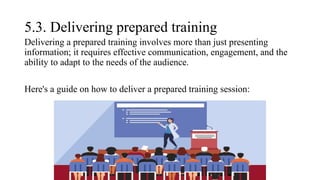
Delivering a prepared training involves more than just presenting
information; it requires effective communication, engagement, and the
ability to adapt to the needs of the audience.
Here's a guide on how to deliver a prepared training session:
8.
1. Be Prepared:Familiarize yourself with the content, training materials,
and any technology or tools you'll be using. Ensure that everything is set
up and ready before the training begins.
2. Establish a Positive Atmosphere: Create a positive and inclusive
atmosphere from the beginning. Greet participants warmly, set
expectations for a collaborative learning environment, and encourage
questions and discussions.
3. Review Learning Aims: Begin by revisiting the learning objectives.
Clearly communicate what participants can expect to learn by the end of
the training session.
9.
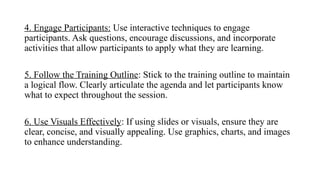
4. Engage Participants:Use interactive techniques to engage
participants. Ask questions, encourage discussions, and incorporate
activities that allow participants to apply what they are learning.
5. Follow the Training Outline: Stick to the training outline to maintain
a logical flow. Clearly articulate the agenda and let participants know
what to expect throughout the session.
6. Use Visuals Effectively: If using slides or visuals, ensure they are
clear, concise, and visually appealing. Use graphics, charts, and images
to enhance understanding.
10.
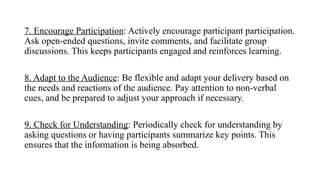
7. Encourage Participation:Actively encourage participant participation.
Ask open-ended questions, invite comments, and facilitate group
discussions. This keeps participants engaged and reinforces learning.
8. Adapt to the Audience: Be flexible and adapt your delivery based on
the needs and reactions of the audience. Pay attention to non-verbal
cues, and be prepared to adjust your approach if necessary.
9. Check for Understanding: Periodically check for understanding by
asking questions or having participants summarize key points. This
ensures that the information is being absorbed.
11.
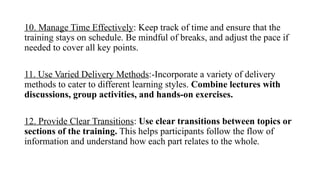
10. Manage TimeEffectively: Keep track of time and ensure that the
training stays on schedule. Be mindful of breaks, and adjust the pace if
needed to cover all key points.
11. Use Varied Delivery Methods:-Incorporate a variety of delivery
methods to cater to different learning styles. Combine lectures with
discussions, group activities, and hands-on exercises.
12. Provide Clear Transitions: Use clear transitions between topics or
sections of the training. This helps participants follow the flow of
information and understand how each part relates to the whole.
12.
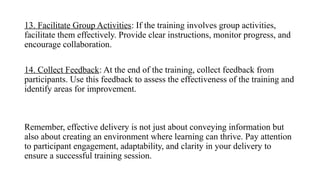
13. Facilitate GroupActivities: If the training involves group activities,
facilitate them effectively. Provide clear instructions, monitor progress, and
encourage collaboration.
14. Collect Feedback: At the end of the training, collect feedback from
participants. Use this feedback to assess the effectiveness of the training and
identify areas for improvement.
Remember, effective delivery is not just about conveying information but
also about creating an environment where learning can thrive. Pay attention
to participant engagement, adaptability, and clarity in your delivery to
ensure a successful training session.